

Product and application illustrations. Follow the product label and written use guidance.
CleenU product solution
Cast Iron Seasoning Oil
Food-grade oils · Fine-mist thin coats · Private label
Rusty or sticky cast iron? After washing and drying, mist a thin coat, wipe until it looks almost dry, and bake upside down at 450–500°F for an hour to build a slick, rust-blocking finish. Factory-direct private label.
- Bare cast iron is porous and rusts on contact with water and air. Seasoning bakes a very thin layer of oil until it polymerizes into a hard, slick, rust-blocking film. Many cooking oils don't polymerize fully and leave a sticky, rancid surface, and too much oil stays tacky. This blend uses high-smoke-point oils chosen for polymerization plus beeswax, and the fine mist makes thin coats easy.
- Daily care takes seconds: wash, dry on the stove, mist, and wipe. Full seasoning is for when the pan looks gray, shows rust, or starts sticking: wipe the oil until nearly dry, bake upside down at 450–500°F for an hour, cool in the oven, and repeat two or three times. Enameled interiors don't need it.
- MOQ
- 500 bottles
- Free samples
- Free samples in 3–5 days
- Bulk lead time
- Scheduled with the order after packaging and labels are approved

Product value
What cookware is it for?
CleenU Cast Iron Seasoning Oil seasons new pans, maintains daily, and reseasons after rust.
View product detailsProduct summary
- Product type
- Food-grade cast iron seasoning oil
- Core use
- Rust, dullness, sticking, and worn seasoning on skillets, Dutch ovens, griddles, and camp cookware
- Formula focus
- High-smoke-point food-grade plant oils (sunflower, canola) with food-grade beeswax; no added fragrance.
- Best for
- Cookware and cast iron brands, Outdoor and camping brands, Kitchenware retailers, Ecommerce sellers

Before & after
Before and after (illustration)
Before: a skillet scrubbed down to bare gray iron after rust, dry and dull. After: misted thin and seasoned three times at 480°F, the surface is an even glossy black, dry to the touch, and eggs release cleanly.
- Before: bare gray iron, dull
- After three rounds: even glossy black
- Dry to the touch, eggs release

How it works
How oil becomes seasoning
Unsaturated fatty acids in plant oils oxidize and polymerize under heat and oxygen, crosslinking into a hard film that grips the iron's micro-pores. Thinner layers polymerize more fully, and high-smoke-point oils resist smoking and charring at high heat. Beeswax fills tiny gaps so the layer is denser and tougher.
- Wash and dry
- Mist a thin coat
- Wipe until nearly dry
- Bake 1 hour at 450–500°F
- Repeat 2–3 times
Usage guidance
Use guidance
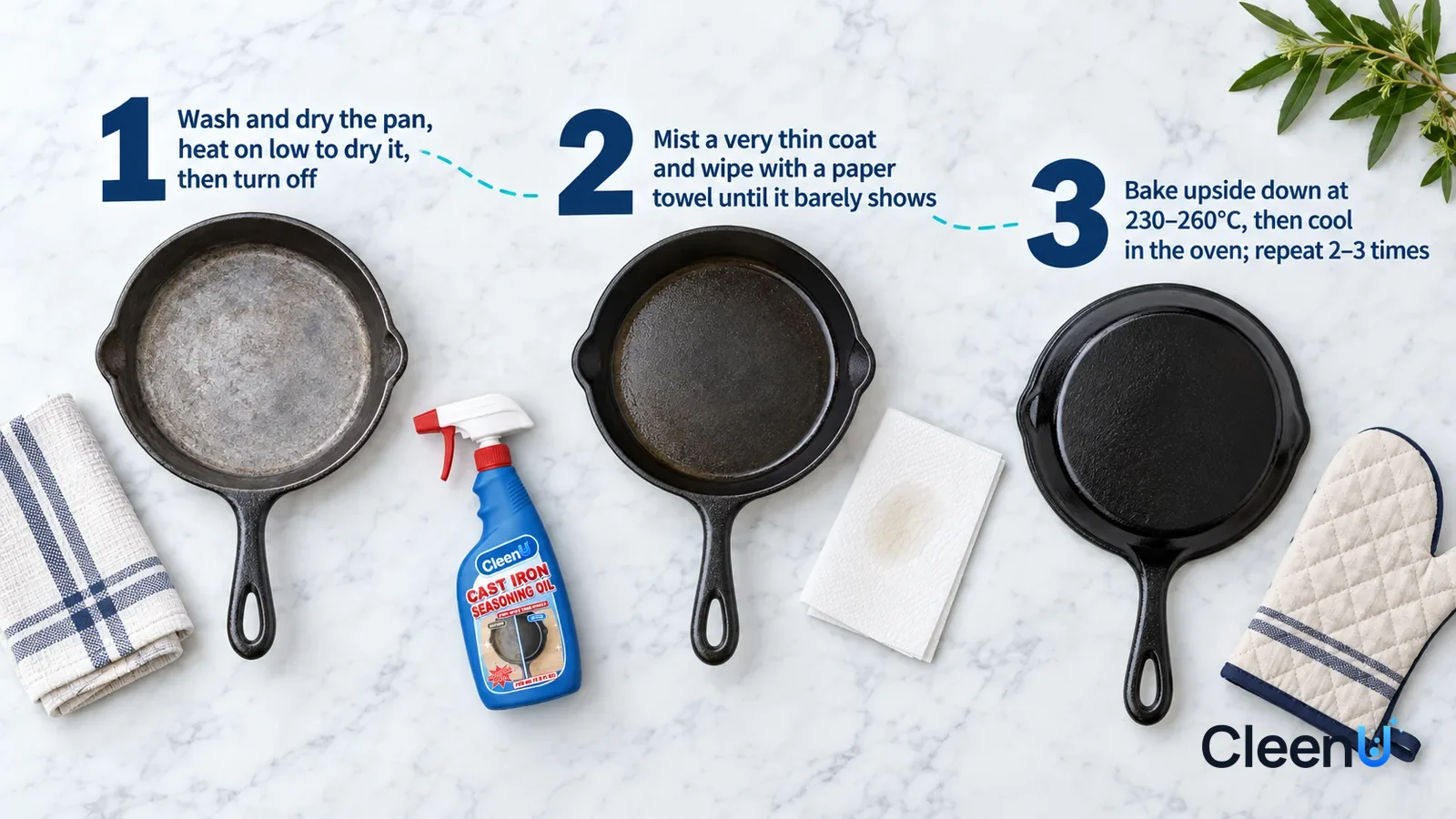
- Wash and dry the pan, then heat it on the stove to drive off moisture.
- Mist a very thin coat and wipe with a clean paper towel until it looks almost dry.
- Bake upside down at 450–500°F for an hour and let it cool in the oven; repeat two or three times. Daily, just dry and mist thin.

Before you use it
Important notes
- Not for: Enameled cast iron interiors
- Not for: Nonstick pans
- Not for: Thick coats
- Not for: Oiling over rust
- Test first for special materials, special equipment, or sensitive scenarios.
Product comparison
How to choose a Cast Iron Seasoning Oil
Use Cast Iron Seasoning Oil to season and protect cast iron, BBQ Grill Cleaner & Degreaser for greasy grills and grates, and Stainless Steel Cleaner & Polish for stainless cookware exteriors.
View product comparison
| Decision point | Cast Iron Seasoning Oil | Ordinary cooking oil |
|---|---|---|
| Polymerization | High smoke point, complete | Often incomplete |
| Finish | Dry, not tacky | Often sticky |
| Odor | Resists rancidity | Can go rancid |
| Thin coats | Easy with fine mist | Easy to overapply |
Where Cast Iron Seasoning Oil stands out
The right oil, applied thin
Bare cast iron is porous and rusts on contact with water and air. Seasoning bakes a very thin layer of oil until it polymerizes into a hard, slick, rust-blocking film. Many cooking oils don't polymerize fully and leave a sticky, rancid surface, and too much oil stays tacky. This blend uses high-smoke-point oils chosen for polymerization plus beeswax, and the fine mist makes thin coats easy.
Daily care versus full seasoning
Daily care takes seconds: wash, dry on the stove, mist, and wipe. Full seasoning is for when the pan looks gray, shows rust, or starts sticking: wipe the oil until nearly dry, bake upside down at 450–500°F for an hour, cool in the oven, and repeat two or three times. Enameled interiors don't need it.
Who it's for, where it's used, and when not to use it
For
End-use scenarios
When not to use it
Product Specifications and Custom Options
Key product details and custom options for your project.
Product specifications
Product type, cleaning scope, and format.
| Product type | Food-grade cast iron seasoning oil |
| Surfaces | Bare cast iron skillets, Dutch ovens, griddles, and camp cookware |
| Applications | Seasoning a new skillet, Reseasoning after rust removal, Protecting camp cookware before storage |
| Main soils | Rust, dullness, sticking, and worn seasoning on skillets, Dutch ovens, griddles, and camp cookware |
| How to use | Wash, dry, coat thin, wipe nearly dry, bake upside down at 450–500°F for 1 hour, repeat 2–3 times |
| Not for / avoid | Enameled cast iron interiors; Nonstick pans; Thick coats; Oiling over rust |
| Size & packaging | 200 mL fine-mist spray bottle |
| pH | Not applicable (oil product) |
| Scent | No added fragrance |
| Shelf life & storage | 24 months unopened; use within 12 months after opening; store cool and away from light |
B2B custom options
Private label, packaging, MOQ, samples, and delivery.
| OEM/ODM & private label | We run Cast Iron Seasoning Oil private-label projects from positioning and samples to packaging, production, and delivery. |
| Packaging & labels | Spray or pump, fill size, labels, and seasoning kits available |
| Case pack | 24 × 200 mL per case |
| OEM/ODM and private label | Available for project discussion |
| Packaging and labels | Spray or pump, fill size, labels, and seasoning kits available |
| MOQ | 500 bottles |
| Sample time | Free samples in 3–5 days |
| Bulk lead time | Scheduled with the order after packaging and labels are approved |
| Documents | SDS/MSDS, TDS, and batch COA provided with quotes |
OEM/ODM project process
Move from product direction and sample review to packaging, production, and delivery for Cast Iron Seasoning Oil.
Define the buyer and plan
Choose spray or pump, whether to sell a seasoning kit with a scraper and chainmail scrubber, and camp cooking or home kitchens.
Free samples
Free samples are usually ready in 3–5 days for project review.
Packaging and labels
Set fill size, bottle, label language, and directions on food-grade ingredients, thin coats, and enameled interiors.
Production and delivery
Standard MOQ is 500 bottles; production is scheduled after packaging and labels are approved.
Why choose CleenU for Cast Iron Seasoning Oil?
From product positioning and samples to packaging and repeat supply, CleenU supports OEM/ODM projects built around Cast Iron Seasoning Oil.
Food-grade ingredients
Oils and beeswax are food-grade, with retained samples and a COA for each batch.
In-box gifts and add-ons
Cookware brands often include seasoning oil in the box or as an add-on, and we can design small sizes to fit your packaging.
Sample testing that means something
We plan sample evaluation around new pans and stripped rusty pans: seasoning color, tackiness, egg release, and rust after a week.
Labels and documents ready
Bilingual label copy, SDS/MSDS, TDS, and batch COAs, with warnings and directions prepared for your target market.
Consistent reorders
Every batch is retained and issued a COA, so reorders match on color, scent, and feel.
Formula discussion
Discuss formula direction based on product positioning, target market, and channel selling points.
Packaging and labeling options
Plan packaging format, label language, and shelf presentation around Cast Iron Seasoning Oil and your target channel.
Show packaging and label options
Packaging options
Main size: 200 mL fine-mist spray. Also available: 200 mL pump, seasoning kits with a scraper and chainmail scrubber, and small in-box sizes, with labels and cartons in your branding.
Supporting Documents and Materials
Purchasers usually confirm whether the materials are complete before formal cooperation. Preparing documents in advance helps with quoting, sampling, and channel review.
Show available documents
Project documents
SDS/MSDS, TDS, batch COA, label directions, and packaging files are provided per project after inquiry.
Related products, solutions, and articles
Explore related cleaning products, application guidance, and OEM/ODM resources for Cast Iron Seasoning Oil.
Frequently asked questions (FAQ)
Find practical answers about Cast Iron Seasoning Oil, private label, samples, MOQ, documents, and delivery.
Product, use, and procurement
Why does cast iron need seasoning?
Bare cast iron is porous and rusts on contact with water and air. A thin coat of oil heated past its smoke point polymerizes into a hard layer, the seasoning, which blocks rust and gets more nonstick with use.
Why not just use vegetable oil?
You can, but many cooking oils don't polymerize fully and leave a sticky, rancid-smelling surface. This blend uses food-grade oils chosen for a high smoke point and good polymerization, plus food-grade beeswax, for a drier, tougher layer that's easier to apply thin.
How often should I season?
A thin wipe after every wash and stovetop dry is everyday maintenance. Do a full oven seasoning when the pan looks dull or gray, shows rust spots, or food starts sticking.
What should we decide first for a private-label seasoning oil?
Applicator, kit, and audience. Spray or pump (spray makes thin coats easy), whether to bundle a pan scraper and chainmail scrubber, and camp cooking or home kitchens, since the packaging looks fully different. Cookware brands often use it as an in-box gift or add-on.
How fast can we get samples and a first order?
Free samples ship in 3–5 days. MOQ is 500 bottles, and production is scheduled once packaging and labels are approved.
Product usage questions
How do I season in the oven?
Wash and dry the pan, heat it on the stove to drive off moisture, apply a very thin coat, then wipe it with a clean paper towel until it looks almost dry. Bake upside down at 450–500°F for an hour, then let it cool in the oven. Repeat two or three times.
My pan is rusty. What now?
Scrub the rust off with steel wool down to gray metal, wash, dry it on the stove right away, and do two or three oven seasonings.
Why is my seasoning sticky?
Too much oil. The excess doesn't fully polymerize and stays tacky. Wipe until the pan looks nearly dry before baking, and rebake a sticky pan at high heat to fix it.
Do enameled cast iron pans need it?
Not the enamel interior; just wash it normally. You can wipe a little on exposed cast-iron rims to prevent rust.
Do I need it for nonstick pans?
No. It's for cast iron and carbon steel; clean nonstick per its instructions.
Can the oil go bad?
Store sealed and cool; if it smells rancid after opening, don't use it.
Can I use it on carbon steel?
Yes. Carbon steel is seasoned the same way as cast iron.
What's the right way to care for cast iron after each use?
Wash, dry, heat, then oil—every time. Rinse out food with hot water and a brush, towel it off, and set the pan over low heat until every trace of moisture is gone. While it's still warm, rub in a thin coat of CleenU Cast Iron Seasoning Oil and wipe it back until the surface looks almost dry. Leftover water is what starts rust, so don't skip the heat-dry step.
What kind of oil is best for seasoning cast iron?
Pick an oil that cures into a hard, dry film instead of staying tacky. Plenty of kitchen oils work, but some cure unevenly and leave a sticky or rancid-smelling surface. CleenU's oil pairs food-grade oils with food-grade beeswax so a thin coat cures dry; whatever you use, apply it thin and bake it above its smoke point.
How many coats does a new or stripped pan need?
Plan on two to three oven rounds for a fresh base layer. Each round is one very thin coat, wiped back, then baked upside down at 450–500°F for about an hour and left to cool in the oven. Several thin layers build a tougher finish than one thick coat, which tends to turn sticky.
OEM/ODM customization questions
What can we customize?
Oil blend, fill size (200 mL spray, pump, and more), packaging style, label design and language, and seasoning kits with a pan scraper, chainmail scrubber, and handle cover.
How should we test samples?
Season a new pan and a stripped, previously rusty pan two or three times each, and record seasoning color, tackiness, how eggs release, and any rust after a week. That tells you more than a before-and-after photo.
What paperwork comes with a private-label order?
Documents such as SDS/MSDS, TDS, COA, and label copy for your target market are prepared per project. We confirm which ones your order includes when we quote.
Launching your own seasoning oil?
Send us your market, spray or pump, kit plans, and estimated volume. We'll build it out with you.