
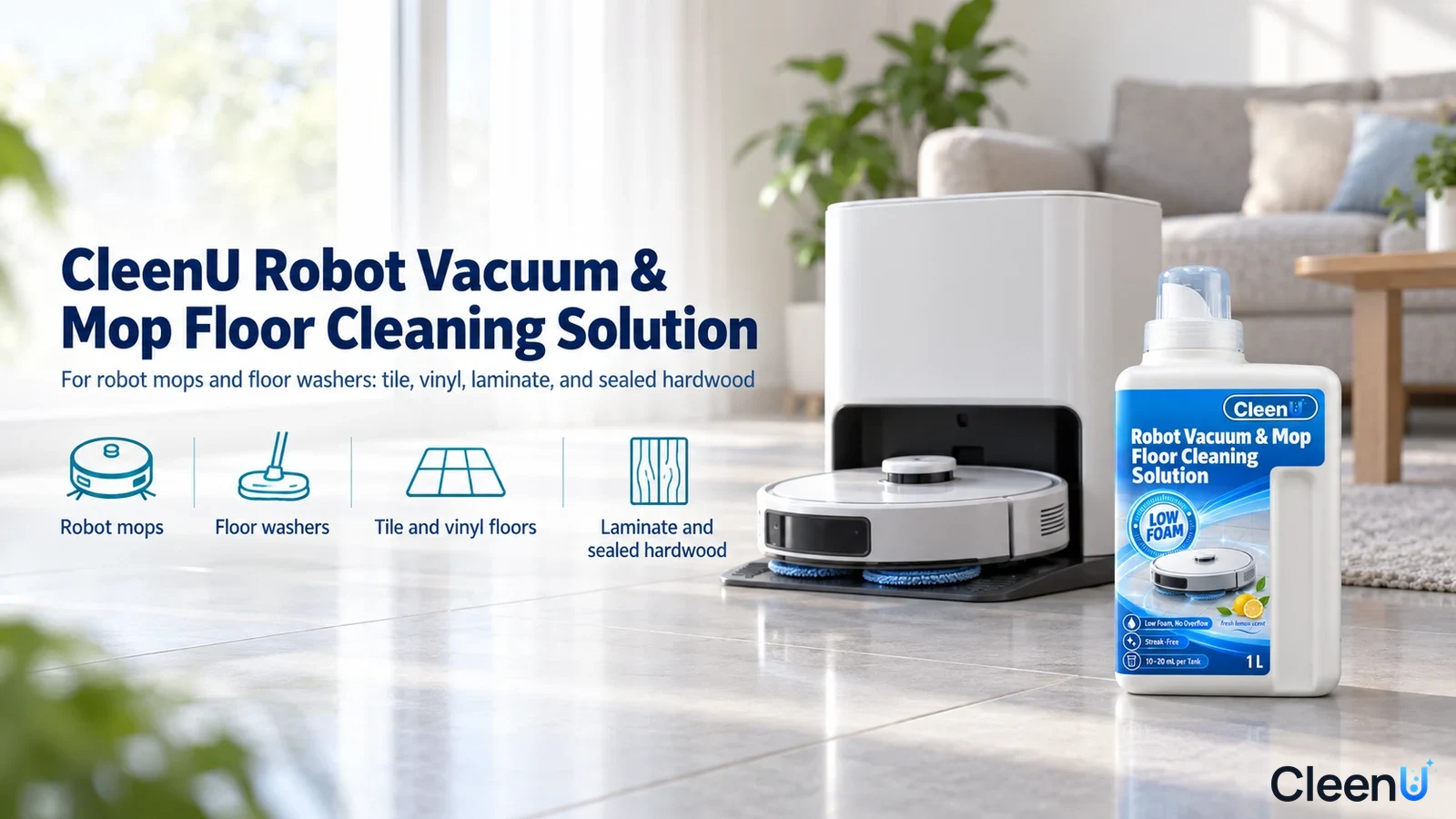
Product and application illustrations. Follow the product label and written use guidance.
CleenU product solution
Robot Vacuum & Mop Floor Cleaning Solution
Low-foam · No streaks · Private label
Robot mop leaving footprints and water marks with plain water? Add 10–20 mL to the clean-water tank and run it as usual—no rinse—for an even floor without prints or streaks. Low-foam, so it won’t overflow the tank or dock; private label from 500 bottles.
- Robot tanks, pumps, nozzles, and dock lines are narrow, and fast-spinning or vibrating mop pads whip ordinary cleaners into foam that overflows the dock, reaches dirty-tank sensors, and leaves residue that clogs nozzles. A robot solution has to be low-foam, low-residue, and particle-free to run safely long term.
- Robots lay down a thin film of water, so too strong a mix leaves residue as streaks and tackiness once it dries. 10–20 mL per fill is just right to emulsify skin oil and dust in footprints for the pad to lift, leaving a dry floor. For very dirty floors, run two passes rather than doubling the dose.
- MOQ
- 500 bottles
- Free samples
- 3–5 days
- Bulk lead time
- Scheduled with the order

Product value
What does Robot Vacuum & Mop Floor Cleaning Solution clean?
Robot Vacuum & Mop Floor Cleaning Solution is made for everyday mopping with robot mops and floor scrubbers on tile, SPC, laminate, and sealed wood.
View product detailsProduct summary
- Product type
- PH-neutral, low-foam concentrate made for robot mops
- Intended use
- Footprints, oily marks, and dust in everyday robot and scrubber mopping
- Formula
- Low-foam nonionic surfactants with a defoamer, pH 6.5–7.5; particle-free, wax-free, chlorine-free; 10–20 mL per fill.
- For
- Robot vacuum and scrubber brands, appliance accessory channels, cleaning product brands, ecommerce sellers
Before & after
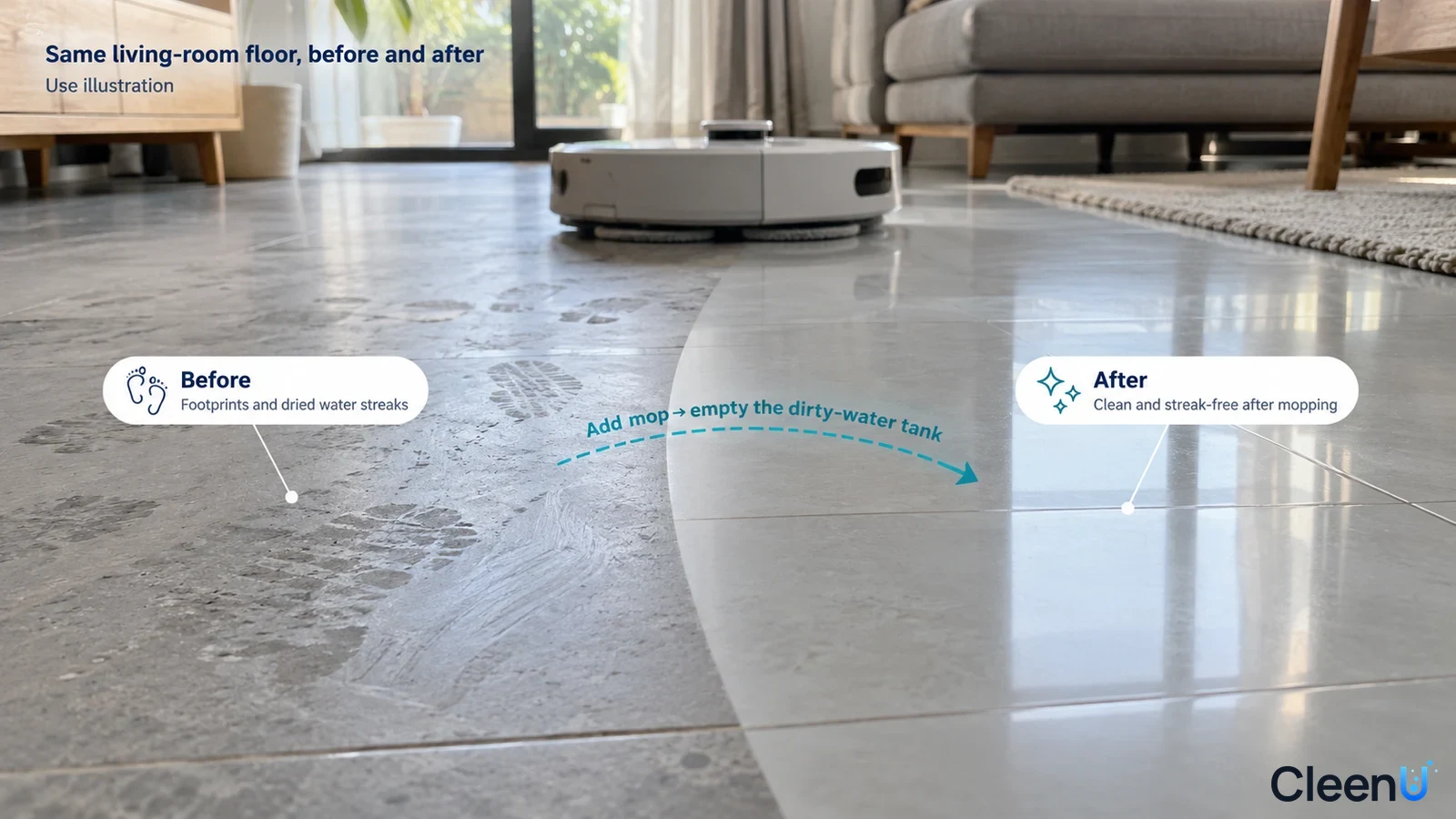
Before and after (use illustration)
Illustration: the same robot mopping with water alone leaves footprints and streaks in side light; with 10–20 mL of solution added, the dried floor is even with no prints or streaks.
- Before: footprints and water marks in side light after a water-only run
- After: an even floor with no prints or marks once dry
- Low foam—no overflow and no clogged nozzles
How it works
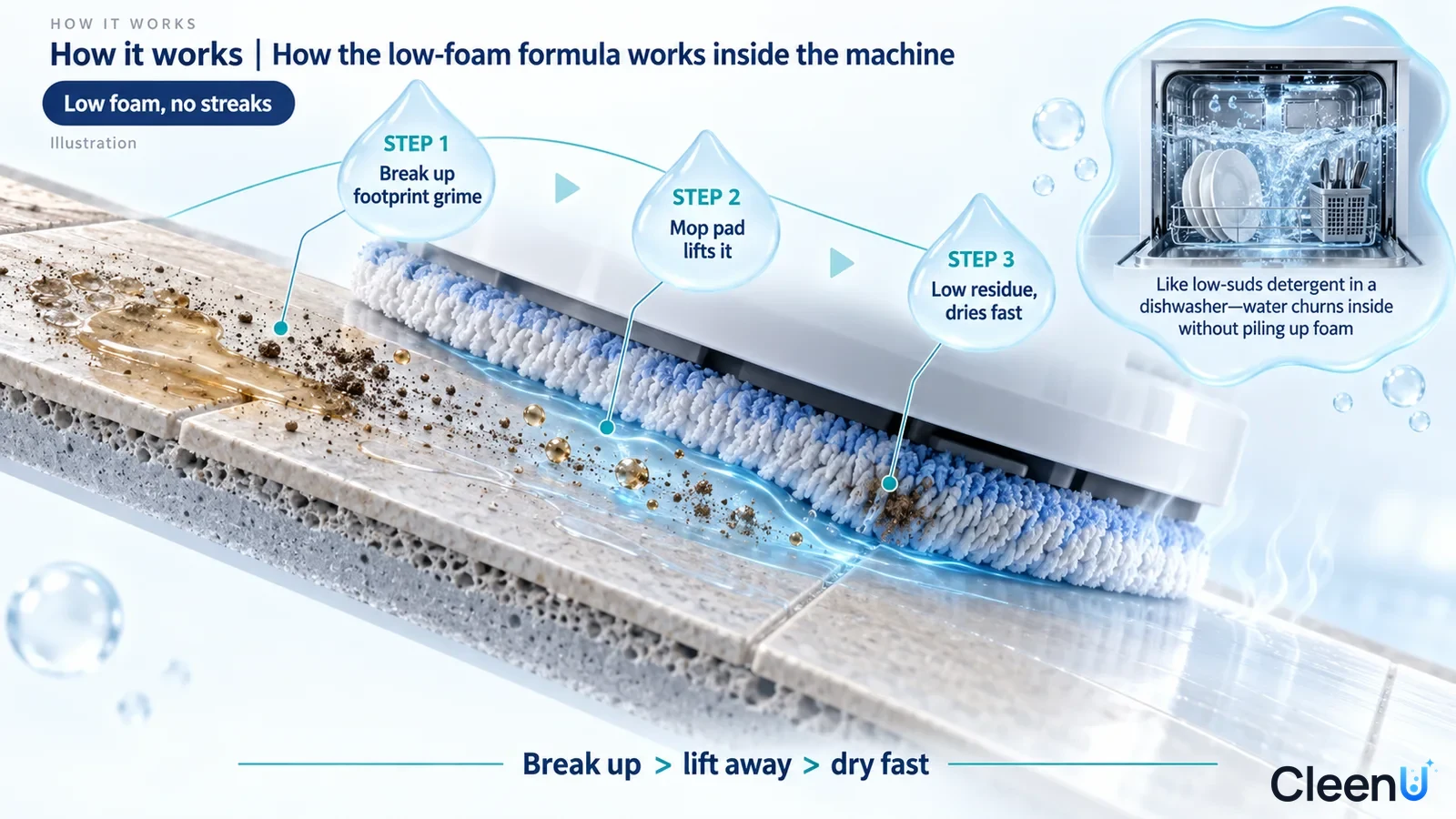
How a Low-Foam Formula Works Inside a Robot
Low-foam nonionic surfactants and a defoamer keep suds down even with fast-spinning pads. The surfactants emulsify skin oil and cooking mist in footprints and disperse dust for the pad to carry to the dirty tank. Low solids and no particles mean almost no residue, so nozzles and lines don’t scale up, and the neutral pH is gentle on floors and machine parts.
- Low-foam surfactants emulsify oily footprints
- Disperse dust
- Pad picks up
- Low-residue drying
- No foam, no clogs
Usage guidance
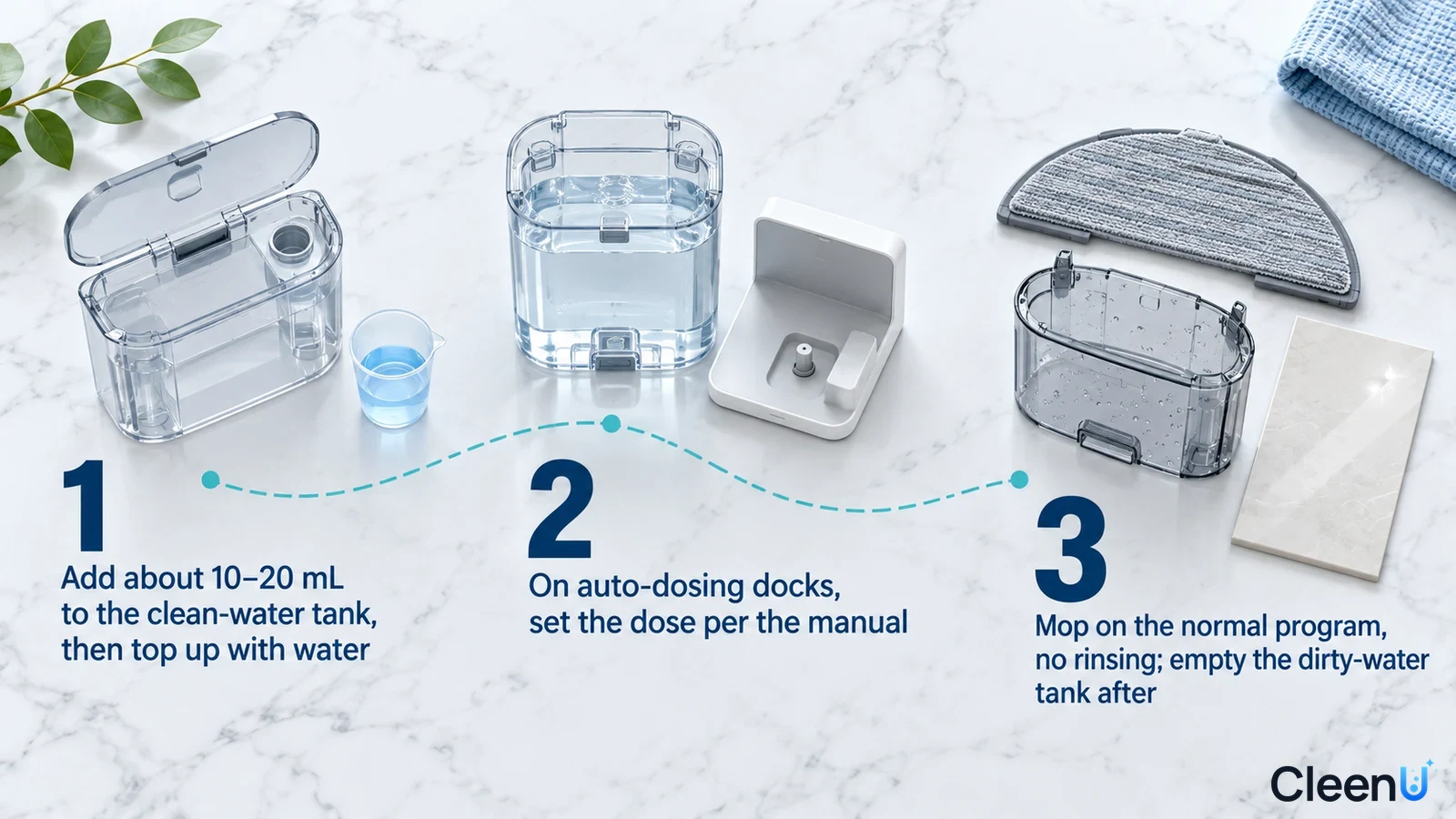
Use guidance
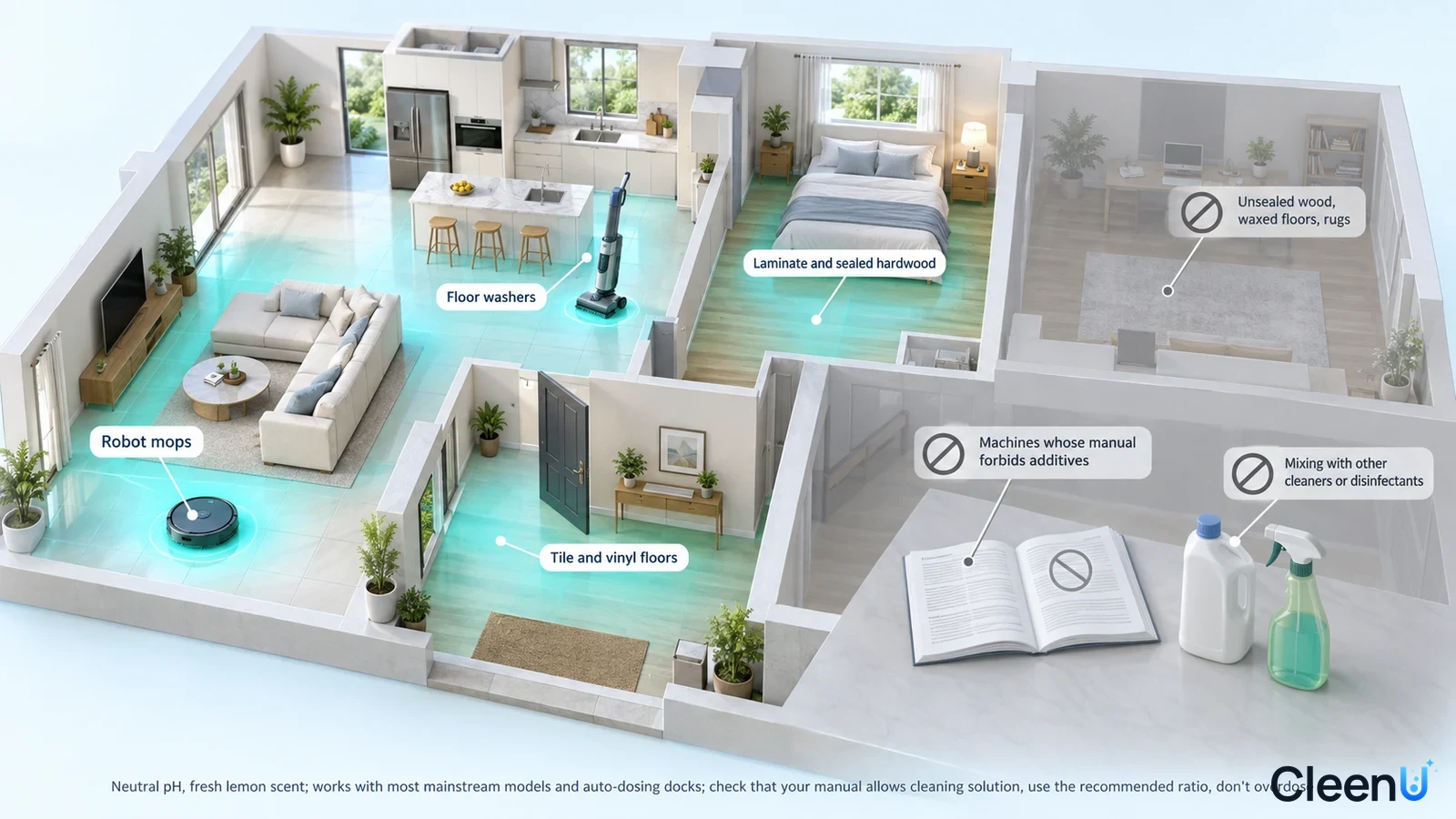
- Open the clean-water tank and add 10–20 mL using the measuring cap.
- Top up with water and refit; set auto-dosing docks per the manual.
- Run a normal mopping cycle, no rinse, and empty the dirty tank after each run.
Before you use it
Important notes
- Not for: Robots whose manual forbids additives
- Not for: Mixing with other cleaners or disinfectants
- Not for: Overdosing
- Not for: Raw or waxed wood and carpet
- Test first for special materials, special equipment, or sensitive scenarios.
Product comparison
How to choose a Robot Vacuum & Mop Floor Cleaning Solution
Robot mops and scrubbers: Robot Vacuum & Mop Floor Cleaning Solution. Pet homes: the Pet Homes version. Manual spray mopping: Floor Cleaner.
View product comparison
| Decision point | Robot Vacuum & Mop Floor Cleaning Solution | Regular floor cleaner or water only |
|---|---|---|
| Foam | Low, no overflow | Regular cleaner foams over |
| Nozzles and lines | No clogs | Residue clogs |
| Result | No prints or streaks | Water leaves prints |
| Dose | 10–20 mL per fill | Guesswork |
Where Robot Vacuum & Mop Floor Cleaning Solution stands out
Why Robots Can’t Take Just Any Floor Cleaner
Robot tanks, pumps, nozzles, and dock lines are narrow, and fast-spinning or vibrating mop pads whip ordinary cleaners into foam that overflows the dock, reaches dirty-tank sensors, and leaves residue that clogs nozzles. A robot solution has to be low-foam, low-residue, and particle-free to run safely long term.
10–20 mL Is Enough; More Leaves Marks
Robots lay down a thin film of water, so too strong a mix leaves residue as streaks and tackiness once it dries. 10–20 mL per fill is just right to emulsify skin oil and dust in footprints for the pad to lift, leaving a dry floor. For very dirty floors, run two passes rather than doubling the dose.
Who it's for, where it's used, and when not to use it
For
End-use scenarios
When not to use it
Product Specifications and Custom Options
Key product details and custom options for your project.
Product specifications
Product type, cleaning scope, and format.
| Product type | PH-neutral, low-foam concentrate made for robot mops |
| Surfaces | Robot mops and floor scrubbers on tile, SPC, laminate, and sealed wood |
| Use scenarios | Daily whole-home mopping; Kitchen and dining areas; Commercial scrubbers |
| Target soils | Footprints, oily marks, and dust in everyday robot and scrubber mopping |
| Directions | 10–20 mL per fill in the clean-water tank (about 1:50–1:100); used during the robot’s mopping run, no rinse |
| Not for | Robots whose manual forbids additives; Mixing with other cleaners or disinfectants; Overdosing; Raw or waxed wood and carpet |
| Size and packaging | 1 L concentrate with measuring cap (10–20 mL per use, about 50–100 uses) |
| pH | pH 6.5–7.5 at 25°C |
| Scent | Lemon (other scents available) |
| Shelf life and storage | 24 months unopened; keep tightly closed in a cool, dry, well-ventilated place. Protect from heat, direct sunlight, and freezing |
B2B custom options
Private label, packaging, MOQ, samples, and delivery.
| OEM/ODM and private label | From product direction and sample review to packaging, production, and delivery for your Robot Vacuum & Mop Floor Cleaning Solution project. |
| Packaging and labels | Graduated measuring cap / dock-compatible refill bottle, fill size, labels, and retail sets can be customized |
| Case pack | 12 × 1 L per case |
| MOQ | 500 bottles |
| Sample time | Free sample: 3–5 days |
| Bulk lead time | Scheduled with the order after packaging and label approval |
| Documents | SDS/MSDS, TDS, and batch COA provided per project on inquiry |
OEM/ODM project process
Move from product direction and sample review to packaging, production, and delivery for Robot Vacuum & Mop Floor Cleaning Solution.
Define bottle and compatible models
Choose measuring-cap or dock refill and confirm target robot models.
Free sample
A free sample is usually ready in 3–5 days for project review.
Packaging and labels
Set fill size, measuring cap, label language, the warnings your market requires, and check-model-compatibility, about-20-mL-per-tank, and don’t-mix instructions.
Bulk delivery
Standard MOQ is 500 bottles; bulk orders are scheduled after packaging and labels are approved.
Why choose CleenU for Robot Vacuum & Mop Floor Cleaning Solution?
From product positioning and samples to packaging and repeat supply, CleenU supports OEM/ODM projects built around Robot Vacuum & Mop Floor Cleaning Solution.
Low foam is non-negotiable
Low foam, low residue, and no particles come first; cleaning power and scent are tuned after.
Measuring cap or dock bottle
A measuring cap makes 10–20 mL easy; dock refills set you apart.
Sample reviews with clear criteria
Review samples on your popular robot mops and various floor panels against clear points: foam height, nozzle and line clogging, and streaks and residue after mopping.
Lemon lead
Lemon leads, with other scents or unscented available.
Labels and documents
We supply bilingual labels, SDS/MSDS, TDS, and batch COAs, with check-model-compatibility, about-20-mL-per-tank, and don’t-mix instructions on the label, and can arrange third-party testing for your market.
Consistent supply and reorders
Each batch is retained and ships with a COA, so reorders match in color, scent, and feel.
Packaging and labeling options
Plan packaging format, label language, and shelf presentation around Robot Vacuum & Mop Floor Cleaning Solution and your target channel.
Show packaging and label options
Packaging options
Core size: 1 L concentrate with measuring cap (10–20 mL per use, about 50–100 uses). Also available: large refill, channel case packs, and ecommerce bundles with replacement mop pads. Graduated measuring cap or dock-compatible refill bottle options, with labels and cartons made to your brand.
Supporting Documents and Materials
Purchasers usually confirm whether the materials are complete before formal cooperation. Preparing documents in advance helps with quoting, sampling, and channel review.
Show available documents
Project documents
When you inquire, we provide SDS/MSDS, a TDS, batch COAs, label directions, and packaging files for your project.
Related products, solutions, and articles
Explore related cleaning products, application guidance, and OEM/ODM resources for Robot Vacuum & Mop Floor Cleaning Solution.
Frequently asked questions (FAQ)
Find practical answers about Robot Vacuum & Mop Floor Cleaning Solution, private label, samples, MOQ, documents, and delivery.
How to use
Can I put regular floor cleaner in my robot?
Not recommended; it foams, overflows the dock, clogs nozzles, and streaks. Use a low-foam robot solution.
How much should I add, especially to a large tank?
At 1:50–1:100, add 10–20 mL per liter of water; 1 L of solution treats 50–100 L of water, or about 50–100 fills of a 1 L tank. Most dock clean-water tanks hold about 1 L, so that's 10–20 mL per fill; scale up for a larger tank (a 3–4 L tank needs three to four times as much) and down for a smaller one. Another brand's 1:200 doesn't apply here, so follow this label, and run a second pass on dirty floors instead of doubling.
Can I put vinegar, bleach, or essential oils in the tank?
Don't. Vinegar is acidic and, used regularly, can wear rubber seals and etch marble and other natural stone floors. Bleach can corrode metal parts, discolor floors, and must never be mixed with other cleaners. Essential oils don't dissolve in water; they coat the lines and pads with an oily film and can swell rubber parts. For a stronger clean, use a low-foam robot solution at the labeled dilution.
The tank smells. Should I add solution to the dirty-water tank?
No. Add solution only to the clean-water tank or the dock's detergent compartment. Odor comes from wastewater left standing: empty, rinse, and air-dry the dirty tank after each run, and don't leave mixed solution in the tank for days.
Will it foam and block the filter?
Very little at the labeled dose. Overdosing or mixing with other cleaners can cause foam. If you see foam in the tank, empty it, rinse with clean water, and refill at the right ratio.
Surfaces and common questions
Can I use it on wood floors?
Yes on sealed wood and laminate with a low water setting; not on raw or waxed wood.
Does it work with auto-dosing docks?
Yes; set the dose per the manual and confirm your model supports it.
Why does the floor feel sticky or show white marks or a dull film?
Stickiness usually comes from the cleaner itself: low-quality or poorly formulated surfactants stay on the floor after the water dries, leaving a tacky film that attracts dust. This concentrate uses a low-residue formula and dries clean at the labeled dose. White marks or a dull film usually mean too much solution, dirty mop pads, or hard-water minerals drying on the floor; keep to the ratio, wash the pads often, and try purified water in hard-water areas.
Can I use it in a floor washer like Tineco?
Yes. It works in most floor washers and wet-dry vacuums, such as Tineco-style machines, as well as robot mops. Add it to the clean-water tank at about 1:50–1:100 (10–20 mL per fill), never the dirty-water tank. The low-foam formula won't trigger foam alarms. Check your machine's manual first.
How often should I wash the mop pads?
Docks with self-cleaning handle it automatically. Otherwise, wash and dry the pads after every run—dirty pads smear grime and make the tank and pads smell.
Can I use it in a Roborock, Roomba, Ecovacs, Dreame, or Narwal robot?
Yes. It's been tested on common models such as Roborock, Roomba, Ecovacs, Dreame, Narwal, and Tineco, with no foam, residue, or water-line issues. Add 10–20 mL to the clean-water tank or the dock's detergent compartment. If your manual requires the brand's own solution, follow the manual.
Will a non-brand solution affect my warranty?
Warranty terms vary by brand, and some manuals ask for the brand's own solution, so check yours or ask the brand during the warranty period. Brands mainly worry about foam clogging water lines and ingredients wearing seals. This low-foam, pH-neutral (7.0–8.5) concentrate is made to avoid both when used at the labeled dilution.
Does it disinfect?
It's a daily floor cleaner for dirt and footprints and makes no germ-kill claims. For areas that need disinfecting, use a registered disinfectant per its label.
Why can't I smell the scent after mopping?
Diluted at 1:50–1:100, the fragrance is diluted too, so it fades soon after the floor dries. That's normal: a scent that lingers longer usually means more fragrance left on the floor, which can feel tacky and attract dust. Don't add extra solution for scent; use a diffuser instead. For private label, scent type and strength can be tuned to your market.
Why does it feel no different from plain water?
Water lifts loose dust, but footprints, skin oils, and greasy film tracked from the kitchen just smear. The solution loosens that film and light soil, so the difference shows as floors that don't feel tacky and show no mop streaks in raking light, not as a dramatic change. On floors that are already clean, the difference is small; it's most noticeable on greasy footprints, kitchens, and entryways. Keep to the labeled dose rather than cutting it.
Buying and private label
For private label, what do we decide first and what can be customized?
Three things first: bottle (measuring cap or dock-compatible refill), concentration and size (such as a 1 L concentrate), and scent (lemon lead, others or unscented available). Formula direction, label design and language, metered squeeze bottles, and bundles with replacement mop pads can also be customized.
What are the sample, MOQ, and lead-time terms?
Free samples are usually ready in 3–5 days, and we recommend testing first: run them in popular robot mops on different floor panels and record foam, clogging, streaks, and residue. Standard MOQ is 500 bottles, and bulk orders are scheduled after packaging and labels are approved. SDS/MSDS, a TDS, batch COAs, and bilingual label content are sent per project on inquiry.
How is private-label pricing quoted?
Pricing is tiered by packaging, cap, label, and order quantity, starting at the 500-bottle MOQ. Send your target quantity, fill size, and packaging needs, and we’ll quote unit prices by volume tier with sample and lead-time details.
Launching your own Robot Vacuum & Mop Floor Cleaning Solution?
Send us your market, target robot models, bottle, scent, and estimated volume. We will work through formula and packaging with you.