
Comparison
Brand-Name vs Third-Party Robot Mop Cleaning Solution: How to Choose
Direct answer
Check four things: low foam, labeled for robot mops and for auto-dosing if you use it, low residue, and cost per run. If a third-party solution meets all four and your manual allows it, it can replace the brand-name one. If the manual requires the brand's own solution or you're under warranty, follow the manual.
How to choose
-
The manual requires the maker's own solution, or the robot is under warranty and you want no disputes
Choose Brand-name solution
The maker stands behind compatibility, and support conversations are simplest.
-
The manual allows any low-foam solution labeled for robot mops and you want a lower cost per run
Choose Third-party robot mop solution
Choose a low-foam, neutral, wax-free product with a stated dilution ratio; at the right dose it performs as well as the brand's.
-
Your dock has an auto-dosing compartment
Choose A solution labeled for auto-dosing
Auto-dosing systems have viscosity and formula requirements, and a mismatched liquid can clog the lines.
-
You have cats or dogs and pet odor is noticeable
Choose A pet-home formula with odor neutralizers
It helps reduce pet odor on floors on top of low-foam cleaning.
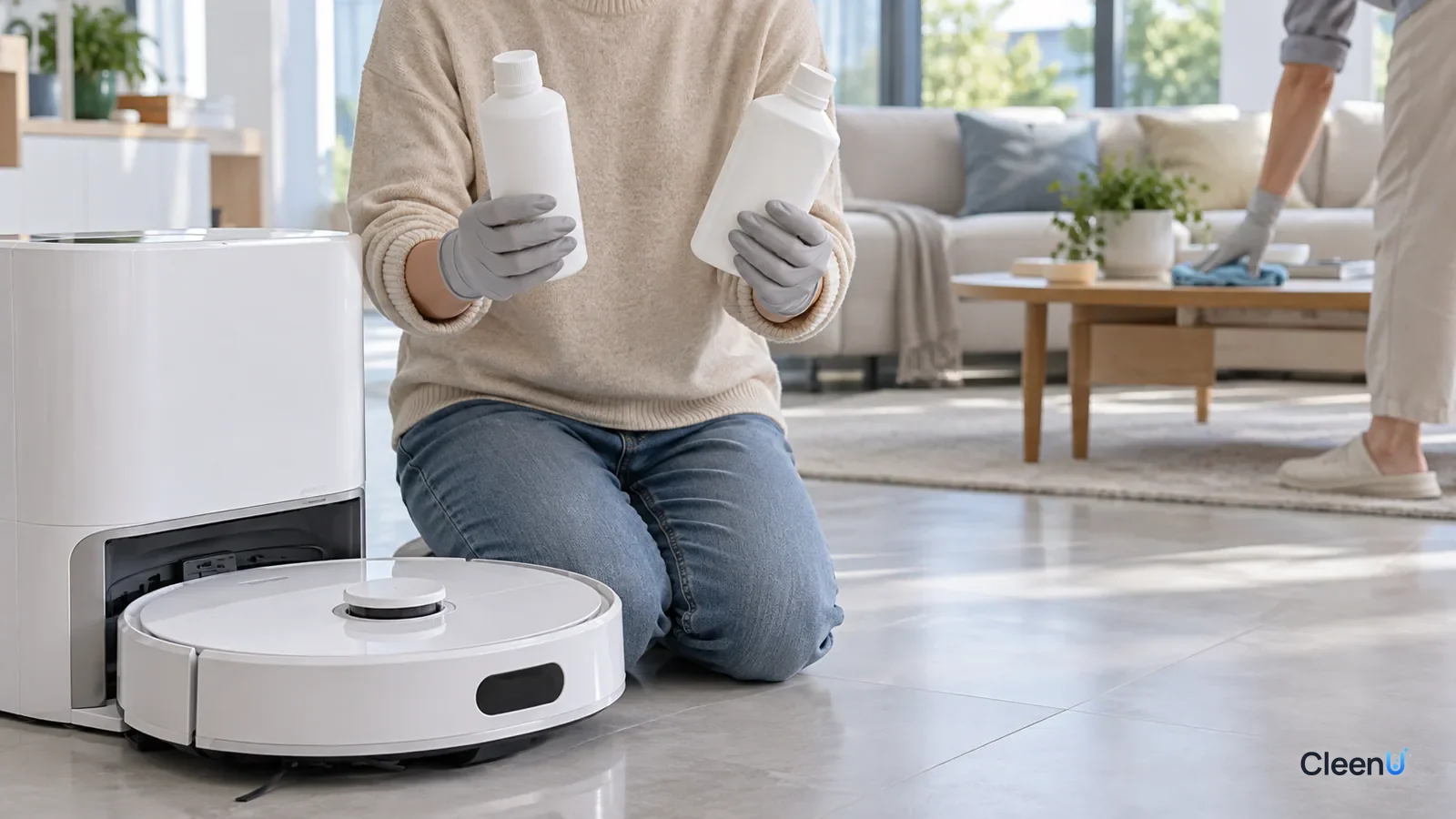
When the robot's own cleaning solution runs out, many owners find it pricey and sometimes out of stock, while online stores are full of "universal" or "fits most brands" robot mop solutions for a lot less. Can you switch? Will it hurt the robot?
In most cases you can switch, as long as you pick the right product and check the manual.
What's actually different between brand-name and third-party solutions?
A brand-name solution is made or licensed by the robot's maker. It's usually matched to that maker's water system, sensors and auto-dosing, and the manual tends to recommend it first.
A third-party solution is made by a cleaning products manufacturer to meet the general requirements of robot mops: low foam, low residue, neutral or near-neutral pH, no wax and no particles, suitable for most robots with a clean tank or auto-dosing.
Both work the same way: surfactants at low concentration wet, emulsify and disperse oily film and footprints so the pads carry them away. A good third-party solution meets the same formula requirements as a brand-name one. A poor one might foam more, leave more residue or have unclear dilution directions.
So the real question isn't brand-name versus third-party. It's whether the bottle meets a robot mop's non-negotiable requirements.
Side by side
Brand-name vs third-party robot mop solution, point by point
| Point | Brand-name solution | Third-party solution |
|---|---|---|
| Model fit | Designed for the maker's models; recommended in the manual | Designed to general requirements; check against the manual |
| Foam | Low foam | Good products are low foam; check the label and results |
| Auto-dosing | Usually matched to the maker's system | Must be labeled for auto-dosing |
| Residue | Floors dry clean at the label dose | Good products dry clean at the label dose |
| Cost per run | Usually higher | Usually lower, lowest for concentrates |
| Availability | Official channels, sometimes out of stock | Lots of choice; quality varies |
| Warranty questions | Simplest | Depends on the manual's terms |
Roborock, Roomba, Braava, Ecovacs, Dreame, Narwal, Tineco: can you use a third-party solution?
Most people searching for a "cleaning solution alternative" are really asking one thing: the solution that came with my robot ran out, so what can I put in it? Here's how it works for the common brands.
Roborock: Roborock sells its own floor cleaning solution. On most models with a self-emptying, self-washing dock, it goes in the clean water tank, and some newer docks have an auto-dosing compartment. If you switch, choose a low-foam, neutral solution labeled for robot mops and add it to the clean tank at the label ratio. If you use the auto-dosing compartment, check that the manual allows third-party solutions.
iRobot Roomba Combo and Braava: Roomba Combo vacuum-mops and Braava mopping robots generally have their own solutions, and some models spell out their requirements in the manual. On small-tank models like Braava, scale the dose to the tank and err low.
Ecovacs Deebot: most Deebot docks take solution in the clean water tank, and some models have auto-dosing. Same rules: low-foam, measured to the ratio, never in the dirty tank.
Dreame and Narwal: both lean heavily on self-cleaning docks that wash the pads over and over, so they're especially sensitive to foam; high-foam products are the fastest way to trigger false "dirty tank full" alerts. Use a low-foam robot solution at the label ratio in the clean tank or the compartment the manual specifies.
Tineco and similar wet-dry floor washers: the clean and dirty tanks sit on the machine, and the brush roll spins fast while washing and vacuuming at once, so these machines also hate foam and residue. Floor washer solutions and robot mop solutions share the same design goals: low foam, near-neutral pH, low residue.
CleenU robot mop cleaning solution, both the standard and the pet-home formula, works in most robot mops from these brands and in Tineco-type floor washers. Add it to the clean water tank or the dock compartment your manual specifies, at about 1:50 to 1:100 (10 to 20 mL per fill is usually enough), and never to the dirty tank. If your manual requires the maker's own solution, or your robot is under warranty, follow the manual and warranty terms first; whether the auto-dosing compartment can be used depends on the model's manual. CleenU isn't affiliated with any of these brands; the names are used only to describe compatibility.
Four things to check in a third-party solution
Low foam: this matters most. Foam triggers false "dirty tank full" alerts, overflows and leaves film on floors. Check that the label says low-foam and for robot mops, and after the first run, open the dirty tank to see whether foam has piled up.
Labeled for robot mops and auto-dosing: the label should say it's for robot mops or robot vacuum-mops and give a dilution ratio. If your dock has an auto-dosing compartment, also check that it's labeled for auto-dosing.
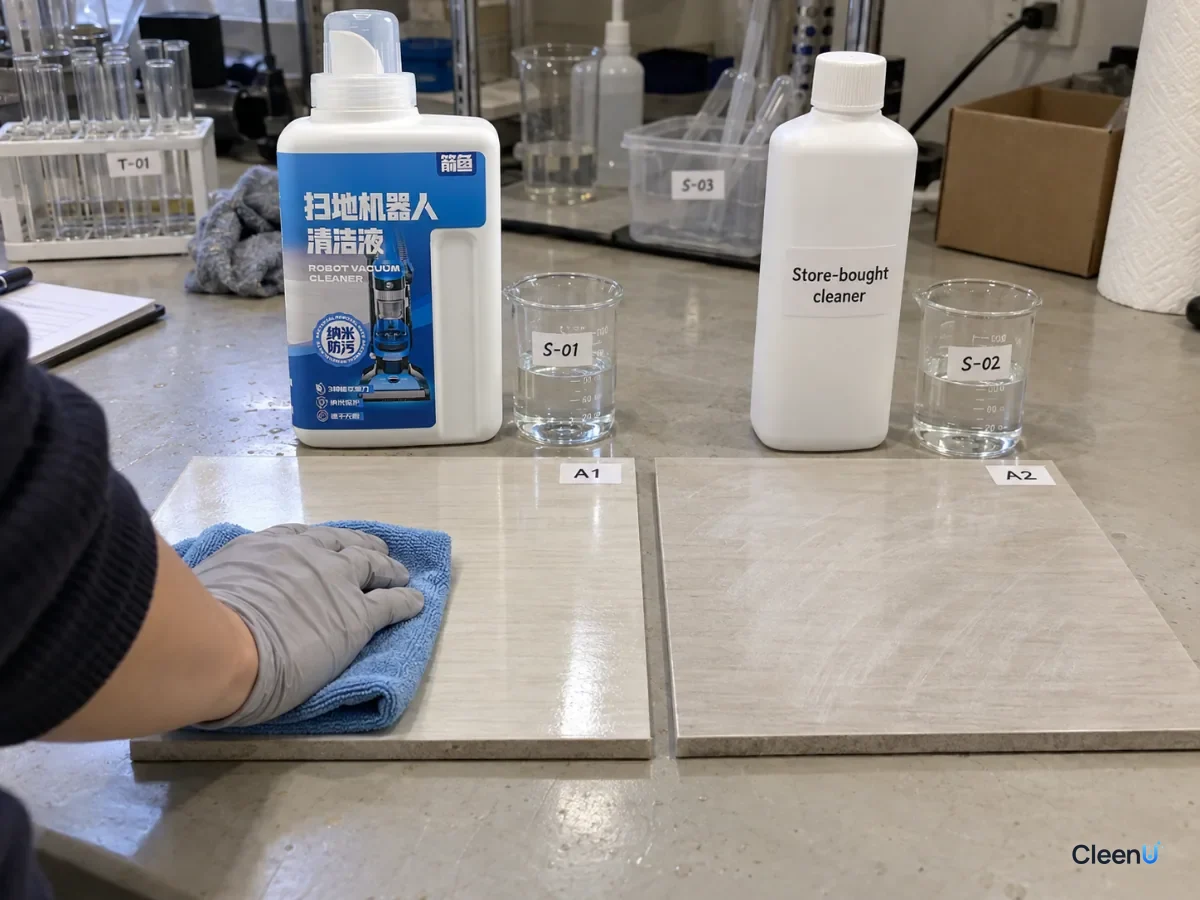
Residue: mop once at the label dose, let the floor dry and walk on it barefoot. Not sticky, not slippery and no obvious streaks in side light means residue is under control. Wax-free products without shine additives are less likely to make floors slicker over time.
Cost per run: don't just compare bottle prices. Divide the price by the number of runs you get. A concentrate that takes a dozen or so milliliters per fill lasts a long time and usually costs less per run.
CleenU Robot Vacuum Cleaning Solution, for example, is a neutral, low-foam concentrate with a pH of 6.5 to 7.5, made with low-foam nonionic surfactants plus a defoaming ingredient, wax-free, chlorine-free and free of particles, with no rinse needed. It dilutes at about 1:50 to 1:100, usually 10 to 20 mL per fill, so a 1 L bottle lasts roughly 50 to 100 runs. Whether it suits your model and dosing method still depends on your robot's manual.
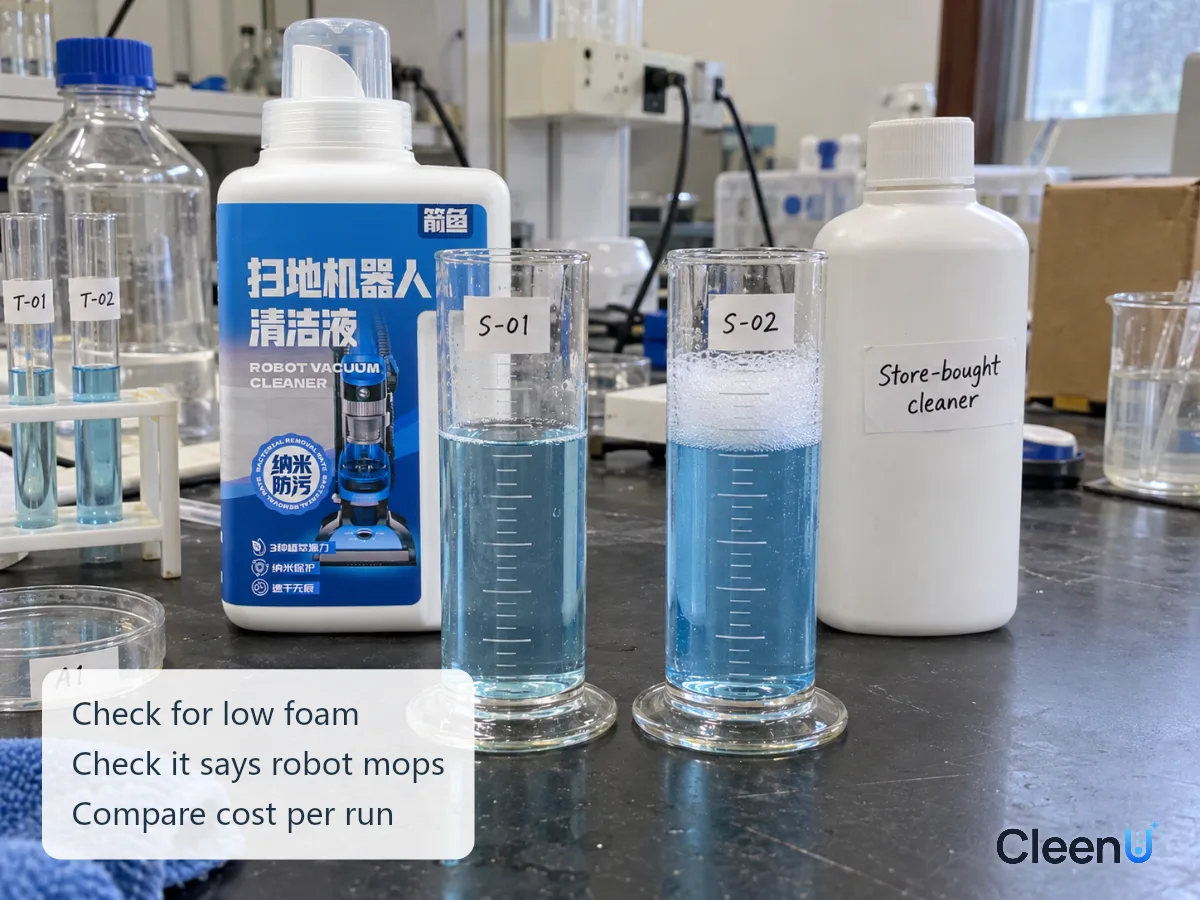
Where the price gap comes from
Robot mop solutions can vary several-fold in price, and the gap usually comes from these factors rather than cleaning performance.
Concentrate or ready-to-use: a concentrate takes a dozen or so milliliters per fill, while a ready-to-use product often takes much more. Two bottles can cover a very different number of runs, so comparing bottle prices tells you little.
Package size: small bottles, special auto-dosing bottles and bundles with accessories usually cost more per ounce. Larger refill sizes are better value.
Channel and brand: official stores, brand premiums and accessory bundles all affect the price.
So when you compare, convert the price to cost per run first, then look at the non-negotiables: foam, residue and compatibility. A cheap solution that foams or leaves residue won't clean well and may cause problems for the robot, so it isn't a bargain.
What a good robot mop solution label should tell you
Use: that it's for robot mops or robot vacuum-mops, and whether it works in auto-dosing systems.
Directions: a clear dilution ratio or amount per fill, not "use as needed."
Formula: whether it's low-foam, its approximate pH, and whether it contains wax or chlorine.
Floors: which floors it's for and which it isn't, such as unsealed wood or waxed floors.
Cautions: don't mix with other cleaners or disinfectants, guidance around children and pets, and storage conditions.
Manufacturer details: who makes it, a date or lot code, and shelf life.
The clearer the label, the more confident the maker is about how the product behaves in a robot. Be wary of vague labels that only promise powerful cleaning and universal fit without any of these details.
A manufacturer's view: what a qualified robot mop solution has to pass
To a cleaning products manufacturer, a robot mop solution isn't just a floor cleaner watered down. It has its own formula requirements and its own set of checks. When the industry develops these products, it typically looks at the following.
Foam: a shake test or the Ross-Miles foam test at working strength, measuring how high foam rises and how fast it collapses, plus how proteins and leftover detergent in dirty water make foam more stable.
Dried residue: working solution spread on tile and wood test panels, dried and compared with plain water for changes in gloss, haze, and whether the surface feels sticky or slippery.
Material compatibility: common flooring samples soaked in working solution or wiped repeatedly, then checked for dulling, whitening or swelling of finishes, vinyl plank and tile glaze.
Preservation: a preservative challenge test, where microbes are added to the product to see whether the preservative system holds them down. Because a robot's clean tank can get backflow from dirty water, preservation matters more here than for many products.
Stability: accelerated storage at high temperature and freeze-thaw cycles, watching for separation, cloudiness, crystals, color change, and drift in viscosity and pH. Stable viscosity matters especially for auto-dosing.
Real-machine runs: continuous operation in actual robots, watching water flow, foam, the dirty tank, the pads and the floor.
Brand-name solutions and good third-party ones face the same requirements. When you buy a third-party solution, favor makers who can explain these points clearly and can provide technical documents such as a safety data sheet (SDS).
Key terms on a robot mop solution label, explained
A few terms come up often on robot mop solution labels and spec sheets.
Nonionic surfactant: an uncharged surfactant that's low-foaming and tolerant of hard water, the workhorse of low-foam solutions. It's easier to make low-foam and low-residue than with anionic surfactants.
Defoamer: an ingredient added specifically to suppress foam. Silicone and non-silicone types exist; silicone is very efficient, but floor products keep it low to avoid adding slipperiness.
Chelating agent: binds calcium and magnesium in the water, reducing hard water's effect on cleaning and cutting calcium-soap residue. Common ones include sodium citrate, GLDA and MGDA.
pH: acidity or alkalinity. Robot mop solutions are usually designed near neutral so they're gentle on floors and machine parts. pH is an outcome of the formula, not a measure of cleaning power.
Solids content: the non-volatile part of the formula. The lower it is, the less stays on the floor once it dries.
CleenU Robot Vacuum Cleaning Solution's formula: low-foam nonionic surfactants with a defoamer, pH 6.5 to 7.5, no particles, no wax and no chlorine.
What to watch when switching to a third-party solution
Read the manual first. See what it says about cleaning solutions. If it requires the maker's own solution and says damage from other liquids isn't covered, stick with it while you're under warranty.
Don't mix. Before switching, pour out the old mixture in the clean tank and rinse it. For an auto-dosing compartment, use up or empty the old solution and rinse it before adding the new one. Two solutions mixed together can foam, separate or crystallize.
Start at the low end. Dose at the low end of the label range for the first run and adjust from there.
Watch a few runs. Over several runs, check for foam in the dirty tank, sticky or slippery floors and smelly pads. If everything looks normal, you can use it long term with confidence.
For why regular floor cleaner and dish soap can't stand in for a robot solution, see can you use floor cleaner in a robot mop. For dosing, see how much cleaning solution to put in a robot mop.
"Substitutes" to avoid
Dish soap, laundry detergent, body wash: high-foam formulas that fill the dirty tank with foam and trigger false alerts.
Regular floor cleaners and all-purpose cleaners: mostly designed for hand mopping, with foam and residue levels that don't suit robots.
Bleach, vinegar, alcohol, essential oils: they can damage seals, pumps and sensors, and floors too. See can you put vinegar or bleach in a robot mop tank for why.
Unlabeled bulk liquids with no ingredient or dilution information: there's no way to judge foam, residue or compatibility. Skip them.
This article is part of the Robot Vacuum Cleaning Solution & Maintenance Guide, which covers the full maintenance schedule and links to every troubleshooting guide.
Brand-name vs third-party solution: questions people ask
Will a third-party solution void my warranty?
Check the manual first; it decides. Some makers require their own solution, while others allow any solution labeled for robot mops. If you're under warranty and unsure, follow the manual.
Can a third-party solution damage my robot?
A low-foam, neutral, wax-free, particle-free solution labeled for robot mops and used at the label dose generally won't. High-foam or unidentified liquids are what cause problems.
Can I mix the brand-name solution with a third-party one?
Don't mix them. Pour out the old mixture and rinse the tank before switching, and empty and rinse the auto-dosing compartment before refilling.
How do I figure the cost per run?
Divide the bottle price by the number of runs. A concentrate at a dozen or so milliliters per fill gives dozens to about a hundred runs, which usually brings the cost per run down.
Can I use a third-party solution in the auto-dosing compartment?
Only if the label clearly says it's for auto-dosing and your manual allows it. If you're not sure, mix it by hand in the clean tank instead.
How can I tell whether a third-party solution is any good?
Use it at the label dose a few times. No foam piling up in the dirty tank, floors that aren't sticky or slippery, and pads that don't smell mean it passes.
What can I use instead of Roborock cleaning solution?
A low-foam, neutral solution labeled for robot mops, added to the clean water tank at the label ratio. CleenU robot mop cleaning solution works in most Roborock models at about 1:50 to 1:100 (10 to 20 mL per fill). If your manual requires Roborock's own solution or you're under warranty, follow the manual.
What cleaning solution can I put in my Roomba Combo or Braava?
A low-foam robot mop solution your manual allows, scaled to the tank size. Keep dish soap, vinegar, bleach and regular floor cleaners out of it.
Can I make my own robot mop solution with vinegar, dish soap, Fabuloso or Pine-Sol?
No. Vinegar can wear down seals and etch stone, and dish soap and regular floor cleaners foam and leave residue that triggers false tank-full alerts and sticky floors. Use plain water or a low-foam robot solution.
Can I use floor washer solution in a robot mop?
Yes, as long as it is low-foam, pH-neutral and free of particles and wax. Wet-dry floor washers and robot mops have nearly the same needs: both are sensitive to foam and residue. Dilute it per the label and add it to the clean water tank or designated compartment. CleenU's solution works in most Roborock, iRobot, Ecovacs, Dreame and Narwal robots and Tineco washers; CleenU is not affiliated with these brands.
Why do robot brands say to use only their own cleaning solution?
Mostly to limit compatibility risk and warranty liability, not because every other solution will damage the robot. A brand can only stand behind solutions it has tested, so the manual names its own. If your robot is under warranty or the manual requires the brand-name solution, follow the manual. Otherwise, choose a low-foam, pH-neutral, wax-free solution and dose it on the low side.
Looking for a low-foam, neutral, wax-free concentrate you measure with the cap? Try Robot Vacuum Cleaning Solution.
Choosing between a brand-name and a third-party robot mop solution isn't really about the brand. It's about whether the bottle meets a robot mop's requirements: low foam, labeled for robot mops and auto-dosing, low residue at the label dose and a sensible cost per run. If the manual requires the maker's solution or you're under warranty, follow the manual. If it allows alternatives, choose a low-foam, neutral, wax-free concentrate, empty and rinse before switching, don't mix products, start at the low end of the dose and watch a few runs.