
Troubleshooting
Sticky Floors After Robot Mopping? Check the Dose and the Residue
Direct answer
A sticky floor after robot mopping usually means too much cleaning solution, or detergent left in the mop pads. Cut back to the label dose, rinse the pads thoroughly, and run one or two passes with plain water to lift the old residue. Still sticky? Check whether the solution is made for robots and whether products were mixed.
Check these five things to find the source of the stickiness
- Did you pour the solution by eye, or double it to get the floor "extra clean"?
- If your dock doses automatically, is the dosing level set to the highest setting?
- When were the mop pads last washed thoroughly, and were they hand-washed with detergent or fabric softener?
- Has anything else gone into the tank, like dish soap, a regular floor cleaner or another product?
- Is the whole house sticky, or only the kitchen and the area under the dining table?
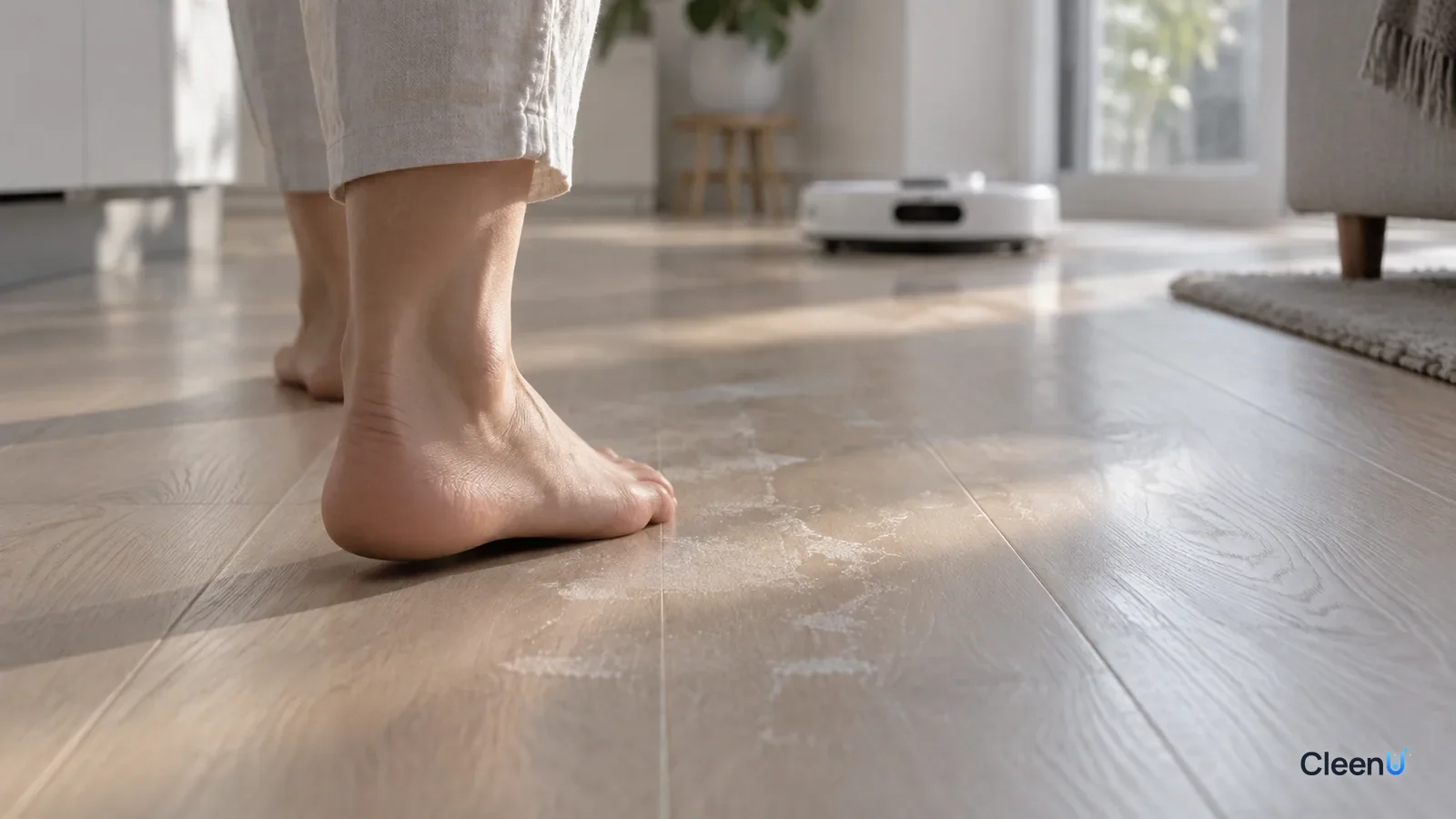
The robot just finished mopping, and when you walk across the floor barefoot, it feels like your feet are sticking. White socks turn gray after one lap. Hair and dust seem to cling to the floor. The natural reaction is to assume the robot didn't clean well enough, add more solution and run it again. The floor gets stickier.
Sticky floors after robot mopping almost always share one cause: something was left on the surface that shouldn't be there, usually residue from cleaning solution or detergent. Robot mops are actually more prone to it than hand mopping, and the reason is how they work.
Why do robot mops leave floors sticky more easily?
When you mop by hand, you rinse the mop in the bucket over and over, and most of the dirty water and extra cleaner gets poured out. A robot mop works differently. It spreads the solution from its tank evenly across the floor at a set flow rate. The pads loosen the soil and pick up part of it, and the rest of the water evaporates on the floor.
At the label dose, so little surfactant stays behind that you can't feel it once the floor dries. Add more and the extra doesn't get picked up by the pads; when the water evaporates, it leaves a slightly tacky film. That film holds dust, hair and skin oil from bare feet, so the floor gets dirty faster. A floor that gets dirty faster tempts you to add more solution, and the cycle keeps going.
A robot also mops the same routes day after day, so residue builds layer on layer. Overpouring once when you mop by hand makes little difference. Overdosing a robot every day becomes noticeable within a week or two.
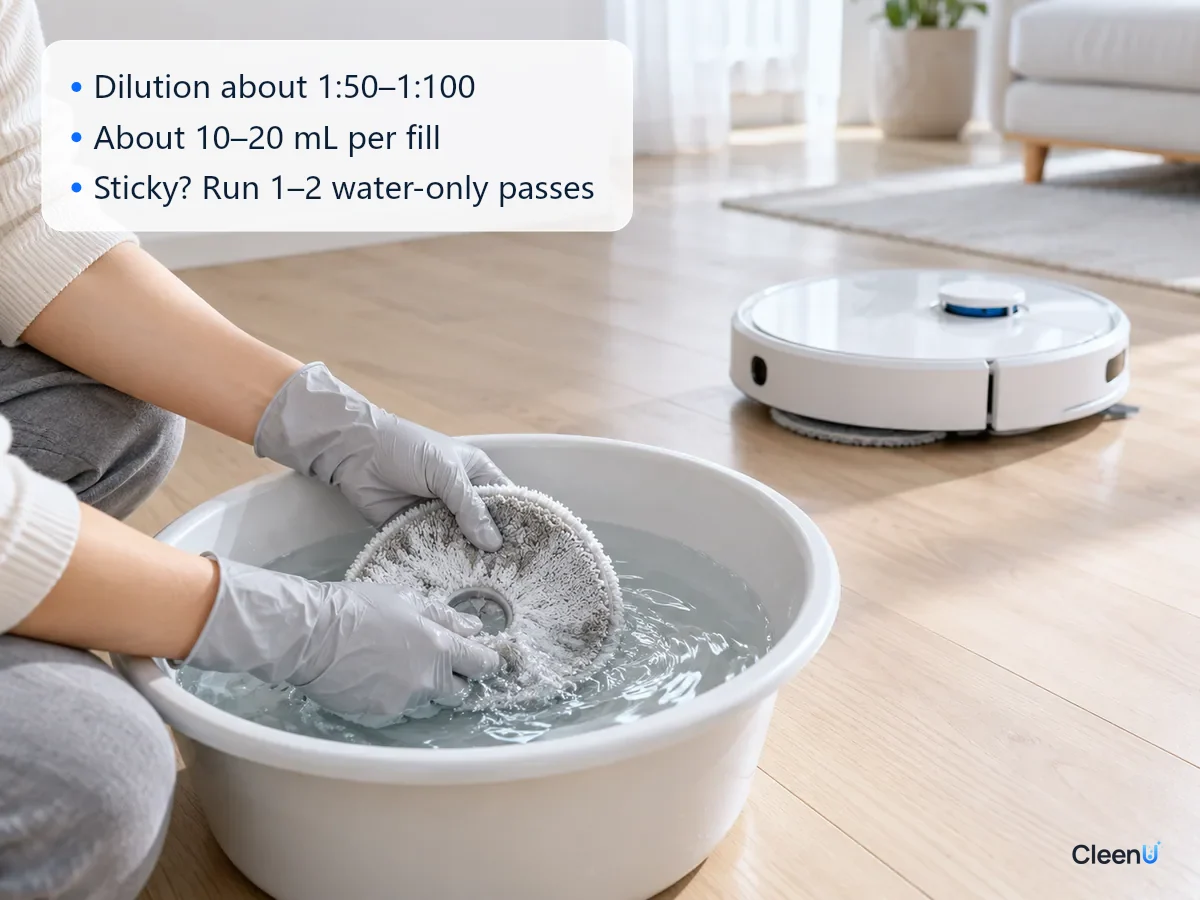
CleenU Robot Vacuum Cleaning Solution, for example, dilutes at about 1:50 to 1:100, which usually means 10 to 20 mL per fill. A lot of sticky floors come from the "more is cleaner" instinct, with doses several times that.
If you have a Roborock, iRobot, Ecovacs, Dreame or Narwal robot mop, or a Tineco-style floor washer, CleenU robot mop cleaning solution works in most models; add it to the clean tank or dosing compartment as the manual directs. (CleenU isn't affiliated with these brands.)
The pads and the dock can leave residue too
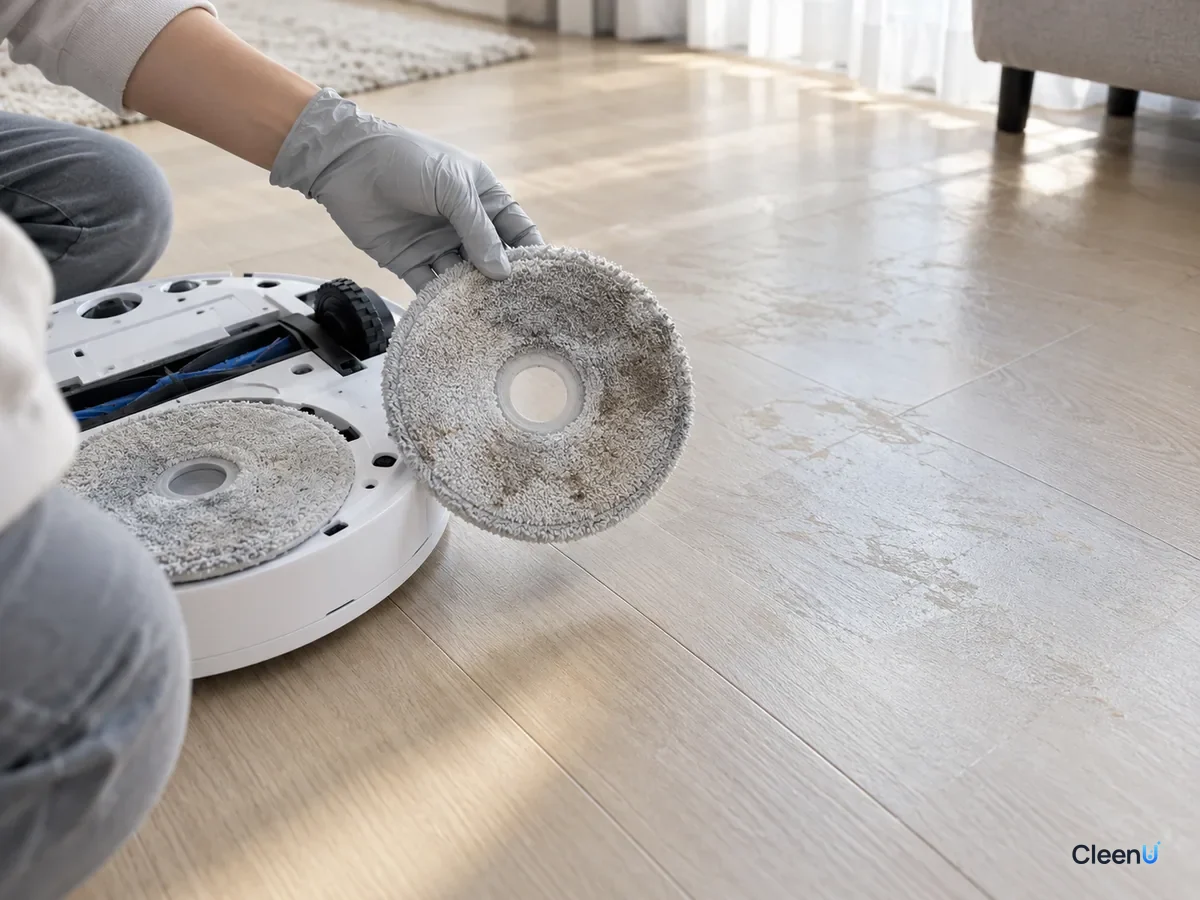
The second common source is the mop pads. On robots with a self-cleaning dock, the pads are rinsed with water from the clean tank. If that water is overdosed, surfactant builds up in the fibers over time. On robots without a dock, many people pull the pads off and hand-wash them with laundry detergent or dish soap. If they aren't rinsed well, that detergent goes straight back onto the floor on the next run. Fabric softener is worse, because it is designed to leave an oily coating on fibers.
The third is mixing products. Dish soap, a regular floor cleaner or a disinfectant in the tank, or a new solution poured in on top of an old one, adds up to more residue and often a lot of foam. High-foaming products get churned in the tank and pads, and the foam dries into a tacky film.
The fourth has nothing to do with the solution. Spilled soda, juice or sweet drinks in the kitchen, under the table or in a kids' play area only partly come up in one pass. The rest gets spread around by the pads, and a whole patch of floor ends up slightly sticky.
The chemistry: why residue feels sticky
Once solution goes into the tank, it's mostly water. After that water evaporates from the floor, what stays behind is the part of the formula that doesn't evaporate, which formulators call the solids content: surfactants, solubilizers, fragrance, preservatives and small amounts of salts. Whether a floor feels sticky depends largely on how much of that is left and what form it takes.
Many surfactants dry into a paste or waxy film, and some solubilizers and humectant-type ingredients pull moisture from the air, keeping the film slightly damp and tacky. Walk on it barefoot and the skin oil from your feet mixes in, making the stickiness more noticeable.
Surfactants also differ a lot in how easily they rinse away. The high-foaming anionic surfactants common in dish soap and regular floor cleaners, such as LAS and AES, along with foam boosters and stabilizers, tend to cling to the floor once dry. Robot mop solutions are usually built on low-foam nonionic surfactants, such as low-ethoxylate fatty alcohol ethoxylates or EO/PO block copolymers, which redissolve more easily in the next mopping pass and build up less.
Hard water makes it worse. Calcium and magnesium in tap water combine with fatty acids, from soap-type ingredients and from skin oil breaking down, to form insoluble calcium soap. That's the same stuff as the gray soap scum on a shower door, and on a floor it shows up as a dull, draggy, tacky film. In hard-water areas, the same dose is more likely to leave residue, which is why some formulas include chelating agents that tie up calcium and magnesium so less calcium soap forms.
Then there's accumulation. A robot mops the same routes day after day. If every fill uses twice the label dose, a reasonable estimate is that roughly twice as much solid material stays on the floor, and over days and weeks it goes from unnoticeable to clearly sticky. That's why the first fix is always a lower dose and a water-only pass, not a stronger product.
CleenU Robot Vacuum Cleaning Solution uses low-foam nonionic surfactants with a defoamer and contains no wax, particles or chlorine. At about 1:50 to 1:100, very little is left on the floor to begin with, which is why it needs no rinse.
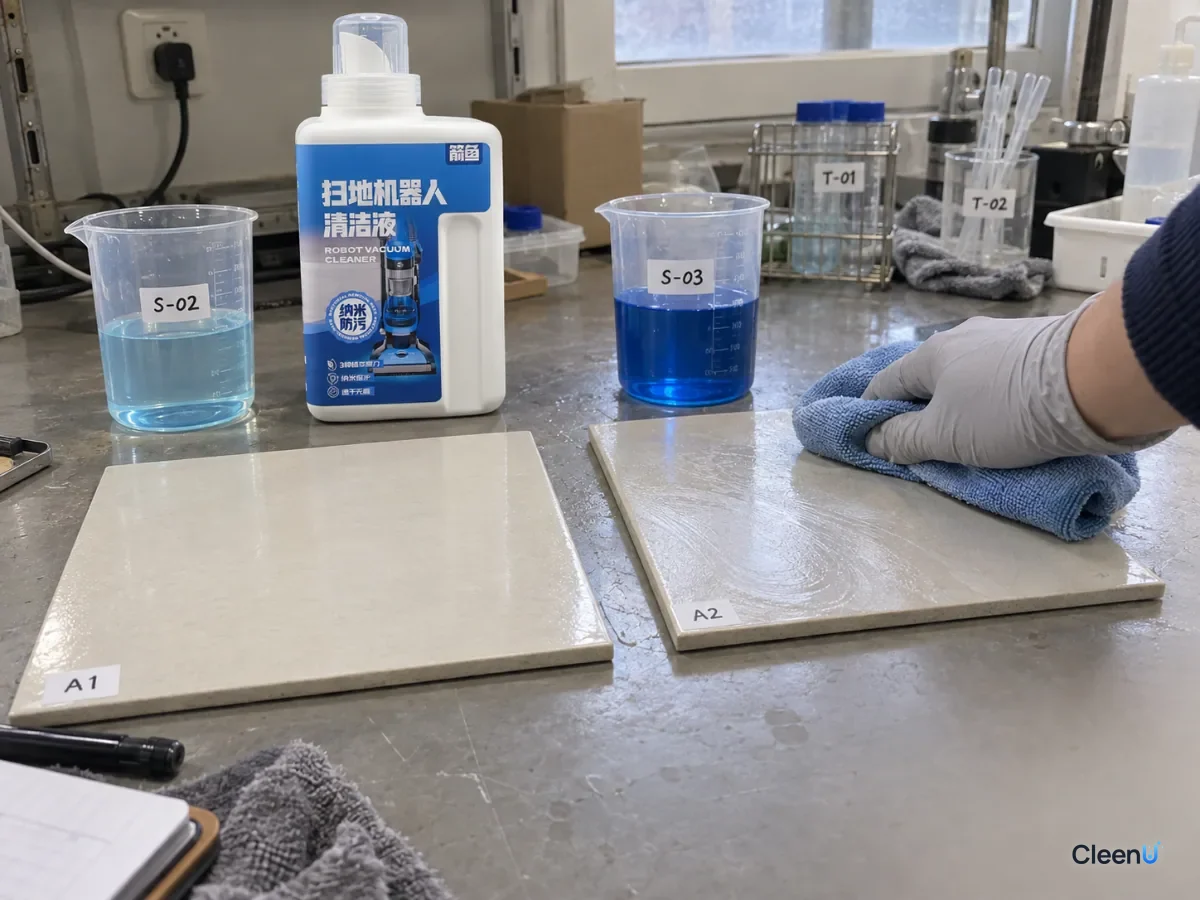
A simple residue test you can do at home
To see the link between dose and residue for yourself, grab a clean small mirror or a dark tile.
On the left, put a few drops of solution mixed at the label ratio. On the right, put a few drops mixed at double the ratio or more. Add a spot of plain water as a control. Let them dry completely at room temperature, then look from an angle. The water spot leaves almost nothing, the label-dose spot leaves a very faint mark, and the overdosed spot leaves an obvious white or hazy ring that feels draggy or tacky to a fingertip.
This isn't a verdict on any particular product. It shows that with the same bottle, the dose decides how much ends up on the floor. What happens on your floor every day is the same process, magnified many times.
Causes and fixes, side by side
The causes run from most to least common. Change one thing at a time, let the robot mop once, and walk on the floor barefoot once it is dry. That tells you whether you found the cause.
Common causes of sticky floors after robot mopping, and what to do
| Cause | What you see | Fix | Prevention |
|---|---|---|---|
| Too much solution | The whole house is sticky; footprints and dust stand out | Put only plain water in the clean tank and run one or two passes | Measure with the cap and follow the label ratio |
| Auto-dosing set too high | Dock doses automatically; whole house is sticky | Turn the dosing level down or off, then run a water-only pass | Choose a low or medium setting per the manual |
| Detergent left in the pads | Freshly washed pads leave the floor sticky | Rinse the pads in plain water several times and dry them fully | Skip fabric softener and rinse hand-washed pads thoroughly |
| Mixed products | Heavy foam, stickiness, maybe a false "dirty tank full" alert | Empty and rinse both tanks, then run with plain water | Use one robot-specific solution at a time |
| Sugary spills | Sticky patches in the kitchen or under the table | Wipe the sugar off by hand with a warm, damp cloth, then mop as usual | Wipe up drink spills the same day |
| Water flow too high | The floor takes a long time to dry, then feels sticky | Lower the water flow one level in the app | Use low to medium flow on hardwood and laminate |
How to get the residue off the floor
A floor that is already sticky doesn't need a stronger solution or a bigger dose. It needs the residue taken off.
Empty the clean tank, rinse it, and fill it with plain water only. If your dock doses automatically, turn that off for now. Take the pads off and rinse them in clean water until squeezing them no longer produces suds, then put them back. On a docked robot, rinse the wash tray and filter too.
Then run a normal mopping cycle with the water flow at a medium setting. Once the floor is completely dry, walk on it barefoot. If the stickiness is clearly less, the problem was residue, and one more water-only pass usually finishes the job.
When you go back to using a cleaning solution, measure it to the label every time. CleenU Robot Vacuum Cleaning Solution is a neutral, low-foam concentrate with a pH of 6.5 to 7.5, wax-free, chlorine-free and free of particles, and it needs no rinse afterward. At about 1:50 to 1:100, or roughly 10 to 20 mL per fill, the floor dries clean instead of sticky. When a floor is especially dirty, have the robot mop twice rather than doubling the dose.
Is it solution residue or something else?
Three quick checks tell you.
Look at where it is sticky. If it is the whole house, the dose or the pads are the likely cause. If it is only the kitchen, under the table or around the pet bowls, it is probably sugar or food residue.
Check the pads. Take one off and swish it in a bowl of plain water. Visible suds mean the pad is holding surfactant or detergent, so rinse the pads clean first.
Try plain water. Have the robot mop once with water only. If the floor feels clearly fresher, it was residue. If one area is just as sticky as before, look at sugary spills or an old polish or finish.
If the floor has ever been waxed or treated with a polish or shine product, the stickiness may be that coating mixed with cleaner. Check the flooring maker's care instructions before you try to remove it. For stickiness after mopping by hand, see why your floor feels sticky after mopping. For streaks and water marks after robot mopping, see robot mop leaving streaks.
Different floors show residue differently
Tile and vinyl plank (LVP/SPC): the surface doesn't absorb water, so residue sits on top. You feel the stickiness most clearly, and it clears up fastest; one or two water-only passes usually do it.
Laminate and sealed hardwood: they don't like water. Keep the water flow off the highest setting while you clear residue, and keep the room ventilated so the floor dries quickly.
Waxed or oiled floors: they already carry a care coating, and robot mopping calls for caution on these floors anyway. Check the flooring maker's guidance first to confirm wet mopping is allowed.
For how much solution to add and how to scale it to different tank sizes, see how much cleaning solution to put in a robot mop.
This article is part of the Robot Vacuum Cleaning Solution & Maintenance Guide, which covers the full maintenance schedule and links to every troubleshooting guide.
Stop using the current product if you see any of these
The floor stays slippery after a water-only pass; wood or laminate edges swell or lift; the finish turns white or dull and plain water won't restore it; heavy foam in the clean or dirty tank, or repeated "dirty tank full" alerts. Stop using the current solution, run with plain water only, and check the product label and your robot's manual.
Sticky-floor questions from robot mop owners
Does a sticky floor mean my robot mop solution is low quality?
Don't blame the product yet. The most common causes are overdosing and residue in the pads. Run one or two water-only passes, then follow the label ratio.
How much solution should I add so the floor doesn't get sticky?
Follow the label. CleenU Robot Vacuum Cleaning Solution dilutes at about 1:50 to 1:100, usually 10 to 20 mL per fill. Measure with the cap instead of pouring by eye.
Can a dock with auto-dosing still add too much?
Yes. Auto-dosing dispenses by level, and a high setting can overdose. Turn it down one level, then run a water-only pass.
How should I wash robot mop pads so they don't leave floors sticky?
Wash them in plain water or a little laundry detergent, rinse until no suds come out, skip fabric softener, and let them dry completely.
Can I add vinegar to cut the residue?
No. Vinegar is acidic and can wear down tank seals and damage natural stone and wood finishes. A water-only pass or two removes the residue.
Why is only the kitchen and the area under the table sticky?
That is usually sugar from drinks and food. Wipe those spots by hand with a warm, damp cloth, then let the robot mop as usual.
Can I pour robot mop concentrate straight into the tank?
No. Dilute a concentrate before it goes into the clean water tank. CleenU Robot Vacuum & Mop Floor Cleaning Solution is used at about 1:50 to 1:100; 10 to 20 mL per fill is usually enough. Pouring it in undiluted is one of the most common causes of sticky floors. Add concentrate directly only to a dock's designated auto-dosing compartment when the manual says the machine mixes it.
For a neutral, low-foam, wax-free robot mop cleaning solution that dries without a sticky film at the label dose, try Robot Vacuum Cleaning Solution.
When the floor gets sticky after robot mopping, start with the dose and the pads. Overdosed solution, auto-dosing set too high or detergent left in the pads all leave a tacky film. Empty the tank and use plain water, rinse the pads clean, and let the robot run once or twice to lift the residue, then measure the solution to the label from then on. If it is still sticky, check for mixed products, sugary spills and old floor finishes. The fix is less solution and more water, not a stronger cleaner.