
Q&A
Can You Use Other Cleaning Solutions in a Bissell CrossWave? Where to Add It and How Strength Really Works
Direct answer
Yes. The key is picking the right one and adding it in the right place: a low-foam, neutral, solvent-free, particle-free concentrate, in the formula tank or the clean water tank, not both. If you're diluting it yourself, aim for about 1:50 to 1:100, and test one room first.
Switching solutions in a CrossWave: quick reference
Yes
- A low-foam, neutral, solvent-free, particle-free concentrate with no disinfectants, added where your manual allows
No
- Dish soap, laundry detergent, vinegar, bleach, rubbing alcohol, solvent-based glass cleaner, floor wax or shine boosters
It depends
- Scent, fill location, and amount: follow the manual for your specific model, and test one room first
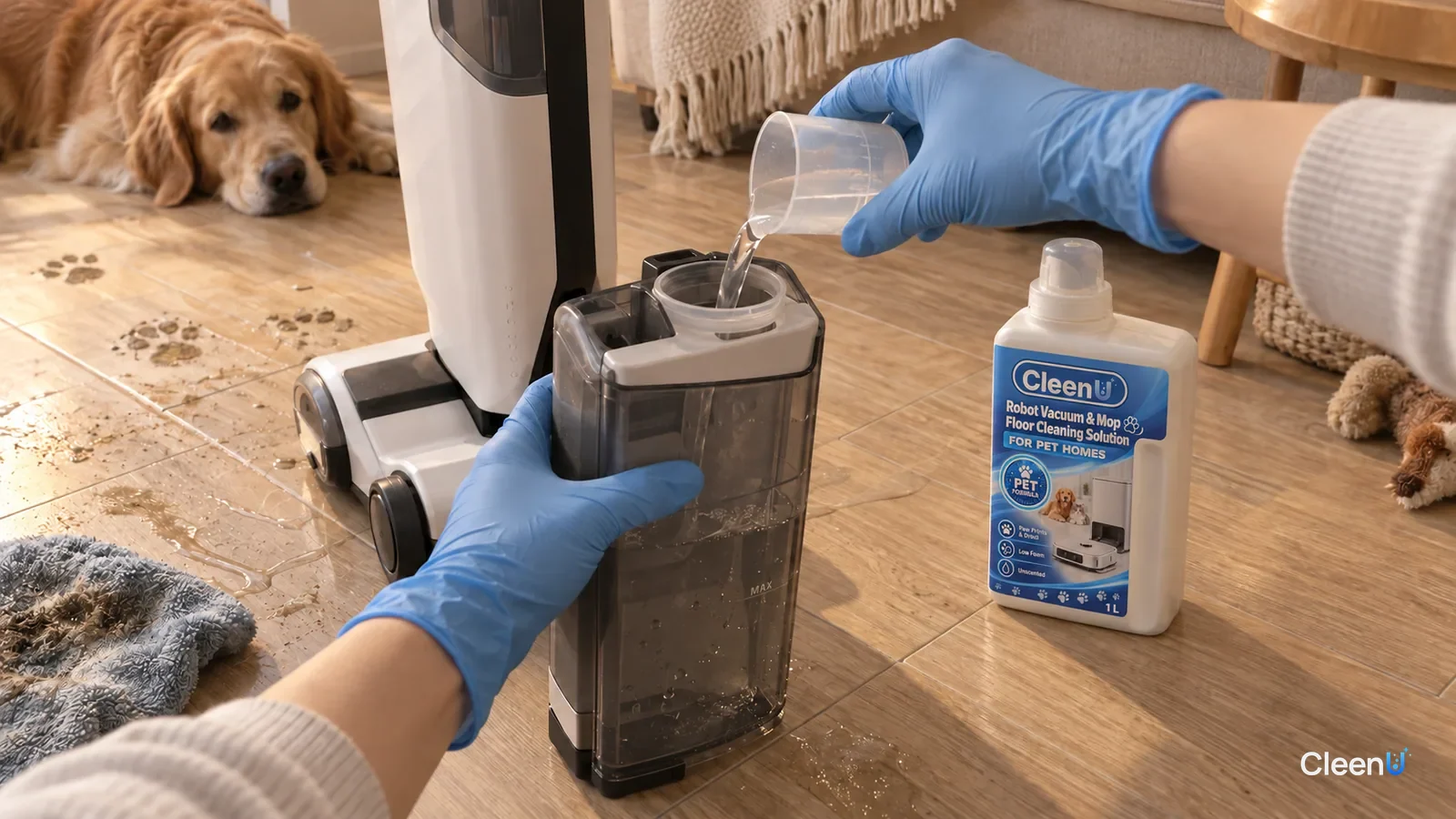
Here's the short version: yes. Choose a low-foam, neutral, solvent-free, particle-free concentrate, and steer clear of anything flammable, corrosive, clog-prone, or sudsy. Then add it in one place only: the formula tank, or the clean water tank at about 1:50 to 1:100 with nothing in the formula tank. Clean one room first and check the dirty tank for foam and the dry floor for tackiness.
Plenty of owners run out of formula, can't find it locally, or go through it fast in a house with a dog. The real question is how to choose and add an alternative so floors come out clean and the machine keeps running smoothly. A wet-dry floor cleaner isn't a robot mop. It pulls dirty water and air back in under strong suction, and the formula sits in its own tank, blended with water by the machine. So you have two extra things to think about: whether suction will multiply foam, and how strong a concentrate ends up after the machine mixes it.
What a floor cleaner solution has to get right: safety and materials
Once you understand how a wet-dry floor cleaner is built, it's clear what any solution needs to get right, and it comes down to two things.
The first is safety, and it follows from the design: water, a motor, and electronics share one body, and the motor pulls dirty water and air back into it. Alcohol or a solvent cleaner can send flammable vapor toward the motor. A heavy-foaming liquid can climb past the dirty tank's separator and carry moisture toward the filter and motor.
The second is material compatibility. There are three things a formula should stay away from: solvents and strong acids or alkalis, which can make seals and tubing swell, harden, or crack; particles and residue that dry hard and block the pump and valves; and heavy foam that carries moisture toward the motor. Steer clear of those and you go a long way toward keeping the seals and pump in good shape.
Turn that into a shopping checklist and you get four requirements:
- Not flammable: no alcohol or solvent ingredients.
- Low foam: stays low even under strong suction and a fast-spinning brush roll, and collapses fast.
- Gentle on materials: neutral pH, no acids, no chlorine, no solvents.
- Nothing that clogs: no particles, waxes, or film-forming polymers that crust on nozzles, tubing, or the brush roll.
The path liquid takes through a CrossWave
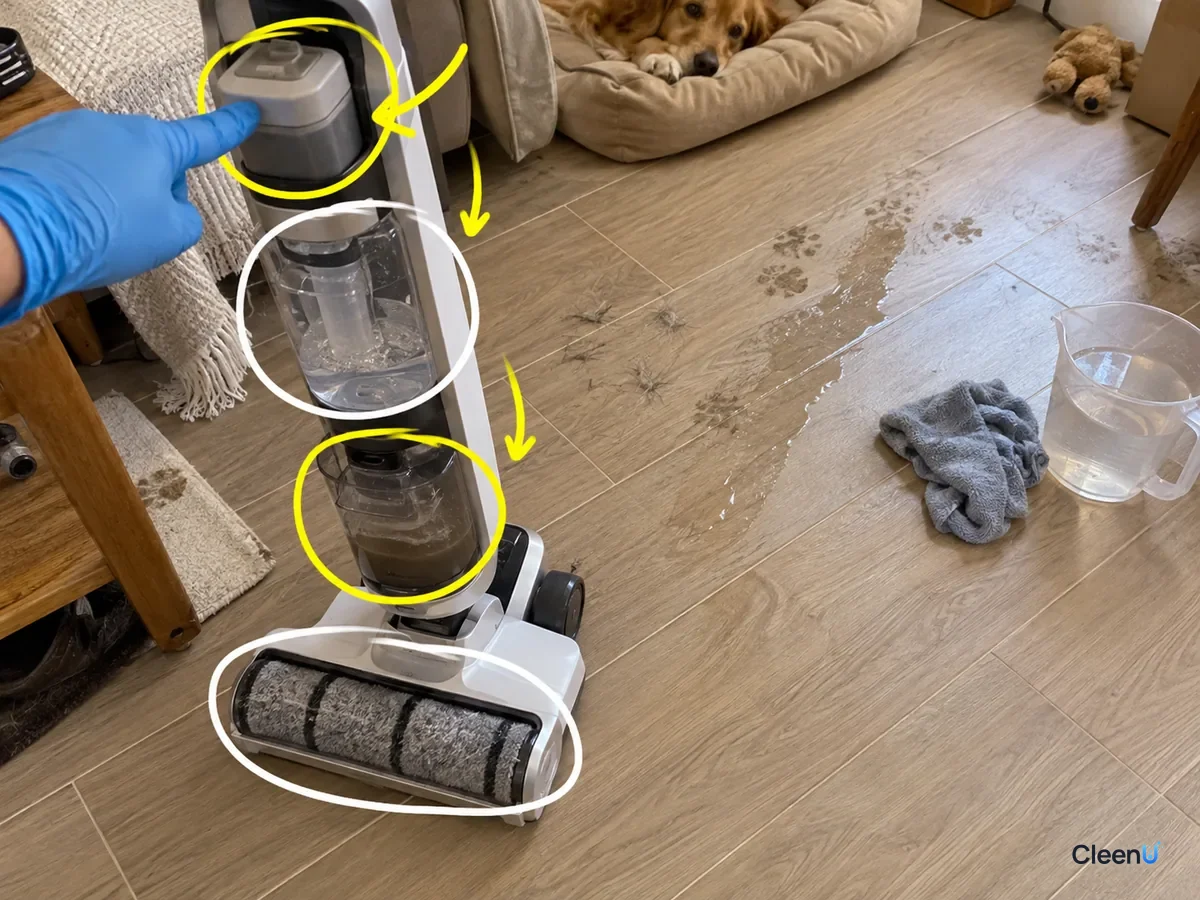
Details vary by model, so check your manual. As Bissell's manuals describe it, CrossWave-style machines hold cleaning formula in a dedicated formula tank, and the machine mixes it with clean water as it runs. The water path usually has four stages.
Stage 1: Water and formula stored separately, then combined. When you run the machine, both liquids feed into one line at a designed ratio and become the working solution. That ratio is set by the machine's channels, valves, or metering parts. Owners usually can't adjust that fixed setting, so pick a formula with stable viscosity that's labeled for auto-dosing, and match it to the label's setting.
Stage 2: Working solution sprayed onto the brush roll. A multi-surface brush roll spins against the floor, spreading the solution while its bristles and fibers scrub up grit, greasy film, and hair. The solution wets and loosens soil; the brush roll supplies the friction.
Stage 3: Dirty water and air pulled back up together. Behind the brush roll, a suction channel draws up dirty water, grit, and hair with a lot of air. Unlike a robot mop, whose pad holds dirt until the dock washes it, a wet-dry cleaner scrubs and extracts at once, churning dirty water through a fast, turbulent airstream.
Stage 4: Water and air separated in the dirty water tank. The air-and-water mix enters the dirty tank, where baffles let the liquid drop while air continues up through a filter to the motor. There's usually a full-tank shutoff, such as a float, that cuts suction when the water gets high. Foam causes trouble right here. Foam is mostly air, so it takes up far more room than the water it contains. It can trigger the full-tank shutoff early or ride the airflow past the separator.
So two questions matter most for any alternative: the Stage 1 mix ratio decides how strong your concentrate ends up, and the Stage 3 and 4 suction and separation decide how much foam gets amplified.
The built-in mix: how strong does a concentrate get inside the machine?
This is the point most people miss, and it has the biggest effect on results.
A concentrate's label ratio assumes you're doing the mixing yourself. CleenU Robot Mop Cleaning Solution is labeled at about 1:50 to 1:100, meaning one part concentrate to 50 to 100 parts water, and 10 to 20 mL per fill is usually enough. In a machine with a dedicated formula tank, though, the machine does the mixing. The strength that reaches your floor equals the concentrate's own strength times the share of formula the machine blends into the water.
An example that only illustrates the math (assumed numbers, not specs for any Bissell model):
- Say a machine blends formula into water at about 1:30. Your concentrate then runs at about 1:30, roughly 1.7 to 3.3 times stronger than the 1:50 to 1:100 on its label.
- Say another machine blends at about 1:150. The same concentrate runs at about 1:150, weaker than even the label's low end.
The first puts far more surfactant on the floor than intended; the second may struggle with greasy footprints and muddy paws. We haven't found published mix-ratio data from Bissell, so we can't give an exact figure. A third-party concentrate in a formula tank simply runs at whatever strength the machine creates.
The same math helps you compare concentrates: in-use strength equals active content divided by the dilution ratio. Many robot mop solutions carry about 2% active surfactant. At 1:200 that leaves about 0.01%, and at 1:500 only about 0.004%. CleenU Robot Mop Cleaning Solution carries 15% active surfactant, so at 1:100 it still leaves about 0.15%: about 15 times the first case and nearly 40 times the 1:500 case. The 2% figure is a typical level used for illustration, not any particular brand. A bigger number on the label doesn't mean a better deal; the in-use strength tells you.
Why is running too strong the more common and more annoying problem? It comes down to the critical micelle concentration. Once surfactant reaches a certain level in water, the molecules cluster into tiny structures called micelles that surround oil and grit and hold them in suspension so suction can pull them away. Below that point, cleaning improves noticeably as you add more. Once you're past it and at a working strength, extra surfactant adds little cleaning power, but it doesn't disappear. Some stays in the film of water on the floor and dries as residue. The rest gets pulled into the dirty tank and feeds foam. In a wet-dry cleaner, "too strong" doesn't mean "cleaner." It means a foamier dirty tank and floors that feel tacky or look hazy once dry.
How strength is decided between the formula tank and the floor
- The concentrate in the formula tank has a fixed strength set by the product
- The machine blends formula into clean water at its own designed ratio
- Multiply the two and you get the strength of the solution hitting the brush roll
- Past the strength needed for cleaning, extra surfactant adds little cleaning power
- The excess either dries on the floor as residue or feeds foam in the dirty tank
We've tested CleenU Robot Mop Cleaning Solution in Bissell floor cleaners both ways: in the formula tank and diluted into the clean water tank. Either works. Pick one of these, in a location your manual allows:
- Formula tank method. Add the solution to the dedicated formula tank as your manual directs, and the machine blends it with water. Clean just one room first. If the floor isn't tacky and the dirty tank isn't foamy, the machine's mix and the solution are in step.
- Clean water tank method. Put nothing in the formula tank and dilute the solution into the clean water tank at about 1:50 to 1:100, for example 10 to 20 mL per liter (about 34 oz) of water, water first. You control the strength completely.
- It's clearly too strong on the first try. Don't add more, and never dilute concentrate with water inside the formula tank. Switch to the clean water tank method at the 1:100 end, so you set the strength yourself. If floors feel tacky or the dirty tank foams, run plain-water passes between uses.
Pick one method. Never add solution to both the clean water tank and the formula tank; that doubles the dose.
Suction multiplies foam: why wet-dry cleaners are pickier than robot mops
On a robot mop, foam mostly causes trouble during dock washing and dirty-water pickup. On a wet-dry cleaner, suction makes it worse, for three reasons.
Foam takes up far more room than the water in it. The dirty tank is sized for liquid, so heavy foam can fill it, trip the shutoff early, or push past the separator.
The suction channel works like a foam generator. The brush roll spins fast, and the air at the suction inlet is fast and turbulent. Liquid gets torn into fine droplets and mixed with air again and again. Even a solution that barely foams in a shake test will foam a little more here, and high-sudsing dish soap or laundry detergent will produce a lot of stable foam.
Floor soil changes foam. This matters in dog homes. Dog saliva contains mucin proteins, coats carry skin oil, and paws bring in dirt and fine sand. Dissolved proteins settle into bubble walls and make them more elastic and harder to pop, so cleaning around a water bowl or dog bed often foams more than cleaning a bedroom. Oily soil does the opposite: small oil droplets create weak spots in the bubble wall and help foam collapse. That's why the same solution can foam more in the pet area than in the kitchen.
Low-foam formulas usually rely on nonionic surfactants plus a little defoamer. Nonionics carry no charge, so they pack less tightly in a bubble wall than anionics, and the wall loses elasticity; defoamers create weak spots so bubbles break sooner. Low foam doesn't mean weak cleaning. Cleaning comes from wetting, emulsifying, and dispersing soil.
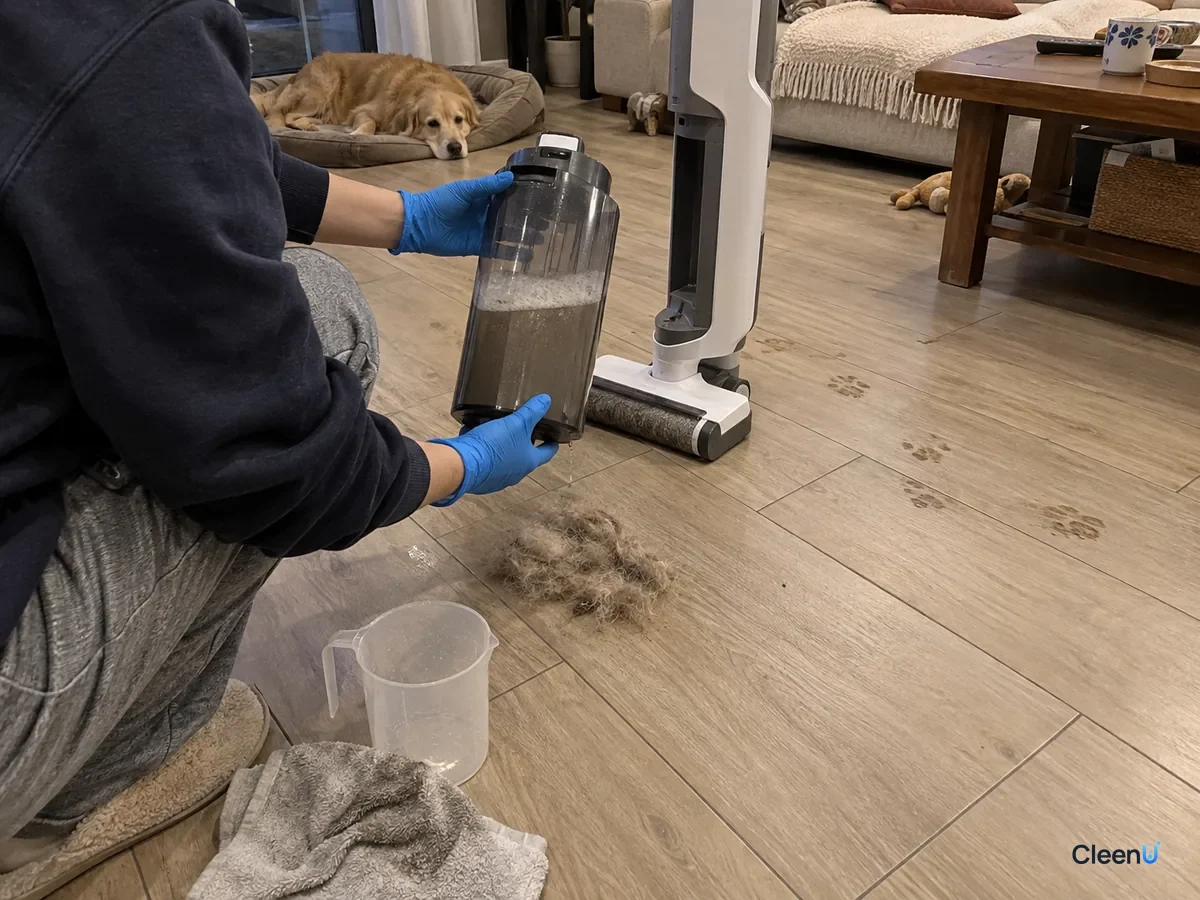
The fastest way to judge a solution in your CrossWave is to open the dirty tank after one room. A thin layer of foam that fades quickly is what you want. Foam stacked well above the water that won't go away means that product, or that strength, isn't right for the machine.
What not to put in a CrossWave
Given how a wet-dry cleaner is built and what its seals and pump are made to handle, skip these:
- Alcohol, alcohol-based glass cleaner, and solvent cleaners: flammable vapor near the motor; solvents can swell seals and crack stressed plastic.
- Vinegar and citric acid: can corrode metal in the pump and fittings over time.
- Chlorine bleach: hardens and cracks rubber, and is used up fast by protein soil, leaving a harsh smell.
- Dish soap and laundry detergent: high, stable foam, exactly what suction amplifies.
- Floor wax, shine boosters, particles, or film-formers: build up and crust on nozzles, tubing, and brush fibers.
- Essential oils and heavy odor sprays: leave oily film and are hard on a dog's nose.
For more on how seal compatibility is tested, see Can robot mop solution damage tank seals and tubing? For whether robot mop and wet-dry cleaner solutions are interchangeable, see Can you swap robot mop solution and wet-dry vacuum solution?
Wood-look tile in a dog home: what the machine is really cleaning
Wood-look tile is glazed porcelain or ceramic. It's sealed and doesn't absorb water, so it's forgiving, but its faux-grain texture has tiny ridges. In a living room with a dog, you're usually dealing with four kinds of mess:
- Muddy paw prints. Grit lodges in the grain, held by a little skin oil. The brush roll digs it out; the solution wets it loose.
- Drool marks and water-bowl rings. Mostly mucin that dries shiny and draggy. Proteins soften slowly, so a slow pass beats a fast one.
- Body-oil film where the dog lies. Hard to see, draggy underfoot. Surfactant has to emulsify it before suction can lift it.
- Dog hair. It wraps the brush roll and mats with mud in the dirty tank, so vacuum it first.
Drool and mud foam the dirty tank most; skin oil plus extra surfactant leaves tacky film. So with a dog, stick to the label dose and make two slow passes over dirty spots instead of using a stronger mix.
Three ways to check a solution at home before you commit
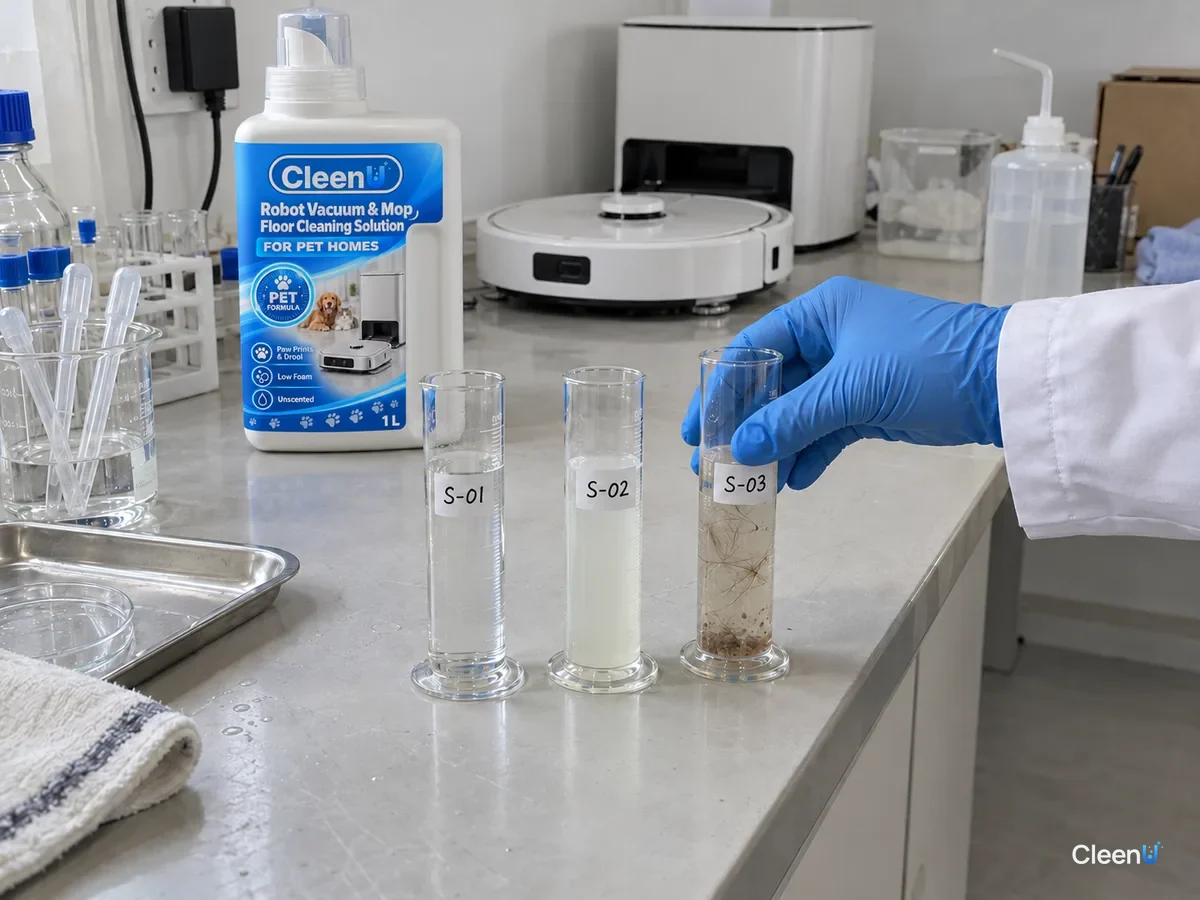
A shake test with real dirt. Fill two clear bottles with about 500 mL (17 oz) of water each and add solution at its label ratio, about 5 to 10 mL at 1:50 to 1:100. Into one bottle, add a pinch of dust swept from near the dog bed and a few dog hairs to mimic real dirty water. Cap both, shake each hard 10 times, and let them sit. A low-foam formula should form a thin layer in both that fades quickly. If the dirty bottle foams much higher and holds it, that product tends to stabilize foam around pet soil, and suction will make it worse. Full method: How to tell if a robot mop solution is low-foam.
Check the dirty tank after one room. Clean only the room your dog uses most, then pull the dirty tank. A thin layer that fades fast is fine. Foam well above the water means pause, empty the tank, rinse and dry the filter, then retry with the clean water tank method at the 1:100 end.
Check the floor once it's dry. Look at the tile with light coming in low from the side for hazy trails, then walk across it in socks. Glazed tile doesn't show residue easily, so if it looks hazy or feels tacky, the solution is running clearly too strong.
CleenU as an example: what to know in a CrossWave
CleenU Robot Mop Cleaning Solution is a neutral concentrate, pH 6.5–7.5 as a concentrate. It's built on low-foam nonionic surfactants with a defoamer, contains no wax, chlorine, particles, solvents, or optical brighteners, and has no disinfecting ingredients such as quats or phenols. Its viscosity is designed for auto-dosing, so it draws well from dosing compartments and formula-tank setups. Each 1 L (about 34 oz) bottle comes with a measuring cap and dilutes about 1:50 to 1:100; 10 to 20 mL per fill is usually enough. The standard version has a lemon scent. For dog and cat homes, the Pet Homes version is fragrance-free, with no added fragrance, and uses a cyclodextrin-based odor neutralizer for pet odors, so floors don't smell heavily perfumed.
It's a cleaning solution for muddy prints, body-oil film, dried drool, and everyday grime, not a disinfectant, and we don't claim it kills germs. We've run foam, residue, and water-path tests on common robot mops and wet-dry cleaners, and it works with most Bissell models, including the CrossWave line, as well as most models from Roborock, iRobot, Ecovacs, Dreame, Narwal, Shark, Eufy, and Tineco. In a CrossWave, we've tested it both in the formula tank, added as the manual directs, and diluted about 1:50 to 1:100 in the clean water tank. Use one, not both, and test one room first to check the strength. CleenU is not affiliated with Bissell; brand names are used only to describe compatibility.
If you have a dog and want a low-foam, fragrance-free option for your floor cleaner, take a look at our Robot Vacuum Cleaning Solution for Pet Homes.
No pets and prefer a fresh scent? The standard CleenU Robot Mop Cleaning Solution has a lemon scent.
Switching and everyday use, step by step
- Clear out the old formula. Use it up or pour it out, rinse, and dry the tank. Don't mix products; see Can you mix different robot mop solutions?
- Vacuum hair first so less of it wraps the brush roll.
- Add solution in one place your manual allows. Either fill the formula tank as the manual directs, or put nothing in the formula tank and dilute about 1:50 to 1:100 in the clean water tank, water first. Never both.
- Clean one room, slowly, twice over dirty spots.
- Check the dirty tank and the dry floor for foam, haze, and tackiness.
- Adjust. If all looks good, make it routine. Too strong means switching to the clean tank method at the 1:100 end.
- Clean up. Empty the dirty tank and rinse the filter and brush roll. Water full of drool and hair smells fast overnight; see Why does a robot vacuum's dirty water tank smell? Before storage, empty, rinse, and dry the formula tank.
Turn the machine off and check if you see any of these
Check your setup if foam fills the dirty tank quickly, the full-tank shutoff keeps tripping, or foam dampens the filter; the machine throws unusual errors, the motor sound changes noticeably, or spraying cuts in and out; whitish, tacky buildup or leaks appear around the formula tank or fittings; floors stay tacky, slippery, or hazy once dry; or there's a harsh smell, or a person's or pet's skin turns red or itchy after contact with the floor. Turn the machine off and unplug it, empty the formula and dirty tanks, rinse and dry the filter and brush roll, then clean with plain water to see if the problem clears. If it does, switch to the clean water tank method at the low end of the label ratio, or try a lower-foam product. If it persists with plain water, contact the machine maker's support.
Using other solutions in a Bissell CrossWave: common questions
Can you use other cleaning solutions in a Bissell CrossWave?
Yes, if you pick the right one and add it in the right place: a low-foam, neutral, solvent-free, particle-free concentrate with no disinfectants, either in the formula tank as the manual directs or diluted about 1:50 to 1:100 in the clean water tank, never both. Test one room first and check dirty-tank foam and floor feel.
Where does cleaning solution go in a CrossWave?
Wherever your manual allows. We've tested CleenU Robot Mop Cleaning Solution both ways on Bissell machines: in the dedicated formula tank, added as the manual directs, or diluted about 1:50 to 1:100 in the clean water tank with nothing in the formula tank. Choose one, never both at once.
If I put a concentrate in the formula tank, will it run at its label ratio?
No, not automatically. The machine blends formula at its own ratio, so the real strength can be stronger or weaker than the label. Always test one room first. To control the strength yourself, use the clean water tank method at about 1:50 to 1:100.
The dirty tank foamed up on the first try. What now?
Switch to the clean water tank method at the 1:100 end. Empty the dirty tank and rinse and dry the filter first, and don't add more; heavy foam usually means the formula tank is running too strong, or the product stabilizes foam around pet soil.
Can I water down concentrate in the formula tank to lower the strength?
No. Never dilute concentrate inside a formula or dosing tank; put solution only where your manual says. If floors feel tacky or foam builds up, clean with plain water between runs, or switch to the clean water tank method and dilute about 1:50 to 1:100 so you set the strength.
Can I use robot mop cleaning solution in a CrossWave?
Yes, if it's low-foam, neutral, and particle-free, which matches what a wet-dry cleaner needs. CleenU Robot Mop Cleaning Solution works with most Bissell models. Test one room first.
What solution should dog owners use in a CrossWave?
Choose a neutral, low-foam solution with no scent or a very light one and no quats or phenols. CleenU's Pet Homes version is fragrance-free and uses a cyclodextrin-based odor neutralizer; let the floor dry before your dog comes back.
Dried drool didn't come up in one pass. Should I use more solution?
No. Mucin needs time to soften, so slow down and make two passes over the spot. A stronger mix just foams the dirty tank and leaves floors tacky.
My wood-look tile looks hazy after cleaning. Is it the solution?
Check whether the mix is too strong first. Clean once with plain water; if the haze goes away, switch to the clean water tank method at the 1:100 end. If it stays, check for mineral spots from hard water.
How long does an alternative solution keep after opening?
Use it within its shelf life, capped tightly and stored somewhere cool and out of direct sun. CleenU Robot Mop Cleaning Solution keeps 24 months unopened; keep it away from freezing (below 32°F). Before storing the machine, empty, rinse, and dry the formula tank.
To weigh brand-name against universal solutions, see Brand-name vs. universal robot mop cleaning solution. For more on cleaning with pets, see Robot mopping in a home with cats and dogs.
You can use an alternative solution in a Bissell CrossWave. The key is choosing one that avoids four problems: flammability, corrosion, clogging, and foam. That means neutral, solvent-free, no chlorine or acids, no particles or wax, no disinfectants, and low foam. CleenU Robot Mop Cleaning Solution has been tested both in the formula tank and diluted about 1:50 to 1:100 in the clean water tank; use one, never both. In the formula tank, the machine's built-in mix decides the real strength, which may not match the label. Clean one room first, check dirty-tank foam and how the dry floor feels, and if it runs strong, switch to the clean water tank method at the 1:100 end.