
Q&A
Can You Put Rubbing Alcohol, Glass Cleaner, or Windshield Washer Fluid in a Robot Mop Tank?
Direct answer
No to all of them. Rubbing alcohol, glass cleaner, windshield washer fluid, and scented alcohol sprays are mostly alcohols and fragrance. They can swell some rubber seals and crack clear plastic parts, evaporate faster in heated docks, and some washer fluids contain methanol.
Thinking about adding one of these to the tank?
Yes
- Plain water
- A low-foam, neutral robot mop cleaning solution with no solvents or disinfectants, diluted per the label
No
- Rubbing alcohol, 70% or 91% isopropyl or ethanol, or liquid squeezed from disinfecting wipes
- Windshield washer fluid, especially winter or de-icer blends
- Household glass cleaner
- Florida water, perfume, room sprays, or essential oils
It depends
- Spots that truly need disinfecting: handle them by hand with a product labeled for floors, then wipe with water; keep it out of the robot
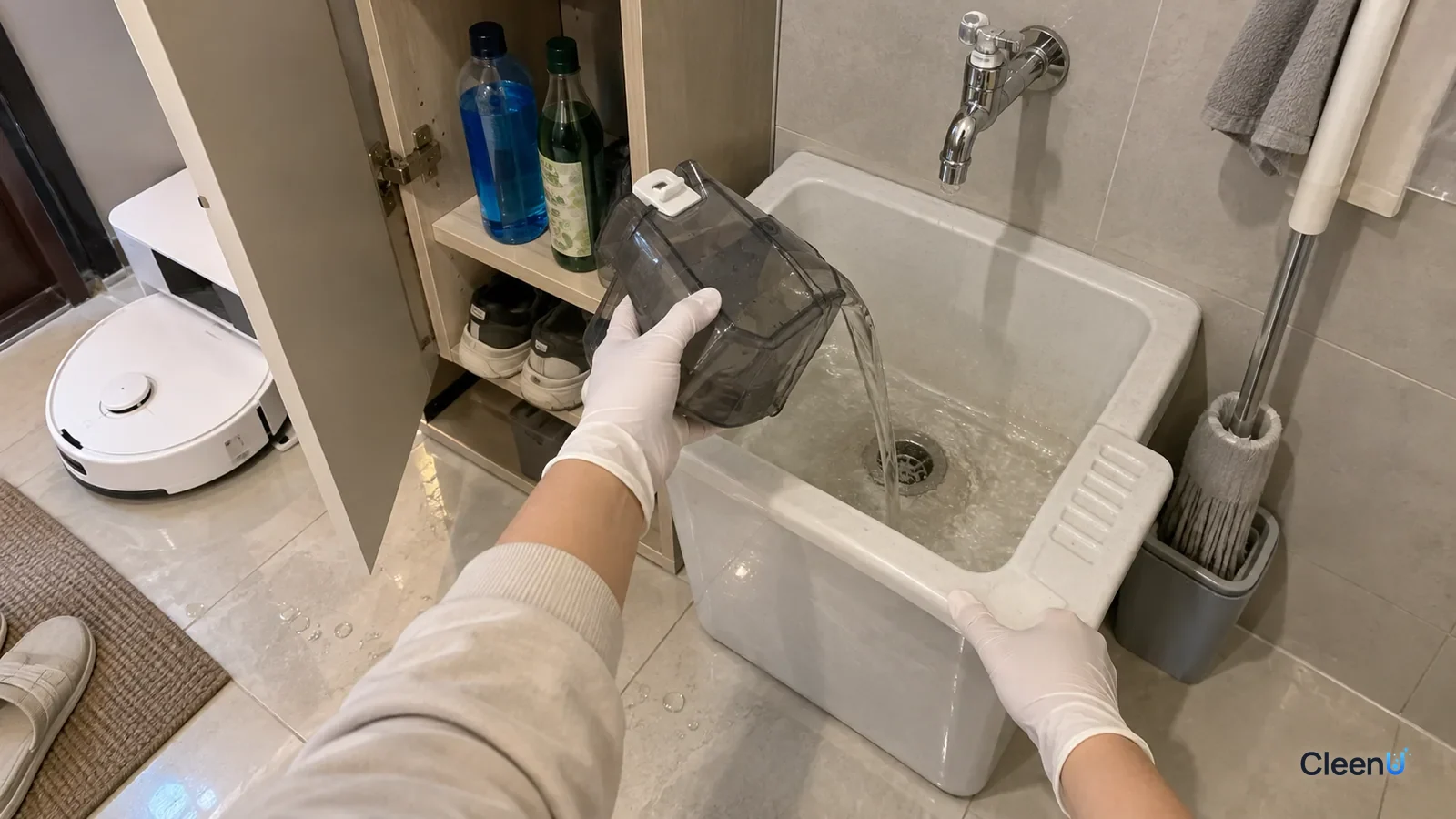
People usually reach for these for one of three reasons. Alcohol disinfects. A scented spray should make the house smell fresh. Glass cleaner leaves windows streak-free, so floors should shine too. All three ideas make sense on the surface, and none of these liquids belongs in a robot mop. What they share is a high load of alcohol solvents, and many add fragrance oils, dyes, or other solvents. A robot mop's clean tank, pump, seals, and tubing are designed for water plus a small amount of cleaning solution. Long contact with alcohols and fragrance oils can swell and soften some rubbers and crack some plastics where they're under stress. You see it later as leaks, uneven water flow, and odd smells.
Here's the plan for this guide. First, what each liquid actually is. Then which materials it touches inside the robot, the chemistry of what happens, and what it does to your floors and household. Finally, what to do instead when you want to disinfect, deodorize, or protect a robot from the cold, and how to clean up if you've already used one of these.
What these liquids actually are
Rubbing alcohol. In the US, that usually means 70% or 91% isopropyl alcohol, though ethanol versions exist too, and disinfecting wipes are soaked in similar solutions. It's alcohol plus water, it evaporates fast, and at full strength it's flammable at room temperature. Its germ-killing power depends on high concentration and contact time. Diluted into a liter or two of tank water, it's far below the range where it disinfects, so you keep the solvent side effects and lose the benefit.
Glass cleaner and windshield washer fluid. These are two different products. Household glass cleaner is typically water with isopropyl alcohol or ethanol, a glycol ether solvent, a little surfactant, and in some formulas ammonia. Windshield washer fluid is mostly water with an alcohol, a trace of surfactant, and dye; many US washer fluids, especially winter blends, use methanol as the antifreeze. Both are built to spray on, wipe off, and flash away, and they avoid streaks because the solvent evaporates quickly.
Scented alcohol sprays. Florida water, body sprays, and many room sprays are mostly ethanol carrying fragrance. Fragrance blends commonly include terpenes such as linalool and limonene, and some sprays also contain menthol-type cooling agents, insect-repellent ingredients, or dye. Essential oils are concentrated versions of the same terpene chemistry.
The common thread: lots of volatile alcohol, usually fragrance or dye, and none of them designed to sit inside a machine's water path for days.
What the liquid touches inside a robot mop
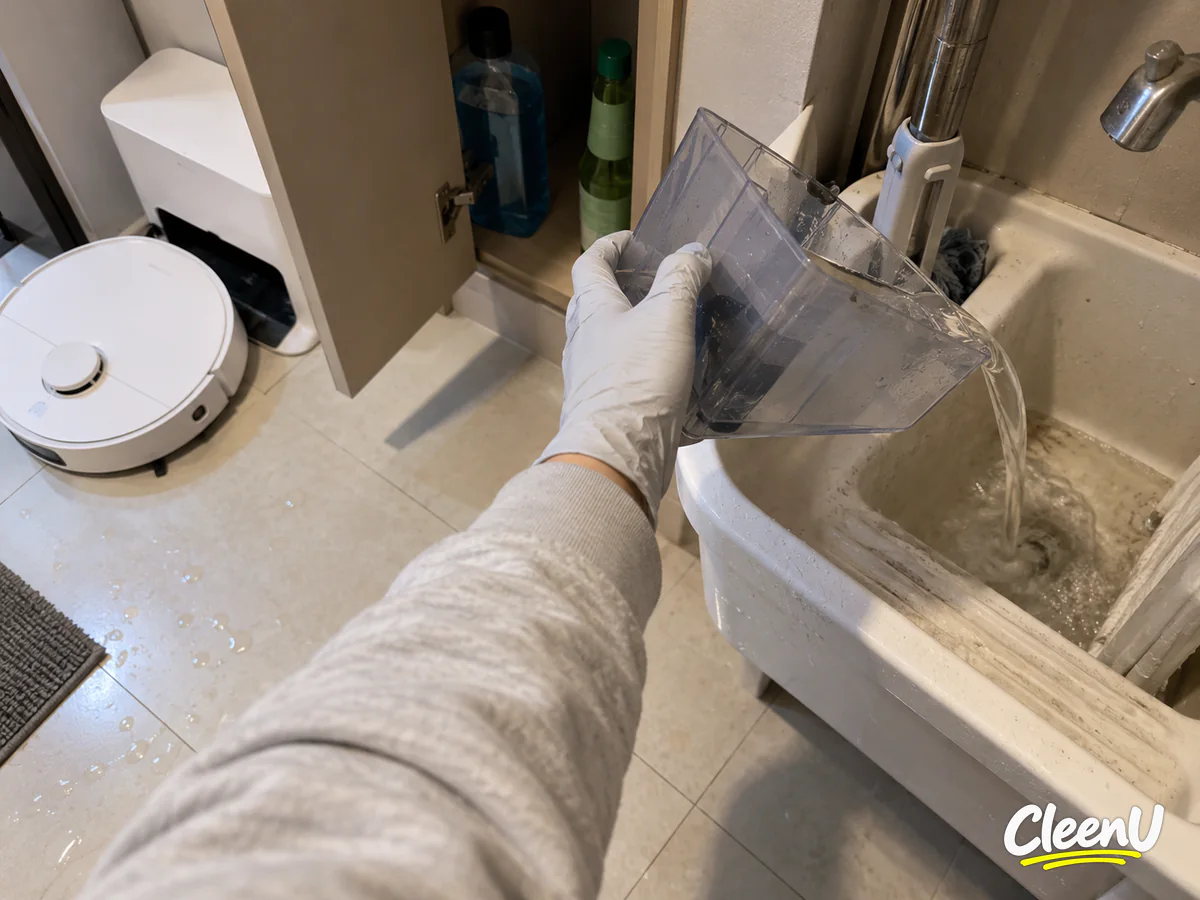
Pour one of these into the clean water tank and it meets several kinds of parts:
- The clean tank and lid, often polypropylene or ABS plastic, sometimes with a clear window. Clear parts are commonly polycarbonate or acrylic.
- Seals at the tank outlet, lid, and connectors, made from rubbers such as silicone, EPDM, or nitrile.
- The pump and tubing: diaphragms in solenoid pumps, and flexible tubing in peristaltic pumps, often silicone.
- Outlets and pad mounts, which are plastic parts with clips and screw bosses under constant load.
- The dock. Some docks wash pads with hot water and dry them with warm air, with heaters, fans, and circuit boards close by.
Liquid often sits in the clean tank for days, and some always stays in the pump and tubing. So the real question isn't whether a quick wipe would hurt anything. It's what happens to these materials after long soaking, repeated wet-dry cycles, and occasional heat.
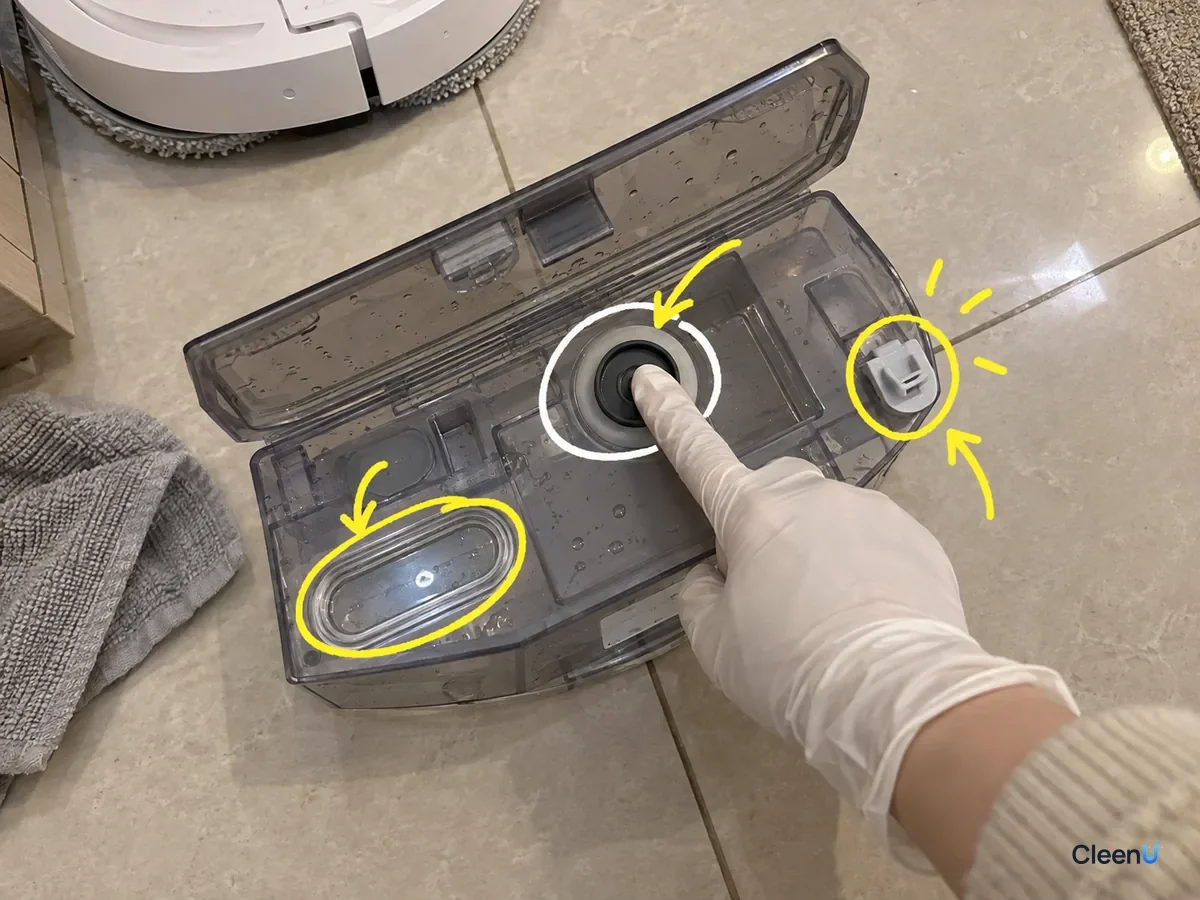
Like dissolves like: why alcohol and fragrance oils deform seals
Rubber is a crosslinked polymer network. A solvent can't dissolve it, but the rubber can absorb a liquid it's chemically compatible with and swell. Materials scientists predict compatibility with solubility parameters: the closer a liquid's value is to the rubber's, the more the rubber soaks up and the more it swells. Water is far from most sealing rubbers, which is why water doesn't hurt them. Alcohols, glycol ethers, and terpene fragrance oils sit much closer to some of them.
The damage happens in two stages. While soaking, the seal grows, softens, and loses strength, and compressed areas can deform. When the liquid evaporates, it can carry out plasticizers and other small molecules that were in the rubber. The seal shrinks, hardens, and doesn't spring back, and a joint that used to seal starts to weep. Each soak-and-dry cycle adds to the change.
Different rubbers react very differently. Published compatibility guides agree on a broad pattern: EPDM handles alcohols fairly well but swells noticeably in terpenes like limonene and in oils; silicone is sensitive to many solvents and fragrance oils; nitrile resists oils but handles some alcohols and glycol ethers only moderately. A scented alcohol spray contains both alcohol and terpenes, so it probes the weak spots of several rubbers at once. One robot can use different rubbers in different places, and owners have no way of knowing which. The safest rule is to keep these liquids out of the water path entirely.
To be fair about it, diluting alcohol in the tank makes it much weaker than straight from the bottle. Two things keep the risk real: people trying to "disinfect" often pour in a lot, and the liquid sits in the tank and pump for days, so the seals stay soaked.
How alcohols and fragrance oils lead to a leaking seal
- Alcohols, glycol ethers, and terpene fragrances have solubility parameters close to some rubbers
- The rubber absorbs them, swells, softens, and deforms where it's compressed
- As the liquid evaporates, plasticizers and small molecules leave the rubber with it
- The seal shrinks, hardens, and loses its spring
- After several wet-dry cycles, joints weep, or pump diaphragms and tubing perform worse and flow becomes erratic
Crazed clear parts: stress cracking and heat
Plastic parts fail in a different way, called environmental stress cracking. Injection-molded parts carry built-in stress, and clips, screw bosses, and connectors are loaded once assembled. Some liquids can't dissolve a plastic but can work their way between polymer chains in those stressed areas, letting the chains slip. Fine hairline marks called crazes appear, and they can grow into cracks. Clear plastics such as acrylic and polycarbonate are known to be sensitive to alcohols; at a stressed point, alcohol contact often shows up as whitening and tiny lines. A cracked tank window or connector means a leak.
Heat amplifies all of this. Some docks wash pads in hot water and dry them with warm air, and warm materials swell and stress-crack faster. Alcohol also evaporates faster when warm, and the vapor lingers in a semi-enclosed dock. Straight rubbing alcohol has a flash point below room temperature. Dilution raises it a lot, but there's no good reason to put a flammable solvent into an appliance with a heater, fan, and circuit boards.
Terms used here
- Swelling
- Volume growth and softening when crosslinked rubber absorbs a liquid; often followed by shrinkage and hardening once the liquid evaporates.
- Solubility parameter
- A measure of the attractive forces between molecules. The closer a liquid's value is to a material's, the more of it the material absorbs.
- Environmental stress cracking
- Crazing and cracking that appear when plastic under stress contacts certain liquids, even ones that can't dissolve it.
- Flash point
- The lowest temperature at which a liquid's vapor can ignite. The lower it is, the more flammable the liquid.
What it does to floors: oil finishes and floor wax suffer most
A robot mop spreads tank liquid across the floor, so the alcohol works on your floor's top layer too:
- Oil- or wax-finished hardwood: the surface is plant oil and wax, and alcohol can dissolve part of that layer, leaving whitish, dull, or streaky paths.
- Polyurethane-finished hardwood and laminate: most modern finishes tolerate brief contact with dilute alcohol, but repeated alcohol mopping can dull edges and seams, and fragrance and dye collect in the gaps.
- Vinyl or luxury vinyl plank with acrylic floor polish: alcohol softens the polish film, which dries hazy or tacky in patches.
- Tile: glazed tile isn't bothered by alcohol, but dyed washer fluid and colored sprays can tint light grout, and fragrance residue helps grout attract dirt.
That's why a robot mop solution should be neutral and solvent-free. A machine that roams the whole house needs one liquid that's gentle on wood, tile, and vinyl alike.
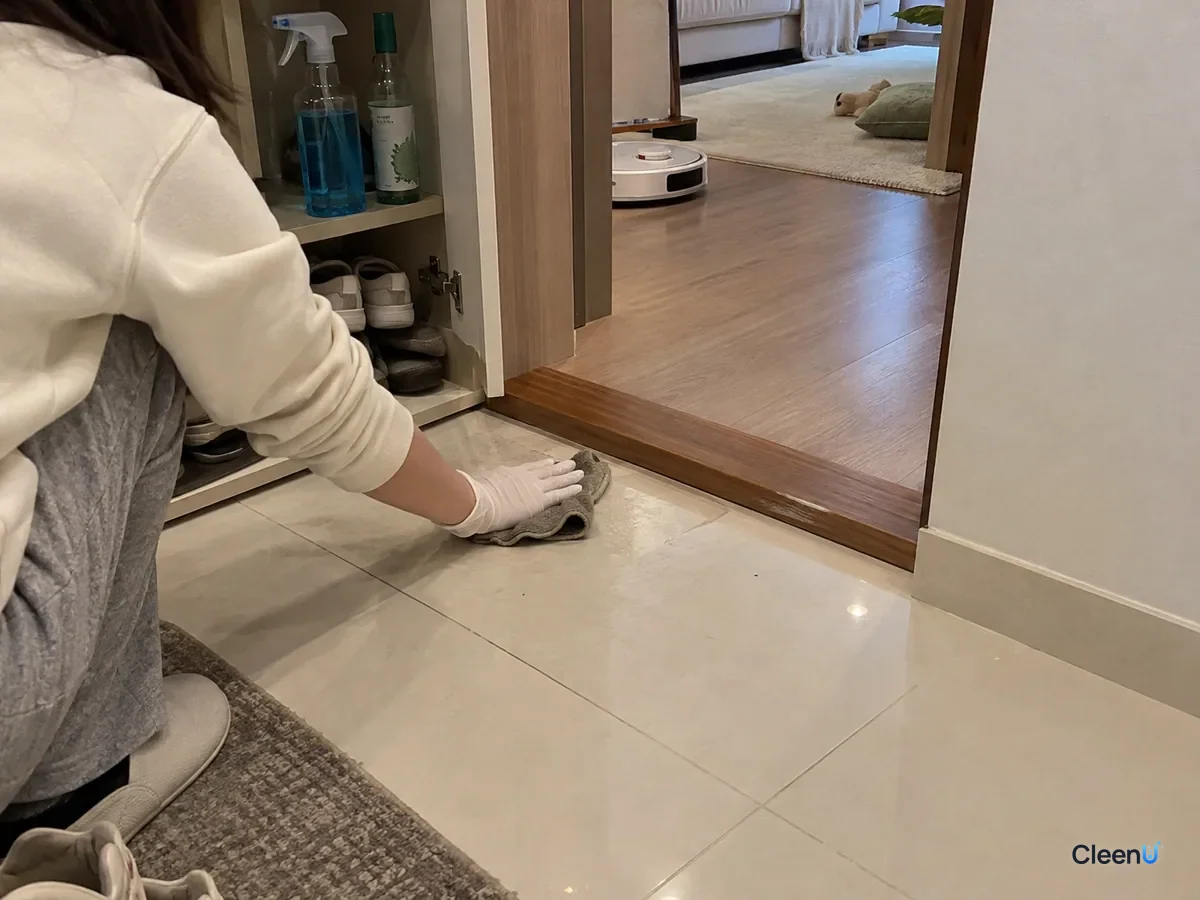
Safety and smell: methanol, fragrance, and pets
Methanol. Many windshield washer fluids contain methanol, which is toxic and can be absorbed through the lungs and skin. Spreading it as a thin film on an indoor floor and letting it evaporate is the opposite of what it's designed for. Washer fluid belongs on the outside of a windshield.
Fragrance and skin sensitivity. Terpene fragrance ingredients like limonene and linalool slowly oxidize in air, and some of their oxidation products are well-known skin sensitizers. Floor residue ends up on bare feet, crawling kids, and paws.
Pets. Cats metabolize some essential-oil compounds poorly. In cat households, avoid mopping with essential oils or scented alcohol sprays.
Smell stacking. Fragrance doesn't cover the odor from a dirty tank or mop pads. The two blend into something worse. Odor has to be fixed at the source.
Want to disinfect, deodorize, or winterize? Do this instead
To disinfect, clean first, then disinfect. Dust and grease use up disinfectant and block it from reaching the surface. For everyday mopping, a robot mop cleaning solution diluted per the label does the job. When a specific spot really needs disinfecting, such as where someone was sick or a pet threw up, use a product whose label allows use on floors, follow its dilution and contact time by hand, then wipe with water. Keep it out of the robot. Robot mop solution is a cleaner, not a disinfectant.
To deodorize, look at where the smell comes from. Most post-mopping odor comes from dirty water sitting in the dirty tank, mop pads, and wash tray, not from the floor. Empty and rinse the dirty tank after every run, wash and dry the pads, and scrub the wash tray regularly. That beats any fragrance. Pet households can use a fragrance-free solution with an odor neutralizer.
To winterize, you don't need antifreeze. A robot mop is an indoor appliance. If it will sit in an unheated room or travel in the cold, empty the clean tank, dirty tank, and any solution compartment, rinse them, and let them dry. Don't add washer fluid or alcohol.
To shine, skip glass cleaner. Its streak-free trick is fast solvent evaporation, which doesn't make floors shinier. Hazy floors usually mean more solution than the label calls for, or hard water; mix at the label ratio (about 1:50 to 1:100) and do one plain-water pass.
Already added it? Clean up and check for damage
After alcohol, glass cleaner, or a scented spray, work through this
- Stop mopping, send the robot back to the dock, and work in a ventilated area
- Empty the clean water tank, rinse it two or three times, and leave it open to dry
- Empty and rinse the dirty water tank; if your dock has a solution compartment, empty and rinse it too
- Fill the clean tank with plain water and run one or two manual mop-wash cycles to flush the lines
- Hand-rinse the mop pads and let them dry; replace pads that still smell strongly
- Mop once with plain water and check oil-finished or waxed floors for whitish marks once dry
- Inspect the tank outlet seal: is it soft, swollen, or tacky, or visibly different from new?
- Inspect clear windows and clips for whitening or fine lines, and look for water marks under the tank
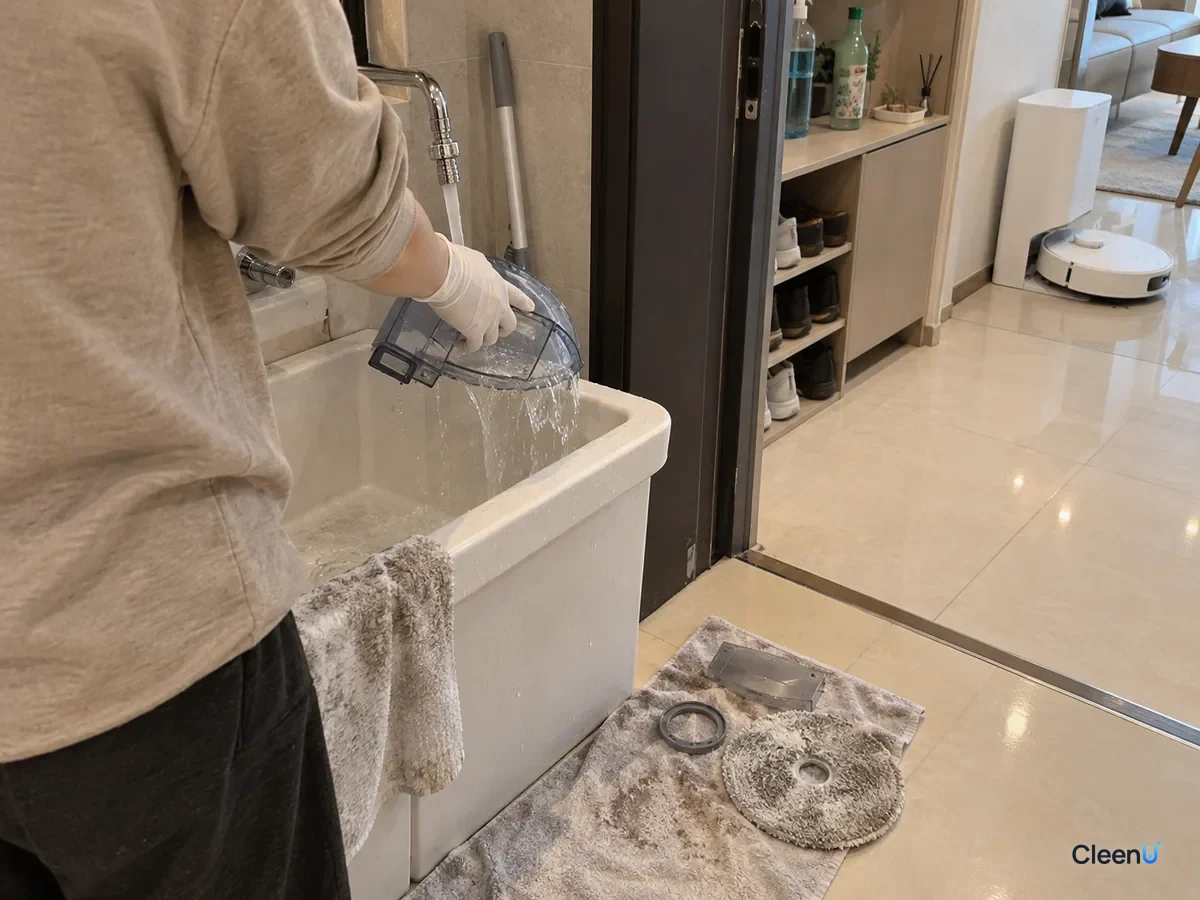
A small amount used once or twice usually leaves no lasting harm after that cleanup. If it went on for weeks, or you poured in half a bottle, inspect more carefully.
Stop and contact the robot maker if you find any of these
Stop if seals are clearly soft, swollen, tacky, or cracked; clear windows or connectors show whitening, crazing, or cracks; water appears under the tank, the robot, or the dock base; water flow drops, stutters, or triggers errors; or you smell something sharp or burning while the dock heats or dries. Don't replace internal tubing or pumps yourself. Contact the manufacturer's support as your manual directs.
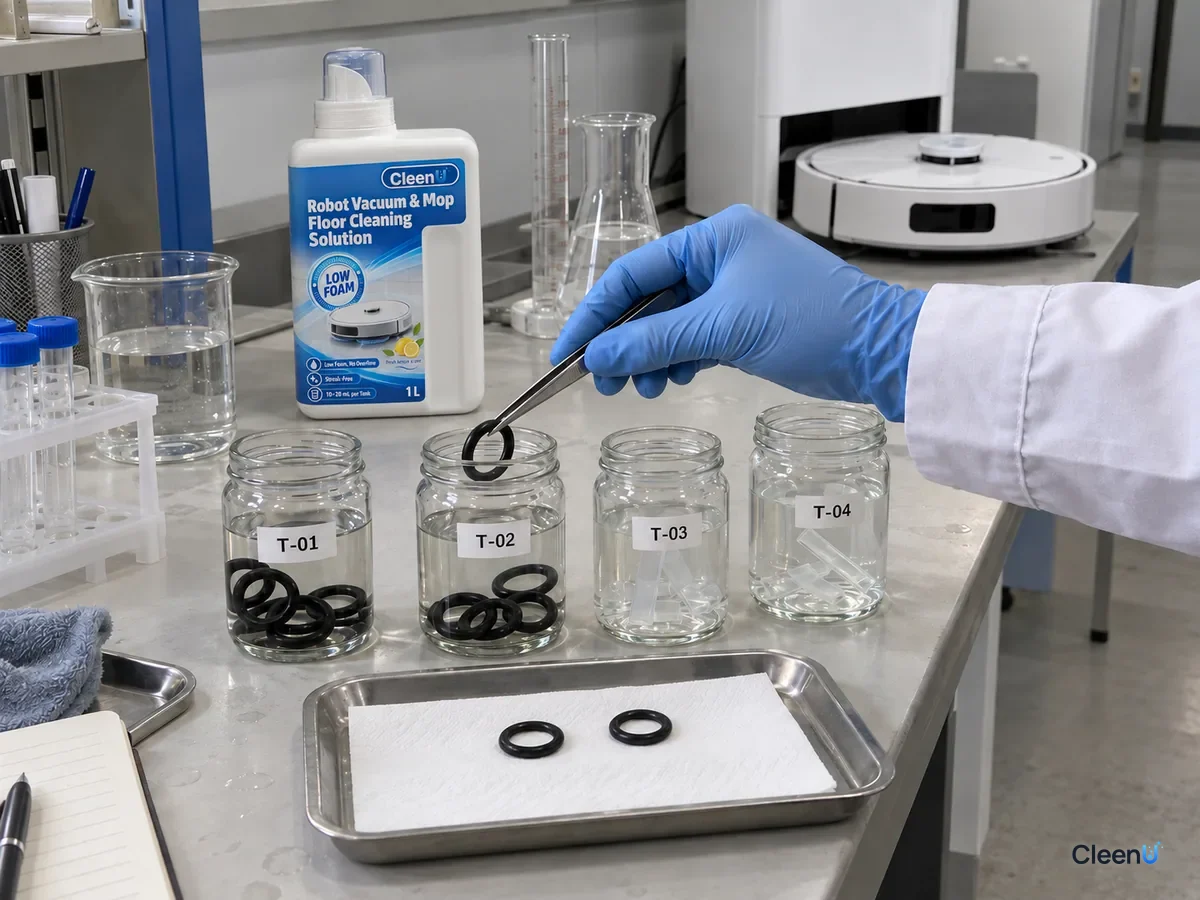
What to use instead: a solution chosen for material compatibility
A big part of what makes a robot mop solution "dedicated" is material compatibility. CleenU Robot Mop Cleaning Solution is a neutral concentrate, pH 6.5–7.5 as a concentrate, built on low-foam nonionic surfactants with a defoamer. It's solvent-free and contains no optical brighteners, wax, chlorine, particles, quats, or phenols, and its viscosity suits dock auto-dosing compartments. Each 1 L (about 34 oz) bottle comes with a measuring cap and dilutes about 1:50 to 1:100; 10 to 20 mL per fill is usually enough. The standard version has a lemon scent. The Pet Homes version is fragrance-free, with no added fragrance, and uses a cyclodextrin-based odor neutralizer. It cleans dust film, greasy footprints, and everyday soil. It isn't a disinfectant.
You can use it in most Roborock, iRobot Roomba Combo and Braava, Ecovacs Deebot, Dreame, Shark, and Eufy RoboVac robot mops, as well as Tineco and Bissell CrossWave wet-dry vacuums. Add it to the clean water tank or the designated solution compartment per your manual; on Narwal robots, it goes in the clean water tank. If your model's manual says otherwise, follow the manual. CleenU is not affiliated with these brands; we name them only to describe compatibility.
If you want a neutral, low-foam solution made for a robot's water path, take a look at our Robot Vacuum & Mop Floor Cleaning Solution.
Alcohol, glass cleaner, and scented sprays in a robot mop: common questions
Can I add rubbing alcohol to the tank to disinfect it?
No. Diluted in the tank, it's far below disinfecting strength, while the alcohol still sits against seals and plastic for days. Disinfect specific spots by hand instead.
I only added a few drops of a scented spray. Is that a problem?
A few drops do little harm and no good. Fragrance won't cover dirty-tank odor and builds up on pads and floors over time, so stop and run one plain-water cycle.
Will alcohol ruin the tank seal?
Rinse everything first; one or two small doses rarely do lasting harm. Then check the seal; if it's soft, swollen, or tacky, stop using the robot and ask support about a replacement.
Why is windshield washer fluid singled out?
Many washer fluids contain methanol, which is toxic and shouldn't evaporate off an indoor floor. Most also contain dye that can tint light grout.
Will glass cleaner make my floors shinier?
No. Glass cleaner avoids streaks by evaporating fast, which doesn't add shine to floors. It can soften floor polish on vinyl and leave a haze.
My oil-finished wood floor turned whitish after mopping with alcohol. What now?
Stop, wipe the area with a well-wrung cloth and plain water, and let it dry fully. Whitening on an oil or wax finish usually means the finish was dissolved and needs the floor maker's maintenance oil or wax.
Should I add antifreeze if my robot lives in a cold garage?
No. Robot mops are indoor appliances. For cold storage or shipping, empty every tank and compartment, rinse, and let them dry.
The house smells after mopping. Can I add a scented spray?
No. Find the source first. Most odor comes from the dirty tank, pads, and wash tray, and emptying, rinsing, and drying them is what fixes it.
Can I squeeze disinfecting wipes into the tank?
No. Wipe liquid typically contains isopropyl alcohol, ethanol, or quat disinfectants, none of which belong in a robot mop's water path.
Is it OK to mop with essential oils in a home with cats?
Avoid it. Cats metabolize some essential-oil compounds poorly, and floor residue gets on paws and is licked off. A fragrance-free robot mop solution is the safer choice.
What kind of robot mop solution is gentlest on tank seals?
A neutral, low-foam formula with no solvents, chlorine, or acids. Dilute it about 1:50 to 1:100, 10 to 20 mL per fill, and empty and air-dry the clean tank now and then so the seals stay springy.
For vinegar and bleach, see Can you put vinegar or bleach in a robot mop tank? For essential oils and pet deodorizers, see Can you add essential oils or pet odor sprays to a robot mop? To understand cleaning versus disinfecting, read Does robot mop solution disinfect? And for the details of seal testing, see Can robot mop solution damage tank seals and tubing?
Keep rubbing alcohol, glass cleaner, windshield washer fluid, and scented alcohol sprays out of your robot mop. Their alcohols and fragrance oils can swell and harden some seals, crack clear plastic parts under stress, and evaporate faster in heated docks. Some washer fluids contain methanol, fragrance lingers on floors and pads, and oil-finished or waxed floors can turn whitish or hazy. To disinfect, clean first and treat spots by hand. To deodorize, clean the dirty tank and pads. To winterize, empty and dry everything. For everyday mopping, use a neutral, solvent-free robot mop solution at about 1:50 to 1:100, usually 10 to 20 mL per fill.