
How-to
Which Cleaning Solution Can You Use in a Narwal Robot Mop, and Where Does It Go?
Direct answer
Yes. The key is picking the right one and adding it in the right place: a low-foam, neutral, clear formula, diluted about 1:50 to 1:100 in the clean water tank with auto-dispensing off, since Freo cartridges are sealed. Use mixed water the same day.
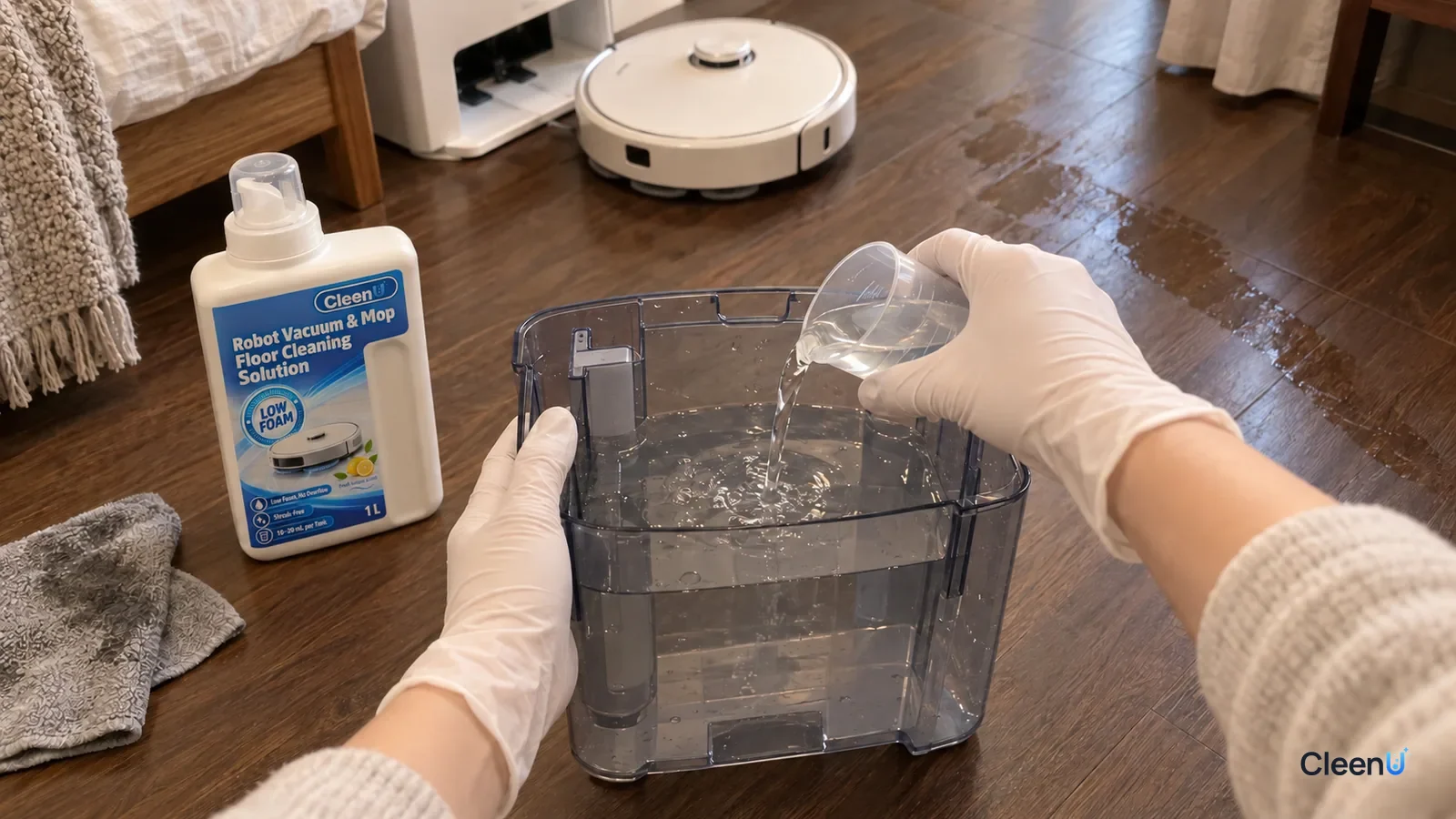
If your Narwal solution has run out, is hard to find, or costs more than you'd like, you can switch. The key is picking the right one and adding it in the right place. Look for five things: low foam that collapses fast; a neutral pH that's gentle on tubing and seals; a formula that stays clear once diluted; no particles or wax, so nothing dries into a film; and no disinfectants. Then add it in one place only: switch off auto-dispensing, dilute about 1:50 to 1:100 in the clean water tank, and mop one room first to check.
What sets Narwal apart from Roborock or Ecovacs is the dock. Those brands use a refillable detergent compartment. Narwal's Freo docks auto-dispense from a sealed, factory-filled cartridge that isn't meant to be refilled, so a third-party solution goes in the clean water tank. This guide is built around that fact, plus two Narwal traits, wash-water dirt detection and wet mops parked in the dock, that make "clear, low-foam, film-free" matter more than usual.
Know your Narwal: the auto-dispensing switch and the clean tank
The Freo, Freo X Ultra, Freo Z Ultra, and Freo Z10 support automatic detergent dispensing from a sealed Narwal cartridge. You turn it on or off in the app under Settings, then Base Station, then "Automatically add detergent." The app doesn't show an exact remaining level; it prompts you when the cartridge runs out. On all of these, the clean water tank lives in the dock and lifts right out for filling.
Narwal machines are precisely built, and mop washing, dirt sensing, and robot refills all run on the same water. That makes the shopping criteria more specific than for a bucket and mop: low foam, gentle on materials, clear once diluted, and no film when dry. The rest of this guide follows those points.
How liquid moves through a Narwal Freo
Here's the rough path water takes through a Freo with a self-cleaning dock:
- Clean water tank (in the dock): holds fresh water. The dock draws from it to wash the mops and to refill the robot.
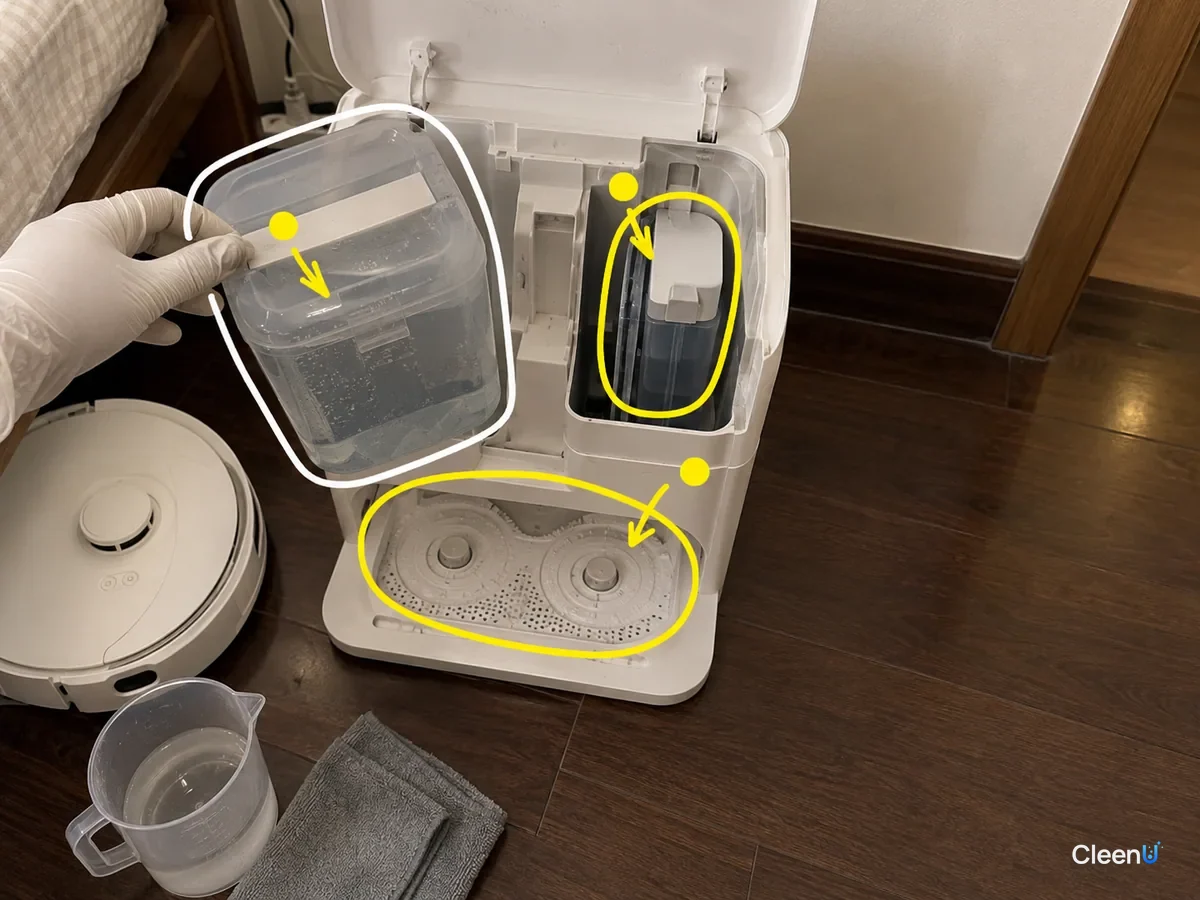
- Auto-dispensing: a sealed Narwal cartridge sits in a dedicated slot. With "Automatically add detergent" on, the dock adds solution to the water while washing the mops.
- Robot and mops: two spinning mop pads carry the water onto the floor and carry soil back.
- Mop washing and DirtSense: the robot returns to wash its mops, and sensors check the water rinsed out of them. Narwal calls this DirtSense. In Freo Mode, dirty wash water sends the robot back to mop the same area again; clear water tells it to move on.
- Dirty water tank: wash water is pumped here until you empty it.
- Parking and drying: clean mops wait in the dock, and models with hot-air drying blow them dry.
In that whole path, a third-party solution has one entry point: the clean water tank. The sealed cartridge isn't meant to be opened, and there's no need to modify it. Some newer Narwal products, such as certain Flow dock versions, use a refillable built-in reservoir instead; follow the manual for those. This guide covers Freo-series docks with the sealed cartridge.
Dosing the clean tank differs from auto-dispensing in two ways: you set the concentration, with no second dilution in the dock, and the whole tank carries solution for both mop washing and robot refills. So measure carefully, and turn auto-dispensing off.
Why auto-dispensing has to go off first
This is the step most people miss. If the Narwal cartridge is still dispensing and you add solution to the clean tank too, two doses run at once. They stack, and dark wood shows it first as haze. You also lose track of how much is reaching the floor, so you can't tell which dose is doing what. One entry point keeps the ratio accurate and the results easy to read.
So turn off "Automatically add detergent" first, leave the cartridge in place or store it as the manual describes, then add solution to the clean tank. Don't pour leftover Narwal solution into the tank to use it up.
DirtSense reads the wash water, so your solution should be clear and low-foam
This is where Narwal differs most from other brands, and it's the point people overlook when shopping.
According to Narwal, DirtSense checks the water rinsed out of the mops when the robot returns to the dock. Sensing like this is typically optical: the sensor measures how much light the water blocks or scatters, so more suspended dust and soil reads as dirtier. But an optical sensor can't tell soil apart from anything else that blocks light. Based on how optical sensing generally works, three things could make wash water read dirtier than it really is:
- Foam and microbubbles. Bubble surfaces scatter light strongly. Mop washing is turbulent, and a high-foaming solution leaves lots of tiny bubbles in the water, which look cloudy to a sensor.
- Clouding above the cloud point. Nonionic surfactants come out of solution as tiny droplets when the water is warmer than their cloud point, and the liquid turns hazy. That haze has nothing to do with dirt, but it scatters light the same way.
- Products that are cloudy or strongly colored to begin with. Formulas with opacifiers, pearlizers, or dark dyes aren't transparent even when diluted.
When readings run high, a robot in Freo Mode goes back over the same area more often, using more water and time. A clear, low-foam solution keeps the reading close to how dirty the floor really is, so re-mopping happens where it's needed.
So for a Narwal, add one item to the usual "low-foam, neutral" checklist: the solution should be clear once diluted, and its foam should collapse fast.
Why mop-wash water can read dirtier than it is
- The dock rinses the mops, and soil, debris, and cleaning solution all end up in the wash water
- An optical sensor shines light through that water; the cloudier it is, the less light gets through
- Foam and microbubbles scatter light strongly and push the reading up just like soil does
- Nonionic surfactants above their cloud point separate into tiny droplets, which also cloud the water
- A high reading makes a Freo Mode robot more likely to re-mop the same area, using more water without a cleaner floor
- A solution that stays clear and drops its foam quickly keeps the reading closer to how dirty the floor really is
Wet mops parked in the dock: drying controls microbes, not your cleaning solution
After washing, Narwal mops may sit damp in the dock for hours. That's the main source of odor, and it often gets blamed on the solution.
Microfiber holds water between its fibers by capillary action (liquid pulled through tiny gaps by surface tension), so a washed pad stays wet, along with skin flakes, crumbs, and oils that didn't rinse out. Water, food, and room temperature are all bacteria need. They attach to fibers and secrete a sticky matrix, a biofilm, that plain water struggles to remove. The smell is their byproducts: sulfur compounds and amines from proteins, rancid short-chain fatty acids from oils.
The cleaning solution has a clear job here: help lift soil off the floor and rinse it out in the dock, so less "food" stays in the pad for bacteria. Once it is diluted 50 to 100 times, a tank of mixed water left standing can start to smell, which is why mixed water should be used the same day.
Adding disinfectant isn't the fix either. Chlorine bleach is used up quickly by organic soil on the pads, and what's left is hard on rubber parts. Quats are cationic and stick to negatively charged fibers, so over time pads absorb less water and floors pick up residue.
What works is leaving less food behind and drying faster:
- Use an easy-rinsing solution without waxes or film-formers, so less stays in the fibers.
- Use hot-air drying. On models that have it, lengthen the drying time in humid weather. On models without it, open the mop area after a run or take the pads out to air-dry now and then.
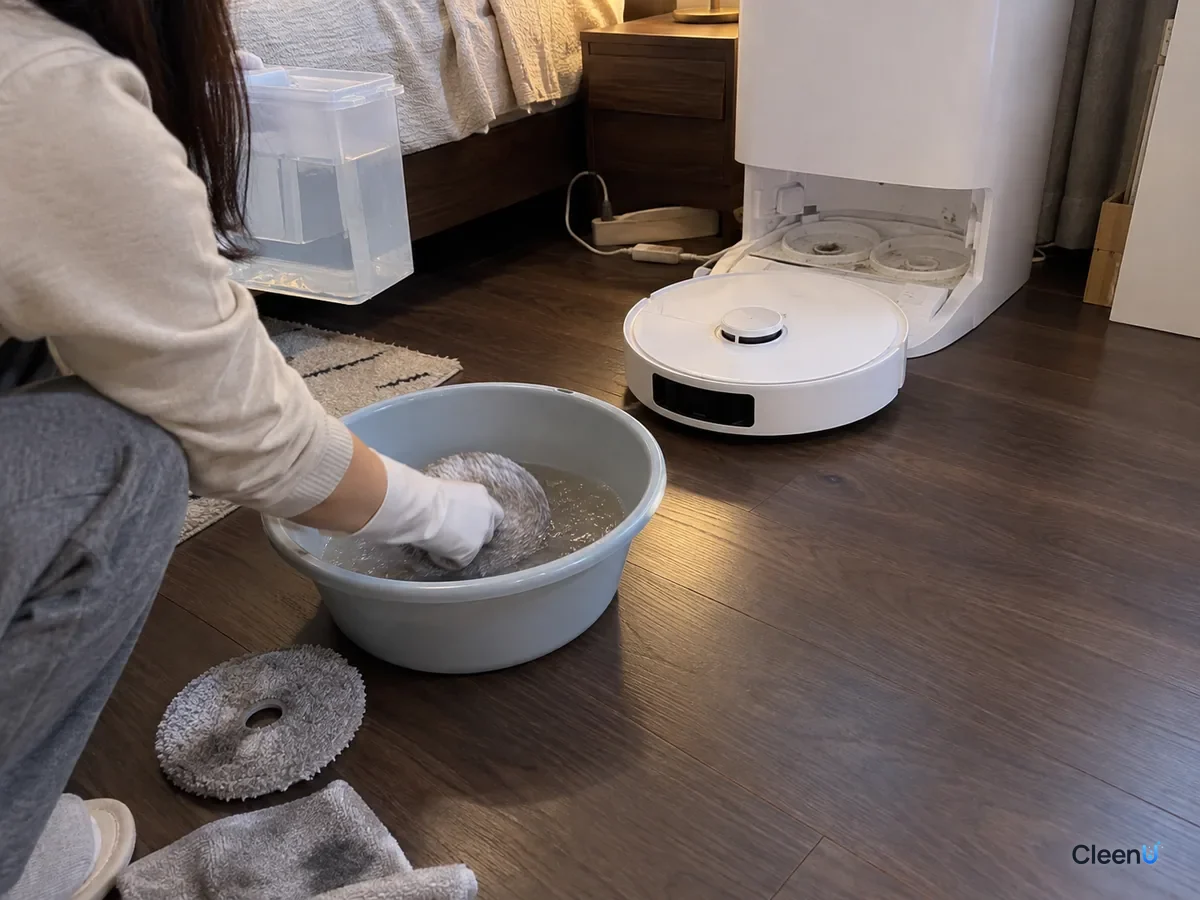
- Hand-wash the pads and clean the wash tray regularly. Scrub slime off the tray, scraper, and pad holders with water and a soft brush.
For more, see How to clean smelly, dark robot mop pads and Black slime and moldy filters in a robot vacuum dock.
Why dark wood floors show residue first
A finished wood floor is sealed on top, but water can seep into the seams and swell board edges, so keep the water flow low on wood. Dark matte or satin finishes are also very sensitive to film. When the working solution dries, whatever was dissolved in it stays behind. Film-forming polymers, waxes, or hard-to-rinse surfactants leave a layer that changes how the finish reflects light. You'd never see it on a light floor; on a dark one it's a cloudy haze that may feel draggy underfoot.
Residue is roughly working concentration times the amount of water film left on the floor. Double the concentration and you roughly double what dries behind. That's the reason to lean toward less when you dose the clean water tank.
For wood floor settings, see Can you use a robot mop on hardwood floors? If your floor already looks cloudy, see Why wood floors look hazy after robot mopping.
How much to add to the clean water tank
CleenU Robot Mop Cleaning Solution dilutes at about 1:50 to 1:100. By water volume:
Dose by clean water volume (about 1:50 to 1:100)
- 1 L (about 34 oz)
- about 10–20 mL
- 2 L (about 68 oz)
- about 20–40 mL
- 3 L (about 101 oz)
- about 30–60 mL
- 4 L (about 1 gal)
- about 40–80 mL
Everyday bedroom dust needs only the low end; greasy footprints can take the high end or a second pass. On dark wood, start low.
You don't need to fill the tank every time. If a run uses half a tank, mix half a tank, use it the same day, then empty, rinse, and mix fresh. That prevents a musty tank far better than running one fill for three days. Auto-dispensing wins on convenience; dosing the tank wins on control, since you can mix less on light days and stay low on wood.
For more on dosing, see How much cleaning solution should you put in a robot mop?
Step-by-step: from switching off auto-dispensing to your first run
App settings, clean water tank, and your first run
App settings
Turn off automatic detergent
Open the Narwal app, go to the Base Station settings, and switch off "Automatically add detergent." Leave the Narwal cartridge in place or remove and store it as the manual describes. Don't pour its contents into the clean water tank.
Caution:If auto-dispensing stays on while you add solution to the tank, the two doses stack and floors tend to look hazy or feel tacky.
Clean water tank
Empty, rinse, and add water
Take out the dock's clean water tank, pour out old water, and rinse the inside. Check the bottom and filter for slimy film. Then add as much water as this run needs; it doesn't have to be full.
Water first, then measured solution
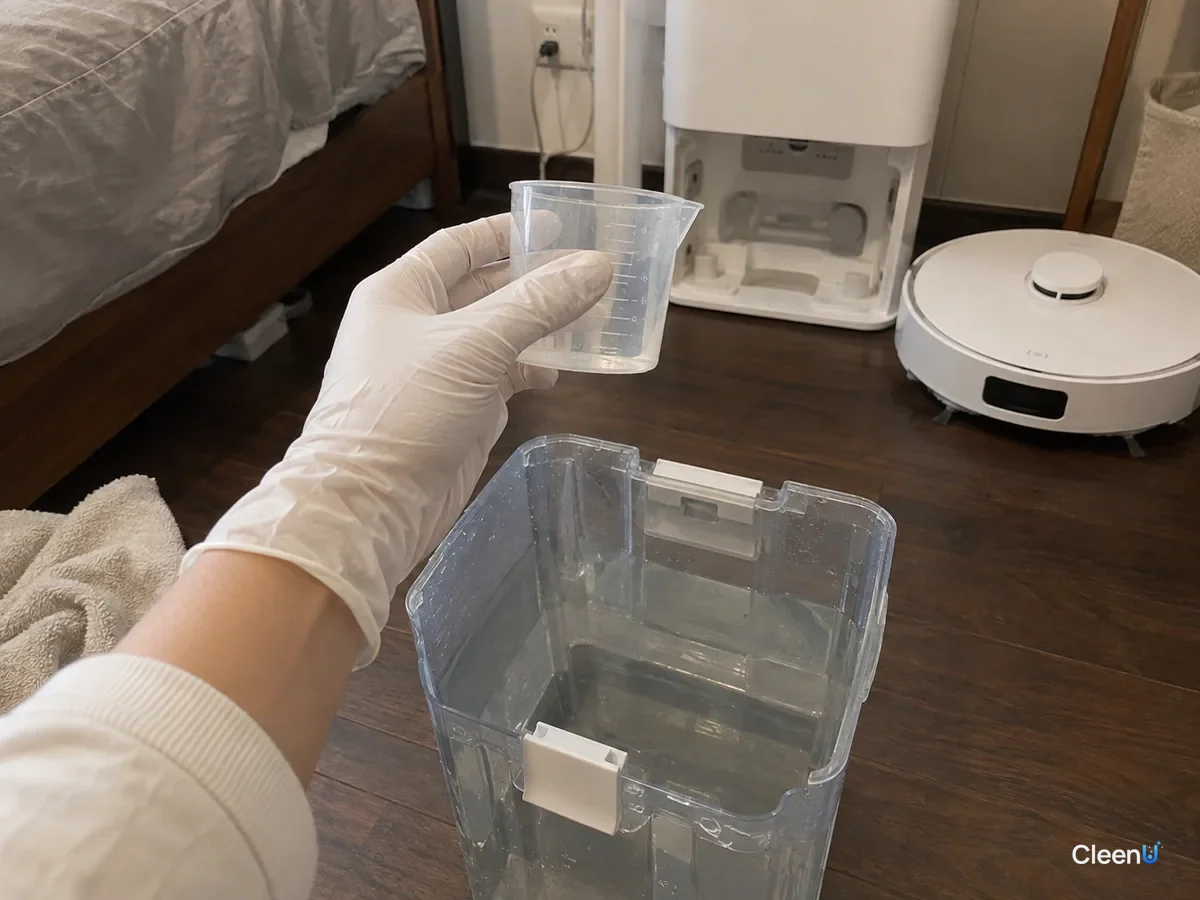
Measure solution with the cap at about 1:50 to 1:100, for example 20–40 mL for 2 L (about 68 oz) of water, using the low end on dark wood. Adding water first keeps foam down. Swirl gently; don't shake.
Caution:Never put solution in the dirty water tank.
First run
Mop one room and check three things
Run one room you use often. Then check whether there's a layer of foam in the dirty tank, whether the robot keeps going back over the same area in Freo Mode, and whether the dark wood looks hazy against window light or feels draggy under bare feet once dry.
Adjust based on what you see
If you see haze, drag, or foam, use less in the next tank. If the robot keeps re-mopping areas that already look clean, check that the diluted solution is clear and its foam drops fast. If all three checks look good, keep that ratio for everyday use.
Routine care
Use mixed water the same day and keep mops dry
Use the mixed tank the same day and remix fresh the next. On models with hot-air drying, keep it on and lengthen it in humid weather. Hand-wash the pads now and then and clean slime off the wash tray.
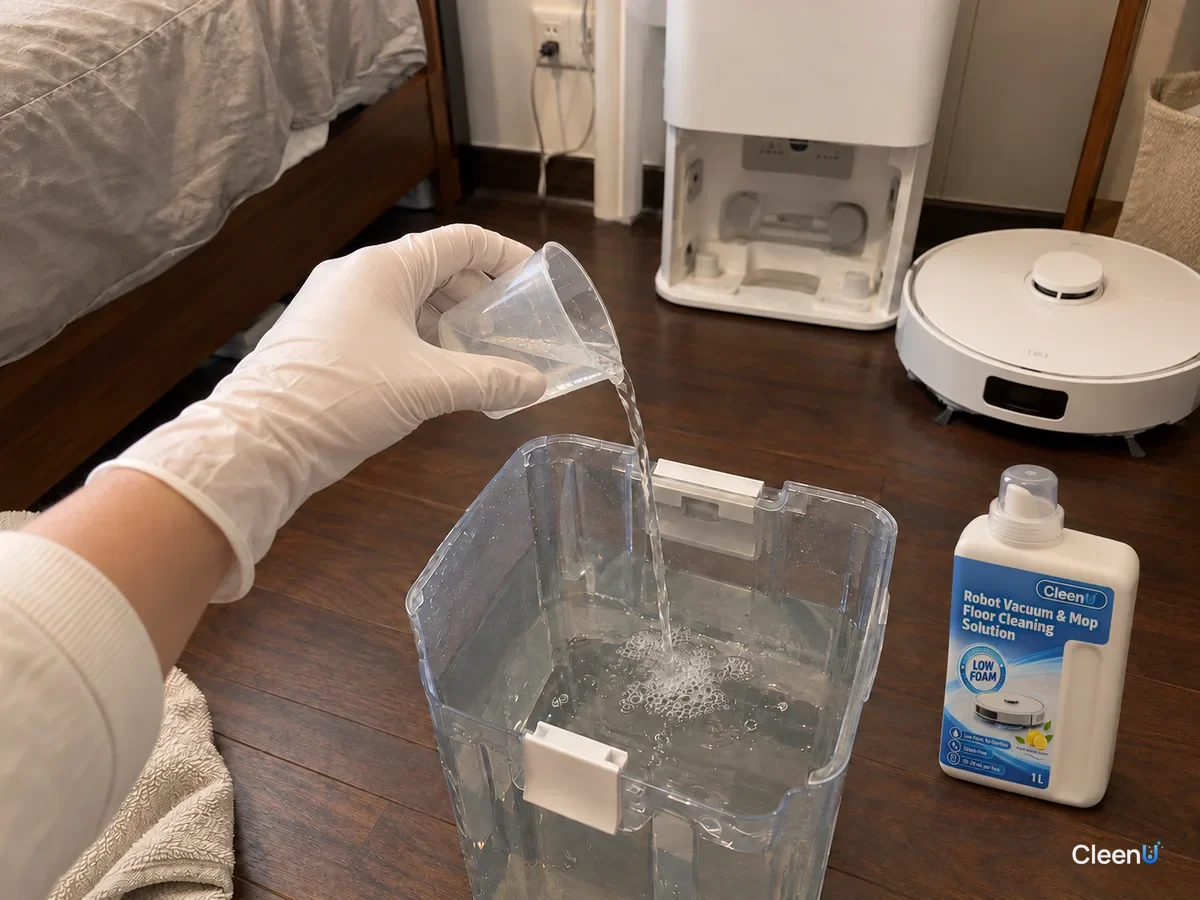
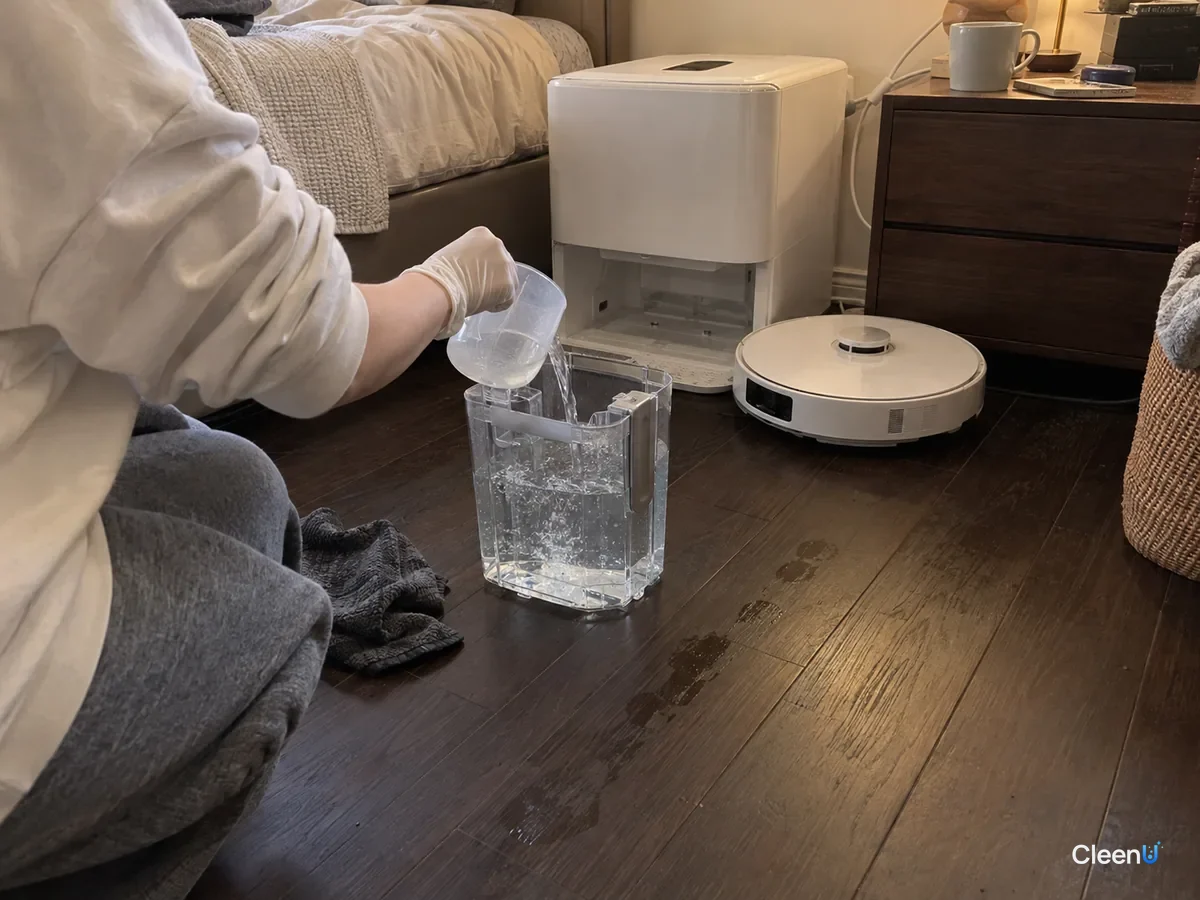
Foam, haze, or repeated re-mopping? Adjust in this order
A layer of foam in the dirty tank, or dark wood that dries hazy or draggy, means too much solution is reaching the floor. Repeated re-mopping of areas that already look clean in Freo Mode usually means the wash water carries too much foam or cloudiness. Step one: confirm "Automatically add detergent" is switched off. Step two: empty the clean water tank, rinse it, wash the mops once, and run one cycle to flush extra solution out of the lines. Step three: remix at the low end and mop one room to check. If re-mopping continues, run the clear-glass test below to see whether the solution stays clear and drops its foam fast, and pick a clearer, lower-foam one if needed.
Two quick home tests before you commit
You don't need lab equipment. Both take about 15 minutes.
The clear-glass test for clarity and foam. Add 2–4 mL of solution to about 200 mL (7 oz) of water in a clear glass and stir hard for 30 seconds to mimic mop washing. Held up to a window, it should look transparent, with fine bubbles that vanish quickly. Repeat with warm (not hot) water to see whether it clouds as it heats. For a full foam method, see How to tell if a robot mop solution is low-foam.
The dark-panel test for residue. On a dark board or a hidden corner of the floor, wipe one patch with working solution and one with plain water. Once dry, look at a low angle. If you can't tell them apart and neither feels draggy, dark wood is unlikely to haze.
One more step makes the clear-glass test closer to real life: add a spoonful of dirty mop water and stir again. A formula that barely foams in clean water foams a little more once it rinses pads loaded with skin flakes and crumbs, and a robot that judges dirt from wash water notices. If it still looks clear and drops its foam fast with dirty water in it, it's an easy fit for a Narwal. Once a solution passes both tests, mix it into the clean tank and mop one room to confirm.
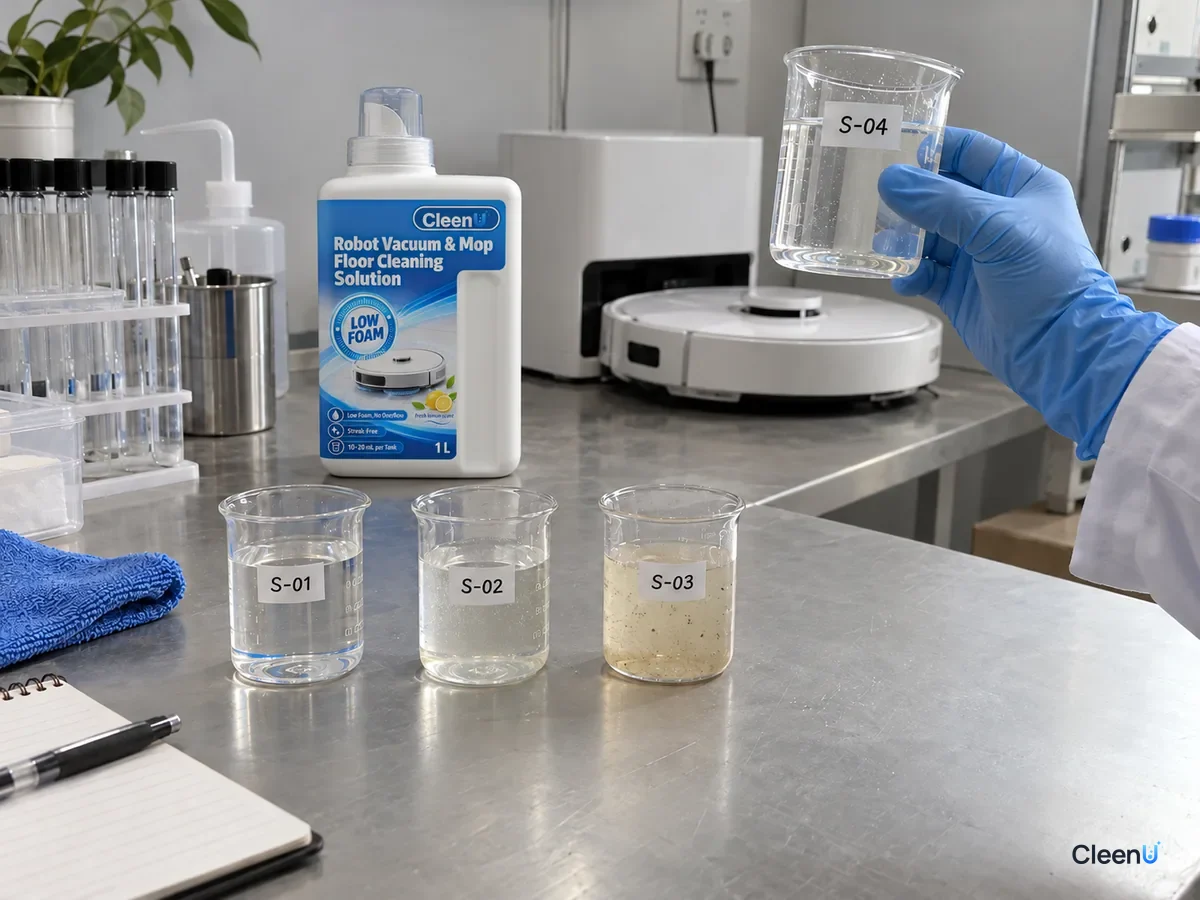
What that looks like in a bottle: CleenU as an example
To see those criteria in an actual product, take CleenU Robot Mop Cleaning Solution. It's a neutral concentrate, pH 6.5–7.5 as a concentrate, built on low-foam nonionic surfactants with a defoamer. It contains no wax, no chlorine, no particles, and no disinfecting ingredients such as quats or phenols. In a Narwal, low foam keeps the dirty tank clear and wash-water readings accurate; neutral and chlorine-free is gentle on tubing and seals; no wax or particles means no film on dark wood and clear filters; no quats means mop fibers stay absorbent. Each 1 L (about 34 oz) bottle comes with a measuring cap and dilutes about 1:50 to 1:100; 10 to 20 mL per fill is usually enough. When you dose the clean tank yourself, that cap is what keeps the concentration right. The standard version has a lemon scent. The Pet Homes version is fragrance-free and uses a cyclodextrin-based odor neutralizer for pet odors, a good pick for a bedroom if you're sensitive to scent. It's a cleaning solution that lifts dust film, footprints, and everyday soil, not a disinfectant. In a Narwal it goes in the clean water tank at about 1:50 to 1:100. It works with most Narwal models and most robot mops and wet-dry vacuums from Roborock, iRobot (Roomba Combo, Braava), Ecovacs Deebot, Dreame, Shark HydroVac, Eufy RoboVac, Tineco, and Bissell CrossWave. CleenU is not affiliated with these brands; brand names are used only to describe compatibility.
If you want a low-foam, neutral solution to mix into your Narwal's clean water tank, take a look at our Robot Vacuum & Mop Floor Cleaning Solution.
Common mistakes to avoid
Opening or drilling the sealed cartridge. It isn't designed for refilling, and modified cartridges can leak and dose inaccurately. Dosing the clean tank is simpler.
Adding disinfectant, vinegar, or rubbing alcohol to the tank. Chlorine disinfectants can harden rubber parts. Vinegar can corrode metal parts over time, and alcohol can swell some rubbers. See Can you put vinegar or bleach in a robot mop tank?
Running one mixed tank for days. See Why a robot vacuum's clean water tank smells musty.
Switching cleaning solution in a Narwal: common questions
Can I use a third-party cleaning solution in my Narwal?
Yes, if you pick the right one and add it in the right place: a low-foam, neutral formula that stays clear once diluted and has no disinfectants, mixed about 1:50 to 1:100 into the clean water tank with "Automatically add detergent" switched off. Don't refill the sealed Freo cartridge.
Can I refill the Narwal auto-dispensing cartridge with another solution?
No. Freo-series docks use a sealed Narwal cartridge that isn't designed for refilling, and we don't recommend modifying it. Put a third-party solution in the clean water tank only.
Do I need to turn off automatic detergent if I add solution to the clean water tank?
Yes. Switch off "Automatically add detergent" in the Base Station settings. Otherwise the two doses stack, and floors tend to look hazy or feel tacky.
How much solution should I add to a Narwal clean water tank?
For CleenU Robot Mop Cleaning Solution, about 1:50 to 1:100: 10–20 mL per liter (about 34 oz) or 20–40 mL per 2 L. Use the low end for routine mopping and on dark wood.
After switching solutions, my Narwal keeps re-mopping the same spot. What should I check first?
Check whether the diluted solution is clear and its foam collapses quickly. Foam or cloudiness in the wash water pushes dirt readings up. Drop to the low end, or pick a clearer, lower-foam product, then watch again.
How long can mixed water stay in the clean water tank?
Use it the same day. Diluted solution can't protect itself, so a tank left for days tends to turn musty and slimy. Empty it, rinse, and mix fresh.
My Narwal mops smell. Will a different cleaning solution fix it?
Drying and cleaning fix it. Mop odor comes from bacteria breaking down residue while pads sit damp, so hand-wash the pads, clean the wash tray, and keep hot-air drying on and longer; an easy-rinsing solution that leaves less in the pad helps too.
Can I put disinfectant in a Narwal clean water tank?
Don't. Chlorine can harden rubber parts, and quats build up on mop fibers and reduce absorbency. Disinfect specific spots by hand if you need to.
My dark wood floor looks hazy after mopping. Is it the solution?
Most often it's too high a concentration, or auto-dispensing left on and doubling up. Turn it off, drop to the low end, and compare with one plain-water pass. If it's still hazy, switch to a lower-residue product.
Which Narwal models does CleenU Robot Mop Cleaning Solution work with?
It works with most Narwal models; compatibility testing used about 1:50 to 1:100 in the clean water tank, the same method this guide recommends. If your model's manual says otherwise, follow the manual.
For more on where solution goes, see Where to put cleaning solution in a robot vacuum.
You can switch cleaning solutions in a Narwal; the key is working with the dock's design. Freo cartridges are sealed, so turn off automatic detergent and dilute about 1:50 to 1:100 in the clean water tank. Because a Narwal judges dirt from its wash water and parks wet mops in the dock, choose a solution that's low-foam, neutral, clear once diluted, film-free, and free of disinfectants. Use mixed water the same day, and keep pads clean and dry. Mop one room first, check the dirty tank, the robot's re-mop behavior, and the shine on your dark wood, and if all three look right, make it your routine.