
How-to
Using a Third-Party Cleaning Solution in an Ecovacs Deebot Auto-Dosing Dock
Direct answer
Yes. The key is adding it the right way: concentrate in the dock's compartment, below the outlet, with auto-adding on in the app, or about 1:50 to 1:100 in the clean tank if there's no compartment. Never use both.
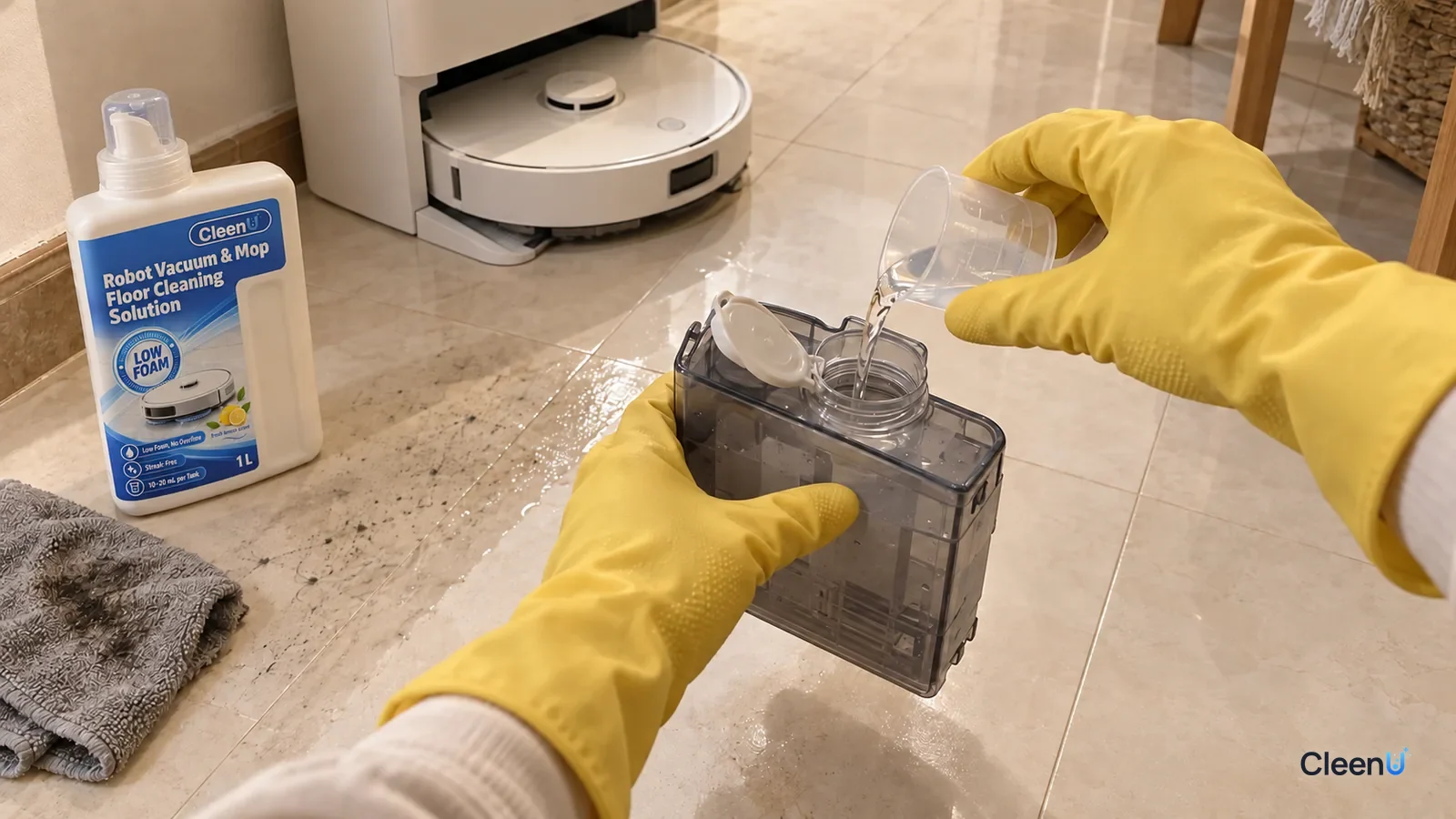
Yes, you can use a third-party cleaning solution in an Ecovacs Deebot. The key is picking the right one and adding it in the right place. On models with automatic solution adding, you pull the cleaning solution unit out of the dock's dust collection area, open its lid, pour in concentrate without letting the level go above the dispensing outlet, put it back, and turn on Auto Cleaning Solution Adding in the app. On models without that feature, you mix solution into the clean water tank at the ratio on your bottle. When you shop, look for three things: low foam, a neutral pH, and a concentrate that still flows when it's cold.
Two things make a Deebot worth its own guide. The solution compartment and its "not above the outlet" rule decide how a concentrate should go in. And newer Deebots often pair a roller mop with temperature-controlled mop washing in the dock, so scrubbing and heat already do much of the work. That changes what the solution needs to do. Below, we cover how to fill the dock and how to read dilution ratios, then the hardware, how the roller and hot water split the work, a step-by-step fill, and three quick home tests.
How a Deebot takes solution: concentrate in the compartment, mixed solution in the clean tank
The Ecovacs US help center keeps its fill instructions short:
- Auto-adding models: pull out the cleaning solution unit from the dust collection area, open the lid, fill it with the level below the dispensing outlet, reinstall it, and turn on Auto Cleaning Solution Adding in the app.
- Models without auto-adding: mix solution into the clean water tank. Ecovacs lists 1:200 for its own solution.
- To tell which kind you have, open the dust collection area and look. The next section shows what to look for.
The same routine works for a third-party solution. Concentrate only goes in the compartment, kept below the outlet. Without a compartment, dilute in the clean tank at the ratio printed on the bottle you're using.
Why you can't compare dilution ratios at face value
People often ask whether 1:200 for Ecovacs solution versus 1:50 to 1:100 for many third-party concentrates means the third-party bottle runs out faster. You can't compare those numbers directly. A ratio only tells you how much water to add. It says nothing about how concentrated the bottle is. What decides cleaning power is how much active ingredient is left in the tank after you mix. The math is simple:
In-tank strength ≈ active surfactant content ÷ dilution ratio
Run a few numbers through it. Many robot mop solutions on the market carry about 2% active surfactant. At 1:200 that leaves about 0.01% in the tank, and at 1:500 only about 0.004%. CleenU Robot Mop Cleaning Solution carries 15% active surfactant, so at 1:100 it still leaves about 0.15%. That's about 15 times the first case and nearly 40 times the 1:500 case. The 2% figure is a typical level used for illustration, not any particular brand. Every concentrate is different, so a bigger ratio doesn't automatically mean a better deal, and a smaller one doesn't mean a worse one.
Compare in two steps. First, ask for the active content and do the division above. Then mix each product at its own label ratio, mop the same floor, and judge how clean it gets, how much foam shows up, and how the floor feels once it dries. For cost, divide the bottle price by the number of fills. At 10 to 20 mL (2 to 4 tsp) per fill, a 34 oz (1 L) bottle covers roughly 50 to 100 fills.
Which Deebot do you have? Check the compartment, then the mop
Where solution goes depends on the dock. How much work the solution does depends on the mop. You can check both at home.
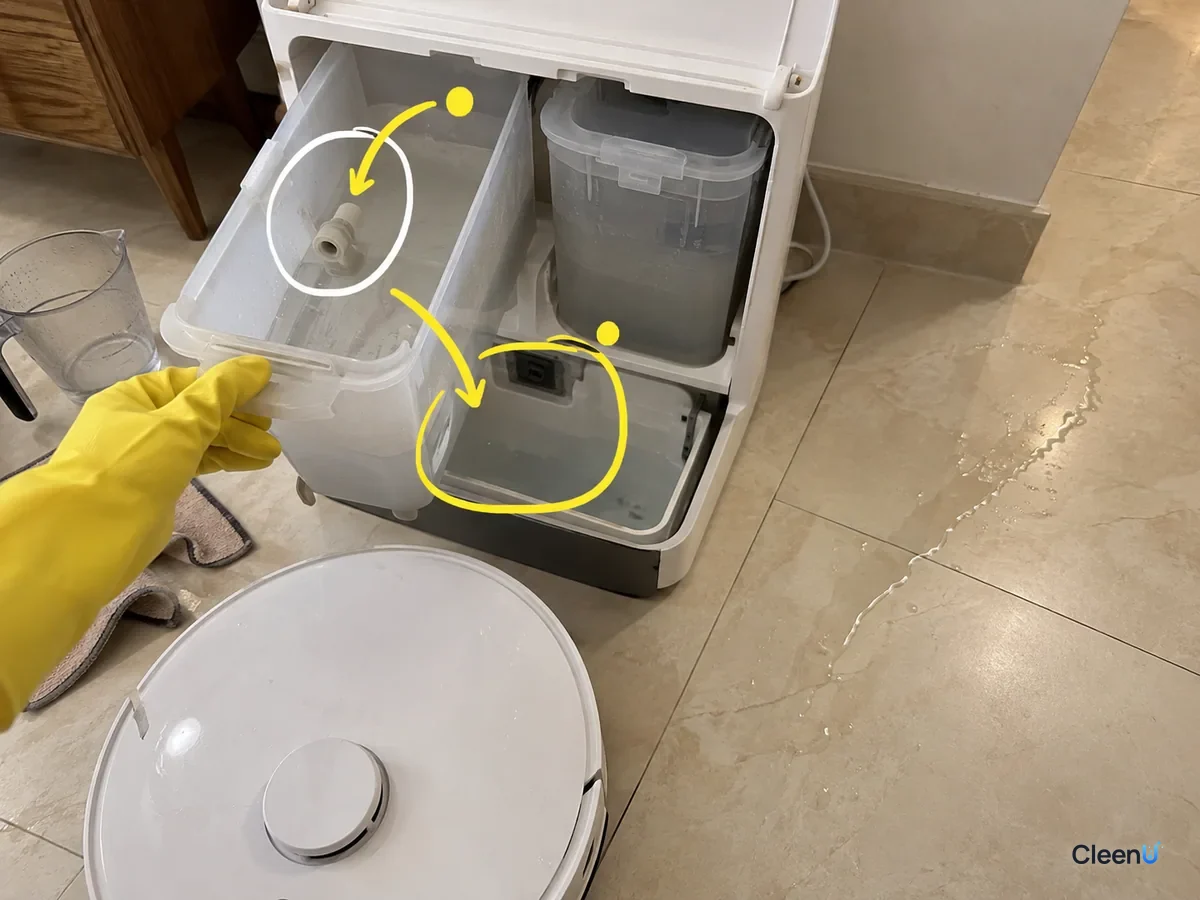
The compartment. It lives in the dust collection area. Lift the cover over the dust bin on top of the dock and look for a small removable unit with its own lid. If it's there, your dock auto-adds. If not, you mix solution into the clean water tank yourself.
The mop. Recent Deebots use one of two styles:
- Spinning pads: two round pads press on the floor and rotate. After mopping a stretch, they're loaded with dirty water and soil and go back to the dock for washing.
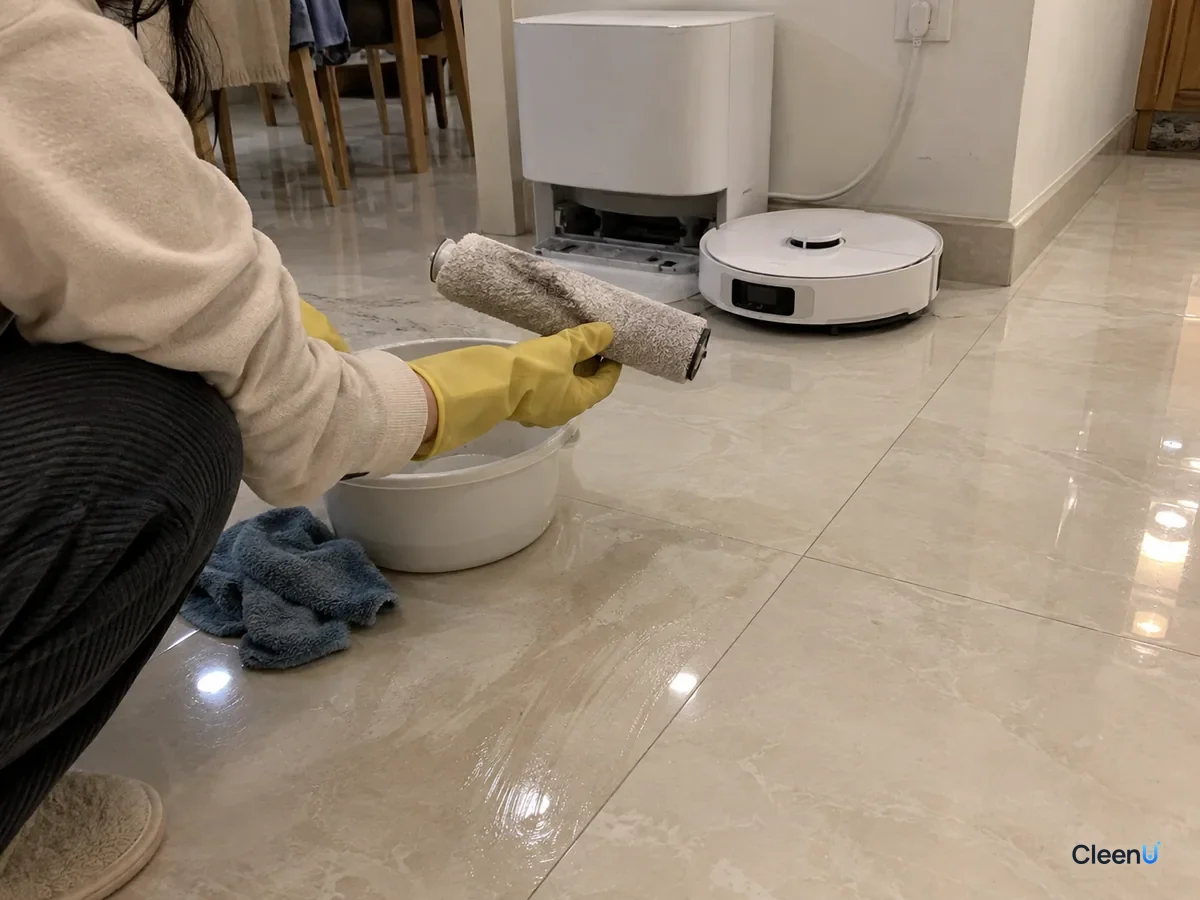
- A roller mop, like the OZMO ROLLER on the DEEBOT X8 PRO OMNI. Ecovacs describes it this way: the robot's onboard clean tank sprays fresh water onto the roller through 16 nozzles, and a floating scraper squeezes dirty water off the roller into the robot's dirty tank. The roller is rinsed continuously while it mops.
The dock treatment differs too. For the X8 PRO OMNI, Ecovacs lists temperature-controlled mop washing at 104–167°F (40–75°C) on its US product page, while its launch press release says 104–158°F (40–70°C), followed by hot-air drying at about 145°F (63°C). Check the figures for your exact model.
The liquid's path:
- With a compartment: concentrate sits in the compartment, and the dock blends it into water at a set ratio for mop washing or refilling the robot. The clean tank gets plain water.
- Without one: you mix solution into the clean tank, and the robot's pump delivers it to the pads or roller.
- Either way, nothing goes in the dirty water tank. It only collects dirty water, and solution there just adds foam that confuses level sensing.
Roller, heat, and solution: who does what (Sinner's circle)
Cleaning pros use a simple model called Sinner's circle. Results come from four factors: chemistry (the cleaner), mechanical action (wiping, scrubbing, scraping), temperature, and time. They trade off. More mechanical action means you need less chemistry; more heat means less time. Put the two Deebot mop styles into that model and the solution's job becomes clear.
Roller mops: strong mechanics, constant fresh water, very short contact. The roller keeps turning, the scraper keeps squeezing, and the nozzles keep adding clean water. Soil the roller picks up gets squeezed off and sent to the dirty tank almost immediately, so the roller surface stays fairly clean and rarely smears soil back onto the floor. The flip side is contact time. The solution barely sits on the floor, so there's no "let it soak" phase. In a roller robot, the solution's job is two fast things: wetting, so water spreads instantly into the fine texture of tile, and lowering how strongly grease clings to the floor, so the roller can scrape it away. Both happen once the surfactant reaches roughly its critical micelle concentration (CMC, the point where surfactant molecules start clustering around oil), which is a low number. What matters is that the mixed solution actually has enough active ingredient in it. A heavier dose doesn't buy more contact time. It just whips more air into the liquid at the scraper and sends foam into the robot's small dirty tank.
Spinning pads: good pressure and friction, but pads fill up. Spinning pads press and rub, so mechanical action is solid. The variable is that they mop a stretch before going back to the dock, collecting more soil as they go. Near saturation, oil and dust they've already absorbed get squeezed back onto the floor, which is called redeposition. Here the solution has one more job: wrapping up oily soil and keeping it dispersed in the water so it doesn't stick back down. That comes from how well the surfactants emulsify grease and from regular trips back to the dock, not from a stronger mix.
Temperature: hot-water washing handles the hardest part on the mop. Greasy footprints are the toughest thing on most floors, and heat is the next section.
Sinner's circle in a Deebot: how the four factors split the work
- Chemistry: the solution wets, loosens grease, and keeps soil dispersed, all at the label ratio
- Mechanical: roller rotation plus scraper squeeze, or spinning-pad pressure, does most of the lifting
- Temperature: temperature-controlled mop washing softens grease on the mop so it rinses out
- Time: roller contact is brief, so make up for it with a second pass and frequent mop washing, not a stronger mix
- Bottom line: each factor covers its own part, so dose at the label ratio and run a second pass where it's dirty
Hot-water mop washing: warm grease lets go, so the label ratio is enough
Temperature-controlled mop washing in an Ecovacs dock is good news for your cleaning solution.
Greasy footprints and kitchen oil tracked onto floors are mostly triglycerides, meaning cooking oils and animal fats. Vegetable oil is liquid at room temperature, but mixed with dust and walked on, it turns into a tacky film. Lard and butter are semi-solid at room temperature, and common animal fats start to soften noticeably somewhere around 86–104°F (30–40°C). As temperature rises, grease gets much less viscous, flows more easily, and lets go of fibers more readily.
Surfactants work better in warm water too. Molecules move faster and reach the oil-water boundary sooner, pulling oil droplets off fibers and dispersing them. So the same greasy roller or pad comes out much cleaner in water above about 104°F (40°C) than in cold water, and the same dose handles more grease.
Two practical takeaways:
- On a Deebot with hot-water mop washing, your routine dose at the label ratio is enough. Grease on the mop gets handled in the dock by heat plus solution, so the liquid on the floor only needs to wet and loosen.
- During hot-air drying, water evaporates and anything dissolved stays in the fibers. So shop for easy rinsing: a low-foam, particle-free formula with no wax or film-formers rinses out in the hot wash and leaves the roller or pads soft and fresh-smelling after drying.
The heat comes from the dock's own heater. The clean tank takes room-temperature water only. Don't pour hot water into the clean tank yourself: the tank, pump, and lines are built for room-temperature water, and hot water can warp plastic parts and age seals faster. See Can you put hot water in a robot mop?
Why the compartment takes concentrate only, below the outlet
On an auto-adding Deebot, the compartment holds concentrate, and the dock draws a small amount at a time. That puts two demands on the solution.
Stable viscosity, even in the cold. Auto-adding relies on a pump or valve drawing a set amount. A free-flowing liquid gives an accurate draw every time. A liquid that thickens in a cold room comes up short on each draw, and you may see "solution low" or "not detected." Many concentrates also do something counterintuitive: add a little water and they get thicker. In certain concentration ranges, surfactants pack into liquid-crystal or gel-like structures that are more viscous than either the concentrate or a dilute solution. So don't pre-dilute in the compartment. Concentrate only means a stable viscosity, and a stable viscosity means a steady ratio.
Keep the level below the outlet. Going by how the compartment is built, if the level sits above the outlet, liquid can escape on that side when you reinstall the unit or the dock gets bumped, then dry into a sticky film around the connector. Fill to the line and top up more often rather than filling to the brim.
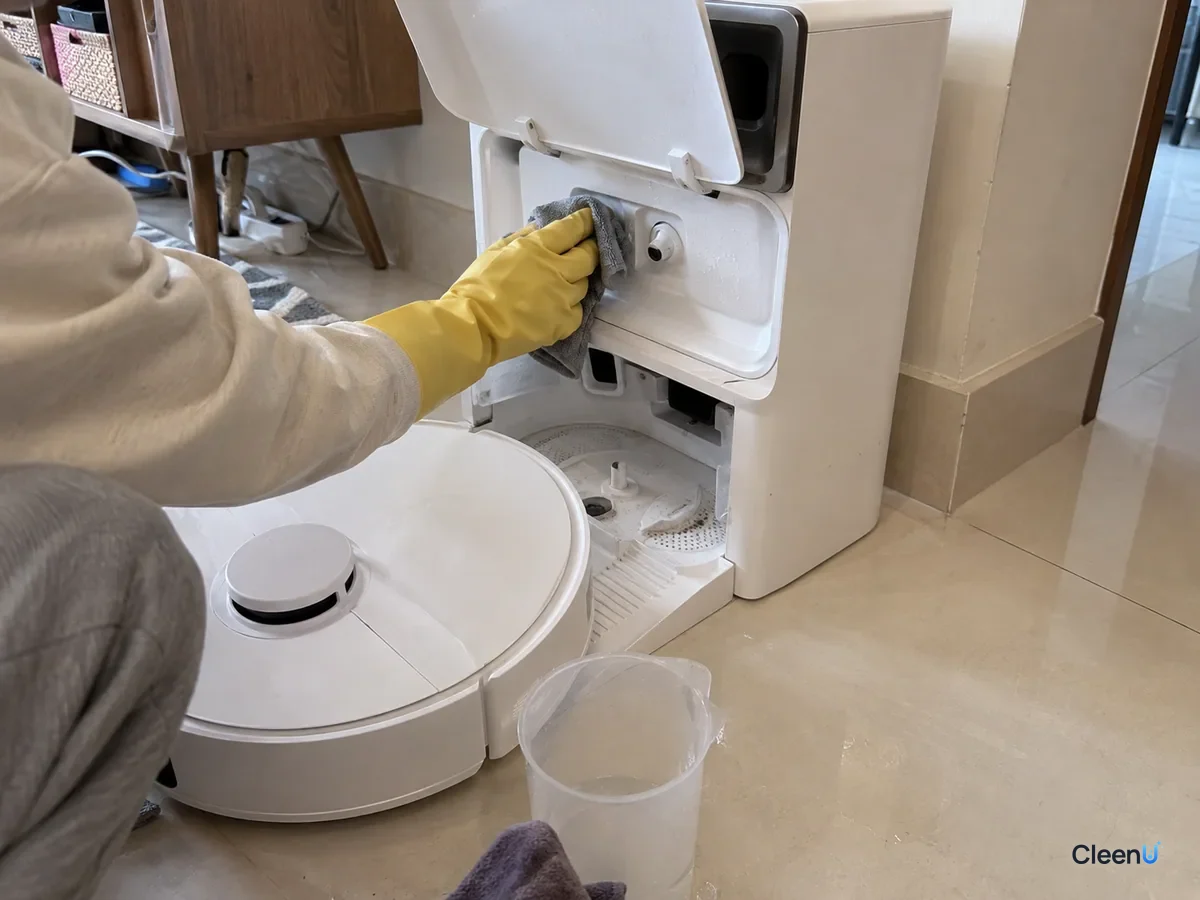
The outlet deserves a quick wipe at every refill. Concentrate there is exposed to air, water slowly evaporates, and surfactants and builders leave a thin film. A damp cloth on the outlet and opening each time keeps the flow steady. More on that in Robot dock not using your cleaning solution?
Adding a third-party solution, step by step
From checking your dock to the first run
Check for a solution compartment
Open the cover over the dock's dust collection area and look for a removable solution unit. If you have one, follow steps 2 to 6. If not, skip to step 7.
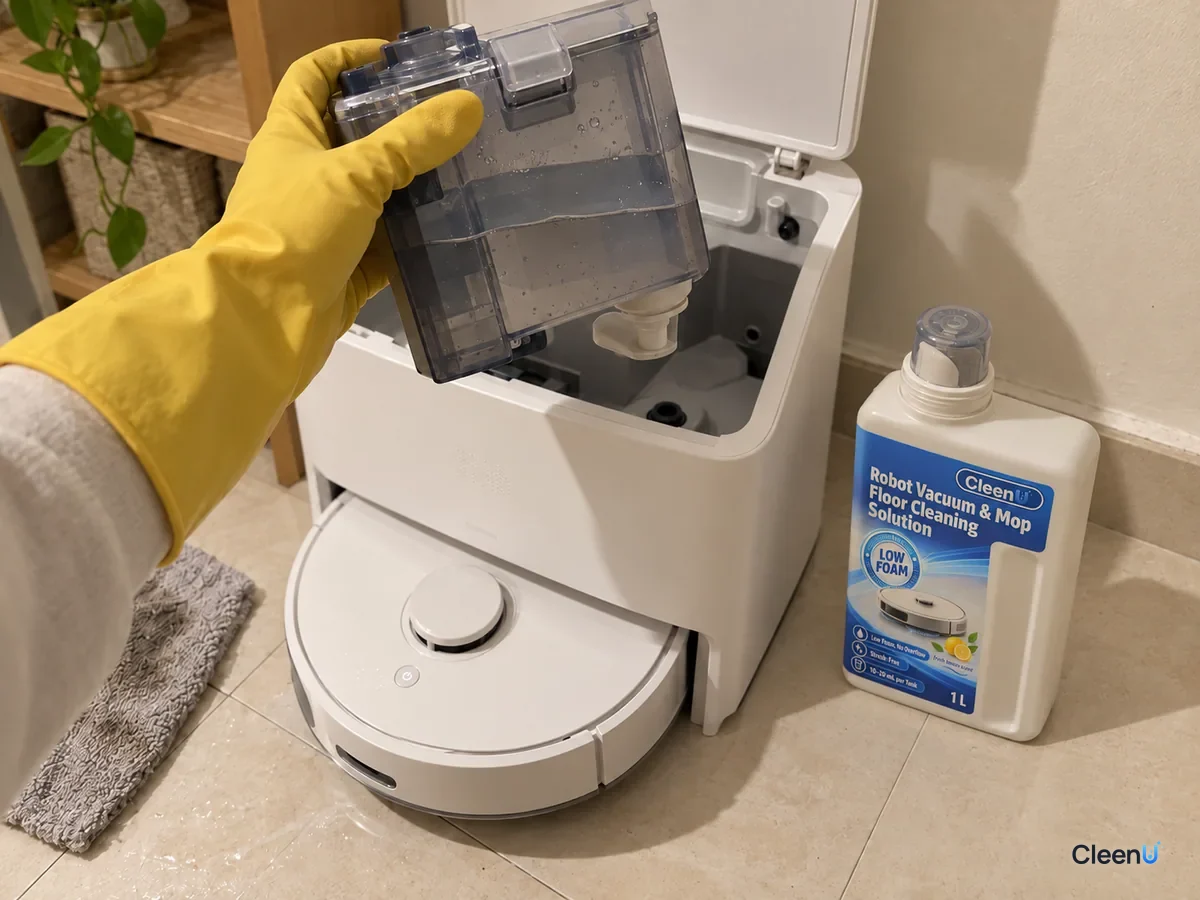
Pull the unit and rinse out the old solution
If there's solution left from before, use it up or pour it out, rinse twice with water, and let it dry upside down. Keep one solution in the compartment at a time so viscosity and foam stay predictable.
Caution:Let it dry fully before refilling. Leftover water dilutes the concentrate into the in-between range where it can thicken.
Add concentrate below the outlet
Open the lid and pour in concentrate straight, with no water, keeping the level below the outlet. Top up more often instead of filling to the top.
Wipe the outlet and reinstall
Wipe drips from the opening and the outlet with a damp cloth, close the lid, and seat the unit back in the dock.
Turn on auto-adding in the app
In the Ecovacs app, confirm Auto Cleaning Solution Adding is on.
Mop one room and check three things
Afterward, check for a foam layer in the robot's or dock's dirty tank, walk the dry floor in socks or touch it with the back of your hand for tackiness, and look at the off-white tile in side light for hazy streaks. If all three look fine, keep the settings. If you see foam or tackiness, use the three-step reset below.
No compartment? Dilute in the clean tank
Fill the clean tank with water first, then add solution at the label ratio with the measuring cap. For a 1:50 to 1:100 concentrate, that's 2 to 4 tsp (10–20 mL) per 34 oz (1 L) of water. Swirl gently. Never add anything to the dirty tank, and use the mix the same day.
If your model's manual gives different instructions, follow the manual.
Foam, tacky floors, or a low-solution alert? Reset in this order
A foamy dirty tank or a tacky, hazy floor means the dose reaching the floor, or the foam level, is running high. A "solution low" alert with liquid still in the compartment, or a dried ring at the outlet, points to how freely the concentrate flows or to the outlet itself. Reset in three steps. First, turn off Auto Cleaning Solution Adding in the app. Second, empty the compartment, rinse it with clean water, wipe the outlet, and run one mop-wash cycle to flush old solution out of the lines. Third, refill with a low-foam, neutral solution labeled for auto-dosing docks, concentrate only and below the line, turn auto-adding back on, and test one room. On a model without a compartment, pour out the clean-tank mix and remix at the label ratio.
Three home tests for roller mops and auto-dosing
No lab gear needed. These are built around how a Deebot works.
The squeegee test (for the roller scraper). Mix 17 oz (500 mL) of water with solution at its label ratio and soak a microfiber cloth in it. Lay the cloth over a sink and drag a plastic scraper or stiff card firmly across it so the squeezed liquid runs into a clear cup. After three or four passes, look at the cup. A thin layer that pops quickly is what you want in a roller robot. For contrast, try dish soap at the same strength. It's designed for rich hand-washing suds, and the head of foam it leaves makes the difference obvious.
The fridge test (for the compartment). Pour a little concentrate into a small clear cup and leave it in the refrigerator overnight. Take it out and tilt it right away. If it flows about as freely as at room temperature, it will draw fine from a dock in an unheated garage, porch, or entryway in winter. This is a rough comparison, not a cold-stability test.
The warm-versus-cool grease test (for hot-water washing). Smear a little cooking oil and dust on two old tiles or plates. Wipe one with cool working solution and one with warm working solution (comfortably warm, not hot), using the same cloth and pressure. The warm side comes clean in one pass. It shows why a stronger mix isn't needed when the dock washes with hot water.
The fridge test and the "no water in the compartment" rule are two sides of the same chemistry. At low temperatures, or at in-between concentrations, surfactants are more likely to line up into ordered structures, and the liquid thickens. Shop for a concentrate that stays fluid when cold, keep the compartment concentrate-only, and let it dry after rinsing. Cover both, and the compartment keeps dosing smoothly.
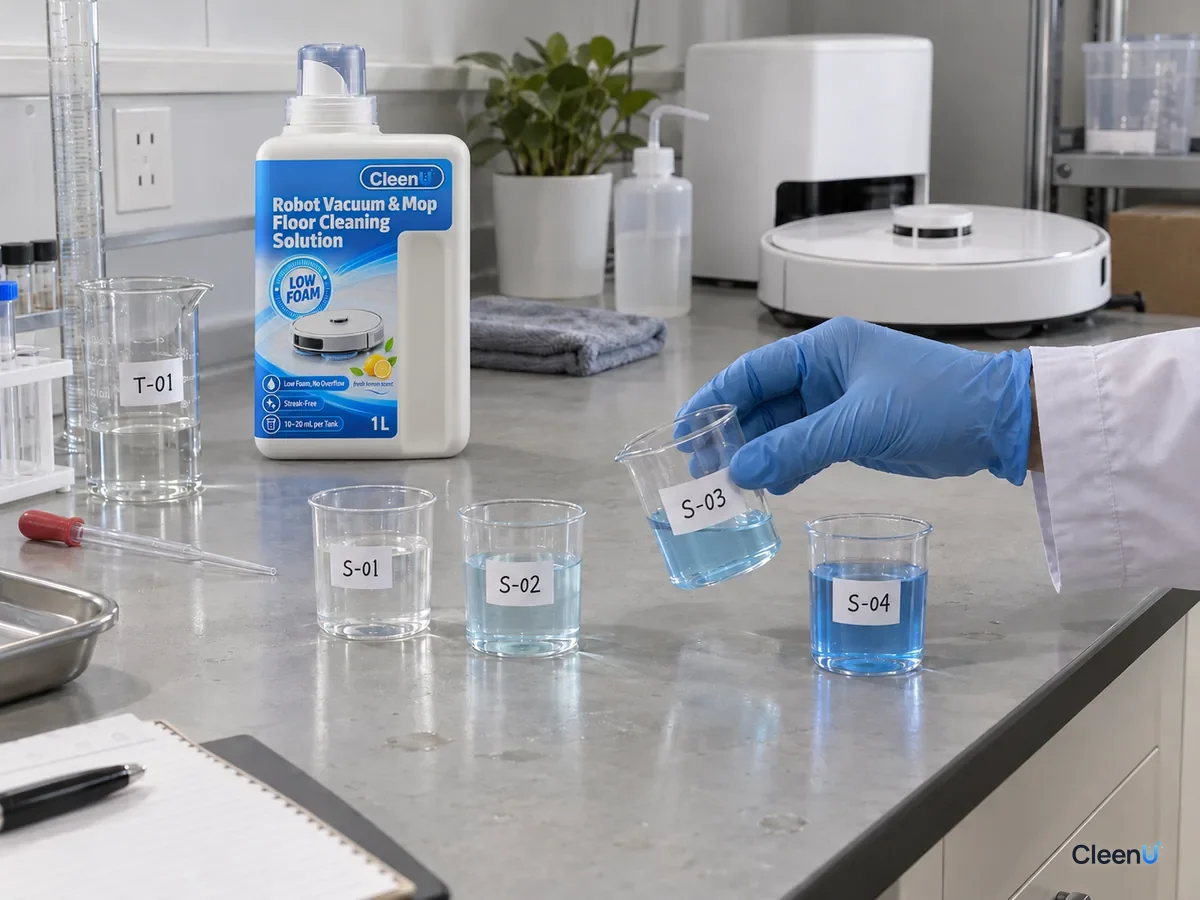
CleenU Robot Mop Cleaning Solution
CleenU Robot Mop Cleaning Solution is a neutral concentrate designed for auto-dosing docks, pH 6.5–7.5 as a concentrate, built on low-foam nonionic surfactants with a defoamer. It's wax-free and particle-free, so drying doesn't leave a wax film on the mop. Each 34 oz (1 L) bottle comes with a measuring cap and dilutes about 1:50 to 1:100; 10 to 20 mL per fill is usually enough. It's a cleaning solution that lifts dust film, greasy footprints, and everyday soil from sealed hard floors, not a disinfectant. Add it to the clean tank or the dock's designated compartment per your manual. It works with most Ecovacs Deebot, Roborock, Dreame, Narwal, and iRobot Roomba Combo and Braava models, as well as Tineco wet-dry vacuums. CleenU is not affiliated with these brands; brand names are used only to describe compatibility.
If you want a low-foam, neutral solution that flows well in a Deebot compartment, even in winter, take a look at our Robot Vacuum & Mop Floor Cleaning Solution.
Common mistakes
Filling the compartment and the clean tank. The compartment is already dosing. Adding more to the clean tank doubles the concentration, and foam and tacky floors follow.
Diluting in the compartment. The in-between concentration is the one most likely to thicken. Concentrate only.
Using a stronger mix for greasy footprints. A roller barely sits on the floor, so a stronger mix doesn't give it more soaking time. Run a second pass and let the dock's hot wash deal with grease on the mop. See Greasy footprints on the kitchen floor: how to robot-mop them clean.
Pouring hot water into the clean tank. The dock heats its own wash water. The clean tank takes room-temperature water.
Switching cleaning solutions in an Ecovacs Deebot
Can I use a third-party cleaning solution in an Ecovacs Deebot?
Yes, if you pick the right one and add it the right way: a low-foam, neutral, particle-free concentrate that still flows in the cold. With a compartment, add concentrate only, below the outlet; without one, dilute about 1:50 to 1:100 in the clean tank. Never both.
Where is the solution compartment on a Deebot dock?
In the dust collection area. Open that cover and look for a removable unit with its own lid. If there isn't one, your model takes solution mixed into the clean tank.
Do I put concentrate or diluted solution in the compartment?
Concentrate. The dock blends it into water at a set ratio. Adding a little water yourself can push it into the in-between range where it thickens.
Why can't I fill the compartment to the top?
Keep the level below the dispensing outlet. Overfilled, it can spill on the outlet side when you reinstall it or the dock gets moved, then dry into a film. Topping up more often works better.
If my dock has a compartment, should I also add solution to the clean tank?
No. That's a double dose, and you'll likely get tacky floors and foam in the dirty tank. The clean tank gets plain water.
How much solution goes in a Deebot without a compartment?
Follow the label ratio. For a 1:50 to 1:100 concentrate, that's 2 to 4 tsp (10–20 mL) per 34 oz (1 L) of water, with a second pass on dirty spots.
Does a roller-mop Deebot need a stronger mix?
No. The roller relies on constant fresh-water spray and the scraper to remove soil. The solution wets and loosens grease at the label ratio, and extra just foams at the scraper.
After switching, the dock says solution is low or not detected. What now?
Check that the unit is fully seated and the outlet is free of dried film, then confirm auto-adding is on. If it persists, empty, rinse, and dry the compartment, and refill with a free-flowing, low-foam concentrate labeled for auto-dosing docks.
My dock is in a cold garage. Will the solution still flow?
Yes, if you choose a formula that stays fluid when cold. Keep the dock somewhere that doesn't freeze, and if the concentrate has frozen, let it warm up, shake it, and make sure it's uniform before using it.
Can I put vinegar or disinfectant in a Deebot dock?
No. Vinegar can corrode metal parts, and chlorine or quat disinfectants can harm seals and add residue. Disinfect specific spots by hand when needed.
Related reading: Roller vs. spinning mops: how solution use differs, Robot dock auto-dosing not working?, and How to clean a robot dock's auto-dosing tank
You can switch to a third-party solution in a Deebot. Start with the dock. With a compartment, pour in concentrate only, keep it below the outlet, wipe the outlet, reinstall, and turn on auto-adding. Without one, dilute at the label ratio in the clean tank, and never do both. To compare products, skip the ratio on the label and work out in-tank strength: active content divided by dilution. A Deebot's roller mop and hot-water washing handle most of the scrubbing and heating, so the solution's job is wetting and loosening grease, and the label ratio is enough. Shop for stable viscosity that still flows in the cold, low foam that holds up under a scraper, and an easy-rinsing, wax-free formula that leaves the mop soft after drying. Mop one room first; no foam and no tackiness means you're good to go.