
Comparison
Pet-Home vs Regular Robot Mop Cleaning Solution: What’s Different?
Direct answer
A pet-home version usually targets paw prints, drool marks and pet odor, with little or no fragrance. A regular version handles everyday footprints, greasy marks and dust. The details depend on the formula and label. "Pet formula" doesn't mean it disinfects or has a pet-safety certification.
Who should choose what
-
Homes with a cat or dog that spends time in the living room and kitchen
Choose Pet-home version
Paw prints, drool and pet odor are the everyday problems, so odor control and no added fragrance fit better.
-
Multi-pet homes, or homes with noticeable pet odor
Choose Pet-home version, plus frequent washing of pads, the dirty tank and wash tray
Odor control cuts floor odor, but smell that builds up in the pads and dock has to be cleaned out.
-
No pets, lots of greasy kitchen footprints
Choose Regular version
Both share the same cleaning base, so without pet odor the regular version is enough.
-
Pets plus someone sensitive to smells or a baby
Choose Pet-home version at the low end of the label
No added fragrance and a low dose keep both residue and smell down.
-
A former pet home where the floor still smells a little
Choose Use the pet-home version for a while, then switch back
Clean the pads and dock thoroughly at the same time to remove lingering odor at the source.
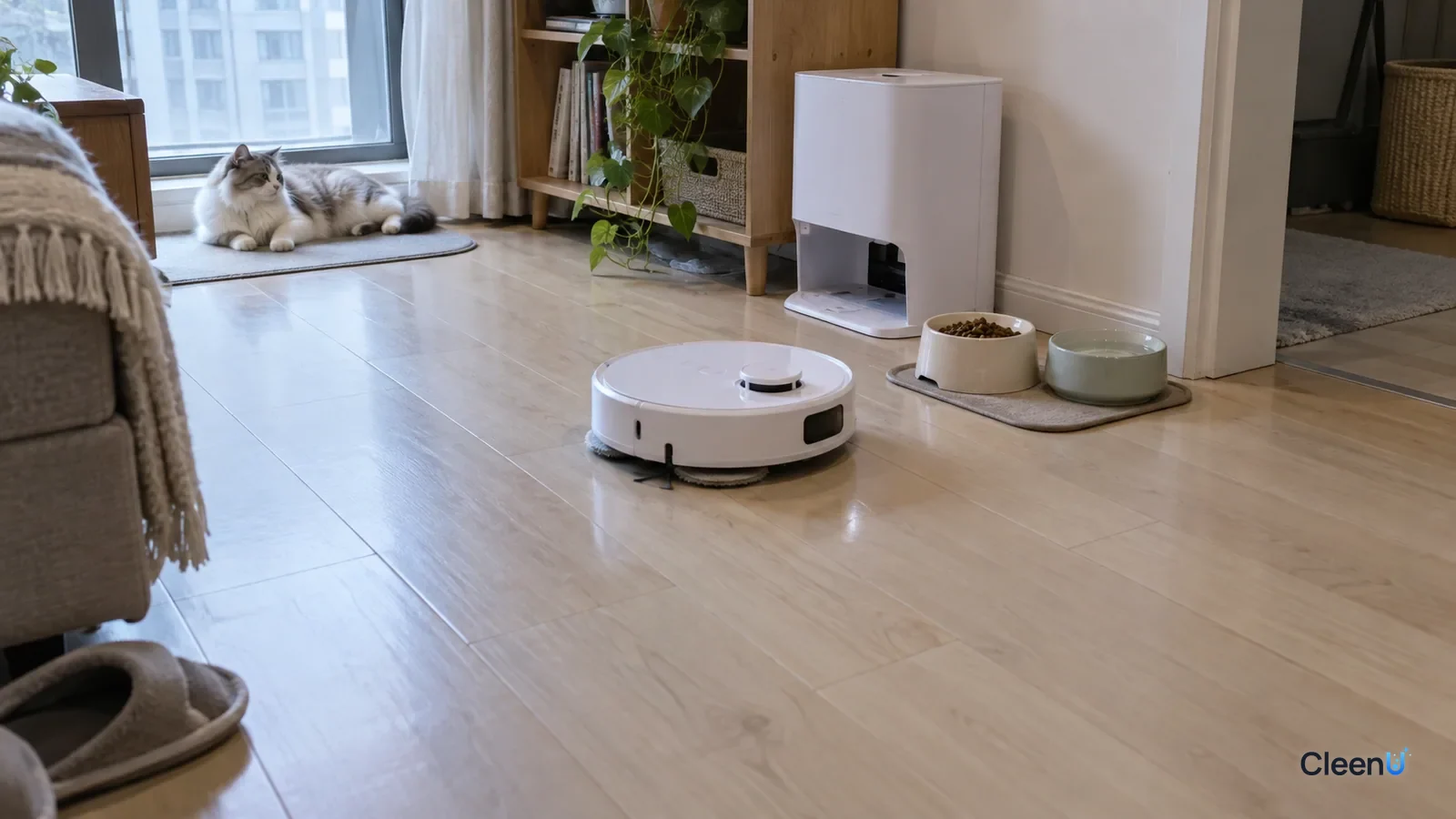
On the shelf you'll often find two robot mop solutions from the same brand: a regular version and one labeled for pet homes. They may cost about the same, or the pet version may cost a little more. Cat and dog owners naturally ask what's actually different, and whether they need the pet version.
The answer comes down to the formula. "Pet formula" isn't a category with a common standard, and pet versions from different brands can differ a lot. Below: what makes pet-home floors different, what pet versions usually change, and, using CleenU's two products as the example, exactly how they differ.
Pet-home floors get dirty differently
Paw prints. Cat and dog paw pads release a little oil and sweat, leaving small greasy prints. Dogs coming in from outside add mud and grit.
Drool marks. Dogs leave drool as they drink, eat and lick the floor. Saliva carries proteins and mucus that dry tacky and mop up harder than water spots.
Around the food bowls. Scattered kibble, wet-food juice and splashed water mix together into one of the dirtiest spots in a pet home.
Pet odor. Fur, skin oils, saliva and the occasional accident give floors, pads and docks a distinct smell.
Shedding. Hair gets picked up by the pads and wraps around them and the wash tray, mixing with oils and proteins so pads start to smell sooner.
What these have in common: they mix oils and proteins, and they're closely tied to odor.
What pet versions usually change
Odor control. This is the most common difference, and there are a few approaches: cyclodextrin ingredients that capture odor molecules, zinc salts that bind certain sulfur- and nitrogen-containing odor compounds, or simply fragrance that masks. The first two reduce how much odor escapes into the air; the last just covers it with another smell.
A more restrained scent. Pets' noses are far more sensitive than ours, and strong scents can make them avoid areas, so pet versions are usually lighter or offer fragrance-free options.
Cleaning for proteins and oils. Some pet versions adjust the surfactant blend to handle mixed soils like drool and paw prints better.
Low residue. Pets lie on the floor, walk on it and lick their paws, so the less residue the better.
To be clear, "pet formula" doesn't mean it disinfects or kills germs, and it doesn't mean it holds any pet-safety certification. Disinfecting is a regulated claim that requires registration and testing. If a label doesn't state it and there's no documentation behind it, don't use it as a disinfectant.
CleenU robot mop cleaning solution: regular vs pet-home, point by point
| What to compare | Regular | Pet-home |
|---|---|---|
| Type | Neutral, low-foam concentrate | Neutral, low-foam concentrate |
| pH | 6.5 to 7.5 | 6.5 to 7.5 |
| Core formula | Low-foam nonionic surfactants with defoamer | Low-foam nonionic surfactants with defoamer, plus cyclodextrin-based odor control |
| Free of | Wax, chlorine, particles | Wax, chlorine, particles |
| Scent | Lemon | Fragrance-free |
| Main targets | Everyday footprints, greasy marks and dust | Paw prints, drool marks, food-bowl mess and pet odor |
| Dilution | About 1:50 to 1:100, usually 10 to 20 mL per fill | About 1:50 to 1:100, usually 10 to 20 mL per fill |
| Floors | Tile, vinyl plank, laminate, sealed hardwood | Tile, vinyl plank, laminate, sealed hardwood |
| Not for | Machines whose manual prohibits additives, mixing with other cleaners or disinfectants, overdosing, unsealed or waxed wood, carpet | Same, plus never send the robot through urine or vomit |
As the table shows, the base formula and directions are the same. The pet-home version differs in two ways: it adds cyclodextrin-based odor control, and its scent is lighter.
How does cyclodextrin control odor?
A cyclodextrin is a ring of several glucose units shaped like a small bucket open at both ends. The outside of the bucket loves water, so it dissolves; the inside is relatively water-repelling and can hold hydrophobic molecules of the right size. Many odor molecules, such as some fatty acids, sulfur compounds and amines, are small and hydrophobic. They slip into the cavity and form an inclusion complex, so less of them escapes into the air.
The key point is that it reduces how much odor evaporates, rather than covering it with a stronger scent. That's how the pet-home version can smell lighter and still cut pet odor.
It has limits. Cyclodextrin handles the light, everyday odor molecules on a floor. It can't deal with a puddle of urine or vomit. Those need hand cleanup first, and then the robot can take over daily mopping. For the right order, see can a robot mop clean up pet urine.
Which one fits your household?
How to tell whether the pet version helps in your home
Odor control is hard to sum up in a number, but you can run a simple side-by-side at home.
Reset first. Hand wash and dry the pads; scrub the dirty tank, wash tray and filter; and clean the pet bed and litter box. This step matters. If the pads and dock smell, they'll drown out any solution and every product will seem useless.
Use the regular version or plain water for a week. Mop at your usual frequency and note the smell when you walk in the door and half an hour after mopping with the windows closed, especially in your pet's favorite corners and around the food bowls.
Switch to the pet version for a week. Same frequency and dose at the label ratio, same check times.
Compare. Is the smell lighter where your pet hangs out? Is the post-mopping scent softer? Is your pet comfortable in freshly mopped areas?
If there's no clear difference, your odor probably comes from somewhere other than the floor: the pet bed, sofa, rugs, litter box or the dock itself, so start there. If there is a difference, stick with the pet version.
One more tip: your nose gets used to your home's smell and stops noticing it. Ask a visiting friend, or take a sniff the moment you come home after an hour or two out.
Pet-home version in hand: what else to keep in mind
Dose at the label ratio. Don't double it because the pet smell is strong; that only adds residue and foam.
Set pet areas as priority zones for an extra pass.
Wipe around the food bowls separately with plain water so there's less residue for pets to lick.
Clean the pads, dirty tank and wash tray often. Pet homes have more hair and organic matter, so docks smell sooner.
Clean up urine and vomit by hand; never send the robot through them.
Let the floor dry and air out before pets come back.
It works in most robot mops from Roborock, iRobot (Roomba Combo and Braava), Ecovacs Deebot, Dreame and Narwal, and in floor washers such as Tineco. Add it to the clean water tank or the dock's designated detergent compartment as your manual directs. CleenU isn't affiliated with these brands; the names only indicate compatibility. For a full pet-home routine, see robot mopping in homes with cats and dogs.
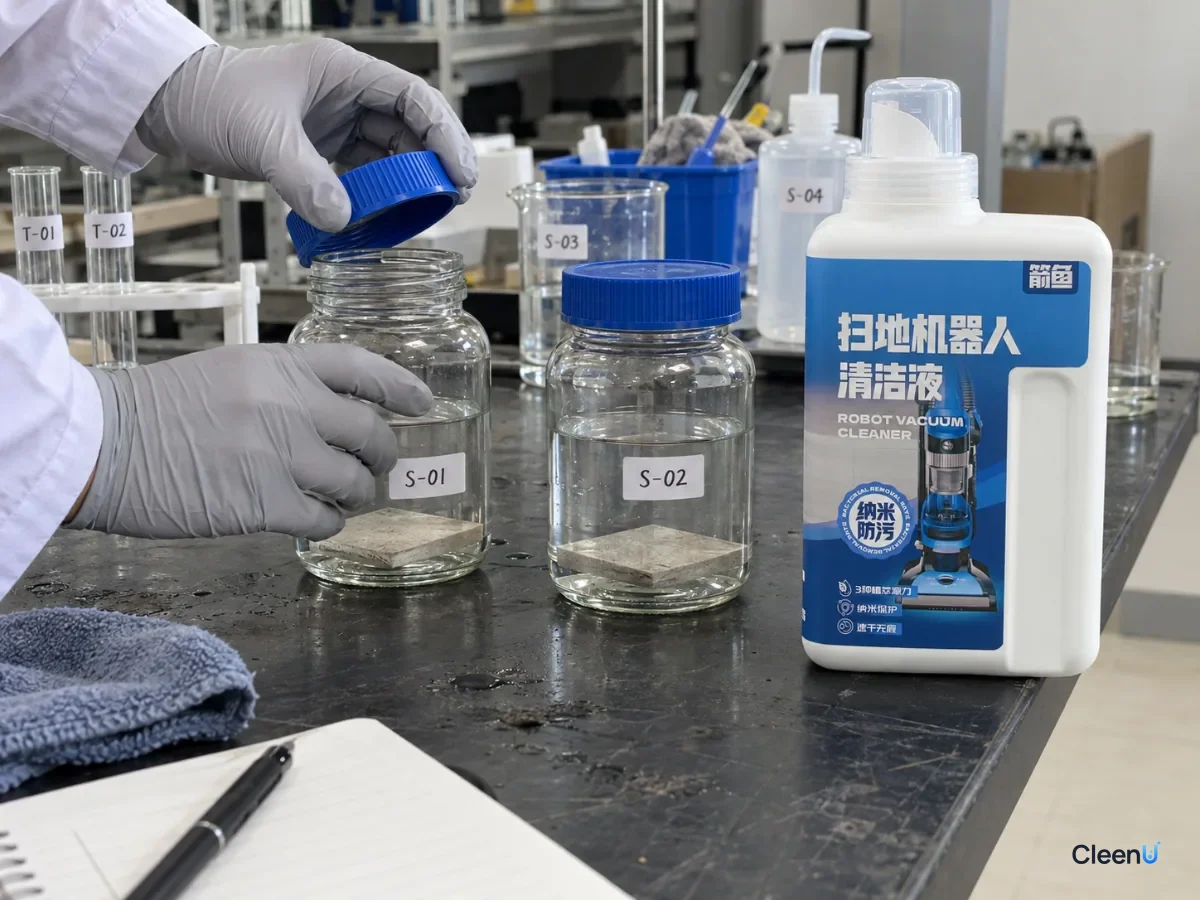
Can odor control and fragrance work together?
Yes, and they usually do. Odor control cuts how much odor escapes, while fragrance adds a touch of freshness. The balance shapes how it feels: strong odor control with light fragrance leaves a clean, faint smell; heavy fragrance with weak odor control feels more like masking.
Fragrance molecules are also small and hydrophobic, so in principle cyclodextrin can capture some of them too. That's why fragrance and odor control have to be designed and tested together rather than just adding more scent, and it's one reason the pet-home version smells lighter.
This article is part of the Robot Vacuum Cleaning Solution & Maintenance Guide, which covers the full maintenance schedule and links to every troubleshooting guide.
Common questions about pet-home vs regular robot mop solution
Do I need the pet version if I have pets?
No, it isn't required. The regular version also cleans paw prints and drool. The pet version adds odor control and no added fragrance, which suits homes where pet odor is noticeable.
Does the pet version disinfect?
No, don't use it as a disinfectant. It's a floor cleaner, and without a stated disinfecting claim and supporting documentation it doesn't disinfect.
Is the pet version safer for pets?
There's no common certification behind "pet formula." What matters is low foam, low residue, no wax or chlorine, dosing at the label ratio and letting the floor dry before pets come back.
Can I mix the regular and pet versions?
Use one at a time. Finish one, rinse the tank, then switch. Don't split a tank half and half.
Should I use more of the pet version?
No. Both dilute at about 1:50 to 1:100, usually 10 to 20 mL per fill. Less is better than more.
I switched to the pet version and the house still smells. What now?
Odor often comes from the pads, dirty tank, wash tray and pet bedding, so clean those thoroughly. Treat any urine spots by hand and let the seams dry out.
Why is the pet-home version fragrance-free?
Pets have a far sharper sense of smell than we do, so a strong scent can make them avoid areas, and fragrance only masks odor anyway. The CleenU pet-home version has no added fragrance and relies on cyclodextrin-type ingredients to hold odor molecules. Judge it by whether paw-print paths and the area around food bowls smell less after mopping.
Can I use the pet-home version in a floor washer?
Yes. The pet-home and regular versions share the same base formula and directions, and both work with Tineco floor washers and most robot mops. Add it to the clean-water tank or the designated detergent compartment per your manual, at about 1:50 to 1:100; 10 to 20 mL per fill is usually enough.
With cats or dogs at home, to cut pet odor during everyday mopping without adding any fragrance, try Robot Vacuum Cleaning Solution for Pet Homes.
The difference between pet-home and regular robot mop cleaning solution comes down to the formula. With CleenU's two versions, the base formula, pH, dilution and floors are the same. The pet-home version adds cyclodextrin-based odor control and no added fragrance, aimed at paw prints, drool, food-bowl mess and pet odor. Cyclodextrin traps odor molecules rather than masking them with a stronger scent. "Pet formula" doesn't mean disinfection or a pet-safety certification. Homes with noticeable pet odor should choose the pet version; homes without pets are fine with the regular one. Either way, dose at the label ratio and clean up accidents by hand.