
How-to
Robot Mopping in a Home With a Crawling Baby
Direct answer
Focus on low residue, no harsh smell and a fully dry floor. Use a fragrance-free or lightly scented, low-foam, low-residue robot mop solution at the low end of the label. Run the robot while your baby naps or is off the floor, air out the room and let the floor dry completely before crawling time.
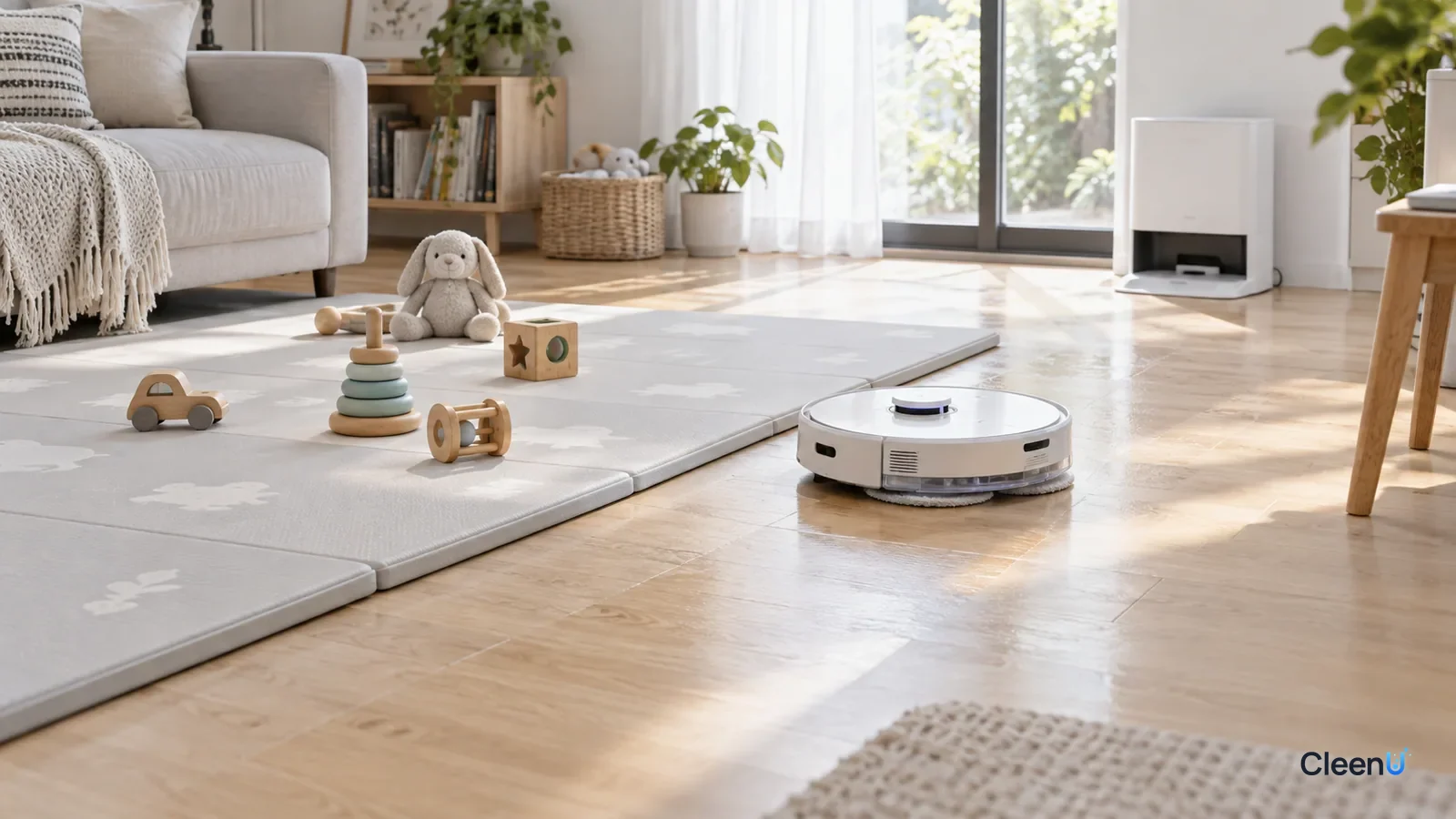
Once a baby starts crawling, the floor becomes their playground. They lie on it, touch everything, put their hands in their mouths and press their cheeks to the boards. It's also when a lot of families buy a robot mop to keep floors clean every day.
For a crawling baby, "clean" means more than no dust and no footprints. It also means as little cleaner residue as possible, no harsh smell, and a floor that isn't wet or slippery. A robot mop spreads whatever is in its tank across every square foot your baby crawls on, so it's worth thinking a step further about settings, what goes in the tank and when it runs.
Babies have far more contact with floor residue than adults
Adults mostly touch the floor with their feet, usually in socks or slippers. A crawling baby is different.
More skin on the floor. Palms, knees, forearms and cheeks all touch it, often for hours a day.
Constant hand-to-mouth contact. Babies put their hands and toys in their mouths all day, so whatever is on the floor can get there.
Closer to the floor. A baby breathes right at floor level, where anything that evaporates after mopping is most concentrated.
Thinner, more sensitive skin. A baby's skin barrier is still developing and reacts more easily to irritants.
For homes with a crawling baby, less residue is better and a fainter smell is better, which is the opposite of the instinct that a stronger cleaner must be better.
Where does cleaner residue come from?
When a robot mop lays down diluted solution, the water evaporates and the non-volatile ingredients stay: surfactants, a little preservative, and the slower-evaporating parts of the fragrance. How much stays depends on two things.
How much you add. Double the dose, double the residue. It's the thing parents control most directly, and the most common mistake.
The formula's solids content. A lean formula designed for low concentration leaves very little each time. Formulas with wax, shine enhancers or heavy fragrance leave more, and wax and shine agents are designed to stay on the floor on purpose.
A robot never follows up with a rinse, so residue builds up on the same floor day after day. Choosing the right formula and dosing lightly matter more than mopping harder or more often.
How to robot mop in a home with a crawling baby
Six steps from choosing a solution to crawling time
Choose a fragrance-free or lightly scented, low-foam, low-residue solution
Look for no or very light fragrance, no wax, no shine enhancers, no chlorine and low foam. For more on choosing a scent level with a baby at home, see the scented vs fragrance-free comparison.
Dose at the low end of the label
CleenU Robot Vacuum Cleaning Solution dilutes at about 1:50 to 1:100; 10 to 20 mL per fill is usually enough. With a baby, start at the low end, around 10 mL for a 1-liter tank. On dusty days you can even use plain water and add solution only when the kitchen or entry gets dirty.
Mop while your baby is off the floor
Schedule runs during naps, walks or while your baby is being held. Keep your baby and a running robot out of the same area; babies grab at robots and tug on pads, and toys can snag the robot.
Set no-go zones and pick up small items
Make the play mat and playpen area no-mop zones in the app and wipe the mat separately with a damp cloth. Before a run, pick up small toys, socks and cords so the robot doesn't catch them.
Ventilate and let the floor dry completely
Open a window or run ventilation after mopping so the floor dries and any smell clears. The floor usually dries within a minute or two, but give it about half an hour for the smell to fade before crawling time.
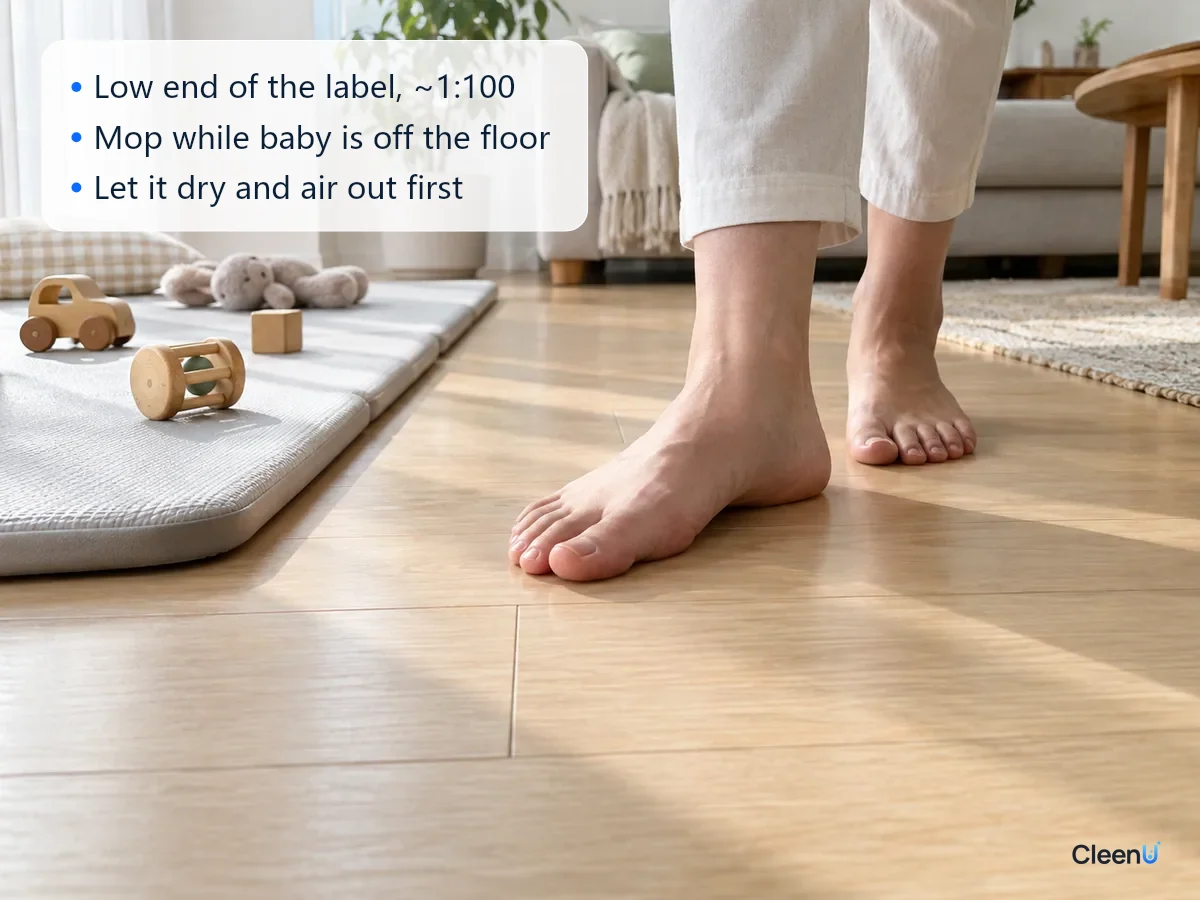
Walk the floor barefoot to check it
Before your baby goes down, walk barefoot over their usual crawling area. No tackiness, no slip and no noticeable smell means the dose is right. If it feels tacky, use less, or have the robot run once more with plain water.
Clean your baby's own zone by hand
The play mat, playpen and the rug where your baby spends the most time are the surfaces with the most contact. They're better cleaned by hand than by the robot.
Play mats are usually PE, XPE or TPU foam with a textured surface. A robot pad may not make good contact, and the robot can push the mat out of place.
Drool, milk and food mess collect in these areas. A wrung-out damp cloth with plain water cleans them more thoroughly and with more control.
If you need a cleaner there, use one made for baby gear, follow its directions and wipe again with plain water afterward.
Let the robot handle the open floor and clean your baby's zone by hand. That split is the easiest and the safest.
Why wipe up milk, drool and baby food by hand first?
Floor messes in a baby home are different. Spilled milk, drool, and dropped cereal or fruit puree are a mix of protein, milk fat, starch and sugar.
Two things make them tricky. They wipe up easily when fresh but not once dry: milk proteins bond tightly to the floor as they dry, milk fat oxidizes into yellow, sour-smelling spots, and starchy food dries into a hard crust. And they're excellent food for bacteria, so left alone they turn sour and smelly.
A robot pad presses lightly and often just smears dried milk or food around. Worse, the pad soaks up that protein and sugar, and in a damp dock, the pads and wash tray start to smell faster.
So wipe these up on the spot: blot the liquid with a dry paper towel, wipe with a soft cloth dampened with warm water, then dry. Warm water helps with milk fat, but don't use hot water, because heat sets proteins and makes them harder to remove. Once the spill is gone, daily robot mopping keeps the floor clean.
Keep these out of the clean water tank
Bleach and chlorine cleaners: harsh residue and smell that don't belong on a crawling floor, and they can damage the robot.
Vinegar and citric acid: can corrode parts, etch stone and grout, and smell sharp.
Essential oils and perfume: adding a few drops "to make the house smell nice" isn't a good idea. Essential oils are concentrated, can irritate babies and float and cling inside the lines.
Dish soap, laundry detergent and body wash: high foam, heavy residue.
Liquid from disinfecting wipes: a complex mix that doesn't belong in the machine.
For why cleaning solution isn't a disinfectant, and whether everyday mopping needs one, see does robot mop solution disinfect.
This article is part of the Robot Vacuum Cleaning Solution & Maintenance Guide, which covers the full maintenance schedule and links to every troubleshooting guide.
About disinfecting
Many parents worry that mopping without disinfecting leaves germs behind. For a healthy baby's everyday home, keeping floors clean and dry and wiping up milk, food mess and pet accidents promptly is usually enough. Disinfecting the whole floor often creates a more real problem: residue and irritation.
When disinfection is warranted, such as illness in the family or a pet accident indoors, treat that specific area with a suitable disinfectant at the label strength and contact time, then wipe with plain water and ventilate. Don't put disinfectant in the robot's tank and mop the whole house with it.
What to look for in a robot mop solution
With a baby at home, check solutions in this order:
Fragrance-free or lightly scented, because smells are strongest at floor level.
Low foam and low residue, with no wax or shine enhancers.
Neutral or near-neutral pH, with no chlorine.
A clear dilution ratio on the label and a measuring cap for easy dosing.
CleenU Robot Vacuum Cleaning Solution is a neutral, low-foam concentrate at pH 6.5 to 7.5 with low-foam nonionic surfactants and a defoamer, no wax, no chlorine and no particles. The standard version has a lemon scent that leaves only a faint smell at label dilution; if your household is sensitive to any scent, start small at the low end. It works in most robot mops from Roborock, iRobot (Roomba Combo and Braava), Ecovacs Deebot, Dreame and Narwal, and in floor washers such as Tineco. Add it to the clean water tank or the dock's designated detergent compartment as your manual directs. CleenU isn't affiliated with these brands; the names only indicate compatibility. For more on scent choices, see scented or fragrance-free robot mop cleaning solution.
Stop using that solution if you see these
After crawling on a freshly mopped floor, your baby's hands, knees or face turn red or get a rash; family members sneeze, tear up or feel dizzy from the smell after mopping; or the floor stays tacky or slippery. Stop using it and mop with plain water. If your baby's skin problem continues or gets worse, see a doctor.
Common questions about robot mopping with a crawling baby
Can I still use cleaning solution with a baby at home?
Yes. Choose a fragrance-free or lightly scented, low-foam, low-residue robot solution at the low end of the label. On dusty days, plain water is fine; add solution when the kitchen or entry gets dirty.
How long after mopping can my baby crawl on the floor?
The floor usually dries in a minute or two. Ventilate and give the smell about half an hour to clear, then walk it barefoot to make sure it isn't tacky or slippery.
Is it safe for my baby to be near the robot while it runs?
It's better to keep them apart. Babies grab robots and pull on pads, and the robot can snag small items. Run it during naps or outings.
Can the robot mop the play mat?
Better not. Make it a no-mop zone and wipe it by hand with a wrung-out damp cloth and plain water.
Should I add disinfectant to the tank to sanitize my baby's floor?
No. Clean and dry is enough day to day. If a specific area needs disinfecting, treat it by hand with a suitable product, then wipe and ventilate. Keep disinfectant out of the robot.
My baby crawled on the freshly mopped floor and then sucked on their hand. Should I worry?
At label dilution on a fully dry floor, residue is very low. To be extra careful, mop while your baby is off the floor and wait until it's dry and aired out.
Is the floor safe for kids once the solution has dried?
The safest routine is to dilute as directed, use the low end of the dose, and let the floor dry fully before your baby crawls on it. Choose a neutral, low-foam, fragrance-free solution, mop the play area with plain water, and ventilate after each run.
With a baby at home, if you want a neutral, low-foam robot mop solution with no wax or chlorine that leaves only a faint scent at the low end of the label, try Robot Vacuum Cleaning Solution.
With a crawling baby at home, robot mopping isn't about scrubbing harder. It's about low residue, no harsh smell and a floor that's completely dry. Choose a fragrance-free or lightly scented, low-foam solution with no wax or chlorine, and dose at the low end of the label, adding it only when floors are dirty. Mop while your baby is off the floor, clean the play mat and playpen by hand, ventilate, wait until the floor is dry and the smell has cleared, and walk it barefoot before crawling time. Keep disinfectants, essential oils and dish soap out of the tank.