
Formulation Science
Hard Water and Robot Mop Floor Spots: What Chelating Agents Do
Direct answer
Calcium and magnesium in water come out as calcium and magnesium carbonate as the water evaporates, leaving white mineral spots. Chelating agents grab those ions and keep them dissolved, cutting deposits and helping surfactants work in hard water. But they can't handle a whole tank's worth, so water level and water type still matter.
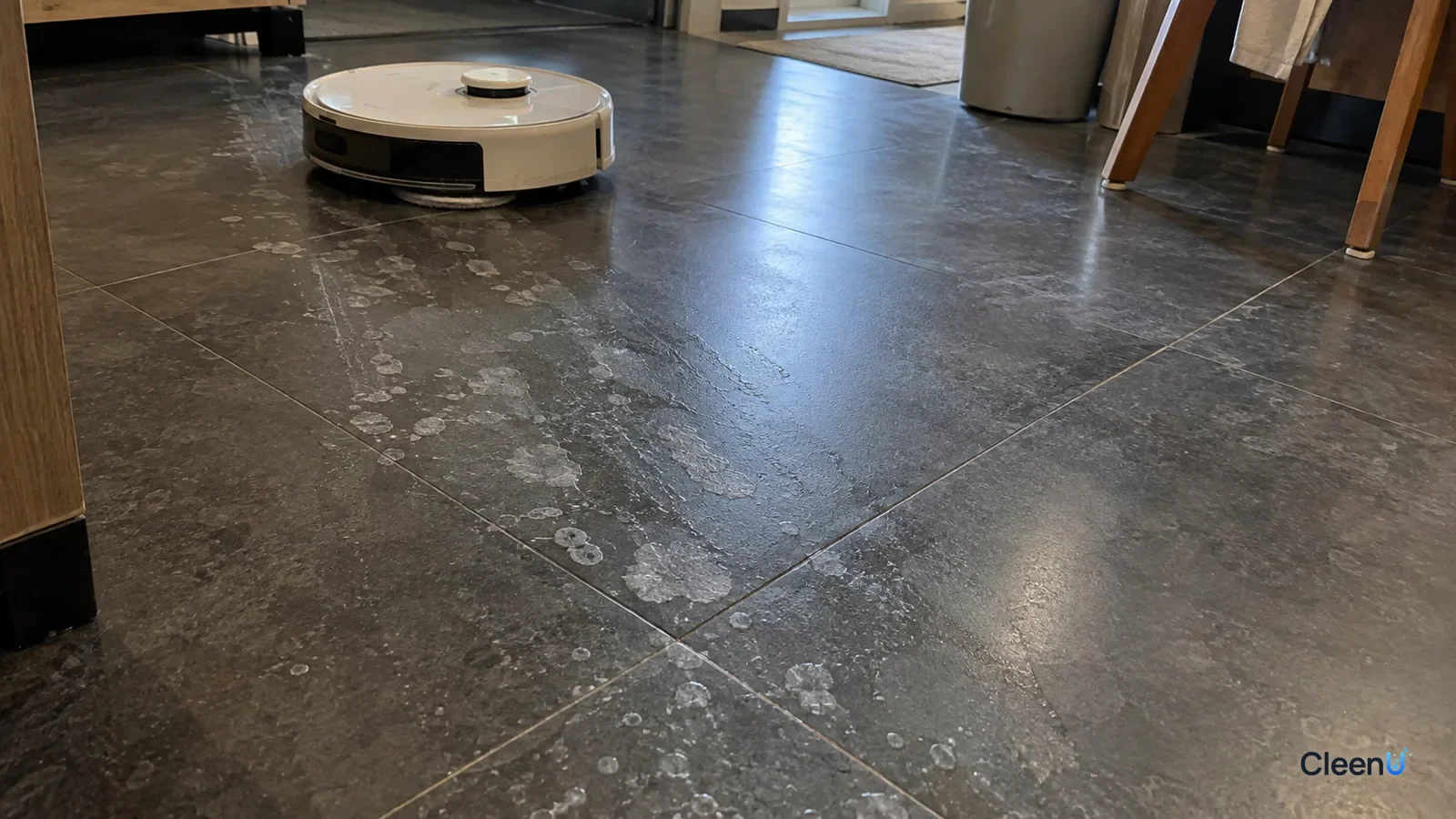
Homes in hard-water areas know the problem: after the robot mops, dark tile is covered in white rings and patches, and switching cleaning solutions doesn't seem to help. To understand where those spots come from, and how much a cleaner can help, start with the calcium and magnesium in your water.
From white floor spots to calcium ions to chelating agents
What you see
As the floor dries after mopping, white rings and dots appear on dark tile. Plain water won't remove them, but something mildly acidic will.
Why it happens
Dissolved calcium and magnesium form poorly soluble calcium and magnesium carbonate as the water evaporates and carbon dioxide escapes, and it deposits on the floor. Chelating agents bind those ions into stable, soluble complexes so they're less likely to precipitate.
What it means for use
Chelants in a cleaner can reduce some spotting and residue, but most of the minerals come from the tap water itself, so lowering the water level and using softer water in hard-water areas are the main fixes.
What is water hardness?
Water hardness is the amount of dissolved calcium and magnesium in water. Those ions come from the rock and soil water passes through. Groundwater in limestone and dolomite regions tends to carry more and is harder; areas supplied by surface water from rivers and reservoirs tend to be softer. In the U.S., much of the Midwest, Southwest and Texas has hard water.
Hardness is usually expressed as milligrams of calcium carbonate per liter, or grains per gallon. Scale in the kettle, crust on the showerhead and spots on air-dried glasses are all signs of hard water.
How do the white spots form?
Much of the calcium and magnesium in tap water is dissolved as bicarbonates. When a robot mops, the pad leaves a thin film of water, and as that film evaporates:
The water shrinks, so calcium and magnesium become more concentrated.
Bicarbonate is unstable and breaks down as water evaporates or warms, releasing carbon dioxide and forming carbonate.
Carbonate combines with calcium and magnesium to form poorly soluble calcium and magnesium carbonate, which comes out of solution and settles on the floor.
The film's edge evaporates fastest, so liquid keeps flowing outward from the middle, carrying more minerals to the edge. That's why spots are often rings with the whitest edge.
Dark, glossy floors show white deposits most, so that's where they look worst. For everyday fixes, see white spots after robot mopping.
Hard water also drags down cleaners
Hard water does more than leave spots. It also weakens some cleaning ingredients.
Anionic surfactants, the main ingredients in soap and many dish soaps, bind calcium and magnesium into insoluble calcium and magnesium soaps. Those precipitates take surfactant out of action, so cleaning suffers, and they're themselves a white, tacky residue, the same stuff as bathroom soap scum.
Calcium and magnesium can also bridge between soil and a surface, helping negatively charged soil particles cling more tightly so they're harder to remove.
So in hard-water areas, the same cleaner may clean somewhat less well and leave somewhat more residue.
What is a chelating agent, and how does it work?
"Chelate" comes from the Greek word for a crab's claw, which describes how these molecules work. A chelant molecule has several sites that can bind a metal ion, like a many-fingered claw that grips a calcium or magnesium ion from several sides and forms a stable ring structure.
Chelated calcium and magnesium stay dissolved but are "occupied." They no longer combine with carbonate to precipitate, no longer form calcium soaps with anionic surfactants, and no longer bridge soil to surfaces.
Cleaners commonly use a few kinds of chelating or complexing ingredients:
Aminocarboxylates: EDTA and its salts are strong and widely used. More readily biodegradable options such as GLDA (tetrasodium glutamate diacetate) and MGDA (trisodium methylglycinediacetate) are increasingly common in household products.
Organic acid salts: sodium citrate and sodium gluconate chelate more gently and are often used in neutral formulas.
Phosphonates and polymer dispersants: some slow scale crystal growth through a threshold effect, where small amounts delay scaling.
Which to use and how much depends on the formula's pH, regulations and environmental expectations in the target market, and how much hard-water tolerance the formula needs.
Chelants vary in strength, and sustainability matters too
Chelants differ in how tightly they hold calcium and magnesium, which chemists describe with a stability constant. The higher the value, the more stable the complex and the less readily it lets go. Aminocarboxylates like EDTA have high stability constants and hold calcium and magnesium firmly across a wide pH range. Citrate and gluconate have lower constants and hold less tightly, but they're gentle and inexpensive in neutral formulas.
pH matters too. Most chelants work better in alkaline conditions. In acidic conditions, hydrogen ions occupy their binding sites and their grip on calcium and magnesium weakens. So choosing a chelant for a neutral formula means balancing pH against real needs.
Sustainability is part of the choice. EDTA chelates strongly but biodegrades slowly in the environment, and some markets are increasingly cautious about it. More renewable, more readily biodegradable alternatives like GLDA and MGDA are showing up in more household products. Some regions also restrict phosphates and phosphonates.
For robot mop solution, more chelant isn't better. Extra adds solids and residue, and cost. Choosing the right type for the target market's water and regulations, keeping the amount in check and pairing it with hardness-tolerant surfactants is the more sensible formula approach.
Why are nonionic surfactants steadier in hard water?
Beyond chelants, there's another approach: use surfactants that aren't sensitive to hardness to begin with.
A nonionic surfactant's water-loving end carries no charge; it binds water through structures like polyethylene-oxide chains. Calcium and magnesium have nothing to grab onto, so no precipitate forms and cleaning stays steady. It's one reason robot mop solutions tend to use nonionic systems: besides low foam, they perform more consistently from region to region and water to water.
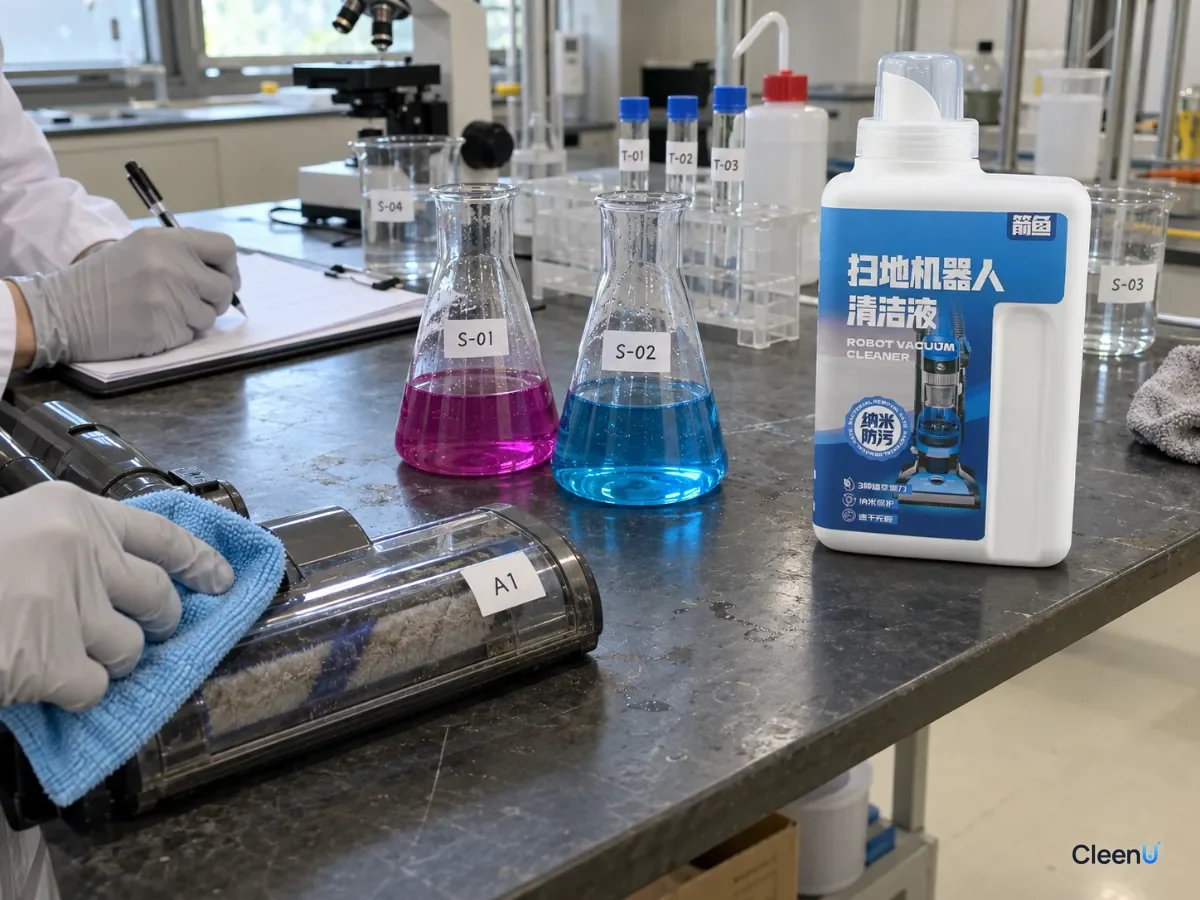
CleenU Robot Vacuum Cleaning Solution, for example, is a neutral, low-foam concentrate at pH 6.5 to 7.5 with low-foam nonionic surfactants and a defoamer, no wax, no chlorine and no particles. It dilutes at about 1:50 to 1:100; 10 to 20 mL per fill is usually enough.
Can chelating agents "solve" hard-water spots?
They help partly, but they can't do it all. It comes down to quantity.
Chelants bind calcium and magnesium in fixed proportions. Diluted 1:50 to 1:100, the working solution holds only a little chelant, so it can tie up only a limited amount of minerals, while most of the minerals come from the large volume of tap water in the tank. The harder the water and the more water the robot puts down, the more minerals there are, and the more the chelant is overwhelmed.
So the main fixes for hard-water spots remain:
Lower the water level: less water means fewer minerals left behind.
Where water is very hard and your manual allows, use distilled, purified or softened water. For more on water choice, see tap, filtered or distilled water in a robot mop.
Dose sparingly with a low-foam formula that isn't sensitive to hardness, so cleaner residue doesn't stack on top of scale.
For spots that have already formed, wipe tile by hand with diluted white vinegar, then with plain water. Never use acid on marble or terrazzo; use a neutral stone cleaner. And never put vinegar in the robot's tank.
It works in most robot mops from Roborock, iRobot (Roomba Combo and Braava), Ecovacs Deebot, Dreame and Narwal, and in floor washers such as Tineco. Add it to the clean water tank or the dock's designated detergent compartment as your manual directs. CleenU isn't affiliated with these brands; the names only indicate compatibility.
How to tell at home whether white spots are scale
A simple comparison tells you the source.
Wipe with a cloth dampened with plain water. If it comes off, it's usually cleaner residue.
If water won't remove it, wipe the tile with diluted white vinegar. If it comes off, perhaps with tiny bubbles as you wipe, it's carbonate scale (acid reacting with carbonate releases carbon dioxide).
If neither removes it, it may be damage or scratches in the floor itself, or another kind of deposit that needs a closer look.
Use the vinegar test on tile only, never on marble, terrazzo or cement grout.
Water hardness can change within the same city
Hardness isn't fixed. Different treatment plants and source waters serve different parts of the same city with very different hardness, and the same area can shift between wet and dry seasons or when the utility switches sources. So "no spots before, suddenly spots now" may mean the water changed, not the solution or the robot.
Check your utility's annual water quality report or test regularly with hardness strips or a TDS meter. When water gets harder, lower the water level or, if your manual allows, switch to distilled water.
Chelants and floor residue
The complexes chelants form with calcium and magnesium dissolve in water, but once the water evaporates, they stay on the floor like any other non-volatile ingredient. So more chelant isn't better; more means more solids and residue. Formulas usually include just enough chelant for the target water, as part of an overall low-residue design.
This article is part of the Robot Vacuum Cleaning Solution & Maintenance Guide, which covers the full maintenance schedule and links to every troubleshooting guide.
More questions people ask
Should I switch to distilled water to stop white spots?
Yes, in hard-water areas, if your manual allows it. The spots are mostly calcium and magnesium left as the water film dries, and chelants in the solution only reduce part of that. Lowering the water flow and keeping the solution at about 1:50–1:100 makes a bigger difference.
How can I tell hard-water scale from cleaner residue on my floor?
Wipe with plain water first: if it lifts easily or feels tacky, it's residue. If not, test tile with diluted vinegar; marks that dissolve with tiny bubbles are usually scale. Use vinegar only on tile, never on marble, terrazzo or grout, and never in the robot's tank.
If a solution has chelating agents, can I stop worrying about hard water?
No. The chelant in a diluted working solution can't bind all the calcium and magnesium in a full tank; it mainly keeps surfactants working and cuts some deposits. Lower water flow, softer water and not overdosing remain the main fixes for white spots.
Hard water leaves white spots after robot mopping because calcium and magnesium come out of the evaporating film as calcium and magnesium carbonate, and since the edge evaporates fastest, spots form rings with the whitest rim. Hard water also turns anionic surfactants into calcium soaps and weakens cleaning. Chelating agents grip calcium and magnesium like a claw so they stay dissolved and don't deposit, helping surfactants work in hard water, and nonionic surfactants are insensitive to hardness to begin with. But a diluted working solution holds only a little chelant, not enough for a tank of hard water, so lowering the water level, using softer water in hard-water areas and dosing sparingly remain the main ways to cut spots.