
Comparison
Robot Mop vs Wet-Dry Vacuum Cleaning Solution: Can You Swap Them?
Direct answer
Not by default. Both need to be low-foam, but they differ in strength, dilution and device limits. Only swap them when the label says the product works in both robot mops and wet-dry vacuums and your manuals allow it, and dilute to each machine's ratio.
How to choose
-
The label clearly says it's for robot mops and wet-dry vacuums, and both manuals allow third-party solutions
Choose Share one bottle, diluted to each machine's ratio
Products like this are designed around the foam, residue and water-path needs of both machine types.
-
You have wet-dry vacuum solution and want to put it in a robot mop
Choose Don't. Use plain water or a robot mop solution instead
Floor washer solutions are often designed for higher working strength, and the foam and residue can exceed what a robot and its dock handle.
-
You have robot mop solution and want to put it in a wet-dry vacuum
Choose Fine if the label or manual allows it; scale the dose to the floor washer's tank size
Robot mop solution is already built for low foam and low residue, so the risk is lower. Just confirm the floor washer's manual doesn't require its own brand.
-
The machine is under warranty and the manual says to use only the maker's solution
Choose Use the maker's solution
Damage from a third-party liquid may not be covered.
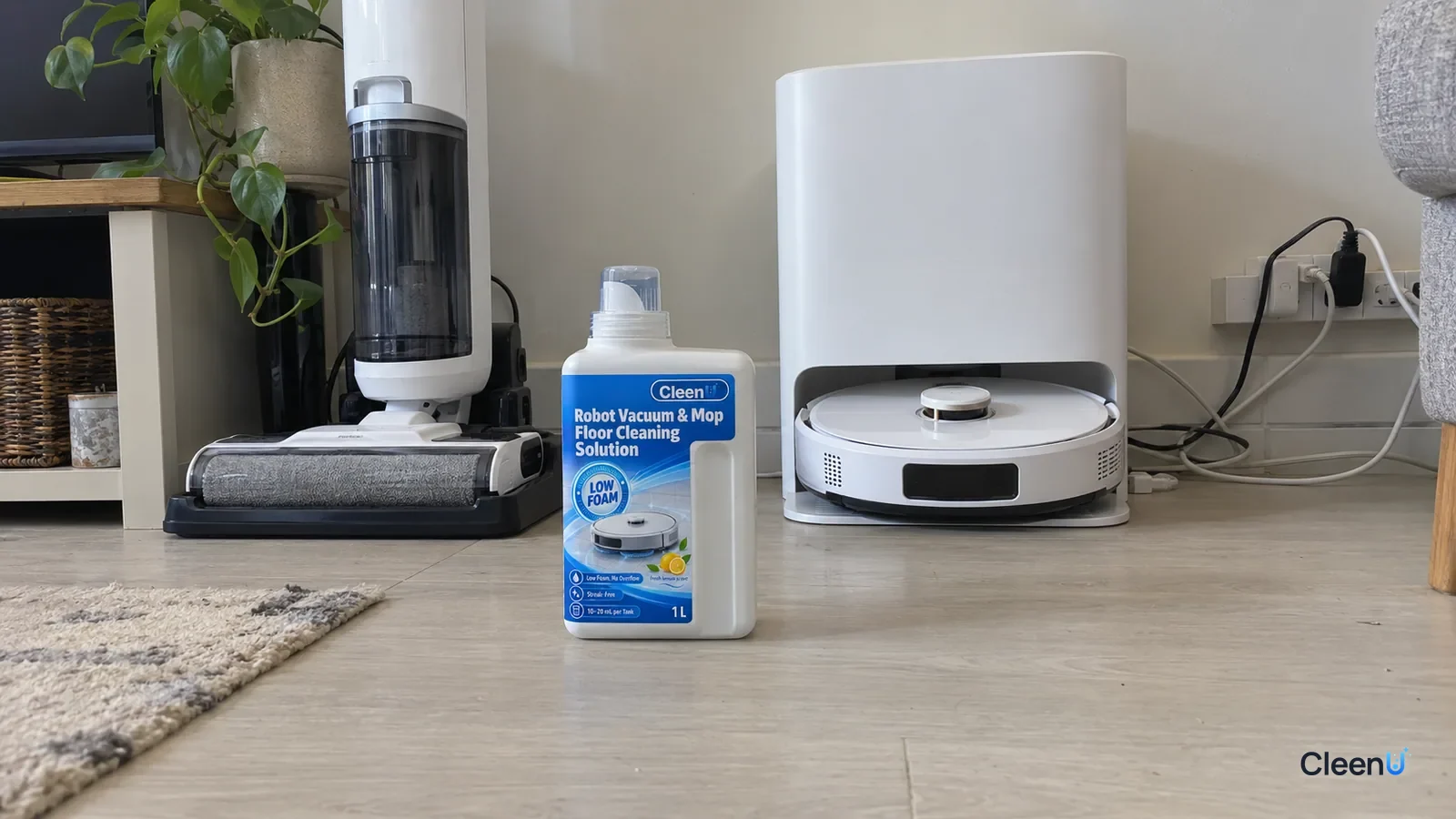
Plenty of homes now have two mopping machines: a robot mop that runs on a schedule every day, and a cordless wet-dry vacuum (floor washer) for weekend deep cleans, kitchen grease and sudden messes. Each came with its own bottle of solution, and sooner or later one runs low. Can you top up with the other?
The answer isn't a simple yes or no. The two types of solution share a lot of design goals, but they weigh concentration, foam control, residue and device limits differently. Knowing where they differ tells you when sharing is fine and when it isn't.
How do the two machines work differently?
A robot mop cleans by wiping the floor over and over with a damp pad. A small pump feeds water from the clean tank through tiny outlet holes onto the pad. Models with a self-cleaning dock return every so often to rinse the pad and pump the dirty water into a waste tank. It's low water flow, slow and steady, every day.
A wet-dry vacuum is pushed by hand. A spinning roller sprays water, scrubs the floor and immediately vacuums the dirty water into its recovery tank with strong suction. It uses more water, scrubs harder and pulls harder, which is why people grab it for kitchen grease, spilled drinks and pet messes. Most run a self-clean cycle on the roller and lines after each use.
Those two ways of working put different demands on the solution.
Where do the two solutions differ?
Robot mop solution vs wet-dry vacuum solution, point by point
| What to compare | Robot mop cleaning solution | Wet-dry vacuum cleaning solution |
|---|---|---|
| Foam | Very low; dock pad washing and dirty-tank level contacts are sensitive to foam | Low; strong suction pulls foam into the recovery tank and airflow path |
| Working strength | Usually very dilute, designed for low concentration | Some are designed for higher strength to tackle heavier soil |
| Residue | Very low; no rinse pass, and it builds up on the same floor every day | Low; heavier cleaning per use, but less often |
| Water path | Tiny outlet holes and a small pump, sensitive to thickness, particles and wax | Wider nozzles and lines, but the roller and airflow path are still sensitive to foam and residue |
| Auto-dosing | Some docks have a detergent compartment that needs a free-flowing liquid | Some models auto-mix; follow the manual |
| Typical use | A small dose every day, long term | As needed, with larger doses per use |
Why is foam the line neither machine can cross?
Both machines have a dirty water tank, and both rely on sensors or a float to tell when it's full.
Robot mop docks often use two metal contacts to sense the waste water level. Foam holds a lot of water and conducts electricity, so once it piles up to the contacts, the dock thinks the tank is full and stops with an error. That's the most common reason behind a "dirty tank full" alert when the tank isn't full.
A wet-dry vacuum pulls dirty water and foam into its recovery tank at high speed. Too much foam fills the tank fast and trips the float or sensor, and foam can get past the baffle into the airflow path and motor, which is hard on the motor over time.
Whether foam lasts depends on how strong the bubble walls are. High-foam surfactants pack tightly into the thin liquid film around each bubble, making it elastic and slow to break. When part of the film stretches thin, surfactant molecules flow in from nearby to patch it, an effect called the Marangoni effect, and it's one of the main reasons foam stays stable. Low-foam formulas use nonionic surfactants that pack loosely into those walls and add a defoamer that disrupts them, so bubbles pop quickly.
So both solutions have to be low-foam. The difference is that a robot dock's level contacts are more sensitive, and the robot runs every day, so robot mop solutions often have to meet a stricter foam standard.
Why are robot mops pickier about residue?
The residue a cleaner leaves on the floor is mostly surfactant and other non-volatile ingredients. Formulators describe it as solids content: how much is left once the liquid fully evaporates. The higher the concentration and solids content, the more stays behind with every pass.
A wet-dry vacuum scrubs and then immediately sucks the dirty water back up, so most of the solution goes into the recovery tank and only a very thin damp film stays on the floor. It's also used every few days, with robot or hand mopping in between.
A robot mop wipes the floor with a damp pad and lets it air-dry. When the water in that film evaporates, nearly all of the non-volatile ingredients stay exactly where they were. And it mops the same floor every day, so today's residue isn't fully gone before tomorrow's layer goes on. Each layer is tiny, but together they become a tacky, slippery film you can see in side light.
That's how the same liquid can work perfectly in a floor washer and leave a robot-mopped floor stickier every week. The liquid isn't bad; it was designed for different conditions.
What can go wrong putting floor washer solution in a robot mop?
More foam. If a wet-dry vacuum solution is designed for higher working strength, pouring it into a robot, or dosing it the way you would a floor washer, can create noticeably more foam, leading to false "full" alerts and overflow.
More residue. A robot mops the same floor every day without a rinse pass. At a strength designed for a floor washer, residue builds up day after day, and floors turn tacky, slippery or streaky.
Clogged lines. Some floor washer solutions are thicker or contain fragrance and thickeners that can coat and dry inside a robot dock's detergent compartment and tiny outlet holes.
So don't assume floor washer solution belongs in a robot mop. If you want to try it, check that the label says it's for robot mops, then check your manual.
Can robot mop solution go in a wet-dry vacuum?
The risk is lower. Robot mop solution is designed for low foam and low residue, so it usually won't foam much in a floor washer. Keep three things in mind.
Scale the dose to the tank. Floor washer tanks are often bigger than robot tanks. Work out the amount at the same ratio rather than adding a single capful.
Check the manual. Some brands restrict you to their own solution in the warranty terms or have specific rules for third-party liquids.
Know its limits on heavy soil. Robot mop solution is made for everyday mopping. For thick kitchen grease or dried-on spills, make an extra pass with the floor washer instead of adding more solution.
What makes one bottle work for both?
If you'd rather buy one bottle for both machines, look for:
A label that clearly says it's for robot mops and wet-dry vacuums, with a dilution ratio or dose for each.
A low-foam formula, ideally nonionic surfactants paired with a defoamer.
Neutral or near-neutral pH with no wax, no particles and no chlorine, which is easier on floors and on machine seals.
Good flow, so it can work in auto-dosing compartments too (always per your model's manual).
CleenU Robot Vacuum Cleaning Solution is designed along these lines: a neutral, low-foam concentrate at pH 6.5 to 7.5 with low-foam nonionic surfactants and a defoamer, no wax, no chlorine and no particles, made for mopping with robot mops and floor washers. It dilutes at about 1:50 to 1:100. For a robot, 10 to 20 mL per fill is usually enough. For a floor washer, scale to the tank: about 10 to 20 mL per liter of water, or about 20 to 40 mL for 2 liters. It works in most robot mops from Roborock, iRobot (Roomba Combo and Braava), Ecovacs Deebot, Dreame and Narwal, and in floor washers such as Tineco. Add it to the clean water tank or the designated detergent compartment as your manual directs. CleenU isn't affiliated with these brands; the names only indicate compatibility.
Brand-name solution or a universal one?
Most robot mops and floor washers have a brand-name solution. It's the closest match to the machine, but it usually costs more, and you need a different bottle for each machine. A universal solution covers more than one machine at a friendlier price, as long as it's genuinely designed for low foam, low residue and device compatibility, and your manual allows it. For a fuller comparison, see brand-name vs universal robot vacuum cleaning solution.
This article is part of the Robot Vacuum Cleaning Solution & Maintenance Guide, which covers the full maintenance schedule and links to every troubleshooting guide.

Common questions about swapping robot mop and wet-dry vacuum solutions
Can I put wet-dry vacuum solution in my robot mop?
Not by default. Only use it if the label says it's also for robot mops and your manual allows it. Otherwise foam and residue can exceed what the robot and dock can handle.
Can I put robot mop solution in my wet-dry vacuum?
Yes, if the label or manual allows it. Scale the dose to the floor washer's tank. Its low-foam, low-residue design keeps the risk low.
Can both machines share one bottle?
Yes, if the label says it's for both types of machine, both manuals allow it, and you dilute to each machine's ratio.
I put the wrong solution in. What now?
Stop the machine, empty the clean and dirty tanks, and rinse them. Rinse the pads or roller, run once with plain water, and resume only when there's no foam and no error.
Is floor washer solution stronger at cleaning?
Some are designed for higher strength and handle heavy soil better. Stronger doesn't mean suitable for daily robot use, though; residue and foam matter more there.
Can I use dish soap in a wet-dry vacuum?
Better not. Dish soap is high-foam, and the vacuum's strong suction pulls that foam into the recovery tank and airflow path, which can affect the motor.
Does robot mop solution work in floor washers like Tineco?
Yes, a neutral, low-foam robot mop solution can work in most wet-dry floor washers, including most Tineco models. Add it to the clean water tank, not the dirty tank, at about 1:50 to 1:100, and follow the manual first if it requires the brand's own solution during warranty.
What is the difference between robot mop and floor washer solution?
The main difference is how much foam and residue each machine tolerates. A robot mop has a small tank and fine outlet holes and leaves solution on the floor, so it needs lower foam and less residue. A floor washer suctions dirty water back up and tolerates a bit more cleaning strength.
If you have a robot mop and a wet-dry vacuum and want one low-foam, wax-free solution you can dilute for both, try Robot Vacuum Cleaning Solution.
Robot mop and wet-dry vacuum cleaning solutions aren't automatically interchangeable. Both must be low-foam, but robot mops run daily, their docks are more sensitive to foam and they never rinse, so their standard for foam and residue is stricter, while some floor washer solutions are designed for higher strength. Don't pour floor washer solution into a robot mop. Robot mop solution can go in a floor washer when the label and manual allow. For one bottle that does both, choose a low-foam, neutral, wax-free product labeled for both machines and dilute to each one's ratio.