
How-to
How Long Does a Bottle of Robot Mop Cleaning Solution Last? Do the Math for Your Home
Direct answer
A 1 L (34 oz) bottle of CleenU Robot Mop Cleaning Solution covers about 50 to 100 fills at 10 to 20 mL each. Mopping three times a week, that's roughly 4 to 8 months; daily, about 2 to 3 months. Your exact number depends on how much water your setup uses each week.
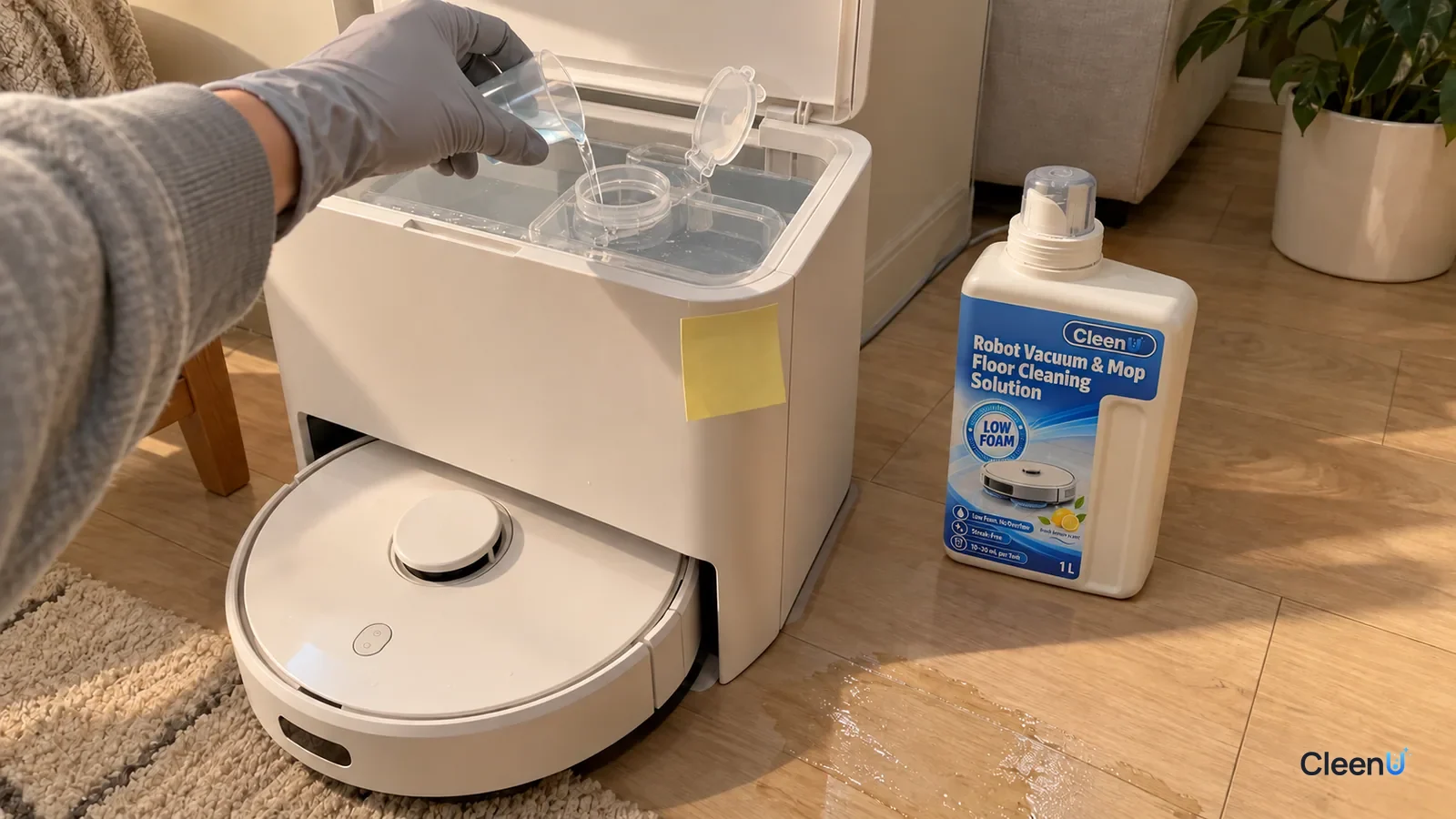
Here's the quick answer. CleenU Robot Mop Cleaning Solution comes in a 1 L (about 34 oz) bottle, dilutes about 1:50 to 1:100, and 10 to 20 mL per fill is usually enough. That works out to roughly 50 to 100 fills per bottle. If you mop three times a week and add solution once per run, a bottle lasts about 4 to 8 months. Mop every day, and it's closer to 2 to 3 months. Bigger homes, pets, and docks that wash the mop often will go through it faster.
Why do reports online range from six months to a few weeks? Because "a fill" means different things. For one owner it's topping up a small onboard tank; for another it's a dock's multi-liter clean tank that lasts days and also supplies mop-wash water. So the better question is how much clean water your setup uses each week. Multiply that by the dilution ratio and you're close.
Three numbers decide how long a bottle lasts
You only need three numbers:
- Bottle size. CleenU Robot Mop Cleaning Solution comes in 1 L, or 1,000 mL of concentrate.
- Dilution ratio. About 1:50 to 1:100, meaning one part concentrate to 50 to 100 parts water.
- Clean water used per week. This varies the most from home to home and is the one people guess wrong.
The first two tell you something useful on their own. At 1:50, one liter of concentrate treats about 50 L of water. At 1:100, about 100 L. In other words, one bottle treats roughly 50 to 100 L of water, or about 13 to 26 gallons. That doesn't change with home size or robot model, and it's the starting point for every estimate below.
Now add the third number:
How to calculate how long a bottle lasts
- Concentrate used per week = clean water used per week × dilution ratio (1/100 to 1/50)
- Weeks per bottle = 1,000 mL ÷ concentrate used per week
- Or skip a step: weeks per bottle = 50 to 100 L ÷ clean water used per week
- The 1:100 end gives the longest-lasting estimate; the 1:50 end gives the shortest
Here's an example that only shows the math. The water use is an assumption, not a measurement from any robot. Say your dock goes through about 10 L (2.6 gal) of clean water a week. At 1:100, that's about 100 mL of concentrate a week, so a bottle lasts about 10 weeks. At 1:50, it's about 200 mL a week, or about 5 weeks. If your floors aren't very dirty and you stay at the low end, that's a bottle every two months or so.
Where the water goes: three uses inside the machine
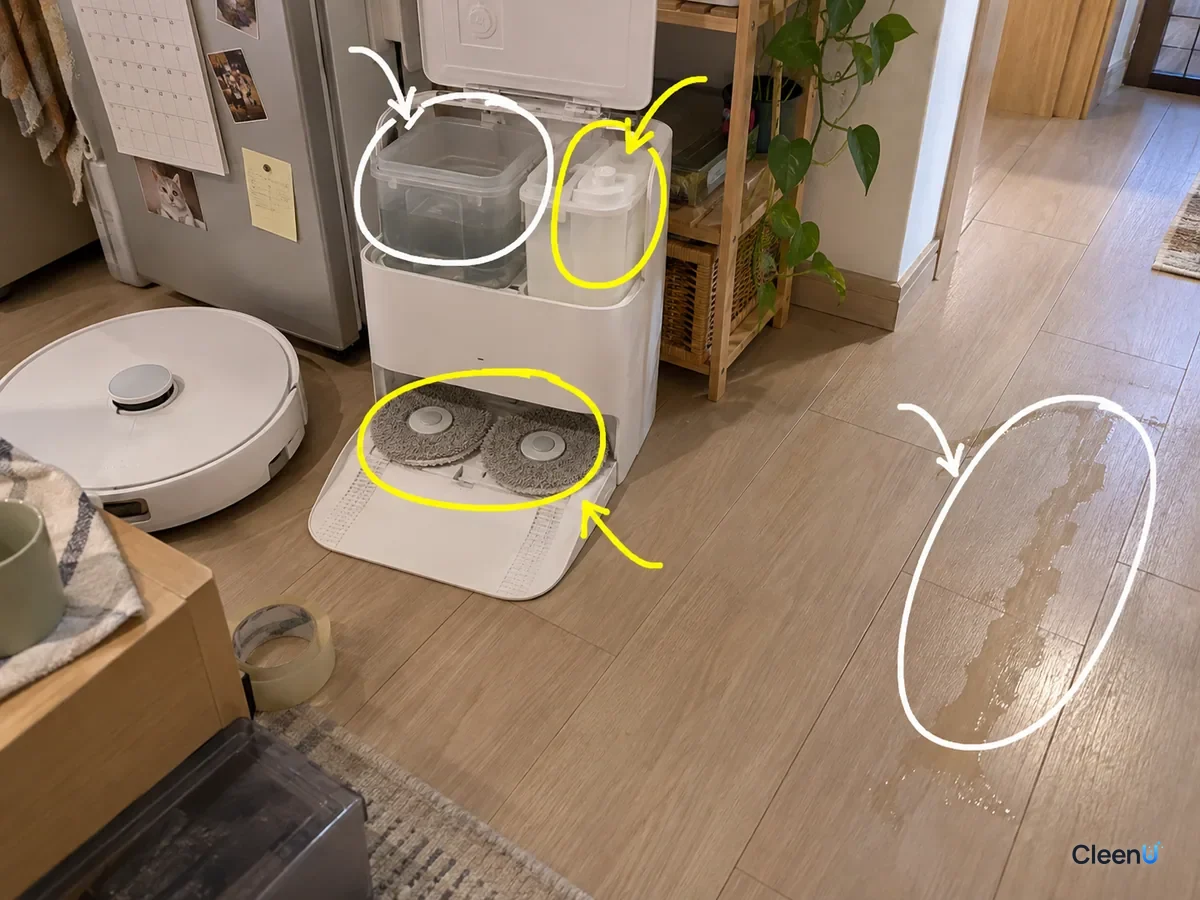
Most people underestimate weekly water use because they only think about the floor. A robot mop with a self-cleaning dock usually sends clean water three places.
1. Wetting the mop and the floor. The robot has a small onboard tank that the dock refills. A pump feeds water to the mop at the flow level set in the app. Higher flow and more square footage mean more water.
2. Washing the mop in the dock. The robot returns to the dock during a run, and the dock rinses and scrapes the mop, then pulls the dirty water into the dirty tank. More frequent returns and deeper wash modes use more water.
3. Dock self-cleaning. Some docks rinse the wash tray and other parts after a job, which uses a bit more.
If you mix solution into the dock's clean water tank, all three of those streams carry solution and all of it counts toward weekly use. That's why "once a day" runs through a bottle much faster on a dock-based robot than on an older model with only an onboard tank.
Docks with an auto-dosing compartment work differently. You don't mix solution into the clean water tank. The dock draws it from the compartment and adds it at a preset ratio to the mop-wash water and the water that refills the robot. Roborock's manual, for example, says the dock automatically adds solution during mop washing and robot refills at a preset ratio. In that case, the dock's dosing decides how long a bottle lasts, not your pour.
Worked examples: how long a bottle lasts in different homes
These are examples to show how the estimate works. "One fill per run" assumes about 10 to 20 mL per fill, and the weekly water figures are assumptions for illustration. To get your real number, use the one-week tracking method below.
Example estimates for one 1 L bottle
- Small apartment, 3 runs a week, one fill per run
- 17–33 weeks, about 4–8 months
- Two-bedroom, daily runs, one fill per run
- 50–100 days, about 2–3 months
- Dock uses about 8 L (2.1 gal) of water a week (assumed)
- 6–12 weeks
- Three-bedroom with pets, dock uses about 20 L (5.3 gal) a week (assumed)
- 2.5–5 weeks
Let's walk through the last row so you can plug in your own numbers. Assume the dock uses about 20 L of water a week. At 1:100, that's 20 L × 1/100 = 200 mL of concentrate a week, and 1,000 mL ÷ 200 mL = 5 weeks. At 1:50, it's 400 mL a week, or 2.5 weeks. So a busy pet household might use about a bottle a month, closer to five weeks if floors are only lightly soiled and you stay at the low end.
Two things stand out. How often you mop and how much water the dock uses matter far more than square footage, and the low end versus the high end of the ratio changes bottle life by a factor of two. Use the low end for routine cleaning and save the high end for greasy footprints.
Want to know what each fill costs? Enter the price you paid, the 1,000 mL bottle size, and the milliliters you actually add per fill.
Cost per fill
Pouring extra doesn't stretch a bottle
Some people figure a stronger mix means fewer passes and better value. The chemistry says otherwise.
Surfactants do most of the cleaning in robot mop solution, and they have a threshold called the critical micelle concentration. Above it, surfactant molecules cluster into tiny structures called micelles that surround skin oil and greasy footprints and hold them in the water so the mop can carry them off. Up to a working strength, adding a bit more clearly improves cleaning. Past that range, results level off. It's like adding more sugar to tea that's already sweet. A concentrate's labeled range follows that rise-then-plateau curve: the low end covers everyday dirt and the high end covers heavier soil.
The extra surfactant doesn't vanish. Some stays in the film of water on the floor and dries tacky or hazy. The rest ends up in the dirty tank as foam. So overpouring doesn't buy a cleaner floor, and it shortens the life of the bottle.
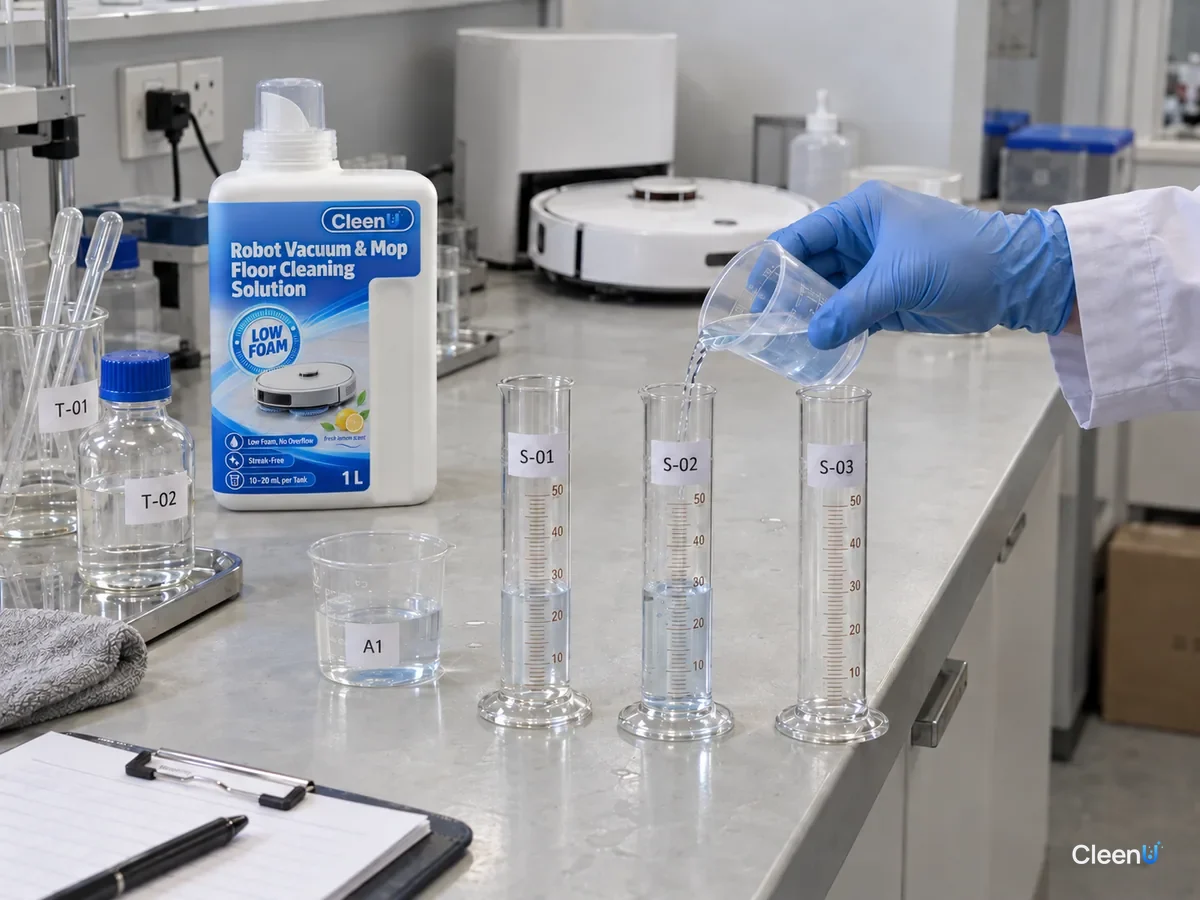
Measuring error matters more than people think. Here's an example to illustrate: if you mean to add 10 mL but actually pour 15 mL each time, a bottle drops from about 100 fills to about 67. That's a third of its life gone. The more concentrated a product is, the more a few extra milliliters matter. So use the measuring cap: set it level, read it at eye level, and pour to the same mark every time. That can add weeks to a bottle compared with eyeballing it.
For more on dosing, see How much cleaning solution should you put in a robot mop? To compare concentrate and ready-to-use by cost per run, see Concentrate vs. ready-to-use robot mop solution: which costs less per run?
Can you mix a big batch ahead of time? Why diluted solution should be used the same day
A concentrate keeps for a long time because, at full strength, the formula isn't a friendly place for microbes. Dilute it 50 to 100 times and that protection is largely gone. Tap water's residual chlorine, which helps hold microbes back, also fades when water sits open. Add the bits of organic matter that cling to any tank or jug, and within a few days a diluted mix can turn cloudy or smelly and leave slimy biofilm in the tank. For more on that musty smell and slime, see Why does a robot vacuum's clean water tank smell musty?
The rule is simple: concentrate keeps; diluted solution gets used the same day. If your dock's clean tank lasts several days, mix only what you'll use that day or that run, or add solution each time you fill the tank with fresh water. Rinse the tank when it runs empty, and empty and dry it before you travel.
How you store the concentrate also affects how long a bottle lasts. CleenU Robot Mop Cleaning Solution keeps 24 months unopened. After opening, cap it tightly and keep it somewhere cool and dark that won't freeze. Avoid spots next to a heater, a sunny balcony, or an unheated garage in winter. Cold can thicken some solutions and make them harder for an auto-dosing compartment to draw. If yours froze, see Is robot mop solution still OK after freezing? If the concentrate changes color, separates, smells off, or the bottle bulges, stop using it; see Robot mop solution looks thinner, discolored, or separated. Is it still usable?
Does auto-dosing use more solution or less?
It can go either way, depending on how you were dosing before.
When it uses less: Hand-dosers often overpour or add another shot before the tank runs dry. Auto-dosing adds the same amount every time, and many docks let you turn it off for some jobs, such as water only in bedrooms and solution in the kitchen. That stretches a bottle.
When it uses more: Auto-dosing usually adds solution to both the mop-wash water and the robot refill water, so frequent mop washing means more solution. The dock also doses in fixed steps, which won't always line up exactly with the ratio on the bottle in your hand. If the compartment drops quickly and floors feel tacky or the dirty tank foams, the dosing level is set too high. Lower it a step in the app, use auto-dosing every few runs, or mix by hand at about 1:50 to 1:100.
For a dosing compartment, choose a solution that's low-foam, neutral, particle-free, wax-free, dries without a crust, and still flows when cold. The dock draws it smoothly and the dosing levels stay predictable. For cleaning the compartment, see How to clean a robot vacuum dock's auto-dosing tank.
Track one week to get your real number
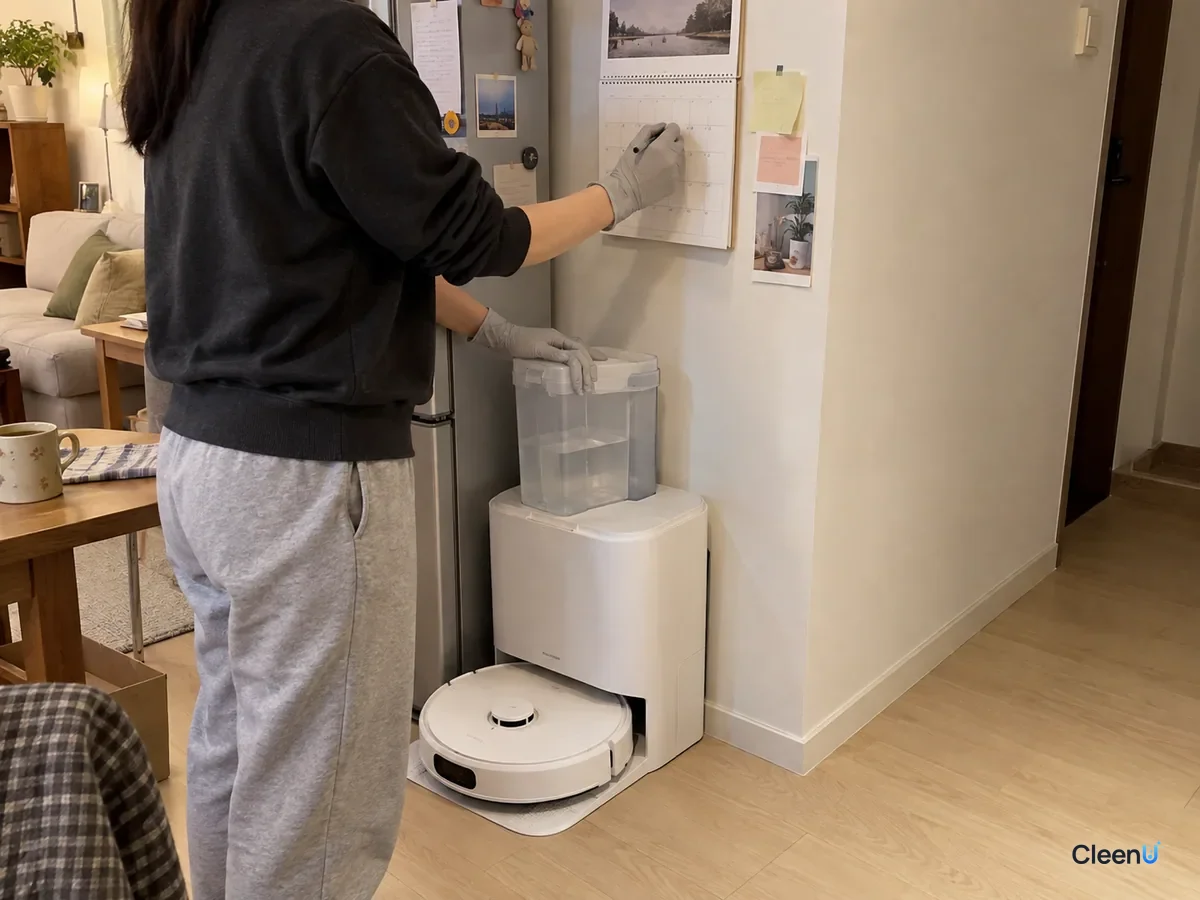
The examples above are estimates. The most accurate way to know your own number is to track it for a week or two. A pen and a sticky note or wall calendar are all you need.
Figure out how long your bottle will last in one week
Note the start date and fill level
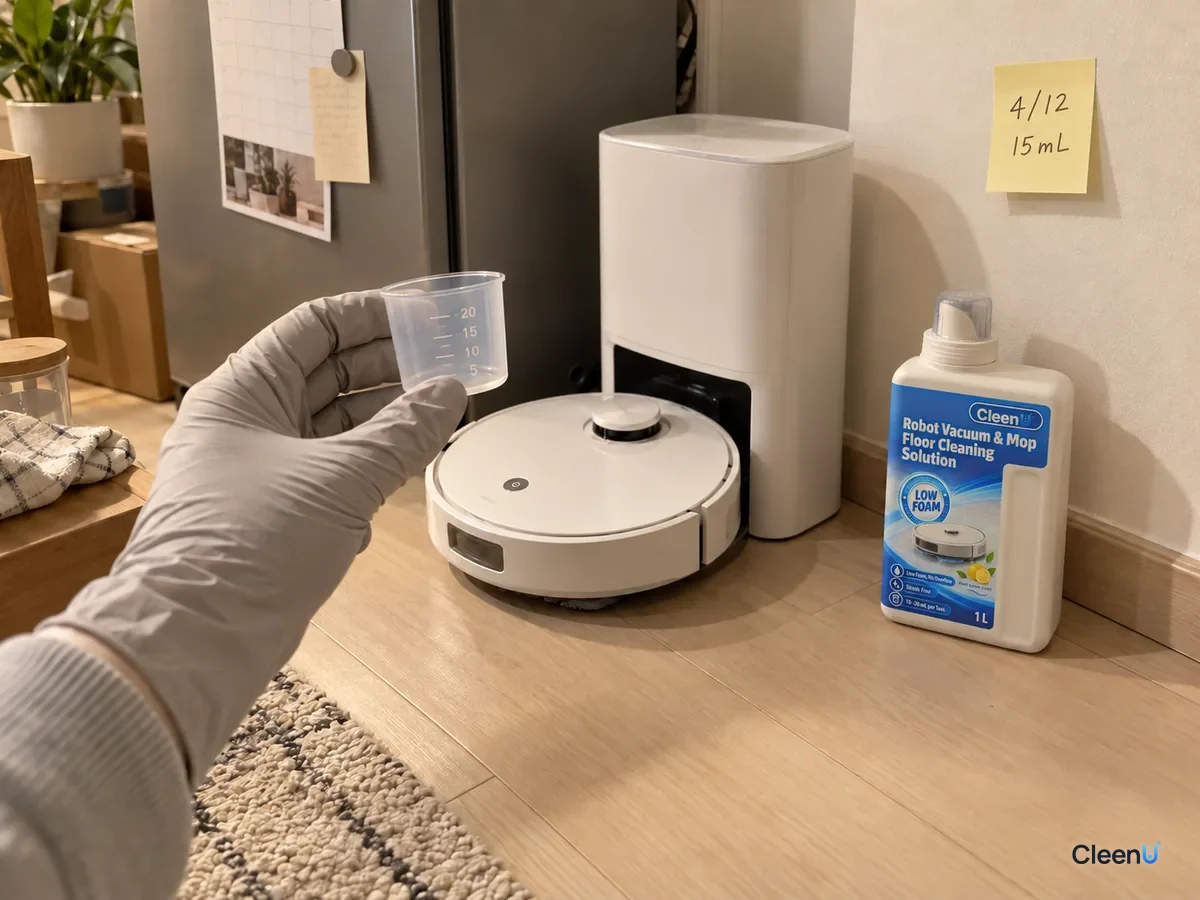
Write the date on a sticky note or calendar. Put a strip of tape on the side of the bottle and mark the current liquid level. You can start with a bottle that's already open.
Dose by water volume with the measuring cap
Add water to the clean tank first, then measure solution at about 1:50 to 1:100, for example 10 to 20 mL per liter (about 34 oz) of water. Set the cap level and read it at eye level. Start at the low end.
Caution:Never add solution to the dirty water tank. On docks with an auto-dosing compartment, add solution only to the compartment, not the clean tank.
Log every fill
Write down the date, how many milliliters you added, and roughly how many days that tank lasted. On auto-dosing docks, skip the per-fill amounts and just note the compartment level every few days.
Do the math after one to two weeks
Add up the milliliters and divide by the number of weeks. That's your weekly concentrate use. Divide 1,000 mL by that number to get weeks per bottle.
Fine-tune based on the floor
If floors dry clean, with no tackiness or haze, the current dose is enough, so stay at the low end. For greasy areas, run an extra pass there instead of strengthening the whole tank.
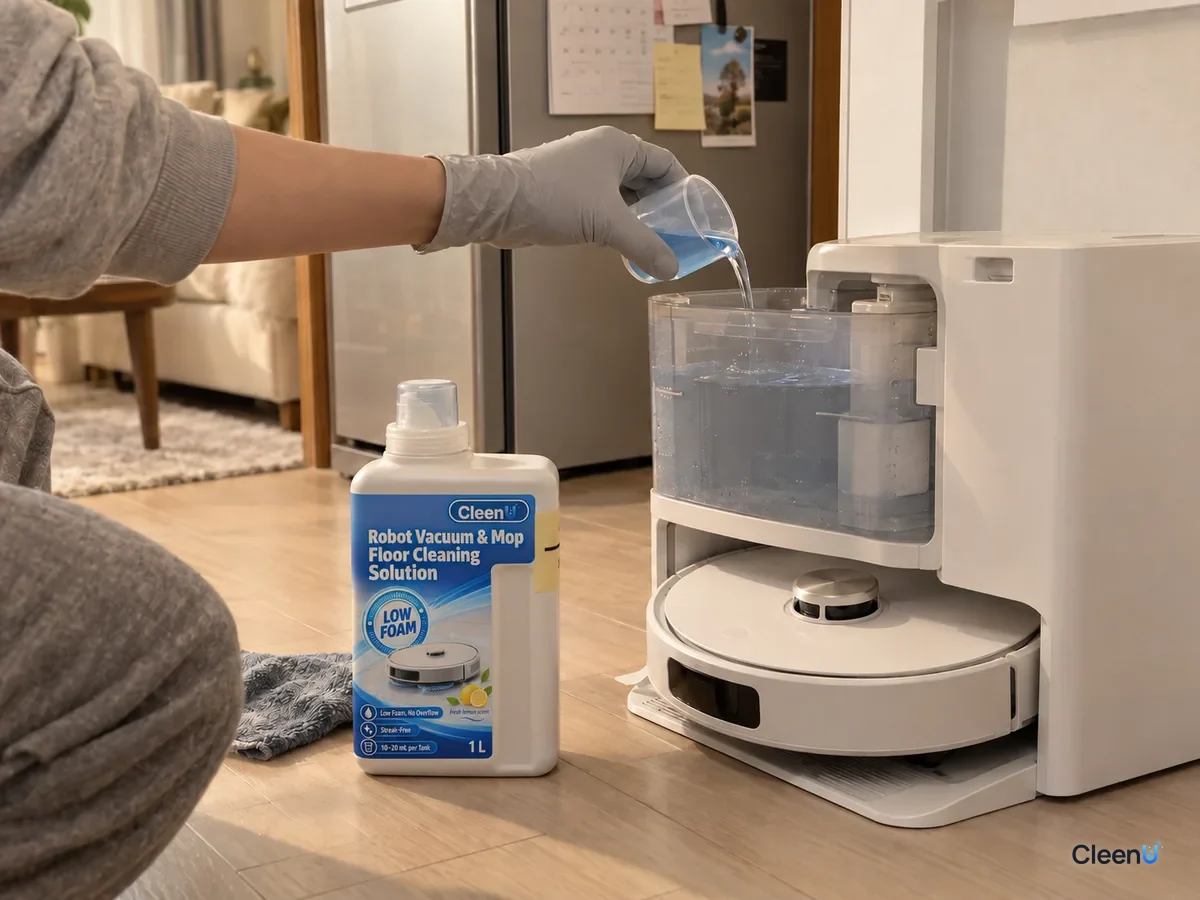
Tracking usually shows that mop washing uses more water than expected and hand-dosing drifts high. Fix both and a bottle often lasts weeks longer.
CleenU Robot Mop Cleaning Solution: the math on one bottle
Take CleenU Robot Mop Cleaning Solution as an example. It's a neutral concentrate, pH 6.5–7.5, built on low-foam nonionic surfactants with a defoamer, wax-free and particle-free. Each 1 L bottle comes with a measuring cap and dilutes about 1:50 to 1:100; 10 to 20 mL per fill is usually enough, so one bottle covers roughly 50 to 100 fills. Pet homes can pick the fragrance-free Pet Homes version.
It works with most robot mops from Roborock, iRobot Roomba Combo and Braava, Ecovacs Deebot, Dreame, and Narwal, plus most Tineco, Shark HydroVac, Eufy RoboVac, and Bissell CrossWave models. Add it to the clean water tank or the dock's designated dosing compartment as your manual directs; on Narwal models, add it to the clean water tank. If your model's manual says otherwise, follow the manual. CleenU is not affiliated with these brands; names are used only to describe compatibility.
If you want a concentrate you can measure precisely and stretch over months, take a look at our Robot Vacuum & Mop Floor Cleaning Solution.
Stop using the bottle if you see any of these
Set it aside if the concentrate has clearly changed color, separated, or smells sour or harsh; the bottle is bulging; after freezing and warming it still has flecks or is too thick to pour; or diluted solution has turned cloudy or smelly after a few days. Empty the clean tank or dosing compartment and rinse and dry it. If the concentrate itself looks or smells wrong, open a fresh bottle and contact the seller.
How long robot mop solution lasts: common questions
How many fills do I get from a 1 L bottle?
About 50 to 100 at 10 to 20 mL per fill. Stay at the low end for everyday cleaning and you'll get close to 100.
If I mop every day, how long will a bottle last?
About 50 to 100 days, or 2 to 3 months, at one fill a day. Docks that wash the mop often and have the whole clean tank dosed will use it faster.
Why did my bottle run out in a month?
Check for overpouring first. Common causes are pouring by eye, skipping the measuring cap, or adding solution before the tank is empty. Frequent mop washing with a fully dosed tank also adds up. Track a week to find the cause.
Isn't a stronger mix cheaper if it means fewer passes?
No. Past the working strength, extra solution doesn't clean better; it adds residue and foam and shortens bottle life. An extra pass on a dirty spot costs less than strengthening the whole tank.
Does auto-dosing use more solution?
Sometimes. It prevents overpouring, but it usually doses mop-wash water too, so frequent washing adds up. If the compartment drops fast and floors feel tacky, turn auto-dosing off and use it every few runs.
Can I mix a big batch and use it over the week?
Don't. Concentrate keeps, but diluted solution should be used the same day. A mix left for days can turn cloudy or smelly and leave slime in the tank.
How long does robot mop solution keep after opening?
CleenU Robot Mop Cleaning Solution keeps 24 months unopened. After opening, cap it tightly and store it cool, dark, and above freezing (32°F). Stop using it if it changes color, separates, smells off, or the bottle bulges.
It froze in the garage. Can I still use it?
Warm it up first and check. Bring it to room temperature and shake. If it's clear, even, and pours normally, it's usable; if it has flecks, separates, or stays thick, don't use it.
My pets make me go through it fast. How can I stretch a bottle?
Vacuum hair before mopping, use plain water in rooms that stay clean, and add solution only for pet areas and entryways. An extra pass on dirty spots beats running the whole tank at the high end.
More on dosing and upkeep: How often should you run a robot mop?, Storing a robot vacuum: what to do with the tanks and solution, and Why cheap robot mop solution can cost more to use.
A 1 L bottle of CleenU Robot Mop Cleaning Solution treats about 50 to 100 L of water, or about 50 to 100 fills at 10 to 20 mL each. Mopping three times a week, that's roughly 4 to 8 months; daily, about 2 to 3 months. Your exact number depends on weekly water use, especially the water your dock uses to wash the mop. To make a bottle last, dose with the measuring cap, stay at the low end, use diluted solution the same day, and keep the concentrate capped somewhere cool. Track one week and you'll have a number that fits your home.