
Testing & Quality
A Simple Shake Test for Robot Mop Cleaning Solution Foam
Direct answer
Dilute the solution at the label ratio, fill a clear bottle halfway, cap it and shake hard for 10 seconds. Check the foam right away and again after a minute, next to a bottle of plain water. Foam that collapses to a thin ring is low-foam. Foam that's still piled high after a minute doesn't belong in a robot mop.
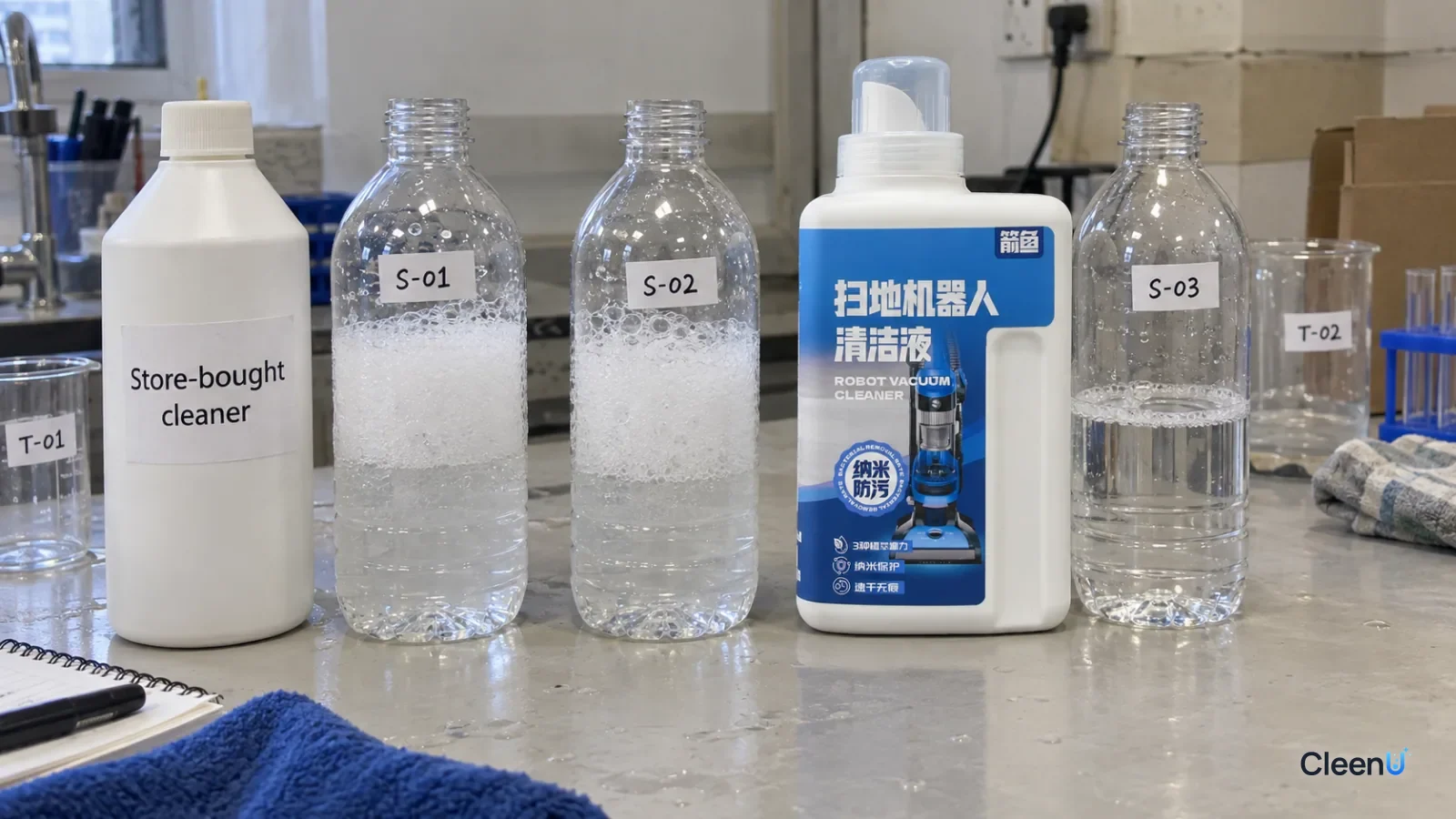
You bought a new robot mop cleaning solution and the label says low-foam, but how low? Or you have a floor cleaner that doesn't say, and you want to know whether it can go in your robot. You don't need any equipment. Two or three clear bottles and a good shake give you a useful answer in five minutes.
It's called a shake test, and the idea is close to the foam tests labs use: at the same concentration and the same shaking, compare how high each liquid foams and how long the foam lasts.
Why test for foam?
Robot mops are very sensitive to foam. The pump and outlet holes pull air into the liquid. A self-cleaning dock scrubs the pads hard, which whips up foam. Many docks sense the dirty tank level with metal contacts, and because foam holds water and conducts electricity, foam that reaches the contacts triggers a false "tank full" alert. Foam can also spill over and get into the airflow path.
So foam height and how fast it collapses are among the most direct ways to judge whether a liquid can go in a robot mop. For more on false full alerts, see a "dirty tank full" alert when the tank isn't full.
What you need for a shake test
- Sample
- The solution diluted at its label ratio, plus plain water as a control. To compare two products, prepare one bottle of each.
- Conditions
- Room-temperature tap water, the same water you normally put in the robot. Each bottle filled to the same level, about halfway. The same person shaking each bottle with the same force and time.
- Equipment
- Several identical clear plastic or glass bottles with caps, a measuring cup or the product's cap, a phone timer and a marker.
- Pass criteria
- Check foam height right after shaking and again after 1 minute. If the foam collapses to a thin layer within a minute and looks close to the water control, it's low-foam and suits a robot mop. If thick foam is still piled high after a minute, it doesn't belong in a robot mop.
A five-minute shake test
Dilute at the label ratio
For 500 mL of water, a 1:50 ratio means about 10 mL of concentrate and 1:100 means about 5 mL. CleenU Robot Vacuum Cleaning Solution dilutes at about 1:50 to 1:100, so you can mix one bottle at each end of the range.
Caution:Always test at the ratio you actually use. Testing straight concentrate tells you nothing, because any concentrate foams more.
Fill and mark the bottles
Pour the diluted solution and the plain water control into identical clear bottles, each about half full. Cap them and mark the liquid level on each with the marker.
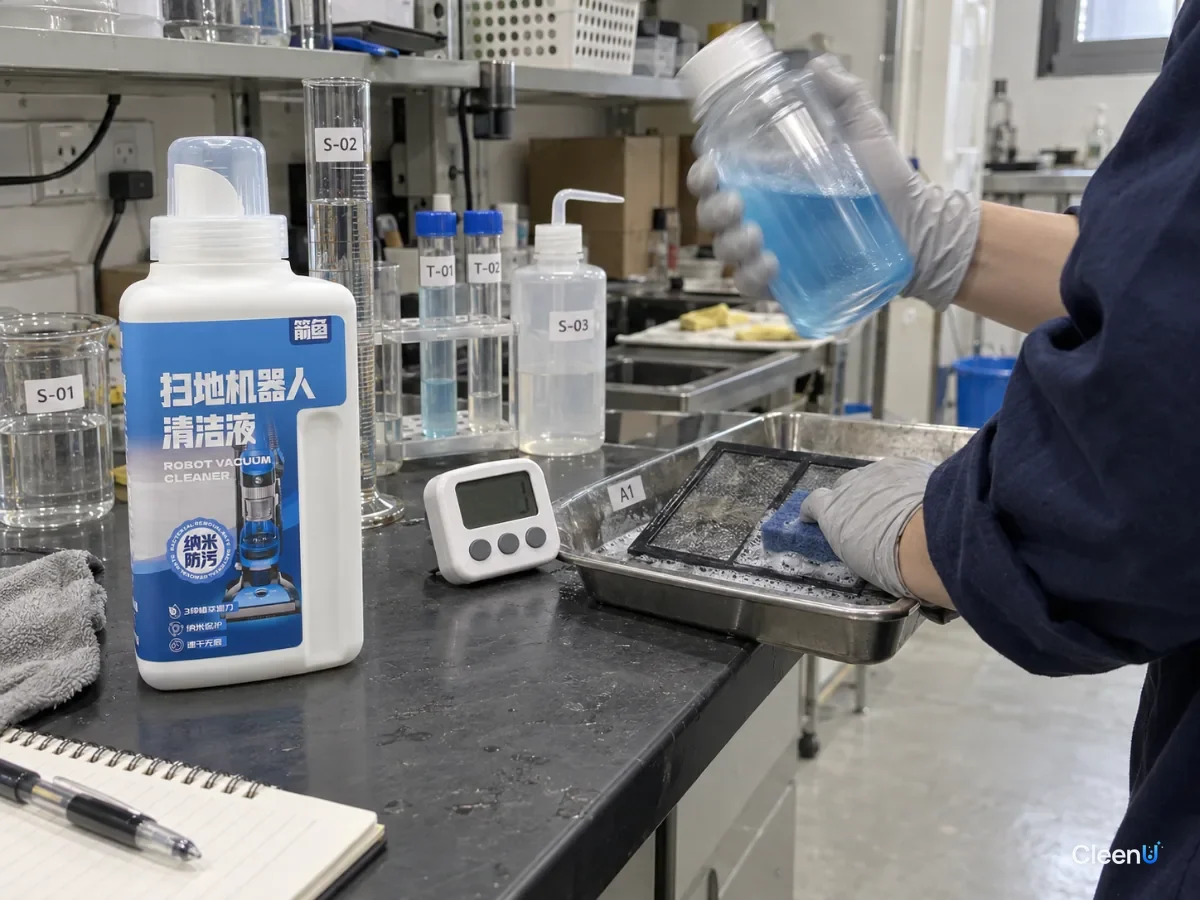
Shake each the same way for 10 seconds
Hold the bottle in both hands and shake hard up and down for about 10 seconds, keeping force and strokes as consistent as you can.
Check foam height right away
Set the bottle down and immediately note how far the foam rises above the liquid. Draw a line or take a photo.
Check again after one minute
Wait a minute and look again. Low-foam liquids collapse fast and leave only a thin ring on the surface. High-foam liquids stay tall and fine-bubbled.
Compare and decide
If the foam height is close to the water control and collapses fast, it's fine for your robot. If it's clearly taller and slower to collapse, keep it out. If you're unsure, try it at the low end of the label and check the dirty tank for foam over a few runs.
How to read the results
Tall foam that lingers usually means a formula with a lot of anionic surfactant or foam boosters, like dish soap or ordinary high-foam floor cleaner. Not for robot mops.
Tall foam that collapses fast, with coarse bubbles mostly gone within a minute, means there's a defoamer, but the formula still leans toward foaming. You can try it at the low end and watch the dirty tank.
Low foam that disappears quickly is a low-foam formula that suits robot mops.
Close to plain water: shaking plain water makes a few bubbles that vanish in seconds, and a low-foam solution behaves about the same or only slightly more.
Limits of the shake test
It's a simple comparison, so keep a few things in mind.
It shows relative foam, not an exact number. People shake with different force, so always compare within the same test against water or another product.
It checks foam, not cleaning or residue. Low foam is the entry requirement for a robot mop solution, but whether it cleans and whether the floor dries tacky need separate checks. For why low foam doesn't mean weak cleaning, see does low-foam mean weaker cleaning.
It isn't identical to the machine. How hard the dock scrubs, soil in the dirty tank, temperature and water hardness all affect real-world foam. Even a product that passes should get a glance at the dirty tank on its first run.
Water hardness matters. Some surfactants foam more in soft or distilled water and less in hard water. Test with the water you actually put in your robot.
Beyond the shake test: a quick dry-down residue check
Once a solution passes on foam, you can run a simple residue check to see whether it'll leave floors tacky.
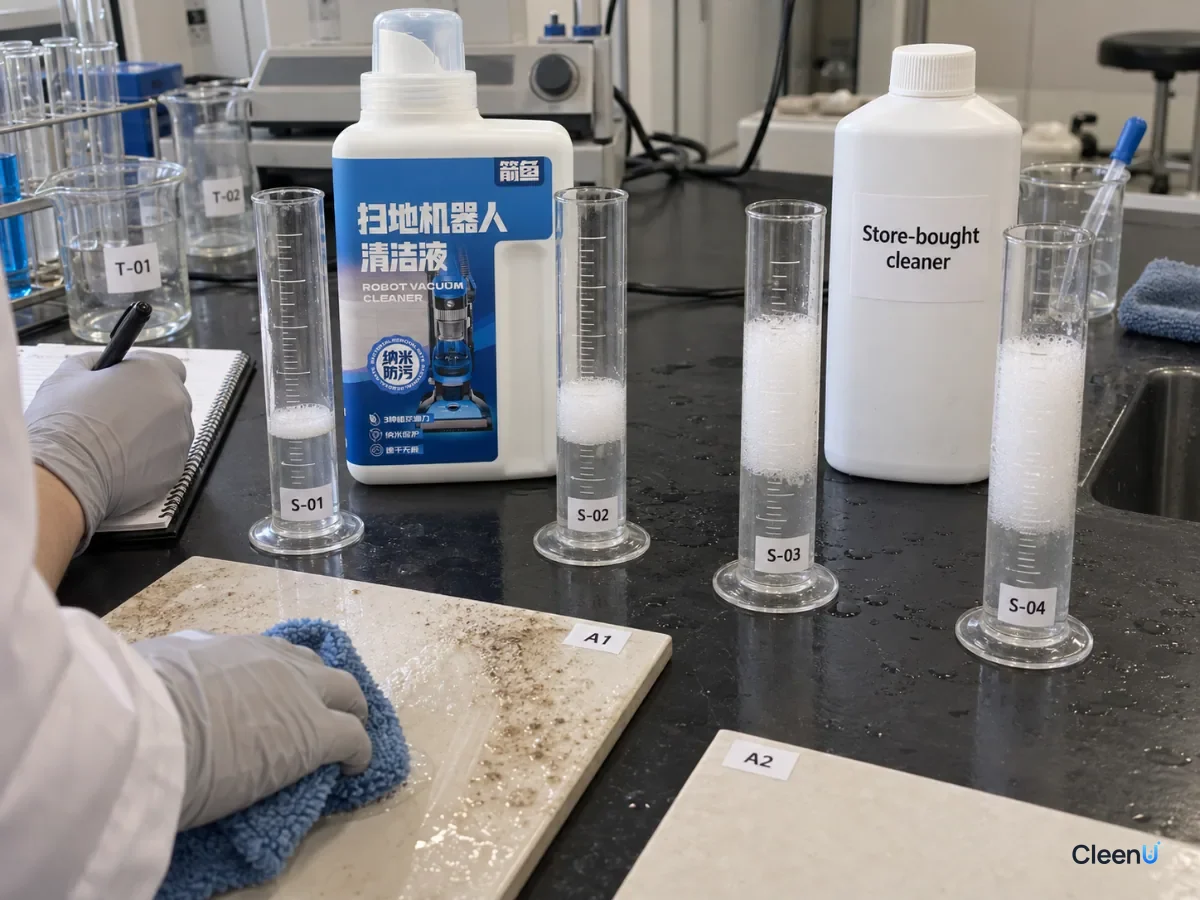
Grab a piece of dark tile, a pane of glass or a mirror. With a clean soft cloth, wipe a stripe of the solution diluted at the label ratio, and next to it a stripe of plain water as a control. Let both air-dry for ten minutes or so.
Then do three things.
Look in side light. Shine a phone flashlight across the surface at a low angle and check the solution stripe for haze, streaks or spots, compared with the water stripe.
Touch it. Run a clean fingertip lightly across it and feel for tackiness, drag or unusual slickness.
Wipe it. Rub a dry, dark soft cloth over it and check whether any white residue comes off.
If the residue looks close to the water control and feels dry, it suits daily robot mopping. If there's clear residue that feels tacky or slick, the formula's solids content is on the high side or its ratio is off, and daily mopping will make floors stickier. For more, see sticky floor after robot mopping.
Note the shake test and dry-down results together, add how well it cleans the kitchen at the label dose, and you have a fairly complete picture: a solution that passes on foam, residue and cleaning is one that belongs in your robot.
How do labs test foam?
In formulation and quality control, foam is measured more precisely. One common approach puts a set volume of diluted solution in a graduated cylinder, inverts or shakes it a fixed number of times with a fixed motion, and records the foam volume at the start and after set intervals. Another uses a standard foam tester that drops liquid from a set height onto a pool of the same liquid and tracks foam height over time. These methods tightly control temperature, concentration, water hardness and technique to give repeatable, comparable data.
The home shake test is a simplified version. As long as you keep the same concentration, the same water, the same shaking and a side-by-side control, the result is good enough to judge whether a liquid suits a robot mop.
CleenU Robot Vacuum Cleaning Solution is a neutral, low-foam concentrate at pH 6.5 to 7.5 with low-foam nonionic surfactants and a defoamer, no wax, no chlorine and no particles. It dilutes at about 1:50 to 1:100; 10 to 20 mL per fill is usually enough. It works in most robot mops from Roborock, iRobot (Roomba Combo and Braava), Ecovacs Deebot, Dreame and Narwal, and in floor washers such as Tineco. Add it to the clean water tank or the dock's designated detergent compartment as your manual directs. CleenU isn't affiliated with these brands; the names only indicate compatibility.
Log your results to make the next switch easier
After a shake test and dry-down test, jot the results in a simple table: product name, dilution ratio, test date, foam height right after shaking, foam height after one minute, whether the dried stripe shows haze or tackiness, and how much foam you saw in the dirty tank after real mopping.
Give every test bottle and panel a different code (such as S-01, S-02) that matches a row in the table so nothing gets mixed up in photos or notes.
It looks basic but pays off. When you try a new solution, run the same tests and compare with your record to see quickly whether it's better or worse. And if foam suddenly jumps one day, you can check back to tell whether you overdosed, changed water or the product itself changed.
This article is part of the Robot Vacuum Cleaning Solution & Maintenance Guide, which covers the full maintenance schedule and links to every troubleshooting guide.
Common questions about testing robot mop solution foam
Can I just shake the concentrate?
No. Always dilute at the ratio you actually use. Concentrate foams more no matter the product, so the result tells you nothing.
How long and how hard should I shake?
About 10 seconds of hard up-and-down shaking. What matters is shaking every bottle the same way and comparing against plain water.
How much foam counts as low-foam?
There's no single home standard. If the foam collapses to a thin layer within a minute and looks close to the water control, treat it as low-foam.
If it passes, will it never foam in the machine?
No guarantee. The dock scrubs harder and the dirty water carries soil. Check the dirty tank on the first run and cut the dose if there's noticeable foam.
Two products foam about the same. How do I choose?
Compare cleaning and residue next. Mop the kitchen or entry at the label dose and see whether greasy prints come up and whether the floor dries tacky.
A tiny bit of dish soap barely foams in the bottle. Can I use it?
Better not. A shake test can't copy the dock's hard scrubbing, and dish soap can still foam a lot in the machine and leave a tacky residue.
For a robot mop solution whose foam collapses fast in a shake test and won't pile up in the dock, try Robot Vacuum Cleaning Solution.
To check whether a robot mop cleaning solution is low-foam at home, a shake test is enough. Dilute at the label ratio, fill a clear bottle halfway, and shake it for 10 seconds with the same force as a plain water control. Check the foam right away and after a minute. Foam that collapses to a thin layer close to plain water suits a robot mop; tall foam that lingers doesn't. The test compares foam only, so check cleaning and residue separately and glance at the dirty tank on the first run.