
Formulation Science
Does Low-Foam Mean Weaker Cleaning? What Actually Removes Floor Dirt
Direct answer
No. Cleaning comes from surfactants wetting, emulsifying and dispersing soil, not from suds. A low-foam formula uses surfactants that don't foam much, plus a defoamer, and still lifts greasy footprints and dull film. For a robot mop, low foam isn't a compromise; it's a requirement.
The four steps of cleaning, none of which need foam
- Wetting: surfactants lower water's surface tension so it spreads across the floor and the greasy film instead of beading up.
- Penetration and lifting: surfactant molecules work in between the grease and the floor, weakening how well the grease sticks so it rolls up and lets go.
- Emulsifying and solubilizing: the oil-loving end wraps around grease while the water-loving end faces out, breaking it into tiny droplets suspended in water.
- Dispersing and anti-redeposition: surfactants coat soil particles so they repel each other, don't clump and don't settle back, and the pad carries them away.
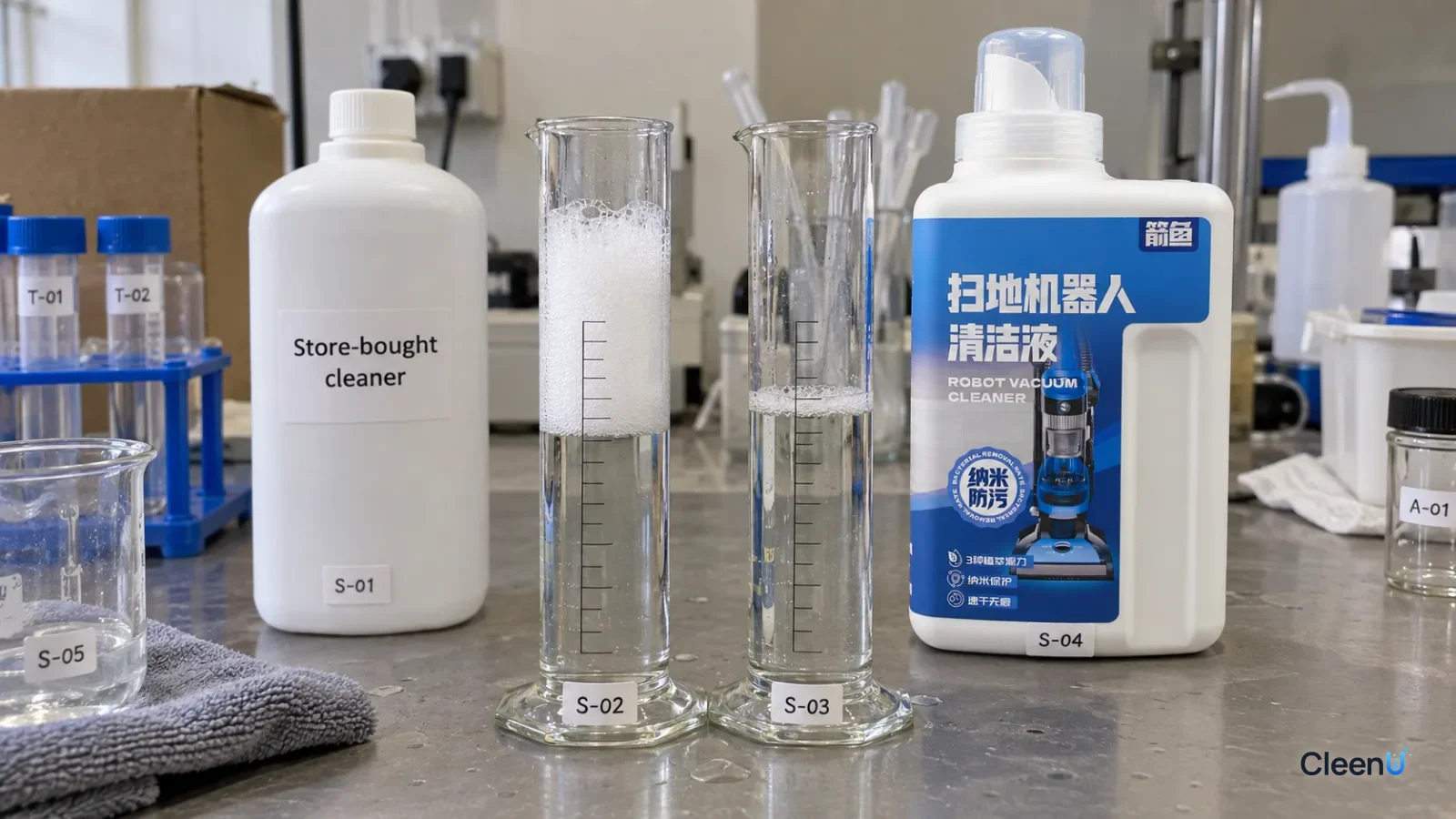
Most of us grew up believing more suds means cleaner. When the bubbles fade from the dishwater, the soap feels "used up"; rich lather in the shower feels thorough. So the first time people shake a robot mop solution and see almost no foam, they wonder whether it can really clean.
It can. Foam and cleaning power are separate properties, and different ingredients control each. To see why, start with how a cleaning solution actually moves soil off the floor.
How does foam form?
Foam is gas wrapped in thin films of liquid. Pure water barely foams; bubbles pop almost instantly. Add surfactant and its molecules line both surfaces of each film, making it elastic and slow to break, so foam lasts.
How long foam lasts depends on a few things.
Film strength. Some surfactants pack tightly and neatly into the film, forming an elastic skin. Others pack loosely, and the film tears easily.
The Marangoni effect. When part of a film stretches thin, surfactant concentration there drops and surface tension rises, so surfactant and liquid flow in from around it to patch the spot. High-foam systems repair themselves well, so their foam lasts.
Drainage. Liquid in the film drains downward under gravity until the film is too thin and breaks. Thicker liquids or foam boosters slow drainage and keep foam around longer.
So how much foam you get depends mainly on which surfactants are used and whether there's a foam booster or defoamer, not on how much cleaning ingredient is present.
Why do people equate suds with cleaning power?
The most common high-foam surfactants are anionics such as sodium alkylbenzene sulfonate and sodium laureth sulfate. They cut grease fast, cost little and foam richly, which made them the classic base for dish soap and shampoo. Years of using those products taught us to link "lots of suds" with "really clean."
In hand dishwashing, foam does help a little: it holds some emulsified grease so less settles back onto dishes, and as long as there's foam, you know the water still has soap in it. That's specific to washing dishes by hand. It doesn't mean foam itself cleans.
How does a low-foam formula keep its cleaning power?
It uses low-foam surfactants that still clean well. Many nonionics foam very little but wet and emulsify well, such as low-ethoxylate alcohol ethoxylates, EO/PO block copolymers and end-capped polyethers. They pack loosely into bubble films so foam breaks easily, but they still work at the boundary between grease and floor.
It uses the cloud point. Many nonionic surfactants have a cloud point temperature. Near or above it, they become less soluble in water and head for surfaces, where they clean strongly and foam very little. Some low-foam formulas choose surfactants whose cloud point puts them in that favorable state at room temperature.
It adds a defoamer. Defoamer molecules spread fast across bubble films and thin them until they break. They come in silicone and non-silicone types. Silicone defoamers are very efficient but can leave floors slicker, so floor products choose the type and amount carefully.
It controls concentration. Surfactant cleaning power stops rising much once concentration passes a certain point, around the critical micelle concentration. Anything beyond that mainly becomes residue and foam. A formula designed for low dosing works at a concentration that's enough.
This article is part of the Robot Vacuum Cleaning Solution & Maintenance Guide, which covers the full maintenance schedule and links to every troubleshooting guide.
HLB: how formulators pick surfactants that are low-foam but still cut grease
When choosing nonionic surfactants, formulators often use a guide called HLB, the hydrophilic-lipophilic balance. It describes which half of a surfactant molecule wins out, the water-loving part or the oil-loving part. Low numbers lean oil-loving; high numbers lean water-loving.
Different HLB ranges do different jobs.
The oil-loving end (lower HLB) works into oily soil easily and is often used to defoam or disperse oily material. On its own it doesn't dissolve well in water.
The middle range wets surfaces and emulsifies grease well, and it's the workhorse range for floor cleaners.
The water-loving end (higher HLB) dissolves easily and tends to foam more, and it's often used to solubilize fragrance and help other ingredients dissolve.
For alcohol ethoxylates, a longer ethylene oxide (EO) chain makes the molecule more water-loving and raises its HLB. A somewhat shorter chain gives a middle HLB with good wetting and grease removal and low foam. EO/PO block copolymers add a more oil-loving propylene oxide (PO) segment, which pushes foam even lower.
Formulators rarely use just one. They blend several nonionics with different HLBs: some to wet and cut grease, some to keep fragrance and other ingredients evenly dissolved, plus a little defoamer to control foam. That's how a formula ends up low-foam without being weak.
Why must robot mop solutions be low-foam?
A robot mop amplifies any foam there is.
The pump and tiny outlet holes pull air into the liquid.
A self-cleaning dock spins and scrubs the pads hard, which whips up foam.
Many docks sense the dirty tank level with metal contacts. Foam holds water and conducts electricity, so once it reaches the contacts the dock reports a full tank. For more, see a "dirty tank full" alert when the tank isn't full.
Foam can also spill out of the dirty tank and into the airflow path.
So for a robot mop, low foam is a basic requirement, and cleaning power comes from choosing the right surfactants and controlling concentration.
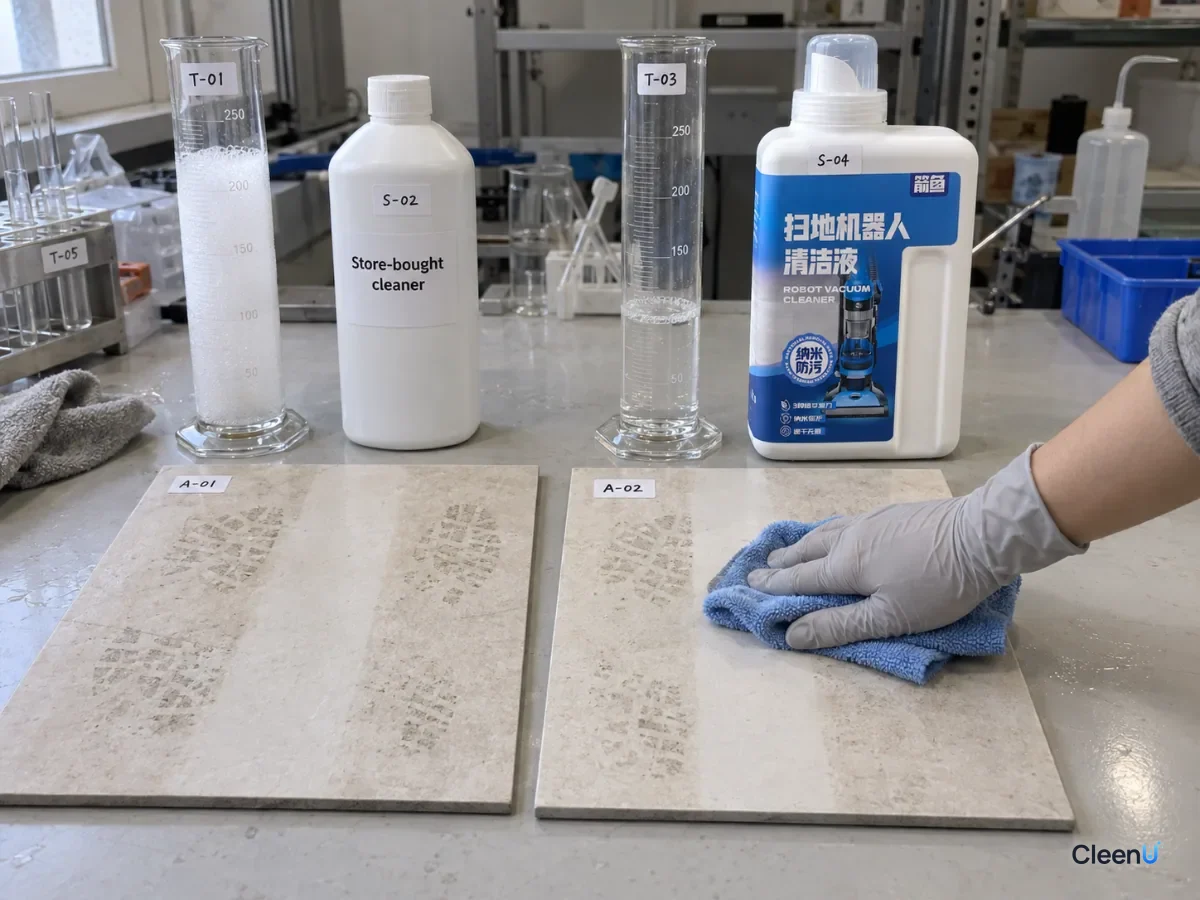
How to tell whether a low-foam solution is doing its job
Don't look at the suds. Look at these:
At the label dose, do the same greasy footprints come up in one or two passes?
Does the floor dry clean, with no tackiness and no oily film or streaks in side light?
Do the pads stay clean after the dock washes them, instead of getting greasier and smellier?
Is the water in the dirty tank darker? That means soil really is being removed.
CleenU Robot Vacuum Cleaning Solution is designed along these lines: a neutral, low-foam concentrate at pH 6.5 to 7.5 with low-foam nonionic surfactants and a defoamer, no wax, no chlorine and no particles. It dilutes at about 1:50 to 1:100; 10 to 20 mL per fill is usually enough. Shake it and the foam disappears quickly, but it still emulsifies everyday greasy footprints. It works in most robot mops from Roborock, iRobot (Roomba Combo and Braava), Ecovacs Deebot, Dreame and Narwal, and in floor washers such as Tineco. Add it to the clean water tank or the dock's designated detergent compartment as your manual directs. CleenU isn't affiliated with these brands; the names only indicate compatibility. For why dish soap doesn't work, see can you put dish soap in a robot mop.
Common misconceptions
"More foam means a stronger concentration." Not necessarily. Foam depends mainly on surfactant type and foam boosters; at the same concentration, low-foam and high-foam formulas can differ many times over in foam.
"No suds means I should add more." That's the most common mistake. More only adds residue and cost. The label ratio is enough.
"Low-foam solutions are watered down." No. Low foam comes from formula choices, not concentration. A low-foam concentrate can be very high in active ingredients.
Why does foam "feel" different from hand mopping?
When you mop by hand, you judge whether the cleaner is working by the suds in the bucket, the sound of the mop and the wet streaks on the floor. Few suds can feel like weak cleaning. With a robot, none of that sensory feedback exists; you only see the result: is the floor clean, is it tacky?
So judge a robot mop solution by results, not suds during the process. After mopping at the label dose, check in side light whether footprints and film are gone, walk barefoot to feel whether it's dry and clean, and look at whether the dirty tank water is darker. If the result is right, low foam is a feature.
Common questions about low-foam cleaning power
Can a low-foam solution really clean greasy footprints?
Yes. Cleaning comes from surfactants wetting and emulsifying soil. At the label dose, one or two passes lift everyday greasy prints, regardless of suds.
Why do dishes need suds but floors don't?
When washing by hand, suds hold some grease and show the soap is still active. Nobody watches suds during robot mopping, and foam only trips dock sensors and overflows.
Will adding more low-foam solution clean better?
Not noticeably. Past the concentration that's enough, the extra mostly becomes residue, the floor turns tacky and foam increases.
Does defoamer reduce cleaning power?
At the right type and amount, defoamer mainly acts on bubble films and barely affects cleaning. The wrong type or too much can leave floors slick.
How can I tell whether a solution is low-foam?
Check whether the label says low-foam and made for robot mops. Or mix a small bottle at the label ratio and shake it for about ten seconds; if the foam collapses quickly, it's low-foam.
Can I use a low-foam robot solution for hand mopping?
Yes, at the label ratio. You won't see suds, and it still cleans.
A robot mop cleaning solution with little foam doesn't clean less. Cleaning comes from surfactants wetting, lifting, emulsifying and dispersing soil, and none of those steps need suds. Foam depends mostly on which surfactants are used and whether there's a foam booster or defoamer. Low-foam formulas use nonionic surfactants that foam little but clean well, add a defoamer and control concentration, and they still lift greasy footprints and dull film. For robot mops, low foam is a requirement. Judge a solution by whether it cleans at the label dose and dries clean, not by the suds.