
Comparison
Allergies or Asthma at Home? How to Choose a Robot Mop Cleaning Solution
Direct answer
Choose a fragrance-free, neutral, low-foam solution with no essential oils or disinfectants, dilute at the low end, and let floors dry before family members walk in. Wet mopping picks up dust, pet dander, and pollen from hard floors with less dust kicked up. Ask your doctor about symptoms.
Who should choose what
-
Someone is allergic to dust mites
Choose Fragrance-free neutral solution at the low end, regular wet mopping
Wet mopping cuts loose floor dust; mites live mainly in bedding and upholstery, so bedding care still comes first, per your doctor's advice.
-
Someone has seasonal pollen allergies
Choose Fragrance-free neutral solution, mopping more often during pollen season
Pollen comes in on shoes and clothes, so entryways and window areas matter most; ventilate outside peak pollen hours.
-
You have cats or dogs and someone is sensitive to dander
Choose Fragrance-free Pet Homes version
Pet areas collect dander and hair; no added fragrance, and a cyclodextrin-based ingredient handles pet odors.
-
Someone at home has asthma
Choose Fragrance-free neutral solution at the low end, mopping while they're out of the room
One less odor variable; ventilate and let floors dry before they come back. Ask a doctor about triggers and medication.
-
Someone gets headaches from strong scents
Choose Fragrance-free neutral solution
No added fragrance, so no lingering scent after mopping.
-
No one has allergies and you like a scent
Choose Scented neutral solution
At the label dose the scent is light, and it's just as low-foam and neutral as the fragrance-free version.
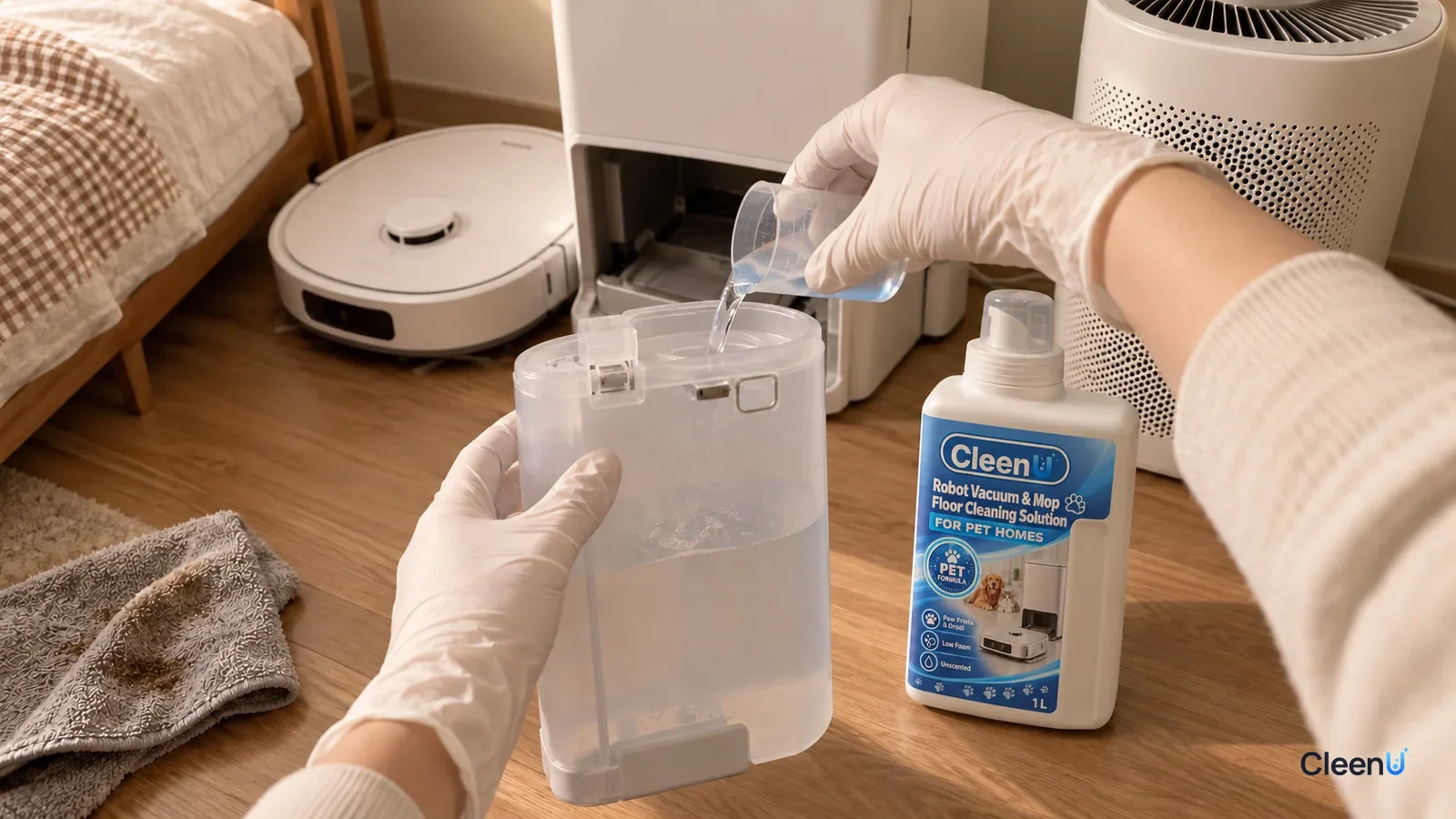
When someone in your home has allergies or asthma, the question isn't which solution "kills the most germs" or smells the nicest. It's what a given bottle adds to your home. Solution goes into the tank, gets spread across the floor by the pads, and as the water evaporates, some of its volatile ingredients end up in your indoor air. For sensitive people, fragrance, essential oils, disinfecting ingredients, and heavy residue are all variables you can simply leave out. So our recommendation is straightforward: use a fragrance-free, neutral, low-foam solution with no quats or phenols, start at the low end of the dilution range, ventilate after mopping, and let the floor dry before anyone walks on it.
It's also worth being clear about what this can and can't do. A robot mop and its cleaning solution clean floors; they don't treat anything, and they're no substitute for medical advice. Wet mopping picks up dust, pet dander, and pollen that have settled on hard floors, and it stirs up less fine dust than dry sweeping. It doesn't touch the dust mites living in mattresses, carpets, and upholstered furniture. What your family member reacts to, which odors set off symptoms, and how medication should be handled are questions for their doctor. Below, we cover what wet mopping does, the chemistry of fragrance and irritants, a side-by-side comparison, and a low-risk way to try a new solution.
What wet mopping does: picks up floor particles, not mites in the bed
Dust on a hard floor isn't one thing. It's a mix of fibers shed from clothing and textiles, skin flakes, grit tracked in from outside, pollen that drifts through windows and doors, and, in pet homes, a lot of dander and hair. The particles vary widely in size. Coarse grit stays put, but fine particles are light enough that footsteps, an opening door, or a robot's side brush can send them back into the air.
A wet pad holds onto those particles in two ways:
- Capillary adhesion. The damp microfiber is laced with thin films of water. When a fine particle touches one, surface tension pulls it into the gaps between fibers, and it doesn't bounce back into the air easily.
- Wetting. Some pollen grains have an oily outer coating, and pet dander carries skin oils. Plain water doesn't wet them well, so they tend to skate across the film. Surfactants lower water's surface tension so these oilier particles get wetted and carried into the pad.
For allergy households, regular wet mopping of hard floors is a practical way to cut down on loose floor dust. Keep its scope in mind, though. House dust mites live mostly in mattresses, pillows, bedding, carpets, and upholstery, feeding on shed skin. A robot mop works on the floor, not those places. For how often to wash or replace bedding, follow your doctor's advice or guidance from a recognized allergy organization.
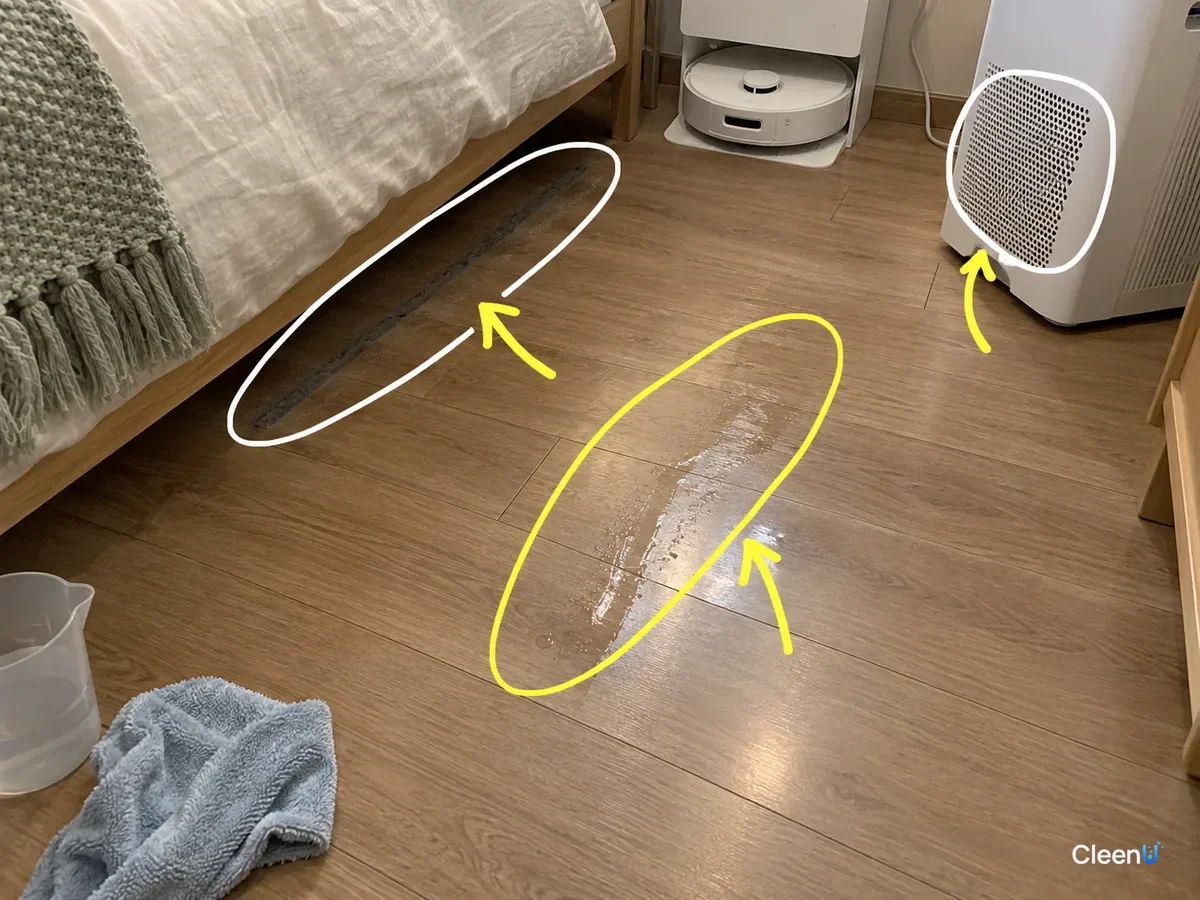
The robot itself: where dust can get back into the air
Apart from the solution, a few parts of the robot often matter more for allergy households:
- Emptying. On self-emptying docks, the dock pulls debris from the robot's bin into a bag when it returns, and there can be a small puff of dust near the dock for a few seconds. On models you empty by hand, dumping the bin kicks up the most dust; have someone without allergies do it outdoors or deep inside a trash bag.
- Filters and bags. A clogged filter cuts suction and leaves fine dust behind, and an overfull bag empties poorly. Clean and replace them on the schedule in your manual.
- Pads. A dirty pad doesn't clean; it smears a film of dust back across the floor. Keep the dock's wash water clean and remove the pads now and then to wash and dry them fully.
- Dirty water tank and wash tray. Dirty water left sitting grows microbes and develops musty or sour odors, and those smells can bother sensitive people on their own. Empty and rinse the dirty water tank after each run. See Why your robot vacuum's dirty water tank smells.
One simple routine works well: run the robot while the family member with allergies is out of the room, open a window for a bit afterward, and let them come back once the floor is dry.
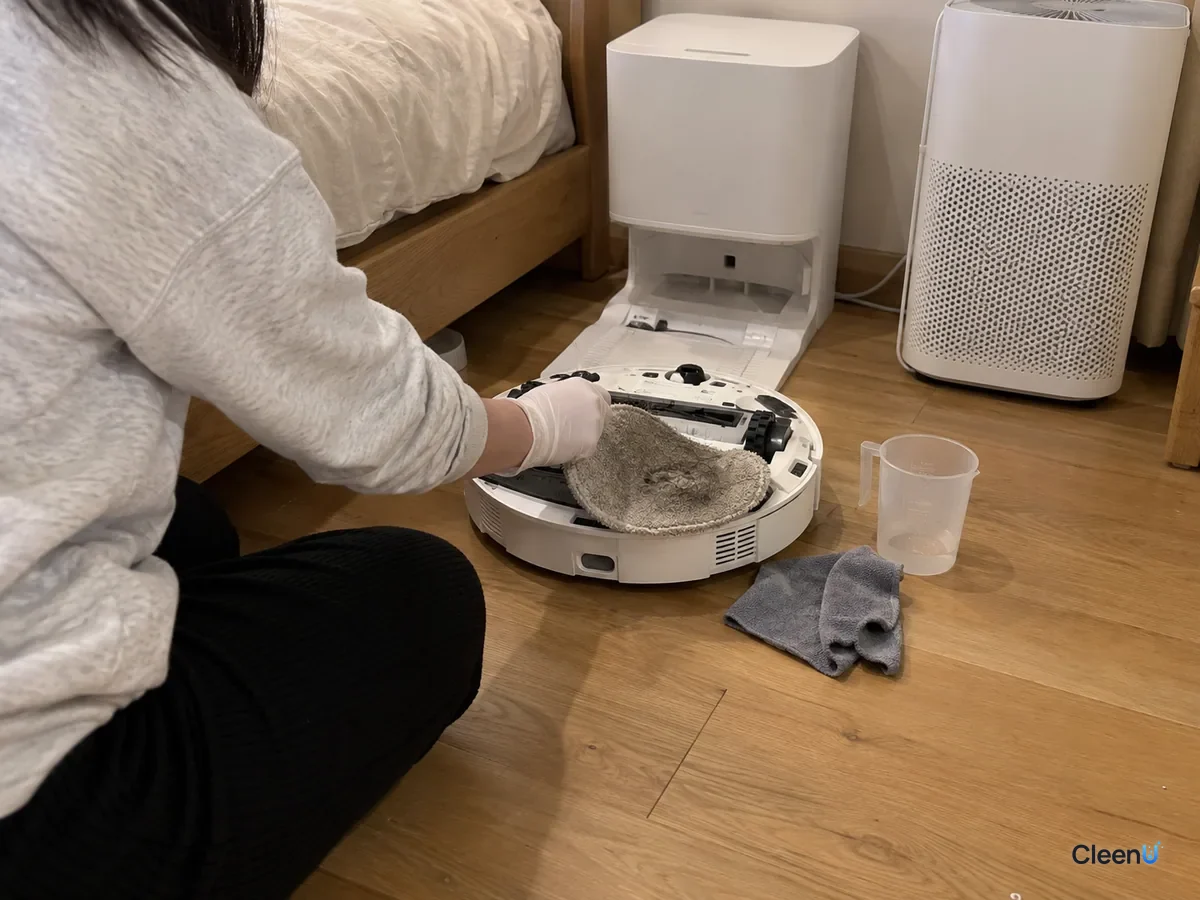
Chemistry, part one: where scent comes from, and why it's a variable
Almost all of a cleaning solution's scent comes from added fragrance. A single fragrance is often a blend of dozens of aroma compounds: terpenes like limonene and pinene (common in citrus and pine scents), alcohols like linalool and geraniol, plus aldehydes and esters. What they share is volatility. That's why you can smell them, and it also means they leave the floor and enter your indoor air.
For sensitive people, fragrance deserves attention for three reasons:
- Some fragrance ingredients are known contact allergens. In the EU, detergents must list specified fragrance allergens on the label when they exceed 0.01 percent, and California's Cleaning Product Right to Know Act requires similar disclosure for products sold there. Limonene and linalool are both on that list.
- Limonene and linalool slowly oxidize in air, and the hydroperoxides they form are more likely to cause skin sensitization than the original molecules. That's one reason an old, long-opened scented product can start to smell harsher.
- Terpenes react with indoor ozone to form secondary products, including formaldehyde and ultrafine particles. Indoor air chemistry research identifies this as one way scented products affect indoor air.
None of this means scented products are off-limits; most households use them without any trouble. But when someone at home has allergies or asthma, fragrance is a variable you can drop entirely. Cleaning works the same without it, and you have one less thing to rule out. The same goes for essential oils. They're plant-derived fragrance blends with the same kinds of terpenes and alcohols, and "natural" doesn't mean non-sensitizing. Don't add them to the tank; see Can you add essential oils or pet odor sprays to a robot mop?
How fragrance gets from the tank into the air
- Solution goes into the clean water tank, and the fragrance disperses through the working solution
- The pad spreads the solution across the floor, and as the water evaporates, volatile aroma molecules go with it into the room
- Some terpenes and alcohols slowly oxidize in air, forming products that are more likely to sensitize
- Terpenes that meet indoor ozone react to form secondary products such as formaldehyde and ultrafine particles
- A fragrance-free solution skips this pathway entirely, with no loss in floor cleaning
Chemistry, part two: irritation and allergy are different problems
People often call any reaction an allergy, whether a smell bothers them or their skin turns red. Chemically and medically, those are two different responses, and they point to different choices.
Irritation is direct discomfort to skin, eyes, or airways caused by an ingredient. It doesn't involve the immune system, and it generally gets worse with higher concentration and longer contact. Strong alkalis and acids, gases released by bleach products, concentrated solvents, and some disinfecting ingredients are common irritants. You reduce irritation by choosing neutral pH, diluting properly, skipping chlorine and harsh ingredients, and limiting contact.
Allergy means the immune system has learned to react to a substance, after which even small amounts can trigger a response. It doesn't track concentration as neatly as irritation does. You reduce allergy risk by avoiding known sensitizers, and fragrance ingredients are the most common group in cleaning products.
Asthma adds one more consideration. People with asthma often have airways that react to many kinds of irritants, and strong odors, sprays, and fumes from bleach products are commonly listed as triggers to watch. Which triggers matter differs from person to person, so confirm with a doctor.
Seen this way, robot mopping has a built-in advantage: the working solution goes onto a pad pressed against the floor rather than being sprayed into a fine mist, so there's far less to breathe in. What's left to control is the liquid itself: no added fragrance, neutral pH, no chlorine, no quats or phenols, and the right dilution.
Two more points. First, fragrance-free doesn't mean odorless. Raw materials can have a faint smell of their own; fragrance-free means no fragrance was added. On US labels, "unscented" can be different: some unscented products contain a masking fragrance to cover base odors, so look for "fragrance-free" or "no added fragrance." Second, keep disinfectants out of your robot. Bleach releases irritating gases when it meets acids or ammonia-containing soil, and quat disinfectants leave more residue on floors. Neither does sensitive people or the machine any favors. See Can you put vinegar or bleach in a robot mop tank?
Comparing floor cleaning options side by side
Floor cleaning options for allergy or asthma households
| What to compare | Fragrance-free neutral robot solution | Scented neutral robot solution | Disinfecting floor cleaner | Plain water |
|---|---|---|---|---|
| Added fragrance | None | Yes | Common | None |
| Main variables for sensitive people | Very few; raw materials may smell faintly | Fragrance ingredients and their oxidation products | Disinfecting ingredients, fragrance, and heavier residue | None |
| Floor residue | Minimal at the label dose | Minimal at the label dose | Quat ingredients tend to leave residue | Only mineral marks from hard water |
| Greasy footprints and dust film | Lifts them | Lifts them | Lifts them, but isn't designed for robots | Weaker |
| Suitability for robot mops | Low-foam and neutral; suitable | Low-foam and neutral; suitable | Foam and corrosion risks; not recommended | Suitable |
| Best for | Homes with allergies, asthma, or scent sensitivity | Homes without scent concerns that like a light scent | Not recommended for robot mops | Clean floors, or times you want nothing added |
Plain water's limitation is that foot oils and cooking grease build up into a dull, draggy film over time, and oily fine particles are harder to wet and pick up. A fragrance-free, neutral solution at the low end (about 1:100) lifts that film without adding an odor variable, which makes it a reasonable balance.
Which option fits your household
Trying a new solution the low-risk way
How allergy or asthma households can try a new solution
- Read the label: no added fragrance, no quats or chlorine, neutral pH, and no "kills germs" or "disinfects" claims
- Open the cap and take a light sniff from arm's length; don't inhale deeply, and skip anything that smells harsh
- Dilute at the low end the first time, about 10 mL per liter (about 34 oz) of water, and mop just one room
- Run it while the family member with allergies or asthma is out of the house or in another room
- Open a window afterward, and let them come back once the floor is dry
- Watch for any reaction over the next day or two before using it throughout the house
Pause that solution if anyone starts sneezing, coughing, or wheezing more after coming in, gets chest tightness, has red or itchy skin after touching the floor, or if a harsh smell lingers in the room. Open the windows, mop the floor once or twice with plain water, and empty and rinse the clean water tank. If symptoms don't settle or are severe, get medical care and bring the product label with you. For more on harsh smells after mopping, see Should you stop using a robot mop solution that smells harsh?
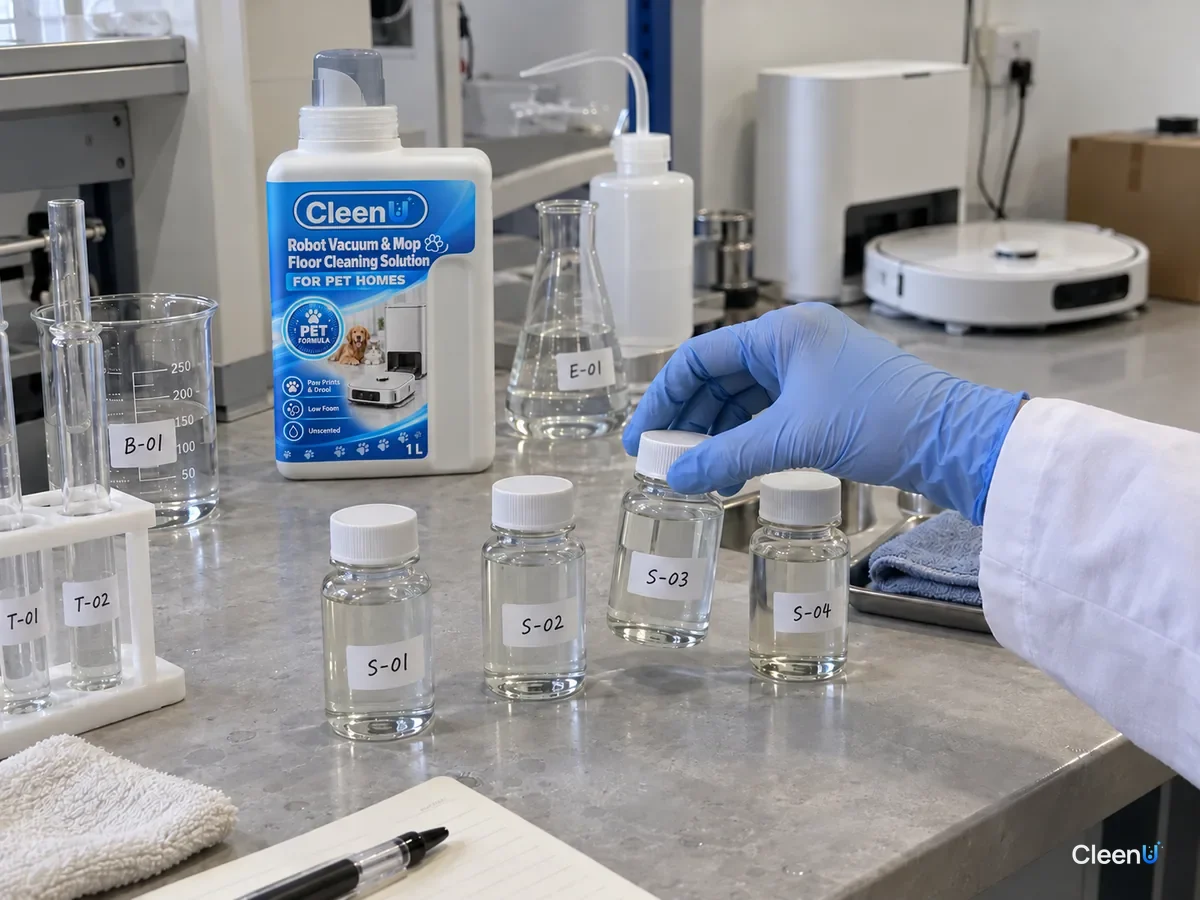
CleenU Pet Homes as an example: odor control without fragrance
If you want a robot mop solution for a home where someone has allergies, asthma, or scent sensitivity, the Pet Homes version of CleenU Robot Mop Cleaning Solution is fragrance-free, with no added fragrance. It handles odors with a cyclodextrin-based ingredient. Cyclodextrins are ring-shaped molecules built from glucose units, with a cavity that's less water-loving inside. Some odor molecules fit into that cavity and form inclusion complexes, so less of them escapes into the air. The ingredient has no scent of its own; it isn't covering one smell with another.
Like the standard version, it's a neutral concentrate, pH 6.5–7.5 as a concentrate, built on low-foam nonionic surfactants with a defoamer. It's solvent-free and contains no optical brighteners, wax, chlorine, particles, quats, or phenols. Each 1 L (about 34 oz) bottle comes with a measuring cap and dilutes about 1:50 to 1:100; 10 to 20 mL per fill is usually enough, and allergy households can start at the low end. It keeps 24 months unopened. It's a cleaning solution that lifts dust film, greasy footprints, and everyday grime in pet areas. It isn't a disinfectant, we don't claim it kills germs, and we don't claim it relieves any symptoms.
If you're looking for a robot mop solution with no added fragrance, take a look at our Robot Vacuum Cleaning Solution for Pet Homes.
It works with most Roborock, Ecovacs Deebot, Dreame, iRobot Roomba Combo and Braava, Shark HydroVac, and Eufy RoboVac models, and with most Tineco and Bissell CrossWave wet-dry vacuums. On Narwal robots, dilute it in the clean water tank. If your model's manual says otherwise, follow the manual. CleenU is not affiliated with these brands; names are used only to describe compatibility.
Choosing robot mop solution for allergy or asthma households
What kind of robot mop solution suits a home with allergies?
A fragrance-free, neutral, low-foam solution at the low end, about 1:100. Its surfactants wet oily dander and pollen so the pad picks them up more completely; ventilate afterward and let the floor dry before family members come in.
Can someone with asthma use a scented floor cleaner?
Start with fragrance-free. Strong odors are commonly listed as triggers to watch, and dropping fragrance removes one variable. Whether a specific product is OK, and what the triggers are, is a question for their doctor.
Does a robot mop pick up pet dander and pollen?
It picks up what has settled on hard floors. A damp pad holds fine particles and kicks up less dust than dry sweeping. It doesn't reach bedding, carpets, or upholstery.
Does fragrance-free mean the solution has no smell?
No. Fragrance-free means no fragrance was added; raw materials can have a faint smell that's usually gone once the room is aired out.
Is "unscented" the same as "fragrance-free"?
No, check the label. Some unscented products contain a masking fragrance to cover base odors. Look for "fragrance-free" or "no added fragrance" on the label.
Essential oils are natural. Can I add a few drops to the tank?
Don't. Essential oils contain terpenes and alcohols that can be sensitizers, and they can harm tank seals and leave an oily film on floors.
Wouldn't a disinfectant be better for allergy households?
Keep disinfectants out of robot mops. Chlorine and quats are irritating, leave more residue, and can damage the machine; floor cleaning doesn't need disinfection.
Why is the Pet Homes version a good fit for scent-sensitive homes?
It's fragrance-free and uses a cyclodextrin-based ingredient that traps some odor molecules instead of masking them. It's a cleaning solution and isn't claimed to relieve symptoms.
How much solution should an allergy household use?
Start at the low end, about 1:100, or roughly 10 mL per liter (about 34 oz) of water. On dirty floors, run a second pass instead of doubling the dose.
When is the best time to run the robot?
While the family member with allergies is out of the room. Ventilate afterward, let the floor dry before they return, and during pollen season air out the room outside peak pollen hours.
Someone started coughing or sneezing after we switched solutions. What now?
Pause that solution, open the windows, mop once or twice with plain water, and rinse the tank. If symptoms don't settle or are severe, get medical care and bring the product label.
To compare scented and fragrance-free options, see Scented vs. fragrance-free robot mop solution. For cleaning versus disinfecting, see Does robot mop solution disinfect? For more pet-home tips, see Robot mopping in homes with cats and dogs.
For homes where someone has allergies or asthma, the rule for robot mop cleaning solution is to add as few variables as possible: choose a fragrance-free, neutral, low-foam solution with no essential oils or disinfectants, start at the low end, run the robot while they're out of the room, ventilate, and let the floor dry before they walk on it. Wet mopping picks up dust, dander, and pollen that settle on hard floors, but it's floor cleaning, not a mite treatment or medical care. Try any new solution in one room first, watch for a day or two, and if anything seems off, pause, ventilate, and talk to a doctor.