
Q&A
Do You Need Cleaning Solution for a Wet Dry Vacuum? And Does It Have to Be the Brand's Own?
Direct answer
Yes, especially for grease spots, dried coffee, and paw prints: a small measured dose of low-foam, neutral solution leaves floors and the brush roll cleaner. The brand's own formula isn't required; one labeled for floor washers works too.
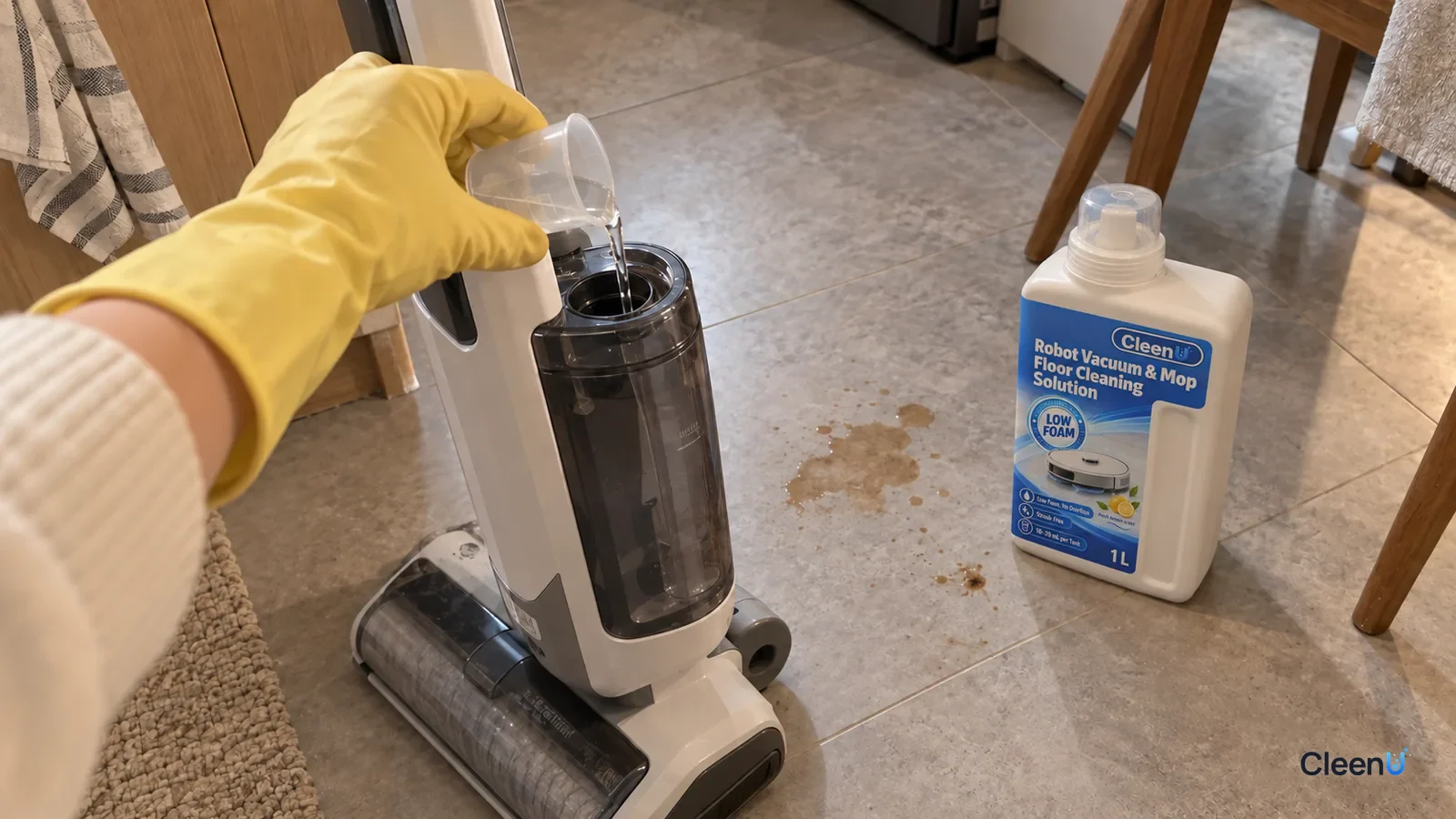
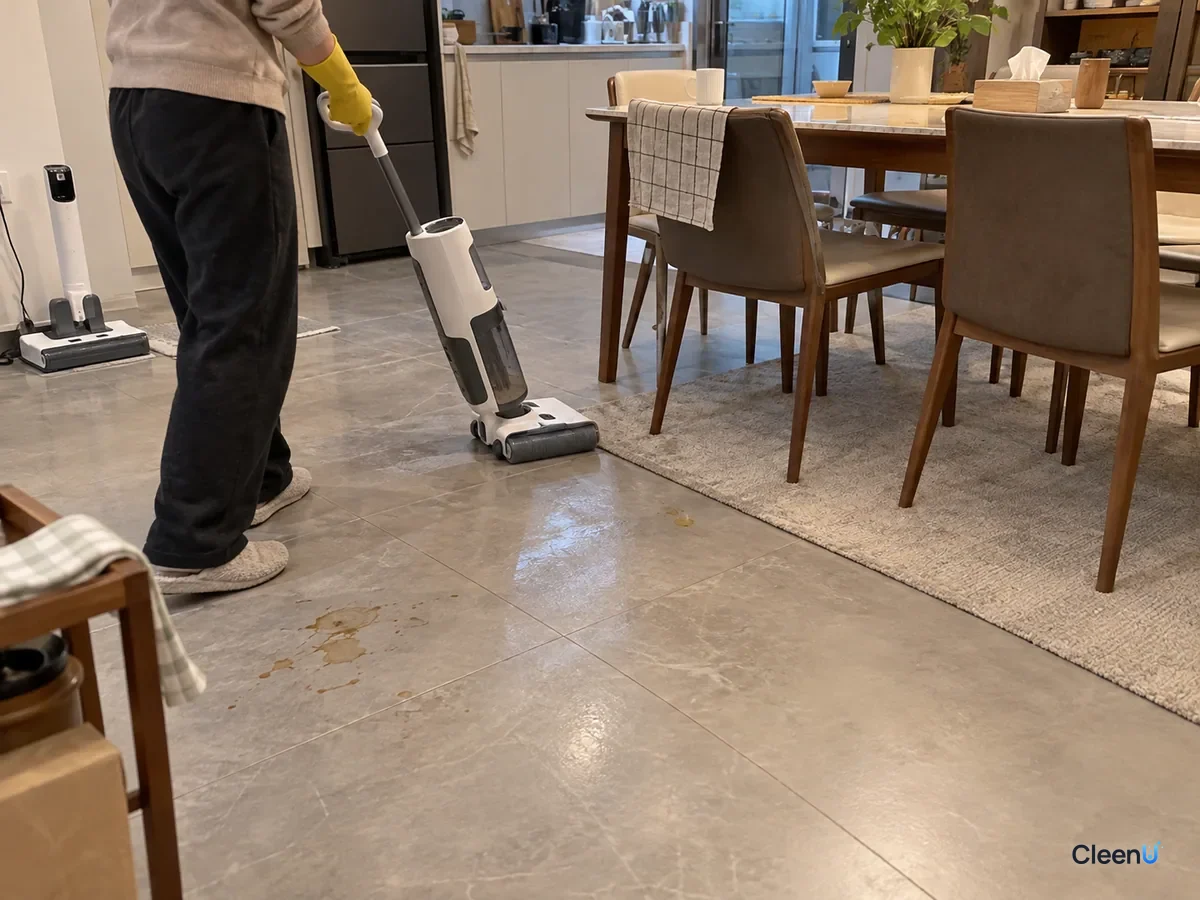
Do you need cleaning solution for a wet dry vacuum? Yes, and how much depends on what's actually on your floor. If the stretch from your stove to the dinner table collects grease spatter, dried coffee rings, juice drips, and muddy paw prints, water mostly pushes that soil around. The floor dries hazy, the brush roll turns greasy, and the dirty water tank starts to smell. A measured dose of solution emulsifies the grease and carries it off, so the floor dries clean and the roll is easy to keep fresh. In bedrooms and living areas where it's mostly dust, the low end of the ratio is enough; the surfactant helps water spread so fine dust doesn't dry into a gray film.
The second question is whether it has to be the brand's own solution. It doesn't. What a floor washer cares about is the liquid itself: low foam, neutral pH, no particles, no wax, no solvents. A solution labeled for floor washers works well, as long as you dose it to your tank size. Here's the reasoning behind both answers, starting with how water moves through the machine.
How much to add? Match it to your floor
The same machine gets a different dose in different homes. Sorting by the kind of mess is more useful than asking "how much?" in the abstract.
How to dose for your floors
- Just vacuumed: dust, hair, fresh water spills
- Low-end dose
- Bedrooms and living room, occasional footprints
- Low-end dose; middle of the range when prints show
- Kitchen to dining area: grease dots, sauce drips
- Dose the tank; slow down over greasy patches
- Dried coffee with milk, juice, soda rings
- Dose the tank; lay a damp cloth on dried spots first
- Cats or dogs: paw prints and drool marks
- Dose the tank; a fragrance-free pet formula is an option
- A baby who crawls on the floor
- Low-end dose; let the floor dry fully first
- Unsealed hardwood, waxed floors, carpet
- Not a job for a wet dry vacuum
The rule underneath is simple. Whatever water can dissolve or flush away needs only the low end. Grease and dried spills, which water can only smear, need the solution to do more. The next sections explain the chemistry.
Where the water goes inside a wet dry vacuum
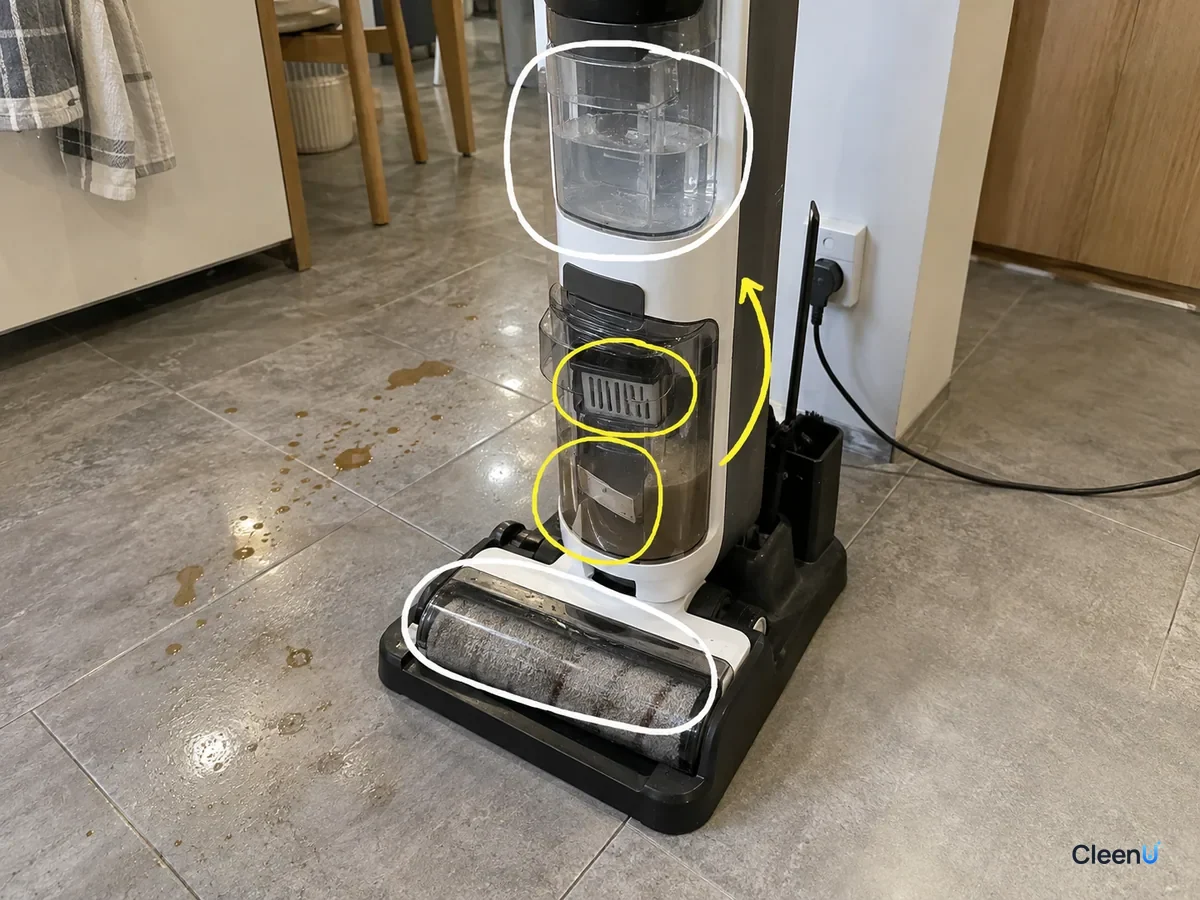
Upright wet dry vacuums, also sold as cordless floor washers, share one basic layout with five stages:
- Clean water tank. Several models listed on Tineco's US site hold about 0.6 to 0.85 L (roughly 20 to 29 fl oz), far less than a robot mop dock's multi-liter tank.
- Pump and outlet. Deliver liquid to the brush roll; some models adjust flow to how dirty the floor is.
- Brush roll. Spins while soaked and works like a conveyor belt: dirt moves from floor to roll, then from roll into the suction path.
- Suction nozzle. Pulls dirty water and a lot of air in at once, so air and liquid churn hardest here.
- Dirty water tank. Liquid settles while air passes a baffle and filter to the motor. When the tank is full, the machine shuts off.
On the dock, most models self-clean by flushing the roll and lines into the dirty tank, and some dry the roll with warm air.
Two points matter most. The brush roll decides whether water alone is enough, because whatever water can't carry away gets wiped back down on the next rotation. The nozzle-to-tank section decides what you can add, because any foamy ingredient fills the tank with bubbles, and foam reaching the full-tank sensor or filter stops the machine.
Why water alone leaves grease and dried coffee behind
For dust and fresh water, the brush roll and suction are enough. Grease and dried spills are different, and the reason is water itself.
First, wetting. Water's surface tension is high, about 72 mN/m at room temperature, so it beads up rather than spreading across an oily film. Cooking grease and skin and paw-pad oils are low-energy surfaces; water rolls over them and the roll only skims the top.
Second, emulsification. Oil and water don't mix, so without a bridge, oil can't move into the water. The roll scrapes it onto the bristles. The grease changes address but never leaves the machine's loop.
Third, redeposition. The roll touches the floor several times per rotation, and oil that wasn't carried off gets laid back down as faint streaks. A kitchen floor that feels draggy after a water-only pass usually has redistributed grease.
Dried coffee with milk is its own problem. Milk protein and butterfat dry into a film bonded with sugar. The roll passes in a second or two, water softens only the top layer, and a pale ring stays behind.
Cleaning solution helps through its surfactants. Each molecule has a water-loving end and an oil-loving end. They lower the water's surface tension so it spreads across the grease, then break the oil into tiny droplets wrapped inside micelles. Those suspended droplets don't stick back to the floor or the bristles. They ride the dirty water into the tank. Chemists call that anti-redeposition, and it's the step plain water can't do and a wet dry vacuum needs most.
One grease spot, two different paths
- Water only: water beads on the grease film without wetting it
- The brush roll scrapes grease onto its bristles, moving it but not removing it
- On the next rotation, the bristles wipe it back down as a faint streak
- With solution: surfactants lower surface tension and water spreads over the film
- Surfactants break grease into droplets and hold them inside micelles
- Suspended droplets stay off the floor and bristles and get pulled into the dirty tank
Then there's the brush roll. After a water-only pass over grease, oil and protein stay in the bristles, plain-water self-clean doesn't fully rinse them, and by morning the roll and dirty tank can smell sour. Tineco recommends cleaning the roll after every use, which matters most in a water-only kitchen. With diluted solution in the clean tank, the self-clean flush carries solution too and grease rinses out more easily. To be clear, solution cleans: it lifts grease and organic residue. It isn't a disinfectant and doesn't replace one.
Two common misconceptions
Misconception one: the machine sucks everything back up, so what you add doesn't matter. It matters more. The nozzle whips air into liquid, the most foam-prone way to clean a floor, so pick a low-foam formula and measure it. A thin water film always stays behind too, so doubling the dose doubles the surfactant left to dry. Clean turns into tacky.
Misconception two: water leaves nothing behind, so water-only is safest. For grease, what water leaves behind is soil. A smeared oil film attracts fresh dust, and the roll needs more hand-washing. Match the dose to the mess: the low end in dusty rooms, the high end or a second pass where grease lives.
Does it have to be the brand's own solution? What to check instead
Take Tineco as an example: its directions are one capful of its own solution in the clean tank, then water to the max line, and some models list 1:50. A generic solution goes in the same place; you just scale the dose to its label ratio and your tank size. To pick one, check these points:
What a third-party wet dry vac cleaning solution should clear
- Low foam that collapses fast, the point that decides whether the dirty tank holds liquid or bubbles
- Neutral or near-neutral pH, so gaskets, pumps, and plastic parts aren't exposed to strong acids or alkalis
- No solvents and no chlorine, since alcohol and essential-oil-type solvents can swell rubber and chlorine can harden it
- No particles, waxes, or film-forming polymers, which build up on the brush roll, outlet, and floor
- A label that names floor washers and gives a dilution ratio, so you can scale it to your tank
- A manufacturer that can explain how foam, residue, and material compatibility are tested
A generic is easy to use: do the dosing math once and glance at the dirty tank on your first run.
For price and ingredient comparisons, see brand-name vs third-party robot mop cleaning solution. Whether robot mop and wet dry vacuum solutions are interchangeable is covered in robot mop vs wet-dry vacuum cleaning solution.
How much to add: small tanks need real math
Robot mop solution labels often say 10 to 20 mL per fill. That figure is built around docks that hold several liters. A wet dry vacuum's clean tank holds closer to 0.6 to 0.85 L, so pouring in the robot-mop amount can overshoot the intended strength. Scale by ratio instead:
Dose = tank volume ÷ dilution factor
CleenU Robot Vacuum & Mop Floor Cleaning Solution dilutes at about 1:50 to 1:100, which works out to:
Dose by clean tank size (about 1:50 to 1:100)
- 0.6 L (about 20 fl oz)
- 6–12 mL (about 1¼–2½ tsp)
- 0.85 L (about 29 fl oz)
- 8.5–17 mL (about 1¾–3½ tsp)
- 1 L (about 34 fl oz)
- 10–20 mL (about 2–4 tsp)
Why isn't stronger better? The key idea is the critical micelle concentration, the point where surfactant forms enough micelles to hold grease. Below it, solution barely helps; above it, cleaning improves; further up, performance levels off and extra product only adds foam and residue. The label ratio keeps you in the "enough, not too much" zone. Use the low end routinely and the high end for a greasy kitchen. For a really dirty patch, slow down or make a second pass instead of pouring more.
Small tanks magnify measuring errors. In a 0.6 L tank, 1:100 is about 6 mL. Pour 11 mL and you're near 1:55, still fine. Pour 20 mL and you're near 1:30, clearly too strong. Use a marked cap or small measuring cup, and never measure one brand with another brand's cap, since both cap size and concentrate strength differ.
Add water first, then solution, below the max line, and swirl gently; shaking makes foam before you start. Use tap water at room temperature. Tineco's FAQs specify 5 to 60°C (41 to 140°F) and warn that hot water can damage internal lines.
Can laundry detergent, dish soap, or floor cleaner stand in?
The test is whether it foams in the nozzle and whether it leaves a film.
- Laundry detergent and dish soap: anionic surfactants that foam fast and hold it, so a tank of suds is likely; dish soap's thickeners can also leave floors tacky.
- Bucket-style floor cleaners: built for a mop and pail, not suction, and some contain wax or shine enhancers that build up on the roll.
- Vinegar and bleach: hard on metal parts and rubber seals.
Hand mopping is a separate question, covered in can you mop with dish soap, vinegar, or bleach.
Four quick checks at home
White cloth wipe. After a water-only kitchen pass, let the floor dry, then rub a white cotton cloth or paper towel firmly over it. A gray or yellow smudge means a soil film remains, so that room needs solution at the high end. A clean cloth means the low end is enough.
Back of the hand, or socks. A draggy feel can be leftover soil. Tackiness that appears only after adding solution usually means too much, so cut the dose before judging the product.
Brush roll check. After self-clean, feel the roll with gloves on. Greasy bristles or a sour smell mean grease isn't rinsing out, or the roll isn't washed and dried often enough.
Shake test. In a clear bottle, mix 500 mL (about 17 fl oz) of water with 5 to 10 mL of solution, cap it, shake 10 times, and watch. A thin layer that collapses quickly suits a wet dry vacuum. Dish soap at the same strength makes a telling comparison. See how to tell if a robot mop solution is low-foam. Then add a few drops of milk and shake again: protein soils like milk, egg, and pet drool stabilize foam once they dissolve, so a formula that stays low-foam with milk in it will keep the dirty tank clear after a kitchen pass. On your first run, clean a short stretch and check the dirty tank. If there's a lot of foam, drop to the low end and try again.
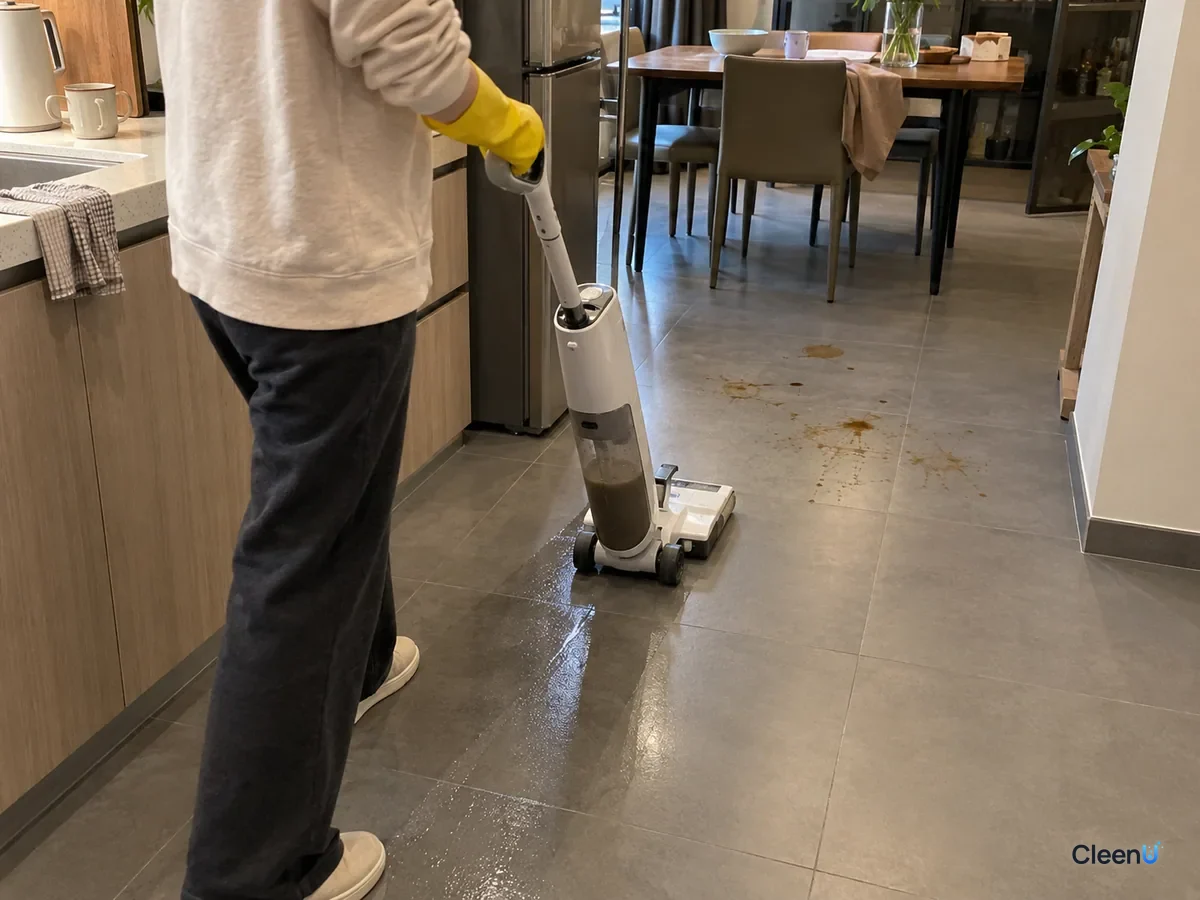
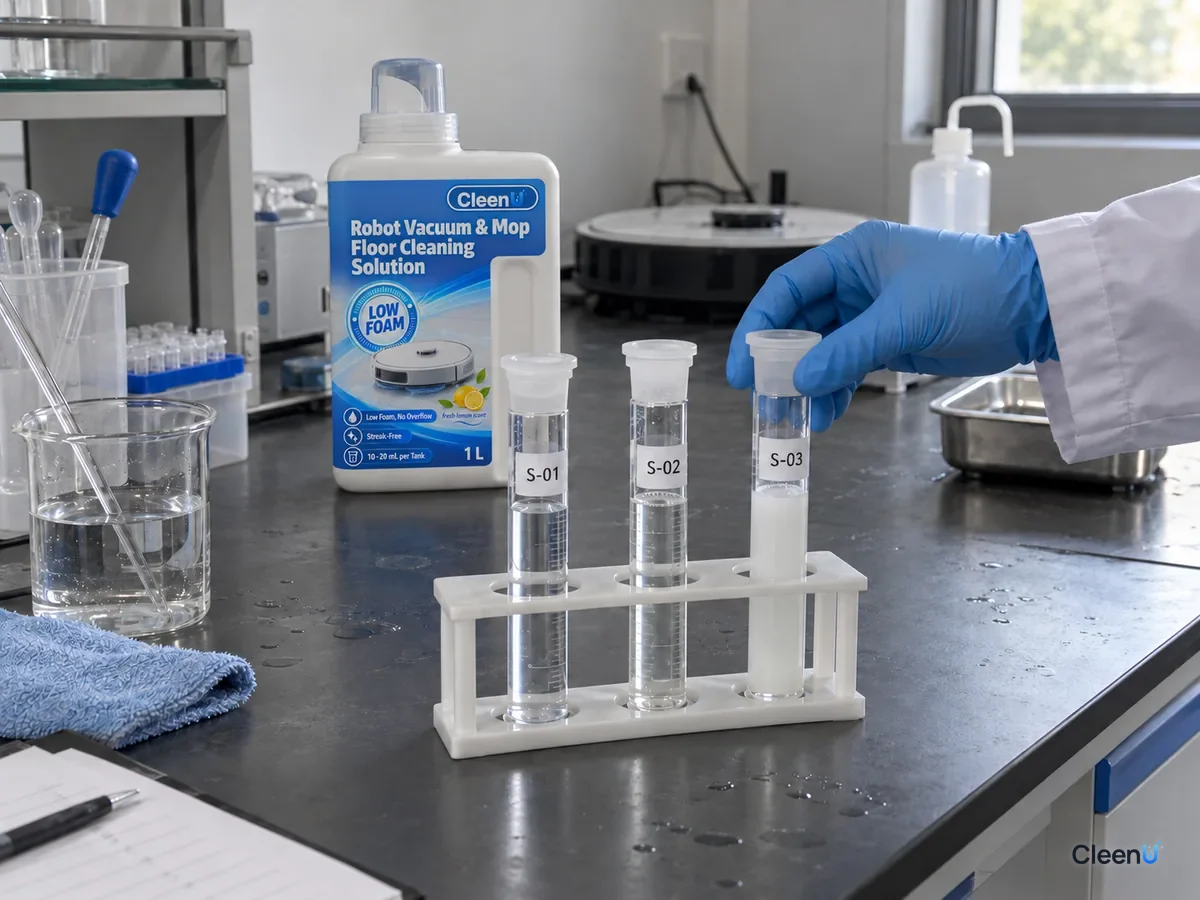
Using CleenU Robot Vacuum & Mop Floor Cleaning Solution in a wet dry vacuum
To see those points in an actual product, take CleenU Robot Vacuum & Mop Floor Cleaning Solution: a neutral concentrate, pH 6.5 to 7.5, built on low-foam nonionic surfactants with a defoamer. It has no particles, wax, or chlorine, and it's solvent-free with no optical brighteners. It handles footprints, grease marks, and dust on tile, vinyl plank, laminate, and sealed hardwood, not unsealed wood, waxed floors, or carpet. The standard version is lemon-scented, with a fragrance-free pet formula available. Each 1 L bottle has a measuring cap and keeps 24 months unopened.
Dilute it in the clean water tank: about 6 to 12 mL for 0.6 L or 8.5 to 17 mL for 0.85 L, water first. If your model has a separate formula tank, follow the manual and use one place, never both.
It works with most Tineco, Shark, and Bissell wet dry vacuum models. CleenU is not affiliated with Tineco, Shark, or Bissell; brand names are used only to describe compatibility.
If you want a low-foam, neutral solution you can dose to your wet dry vacuum's tank, take a look at Robot Vacuum & Mop Floor Cleaning Solution.
Switching solutions: the order that works
First run with a new solution, step by step
- Vacuum first so grit and hair don't end up in the brush roll
- Empty and rinse the clean tank, then fill with room-temperature tap water
- Add solution with a marked cap: 6–12 mL for 0.6 L, 8.5–17 mL for 0.85 L, below the max line
- Swirl gently and reinstall the tank
- Lay a damp cloth on dried coffee or juice spots for a few minutes to soften them
- Clean a short stretch, then check dirty-tank foam and how the floor feels once dry
- Run self-clean, empty the dirty tank, and rinse and air-dry the brush roll and filter
- Use mixed solution the same day; dump leftovers and let the clean tank dry
Foam or tacky floors? Adjust in this order
Foam filling half the dirty tank or more, a full-tank warning that keeps going off, or a floor that dries tacky or slick means too much solution is reaching the floor, or old dish soap is still in a tank. Step one: empty both tanks, rinse them, and wash and dry the filter. Step two: run a plain-water self-clean to flush extra solution out of the roll and lines. Step three: remix at the low end and clean a short stretch to check. If there's a white film around the outlet or brush roll, wipe it off with a damp cloth.
Floor type matters too. Wet dry vacuums are for well-sealed hard floors. Carpet, unsealed hardwood, and waxed floors shouldn't be wet-cleaned this way, with or without solution.
Still streaky or smelly? Work down this list
If you're using solution at the right dose and the floor still looks hazy, or the machine smells, check the most likely causes first:
- The brush roll isn't washed and dried. The big one. A damp roll on the dock goes sour and smears old soil back down. Rinse it after each use and let it dry.
- The dirty tank and filter stay wet. Dirty water left overnight turns to odor. Empty, rinse, and dry right away.
- Too much solution. Tackiness or haze means overdosing. Drop to the low end and do one water-only pass.
- Too little, or spills dried hard. Use the high end and soften old spots with a damp cloth first.
- Hard water spots. White mineral marks on dark tile have little to do with the solution; a final wipe with a wrung-out cloth fixes them.
- A floor that shouldn't be wet-cleaned. Unsealed wood and waxed floors cloud when wet; dry-mop them or use a care product made for them.
Is buying solution worth it?
At 0.6 to 0.85 L per tank and 1:50 to 1:100, one 1 L (about 34 oz) bottle makes roughly 60 to 160 tanks, more at the low end. The real cost of water-only kitchens is time: extra passes and more roll scrubbing. With solution, one pass does it and the roll stays easy to keep clean. When comparing prices, don't stop at the label ratio; divide active content by the dilution ratio. At about 2% active, a 1:200 mix leaves only about 0.01% active in the tank and a 1:500 mix about 0.004%, so people end up pouring more. At 15% active, CleenU diluted 1:100 still delivers about 0.15%: about 15 times the 1:200 mix and nearly 40 times the 1:500 one, so the tanks-per-bottle math holds up. Homes that cook daily, have kids who spill, or pets that track in prints will notice the biggest difference; dust-only homes can stay at the low end and make a bottle last a long time. Whichever bottle you buy, choose by the checks above. If your model's manual says otherwise, follow the manual.
Wet dry vacuum cleaning solution: common questions
Do you need cleaning solution for a wet dry vacuum?
Yes, at a small measured dose. Use the high end for grease, dried coffee or milk, and paw prints, and the low end in dusty rooms so floors dry cleaner.
Do you have to use the brand's own cleaning solution in a wet dry vacuum?
No. A low-foam, neutral solution labeled for floor washers with a stated dilution ratio works, dosed to your tank size. Clean a short stretch first and check the dirty tank.
Can you use just water in a wet dry vacuum?
Water picks up dust, but grease and dried spills need solution. Water alone tends to smear oil and leaves the brush roll smelling sooner, so dose at the low end day to day and the high end in greasy kitchens.
Can I use laundry detergent or dish soap instead?
No. Both foam heavily and hold that foam, and the suction nozzle churns air into liquid, so the dirty tank can flood with suds. Dish soap can also leave floors tacky.
How much solution should I put in a wet dry vacuum?
Scale it to the tank. At about 1:50 to 1:100, use 6 to 12 mL for a 0.6 L tank and 8.5 to 17 mL for a 0.85 L tank, starting at the low end.
Can I use robot mop solution in a wet dry vacuum?
Yes, if it's a low-foam, neutral formula labeled for floor washers. Recalculate for the smaller tank instead of using the robot mop's 10 to 20 mL per fill.
Can I put hot water in the clean tank?
No. Tineco specifies 5 to 60°C (41 to 140°F) tap water and warns hot water can damage internal lines. Dilute solution in room-temperature water too.
Can I add bleach or disinfectant?
No. Chlorine hardens rubber seals and corrodes metal parts. Disinfect specific spots by hand instead.
My floor feels sticky after using solution. What now?
Cut back to the low end and do one water-only pass. If it's still sticky, check whether you're using another brand's cap or a product with wax or film formers.
Do I need to add solution for the self-clean cycle?
No. Self-clean draws from the clean tank, so a diluted tank already helps rinse the roll. Keep the water level where the manual says.
Can I use solution if I have a baby or pets?
Yes, at the low end, keeping kids and pets off until the floor is fully dry. Pet homes can use the fragrance-free pet formula; baby play areas get the standard formula at the low end with good airflow.
Sources: Tineco US support FAQs for the FLOOR ONE S3, S5, S7 PRO, S7 STRETCH STEAM, and iFloor 3 (accessed October 2026).
Cleaning solution for a wet dry vacuum is worth having. Grease spots, dried coffee and milk, and paw prints get pushed around and wiped back down by water alone, so a measured dose of low-foam, neutral solution makes floors and the brush roll noticeably cleaner; dusty rooms need only the low end. The brand's own solution isn't required. Choose a generic that's low-foam, neutral, solvent- and chlorine-free, and free of particles and wax, and dose it to your tank: about 6 to 17 mL for a 0.6 to 0.85 L tank. Start low and check the dirty tank on your first run.