
Formulation Science
How Robot Mop Cleaning Solution Lifts Footprints and Oily Film
Direct answer
Surfactants first let water spread over the floor and the oily film, loosening the film's grip. Then they emulsify and disperse grease and dust into tiny particles suspended in water, which the pad soaks up and the dock washes out. At the label ratio, very little stays behind, so floors don't turn tacky.
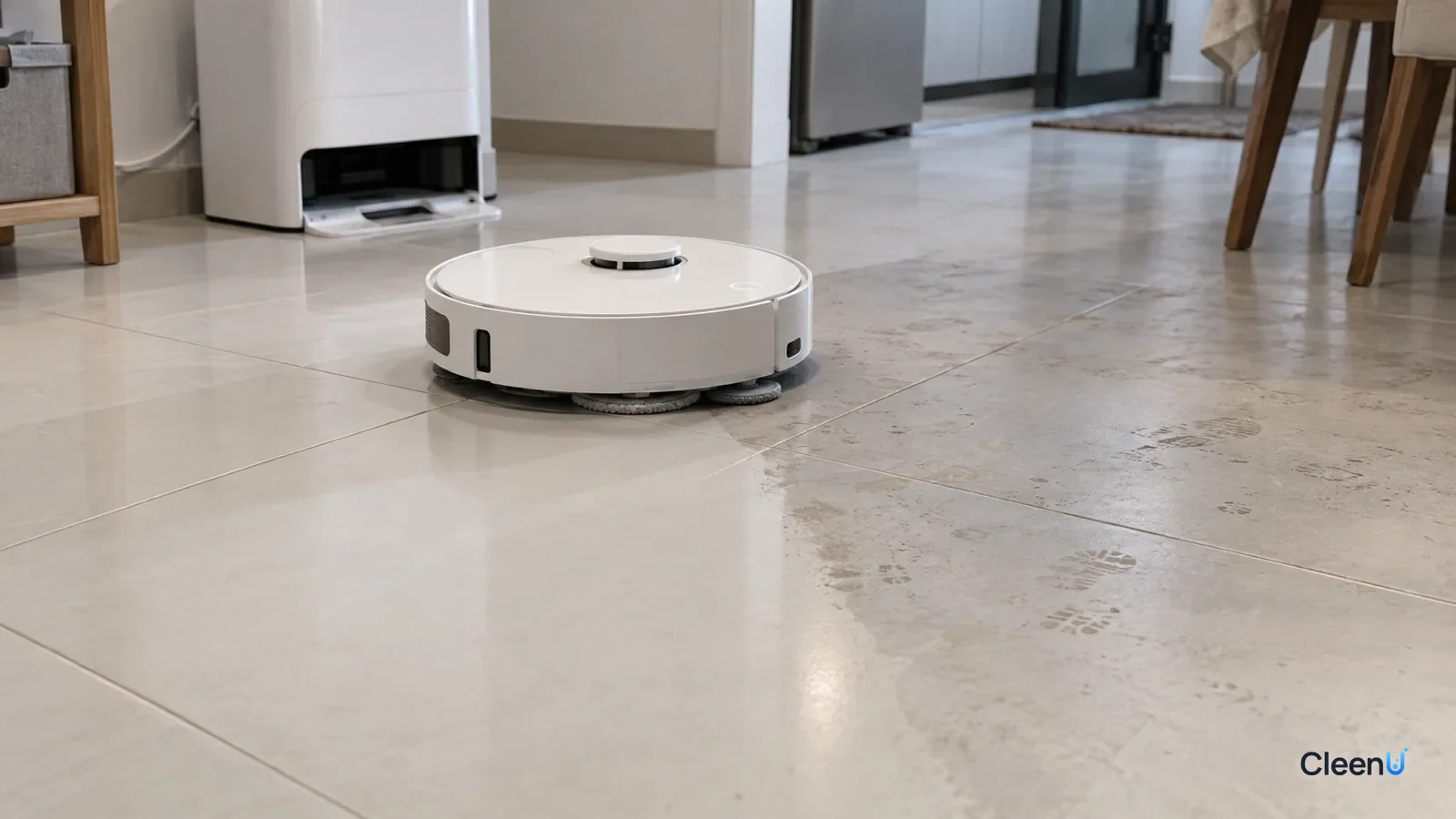
After a robot mops, a floor goes from dull and full of footprints in side light to clean and bright. It looks simple: a damp pad wipes the floor. But with plain water, many footprints and much of that dull film stay put; add a little solution and one or two passes clear them. What happens in between?
First you have to know what the "dirt" on a floor actually is.
What are that dull film and those greasy footprints?
Dull film. Household dust is a mix of skin flakes, fibers, pollen, soil particles, cooking fumes and fine particles tracked in from outside. On the floor it starts out loose, but it only takes a little oil acting as glue to bind it into a thin film that a pad can't simply wipe away. In side light, it looks gray and hazy.
Greasy footprints. Skin constantly produces sebum, mostly triglycerides, fatty acids, wax esters and squalene. Walking barefoot or in socks leaves print after print of it on the floor, and cooking fumes and splatter make them heavier.
Both are mostly oily, both hold dust particles, and both cling tightly. An oily film holds onto the floor through intermolecular forces (van der Waals forces), and the smoother the floor, the closer the contact and the tighter the grip. The dust is glued inside that film.
Why does plain water only fade it?
Water is polar and oil is nonpolar. Like dissolves like, so they don't mix. On an oily film, water's high surface tension pulls it into beads that barely touch the grease. The pad picks up the loose dust on top and pushes the film around, smearing it into an even layer that actually looks worse in side light.
A robot mop presses lightly and passes each spot only once or twice, so scrubbing the film off mechanically is hard. It needs chemistry to help.
Step 1: Wetting, so water reaches the grease
What you see: Water beads up on greasy footprints, and the floor still looks hazy after mopping.
What happens: Surfactants lower water's surface tension so it spreads into a thin film over the grease and floor. That's wetting, and nothing else can happen until water is in full contact with the grease.
What it means for mopping: With a little solution, the water on the pad actually reaches every footprint instead of sliding over it.
Step 2: Roll-up, lifting the film off the floor
What you see: The pad pushes the grease around and the floor looks streakier.
What happens: Surfactant molecules work into the boundary between the grease and the floor, lowering how strongly the grease sticks. The film curls into droplets and lets go of the surface, a process called roll-up.
What it means for mopping: Grease gets lifted off the floor rather than just moved around.
Step 3: Emulsifying and dispersing, holding soil in the water
What you see: Lifted grease and dust settle back onto the floor or get dragged elsewhere.
What happens: The oil-loving ends of surfactants wrap grease droplets and dust particles while the water-loving ends face out, dispersing them as tiny particles stably suspended in water. That's emulsification and dispersion. Particles carry like charges or a molecular coating, so they repel each other and don't clump or settle back.
What it means for mopping: Soil is held in the water and travels with it into the pad instead of staying on the floor.
Step 4: The pad soaks it up and the dock washes it out
What you see: The pad fills with dirty water and gets dirtier as the run goes on.
What happens: Microfiber pads have countless tiny gaps between fibers that draw dirty water in by capillary action. The dock rinses and scrapes the pads with clean water, squeezing the dirty water into the waste tank.
What it means for mopping: Regular dock washes keep the pad absorbent. A pad that's dirty or stiff needs hand washing or replacing.
Finally: what stays behind once it dries
What you see: Once dry, some floors feel tacky and others feel clean.
What happens: As the water evaporates, the non-volatile parts of the working solution stay on the floor. At the right dose, it's too thin to notice. Overdose and it builds into a film that's tacky, slippery and dusty.
What it means for mopping: Dosing at the label ratio, erring low, is how you get a clean floor with no film.
The whole process in one line
What you see
After a water-only pass, footprints and dull film remain and the floor looks hazy.
Why it happens
Surfactants wet, roll up, emulsify and disperse the soil in turn, and the pad draws the dirty water up by capillary action.
What it means for use
A small, label-strength dose cleans in one or two passes and dries without a film.
When does an oily film roll up?
Roll-up is easy to picture. A patch of oily film starts out flat, with lots of contact with the floor. Once there's surfactant in the surrounding water, water bonds more strongly to the floor, creeps in from the film's edges and slides underneath, squeezing the film toward its center. The contact angle between the grease and the floor keeps rising until the film becomes a droplet touching the floor at just a point, and the slightest nudge lifts it away.
Whether that happens depends on the balance between three interfaces: oil and floor, water and floor, and oil and water. Surfactants lower the oil-water interfacial tension and strengthen how well water wets the floor at the same time, tipping the balance toward water taking over the surface and pushing the oil out.
So roll-up works best on smooth, water-friendly surfaces like glazed tile and glass. On surfaces that lean water-repelling, such as some vinyl plank coatings or waxed floors, oil clings more readily, so they need thorough wetting and a little more wiping.
Why do microfiber pads pick up soil so well?
Most robot mop pads are microfiber. Each filament is far finer than a hair and is often split into a wedge-shaped cross-section, so one pad holds a huge number of fine fibers with tiny gaps between them.
That gives two advantages. The total surface area is large, so it contacts and scrapes up more soil. And the tiny gaps create strong capillary action, pulling water loaded with emulsified oil droplets and dust into the fibers rather than pushing it across the floor.
Capillary pickup can saturate, though. Once the gaps are packed with grease and soil, the pad absorbs less, turns stiff and slick, and smears more as the run goes on. At that point even a good solution can't do its job. The dock needs to rinse the pads regularly, and they need hand washing now and then and replacing when worn. For washing tips, see how to clean smelly robot mop pads.
Micelles: how surfactants pack grease into water
Once surfactant concentration in water passes a certain level, the molecules spontaneously gather into tiny spheres with their oil-loving tails inward and water-loving heads outward. These are micelles, and the concentration where they start forming is the critical micelle concentration. The inside of a micelle is a small water-repelling space where oily soil can dissolve. That's solubilization.
Cleaning power jumps noticeably around the critical micelle concentration and then levels off; adding more past that point mostly adds residue. That's why robot mop solutions are designed for low concentration and work at the label ratio. The working solution only needs enough surfactant to wet, emulsify and disperse everyday soil. Anything more is wasted and leaves a film.
Why are some floors harder to clean than others?
Glossy glazed tile and vinyl plank hold oily film tightly, but with no pores, once the film lifts it comes away easily.
Matte and textured tile has fine surface texture where oil and dust lodge, so the pad needs some scrubbing action and dirty areas need an extra pass.
Grout lines and wood seams sit below the surface. The pad can't reach them, so buildup there needs a brush.
Sealed hardwood is smooth but doesn't like water, so water flow stays low and the solution's chemistry matters even more.
What approach does CleenU robot mop solution take?
CleenU Robot Vacuum Cleaning Solution is a neutral, low-foam concentrate at pH 6.5 to 7.5. Low-foam nonionic surfactants handle wetting, emulsifying and dispersing, a defoamer keeps foam down in the dock, and it contains no wax, no chlorine and no particles so nothing builds a film on floors or settles in the lines. It dilutes at about 1:50 to 1:100; 10 to 20 mL per fill is usually enough, or about 10 to 20 mL for a 1-liter tank.
It works in most robot mops from Roborock, iRobot (Roomba Combo and Braava), Ecovacs Deebot, Dreame and Narwal, and in floor washers such as Tineco. Add it to the clean water tank or the dock's designated detergent compartment as your manual directs. CleenU isn't affiliated with these brands; the names only indicate compatibility. For why low foam doesn't mean weak cleaning, see does low-foam mean weaker cleaning. For tacky floors, see sticky floor after robot mopping.
Details that make the chemistry work
Vacuum before mopping. Clear dust, hair and grit first so the pad only has to handle the film stuck to the floor and doesn't clog with large particles.
Keep pads clean. Once fibers are packed with grease and soil, capillary pickup drops and the pad gets dirtier as it goes. Hand wash pads regularly and replace them per the manual.
Use moderate water flow. Too little and surfactant can't spread; too much and the pad can't pick up all the dirty water, which dries into water marks.
Add a pass instead of more solution on dirty areas. The second pass lifts soil the first one loosened, along with the film it left.
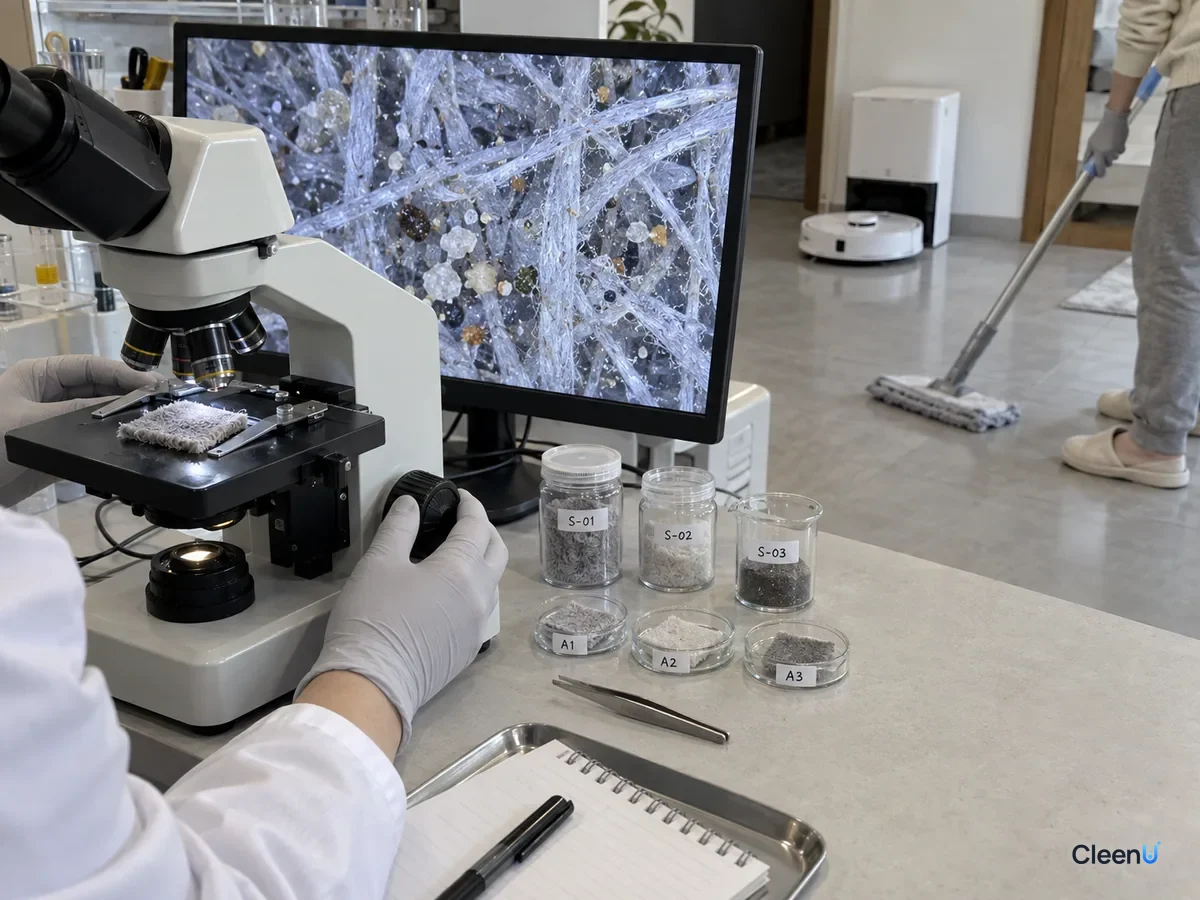
Why can it cut grease at room temperature?
Many people assume grease needs hot water. Heat does soften grease and help it flow, but surfactant action doesn't depend on high temperature. By lowering the interfacial tension between oil and water, surfactants let a greasy film roll up and emulsify even at room temperature, and nonionic surfactants at low concentration form micelles in room-temperature water that take up oily soil.
A robot's clean tank holds room-temperature water, and the pads and floor are room temperature too, so robot mop solutions are designed from the start to clean under exactly those conditions: room temperature, low concentration and light scrubbing.
This article is part of the Robot Vacuum Cleaning Solution & Maintenance Guide, which covers the full maintenance schedule and links to every troubleshooting guide.
More questions people ask
Can I mop with plain water and skip the solution?
For everyday dust, plain water is fine; for footprints and oily film, water only thins them out. Water and oil don't mix, so water beads up on the film and the pad lifts just the top layer. In kitchens, dining areas and entryways, a small dose of low-foam solution makes those marks much easier to remove.
How is robot mop solution different from regular floor cleaner?
The cleaning chemistry is the same: wetting, rolling up, emulsifying and dispersing soil. The difference is foam and residue control. Robot mop solution pairs low-foam nonionic surfactants with a defoamer to handle the dock's repeated scrubbing, while most floor cleaners are designed for hand mopping and can foam or leave residue in a robot.
Robot mop cleaning solution lifts greasy footprints and dull film through a chain of surfactant actions. It wets, so water spreads over grease and floor. It rolls the film up, weakening its grip. It emulsifies and disperses, packing grease and dust into micelles and tiny suspended particles that don't settle back. Then the pad draws them up by capillary action and the dock washes them away. The concentration only needs to be enough, because extra dries into a tacky film. Vacuum first, keep pads clean, use moderate water flow and add a pass on dirty areas to get the most from the chemistry.