
OEM/ODM
Comparing Quotes for Private-Label Robot Mop Cleaning Solution
Direct answer
Put active content, recommended dilution, packaging specs, testing and MOQ into one table, then convert each quote to cost per mopping run. Comparing only unit price makes it easy to pick a formula that needs double the dose, fails on foam or residue, and ends up costing more.
Put several manufacturer quotes on the same basis
-
Send one brief to everyone
Write your target market, channel, compatible machines, format, size, scent, packaging and estimated quantity into one brief and send it to every supplier. Quotes are only comparable if the requirements are identical.
-
Ask for a cost breakdown
Have each supplier state the formula type (low-foam or not, wax or particles), recommended dilution, packaging specs (bottle, material, measuring cap, seal), included testing, MOQ and lead time.
-
Convert to cost per run
Use unit price ÷ (volume ÷ recommended dose per fill) to turn price per bottle into a comparable number.
-
Test samples under the same conditions
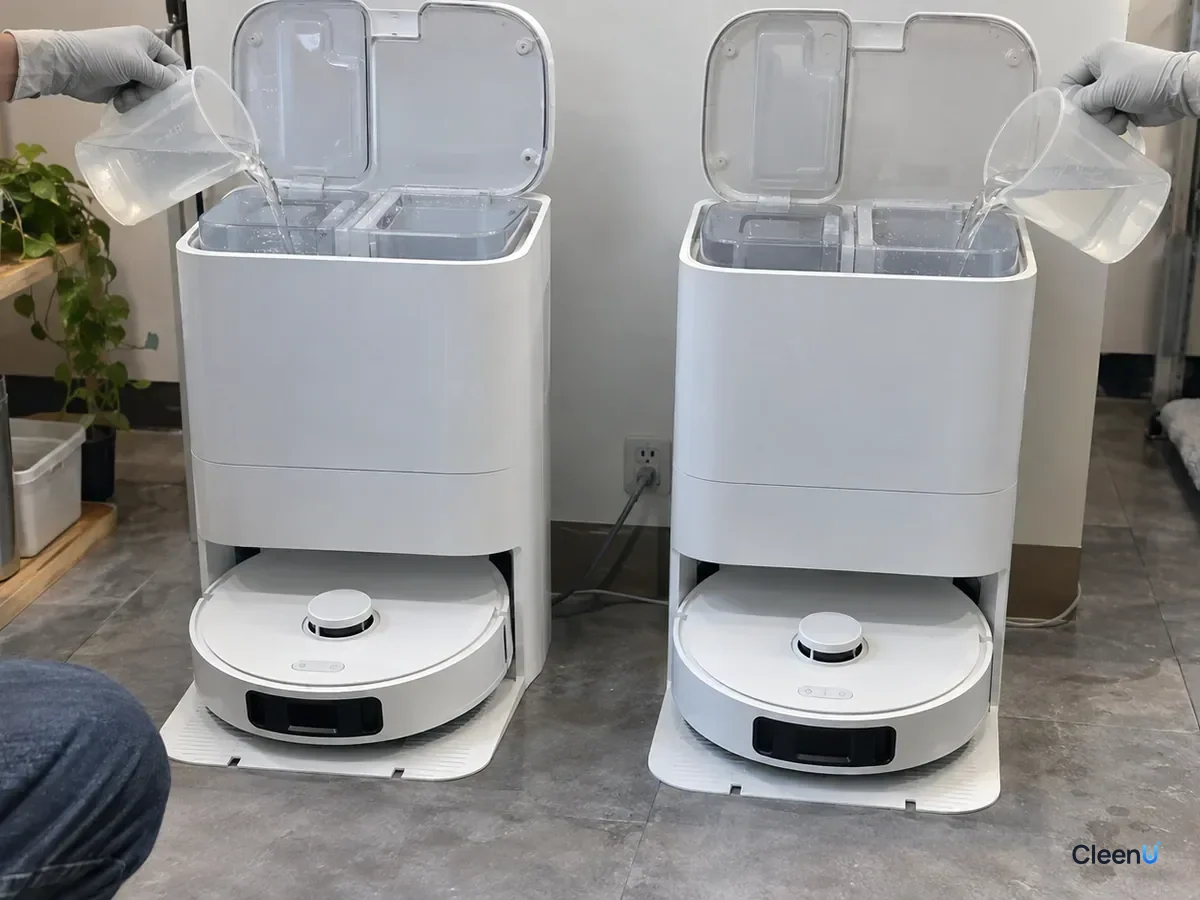
At each supplier's recommended ratio, test foam, residue and cleaning on the same machine and floor. Does the dirty tank trigger false full alerts? Does the floor dry tacky? Do greasy footprints come up?
One to two weeks after samples arrive
-
Weigh everything together
Evaluate cost per run, test results, packaging quality, responsiveness and lead time together rather than unit price alone.
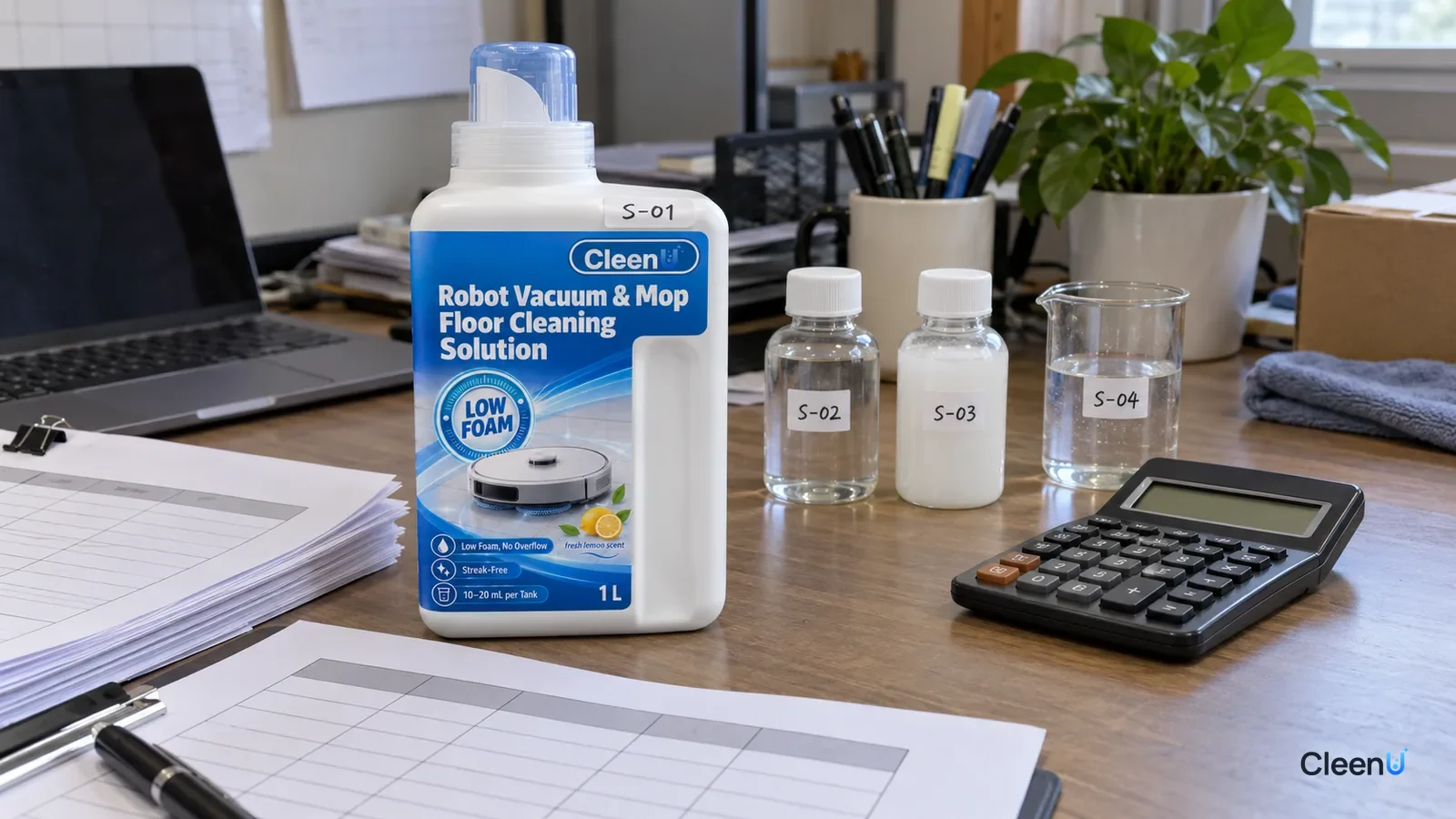
When brands request quotes for private-label robot mop cleaning solution, they often get numbers that are far apart. For the same liter, one supplier is 30% cheaper and another is well above the rest. The first instinct is to take the cheapest, or to assume the expensive one is better. Neither is reliable, because the quotes may not describe the same product at all.
Why do quotes vary so much?
The cost of a bottle of robot mop solution comes from a few places.
Formula ingredients. Surfactants, defoamer, odor control, fragrance and preservatives drive raw material cost; water costs almost nothing. Higher active content means higher ingredient cost.
Packaging. Bottle, cap, measuring cap, liner or seal, label and carton. Custom bottles, graduated measuring caps and induction seals all add cost.
Filling and labor. Filling, labeling and packing steps and efficiency.
Testing and validation. Formula sampling, foam and residue testing, device compatibility and stability observation. Some quotes include these; some don't.
Volume. The higher the quantity, the lower the fixed costs spread across each bottle.
So a low quote might mean low active content, basic packaging or no testing, or genuinely efficient production. A high quote might mean a stronger formula, better packaging and more testing, or just higher margin. Unit price alone can't tell you which.
The most overlooked line: active content and recommended dose
For a concentrated robot mop solution, cost per mopping run matters far more than price per bottle.
At the same liter, a product dosed at 10 to 20 mL per fill gives roughly 50 to 100 runs. One that needs 40 mL to clean gives about 25. Even at half the unit price, the second costs more per run, and shoppers will complain it runs out too fast.
Behind the recommended dose sits active content: put in less of the working ingredients and users have to add more. So when you compare quotes, ask each supplier for its recommended ratio and test under the same conditions. At each supplier's own ratio, does it clean the same soil?
Compare quotes in five steps
What belongs in the comparison table?
MOQ and lead time
CleenU Robot Vacuum Cleaning Solution starts at an MOQ of 500 bottles. Free samples ship in 3–5 days. After packaging and labels are approved, bulk orders are scheduled when the order is confirmed. Final pricing, MOQ and lead time follow the formal quote and order confirmation; SDS and other documents are provided per project after inquiry.
CleenU robot mop solution base specs (for your comparison table)
- Type
- Neutral, low-foam concentrated robot mop cleaning solution
- pH
- 6.5 to 7.5 (25°C)
- Formula
- Low-foam nonionic surfactants with defoamer; no particles, no wax, no chlorine
- Dilution
- About 1:50 to 1:100; 10 to 20 mL per fill is usually enough
- Estimated runs
- About 50 to 100 per liter at that dose
- Default pack
- 1 L concentrate with measuring cap
- Shelf life
- 24 months unopened
Common traps in low quotes
Low active content: the label lists the same ratio as competitors, but it doesn't clean, so shoppers add more.
High-foam systems: anionic surfactants are cheap and cut grease fast but foam in robot mops, triggering false full alerts and a wave of bad reviews.
No defoamer or stabilizers: samples look fine short term, then separate or spoil after a few months or a hot-and-cold shipping route.
Stripped-down packaging: no measuring cap and no seal lead to more complaints about wrong doses and leaks.
Testing extra or skipped: testing costs you don't see on the quote cost more when added later, and skipping device compatibility means discovering foam or clogged dosing compartments only after launch.
Overreaching compatibility claims: a label that says it works in every robot mop becomes a customer service and marketplace problem the moment something goes wrong.
None of these show on a quote sheet. You only find them by using one brief, converting to cost per run and testing under the same conditions. For what to test, see how to evaluate robot mop cleaning solution samples.
Question high quotes too
A higher price doesn't guarantee better. Ask where the difference comes from: higher active content, better packaging, more complete testing, or just margin? Have the supplier break it down, and verify with the same tests. If a high quote doesn't deliver matching value on cost per run and test results, there's no reason to pay more.
How to keep first-order cost and risk down
Brands new to robot mop solution usually worry most about getting stuck with inventory: order small and the unit price is high, order big and it may not sell. A few ways to manage it:
Start with an existing formula and existing packaging. A proven formula in a stock bottle and measuring cap with just your label is the fastest route to samples, needs no molds, and keeps first-order fixed costs lowest. Once sales settle, consider a custom bottle or new scent.
Keep the first order close to MOQ. CleenU's MOQ starts at 500 bottles, so you can size the first order to one or two months of expected sales, prove reviews and repeat purchases, then scale.
Test up front. Finishing foam, residue and device compatibility tests on your target machines during sampling is far cheaper than reformulating after bad reviews.
Work out cost per run and pricing room. Use cost per run to back into retail pricing, for example by stating roughly how many runs a bottle gives and what each run costs. That's a selling point for shoppers and a check on whether your margin works.
Keep records. File quotes, briefs, test records and approved label proofs. When you reorder, change scents or add sizes, you can compare on the same basis instead of starting over.
What CleenU can offer
CleenU can start from a proven neutral, low-foam concentrate and adjust scent, odor control and packaging to your brief. Free samples ship in 3–5 days with a suggested dilution ratio and test method, so you can compare under the same conditions on your own machines. Compatibility is stated for confirmed brands: most robot mops from Roborock, iRobot (Roomba Combo and Braava), Ecovacs Deebot, Dreame and Narwal, and floor washers such as Tineco, added to the clean water tank or the dock's designated compartment as the manual directs. CleenU isn't affiliated with these brands; the names only indicate compatibility.
Costs that are easy to miss in a quote
Sampling and testing: some factories sample free, some charge or credit it against bulk orders.
Label design and printing: whether you design or the factory helps, and label material (waterproof, scuff-resistant) changes the price.
Packaging minimums: custom bottles, caps and printed cartons often have their own MOQs, which may be higher than the solution's.
Documents: whether the SDS and other documents are included, and who pays for extra test reports if needed.
Shipping and packing: the difference between ex-works, port and warehouse pricing, and whether cartons, pallets and leak-proof packing are included.
Ask all of this up front and add it to your comparison table so quotes are truly comparable.
This article is part of the Robot Vacuum Cleaning Solution & Maintenance Guide, which covers the full maintenance schedule and links to every troubleshooting guide.
What brands ask about robot mop solution manufacturing quotes
One quote is 30% lower. Should we just take it?
Convert to cost per run and test under the same conditions first. If the cheaper one needs double the dose or fails on foam or residue, it costs more and brings bad reviews.
How can we tell a supplier's active content?
Ask for the formula type and recommended dilution, then run the same mopping test at each supplier's ratio. The one that cleans at a lower dose usually has stronger active content.
Is testing usually included in the quote?
It varies, so ask. CleenU provides free samples with a suggested ratio and test method so you can compare on your own machines.
What are CleenU's MOQ and lead time?
MOQ starts at 500 bottles, free samples take 3–5 days, and bulk is scheduled after packaging and labels are approved, subject to the formal quote and order confirmation.
Should packaging be quoted separately?
Spell out the bottle, measuring cap and seal in your brief so every quote includes the same packaging and nothing gets added later.
What should we include in an inquiry?
Target market and channel, compatible machines, format and size, scent, packaging requirements, label language and an estimated first-order quantity.
Two suppliers recommend different dilution ratios. How do we compare quotes?
Convert both to cost per run. Use unit price divided by (bottle volume divided by recommended dose per run), then mop once at each recommended rate on the same machine and floor, checking cleanliness, foam and residue. A thinner ratio that leaves the floor dirty is not actually cheaper.
Does the quote include compatibility testing on major robot brands?
Ask line by line rather than assuming it does. Have each supplier list the brands and models used for foam, residue, flow and auto-dose checks, and whether testing costs extra. CleenU samples from a mature neutral, low-foam formula, ships free samples in 3–5 days with suggested test methods, and can run machine tests on your target models.
For a reference formula with clear specs and an easy cost-per-run calculation to include in your comparison, see the CleenU Robot Vacuum Cleaning Solution.
When quotes for private-label robot mop cleaning solution vary widely, it's often because they describe different things: active content, recommended dose, packaging, testing and MOQ may all differ. Send one brief, ask each supplier for a cost breakdown, convert to cost per run, then test foam, residue and cleaning at each supplier's ratio on the same machine and floor. Comparing unit price alone invites a formula that needs double the dose and fails on foam or residue. CleenU can provide a clearly specified neutral, low-foam concentrate and free samples in 3–5 days to test alongside the rest.