
Formulation Science
Robot Mop Cleaning Solution Dilution Ratios Explained: Why a Bigger Ratio Isn't a Stronger Formula
Direct answer
A ratio alone doesn't tell you how strong a solution is. Whether 1:200 beats 1:50 depends on how much active ingredient the concentrate holds and what the mixed solution ends up at. To compare two products, mix each per its own label, then compare foam, residue, cleaning, and cost per fill.
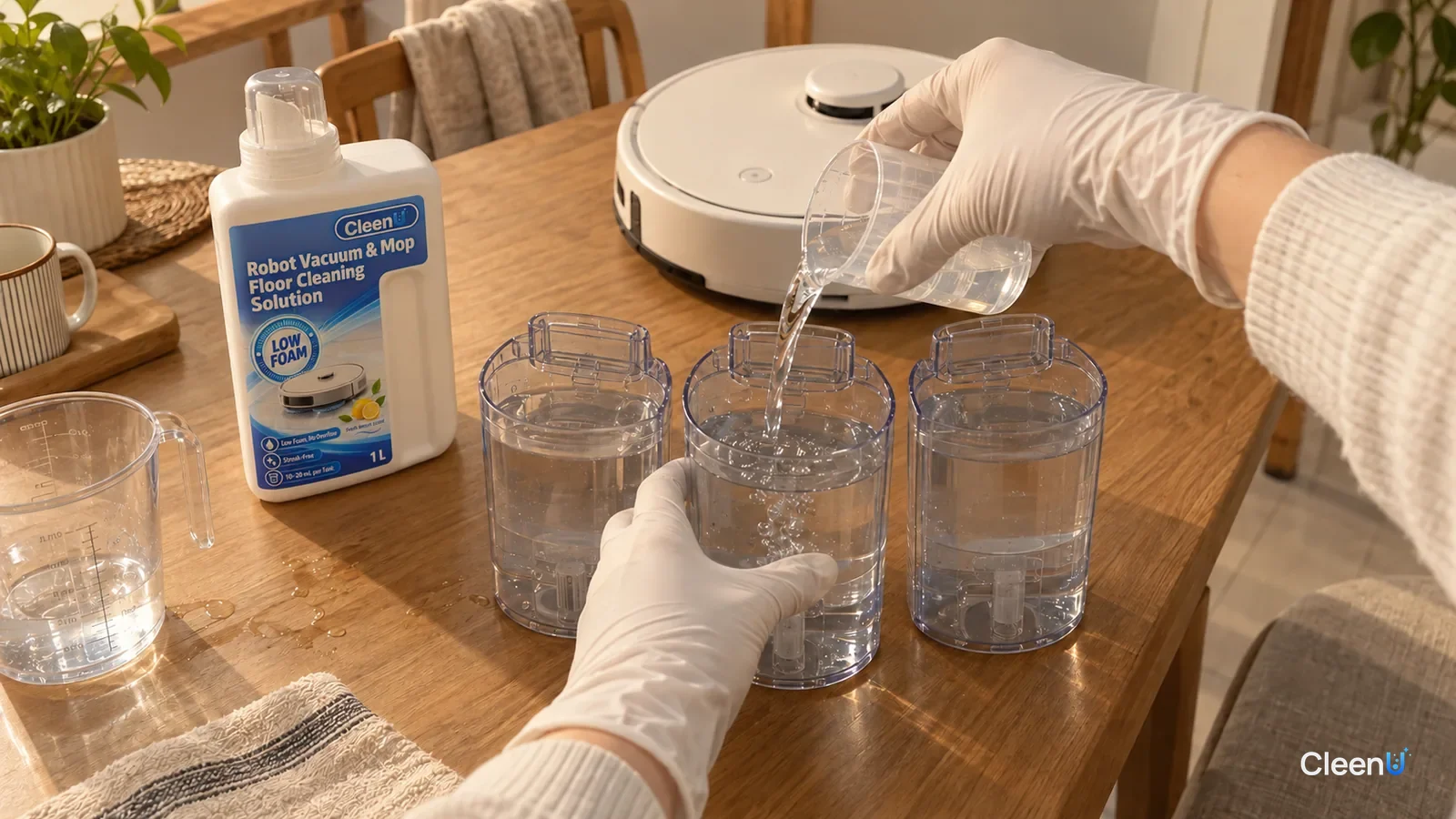
Shop for robot mop cleaning solution and the ratios jump out. Some solutions say 1:200 or 1:300. Some docks mix automatically at 1:100. CleenU Robot Mop Cleaning Solution says about 1:50 to 1:100. The natural assumption is that a bigger ratio means a more concentrated, better-value product, and that 1:50 must be "weaker" and cost more to use. That assumption doesn't hold. A dilution ratio is just a volume ratio between concentrate and water. It tells you how to mix, not how much cleaning power ends up in the thin film on your floor.
A concentrate is water plus surfactants, defoamer, fragrance, and other ingredients, and the share of active ingredients can differ several-fold from one product to the next. A product with more actives gets diluted more; one with fewer gets diluted less. Mixed per their labels, two products can land at exactly the same working strength. So the useful questions are different: does the mixed solution sit in the range that's strong enough without overdoing it, is the dose easy to measure accurately, and what does each fill cost? Below we cover how ratio converts to strength, the chemistry of why extra solution stops helping, how foam and residue climb with dose, why big ratios are less forgiving, how a manufacturer sets a ratio, and how to compare two products at home.
What a dilution ratio actually says
On a cleaning-solution label, "1:100" usually means 1 part concentrate to 100 parts water. Some people read it as 1 part in 100 total. The two readings differ by about 1%, which doesn't matter at home. Two other points cause real confusion.
First, the "1" is the whole concentrate, not the active ingredient. Much of a concentrate can be water, and the surfactants doing the cleaning are only part of it. Formulators describe that part as active content or solids, but most household solutions don't print it on the label.
Second, the ratio is by volume. When the concentrate's density is close to water's, you can treat it as a weight ratio. The working solution's active concentration is then roughly the concentrate's active content divided by the total number of parts. Double the active content at the same ratio and the working strength doubles. Double the ratio at the same active content and it halves.
As a formula: in-use strength ≈ active content ÷ dilution ratio. Run a few real-world numbers through it and you can see why a big ratio fools the eye. Many products on the market carry about 2% active surfactant, yet the label says 1:200 or even 1:500, which looks economical. At 1:200, the mopping water holds only about 0.01% active; at 1:500, about 0.004%. That rarely cleans, so people pour in more and the ratio on the label stops meaning anything. CleenU Robot Mop Cleaning Solution carries 15% active surfactant. Diluted 1:100, it still delivers about 0.15%: about 15 times the 1:200 mix and nearly 40 times the 1:500 one, which is why it keeps cleaning after dilution. The 2% figure is a typical level used for the math, not any particular brand.
In-use strength = active content ÷ dilution ratio
- About 2%, mixed 1:200
- 0.01%
- About 2%, mixed 1:500
- 0.004%
- 15%, mixed 1:100
- 0.15%
In the first two rows, the bigger the ratio, the weaker the mix. The third row says only 1:100 and ends up far stronger. The ratio alone can't show you any of that. The same goes for comparing prices: work out the in-use strength first, then the cost per fill. That's a better guide than the ratio printed on the label.
Does more active ingredient clean better? The critical micelle concentration decides
To answer "Would a stronger mix clean better?" you need one concept: the critical micelle concentration, or CMC.
A surfactant molecule has a water-loving end and an oil-loving end. At low concentrations, surfactant molecules head to the water's surface and to solid surfaces, lining up there and lowering surface tension. That helps water spread out and get into floor texture and between soil particles. Once those surfaces are full, extra molecules start clustering in the water, oil-loving ends pointing inward. Those clusters are micelles, and the concentration where they start forming in quantity is the CMC.
The CMC matters for dosing in a straightforward way:
- Below the CMC, adding more surfactant clearly improves wetting and cleaning, because surfaces aren't saturated yet.
- Around the CMC and somewhat above, surface tension bottoms out, wetting is complete, and micelles can tuck oily soil inside and carry it away in the water.
- Beyond that, surface tension barely changes. Cleaning gains flatten out, but every extra bit of surfactant adds to what dries on the floor and to the foam.
Common nonionic surfactants have very low CMCs; most start forming micelles below one-tenth of a percent. Formulators usually set the working strength at several times the CMC rather than right at it, because floor soil uses some surfactant up. Dust particles and oily films adsorb surfactant, and calcium and magnesium in hard water tie up some ingredients. That margin keeps a dirtier floor manageable.
That's the "rise, then plateau" dose curve. A label ratio is really telling you to mix so the working solution lands where the curve starts to flatten. Mixing stronger buys you more residue and foam, not a cleaner floor. One more caveat: surfactants differ in CMC and cleaning efficiency, so two solutions with the same active strength can still perform differently. Concentration is necessary, but it's not the whole story.
From one extra pour to a sticky floor
What you see
The floor looked dirty, so you doubled the solution. Afterward it feels tacky, shows swipe marks, and the dirty tank is foamier.
Why it happens
The working solution was already several times above the critical micelle concentration, so cleaning had plateaued. The extra surfactant didn't add cleaning power; it stayed on the floor when the water evaporated and stabilized more foam.
What it means for use
Mixing at the label ratio puts you where the curve flattens. For dirtier floors, use the strong end of the label range or make a second pass instead of going past the range.
The foam window: same formula, different behavior at different strengths
Robot mops are especially sensitive to foam. Too much foam during mop washing can trigger false "dirty tank full" alerts, and foam carrying dust into the filter clogs it. Low-foam formulas usually rely on low-foaming nonionic surfactants plus a defoamer that pops bubbles soon after they form.
"Low foam" holds within a range of concentrations, though. Foam volume and stability rise as surfactant concentration rises, often faster than linearly, and protein soil dissolving into mop-wash water makes foam more stable. When formulators design a solution, they test foam at the target strength with simulated soil added, confirming that foam stays low and collapses fast around that strength. The range where cleaning is sufficient and foam and residue stay acceptable can be called the foam window.
The ratio range on a label is that window translated for the user. Take a solution labeled about 1:50 to 1:100: the twofold span is the recommended range. 1:100 for light everyday soil, 1:50 for greasy footprints or floors that haven't been mopped in a while. Go past the strong end and you leave the window, and foam and residue rise noticeably. Go far below the weak end and cleaning falls short, which tends to leave a gray film.
How foam and residue track working strength
- Below the window: wetting and dispersion fall short, and dust film and greasy footprints don't fully lift
- Inside the window: cleaning is near its plateau, and the defoamer can keep up with mop-wash foam
- Above the window: cleaning barely improves, foam builds and lingers, and protein from dirty water stabilizes it further
- Residue rises roughly in proportion to strength and shows up as haze and tackiness on dark floors once the water evaporates
The bigger the ratio, the easier it is to mismeasure
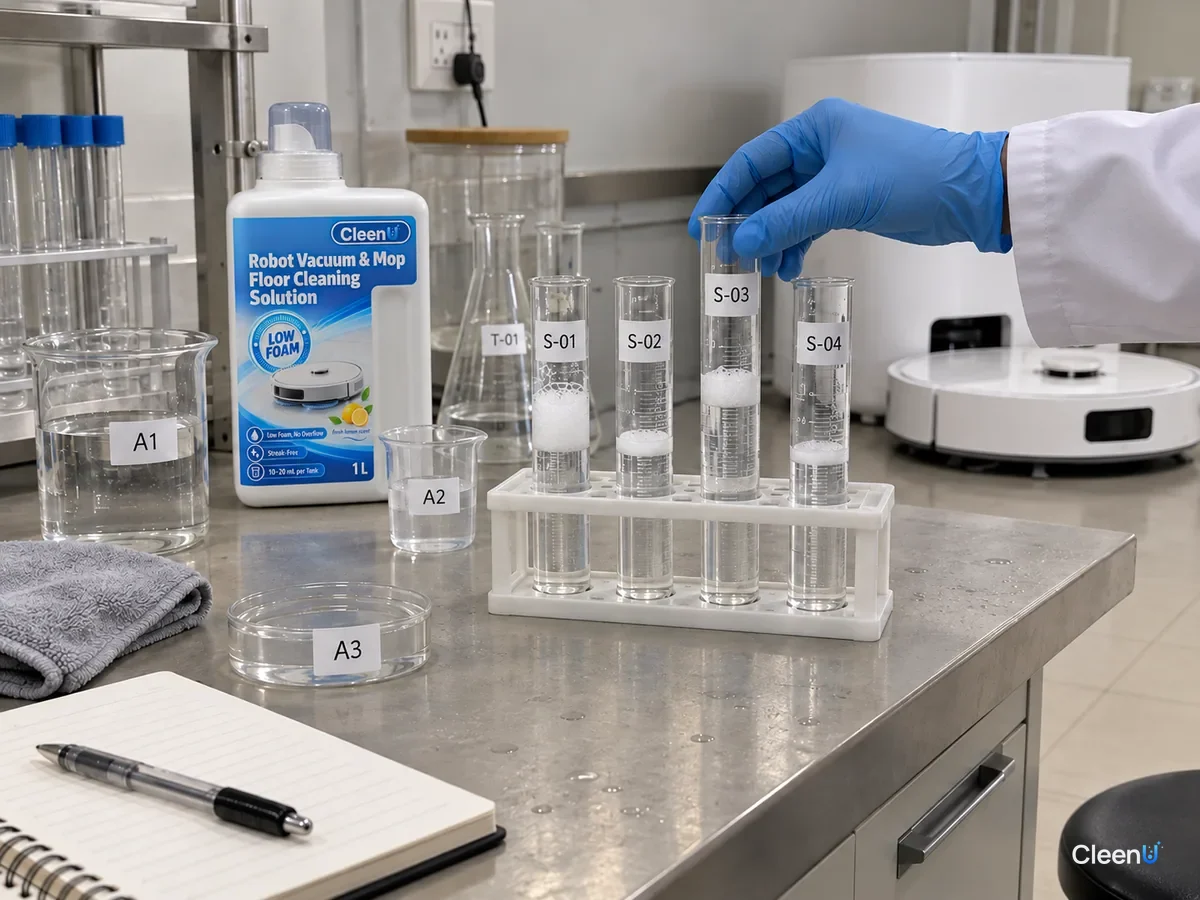
Big ratios have a less obvious cost: they're less forgiving of measuring errors. To mix 1 liter (about 34 oz) of water, the amount of concentrate needed varies a lot by ratio, and pouring by hand and reading cap markings is often off by a milliliter or two. Here's a teaching example that assumes each pour is off by about 2 mL:
Teaching example: concentrate needed for 1 L of water, and a 2 mL pour error
- 1:300, about 3.3 mL
- about 60%
- 1:200, about 5 mL
- about 40%
- 1:100, about 10 mL
- about 20%
- 1:50, about 20 mL
- about 10%
The same slip of the hand can push a 1:300 product more than 50% stronger and out of its foam window, while on a 1:50 to 1:100 product the error stays modest. High-ratio products aren't bad, but they demand more precise measuring, ideally a finely marked measure or a dock that doses automatically.
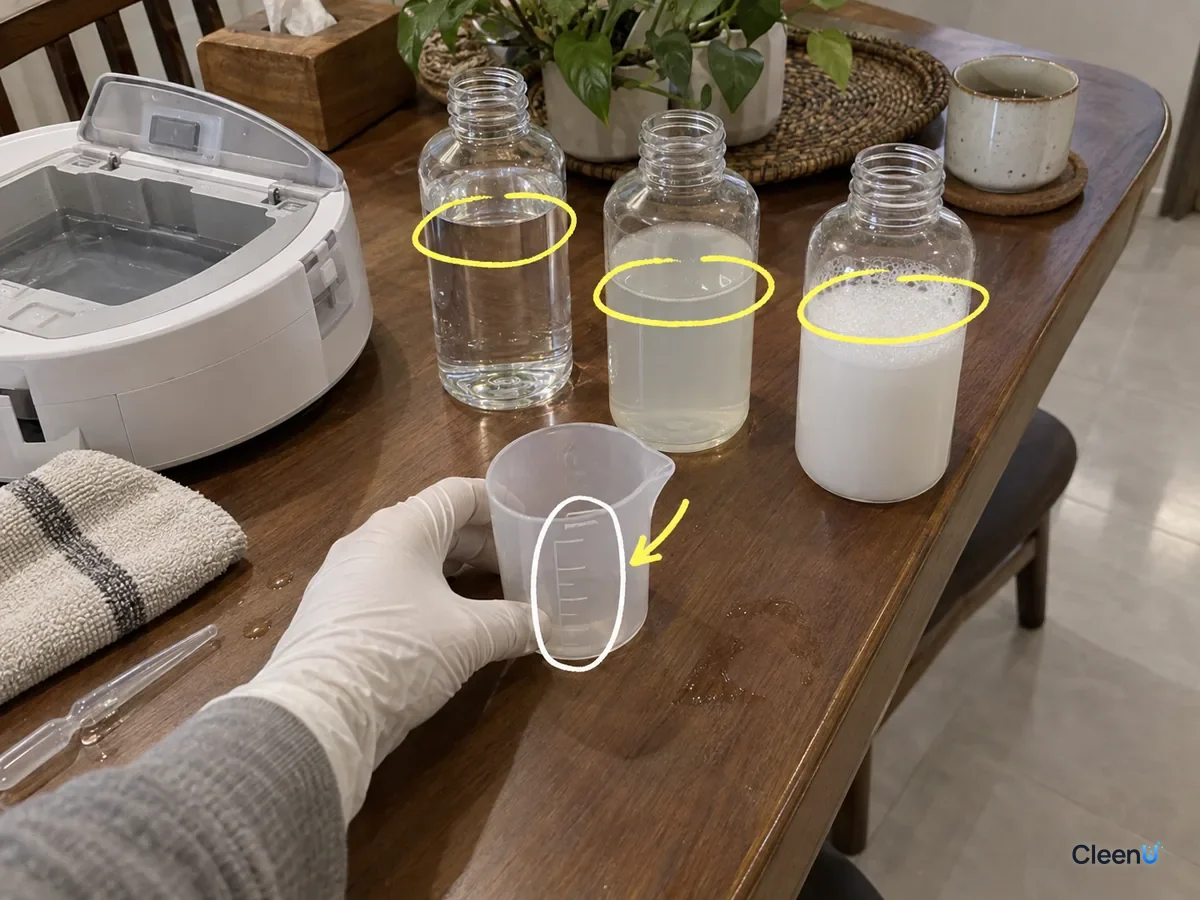
With a solution mixed at 1:50 to 1:100, common tank sizes need 10 to 20 mL per fill, roughly 2 to 4 teaspoons, and a measuring cap with clear markings is fine enough for that range:
Dose by water volume (about 1:50 to 1:100)
- 0.5 L (about 17 oz)
- about 5–10 mL
- 1 L (about 34 oz)
- about 10–20 mL
- 2 L (about 68 oz)
- about 20–40 mL
- 4 L (about 1 gal)
- about 40–80 mL
Auto-dosing docks: when the machine sets the ratio
On docks with an auto-dosing compartment, you fill the compartment with concentrate and the dock's pump blends it into clean water at a preset ratio. The dock, not you, carries out the ratio.
Two points follow. First, the dock dispenses a set amount of concentrate each time, so the strength that actually reaches the water depends on that amount and on the active content of the product you load. Check the ratio on the bottle in your hand, pick the closest dosing level in the app, and confirm with the checks below. Second, the pump draws small volumes, and the concentrate's viscosity affects how much comes out each time. A concentrate that's too thick, especially when cold, may be under-drawn, leaving the mix weaker than intended.
So the first time you use a new solution in an auto-dosing dock, judge it the same way as hand mixing. After mopping, check the dirty tank for foam, feel the dry floor with the back of your hand or in socks, and look for haze on dark floors. If it runs strong, lower the dosing level in the app or turn dosing on only every few runs; if it runs weak, raise it a level. Don't dilute concentrate inside the compartment; a watered-down solution sitting there is more likely to spoil. Choose a solution that's low-foam, neutral, particle-free, wax-free, dries without a crust, and still flows when cold, and the dock will draw it smoothly.
How to compare two robot mop solutions at home
You don't need to know active content to run a fair comparison. The key is mixing each product per its own label, not at the same ratio.
Five steps to a fair comparison
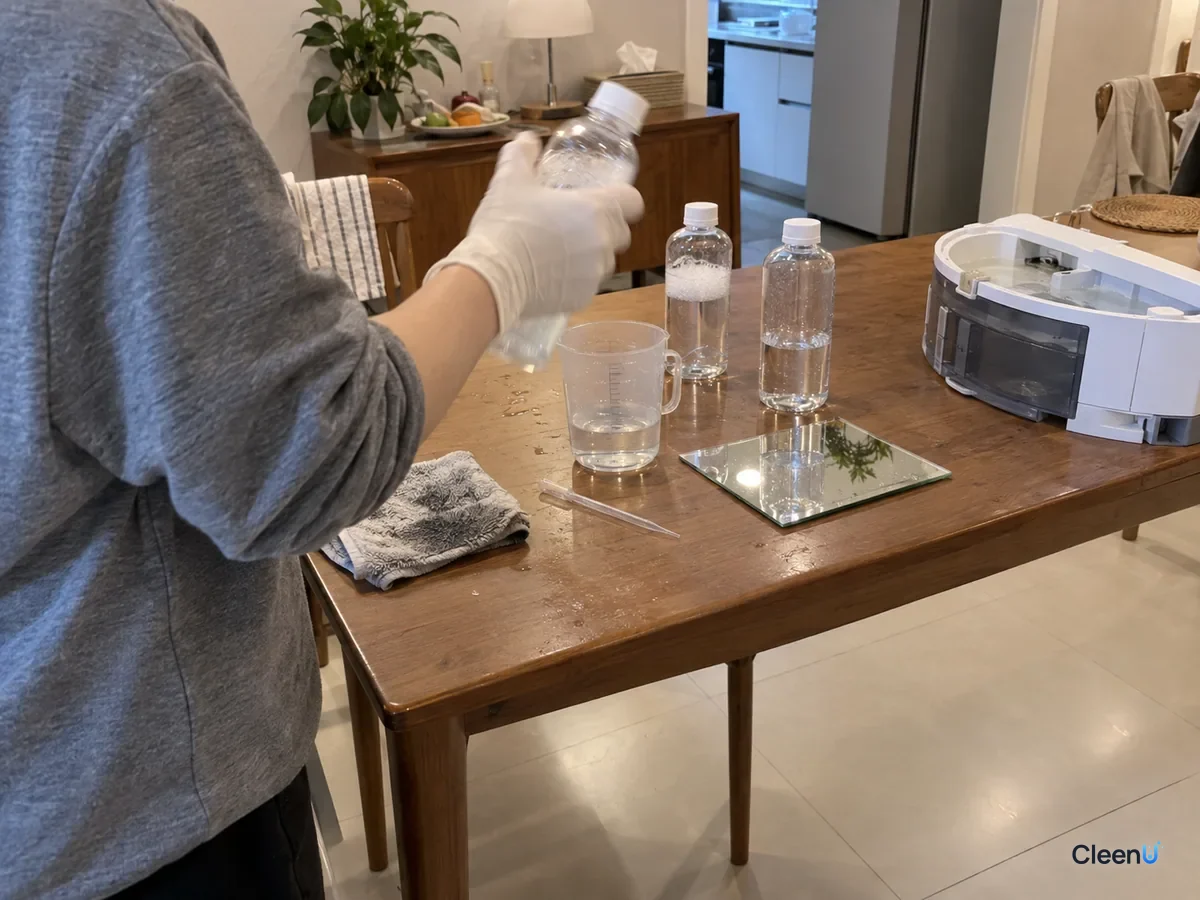
- Same water: fill two identical clear bottles with about 500 mL (17 oz) of water each, and add each concentrate at its own label ratio
- Shake for foam: cap them and shake each 10 times with the same force, then compare starting foam and how fast it fades
- Mirror for residue: wipe a patch of each on a mirror or dark glass, plus a patch of plain water, let dry, and look for haze at an angle
- Real mopping: split one room in half, or mop on two consecutive days, and compare feel, swipe marks, and gray film once dry
- Cost per fill: divide bottle price by bottle volume in mL and multiply by the dose per fill; compare that number, not the ratio
Use the calculator below for cost per fill, entering the price and dose for the product in your hand:
Cost per fill from the label dose
Two more cautions. Don't mix the two products; rinse the tank before switching, or their defoamer systems can interfere and make foam hard to judge. And compare with the same water, since results in hard-water areas can differ from soft-water areas.
CleenU Robot Mop Cleaning Solution: the formula behind the ratio
Take CleenU Robot Mop Cleaning Solution as an example. It's a neutral concentrate, pH 6.5–7.5, with 15% active surfactant, built on low-foam nonionic surfactants with a defoamer, wax-free and particle-free. Dilute about 1:50 to 1:100; 10 to 20 mL per fill is usually enough, and each 1 L bottle comes with a measuring cap. It's a cleaning solution for dust film, greasy footprints, and everyday soil, not a disinfectant. It works in most Roborock, iRobot Roomba Combo and Braava, Ecovacs Deebot, Dreame, Shark, and Eufy RoboVac robot mops, as well as Tineco and Bissell CrossWave wet-dry vacuums. Add it to the clean water tank or designated solution compartment per your manual; on Narwal robots, use the clean water tank. CleenU is not affiliated with any of these brands; names are used only to describe compatibility. If your model's manual says otherwise, follow the manual.
If you want a solution you can measure accurately with the cap and that lands in a low-foam range when mixed per label, take a look at our Robot Vacuum & Mop Floor Cleaning Solution.
Robot mop solution dilution ratios: common questions
Is a 1:200 solution always stronger than a 1:100 one?
You can't tell from the ratio. It's a volume ratio, and concentrate strength depends on active content. Mixed per their labels, the two can end up at the same working strength.
Is a higher-ratio solution cheaper to use?
Work out cost per fill. Bottle price divided by bottle volume, times the dose per fill, is what each mopping costs. The ratio alone doesn't tell you.
My floors are filthy. Can I double the label dose?
Don't. Past the label range, cleaning barely improves while residue and foam increase. Use the strong end of the range or mop twice.
How much water do I mix with CleenU Robot Mop Cleaning Solution?
About 1:50 to 1:100, usually 10 to 20 mL per fill, or 10 to 20 mL per liter of water. Use the low end for routine mopping and the high end, or a second pass, for dirtier floors.
My old solution said 1:300. How do I mix one labeled 1:50 to 1:100?
Follow the new label, about 1:50 to 1:100. Don't carry over the old ratio; each ratio applies only to its own concentrate.
How do I work out a solution's strength once mixed?
Divide active content by the dilution ratio. A 2% concentrate at 1:200 ends up around 0.01%, while a 15% concentrate at 1:100 ends up around 0.15%.
My dock auto-doses. How do I control the ratio?
The dock doses at its preset ratio. With a new solution, mop one room first and check dirty-tank foam and floor feel; if it runs strong, lower the dosing level or dose every few runs.
Can I dilute concentrate before putting it in the dosing compartment?
No. Put concentrate in the compartment and let the dock handle the ratio. A diluted mix sitting there is more likely to spoil.
What happens if I use too little?
Cleaning falls short, and greasy footprints and dust film may not lift, leaving a gray film once dry. For light soil, use the weak end of the range rather than going lower.
Why do some labels give a ratio range?
The range covers different soil levels. CleenU lists about 1:50 to 1:100: 1:100 for everyday mopping and 1:50 for dirtier floors, and there's no need to go beyond it.
Is a measuring cup or a measuring cap more accurate?
Either works if you read the markings and use the same amount each time. Smaller doses need finer markings; for 10 to 20 mL, the measuring cap is accurate enough.
Should I use more solution in hard water?
Start with the label dose. White marks in hard-water areas usually come from calcium and magnesium in the water, and extra solution won't fix that; it just adds residue.
How long can I keep mixed solution in the tank?
Mix it the day you use it. Diluted solution left in a tank for days can go off, grow microbes, and start to smell.
For more on dosing, see How much cleaning solution should you put in a robot mop? To compare costs, see Concentrate vs. ready-to-use robot mop solution: which costs less per mop? On foam and cleaning power, read Does low-foam robot mop solution clean less? And for hard-water marks, see Why hard water leaves white marks after robot mopping.
A dilution ratio is only a volume ratio between concentrate and water. A bigger ratio doesn't mean a stronger concentrate or a better deal. What decides cleaning is the strength of the mixed solution, which you can estimate as active content ÷ dilution ratio: a 2% concentrate at 1:500 leaves only about 0.004%, while a 15% concentrate at 1:100 still delivers about 0.15%. Once that strength is several times above the critical micelle concentration, cleaning nears its plateau, and more only adds foam and residue. To compare two solutions, mix each per its own label and compare foam, residue, real mopping, and cost per fill, and remember that bigger ratios demand more careful measuring. A solution diluted about 1:50 to 1:100 needs 10 to 20 mL for common tanks, easy to measure with the cap.