
Testing & Quality
Stability Testing for Robot Mop Cleaning Solution: Heat, Cold, and Retained Samples
Direct answer
Store samples from one batch under heat, cold and freeze-thaw cycles, with a room-temperature retained sample as the control, and check appearance, viscosity, pH, odor and packaging at set time points. If nothing separates, discolors or thickens in heat or cold and the packaging holds its shape, the formula keeps.
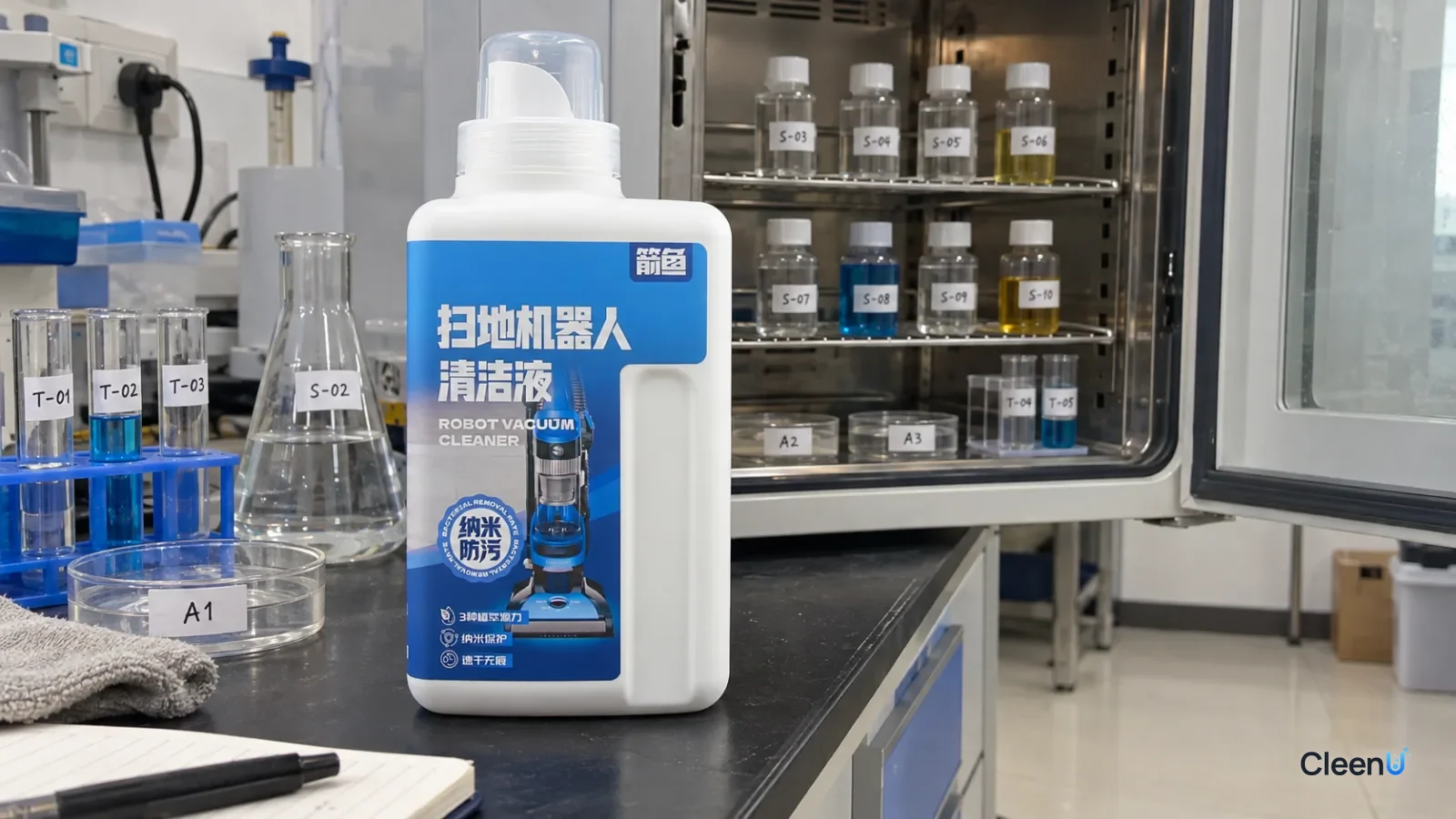
A bottle of robot mop cleaning solution travels from factory to home through summer warehouses, winter trucks and bumpy parcel routes, then may sit for months in a garage, on a porch or next to a water heater. A fresh sample that looks clear and even doesn't guarantee it'll look the same months later, after hot and cold swings.
Stability testing simulates those conditions ahead of time, under control, to see whether the formula and packaging hold up before launch.
Why does robot mop solution especially need stability testing?
It's a balanced system of several ingredients. Surfactants, defoamer, solubilizer, fragrance, preservative and odor control only stay together because of formula design. Temperature swings can upset that balance: nonionic surfactants can pass their cloud point and turn cloudy in heat, defoamer and fragrance can separate out, and some ingredients can crystallize in the cold.
It goes into a machine. A separated, precipitated or thickened liquid foams, leaves residue and clogs outlet holes and dosing compartments. For robot mop solution, stability isn't just about looks; it decides whether the product works at all.
It's stored for a long time. A concentrate lasts dozens of runs and sits open for a long while, and unopened stock may sit in warehouses and on shelves. CleenU Robot Vacuum Cleaning Solution, for example, has a 24-month unopened shelf life.
What conditions does stability testing cover?
High-temperature storage: samples go into a chamber above room temperature to speed up changes between ingredients and surface problems like separation, discoloration, scent shifts and preservative failure. Heat also roughly mimics summer warehouses and shipping.
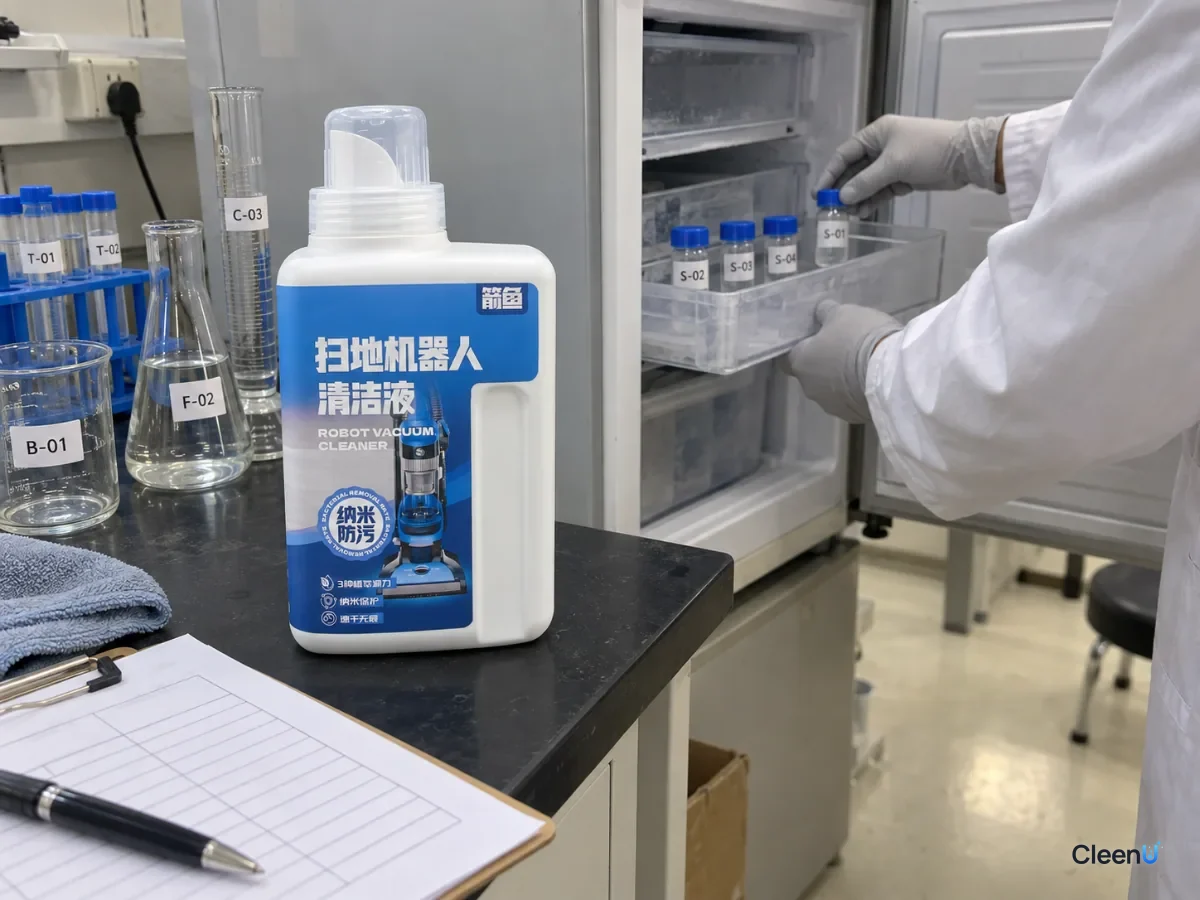
Low-temperature storage: samples go into a refrigerator or cold chamber to check for crystallization, precipitation, clouding or thickening, and whether they recover at room temperature.
Freeze-thaw cycling: samples alternate between frozen and room temperature, mimicking winter shipping or storage in an unheated garage. Freeze-thaw is tough on emulsions and fragrance-containing systems, and on packaging seals and bottles.
Light: samples sit by a window or in a light cabinet to see whether fragrance or dye fades or yellows.
Room-temperature retained samples: part of the same batch is kept at room temperature as the control, and as a reference for future traceability and customer feedback.
Specific temperatures, durations and cycle counts depend on the product, the target market's climate and shipping conditions.
What you need for stability testing
- Sample
- One batch filled into production bottles and caps, split into several bottles per condition; every bottle labeled with a different test code (such as ST-01, ST-02) plus the condition and start date
- Conditions
- Room-temperature retained samples; a heated chamber; a cold chamber or refrigerator; freeze-thaw cycling; a light-exposure group if needed
- Equipment
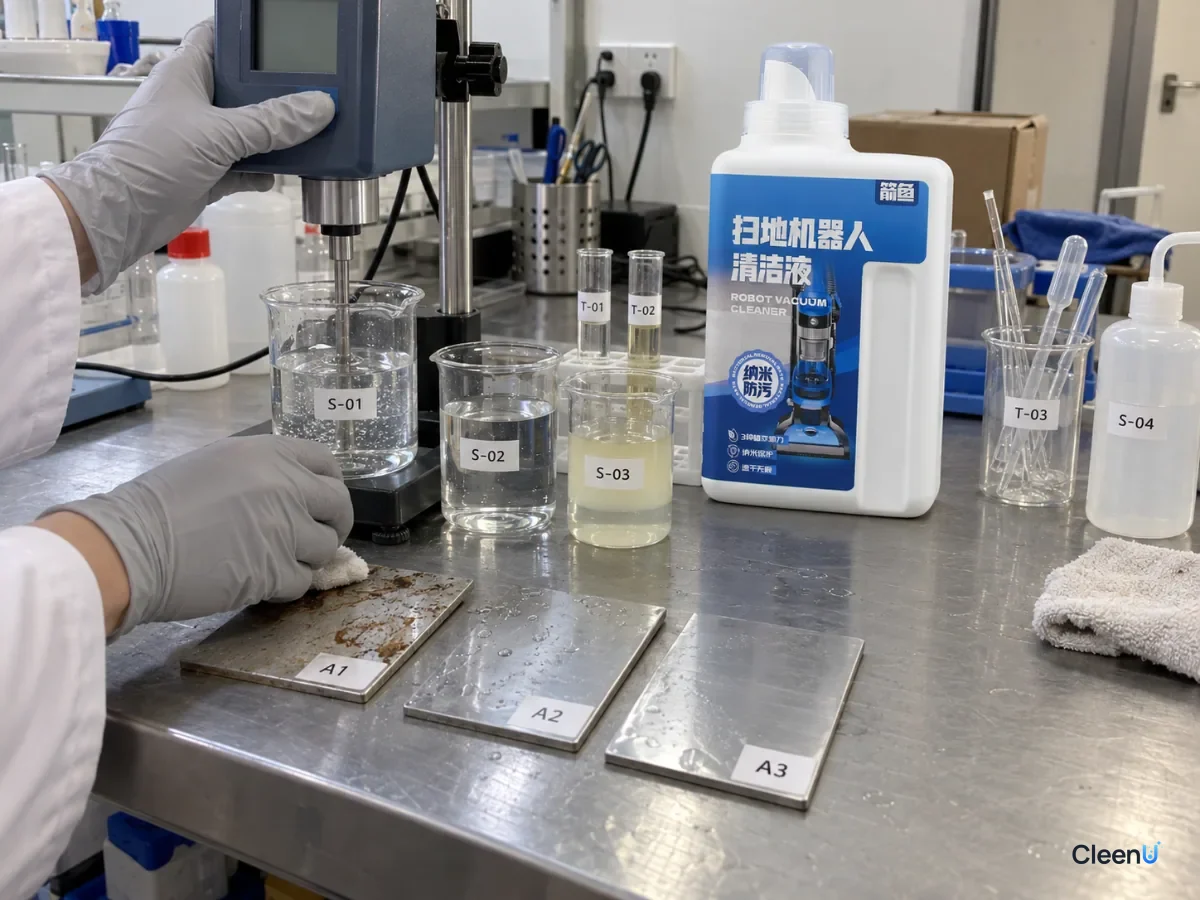
- Stability chamber, cold chamber, viscometer, pH meter, clear measuring cups, a camera and a record sheet
- Pass criteria
- Compared with the retained sample, no separation, sediment, crystals or clear color change; viscosity and pH within set ranges; no clear change in odor; no bulging, deformation or leaks in the packaging; normal foam and residue once diluted to working strength
Six steps for stability testing
Record the starting state
After filling, record appearance (color and clarity), viscosity, pH and odor, and photograph the samples. Give every bottle a different test code with its condition and date.
Place the groups
Put samples into room-temperature, heated and cold conditions, and cycle the freeze-thaw group between frozen and room temperature on a set schedule.
Caution:Use production bottles and caps in every group so packaging problems like bulging, leaks and deformation show up too.
Check at set time points
At each time point (for example one week, two weeks, one month and three months), bring samples back to room temperature and check appearance, viscosity, pH and odor, with photos.
Recheck performance
Dilute heat- and freeze-thaw-aged samples at the label ratio and run a foam test and a residue test to see whether they match the starting sample.
Compare with retained samples
Compare every result with the room-temperature retained sample to separate condition-driven changes from normal batch variation.
Conclude and adjust
If samples separate, precipitate, discolor clearly, or drift out of the viscosity or pH range, send the results back for formula adjustment, such as the solubilizer system, defoamer type or fragrance level, then retest.
Reading the results
Appearance: cloudiness in heat that clears at room temperature is usually a nonionic surfactant's cloud point and may be acceptable depending on degree. Cloudiness, separation or sediment that remains at room temperature means the system isn't stable.
Viscosity: clear thinning or thickening can affect water flow and auto-dosing, so viscosity has to stay within a set range.
pH: noticeable drift may mean an ingredient is breaking down, and it can affect preservation and material friendliness.
Odor: fading, off-notes or sourness can mean fragrance evaporating or oxidizing, or microbial trouble.
Packaging: bulging, deformation or leaks at the cap mean the packaging isn't matched to the formula and temperatures.
Performance: more foam or residue after dilution means the defoamer or solubilizer system has been affected, which matters most for robot mop solution.
What are retained samples for?
Retained samples are a small portion of every production batch kept under set conditions for a set period. They serve as:
The control for stability testing.
A reference for customer feedback. If someone says a bottle changed color, you compare it with the same batch's retained sample to tell whether storage conditions or the batch itself caused it.
A way to trace problems back to a production batch.
How users can help solution stay stable
Store it indoors somewhere cool, dry and dark, not on a porch, in the car or next to the water heater.
Keep it from freezing in winter. If it freezes, let it thaw slowly at room temperature, shake it and check that it's clear and even.
Close the cap tight after use, and never add water to the bottle.
Stop using it if it separates, has sediment, clearly changes color, smells off or the bottle bulges. See robot mop cleaning solution changed color or separated.
CleenU Robot Vacuum Cleaning Solution is a neutral, low-foam concentrate at pH 6.5 to 7.5 with low-foam nonionic surfactants and a defoamer, no wax, no chlorine and no particles, in a 1-liter bottle with a measuring cap and a 24-month unopened shelf life. It dilutes at about 1:50 to 1:100; 10 to 20 mL per fill is usually enough. It works in most robot mops from Roborock, iRobot (Roomba Combo and Braava), Ecovacs Deebot, Dreame and Narwal, and in floor washers such as Tineco. Add it to the clean water tank or the dock's designated detergent compartment as your manual directs. CleenU isn't affiliated with these brands; the names only indicate compatibility. For other sample tests, see how to evaluate robot mop cleaning solution samples.
Shipping simulation: the last hurdle
A stability chamber simulates storage, but real logistics add vibration, crushing, drops and pressure changes. Cross-border shipments may spend weeks at sea, in warehouses and through several transfers.
So beyond stability testing, run a shipping round. Ship production-packed samples by the real route (parcel, ocean or air), or run vibration, drop and stacking tests in the lab. On arrival, check whether bottles bulged, deformed or leaked, whether the liquid separated or changed color, and whether caps and seals are intact.
Watch batch-to-batch consistency too
Stability testing usually covers one or two batches, but every production batch can differ slightly because of raw material lots, plant conditions or fill temperature. Keep a retained sample from every batch and spot-check appearance, viscosity and pH regularly. When customer feedback comes in, you can compare it with the same batch's retained sample and tell whether it's a storage issue or a batch issue.
A simple check brands can run on samples
You don't need lab equipment for a basic version. Take several bottles from the same batch and give each a different code. Put one in the refrigerator, one at room temperature and one somewhere warm (near a heater, but not touching it). Once a week, look at them, smell them, and dilute a little at the label ratio and shake it to check foam, comparing against the room-temperature bottle and noting the results. After a few weeks, you'll have a clear sense of whether the product keeps.
This article is part of the Robot Vacuum Cleaning Solution & Maintenance Guide, which covers the full maintenance schedule and links to every troubleshooting guide.
Common questions about cleaning solution stability testing
How long does stability testing take?
Usually weeks to months, set by product and market. Typically samples are watched for weeks to months under heat, cold and freeze-thaw, with checks at several time points.
How much shelf life does accelerated heat testing represent?
It helps predict trends but doesn't convert neatly into a definite shelf life. Long-term room-temperature retained samples still have the final say.
If a sample turns cloudy in heat, does it fail?
Not by that alone. If it clears at room temperature and performs normally, it's usually a cloud point effect. Staying cloudy or separated at room temperature means it's unstable.
Why use production bottles?
Packaging is part of stability. Only production bottles, caps and seals show whether they bulge or leak through temperature swings.
Why does freeze-thaw testing matter?
In winter shipping and cold-climate storage, a product may freeze and thaw repeatedly, which is a big test of formula uniformity and packaging seals.
Can a brand do a simple stability check on samples it receives?
Yes. Put a few bottles in the refrigerator, at room temperature and somewhere warm, check appearance, smell and foam regularly against the room-temperature bottle, and give each bottle a different code so they don't get mixed up.
For a neutral, low-foam robot mop solution with a 24-month unopened shelf life that keeps well, try Robot Vacuum Cleaning Solution.
Robot mop cleaning solution stability is proven through heat, cold, freeze-thaw cycling and comparison with room-temperature retained samples. Fill one batch into production packaging, give every bottle a different test code, and check appearance, viscosity, pH, odor and packaging at set time points, then dilute the aged samples to recheck foam and residue. For robot mop solution, stability decides whether it will foam, leave residue or clog once it's in the machine. Users can help by storing it cool and dark, keeping it from freezing, closing the cap tight and never adding water to the bottle, and by stopping use if it separates or changes color.