
OEM/ODM
How Should a Private-Label Robot Mop Cleaning Solution Set Its Dilution Ratio?
Direct answer
A higher ratio isn't automatically better. About 1:50 to 1:100 is forgiving to measure and steadier in cold storage and auto-dosing docks, which suits most universal products. 1:200 needs a stronger concentrate and tighter control of dosing, foam, and stability. Pick your target robots first, then the ratio.
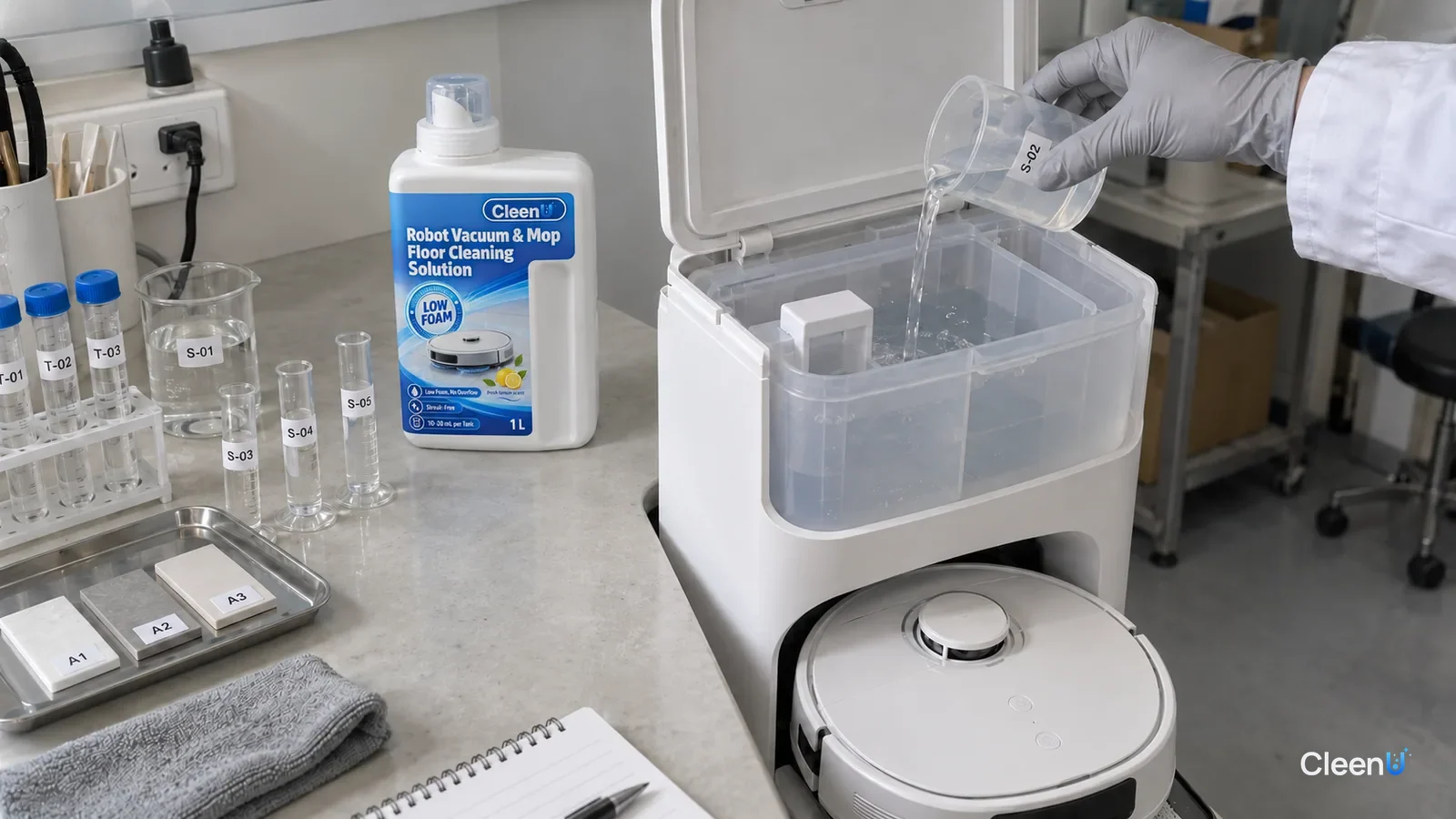
When brands plan a private-label robot mop cleaning solution, they often see competitors labeled 1:200 or 1:300 and want a bigger number of their own, because it reads as more concentrated and longer-lasting. That instinct makes sense, but a dilution ratio isn't a spec you can raise in isolation. It sets how strong the concentrate has to be, how much goes in per fill, how the measuring cap is designed, whether an over-pour causes foam or tacky floors, whether the product thickens in winter, whether an auto-dosing dock can draw it, and every number on your label and listing. Change the ratio and you've changed the product.
Our view: for a universal product sold across many robot brands, where most customers mix it into the clean water tank by hand, about 1:50 to 1:100 is the safer range. It's also the ratio our existing CleenU Robot Mop Cleaning Solution uses. A higher ratio like 1:200 is worth considering when you have a specific reason, such as targeting a certain type of auto-dosing dock or caring a lot about per-fill numbers and shipping weight, and only with tougher sample validation behind it. Below we cover what the ratio actually sets, the five things it affects, the formulation hurdles, how to work backward from your target robots, how to validate samples, and how to keep labels and listings consistent.
What the ratio actually sets: concentrate strength, working strength, and dose
A dilution ratio is just the volume ratio of concentrate to water. What determines mopping performance is how much active ingredient ends up in the working solution, the mix that actually goes on the floor. Surfactants need to reach a certain concentration there, usually around or above the critical micelle concentration (the point where molecules start forming clusters and solubilizing and emulsifying power picks up), to reliably wet, emulsify, and carry away grease film and dust film. That working concentration is set by the cleaning job, not by the ratio.
So the higher the ratio, the stronger the concentrate has to be. A teaching example makes this concrete (assumed values, not any product's formula): suppose a formula needs 0.15 percent actives in the working solution.
Same working strength, different ratios (teaching example)
- 1:50
- 7.7%
- 1:100
- 15.2%
- 1:200
- 30.2%
The math is concentrate strength ≈ working strength × (ratio number + 1). Two things follow. First, 1:200 doesn't mean "less chemistry." At the same working strength, about the same amount of active ingredient reaches the floor each time; you're just shipping less water. Second, formulation difficulty doesn't scale in a straight line. As we'll get to, very concentrated surfactant systems run into new problems with flow, cold stability, and defoamer compatibility.
That also answers a common question: is a 1:200 product "more economical"? Per fill, the actives used are often about the same. The real savings are in packaging and freight per use. That's a legitimate selling point, but it has to be stated accurately, not as "use half as much for the same results" without comparative testing to back it.
For a real product, divide active content by the dilution ratio for a quick estimate of in-use strength. CleenU carries 15% active surfactant, while many products on the market sit around 2%. At about 2% active content, a 1:200 mix leaves only about 0.01% active in the tank, and a 1:500 mix about 0.004%, well short of the working strength described above. CleenU diluted 1:100 still delivers about 0.15%: about 15 times the 1:200 mix and nearly 40 times the 1:500 one, which is why it keeps cleaning after dilution, and also why it costs more. When you set a ratio, check that the in-use strength is enough first, then look at the number on the label.
Five things the ratio changes
Dosing tolerance: the higher the ratio, the more an over-pour matters
Customers don't measure precisely every time. The same 5 mL over-pour hits each ratio very differently:
Concentrate per liter (about 34 oz) of water, and the effect of a 5 mL over-pour
- 1:50
- About 20 mL; about one-quarter stronger
- 1:100
- About 10 mL; about half again as strong
- 1:200
- About 5 mL; roughly double strength
With a 1:200 product, a casual "little extra" can easily double the working strength. In a robot mop, doubled strength tends to mean more foam, false full-tank alerts, and tacky or hazy floors. Cap resolution becomes a problem too: a 5 mL mark is a tiny step inside a cap, so reading errors are large relative to the dose.
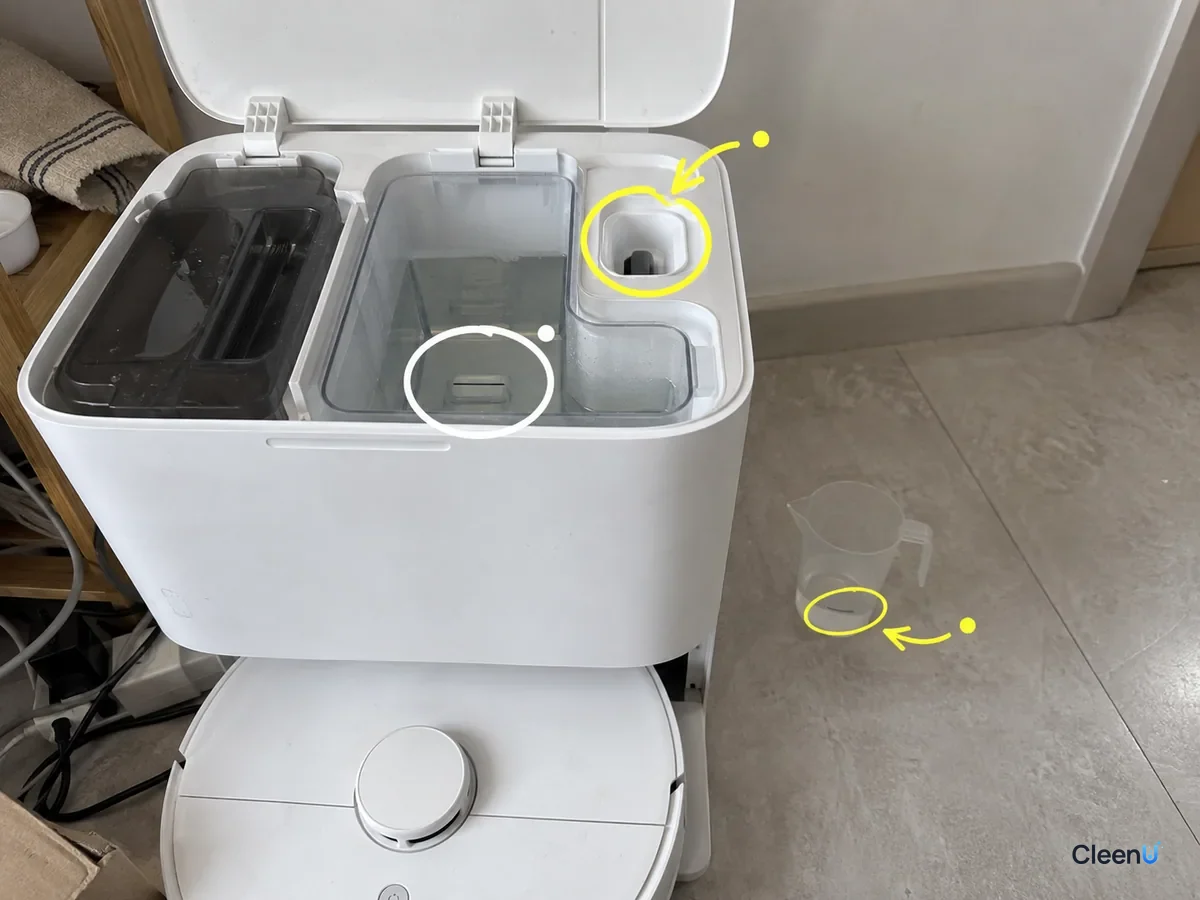
Perceived cost per use: state fills per bottle with the assumptions
The ratio and bottle size together set "how many fills per bottle." For CleenU Robot Mop Cleaning Solution, each 1 L bottle at 10 to 20 mL per fill covers roughly 50 to 100 fills. A higher ratio makes that number look bigger, but always state the assumptions: tank size and dose per fill. If a customer runs the math on their own tank and it doesn't match, that's a review waiting to happen.
The foam window: how wide a dose range stays low-foam
"Low foam" holds within a range. A formula built on low-foam nonionic surfactants with a defoamer stays low-foam near the label dose. Keep adding product and surfactant concentration climbs while the defoamer falls behind, and foam shows up. We call the dose range where a formula stays low-foam and non-tacky its foam window. The higher the ratio, the easier it is for an over-pour to fall outside that window, so high-ratio products need a wider window and more formulation headroom.
Cold and storage stability: stronger concentrates are touchier
Highly concentrated products are more likely to turn cloudy, separate, precipitate, or thicken in the cold. Nonionic surfactant solubility is very temperature-sensitive, and the stronger the concentrate, the closer it sits to the range where gel or liquid-crystal phases form. Winter warehousing, freezing in transit, or a bottle kept in an unheated garage all become risk points. A concentrate that thickens or separates is hard to pour and measure, and dock pumps can't draw it. For test methods, see How to test robot mop solution stability and Is robot mop solution still usable after freezing?
Auto-dosing compatibility: the dock sets the dose, not you
Docks with a solution cartridge or auto-dosing compartment draw at a fixed setting, and users usually can't change it. Choose a solution with stable viscosity that's labeled for auto-dosing, and set the dock per its label. Published numbers differ by brand. Eufy's materials say the S1 series dock mixes at 1:100, Ecovacs specifies 1:200 when solution is added to the clean water tank by hand, and Roborock's own pages list both 1:200 and 1:300. When you develop a concentrate, match its strength to the target dock's setting and the working strength stays steady: much stronger means overdosing, much weaker means underdosing. Some brands' auto-dosing cartridges are also sealed and not refillable, so a third-party solution simply goes into the clean water tank at its ratio.
If your main channel is owners of specific auto-dosing docks, it makes sense to align the ratio with those docks' dosing settings and test on the machines during sampling. If you're targeting many brands with hand dosing, put dosing tolerance and stability first. CleenU Robot Mop Cleaning Solution's viscosity is designed for auto-dosing compartments, and we've run foam, residue, and water-path tests on common robot mops.
The formulation hurdles: why stronger concentrates are harder
What a formula has to clear as the concentrate gets stronger
- As surfactant content rises, the concentrate approaches gel or liquid-crystal phases, and viscosity can jump, especially in the cold
- Keeping a strong concentrate fluid usually takes hydrotropes or solvent-type ingredients, which affect odor, seal compatibility, and any solvent-free positioning
- Defoamer and surfactant compatibility has to be rechecked at high strength; if the concentrate separates, foam control becomes uneven
- Adding a little water to a strong concentrate can pass through a thicker zone, so residue at a dock outlet that meets rinse droplets can thicken and dry there
- The higher the ratio, the smaller the label dose, so the cap, its markings, and the instructions all have to be redesigned
Each hurdle is manageable, but each has to be validated at the sample stage, not after the ratio is already printed on the packaging. From a manufacturing standpoint, the ratio is an output of the formula, not the starting point. First define the cleaning and low-foam performance the working solution needs, then see how strong the concentrate can be while staying stable across your temperature range, and only then set the label ratio.
The "thicker when slightly diluted" effect matters most for auto-dosing compartments. Concentrate left near the outlet meets a little water, the local mix falls into the gel range, and a viscous film forms that eventually dries. Customers see it as no dispensing or a "solution not detected" error. For troubleshooting, see Why a robot dock's auto-dosing stops dispensing.
What you can customize
Work backward from your target robots: four questions first
Before setting a ratio, CleenU will walk through these questions with you. Once they're answered, the ratio, cap, and label usually lock in on the first pass, and samples don't bounce back and forth over foam and residue. For more on why samples get revised repeatedly, see Why private-label robot mop solution samples keep getting revised.
Answer these four questions before you set a ratio
- Which robots are you targeting: robot mops dosed by hand into the clean water tank, docks with auto-dosing compartments, or wet-dry vacuums with a dedicated solution tank
- Roughly how big are those clean water tanks and dosing compartments, and what ratio and dosing method does the manual specify
- How will customers measure: with the cap, a measuring cup, or by eye; and are you selling online or in stores
- Which selling point matters most: easy measuring, winter stability, fills per bottle, or shipping weight
Put the answers together and most projects land in one of these:
- Many brands, mostly hand dosing, sold online: about 1:50 to 1:100, with cap markings for 1 L and 2 L (about 34 and 68 oz) tanks. It's forgiving, steadier in winter, and generates the fewest support tickets.
- Focused on a specific type of auto-dosing dock: align the ratio with that dock's dosing settings and confirm drawing, dispensing, and foam on the machine during sampling.
- Per-fill dose and shipping weight are the priority: a higher ratio can be discussed, but expect stricter cold-stability and foam-window validation, a cap with finer markings, and a more prominent "measure to the mark" note on the label.
How to validate a ratio at the sample stage
Once the ratio is chosen, sample validation should reflect how customers really use the product, not just one test at the label dose.
Tests to run when validating a dilution ratio
- Dose window: mix working solution at half, standard, and double the label dose, and find where foam and residue start to change
- Foam: cylinder shake or Ross-Miles testing in soft and hard water, repeated in water spiked with simulated soil
- Residue: wipe double-dose working solution onto mirror and tile panels and check for tackiness or haze once dry
- Cold: refrigerated and freeze-thaw cycles on the concentrate; look for cloudiness, separation, or precipitation, recovery at room temperature, and whether it still pours easily cold
- Viscosity: check flow at different temperatures to confirm dosing compartments can draw it and outlets don't crust easily
- Materials: soak common seals and plastics in concentrate and working solution, and look for swelling, hardening, or cracking
- Real runs: operate on the target robots, with no false full-tank alerts and no abnormal buildup on filters or outlets
The double-dose and cold tests separate good ratios from bad ones. The first stands in for customers who over-pour, the second for warehousing and shipping. Looking good at the label dose and room temperature is easy. Still looking good after a customer pours an extra capful, or after a winter in the garage, means the ratio is right. For more on sample checks, see How to accept robot mop solution samples and How to tell if a robot mop solution is low-foam.
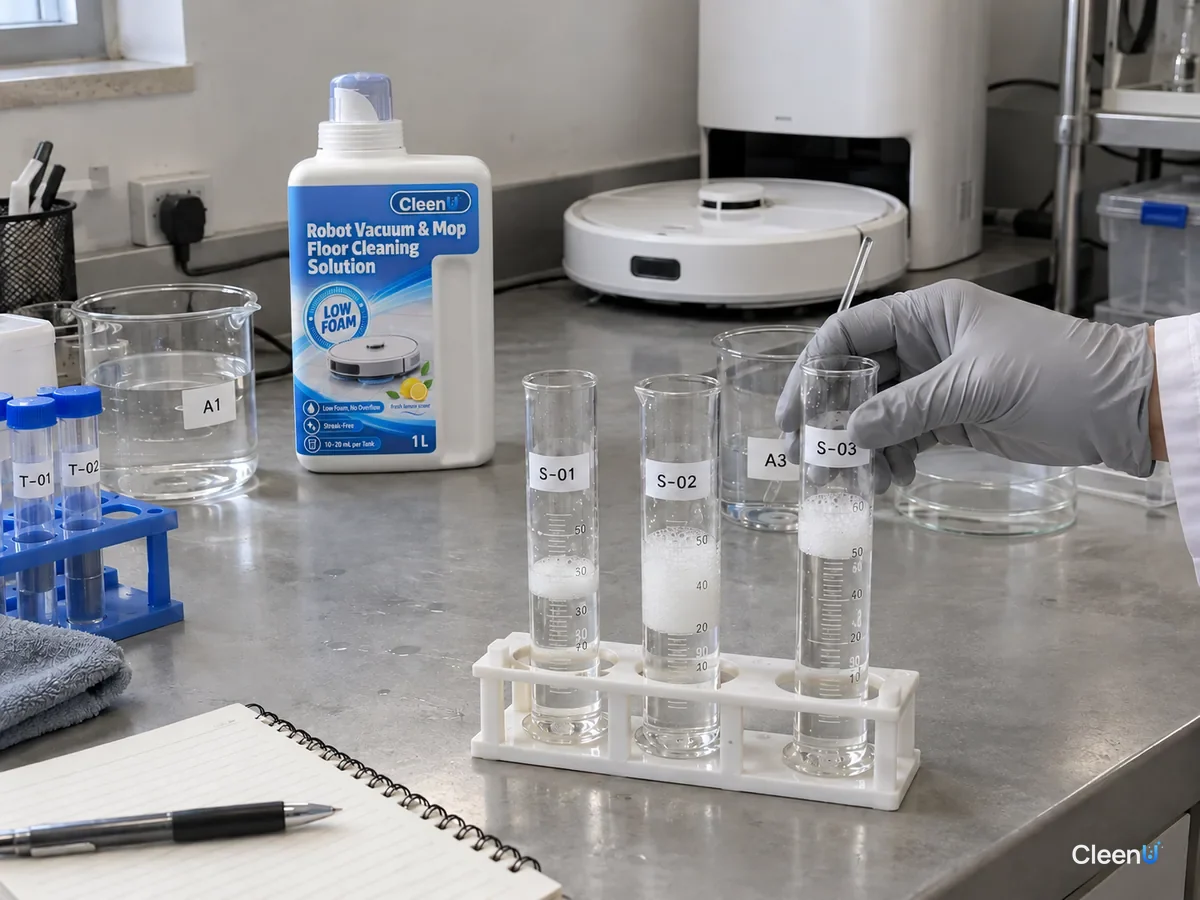
In production: how the ratio reaches every bottle
A ratio on the label promises that every bottle of concentrate is as strong as the approved sample. The stronger the concentrate, the more directly any batch-to-batch variation in actives shows up in every tank a customer mixes. CleenU production runs five quality checkpoints: incoming materials, weighing verification before batching, an in-process check before filling, first-piece and patrol checks during filling, and finished-goods inspection, with batch traceability. Weighing verification confirms the amount of every raw material before it goes in, which is what keeps concentrate strength matched to the label ratio. The in-process check before filling keeps an off-spec batch from reaching the filling line.
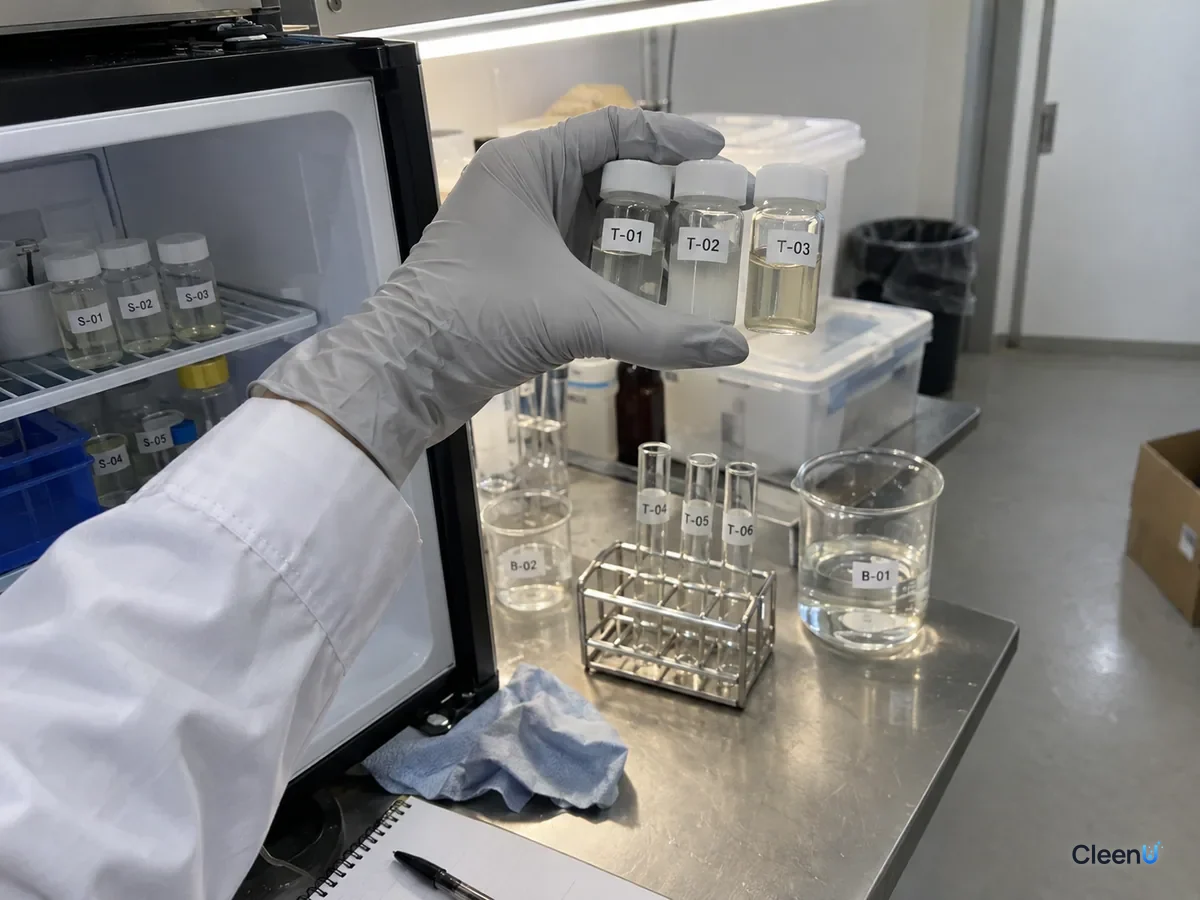
Labels and listings: one ratio, everywhere
After the ratio is set, the most common support problem isn't the formula. It's inconsistent information: the label says 1:100, the listing says "one capful per bucket," and customer service says "just add a splash." Keep one set of numbers across all of these:
Where ratio information has to match
- Bottle label: the ratio, a "mL per liter of water" conversion, and a table for common tank sizes, with ounces for US buyers
- Measuring cap: markings that match the label table, with the most-used mark the easiest to read
- Product page and listing bullets: ratio, per-fill dose, and fills per bottle, with the assumption behind it (which tank size)
- Where to add it: the clean water tank or the compartment the manual specifies, with a clear note never to use the dirty water tank; auto-dosing models follow the manual
- Compatibility: "works with most models," add per the manual, and state no affiliation with robot brands; avoid blanket compatibility claims or any suggestion of endorsement by a robot brand
- Dosing guidance: low end for routine runs, a second pass for dirty floors instead of doubling the dose
For more on what packaging can and can't claim, see What robot mop solution packaging can and can't say. For Amazon listing and compliance points, see Selling robot mop cleaning solution on Amazon.
What CleenU brings to the decision
Our existing CleenU Robot Mop Cleaning Solution can serve as the starting point for a private-label project. It's a neutral concentrate, pH 6.5–7.5 as a concentrate, built on low-foam nonionic surfactants with a defoamer, with no wax, chlorine, or particles and no quats or phenols. Its viscosity is designed for auto-dosing compartments. It dilutes about 1:50 to 1:100, usually 10 to 20 mL per fill, comes in a 1 L bottle with a measuring cap, and keeps 24 months unopened. We've run foam, residue, and water-path tests on common robot mops, including most Roborock, iRobot Roomba Combo and Braava, Ecovacs Deebot, Dreame, Narwal (added to the clean water tank), Shark HydroVac, and Eufy RoboVac models, plus most Tineco and Bissell CrossWave wet-dry vacuums. CleenU is not affiliated with these brands; names are used only to describe compatibility.
From there, CleenU can sample at your target ratio and work with you to set the ratio, formula version, scent, cap, and label instructions for your target robots and channels. If you want a higher-ratio direction, we sample it for your target robots first, validate the dose window and cold stability with the methods above, and then decide together whether to adopt it.
From choosing a ratio to production
-
Requirements
Confirm your target market, sales channels, main target robots, dosing method, and the selling points that matter most.
-
Free samples
Prepare samples at the agreed ratio and formula version.
about 3 days
-
Sample validation
Check the dose window, foam, residue, cold stability, and real runs on the target robots, and adjust based on the results.
-
Packaging and label approval
Approve the bottle, cap markings, inner seal, and the label's ratio, conversion table, and fill instructions.
-
Production
Production starts once packaging and labels are approved, with five quality checkpoints and batch traceability.
about 7 days
MOQ, lead time, and documents
MOQ is 500 bottles. Free samples take about 3 days, and bulk production ships in about 7 days once packaging and labels are approved. SDS, TDS, and COA documents are provided per project after you inquire. Final pricing is confirmed in a formal quote.
To see the existing formula, packaging, and private-label options, take a look at our Robot Vacuum Cleaning Solution.
When you reach out, tell us your target market, sales channels, main target robots, and expected volume, and we'll recommend a ratio and dosing method and prepare matching samples. To weigh concentrate, ready-to-use, and auto-dosing formats, see Concentrate, ready-to-use, or auto-dosing: which private-label format first? To compare contract manufacturing quotes, see Why robot mop solution quotes vary so much.
Dilution ratios for private-label robot mop solution: what brands ask
Is 1:200 more competitive than 1:100?
Competitiveness doesn't come from the ratio itself. A 1:200 product needs a stronger concentrate and usually puts about the same actives on the floor per fill; it mainly saves packaging and freight, at the cost of less dosing tolerance and tougher cold-stability and foam-window requirements.
Is a 1:200 product more economical because the dose is half as big?
Per fill, the actives are usually about the same. The cleaning job sets the working strength, so a higher ratio just means a stronger concentrate. If you claim savings, state the basis, and don't claim "half the product, same results."
What ratio do you recommend for a universal, multi-brand product?
About 1:50 to 1:100. It's forgiving to measure with a cap, steadier in the cold and in auto-dosing docks, and generates the fewest support issues.
How should we set the ratio if we're targeting auto-dosing docks?
Align it with the target dock's dosing settings and verify on the machine during sampling. Docks dose at a fixed setting, so matching your concentrate's strength to it keeps the working strength steady.
How should the measuring cap match the ratio?
Make the most-used mark equal one fill for the most common tank size and match the label table. The higher the ratio, the finer the markings need to be, and the more prominent the main mark should be.
If we change the ratio, does the formula need revalidation?
Yes. A new ratio means a new concentrate strength, so the foam window, cold stability, viscosity, and material compatibility all need rechecking.
What goes wrong with strong concentrates in winter?
Cloudiness, separation, precipitation, or thickening, which make it hard to pour, measure, or draw into a dock. Run refrigerated and freeze-thaw cycles at the sample stage and confirm it recovers at room temperature.
Can we private-label your existing ratio and formula?
Yes. The existing formula runs about 1:50 to 1:100, is neutral and low-foam, has viscosity designed for auto-dosing, and has been foam, residue, and water-path tested on common robot mops. You can start there and choose scent and packaging.
Can you make a 1:200 concentrate?
We can explore that direction for your target robots: sample it first, validate the dose window, cold stability, and real runs, and adopt it once the results meet your requirements.
What should we watch when writing the ratio on labels and listings?
Use one set of numbers across the label, cap, product page, manual, and support scripts, and give both the ratio and mL per liter. For compatibility, say "works with most models" and avoid blanket claims.
What are the MOQ and lead times?
MOQ is 500 bottles, free samples take about 3 days, and bulk production ships in about 7 days once packaging and labels are approved. Final pricing is per formal quote.
What documents can you provide?
SDS, TDS, and COA are provided per project after inquiry, and compatibility checks on your target robots can be arranged during sampling.
For a private-label robot mop cleaning solution, the dilution ratio is an outcome of the formula, not a selling point you can raise on its own. A higher ratio means a stronger concentrate, less room for dosing error, and stricter cold-stability and foam-window requirements, while the actives reaching the floor per fill often stay about the same. For a universal, hand-dosed product across many brands, about 1:50 to 1:100 is the safer choice. If you're targeting auto-dosing docks, align with their dosing settings and test on the machines. If you truly need a higher ratio, back it with double-dose and cold testing. Then make the label, cap, listing, and customer service tell the same story. CleenU can start from our existing formula and help you get the ratio, version, and packaging right the first time.