
OEM/ODM
Selling Robot Mop Cleaning Solution in the US: Labels and Documents to Prepare
Direct answer
Plan on four things: a 16-section English SDS, a warning-label decision under the FHSA, net contents in US and metric units with a responsible-party line, and claims limited to cleaning, soil removal, and odor reduction. For California, also check SB 258, Prop 65, and VOC. Confirm everything against current official text.
Six steps from sample to export shipment
-
Set market, channel, and claims
Decide whether you'll sell in California, on Amazon or your own site, and which claims you'll make. Keep claims to cleaning, soil removal, odor reduction, and factual features.
-
Choose formula and scent
Start from CleenU Robot Mop Cleaning Solution or choose lemon, light lemon, or unscented. If California is in scope, share VOC and disclosure needs now.
-
Free samples
Free samples ship in about 3 days while your team confirms robot fit and directions.
about 3 days
-
Document preparation
SDS, TDS, and COA are provided per project on inquiry, and your team or adviser uses them to settle label elements, disclosure, and VOC.
-
Label and packaging sign-off
Check the English label line by line. An inner seal goes under the cap, and drop and leak tests run on the final packaging to reduce leak risk over long routes.
-
Bulk production and shipping documents
Bulk production takes about 7 days after packaging and labels are approved, with five quality checkpoints, batch traceability, and a COA matched to each batch code.
about 7 days
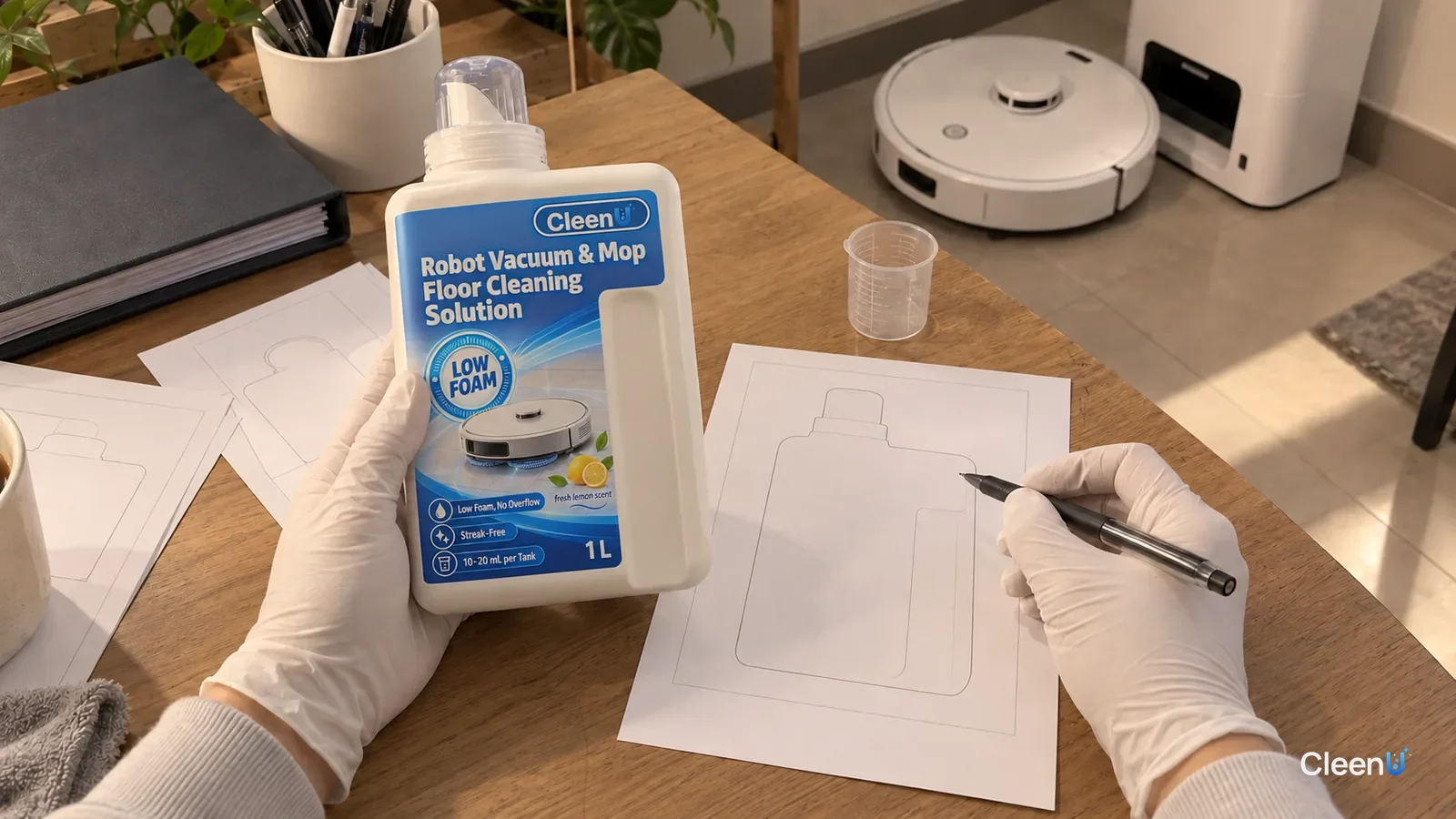
For brands bringing a robot mop cleaning solution to the US, the formula is rarely what holds things up. Paperwork and labels are. The freight forwarder wants an SDS. The marketplace wants a dangerous goods review. A buyer asks whether the bottle can say "antibacterial." A California retailer wants an ingredient disclosure link. Each of those traces back to a specific federal or state rule, and the rules interact. One wrong word in a claim can turn a cleaner into a pesticide that needs registration. One missing line can leave a label short of hazardous-substance requirements.
A note on what this is. CleenU is a manufacturer, and this is the checklist and reasoning we use when helping brands prepare export documents. It isn't legal advice. Every rule mentioned below is named, and the details were checked in October 2026. Regulations get amended and marketplace policies change, so confirm against the current official text before launch and work with your importer, freight forwarder, or compliance adviser. Items described as "commonly requested" especially need that confirmation.
The checkpoints a cleaning solution passes in the US
Following the product from factory to customer, the main checkpoints are:
- Workplace and distribution: the safety data sheet (SDS) required under OSHA's Hazard Communication Standard (HazCom). Forwarders, warehouses, and distributors all ask for it.
- Consumer labeling: the Federal Hazardous Substances Act (FHSA), enforced by the CPSC, determines whether the label needs cautionary statements and which ones.
- Claims: the EPA regulates "kills germs," "disinfects," and similar claims under FIFRA, the federal pesticide law. Make those claims and you need registration.
- California: the Cleaning Product Right to Know Act (SB 258) requires ingredient disclosure, Prop 65 covers warnings for listed chemicals, and CARB's consumer products rules limit VOC content.
- Package information: the Fair Packaging and Labeling Act (FPLA), enforced by the FTC, covers net contents and responsible-party information.
- Marketplaces and shipping: dangerous goods reviews on Amazon and similar platforms, plus whatever transport documents your forwarder requires.
Not every checkpoint is a big project, but each one needs someone to make the call and keep the basis on file.
Get the directions right first: the machine shapes the label
US shoppers buying robot mop solution first want to know whether it works in their machine and where it goes. Wrong directions lead straight to returns and bad reviews. The directions should match how robots actually take liquid:
- Add it to the clean water tank or the dock's designated auto-dosing cartridge (detergent compartment), following the robot's manual. Never the dirty water tank.
- In the clean water tank, dilute about 1:50 to 1:100, for example 10 to 20 mL per liter, or roughly 0.3 to 0.7 fl oz per quart. In an auto-dosing cartridge, add concentrate and let the dock meter it.
- If the dock uses a sealed factory dispenser that can't be refilled, such as Narwal's auto-dispensing box, add the solution to the clean water tank at the label ratio.
- Keep compatibility wording qualified, along the lines of "compatible with most models from …." If a model's manual says otherwise, follow the manual.
On using other brands' names: a common practice is plain-text "compatible with" or "for" plus the brand's product, with no logos and no "similar to" or "better than" comparisons. That guidance comes from third-party seller resources and is a commonly requested practice; confirm the current platform policy with the marketplace or your compliance adviser. CleenU is not affiliated with any robot brand; brand names are used only to describe compatibility.
SDS: a 16-section English version under OSHA HazCom
Rule: OSHA Hazard Communication Standard, 29 CFR 1910.1200 (checked October 2026; confirm against the current official text).
An SDS has 16 sections in a fixed order. OSHA doesn't enforce the content of Sections 12 through 15 (ecological information, disposal, transport, and regulatory information), but the section headings must be there.
On versions: OSHA published an updated HazCom on May 20, 2024 (89 FR 44144), effective July 19, 2024. On January 15, 2026, OSHA extended the compliance dates (91 FR 1695). Manufacturers, importers, and distributors of mixtures now have until November 19, 2027, and employers until May 19, 2028. Until then, either the 2012 or the 2024 version is acceptable. For a new launch, writing the SDS to the 2024 version saves a rewrite in two years.
A common misunderstanding is that consumer products don't need an SDS. The consumer product exemption in HazCom, paragraph (b)(6)(ix), applies to employers whose workers use the product the way a consumer would. It doesn't excuse manufacturers or importers from preparing one, and in practice, forwarders, warehouses, distributors, and marketplaces nearly always ask.
CleenU provides SDS, TDS (technical data sheet), and COA (certificate of analysis) per project on inquiry, prepared for the product and the target market. Hazard classification has to rest on the actual formula and data, so if a brand changes the scent, strength, or pack size, the SDS needs another look.
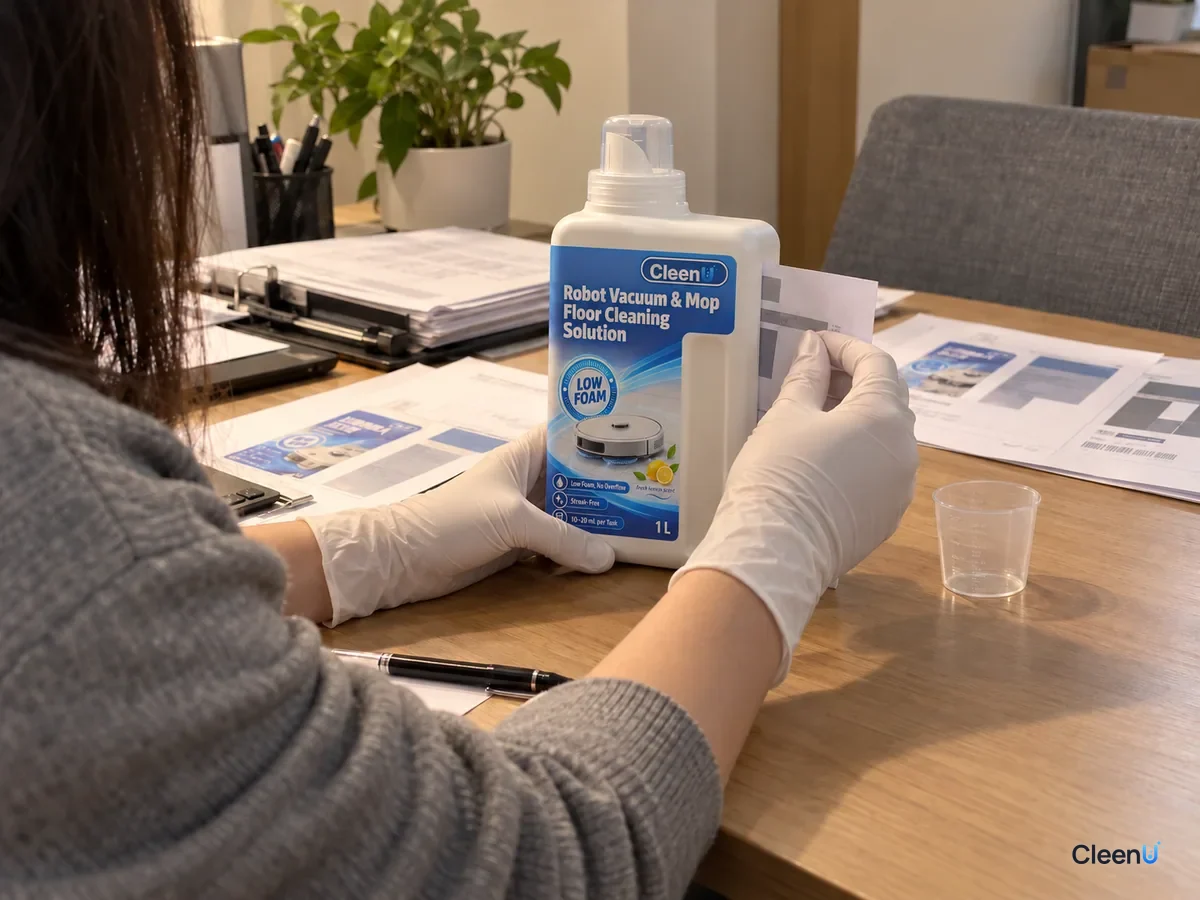
Warning labels: is it a "hazardous substance" under the FHSA?
Rule: Federal Hazardous Substances Act, 16 CFR 1500, enforced by the CPSC (checked October 2026; confirm against the current official text).
A product is a hazardous substance under the FHSA only if it meets both conditions. First, it's toxic, corrosive, an irritant, a strong sensitizer, flammable, or pressurized. Second, it may cause substantial injury or illness during reasonably foreseeable handling or use, including a child swallowing it.
If it qualifies, the label needs a signal word (such as CAUTION or WARNING), a statement of the principal hazard, the names of the hazardous ingredients, precautionary and first aid instructions, "Keep out of reach of children," and the name and address of the manufacturer, packer, distributor, or seller.
One more point tends to collide with marketing copy. 16 CFR 1500.122 prohibits label statements that contradict or minimize required warnings, such as "harmless" or "safe around pets." If the product needs a cautionary label, a "pet safe" banner on the front works against it.
Why "neutral pH" doesn't settle the warning question
Brands often ask whether a pH-neutral robot mop solution is automatically outside the FHSA. You can't assume that. The FHSA call rests on toxicity and irritation data, and pH is only one input.
The reason is the surfactants. Surfactants clean by lowering interfacial tension and dissolving oils. On the surface of the eye, the same action disturbs the lipid structure of corneal cell membranes, which causes irritation. That irritation has little to do with pH and mostly depends on surfactant type and concentration. So a pH-neutral concentrate can still irritate if it splashes into an eye. Diluted into working solution, its concentration drops by a factor of 50 to 100 and irritation potential usually drops with it. But the label goes on the concentrate bottle, so the assessment has to cover the concentrate as sold, not the diluted solution.
From neutral pH to a labeling decision
- The concentrate's pH only tells you corrosion risk from acidity or alkalinity is low; it says nothing about surfactant irritation
- On the eye, surfactants also lower interfacial tension and disturb membrane lipids, and irritation depends mainly on type and concentration
- The assessment covers the concentrate as sold, using ingredient data, irritation data, and foreseeable misuse, including a child swallowing it
- Only a product that both has a hazardous property and may cause substantial injury falls under FHSA cautionary labeling
- The result has to land on specific label elements: whether a signal word is needed, which precautions and first aid go on, and no wording like "harmless" that undercuts them
In practice, a brand can ask the manufacturer for formula-based information as the basis for the hazard assessment, and the compliance adviser decides the label elements. For export projects, the English label elements are finalized based on the brand's compliance review.
Claims: in the US, cleaning and killing germs follow different rules
Rule: the EPA's definition of pesticides under FIFRA, the Federal Insecticide, Fungicide, and Rodenticide Act (checked October 2026; confirm against the current official text).
This is the line that matters most for US sales. According to EPA guidance, the following claims make a product a pesticide that needs registration, whether they appear on the label or on a website, a product listing, or an ad: sanitizes, disinfects, kills germs, antibacterial, and unqualified "removes allergens" or "removes biofilm."
Claims that aren't pesticidal include cleaning dirt (cleans, removes soil), removing or reducing odors, and removing soap scum.
The chemistry explains the split. A cleaner wets, emulsifies, and disperses soil, then carries it, and whatever is trapped in it, off the surface. That's physical removal. Sanitizing or disinfecting means inactivating microorganisms, which takes specific active ingredients at specific concentrations and contact times, backed by efficacy testing. One removes; the other kills. They're regulated as different things.
Another provision often gets stretched. The treated articles exemption covers only preservatives added to protect the product itself. It doesn't allow a product to claim antimicrobial benefits for the user.
For a robot mop solution, the safe zone is claims that match the facts: cleans, removes dirt and grime, lifts everyday soil, reduces odors, low-foam, neutral pH. CleenU Robot Mop Cleaning Solution is a cleaning solution, not a disinfectant, and it has no EPA pesticide registration. We don't make germ-killing, disinfecting, or antibacterial claims for it. For more on cleaning versus disinfecting, see Can robot mop cleaning solution disinfect? For a broader look at packaging claims, see Robot mop solution label claims: what you can and can't say.
On voluntary eco labels: the EPA Safer Choice logo can only appear on certified products, and it can't appear on concentrate packaging (checked October 2026). CleenU Robot Mop Cleaning Solution isn't Safer Choice certified, so brand packaging and listings shouldn't show or suggest that mark.
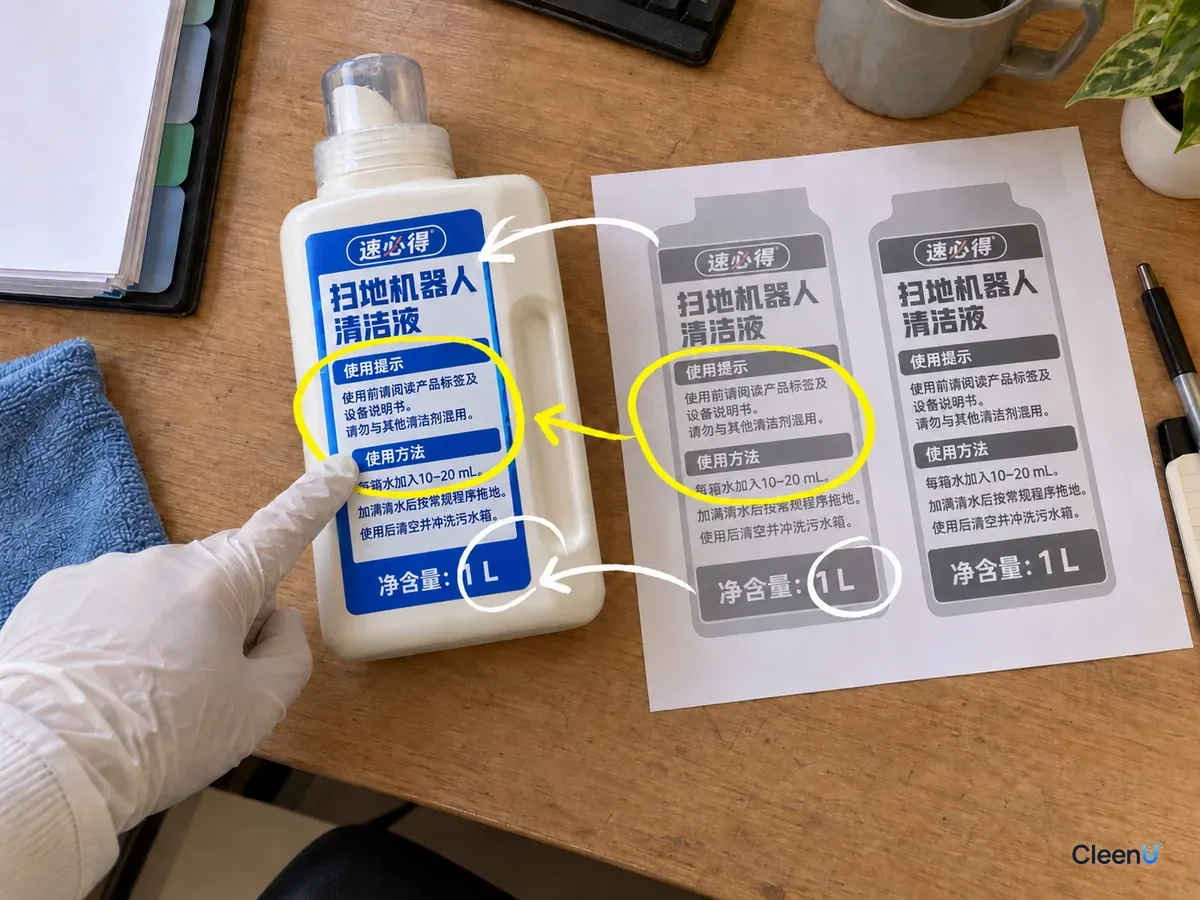
Selling in California: ingredient disclosure, Prop 65, and VOC
SB 258 ingredient disclosure. Rule: California Cleaning Product Right to Know Act, SB 258, Health and Safety Code sections 108950 to 108960 (checked October 2026; confirm against the current official text). Online disclosure took effect January 1, 2020, and on-label disclosure January 1, 2021. For the label, there are two options. One is to list ingredients on the designated lists plus EU fragrance allergens at 0.01% or more, with a website or phone number for full information. The other is to list all intentionally added ingredients. The brand picks the option, and the manufacturer prepares matching ingredient information from the formula. Whether other states have similar requirements, New York's status for example, is a commonly asked question; confirm the current situation with your compliance adviser.
Prop 65. Rule: California Proposition 65 warning requirements (checked October 2026; confirm against the current official text). A warning is required only when the product contains a listed chemical and causes an exposure. Adding a warning "just in case" isn't recommended, because unnecessary warnings also mislead shoppers. Starting January 1, 2028, only the new short-form warning keeps safe-harbor status. On the small-business exemption, often described as applying to businesses with fewer than 10 employees, confirm with your compliance adviser whether it covers you.
CARB VOC. Rule: California Air Resources Board consumer products regulation, 17 CCR 94509 (checked October 2026; confirm against the current official text). Robot mop solution is often classed as a General Purpose Cleaner (non-aerosol), which has a VOC limit of 0.5% by weight. Classed under Floor Maintenance or Floor Polish, the limit is 1%. Which category applies, and whether a concentrate's VOC is calculated as sold or as diluted, are questions to settle with your compliance adviser.
Where VOCs come from in a water-based cleaner
VOCs are volatile organic compounds. A water-based cleaner is mostly water, but that doesn't make its VOC content zero. Typical contributors include volatile fragrance components, alcohols such as ethanol and isopropanol, solvents such as glycol ethers, and some solubilizers. Surfactants themselves have very low volatility and usually aren't the main source.
For product development, that means VOC has to be calculated from the actual formula, and changes to scent or the solubilizer system can move the result. If you plan to sell in California, share the VOC requirement before scent and formula are locked, not after. CleenU can provide SDS, TDS, and related information per project as the basis for your team's or adviser's calculation.
Net contents and responsible party under the FPLA
Rule: Fair Packaging and Labeling Act and its regulations at 16 CFR 500 (checked October 2026; confirm against the current official text).
Net contents go in both US customary and metric units, in the bottom 30% of the principal display panel. A 1 L bottle is commonly declared along the lines of "1 qt 1.8 fl oz (33.8 fl oz) 1 L"; confirm the exact format against the regulation and your compliance adviser.
If the brand isn't the actual manufacturer, the label uses "Manufactured for" or "Distributed by" with the brand's name and address. That line can also serve the name-and-address element the FHSA requires.
Amazon and shipping: have documents ready early
Amazon dangerous goods review. Cleaning products are commonly asked to go through a dangerous goods (hazmat) review, with sellers uploading an SDS or exemption sheet per ASIN. That comes from third-party resources and is a commonly requested process; check current requirements in Seller Central and Amazon's own guidance. For more on selling robot mop solution on Amazon, see Selling robot mop cleaning solution on Amazon: listing and compliance tips.
Transport classification. In general, a mixture that doesn't meet GHS hazard criteria, for example nonflammable and noncorrosive, usually isn't regulated as dangerous goods for transport, and SDS Section 14 can read "Not regulated." Whether that applies to your product depends on the actual formula and hazard classification, so confirm with your forwarder and carrier.
Origin-side documents. Forwarders usually ask for the SDS. For air freight out of China, a transport condition identification report is commonly requested; confirm early with your forwarder which document is needed and who issues it.
The document set to have in hand before export
Common documents and label items for exporting robot mop solution to the US
- English SDS: 16 sections, written to the 2012 or 2024 HazCom version, with hazard classification based on the actual formula
- TDS: appearance, pH, directions, dilution, storage conditions, and other technical parameters
- COA: inspection results for each batch, matched to the batch code on the bottle
- Hazard assessment basis: the information used to decide FHSA label elements
- English label draft: directions, where to add it, dilution, warnings and first aid if required, net contents, and responsible party
- Claims list: each claim checked, keeping only cleaning, soil removal, odor reduction, and factual product features
- California items, if selling there: SB 258 disclosure option, Prop 65 decision, and VOC calculation basis
- Marketplace and shipping: Amazon hazmat review materials and the transport documents your forwarder requires
How CleenU supports a US export project
MOQ and lead times
MOQ is 500 bottles. Free samples ship in about 3 days, and bulk production takes about 7 days after packaging and labels are approved. Compliance review of the English label is done by the brand or its adviser; CleenU prints and produces to the approved version.
The five quality checkpoints are incoming materials, weighing verification before batching, an in-process check before filling, first-piece and patrol checks during filling, and finished-goods inspection, with batch traceability. For export, that means every COA ties to a specific batch code, and if a marketplace or importer asks about a shipment, the batch code leads back to its raw-material lots and production record.
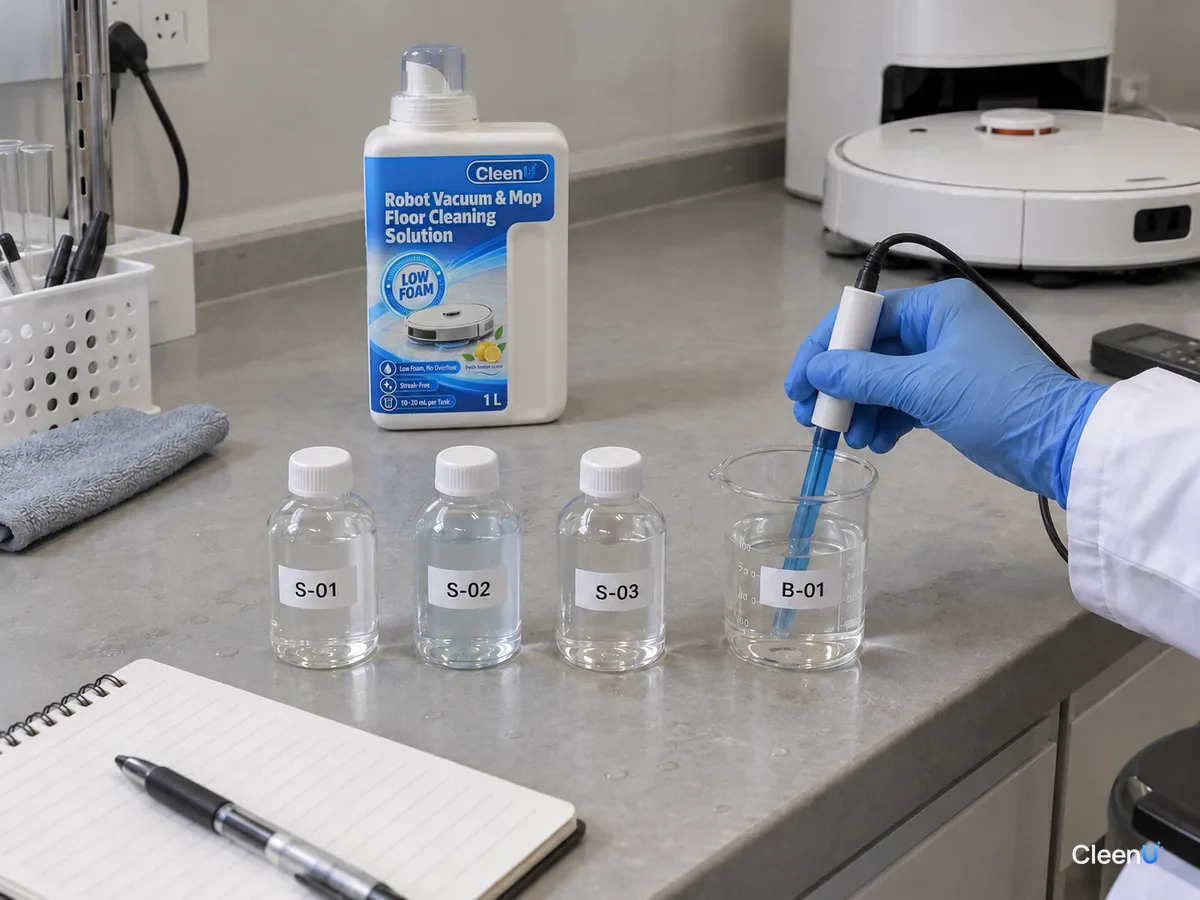
CleenU Robot Mop Cleaning Solution: ready specs for export projects
CleenU Robot Mop Cleaning Solution is a neutral concentrate, pH 6.5–7.5 as a concentrate, built on low-foam nonionic surfactants with a defoamer. It's solvent-free and contains no optical brighteners, wax, chlorine, particles, quats, or phenols, and its viscosity is designed for dock auto-dosing compartments. Each 1 L (33.8 fl oz) bottle comes with a measuring cap and dilutes about 1:50 to 1:100; 10 to 20 mL per fill is usually enough. The standard version has a lemon scent, and the Pet Homes version is fragrance-free with a cyclodextrin-based odor neutralizer. Shelf life is 24 months unopened. The cap can include an inner seal, and drop and leak tests run on the final packaging.
We've run foam, residue, and water-path tests on common robot mops and wet-dry vacuums, covering most models from Roborock, iRobot Roomba Combo and Braava, Ecovacs Deebot, Dreame, Narwal, Shark HydroVac, and Eufy RoboVac, plus Tineco and Bissell CrossWave floor washers. It's a cleaning solution, not a disinfectant. It has no EPA registration and no Safer Choice certification. CleenU is not affiliated with any of these brands; names are used only to describe compatibility.
To build a US private-label line on a neutral, low-foam concentrate with documents provided per project, start with our Robot Mop Cleaning Solution.
Single-product specs are on the CleenU Robot Mop Cleaning Solution product page. If you're a robot brand planning your own matching solution, read What a factory needs from a robot vacuum brand launching its own cleaning solution.
Stop and check before you print or ship
Stop if the label, listing, or ads use sanitizes, disinfects, kills germs, antibacterial, or unqualified removes allergens; the product needs a cautionary label but the front says harmless or pet safe; the SDS isn't in the 16-section format, or wasn't rechecked after a scent or strength change; you're entering California without a disclosure option and VOC category settled; the pack shows a certification mark you don't hold or a robot brand's logo; or no one has confirmed who issues the transport documents your forwarder or marketplace needs. Check with your compliance adviser and forwarder, then finalize printing and shipping.
Exporting robot mop solution to the US: questions brands ask
Which HazCom version should the SDS follow?
Use the 2024 version for new products. Under the January 2026 extension, manufacturers, importers, and distributors of mixtures have until November 19, 2027, and either version works until then; confirm against OSHA's current text.
Don't consumer products skip the SDS?
Prepare one anyway. The HazCom consumer product exemption covers employers using the product, and forwarders, warehouses, distributors, and marketplaces nearly always ask for an SDS.
If the solution is pH-neutral, can we skip warning labels?
Assess the actual formula; neutral pH alone doesn't decide it. The FHSA call rests on toxicity and irritation data, and a surfactant concentrate can irritate eyes even at neutral pH, so assess the actual formula.
Can the bottle say antibacterial or kills germs?
No, unless the product is registered with the EPA under FIFRA. Those words count as claims on websites, listings, and ads too.
Can we say removes odors?
Yes. Removing or reducing odors isn't a pesticidal claim; just don't stretch it into germ-killing deodorizing.
Can the front panel say pet safe?
Leave pet safe off the front panel. If the product needs FHSA cautionary labeling, 16 CFR 1500.122 prohibits wording like harmless or safe around pets that undercuts the warning; confirm with official text and your adviser.
How does California ingredient disclosure work?
Pick one of the two SB 258 on-label options and disclose ingredients online. The brand chooses the option, and the manufacturer prepares ingredient information from the formula.
Should we add a Prop 65 warning just in case?
No. A warning is required only when a listed chemical causes an exposure, and whether the small-business exemption applies is a question for your compliance adviser.
How is VOC calculated for a concentrate?
From the actual formula, ingredient by ingredient. Whether it's figured as sold or as diluted, and which category applies, should be confirmed with your adviser.
How should net contents read on a 1 L bottle?
In US and metric units in the bottom 30% of the front panel, commonly along the lines of "1 qt 1.8 fl oz (33.8 fl oz) 1 L"; confirm the format against 16 CFR 500 and your adviser.
Can the label say compatible with Roborock or Roomba?
Yes, in plain text such as "compatible with most models from …," with no logos and no "better than"; confirm current marketplace policy.
What export documents can CleenU provide?
SDS, TDS, and COA per project on inquiry. MOQ is 500 bottles, free samples ship in about 3 days, and bulk takes about 7 days after packaging and labels are approved.
Is CleenU's solution Safer Choice certified or EPA registered?
No. CleenU Robot Mop Cleaning Solution is a cleaning solution, not a disinfectant, so packaging and listings shouldn't show or suggest either.
Selling robot mop cleaning solution in the US comes down to four things: a 16-section English SDS under OSHA HazCom, an FHSA decision on cautionary labeling with no wording that undercuts it, US and metric net contents with a responsible party under the FPLA, and claims limited to cleaning, soil removal, and odor reduction, staying clear of FIFRA's germ-killing territory. California adds SB 258 disclosure, a Prop 65 decision, and a CARB VOC check. Everything here was checked in October 2026; confirm against current official text before launch, and settle the commonly requested marketplace and shipping documents with your forwarder and compliance adviser. CleenU's part is providing SDS, TDS, and COA per project and consistent batch quality, so the documents match every shipment.