
OEM/ODM
Packaging Robot Mop Cleaning Solution: Caps, Dosing, and Leak Prevention
Direct answer
Give concentrates a clearly marked measuring cap that matches the label ratio, use a spout that lines up with the clean tank and dosing compartment without spilling, and run inversion, drop and shipping simulation tests before locking the bottle and carton. These steps target the two most common complaints: wrong doses and leaks.
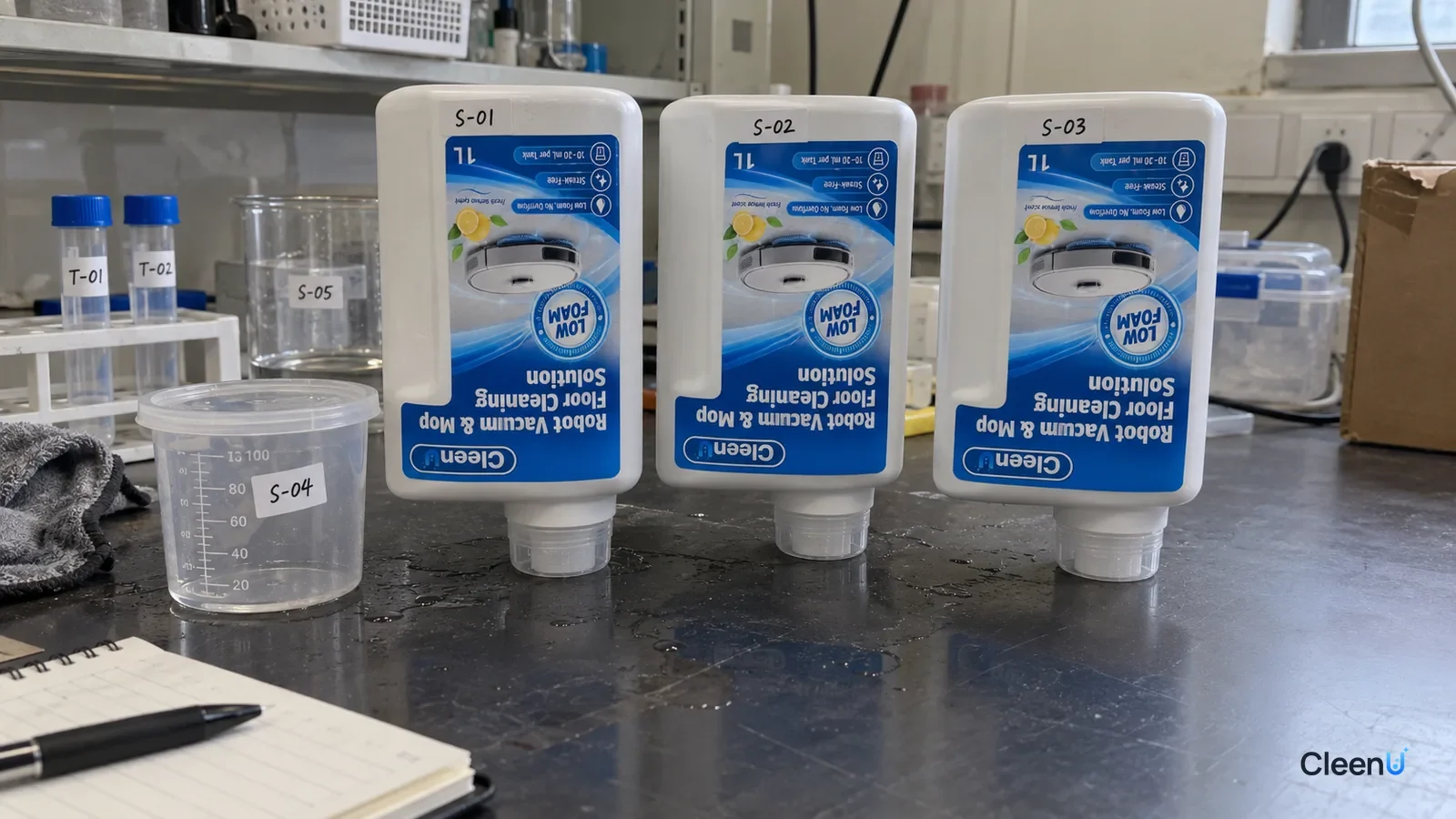
Plenty of bad reviews for robot mop cleaning solution have nothing to do with the formula. They're about the packaging: "I can't read the cap markings, so I don't know how much to add." "It spilled all over the counter." "Half the bottle leaked in the box." "The spout won't fit the dosing compartment." These are easy to miss at the sample stage, because samples usually arrive on a brand manager's desk and get looked at, not used for weeks and shipped across the country.
Get the packaging right and most of these complaints disappear before launch.
Where do packaging complaints come from?
Measuring. Concentrate has to be measured by the user. Faint cap markings, markings that don't match the label ratio, or a cup that's too small or too large all lead to wrong doses. Too much, and floors get tacky and the dirty tank foams; too little, and floors don't get clean. Shoppers rarely blame their own measuring; they blame the product.
Pouring. A wide spout with no pour control spills when you fill the clean tank. Auto-dosing docks often have small fill openings, and a spout that doesn't line up splashes the rim, which can crystallize there over time.
Sealing. A poor cap-to-neck fit or a missing or misplaced liner or seal lets product seep out under pressure, when inverted or through temperature swings in transit.
Shipping. Parcel and cross-border shipping mean crushing, drops, vibration and heat and cold far harsher than a bottle sitting on a lab shelf.
Packaging options to choose from
Designing a cap so shoppers don't overdose
Match the markings to the use. The best approach for a concentrate is markings that show exactly how much to add per fill, so no one has to calculate a ratio. CleenU Robot Vacuum Cleaning Solution, for example, dilutes at about 1:50 to 1:100; 10 to 20 mL per fill is usually enough, or about 10 to 20 mL for a 1-liter tank. So the cap should clearly show 10 mL and 20 mL lines, and the label should say "10 to 20 mL per 1-liter tank."
Make them readable. Lines need strong contrast. On a clear cup, use raised or printed markings rather than faint molding, with large numbers that are legible under kitchen lighting.
Size it right. Too big and people pour too much; too small and they have to pour several times.
Let it drain. The cap goes back on the bottle after use, and liquid left sitting in it dries into crystals, can grow bacteria and drips down the bottle. Design for drain-back.
Back it up on the label. A simple graphic, "water first, then solution, fill to the line," works better than a paragraph of text.
Choosing a spout that doesn't spill
Regular clean tanks: the fill opening is usually generous, so a controlled-pour spout or a moderate neck works. What matters is a steady stream that doesn't glug out all at once.
Auto-dosing compartments: the fill opening is often small and recessed, so you need a narrow neck or extended spout to aim, and a pour rate the user can control to limit foam and splashes. Concentrate splashed on the rim dries into crystals that can interfere with level sensing; see robot vacuum says detergent is low right after you refilled it.
Grip: for bottles 1 liter and up, think about one-handed holding and balance while pouring. A grip area or handle helps.
How to verify leak prevention
"Is the cap tight?" isn't a test. You need to simulate real use and shipping. Common approaches include:
Inversion test: fill, cap and store upside down for a set period, then check the neck, cap and measuring cap for seepage.
Compression test: squeeze the bottle as a parcel would be squeezed in transit and check whether product seeps from the cap.
Drop test: drop single bottles and full cartons from a set height onto a hard floor and check for cracks or leaks.
Temperature cycling: move samples between heat and cold repeatedly to mimic seasons and routes, and check for leaks as pressure changes and for bottle deformation.
Shipping simulation: run vibration and stacking simulations for your real route, or simply ship a batch of samples through real carriers and inspect them on arrival.
Specific conditions such as hold time, drop height and temperature range depend on channel and shipping method, and test samples should use the same lots of bottles, caps and seals as production.
Choosing a bottle material
Household cleaners mostly come in high-density polyethylene (HDPE) or polyethylene terephthalate (PET), with some polypropylene (PP).
HDPE: milky or opaque, with good chemical resistance. It's stable with neutral, mildly alkaline and most surfactant systems, resists drops and doesn't shatter, which is why it's the most common cleaner bottle. The downsides: some fragrance compounds can permeate it, so scent may fade or the bottle may absorb scent over long storage, and because it's opaque, users can't see how much is left unless you add a level window or markings.
PET: clear and attractive, showing the liquid's color and remaining volume, which suits retail display. It's stable with neutral formulas but can hydrolyze and turn brittle with long contact with strong alkali, and it cracks more readily than HDPE when dropped, so large bottles need careful drop testing.
PP: common for caps, measuring caps and some bottles, with good chemical resistance and higher stiffness.
Robot mop solutions are usually neutral, low-foam formulas, so both HDPE and PET generally work. The choice comes down to whether you want a clear display, drop and shipping risk, fragrance permeation and absorption, cost and supply. Either way, run storage observations with production-lot bottles and the actual formula, not just sample bottles.
Test packaging and formula together
Packaging doesn't stand alone. Surfactants and fragrance in long contact with bottle and gasket materials can soften bottles, swell gaskets or let scent fade through the bottle wall. So when finalizing packaging, check compatibility and stability together with the formula: fill, store at several temperatures for a period, and inspect the bottle, cap, seals and liquid. For other sample checks, see how to evaluate robot mop cleaning solution samples.
MOQ and lead time
MOQ starts at 500 bottles. Free samples ship in 3–5 days. After packaging and labels are approved, bulk orders are scheduled when the order is confirmed. Custom bottles or measuring caps that need new molds or new packaging materials are quoted separately for time and cost.
Packaging specifications for the current robot mop solution
- Default pack
- 1 L concentrate with measuring cap
- Dilution
- About 1:50 to 1:100; 10 to 20 mL per fill is usually enough
- Estimated runs
- About 50 to 100 per liter at that dose
- Shelf life
- 24 months unopened
- Type
- Neutral, low-foam concentrate, pH 6.5 to 7.5
What the label must say to prevent misuse
How much to add, tied to tank size, such as "10 to 20 mL per 1-liter tank."
Where it goes: the clean water tank or the dock's designated compartment, never the dirty tank.
Compatibility: confirmed brands, qualified with "most models" and "follow your manual." CleenU Robot Vacuum Cleaning Solution, for example, works in most robot mops from Roborock, iRobot (Roomba Combo and Braava), Ecovacs Deebot, Dreame and Narwal, and in floor washers such as Tineco. CleenU isn't affiliated with these brands; the names only indicate compatibility.
Exclusions: machines whose manual prohibits additives, mixing with other cleaners or disinfectants, overdosing, unsealed or waxed wood, and carpet.
Storage: close tightly and store cool and out of light, away from children and pets.
This article is part of the Robot Vacuum Cleaning Solution & Maintenance Guide, which covers the full maintenance schedule and links to every troubleshooting guide.
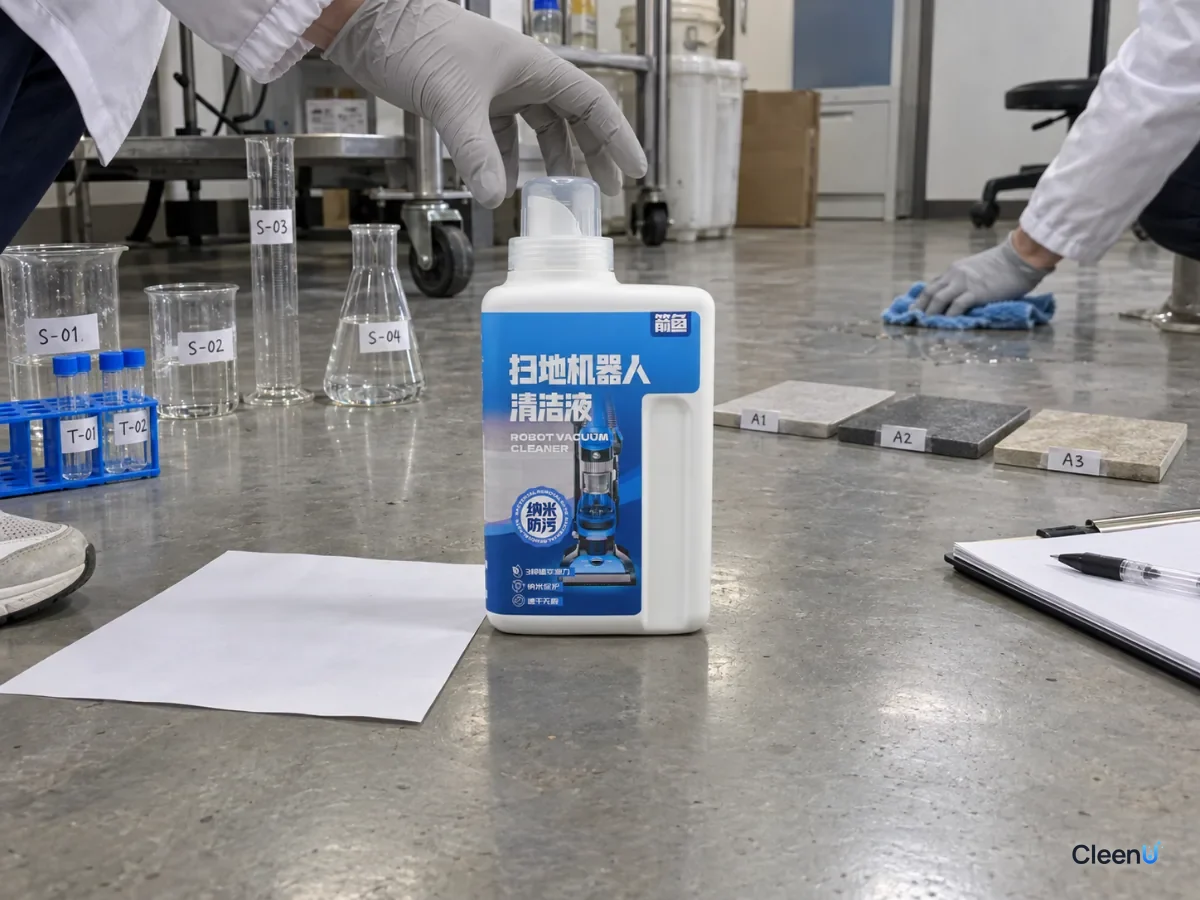
Laying out label information so it isn't missed
Shoppers mostly look at the front of the bottle and the cap and rarely read the back label closely. So put the most important information where it's most visible.
Front: the category (robot mop cleaning solution), concentrate or ready-to-use, for robot mops and floor washers, low-foam.
Cap or bottle shoulder: dose markings and a simple graphic, such as "10 to 20 mL per 1-liter tank."
Back: where to add it (clean tank or dosing compartment, never the dirty tank), compatibility with "most models, follow your manual," exclusions, storage and precautions.
Graphics in place of long text are easier to follow and cut complaints about wrong doses and wrong fill locations.
What brands ask about robot mop solution packaging
Do we really need a measuring cap?
Yes, strongly recommended for a concentrate. Markings that show exactly how much to add per fill cut complaints about tacky floors and foam from overdosing.
Do we need an extra seal for cross-border shipping?
We recommend one, such as a plug liner or induction foil seal, plus inversion, drop, temperature cycling and shipping simulation tests before launch.
What does an auto-dose bottle need?
A spout that lines up easily with the compartment's fill opening and lets users control the pour, so less splashes on the rim. Choose it around your target models' compartments.
Can we use the existing bottle and just change the label?
Yes. Using the existing 1-liter concentrate with measuring cap and your own label is the fastest route. New bottles or molds are quoted separately.
Should the label say roughly how many uses a bottle gives?
Yes, it's persuasive. Calculate it from the label dose and write it as approximate, for example about 50 to 100 runs per liter at 10 to 20 mL per fill.
What are the MOQ and lead time?
MOQ starts at 500 bottles, free samples take 3–5 days, and bulk is scheduled after packaging and labels are approved. Custom packaging timing follows the quote.
How should the measuring cap be marked?
Mark it by how much to add per fill, not just the ratio. At about 1:50 to 1:100, a 1 L tank takes 10 to 20 mL, so print 10 mL and 20 mL lines on the cap and state the matching tank size on the label. For larger tanks, add a conversion, such as about 20 to 40 mL for 2 L.
How long does robot mop solution keep, and what should the label say?
Print the unopened shelf life and production date, plus storage directions: cap tightly and keep it cool and out of direct sun. CleenU's default is 24 months unopened. Also tell users to use diluted solution the same day, so they don't leave it sitting in the tank.
To launch your own brand quickly with a proven 1-liter concentrate and measuring cap, start with the CleenU Robot Vacuum Cleaning Solution.
Robot mop solution packaging complaints mostly come down to wrong doses and leaks. Give a concentrate a clearly marked cap that shows exactly how much to add, and back it up with a simple "water first, then solution, fill to the line" graphic. Choose a spout that lines up with clean tanks and dosing compartments to cut spills and crystal buildup, and run inversion, compression, drop, temperature cycling and shipping simulation tests before launch, together with formula compatibility checks. CleenU can start you on the existing 1-liter concentrate and cap or evaluate new bottles and seals by channel. Send your channel, shipping method, target machines and estimated quantity to begin.