
Troubleshooting
White Spots After Robot Mopping? Hard Water Is Often Behind Them
Direct answer
White spots are usually calcium and magnesium from tap water, left behind as scale when the floor dries, or residue from too much solution. Lower the water level and cut the dose. In hard-water areas, switch to distilled water if your manual allows it, and wipe off existing spots by hand.
Check these to find the source of the white spots
- Shape: round rings and dots, or an even haze following the robot's path?
- Feel: rough and slightly gritty, or smooth and a little tacky?
- Water test: does a cloth dampened with plain water wipe it off?
- Acid test: does a cloth with a little white vinegar wipe it off tile? (Don't try this on marble, terrazzo or grout.)
- Water hardness: is your area known for hard water? Does your kettle, showerhead or faucet build up white scale?
- Dose: did you recently add more solution than usual or switch products?
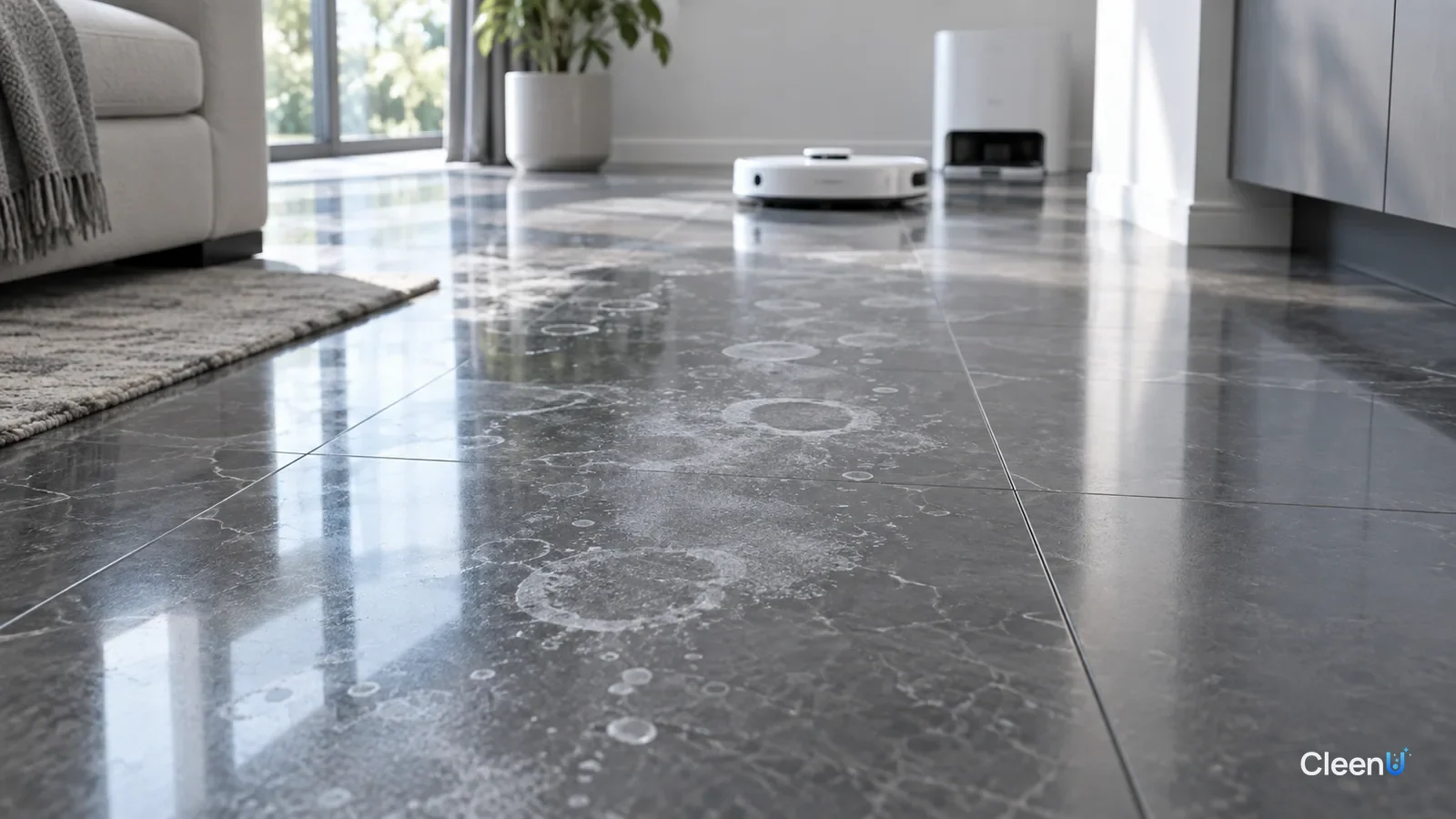
The floor dries, and there they are: white haze, rings and dots, especially obvious on dark tile, black marble and dark vinyl plank. Many people blame the cleaning solution and try bottle after bottle with no change. Others notice the same robot never had this problem in their old house in another city.
White residue almost always comes from one of two things: minerals in the water or too much cleaner. They look alike, but the fixes differ, so figure out which one you're dealing with first.
The rule of thumb: if plain water won't remove it, vinegar does, and it feels a bit rough, it's mineral scale. If plain water removes it, it feels smooth or slightly tacky and it follows the mopping path, it's cleaner residue. Sometimes it's both.
Why does hard water leave white spots?
Tap water carries dissolved calcium and magnesium ions; when there's a lot, it's called hard water. Hardness is usually reported as milligrams of calcium carbonate per liter, and it varies widely. In the U.S., much of the Midwest, Southwest and Texas has hard water, while parts of the Pacific Northwest and New England have soft water.
Those minerals usually sit in water as bicarbonates. As water evaporates from the floor, two things happen: the ions become more concentrated, and bicarbonate breaks down, releasing carbon dioxide and forming calcium and magnesium carbonates that don't dissolve. They come out of the water and stay on the floor as white scale, the same stuff that coats the bottom of a kettle.
Robot mops make it more visible for a few reasons.
They mop the same floor every day, leaving a little more mineral each time.
The water film on the floor air-dries instead of being wiped or vacuumed up, so nearly all the minerals stay put.
At higher water settings the film thickens and forms tiny puddles that dry into white rings with the whitest edge. That coffee-ring shape happens because a puddle evaporates fastest at its edge, so liquid keeps flowing outward and carries minerals there.
Dark, glossy floors reflect a lot of light, so white deposits stand out most.
Why can cleaning solution leave a white haze too?
Surfactants and other non-volatile ingredients stay on the floor after the water evaporates. At the label ratio the film is too thin to see. Overdose and it thickens into a haze or streaks on dark, glossy floors.
Hard water and cleaners can also make each other worse. Some anionic surfactants react with calcium and magnesium to form insoluble calcium and magnesium soaps, which is why dish soap and bar soap leave white soap scum in hard water. Robot mop solutions usually use nonionic surfactants that aren't sensitive to water hardness, which limits that reaction. But with an ordinary high-foam cleaner, or too much solution, white spots get worse in hard-water areas.
What do nonionic surfactants and chelating agents do in hard water?
Surfactants are grouped by whether their water-loving end carries a charge. Anionic surfactants carry a negative charge, and calcium and magnesium ions are positive, so they bind readily and form insoluble salts. Once those salts drop out, cleaning power falls and the precipitate itself becomes white residue.
Nonionic surfactants have an uncharged water-loving end, usually a polyethylene-oxide chain, so calcium and magnesium have nothing to grab onto. They perform consistently in hard water and don't precipitate with the minerals. That's one reason robot mop solutions tend to use nonionic systems: besides low foam, they behave the same from city to city and water supply to water supply.
The other common tool is a chelating agent. A chelant molecule works like a claw that wraps around calcium and magnesium ions, keeping them in solution so they don't react with other ingredients or deposit on the floor. Some cleaners include chelants to handle hard water better. But a chelant can only tie up the ions matched to its dose, and most of the minerals come from the tap water itself. In very hard-water areas, lowering the water level and switching to distilled water do more than expecting the solution to "remove scale."
Common causes of white spots and what to do
| Cause | What you see | Fix | Prevention |
|---|---|---|---|
| Hard tap water | Round rings and dots, whitest at the edges; plain water won't remove them | Wipe tile with diluted white vinegar, then rinse with plain water; use a neutral stone cleaner on stone | Lower the water level; use distilled or softened water if your manual allows |
| Water level too high | Tiny puddles that dry into white rings | Turn the water down so floors dry within a minute or two | Set water level by room and floor type |
| Too much solution | An even haze or streaks along the path; plain water removes it; slightly tacky | Run the robot once or twice with plain water | Measure by the cap and stay at the label ratio |
| High-foam or general cleaner | Haze plus lots of foam in the dirty tank and a tacky floor | Empty and rinse the clean tank; mop with water a few times | Use only low-foam robot mop solution |
| Dirty pads | White and gray marks mixed together, with visible streaks | Remove, hand wash, rinse and dry the pads | Wash pads regularly and replace per the manual |
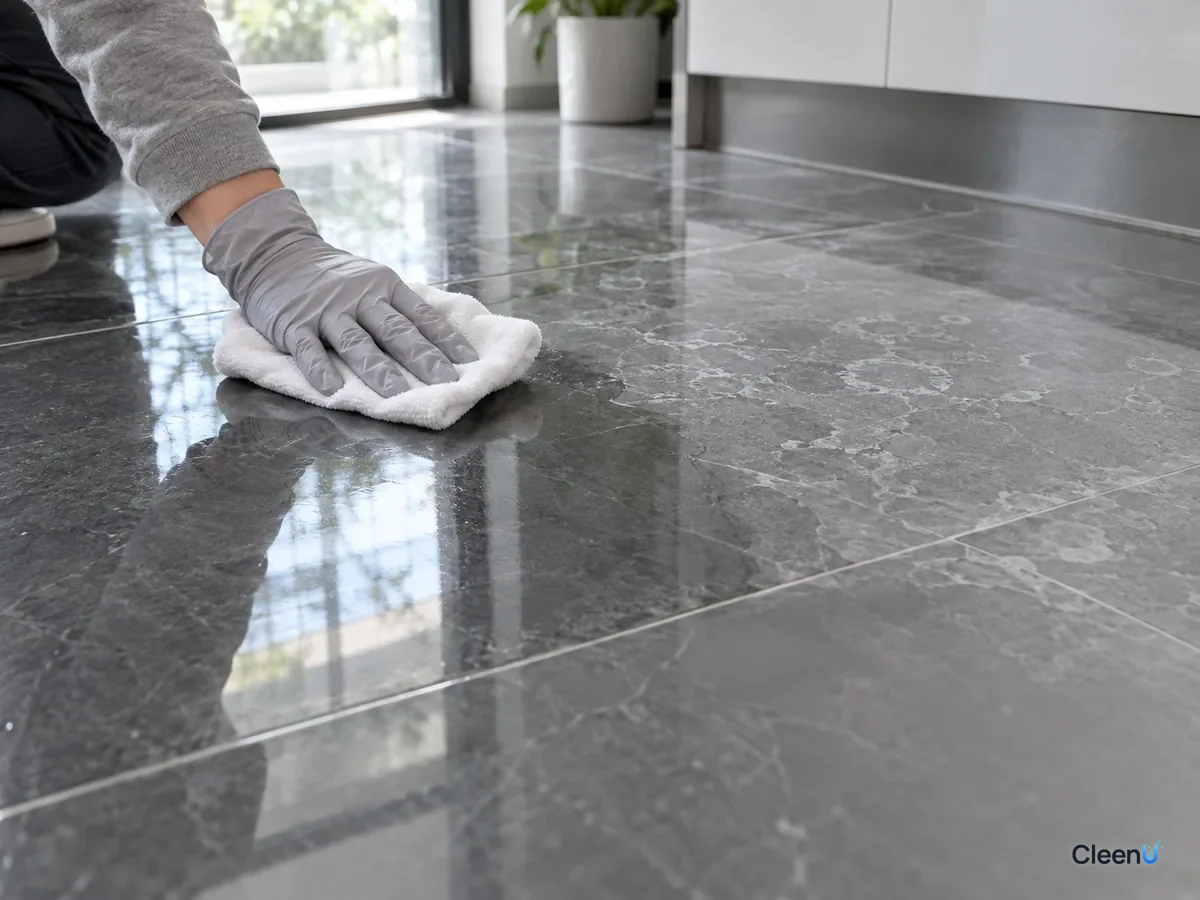
How to remove white spots that are already there
Glazed or polished tile: scale is an alkaline carbonate that a mild acid dissolves. Mix white vinegar with a few parts water, wipe the spots with a damp cloth, wait a minute or two, then wipe with plain water and dry. Keep the acid on the tile face and away from the grout, and always rinse afterward so no acid is left.
Vinyl plank and LVT: try plain water first. If that doesn't work, use a little diluted vinegar briefly, then rinse. Some flooring makers restrict acidic cleaners, so check the care guide.
Marble and terrazzo: they're made of calcium carbonate, and acid etches them into dull, rough spots. Never use vinegar, citric acid or acidic cleaners. Use a neutral stone cleaner and a soft cloth, and call a stone care pro for heavy buildup.
Cleaner residue: no acid needed. Run the robot once or twice with plain water, or wipe with a damp cloth, and the residue comes off.
Use vinegar and citric acid only for wiping by hand. Never put them in the robot's clean water tank. Acids can corrode metal parts, damage seals, and etch natural stone and cement grout. For more, see can you put vinegar or bleach in a robot mop tank.
How to prevent white spots in hard-water areas
Lower the water level. Less water means fewer minerals left behind. If floors dry within a minute or two, spots drop noticeably.
Use a low-foam, nonionic solution at the label ratio. CleenU Robot Vacuum Cleaning Solution is a neutral, low-foam concentrate at pH 6.5 to 7.5 with low-foam nonionic surfactants and a defoamer, no wax, no chlorine and no particles. It dilutes at about 1:50 to 1:100; 10 to 20 mL per fill is usually enough, or about 10 to 20 mL for a 1-liter tank. Less is better than more.
Switch to distilled or softened water. Where water is very hard, if your manual allows it, fill the clean tank with distilled, purified or softened water to cut minerals at the source. Some manuals give specific water recommendations, so follow yours.
Keep the pads clean. Scale and residue caught in pad fibers get wiped back onto the floor. Hand wash the pads regularly and replace them on schedule.
Watch for scale inside the machine. In hard-water areas, scale slowly builds in the clean tank, outlet holes and lines, causing uneven water flow. Clean them per the manual and clear clogged holes with a soft pin or water.
It works in most robot mops from Roborock, iRobot (Roomba Combo and Braava), Ecovacs Deebot, Dreame and Narwal, and in floor washers such as Tineco. Add it to the clean water tank or the dock's designated detergent compartment as your manual directs. CleenU isn't affiliated with these brands; the names only indicate compatibility.
This article is part of the Robot Vacuum Cleaning Solution & Maintenance Guide, which covers the full maintenance schedule and links to every troubleshooting guide.
White spots, water marks or streaks?
White spots appear after the floor dries. They're white rings or patches, usually scale or cleaner residue.
Water marks are lines you see while the floor is still wet. They may vanish as it dries or turn into white spots. The usual cause is too much water or a soaked pad.
Streaks follow the mopping path. Gray streaks point to dirty pads; hazy streaks point to too much solution. For more, see robot mop leaving streaks.
Stop and check if you see these
Dull, white, rough patches on natural stone may be acid etching. Stop using anything acidic and call a stone care pro. If water flow drops noticeably or one pad stays dry, scale may be clogging the outlet holes or lines. Clean them per the manual and don't take the machine apart yourself.
Common questions about white residue after robot mopping
Can I use distilled water in my robot mop?
In most models, yes, and it cuts white spots noticeably in hard-water areas. Some manuals have specific water recommendations; follow yours.
Can I add vinegar to the clean tank to fight scale?
No. Vinegar can corrode metal parts, damage seals and etch stone and grout. Use it only to wipe spots off tile by hand.
Do white spots mean my cleaning solution is bad?
Usually not. Spots that plain water won't remove but vinegar will are mineral scale. Only spots that plain water removes are cleaner residue, and cutting the dose fixes those.
Why are the spots so obvious on dark floors?
Dark, glossy floors reflect the most light, so white deposits have the highest contrast. The same scale barely shows on a light floor.
If I lower the water level, will the floor still get clean?
For everyday mopping, yes. Lower flow just means a thinner film. For very dirty areas, add an extra pass instead of more water.
Can I use the reject water from my reverse osmosis system?
Better not. RO reject water has more minerals than tap water, so the spots get worse.
Do white streaks mean I'm using too much solution?
Often, yes. Cut the dose to the low end of the label, about 10 mL per liter, wash the pads, and run one pass with plain water to lift the extra residue. If spots remain after that, minerals in hard water are the likely cause, so try softened or distilled water.
To cut down residue in a hard-water area, dose sparingly with a nonionic, low-foam Robot Vacuum Cleaning Solution.
White spots after robot mopping in hard-water areas usually come from calcium and magnesium in tap water drying into scale, and sometimes from too much solution. Test with water and vinegar: if water won't remove it but vinegar does, it's scale; if water removes it, it's residue. Prevent it by lowering the water level, dosing a low-foam solution sparingly and switching to distilled water where your manual allows. Wipe existing spots off tile with diluted vinegar, use a neutral cleaner on stone, and keep vinegar and other acids out of the robot's tank.