
OEM/ODM
Refill Packs for Robot Mop Auto-Dosing Docks, How to Spec the Bottle, Viscosity and Spout
Direct answer
Spec the refill backward from the target dock. The concentrate must stay pumpable when it's cold or slightly diluted and must not crust at the outlet. The spout must hit a small fill opening without splashing. The final pack needs an inner seal, drop and leak tests, and a label that shows where the liquid goes.
Six steps from brief to bulk production
-
Pin down target docks and fill method
List the docks you want to support and confirm from each manual whether it has a refillable cartridge, a sealed factory dispenser, or only a clean water tank, plus the seasonal temperatures in your market.
-
Start from an existing formula or set a custom direction
CleenU Robot Mop Cleaning Solution can serve as a ready starting point; settle any changes to scent, size, bottle, or label here.
-
Free samples
CleenU can sample at your target ratio. Free samples ship in about 3 days, and your team can run the cold-pour, splash-of-water, and small-opening screens in parallel.
about 3 days
-
Dock and viscosity verification
Check dosing, foam, residue, and the water path on common docks, along with cold flow and the dilution path, against pass criteria agreed in advance.
-
Packaging and label sign-off
Finalize the bottle, cap, inner seal, and carton, run drop and leak tests on that final pack, and approve the fill graphic, dose conversion, and compatibility wording together.
-
Bulk production and delivery
Bulk production takes about 7 days after packaging and labels are approved. Production runs through five quality checkpoints with batch traceability, and SDS, TDS, and COA are provided per project.
about 7 days
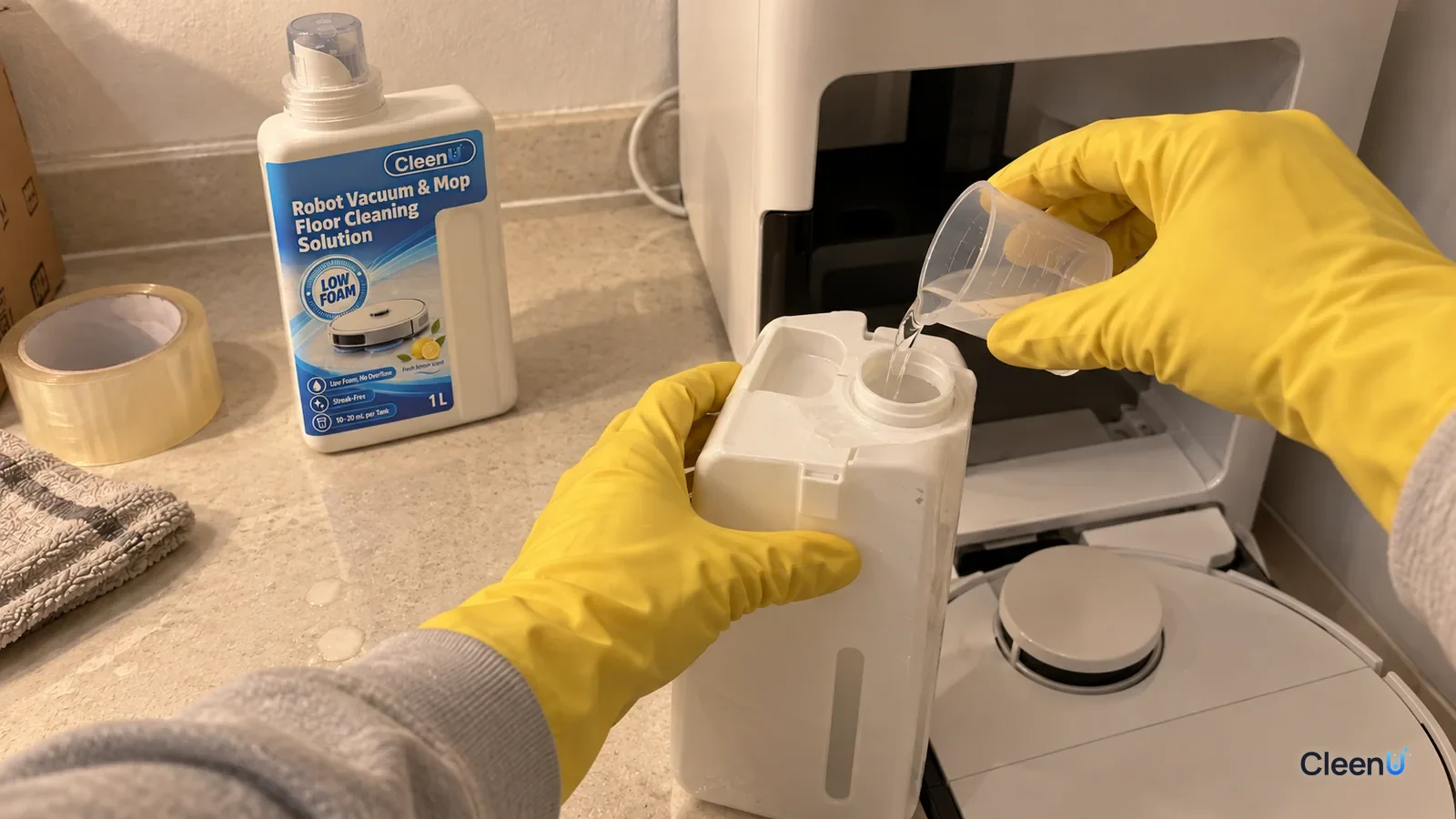
First-round robot mop solution samples usually focus on cleaning, foam, and scent. Put them in an auto-dosing dock and different problems show up: the dock can't draw the liquid in winter, white crust forms around the cartridge opening, shoppers spill concentrate on the dock, and bottles arrive with product around the cap. None of these are cleaning problems. They come from three refill specs that were never designed together: how the liquid flows, how the bottle pours, and how the pack is sealed.
So start with the target docks and how each one takes solution, then work backward: from a tiny pump and long dwell time to a viscosity window, from a shopper crouched at a small opening to a spout, and from a long shipping route to the seal and test plan.
What path does the solution take inside an auto-dosing dock?
Auto-dosing docks differ in the details, so each manual is the final word, but most follow a similar layout. The user pours concentrate into a cartridge, sometimes called a detergent compartment. A pickup port at its base, often behind a small screen, feeds a thin tube and a small metering pump; peristaltic and diaphragm pumps are common for this kind of low-flow dosing. A check valve keeps water from flowing back. At a mixing point the concentrate joins two water streams, one for washing the mop pads and one for refilling the robot's tank. A float, electrodes, or a pump-run-time estimate tells the dock when solution is low.
Three things about that path drive refill design:
- Small doses, thin tubing, long dwell. Concentrate can sit in the cartridge and lines for weeks, so viscosity, drying behavior, and stability matter far more than in a bottle on a shelf.
- Temperature follows placement. Docks end up by patio doors, in hallways, and next to drafty windows, and the liquid has to flow there in January and in August.
- The user pours; the dock dilutes. The shopper's whole job is open, aim, and fill to the max line, so the spout decides whether that goes cleanly.
Some docks can't be refilled at all. Narwal's auto-dispensing box, for example, is a sealed factory cartridge, so a third-party solution goes into the clean water tank at the label ratio instead. A refill label that doesn't say this invites people to pry open a box that was never meant to be opened.
How refilling a cartridge differs from dosing a tank
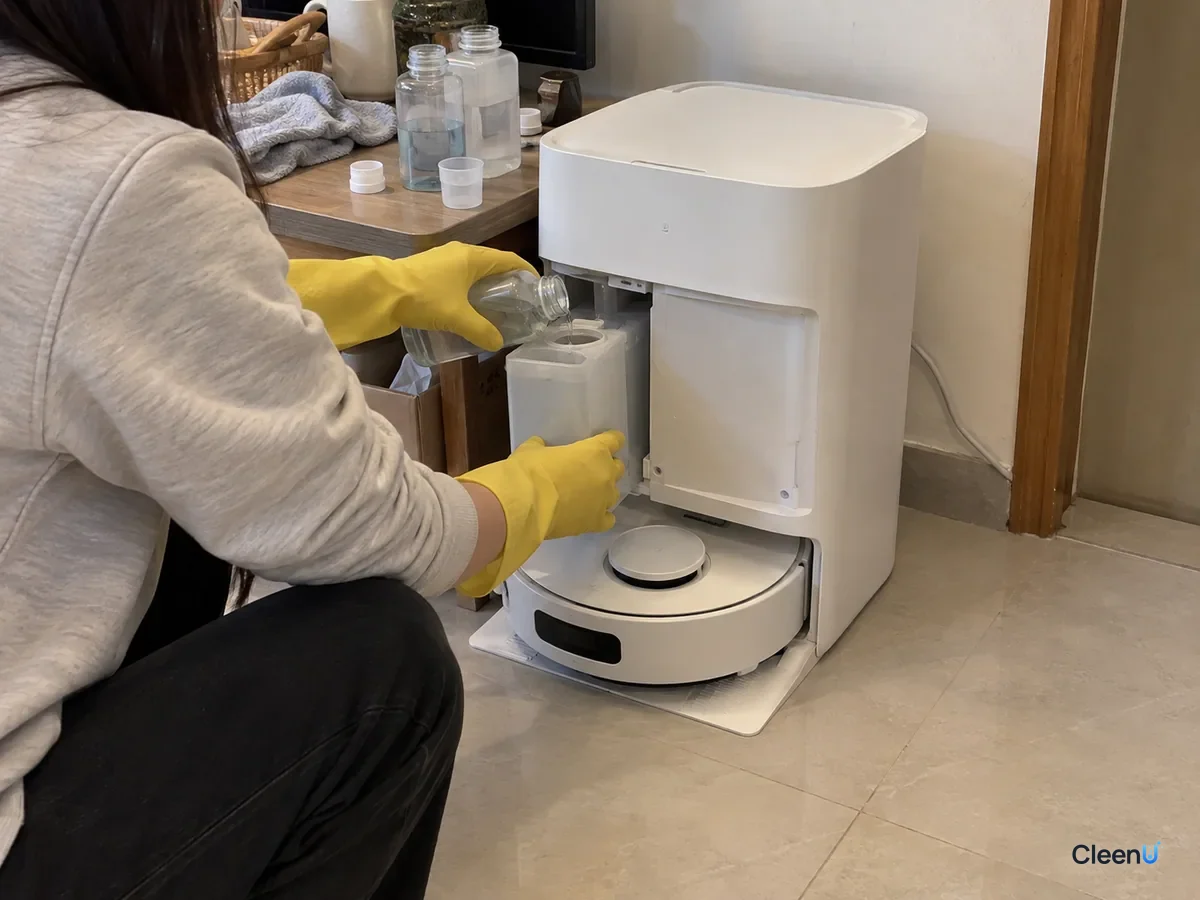
With a standard bottle, the shopper measures 10 to 20 mL (about 0.3 to 0.7 fl oz) with a cap and pours it into a clean water tank with a wide opening, so a small spill doesn't matter. A cartridge opening is much smaller and sits on top of or beside the dock. People kneel, hold the cartridge with one hand, pour with the other, and pour more than a capful.
That creates three failure points. Pour too fast and the liquid glugs out and splashes onto the dock or floor, where concentrate is slick underfoot. Misjudge the level and the cartridge overfills, leaking at the connector or confusing the level sensor. Turn the bottle upright and the last drop runs down into the label. A refill spout has to be designed around aiming at a small hole, not just filling-line speed or shelf appeal.
Viscosity: why you should spec for the coldest day
Viscosity is a liquid's internal resistance to flow, usually measured in mPa·s (centipoise). Too thick, and the pump doesn't fill completely on each intake stroke, so less concentrate goes out and cleaning drops off; thicker still, and a sluggish mass blocks the pickup screen and the dock reports low solution. Thinner isn't automatically better: a very thin concentrate seeps more easily at seals and is harder to pour with control.
The variable most teams underestimate is temperature. Most surfactant concentrates thicken as they cool; some gradually, others sharply, sometimes turning hazy or separating. Concentrates are surfactant-rich, and the molecules form ordered clusters. As the liquid cools, those clusters grow and tangle. Anionic surfactants also have a Krafft point, below which their solubility drops steeply, which is why some products cloud up in winter.
The second variable is a little added water. A small amount of water doesn't always thin a surfactant concentrate; sometimes it thickens first, or gels. Surfactant and water arrange into different phases depending on the ratio. At high concentration you get a pourable liquid. In a middle range the molecules can stack into layered or hexagonal liquid-crystal structures that behave like jelly. More water and it thins again. That middle range is easy to hit in a cartridge: someone refills it before the rinse water dries, or tops it off with water to "make it last," and gel settles over the pickup port.
The third variable is shear. Some liquids are thick at rest and thin out once they move. A dosing pump draws liquid slowly, so what matters is how the concentrate behaves at low flow, not how it looks after a hard shake.
Put those together and refill viscosity isn't a single number. It's a window. Across the coldest and warmest conditions in the target market, the dock has to draw the concentrate reliably. Along the whole dilution path from concentrate to slightly watered down, it shouldn't gel. And after sitting for weeks, it should flow the same way it did on the filling line.
How a cartridge of concentrate becomes unpumpable
- The dock sits near a cold window in winter, surfactant clusters grow and tangle, and viscosity climbs
- The user refills a rinsed cartridge before it dries, and leftover water dilutes some concentrate to a middle strength
- That middle strength falls into the liquid-crystal range and forms gel pockets that sink to the pickup port and screen
- The pump no longer fills completely on each stroke, less concentrate is dosed, and floors come out less clean
- Once gel fully blocks the port, the dock reports low solution while the cartridge is still mostly full
Common industry approaches include nonionic surfactant systems that stay fluid when cold, hydrotropes where needed to widen the liquid region and push the gel range away, and controlled solids without thickening polymers. How much of each depends on the viscosity window and target docks. To troubleshoot a dock that's already not dispensing, see Robot vacuum auto-dosing not working? How to check for thick solution and clogged ports.
Outlet crusting: what happens when concentrate meets air
The second most common auto-dosing complaint is a white or glassy crust around the pickup port, the cartridge opening, or the pump outlet. It's slow evaporation at work.
A thin film of liquid sits exposed at the cartridge mouth, bottle lip, and connectors. Water leaves first, the surfactants, salts, and other solids concentrate into a paste and dry into a skin, and the next refill only dissolves the surface, so crust builds layer by layer. Warm-air mop drying speeds it up.
How much a concentrate crusts comes down to three factors:
- Solids content. The more nonvolatile material in the concentrate, the more is left when the water goes.
- What those solids are. Film-forming polymers, waxes, particles, and some inorganic salts dry into hard crusts or crystals that don't redissolve easily. Easy-rinsing nonionic surfactants tend to dry to a soft paste that water picks back up.
- Exposure. Drips on the lip, an unwiped opening, and a lid left open all add to it.
That boils down to one formulation requirement: low solids, no particles, no waxes or film-formers, and whatever residue does dry should redissolve in water. On the label, pair it with two habits: wipe the bottle lip and cartridge opening after filling, and empty, rinse, and dry the cartridge before the robot sits unused. For cartridge cleaning steps, see How to clean a robot vacuum auto-dosing tank.
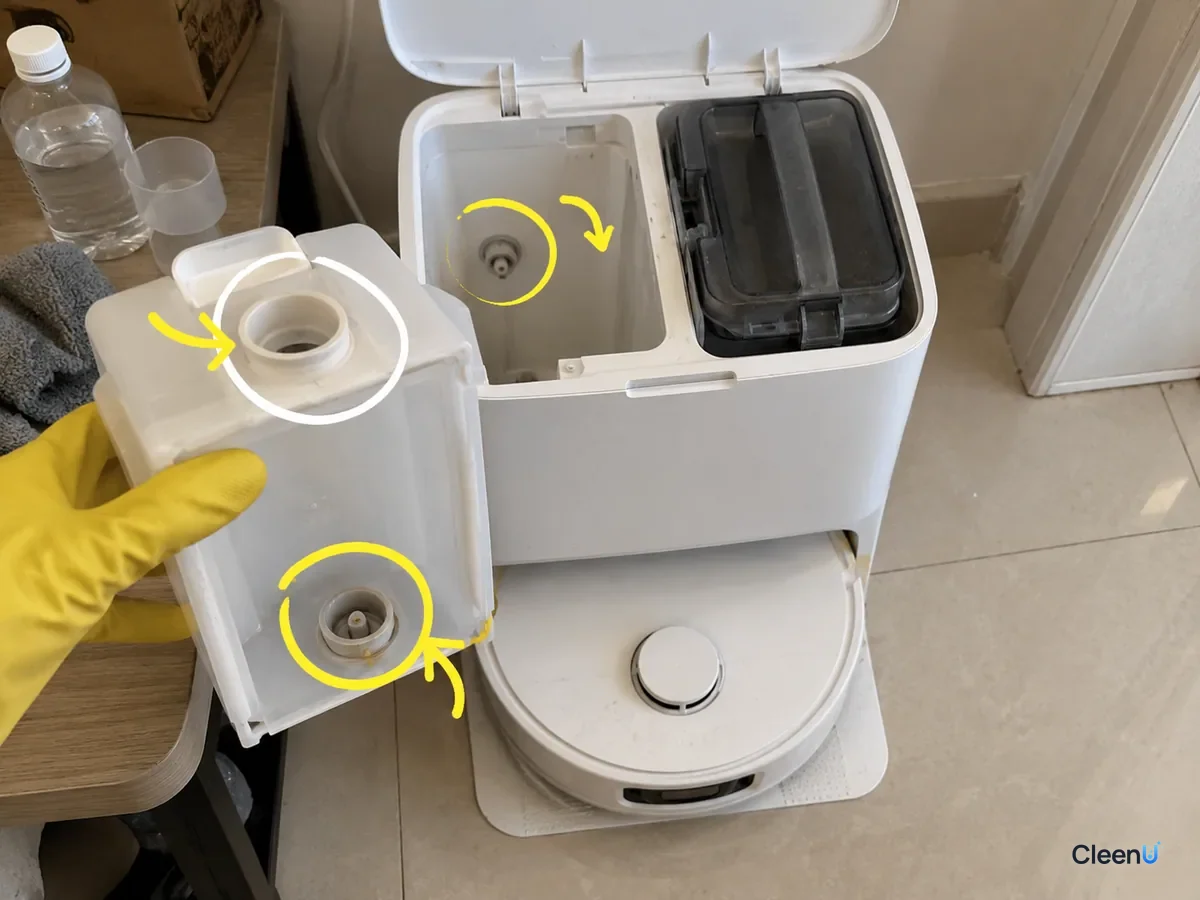
Bottle and spout: designing around a small opening
Once the flow requirements are clear, choose the container. These are the common refill choices. What's feasible depends on packaging supply and the target docks:
A few details are easy to underestimate.
Smooth pouring. Air has to enter through the same opening the liquid leaves. With a small neck or steep pour, it can't, and the liquid surges out. That glugging causes most splashes. A pour-control insert, angled lip, or pointed spout gives liquid and air separate paths; moderate viscosity helps too.
Seeing the fill level. From above, the max line is hard to see. A translucent or graduated bottle helps, and "Fill to the max line; don't add water" on the label is the most direct fix.
Drips when the bottle turns upright. A spout without drip-back leaves a drop that runs down the side, ruins labels, and starts the crust cycle.
Keeping a measuring cap. Many households have a newer dock with a cartridge and an older robot with only a clean water tank, or they switch between modes. A measuring cap covers both: about 1:50 to 1:100 in the clean water tank, for example 10 to 20 mL per liter (about 0.3 to 0.7 fl oz per quart), and straight concentrate in the cartridge. CleenU Robot Mop Cleaning Solution comes standard in a 1 L (33.8 fl oz) bottle with a measuring cap; 10 to 20 mL per fill is usually enough, so one bottle covers roughly 50 to 100 fills.
Leak protection: inner seal, drop test, leak test
Refill packs travel far, and export adds a container or air freight leg. Leaks usually trace back to a cap that wasn't torqued enough or vibrated loose, a liner that doesn't seal well against the neck, temperature and pressure swings that push liquid out at the weakest point, or a crushed carton.
The fix is an inner seal under the cap, which the user peels off on first use, plus drop and leak tests on the final packaging: the production bottle, cap, seal, and carton, not sample bottles. Test conditions such as drop orientation and hold time should match the sales channel and shipping method, using the same component lots as production. That's how CleenU handles its robot mop solution: an inner seal under the cap, then drop and leak tests on the final packaging before bulk production.
Fragrance and some ingredients can swell liners or migrate through plastics, so empty-bottle drops don't replace watching filled bottles over time. For a broader look at caps and leak-proofing, see Robot mop solution packaging: spouts, measuring caps, and leak protection.
The label: show where the liquid goes
The most expensive refill complaints often come from putting the liquid in the wrong place: concentrate in the dirty water tank, water in the cartridge, or a sealed Narwal-style box forced open. A fill-location graphic is the cheapest error-proofing you can buy.
At a minimum, the label should cover:
- Where it goes: a check for the clean water tank and the cartridge, an X for the dirty water tank.
- Concentrate or diluted: straight concentrate in the cartridge; about 1:50 to 1:100 in the clean water tank, with a conversion for common tank sizes.
- Sealed cartridges: if the dock's dispenser is a sealed factory box, add the solution to the clean water tank at the label ratio.
- Switching products: empty, rinse, and dry the cartridge first, and don't mix products.
- Storage: cap tightly, keep cool, and protect from freezing and direct sun. CleenU Robot Mop Cleaning Solution keeps for 24 months unopened.
- Compatibility: say "works with most models" and "add as your manual directs."
Quick screening at your desk, and how the factory verifies
When samples arrive, a product team can run a few quick screens without any instruments to decide whether a candidate is worth formal testing.
Cold pour. Refrigerate the sample overnight, then pour it into a narrow cup next to a room-temperature sample. If it strings, clumps, or won't pour, it will likely struggle in a cold dock.
A splash of water. Stir a very small amount of water into a little concentrate in a clear cup, then keep adding water in steps. If it turns jelly-like along the way, it can gel in a cartridge with rinse water left in it.
Drip and dry. Leave a few drops on a dark saucer for a day or two. A hard skin that won't redissolve in a drop of water means outlets will crust.
Aim at a small opening. Kneel and pour one-handed into a container with a cartridge-sized opening. Watch for surging, splashing, and drips.
These screens only rule out clear misfits. They don't replace factory verification. When CleenU validates a refill, it covers the following:
What a refill should pass between sample and sign-off
- Viscosity vs. temperature: flow of the concentrate across the low, room, and high temperatures expected in the target market, with no thickening to the point the dock can't draw it
- Dilution path: concentrate diluted with water in small steps, watching for gel or haze anywhere along the way
- Crusting: concentrate left exposed to air, then the dried film checked for how it redissolves in water
- Dock draw: runs on common cartridge docks, checking for steady dosing and no false low-solution alerts
- Storage stability: hot, cold, and retained-sample observation of appearance, odor, separation, and flow
- Packaging: drop and leak tests on the final bottle, cap, inner seal, and carton, plus checks of filled bottles and liners after standing
Agree on each item as a method, a condition, and a pass criterion, such as "pours freely after cold storage and doesn't trigger alerts on the target dock," not "same as the sample." For sample acceptance in general, see How to evaluate robot mop solution samples.
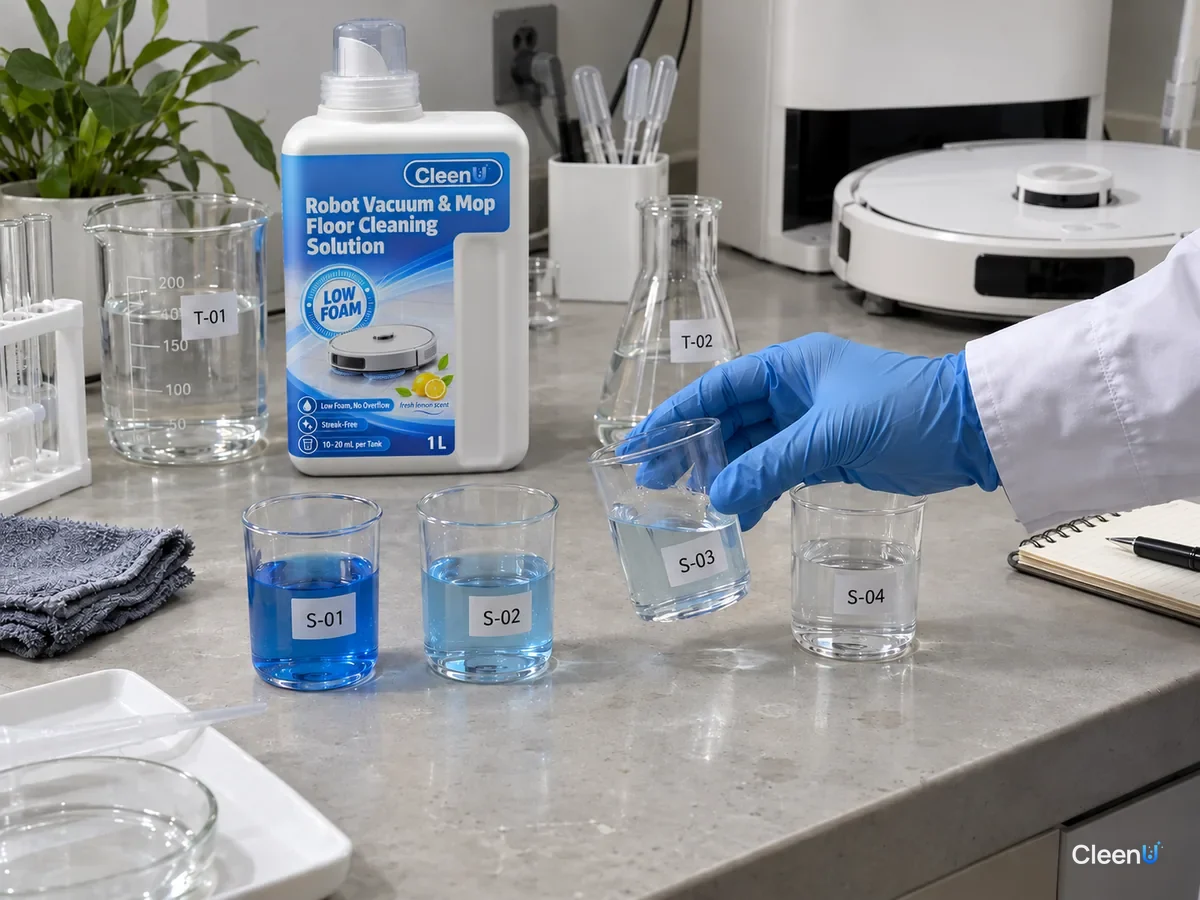
How CleenU works with brands on a refill project
A refill project follows the usual private-label path, except that target docks come first and viscosity and packaging checks take more of the schedule:
MOQ and lead times
MOQ is 500 bottles. Free samples ship in about 3 days, and bulk production takes about 7 days after packaging and labels are approved. Custom bottles or spouts that need new tooling or new packaging components are quoted separately for time and cost.
The five quality checkpoints are incoming materials, weighing verification before batching, an in-process check before filling, first-piece and patrol checks during filling, and finished-goods inspection, with batch traceability. If one batch draws poorly or leaks in the field, the batch code leads back to its raw-material lots and production record.
A ready starting point: CleenU Robot Mop Cleaning Solution
If you want a shorter development cycle, start from CleenU Robot Mop Cleaning Solution's existing specs. It's a neutral concentrate, pH 6.5–7.5 as a concentrate, built on low-foam nonionic surfactants with a defoamer. It's solvent-free and contains no optical brighteners, wax, chlorine, particles, quats, or phenols. Its viscosity is designed for dock auto-dosing compartments. Each 1 L bottle comes with a measuring cap and dilutes about 1:50 to 1:100; 10 to 20 mL per fill is usually enough. The standard version has a lemon scent, and the Pet Homes version is fragrance-free with a cyclodextrin-based odor neutralizer. For private label, scent options include lemon, light lemon, and unscented. Shelf life is 24 months unopened.
We've run foam, residue, and water-path tests on common robot mops and wet-dry vacuums, covering most models from Roborock, iRobot Roomba Combo and Braava, Ecovacs Deebot, Dreame, Narwal, Shark HydroVac, and Eufy RoboVac, plus Tineco and Bissell CrossWave floor washers. Refillable cartridges take the concentrate directly. Narwal's auto-dispensing box is a sealed factory cartridge, so CleenU Robot Mop Cleaning Solution goes into the Narwal clean water tank at the label ratio. If your model's manual says otherwise, follow the manual. CleenU is not affiliated with Roborock, iRobot, Ecovacs, Dreame, Narwal, Tineco, Shark, Eufy, or Bissell; brand names are used only to describe compatibility.
To build your refill on a 1 L concentrate with a measuring cap and viscosity designed for auto-dosing compartments, start with our Robot Mop Cleaning Solution.
Single-product specs are on the CleenU Robot Mop Cleaning Solution product page. If you're still deciding between concentrate, ready-to-use, and auto-dosing formats, read Private-label robot mop solution: which format to launch first.
Hold sign-off if you see any of these
Hold sign-off if the sample strings, clumps, or won't pour after a night in the refrigerator; turns to jelly when a little water is added; dries to a hard skin on a saucer that won't redissolve; triggers frequent low-solution alerts on a target dock; splashes or drips repeatedly during pouring; shows seepage at the cap or deformed liners after drop and leak tests on the final pack; or if the label doesn't tell owners of sealed-dispenser docks to use the clean water tank instead. Go back to the formula, spout, or label, confirm the problem is gone, and only then move to bulk production.
Auto-dosing refill packs: questions brands ask
Does an auto-dosing refill need a different formula from a standard concentrate?
It needs extra checks on viscosity and the dilution path. Cleaning and low-foam targets are the same, but refill concentrate sits in a cartridge for weeks and feeds a small pump, so cold flow, no gelling with a little water, and crusting all need to be confirmed.
What viscosity should a refill target?
Whatever the target docks can draw reliably, not one fixed number. Check flow across the market's cold-to-warm range and confirm on real docks that it doesn't trigger low-solution alerts.
What happens if users add water to the cartridge to stretch it?
It raises the risk of gelling and spoilage. Some surfactant concentrates thicken with a little added water, and diluted liquid sitting in a cartridge spoils more easily, so the label should say concentrate only.
Should a refill keep the measuring cap?
Keep it if tank-only users will buy the same bottle. The cap lets them measure about 1:50 to 1:100 for the clean water tank, while cartridge users pour concentrate straight in.
Is a pointed spout or a wide mouth better?
For cartridge-only refills, a pointed or flow-control spout is easier to aim. A wide mouth fills and rinses easily but splashes more at a small opening; pour into the actual target cartridge to decide.
Why does a white crust form around the fill opening?
Concentrate evaporates and dries there. Low-solids formulas without particles, waxes, or film-formers crust less, especially if users wipe the opening and dry the cartridge before storage.
Does an inner seal guarantee no leaks?
It reduces leak risk in shipping, but it has to be paired with testing. Run drop and leak tests on the final bottle, cap, seal, and carton once the pack is set.
How should the label handle docks with sealed dispensers, like Narwal?
Tell users to add it to the clean water tank. Narwal's auto-dispensing box is a sealed factory cartridge, so CleenU Robot Mop Cleaning Solution goes into the Narwal clean water tank at the label ratio.
Can a refill claim it fits every auto-dosing dock?
No, say "works with most models." Pair it with "add as your manual directs" and a fill-location graphic so users put it in the right place.
How long do samples and bulk orders take?
About 3 days for samples and about 7 days for bulk. Free samples ship in about 3 days, and bulk production takes about 7 days after packaging and labels are approved. New tooling or new packaging components are quoted separately.
Spec an auto-dosing refill backward from the target dock. The concentrate has to stay pumpable in the coldest likely spot and when a little water gets into the cartridge, without drying into a hard crust. The spout has to let someone kneeling at the dock hit a small opening cleanly. The pack needs an inner seal plus drop and leak tests on the final packaging, and the label needs a graphic showing where the liquid goes. Settle those four things with the target docks before bulk production, and most clogging, crusting, spill, and leak complaints never happen.