
How-to
How to Add Cleaning Solution to a Dreame Robot Vacuum, and What Hot Mop Washing Changes
Direct answer
Yes. The key is picking one that stays low-foam in cold and hot washes and adding it in the right place: concentrate only in the auto-add compartment, or about 1:50 to 1:100 in the clean tank.
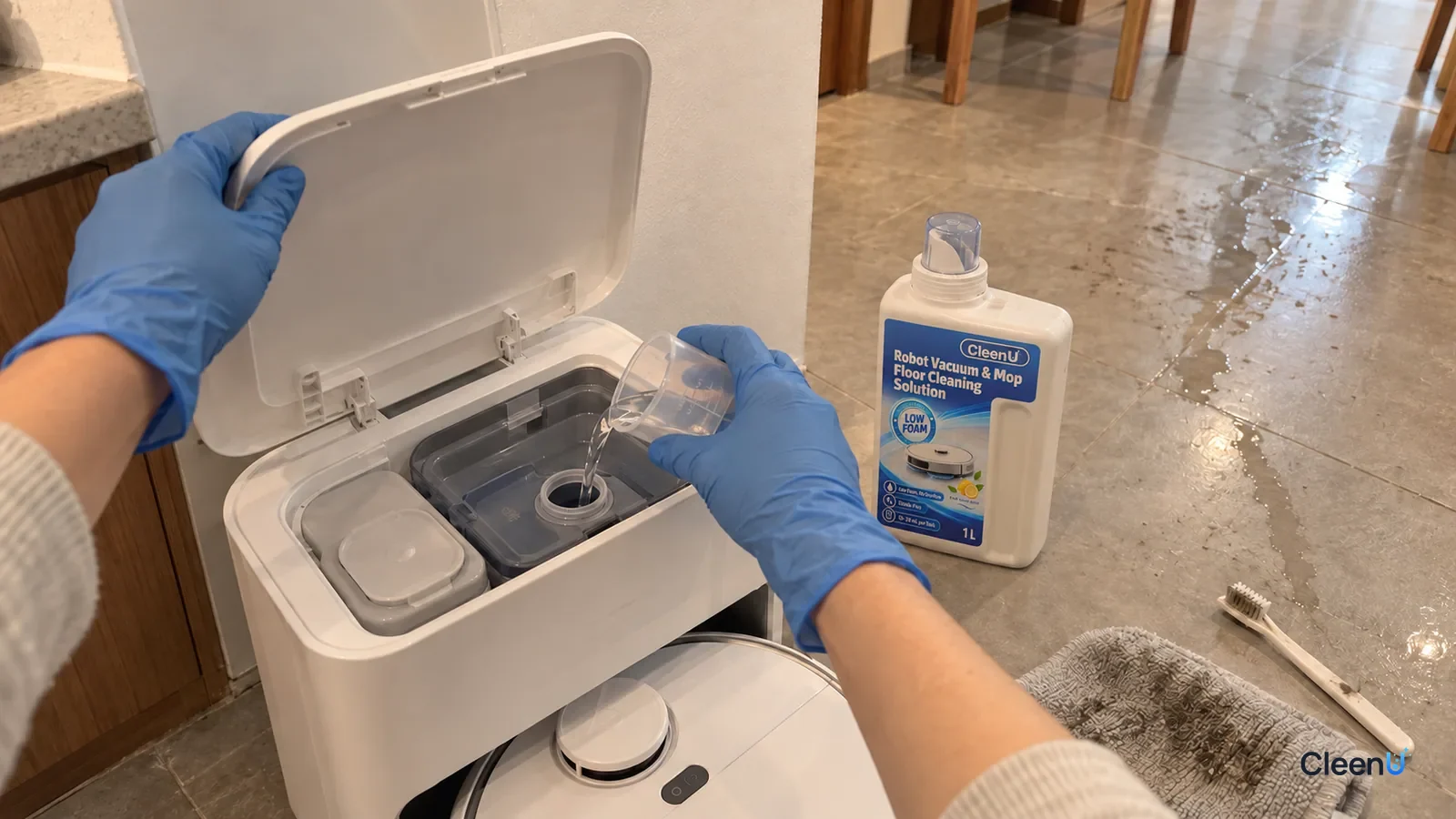
Yes, you can use a third-party cleaning solution in a Dreame. The key is picking the right one and adding it in the right place. Look for four things: clearly stated ingredients, low foam in both cold and hot water, a neutral pH that's gentle on seals and tubing, and no particles or wax that could dry into a crust. Then add it where Dreame's design expects it, at about 1:50 to 1:100, and mop one room first to check.
When you switch, two things about Dreame are different from other brands. First, how the compartment works: on auto-add models like the X40 Ultra, X30 Ultra, and L10s Pro Ultra, Dreame says solution is dosed into the line and mixed with water during mop washing. Second, hot mop washing: some models' docks can wash mops with hot water, with selectable temperatures. Change the temperature and you change how foam, defoamers, and the soil itself behave. Here's the structure, the chemistry, the steps, and how to check your results.
Key design points on a Dreame
Here's what we could verify from Dreame's own materials about how the machines are built:
- The X40 Ultra, X30 Ultra, and L10s Pro Ultra have an auto-add compartment. During mop washing, solution is dosed into the line and mixed with water, and the app has an on/off setting for it.
- Some models' docks support hot-water mop washing with selectable temperatures; check your model's manual for the actual temperature.
- The X40 Ultra's mop can extend outward (Dreame calls it MopExtend) to reach along walls, into corners, and under low furniture.
For other models, a look under the dock lid and a glance at the manual will tell you whether there's a compartment and how hot the wash gets.
One detail is worth calling out. A Dreame help article on troubleshooting solution that isn't being dispensed suggests checking the dirty water tank for foam after mop washing: if there's foam, the dock added solution. That check works with a sudsy solution. A low-foam solution barely foams to begin with, so after switching, no foam in the dirty tank doesn't mean nothing was added. The more reliable check is whether the compartment level drops over several runs, which we cover in the steps below.
How liquid moves through a Dreame
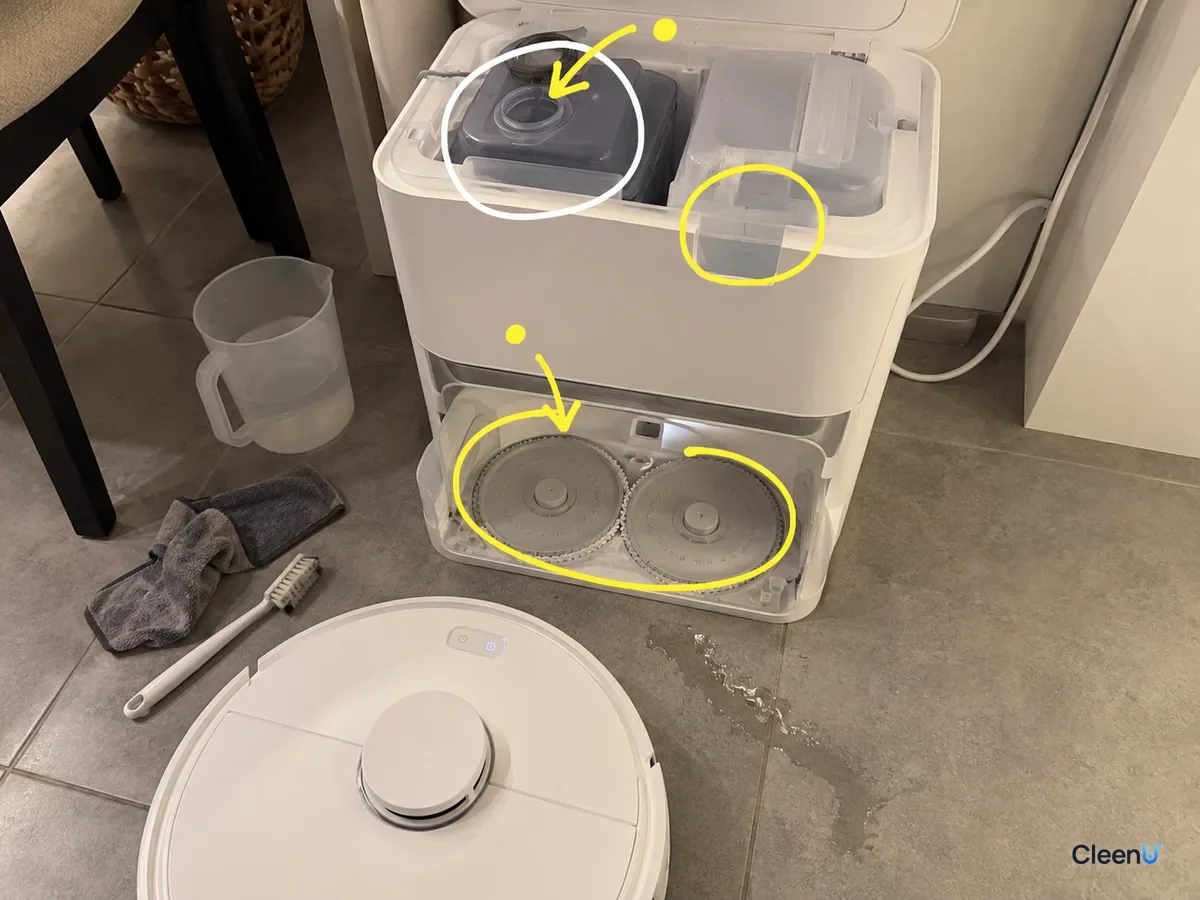
On a Dreame with a compartment, the water path has three stages.
Compartment to line. The compartment holds concentrate. During mop washing, the dock draws a small amount into the mop-washing line, where it mixes with water from the clean tank. So the solution's first job is washing the mop. The clean mop then heads out carrying water and a little working solution.
Wash tray. Back in the dock, the mop is rinsed and scrubbed in the wash tray, and dirty water is pulled into the dirty tank. On some models, this step can use hot water. Heat, solution, and scrubbing work together to get grease and dust out of the mop. Then the dock dries it.
Floor and edges. The mop works the floor with water and a little solution. On the X40 Ultra, it swings out along baseboards and into corners. That pass decides how clean the edges get, and whether they're left with a faint line.
Without a compartment, the path is simpler: you mix solution into the clean tank, and the pump sends that mix to both mop washing and mopping. Either way, nothing goes in the dirty tank, and on compartment models, don't add solution to the clean tank too, or the doses stack.
Hot mop washing changes foam, and it changes the soil
Because a Dreame dock lets you pick the wash temperature, "Is this solution low-foam in both cold and hot water?" becomes a real question. Temperature doesn't push foam in just one direction, so it helps to separate the effects.
Heat makes foam less stable. Bubbles are held up by thin liquid films lined with surfactant. Gravity slowly drains liquid out of those films until they get thin enough to pop, which is called drainage. Warmer water is less viscous, so it drains faster, and the air inside bubbles expands, stretching the films thinner. In most cases, the same foam collapses faster in hot water than in cold.
Defoamers depend on temperature too. Low-foam solutions usually rely on one of two approaches. One uses polyether nonionics, such as EO/PO block copolymers. They stay dissolved in cold water and do little to foam. Above a certain temperature they come out of solution as tiny oily droplets that slip into bubble films and break them. The other uses silicone defoamers, which work across a wide temperature range at very low levels but, in the wrong formula or dose, can leave a film on floors or parts that's hard to rinse off.
Put those together in a Dreame and you get a practical rule: low foam in hot water alone isn't enough. If a solution relies mainly on "drops out when hot" defoaming, it can foam noticeably more on the Normal setting or during a cold first rinse in winter, before the defoamer kicks in. The dirty tank and level sensing don't care that the next cycle will be warmer. So test any third-party solution for foam in both cold and warm water.
Why the same solution foams differently on cold and hot settings
- Rinsing and scrubbing in the wash tray trap air in the working solution and make foam
- Warmer water drains out of bubble films faster, and heated air expands, so films thin and pop sooner
- Polyether defoamers stay dissolved and mostly idle in cold water, then come out as droplets that break films once it's warm enough
- Silicone defoamers work hot or cold, but the wrong dose can leave a hard-to-rinse film
- Bottom line: choose a formula that stays low-foam on both cold and hot settings without relying on a silicone film, and test both
Heat helps with grease and hurts with protein. Floors running from kitchen to dining area pick up two main kinds of soil. One is grease: footprints from the stove area, soup dripped under the table. The other is protein: spilled milk, egg, meat broth. Grease softens and thins as it warms, so it washes out of mop fibers more easily, and a hotter wash setting suits greasy areas. Protein does the opposite. Proteins in milk and egg denature and set at high temperatures, the way an egg firms up in a pan. They go from dissolved to stuck to the fibers. A mop soaked with a big egg or milk spill, sent straight into the hottest wash, can end up with that protein cooked onto it, harder to remove every cycle and stale-smelling after drying.
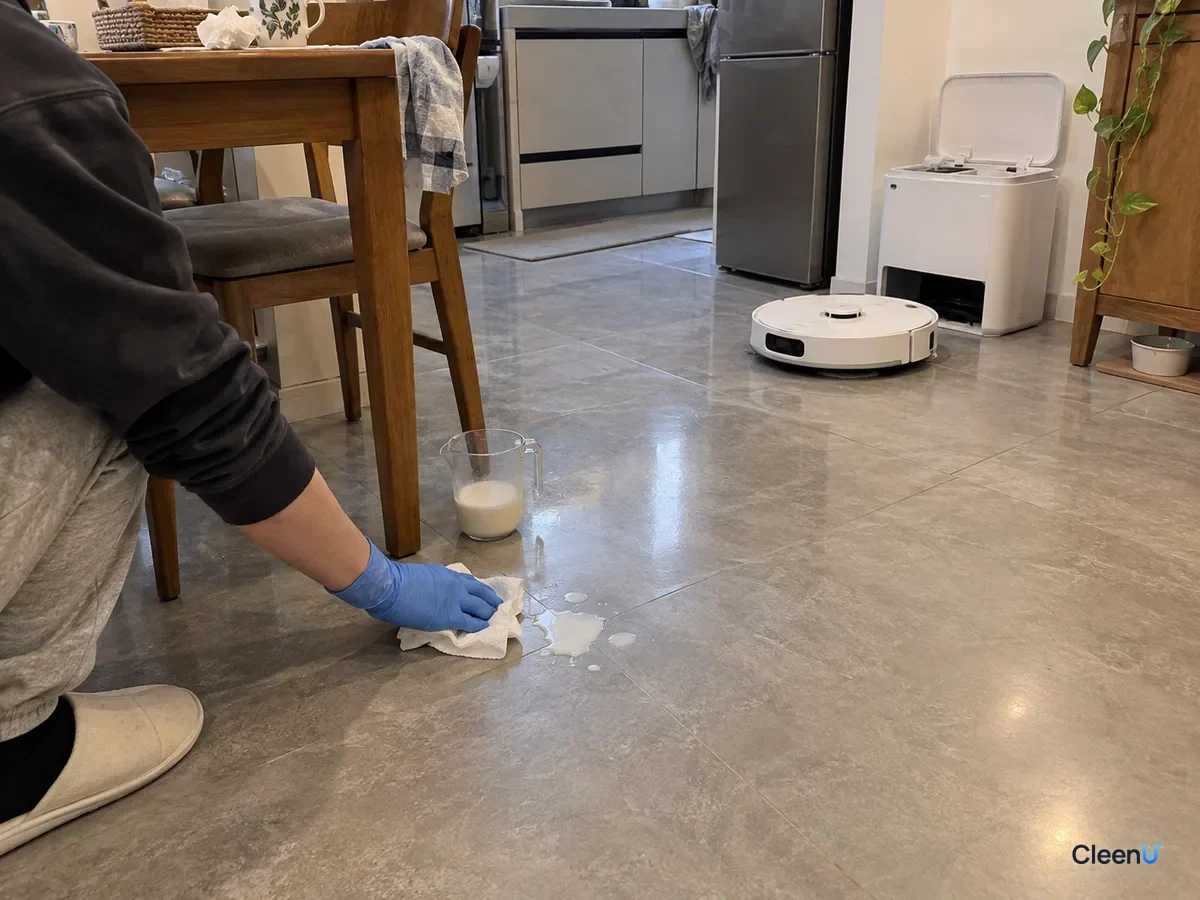
That makes one habit more useful than any solution swap: wipe up big milk or egg spills by hand with a paper towel or damp cloth, then let the robot mop. For everyday dust and greasy footprints, a hotter wash is fine. The solution's job here is dispersion, keeping loosened grease and protein suspended so they're flushed into the dirty tank instead of sticking back to the fibers. That doesn't take a strong mix. The low end of the ratio is enough.
More on greasy floors: Greasy footprints on the kitchen floor: how to robot-mop them clean.
An extending mop along the wall: why edges can end up with a line
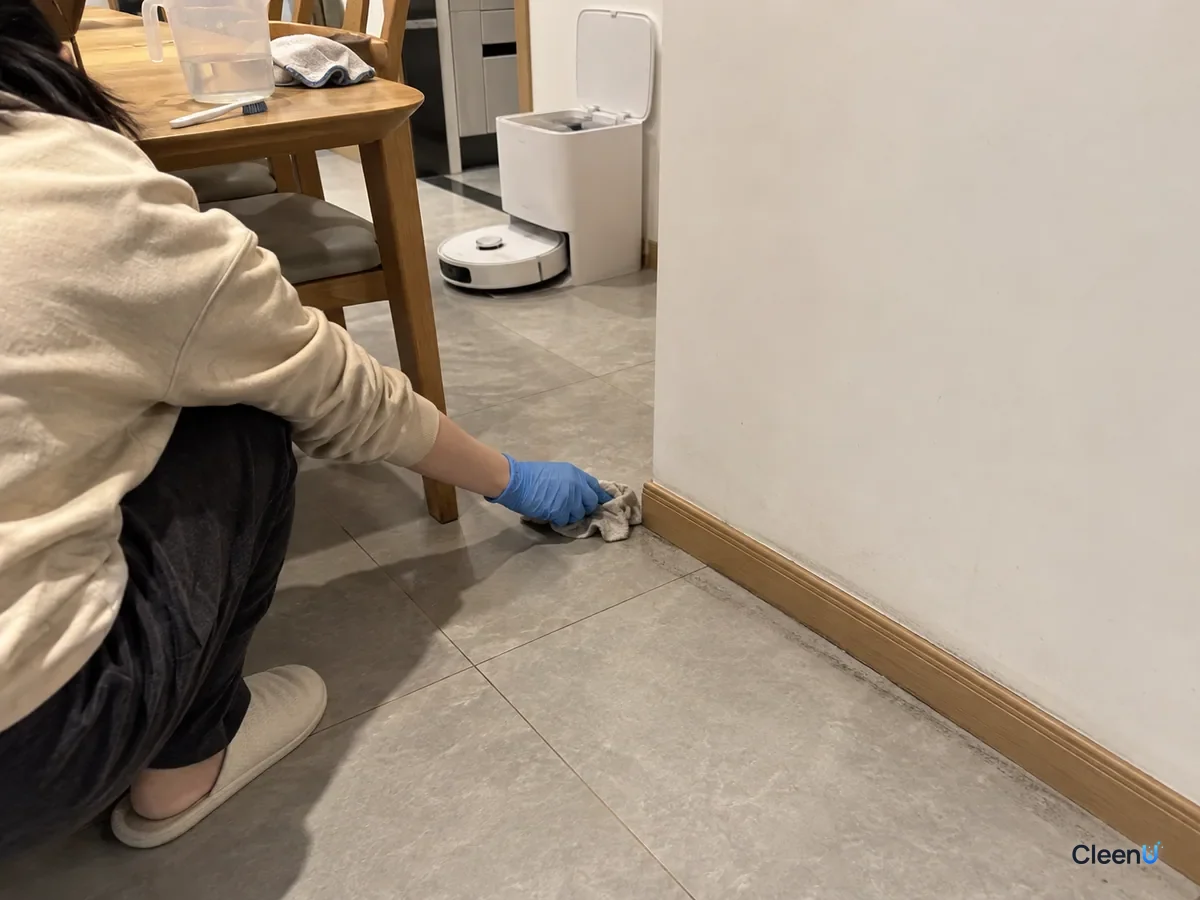
The X40 Ultra's mop swings out to run along baseboards and into corners. Edges get much cleaner, but some owners notice a faint line along the wall once the floor dries, or a grayish band at the bottom of the baseboard. Solution, water level, and the edge itself all play a part.
The mop's outer edge pushes a wet bead. As the mop moves, its outer edge acts like a soft squeegee and pushes some water and loosened soil ahead and to the side. That forms a bead of liquid thicker than the film elsewhere. As the mop swings out, turns, and retracts at the wall, the bead often stops right where the baseboard meets the floor. Thicker liquid dries more slowly, and whatever is dissolved in it, soil and solution alike, stays behind as a line.
Walls collect the most soil. Dust and airborne grease settle into corners, and vacuuming often pushes debris toward the edges. Along kitchen walls, cooking grease condenses and drips. A mop running along the wall picks up more soil than in the middle of the room, and a mop that's already dirty can smear some of it back.
Baseboards and grout lines absorb. The bottom edge of wood or MDF baseboards and the grout between tiles both soak up liquid. Working solution wicks in and leaves dissolved material behind as it dries, which builds into a gray band over time.
What to do about it:
- Use less solution. The fewer solids in that bead, the less visible it is when dry. A low-solids, easy-rinsing formula with no waxes or film-formers leaves the faintest trace.
- Don't run water flow at maximum. Bead thickness tracks water flow.
- Hand-wipe very dirty kitchen edges once, then let the robot's edge mopping handle upkeep.
- If a line appears, mop once with plain water. If water removes it, it was residue. If it stays or looks yellow, the baseboard or grout has absorbed soil and needs hand cleaning.
Adding a third-party solution, step by step
Switching a Dreame to a third-party solution
Check for a solution compartment
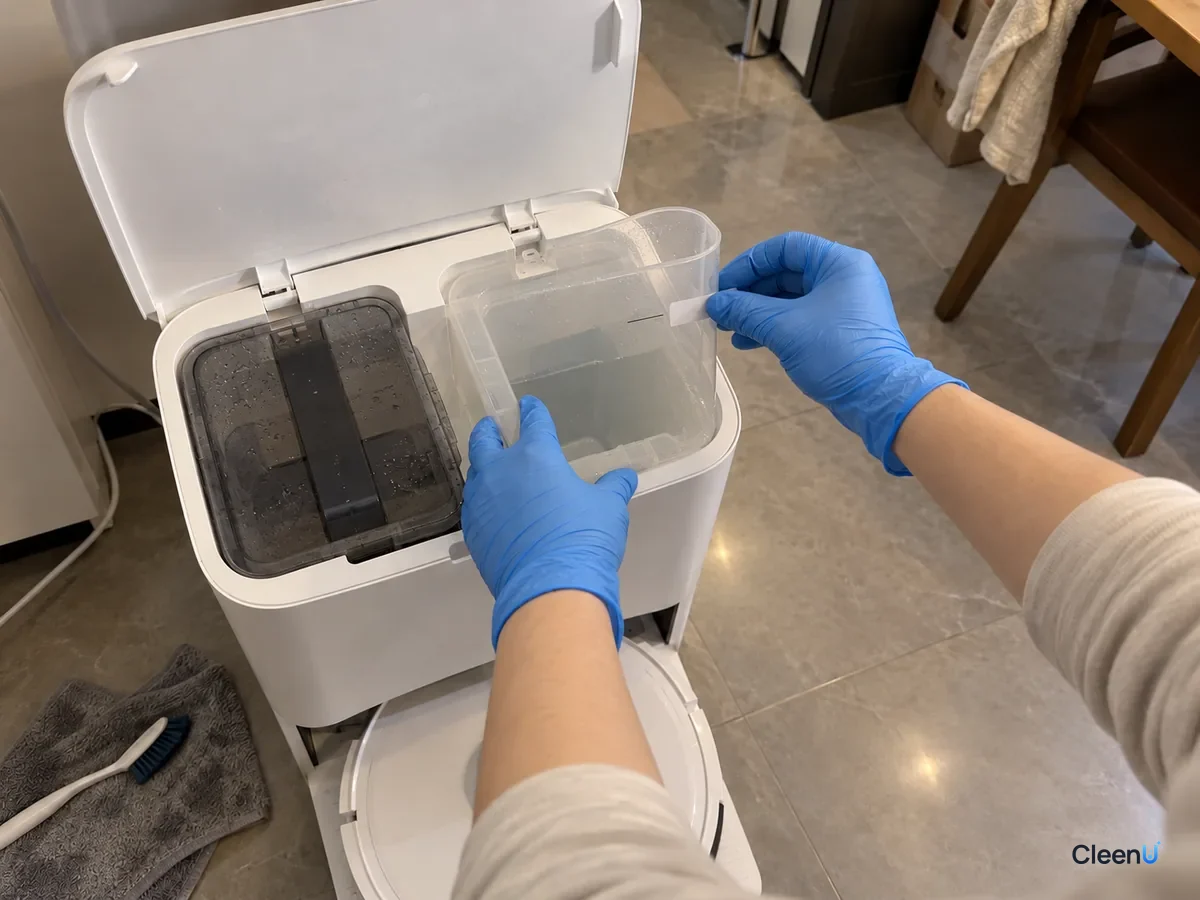
Lift the dock lid and look for a separate solution compartment with a fill mark. The X40 Ultra, X30 Ultra, and L10s Pro Ultra have one; for other models, check your manual. No compartment? Skip to step 7.
Empty and rinse the compartment
If Dreame solution is still inside, use it up or pour it out, rinse twice with water, and let it dry upside down. Don't mix products in the compartment.
Caution:Leftover water dilutes the concentrate, and some concentrates thicken at that in-between strength, which can affect dosing.
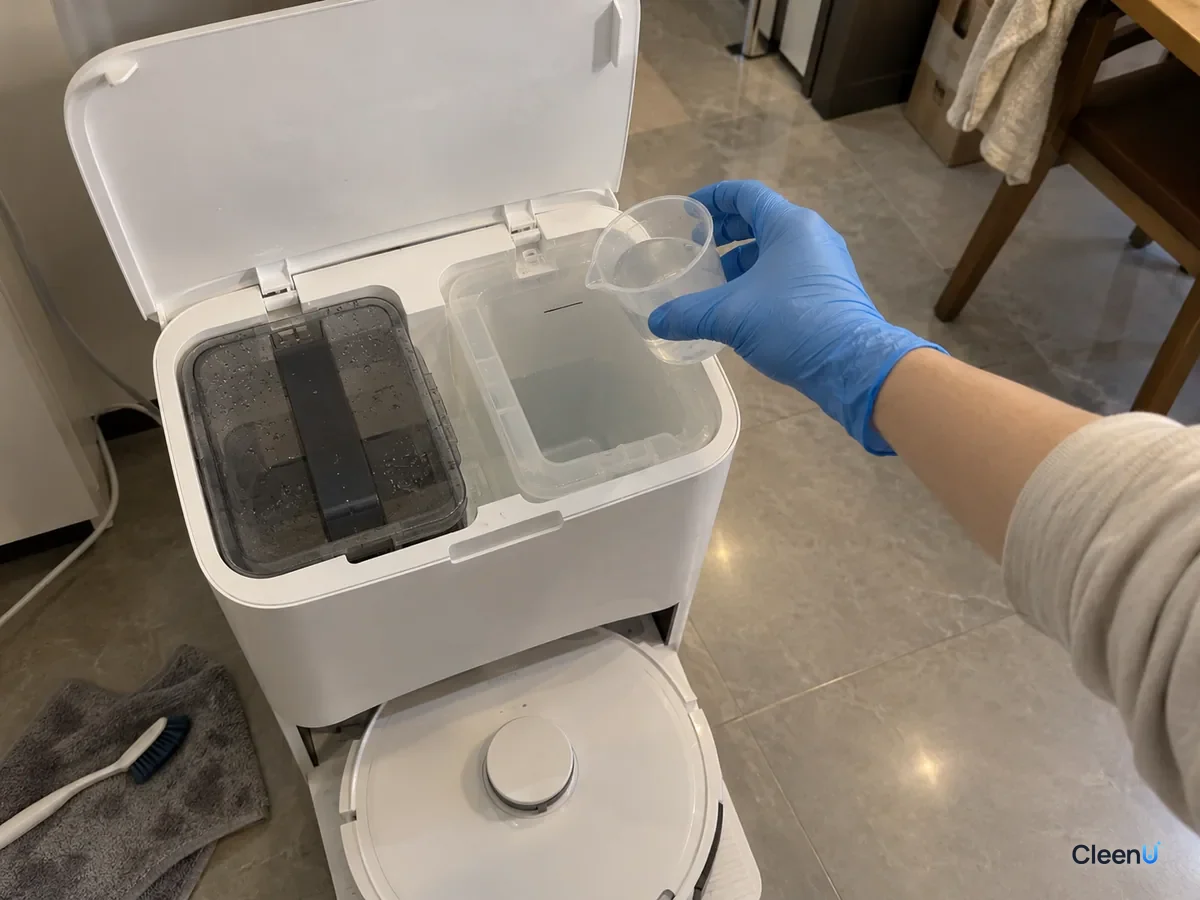
Add concentrate up to the max mark
Pour in concentrate straight, with no water, no higher than the max mark. Wipe the opening with a damp cloth and close the lid.
Turn on auto-add and mark the level
In the Dreame app, confirm automatic solution adding is on. Mark the current level on the outside of the compartment with a marker or small sticker so you can tell later whether it's being used.
Pick the wash temperature for the mess
For everyday dust and greasy footprints, a hotter wash works well. If there's a big milk or egg spill, wipe it up by hand first, then let the robot mop, so high heat doesn't set protein into the mop.
Mop one room and check the level and the floor
Check the dirty tank for obvious foam, look at the gray tile and the wall edge in side light for haze or lines, and touch the floor with the back of your hand for tackiness. After a few runs, compare the level to your mark. A slow drop means dosing is working. With a low-foam solution, a foam-free dirty tank is normal and doesn't mean nothing was added.
No compartment? Dilute in the clean tank
Fill the clean tank with water first, then add solution at about 1:50 to 1:100 with the measuring cap, such as 10–20 mL per liter (about 34 oz) of water, using the low end for routine mopping. Swirl gently, never add anything to the dirty tank, and use the mix the same day.
Foam, tacky floors, or a level that won't drop? Adjust in this order
A foamy dirty tank, tile that dries tacky or hazy, or a line along the wall means too much solution is reaching the floor. A compartment level that hasn't moved after several runs usually means auto-add is off, the compartment isn't fully seated, or there's a dried ring on the connector. Step one: check the auto-add setting and that the compartment is seated, and wipe the opening and connector with a damp cloth. Step two: empty the compartment or clean tank, rinse with water, and run one mop-wash cycle to flush extra solution out of the lines. Step three: refill at the label ratio; on models without a compartment, use the low end and turn water flow down a level, then mop one room to check. If the mop comes out stiff and stale-smelling after drying, milk or egg was likely set into it by heat: hand-wash the pad in warm water and wipe spills before the robot mops from now on.
Home tests: check both cold and hot
Since water temperature is adjustable on a Dreame, bring temperature into your testing.
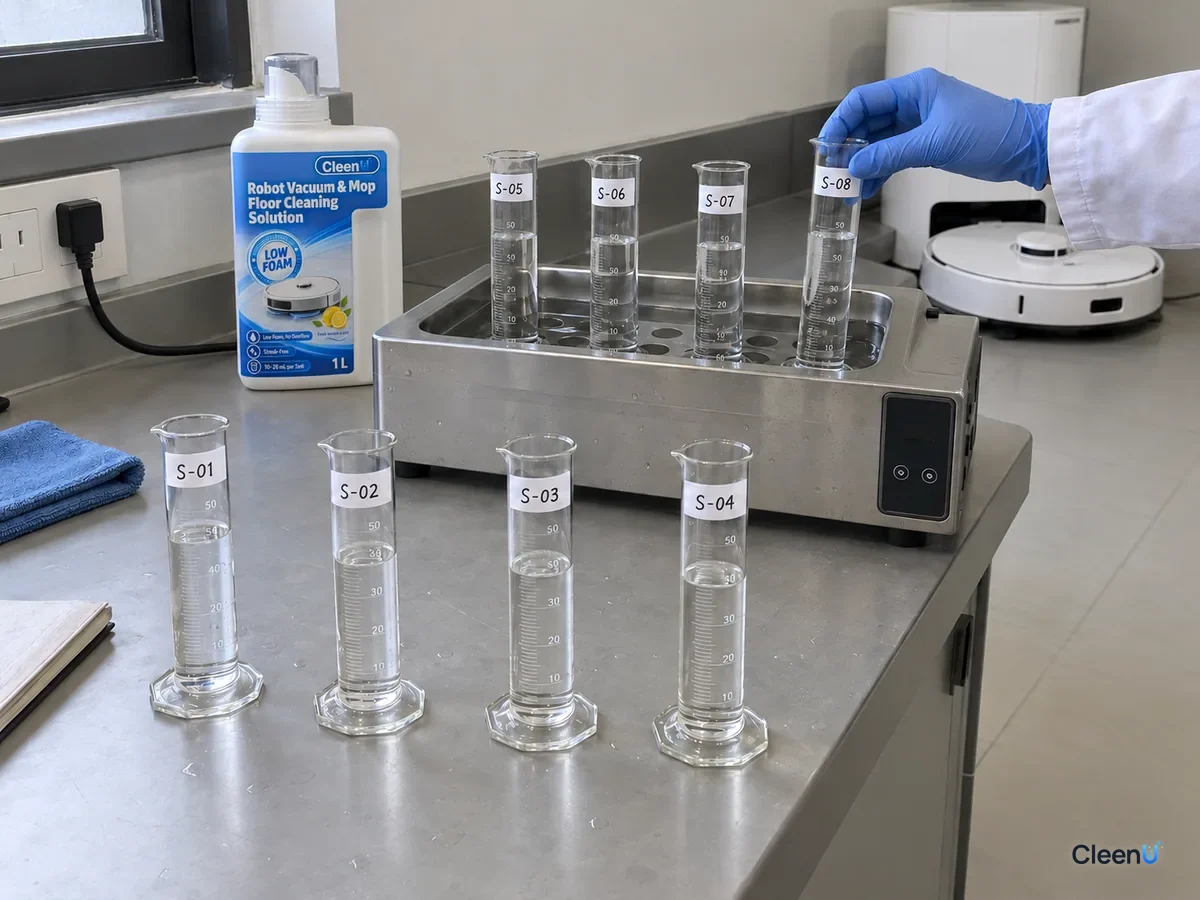
The cold-and-warm shake test. Fill two identical clear plastic bottles, one with about 500 mL (17 oz) of cold water and one with about 500 mL of clearly warm water (warm to the touch, not hot, and never boiling). Add solution at its label ratio to each, cap them, shake each 10 times, and watch the foam. If both show a thin layer that collapses quickly, it suits every wash setting. If the warm bottle barely foams but the cold one foams a lot, the solution relies on heat to defoam, so keep an eye on the dirty tank when you wash on Normal.
The milk strip test. Cut two strips from an old towel or microfiber cloth and put a small spot of milk on each. Scrub one in warm water and the other in very hot water (protect your hands), then let both dry and compare. The very hot strip is more likely to keep a stiff, yellowish mark. It shows why milk and egg spills should be wiped before the robot mops.
The flashlight check along the wall. After the robot has mopped the edges and the floor is fully dry, hold your phone flashlight flat on the floor and shine it toward the wall. Look for a line that's brighter or grayer than the rest. If you see one, mop once with plain water. If water removes it, drop the solution to the low end and turn water flow down one level.
One more step makes the shake test closer to real life: add a few drops of milk and shake again. A formula that barely foams in clean water foams a little more steadily once protein from milk or broth is in the water, because protein molecules also line up in bubble films and reinforce them. If it still foams lightly and settles fast with milk in it, it's an easy fit for a hot-washing dock like a Dreame's.
What that looks like in a bottle: CleenU as an example
To see those criteria in an actual product, take CleenU Robot Mop Cleaning Solution. It's a neutral concentrate, pH 6.5–7.5 as a concentrate, gentle on seals and plastics during hot mop washing. It's built on low-foam nonionic surfactants with a defoamer, with foam controlled for both cold and hot conditions. It contains no wax, chlorine, particles, solvents, or optical brighteners, and no quats or phenols, so a drying edge bead leaves only a faint trace and the mop doesn't pick up a wax film in the dryer. Its viscosity is designed for dock auto-dosing compartments. Each 1 L (about 34 oz) bottle comes with a measuring cap and dilutes about 1:50 to 1:100; 10 to 20 mL per fill is usually enough. The standard version has a lemon scent, and the Pet Homes version is fragrance-free with a cyclodextrin-based odor neutralizer. It's a cleaning solution that lifts dust film, greasy footprints, and everyday soil from sealed hard floors, not a disinfectant. Add it to the compartment or clean tank as your manual directs. It works with most Dreame models and most robot mops and wet-dry vacuums from Roborock, iRobot (Roomba Combo, Braava), Ecovacs Deebot, Narwal, Tineco, Shark HydroVac, Eufy RoboVac, and Bissell CrossWave. CleenU is not affiliated with these brands; brand names are used only to describe compatibility.
When you choose a solution, look at active content as well as the dilution ratio. Many products carry about 2% active surfactant, which leaves about 0.01% at 1:200 and about 0.004% at 1:500. CleenU's robot mop solution is 15% active and leaves about 0.15% at 1:100, about 15 times the first and nearly 40 times the second. The formula is active content divided by dilution ratio, and it works the same for cold and hot wash settings.
If you want a solution for your Dreame that stays low-foam hot or cold and leaves fewer edge marks, take a look at our Robot Vacuum & Mop Floor Cleaning Solution.
Switching cleaning solutions in a Dreame
Can I use a third-party cleaning solution in a Dreame robot?
Yes, if you pick the right one and add it in the right place: a neutral, particle-free concentrate with no disinfectants that stays low-foam hot and cold. On compartment models, add concentrate only; otherwise dilute about 1:50 to 1:100 in the clean tank. Never both, and never the dirty tank.
Where does cleaning solution go in a Dreame?
On compartment models such as the X40 Ultra, X30 Ultra, and L10s Pro Ultra, concentrate goes in the solution compartment. On models without one, dilute it in the clean tank. Never the dirty tank.
Should I dilute the solution before putting it in the compartment?
No. The compartment takes concentrate, and the dock mixes it with water during mop washing. Diluting it yourself can make it thicker or let it spoil.
If my Dreame has a compartment, should I also add solution to the clean tank?
No. The doses stack, which tends to leave floors tacky and the dirty tank foamy.
I switched to a low-foam solution and there's no foam in the dirty tank. Is it being added?
Don't judge by foam. A low-foam solution barely suds. Mark the compartment level and check that it drops slowly over several runs.
The compartment level never goes down. What should I do?
Confirm auto-add is on in the app and the compartment is fully seated, then check the connector for dried film. Empty, rinse, dry, and refill with concentrate, then compare against your mark after a few more runs.
Which wash temperature should I use?
Use a hotter setting for everyday dust and greasy footprints, since grease rinses out more easily. After a big milk or egg spill, wipe it up by hand first so heat doesn't set protein into the mop.
What kind of solution suits Dreame's hot mop washing?
Pick one that stays low-foam in both cold and hot water. Shake one bottle with cold water and one with warm water; if both foam lightly and settle fast, it suits every setting.
There's a faint line along the wall after mopping. Is it the solution?
Check for too much solution or water first. Mop once with plain water; if that clears it, drop to the low end of the ratio and turn water flow down a level. If it stays or looks yellow, the baseboard or grout has absorbed soil and needs hand cleaning.
How much third-party solution goes in a Dreame without a compartment?
For CleenU Robot Mop Cleaning Solution, about 1:50 to 1:100 in the clean tank, or 10–20 mL per liter (about 34 oz) of water. Use the low end for routine mopping and do a second pass on dirty spots.
Which Dreame models does CleenU Robot Mop Cleaning Solution work with?
It works with most Dreame models, and we've run foam, residue, and water-path tests on common robot mops. Put concentrate in the compartment if your dock has one; otherwise dilute about 1:50 to 1:100 in the clean tank.
My bottle arrived with a damp cap. Is it OK to use?
Check the inner seal and the bottle first. If the seal is intact and only the outside is damp, wipe it and use it. If the seal is broken or the bottle is leaking, contact the seller.
Related reading: Can you put hot water in a robot mop?, Robot says the dirty tank is full when it isn't, "Solution low" alert right after a refill, Black slime or mold in the dock wash tray, and Robot mop leaving streaks?
You can switch to a third-party solution in a Dreame. Compartment models take concentrate only, never diluted and never doubled up in the clean tank; models without one take about 1:50 to 1:100 in the clean tank. Two Dreame features shape the choice. Hot mop washing means the solution should stay low-foam on both cold and hot settings, and big milk or egg spills should be wiped first so heat doesn't set protein into the mop. The extending mop means a low-solids formula and a light dose, so walls don't end up with a line. After switching to a low-foam solution, judge dosing by the compartment level, not by foam in the dirty tank. Mop one room first; no tackiness and no wall line means you're set.