
OEM/ODM
Robot Mop Cleaning Solution Labels: Which Claims You Can Make and Which to Avoid
Direct answer
Print what you can verify: low-foam, neutral pH, wax-free, chlorine-free, the dilution ratio, the floors it suits and which robot models it works with. Leave off germ-kill, disinfecting and sanitizing claims, and any blanket promise about every machine or total safety.
From draft to final: a robot mop solution label
-
List each claim and its basis
Write down every claim you want to make and the evidence behind it, whether that's the formula record, a foam test, a residue test or a compatibility test. Set aside any claim with no basis, or reword it into one you can support.
-
Screen the wording for each market
Check for registered claims and absolutes against each target market, whether domestic ecommerce, Amazon U.S. or Europe. If a marketplace has its own restricted-word list, check that too.
-
Put the directions on the label
The dilution ratio, dose per fill, where to add it and where not to use it must match your test conditions. Make sure the measuring cap markings line up with the ratio on the label.
-
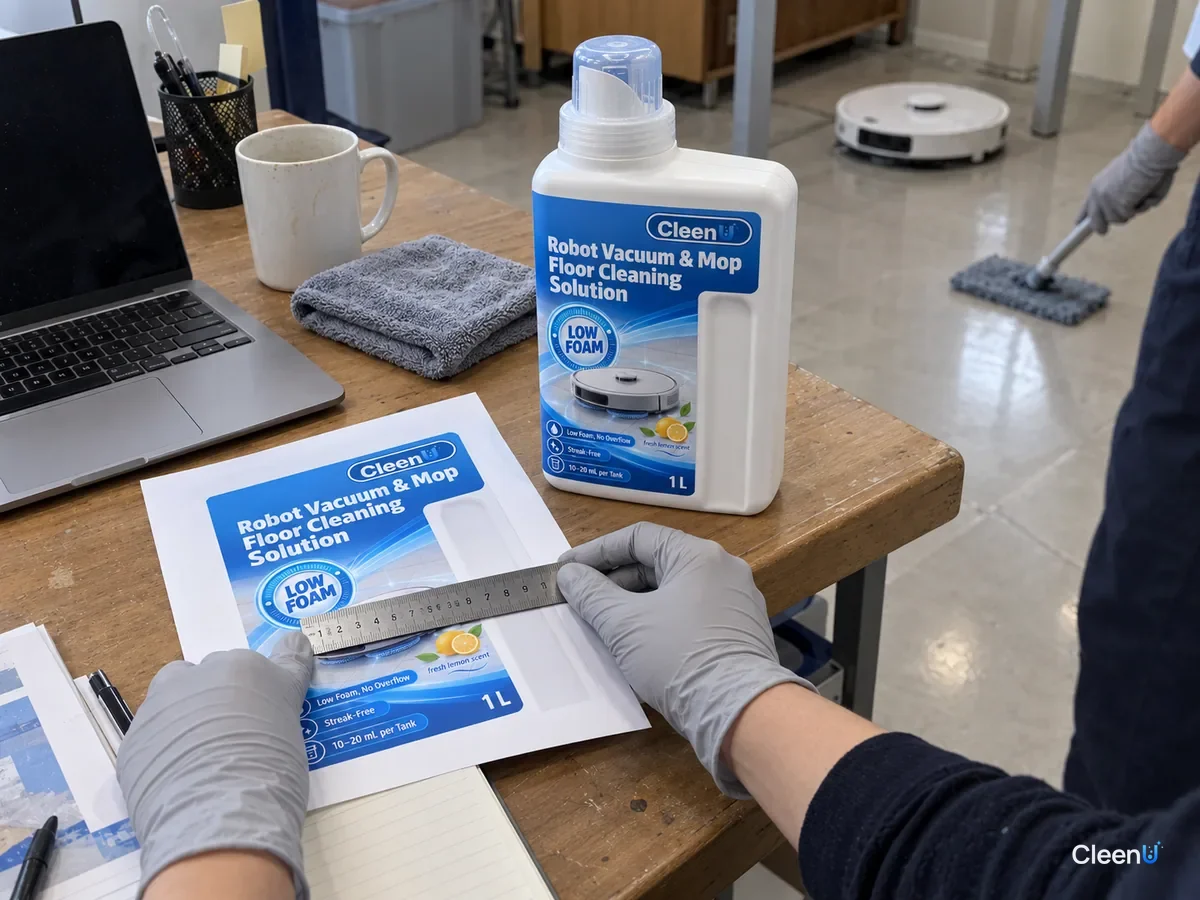
Proof it on the real bottle
Put the label proof on an actual bottle and check that the type is readable, the ratio graphic makes sense and no key warning is covered.
-
File the final version
File the final label with the formula version and test records behind it. When you change the formula or scent later, review the label with it.
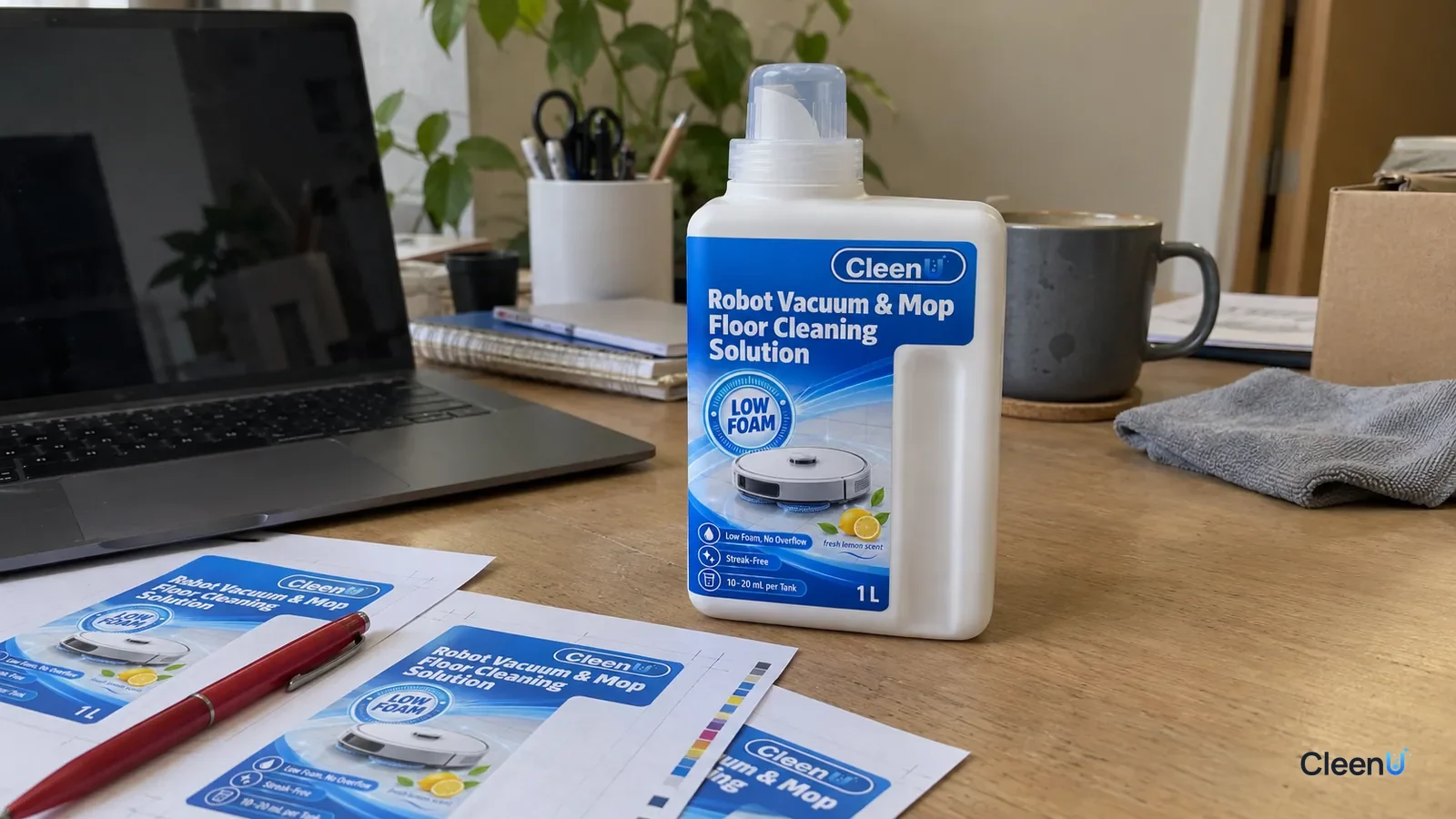
The front of a robot mop cleaning solution bottle usually has room for a dozen words. That's where brands want their strongest selling point, and it's also where most label trouble starts. A germ-kill percentage pulls the product into the rules for disinfectants. A one-size-fits-all compatibility line turns one model's foam alarm or clogged line into a return and a bad review.
A good label doesn't mean a timid one. It puts the space into claims you can back up and that buyers actually care about. Below, we sort the claims that show up most on robot mop solution labels into three groups: fine to print, fine once narrowed, and best left off.
Why robot mop solution labels get into trouble more easily
A regular floor cleaner's label answers for the floor. A robot mop solution's label also answers for a machine. Buyers follow the label ratio into the clean water tank or the dock's detergent compartment, where the liquid runs through a pump, narrow lines and outlet holes, and any foam gets picked up by the full-tank sensor in the dirty tank. A line like "super concentrated, add more for tougher dirt" can lead someone to pour in three or four times the dose, and the result is foam spilling over, false full-tank alerts and sticky floors.
So a robot mop solution label has two jobs: describe the product accurately without overselling it, and spell out correct use so people don't get it wrong. Plenty of complaints trace back not to the formula but to a label that never said how much to add, where to add it or which floors to skip.
Claims you can print with confidence
These describe the formula itself. If the formula really works this way and you have the formula record or test data behind it, print them. They're worth the space.
Low-foam, made for robot mops: the core selling point of the category. Low foam can be backed by the formula (low-foam nonionic surfactants plus a defoamer) and by a foam test.
Neutral, with a pH range: for example, "neutral formula, pH 6.5 to 7.5." A specific range reads as more credible than "gentle," and it's easier for retail channels to review.
Wax-free, chlorine-free, no particles: "free-of" claims must match the formula. Don't claim to be free of anything the formula could contain.
Concentrate and dilution ratio: for example, "concentrate, dilute about 1:50 to 1:100" and "10 to 20 mL per fill." That's both a selling point and the most important line for preventing overdosing.
Floor types: for example, "for tile, vinyl plank, laminate and sealed hardwood." List only floors the formula suits and you've tested.
Scent: lemon, light scent or fragrance-free, as it actually is.
CleenU Robot Vacuum Cleaning Solution is an example. It's a neutral, low-foam concentrate at pH 6.5 to 7.5 with low-foam nonionic surfactants and a defoamer, no wax, no chlorine and no particles. It dilutes at about 1:50 to 1:100, and 10 to 20 mL per fill is usually enough. It comes in a 1 L bottle with a measuring cap and has a 24-month unopened shelf life. All of that can go straight onto a label.
Claims that work once you narrow them
Some selling points point in the right direction but are worded too broadly. A small rewrite makes them safe to use.
A one-size-fits-all compatibility line becomes "Works in most robot mops and floor washers; add to the clean water tank or designated compartment as your manual directs." There are many brands and models, and some manuals forbid adding any solution. Claiming a universal fit isn't true, and it makes a promise the machine maker never made.
"Compatible with Brand X" becomes "Works in most Brand X models," plus a note that you aren't affiliated with that brand. Brand names can describe compatibility, but they can't suggest official approval or a partnership.
"Leaves zero residue" becomes "Low-residue formula; used as directed, it's unlikely to leave streaks." Residue depends on dose, water hardness and water level, so zero can't be promised.
"Removes all stains" becomes "Removes everyday dust, greasy footprints and light soil." Naming the soils it handles is more convincing than "all."
"Worry-free for pets and babies" becomes specific facts and directions, such as "neutral, chlorine-free formula; let floors dry before pets and kids walk on them." Reassurance comes from concrete information, not absolutes.
"Eliminates odors" works only if the formula has an odor-reducing ingredient, such as the cyclodextrin in a pet-home version, and even then "helps reduce everyday pet odors" is the safer line.
Claims to leave off: registered claims and absolutes
Some claims are a problem not because they're exaggerated but because they belong to a regulated category. A cleaner that makes them may be treated as a disinfectant or pesticide product, and an ordinary cleaner doesn't hold that registration.
Kills germs, disinfects, sanitizes, antibacterial, antimicrobial, and any germ-kill percentage: in the U.S., a product that claims to kill or control bacteria or viruses generally needs EPA registration. China manages germ-kill claims under its disinfectant product rules, and the EU has its own biocidal product rules. Even if the formula contains a preservative, the preservative protects the product in the bottle from spoilage. It can't be sold as germ-killing power on the floor. For more on cleaning vs disinfecting, see does robot mop solution disinfect.
Guarantees and superlatives such as "never," "the strongest" or "number one": risky under advertising rules in many markets and likely to be flagged by marketplace review.
"Non-toxic," "all-natural" and "food-grade": leave them off unless you have the basis and any required approvals. Even "plant-based" should be backed by specific ingredients and levels.
Certification marks and test results you don't have: no logo for a certification you haven't earned, and no "lab-tested" without a test.
What the label needs to tell the user
Beyond selling points, a sound robot mop solution label should let the buyer know at least the following.
Product name and purpose: robot mop cleaning solution, for robot mops and floor washers.
Directions: add to the clean water tank or the dock's designated detergent compartment, never the dirty water tank; the dilution ratio and dose per fill, ideally with a simple ratio graphic.
Suitable and unsuitable floors: which floors it's for, and which it isn't, such as unsealed or waxed wood, carpet or natural stone, depending on the formula and testing. Don't use it in machines whose manual forbids adding solution.
Precautions: don't mix with other cleaners or disinfectants, avoid eye contact, keep out of reach of children, and store somewhere cool.
Ingredients or key ingredients, as the target market requires.
Net contents, lot number or manufacture date, shelf life, and the maker's or brand owner's details.
Export products also need the target market's language and labeling requirements, such as hazard labeling, recycling marks and importer details. Check each against current rules for that market before you order.
How CleenU can help
CleenU can supply the technical details a label needs, including formula features, pH range, dilution ratio, suitable floors and where not to use it, and can check the directions and claims on your label against the test conditions you and we agree on. Minimum order is 500 bottles. Free samples ship in 3–5 days, and bulk production is scheduled after packaging and label approval, subject to the formal quote and order confirmation.
Label-ready basics for CleenU Robot Vacuum Cleaning Solution
- Type
- Neutral, low-foam concentrate made for robot mops
- pH
- 6.5 to 7.5 (25°C)
- Formula
- Low-foam nonionic surfactants with a defoamer; no particles, no wax, no chlorine
- Dilution
- About 1:50 to 1:100; 10 to 20 mL per fill is usually enough
- Floors
- Tile, vinyl plank, laminate, sealed hardwood
- Not for
- Machines whose manual forbids adding solution; unsealed or waxed wood; carpet
- Standard pack
- 1 L concentrate with a measuring cap
- Shelf life
- 24 months unopened
How to write claims that still sell
Many brands worry that without germ-kill or works-in-everything claims, the label loses its punch. In practice, robot mop owners care about more specific things: will it foam, will it set off the full-tank alert, will the floor feel sticky, will it hurt the machine, and how long will a bottle last.
Turning those pain points into claims beats a germ-kill number, and it holds up when someone asks follow-up questions:
"Low-foam formula for fewer suds in the dirty tank and fewer false full-tank alerts" answers the most common complaint head-on. For why it matters, see why robot mop solution must be low foam.
"Concentrated, dilutes 1:50 to 1:100, so one bottle makes dozens of liters of working solution" makes the value clear.
"Neutral, wax-free and chlorine-free, so floors feel clean, not sticky" speaks to residue and surface worries.
"Measuring cap included, 10 to 20 mL per fill, no guessing" lowers the odds of overdosing.
Claims written this way are sharp, and they don't leave the brand with compliance or after-sales risk.
Selling on Amazon and other marketplaces
Cross-border marketplaces usually review cleaners more strictly than domestic ecommerce. Listings that claim to kill germs may be asked for registration details, certain ingredients and hazard labels have specific rules, and the platform may ask for an SDS. Listing titles, bullet points and text in images are held to the same standard as the bottle, so an image can't say what the label can't. For details, see selling robot mop solution on Amazon. For the whole private-label process, see why robot mop solution samples keep getting revised.
CleenU Robot Vacuum Cleaning Solution works in most robot mops from Roborock, iRobot (Roomba Combo and Braava), Ecovacs Deebot, Dreame and Narwal, and in floor washers such as Tineco. Add it to the clean water tank or the dock's designated detergent compartment as your manual directs. CleenU isn't affiliated with these brands; the names only indicate compatibility. If your label names compatible brands, keep a note like that on it too.
When you change the formula or scent, review the label
Review it every time. Many brands adjust the scent, add an odor-reducing ingredient or change the pack size after the first production run, and that's when the label drifts from the product. The label still says fragrance-free after a light-scent version replaced it. It still says 1:100 after the concentration changed. The old measuring cap marked 20 mL, and the new cap doesn't.
Treat the label as part of every formula, scent or packaging change. Recheck the claims, directions, ingredients and warnings before you print. It takes little time and can save a whole run of packaging from the scrap bin.
This article is part of the Robot Vacuum Cleaning Solution & Maintenance Guide, which covers the full maintenance schedule and links to every troubleshooting guide.
Common questions about robot mop solution labels and claims
The formula has a preservative. Can I say "antibacterial"?
No. A preservative keeps the product in the bottle from spoiling. It doesn't make the solution antibacterial on the floor, and saying so is a registered claim.
Can I name compatible robot brands on the label?
Yes, as "works in most Brand X models," with a note that you aren't affiliated with those brands. Don't claim a universal fit, and don't use their logos.
What's the difference between "low-residue" and "zero residue"?
Use "low-residue." Residue depends on dose, water hardness and water level, so zero can't be guaranteed and invites complaints.
Can a pet-home version say it removes pet odors?
"Helps reduce everyday pet odors" is the safer line. It's fair if the formula has an odor-reducing ingredient, but don't promise complete removal.
What dilution ratio should the label show?
The ratio set by the formula and testing, plus the dose per fill. For CleenU Robot Vacuum Cleaning Solution, that's about 1:50 to 1:100 and 10 to 20 mL per fill.
Should a U.S. label use the word "sanitizing"?
Leave it off. Sanitizing is a registered claim in the U.S., and an ordinary cleaning solution without EPA registration shouldn't make it.
Shoppers compare our dilution ratio with a competitor's 1:200. What should the label say?
State your own recommended dose and skip the comparison. Concentrations differ, so ratios differ. Printing milliliters per tank, such as about 10–20 mL per 1 L tank, prevents more dosing mistakes than a ratio alone.
To build a private-label solution with clear claims you can back line by line, start from CleenU's neutral, low-foam formula: Robot Vacuum Cleaning Solution.
On a robot mop cleaning solution label, print what the formula and testing can prove: low-foam, neutral with a pH range, wax-free, chlorine-free, the dilution ratio, suitable floors and compatibility with most models of named brands. Narrow any claim that points the right way but says too much. Leave off germ-kill, disinfecting and sanitizing claims, germ-kill percentages and blanket promises about every machine or total safety. The claims that sell come from real pain points: no foam, no false alerts, no sticky floors, no harm to the machine and a clear dose. Put the directions and the where-not-to-use list on the label, and review it whenever the formula or scent changes, so the product sells well and draws fewer complaints.