
Formulation Science
How Long Do Floors Take to Dry After Robot Mopping? Does Cleaning Solution Slow It Down?
Direct answer
With normal airflow and a low-to-medium water setting, a thin, even mop film usually dries in a few minutes to about 15 minutes. Cleaning solution diluted about 1:50 to 1:100 doesn't meaningfully slow drying. Too much solution leaves residue that feels damp.
How a mop film spreads out and dries
- The pad leaves working solution on the floor, and surfactants line up at the water–air surface, lowering surface tension
- The contact angle drops, so water spreads into a continuous thin film instead of beading
- A thin film has a large surface and little depth, so water leaves the whole area at once and dries evenly
- Once the water is gone, a trace of dissolved solids stays behind; at the right dose it's too thin to see or feel
- At too high a dose, the residue is thicker, and moisture-attracting ingredients keep pulling water vapor from the air, so the floor feels tacky and never quite dry
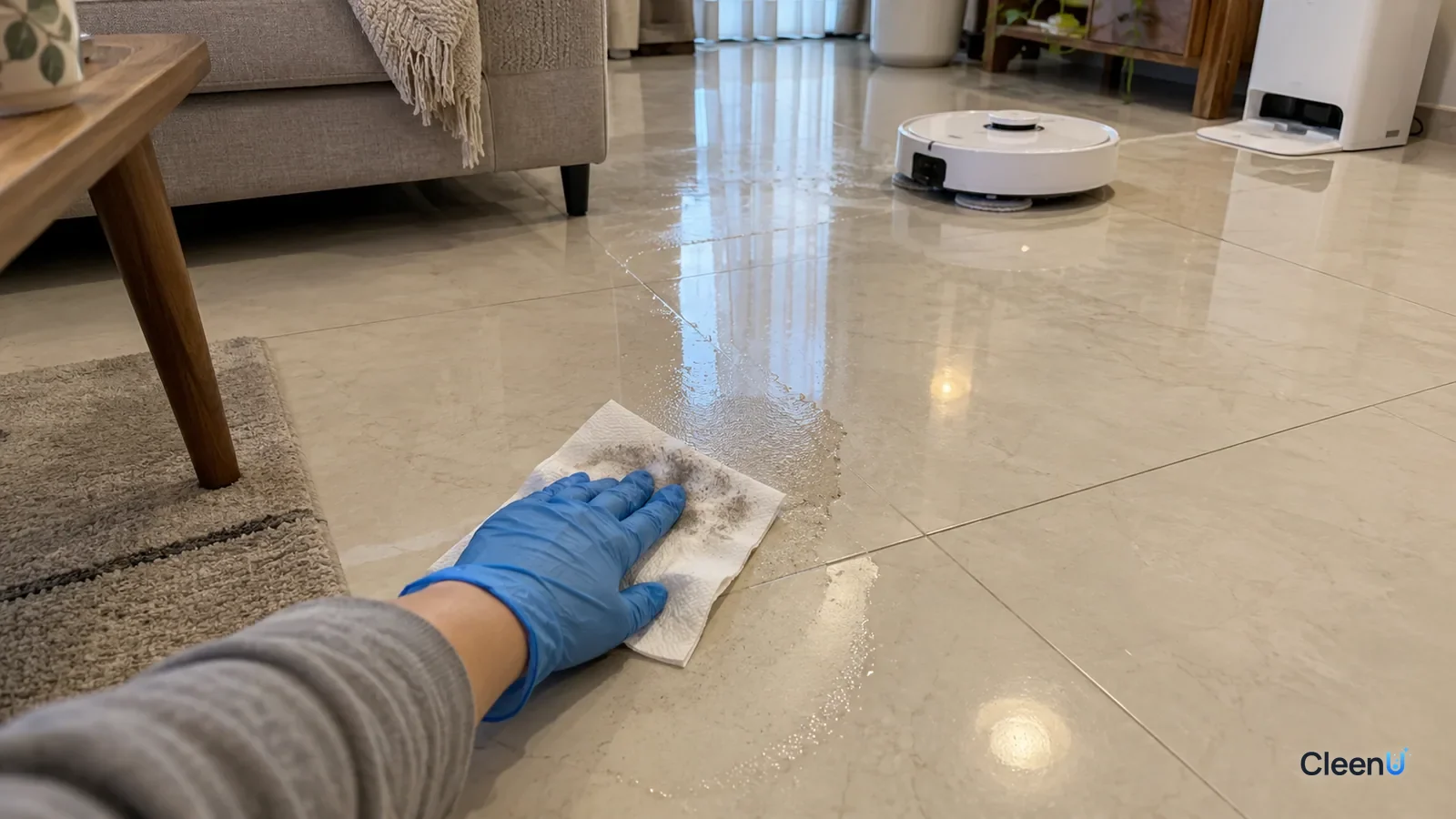
There's no fixed number of minutes, but the pattern is predictable. The less water the robot leaves, and the thinner and more evenly it's spread, the faster the floor dries; warm, dry, moving air speeds it up further. On a normal day with low or medium water flow, polished porcelain or ceramic tile usually loses any visible streak within a few minutes to about a quarter of an hour. On a muggy day, in a closed-up house in winter, or with water flow at max, the same floor can stay damp for half an hour or longer.
As for cleaning solution: at the label ratio it generally doesn't slow drying, and the floor often dries more evenly. A working solution at about 1:50 to 1:100 is roughly 98 to 99 percent water, so water sets the pace. Surfactants help that water spread into a thin, continuous film instead of beads, and a thin film dries all at once. When a floor "never dries," overdosing is the usual cause: the extra residue pulls moisture back from the air, so the floor feels tacky even with no standing water. Below: how water moves through the robot, the chemistry, home checks, and the settings that change drying time.
The robot decides how much water stays on the floor
In most robot mops, water from the clean water tank (or water the dock pumps into the robot) passes through a small pump, which sends it at the flow level you pick in the app to outlets on the underside and onto the pads. The damp pads drag across the floor, leaving some water behind while picking up soil. On self-cleaning docks, the robot returns to wash its pads, and those freshly washed pads head back out already wet.
Four things decide how much water ends up on your floor:
- Water flow setting. Higher settings send more water to the pads. It's the variable you control directly, and it matters most.
- Pad wetness. Pads fresh from a wash cycle are wettest, so the first stretch after the dock is often the wettest floor in the house.
- Pad pressure and style. Spinning pads press hard; roller mops are scraped as they turn. How much water each leaves varies by model.
- Overlapping paths. Edges, doorways, and spots around furniture get passed several times and tend to dry last.
So if you want faster drying, turn down the water flow first, and keep adding solution at the label ratio as usual.
Chemistry, part one: surface tension, and why solution makes a thinner film
A drop of plain water on polished tile sits up as a bead; a drop of diluted cleaning solution flattens out almost at once. The difference is surface tension, the tendency of a liquid's surface to pull itself tight. Water molecules attract each other strongly, so water minimizes its surface area and beads. At room temperature, pure water's surface tension is about 72 mN/m, high for a common liquid, and an invisible film of foot oil or cooking grease makes it bead even more.
Surfactant molecules have a water-loving end and an oil-loving end, and they crowd onto the boundary between water and air. That lowers surface tension; typical cleaning surfactant solutions bring it down to roughly 30 mN/m. The contact angle between liquid and floor shrinks, and instead of beads you get a continuous thin film, which chemists call spreading.
Spreading changes drying in three ways:
- Spread thinner, the same water has less depth to evaporate through, so the whole area finishes at about the same time.
- With no thick droplets, you don't get "everything's dry except these few spots."
- A drying droplet carries dissolved minerals and soil to its edge and leaves a ring, the coffee-ring effect. A thin, even film leaves fewer ring marks.
Do surfactants at the surface act like a lid on evaporation? At cleaning concentrations, barely. What really slows evaporation are insoluble materials like cetyl alcohol, which pack into a tight single-molecule layer and have been used on reservoirs to cut water loss. Cleaning surfactants are soluble and constantly move in and out of the surface, so they don't seal it.
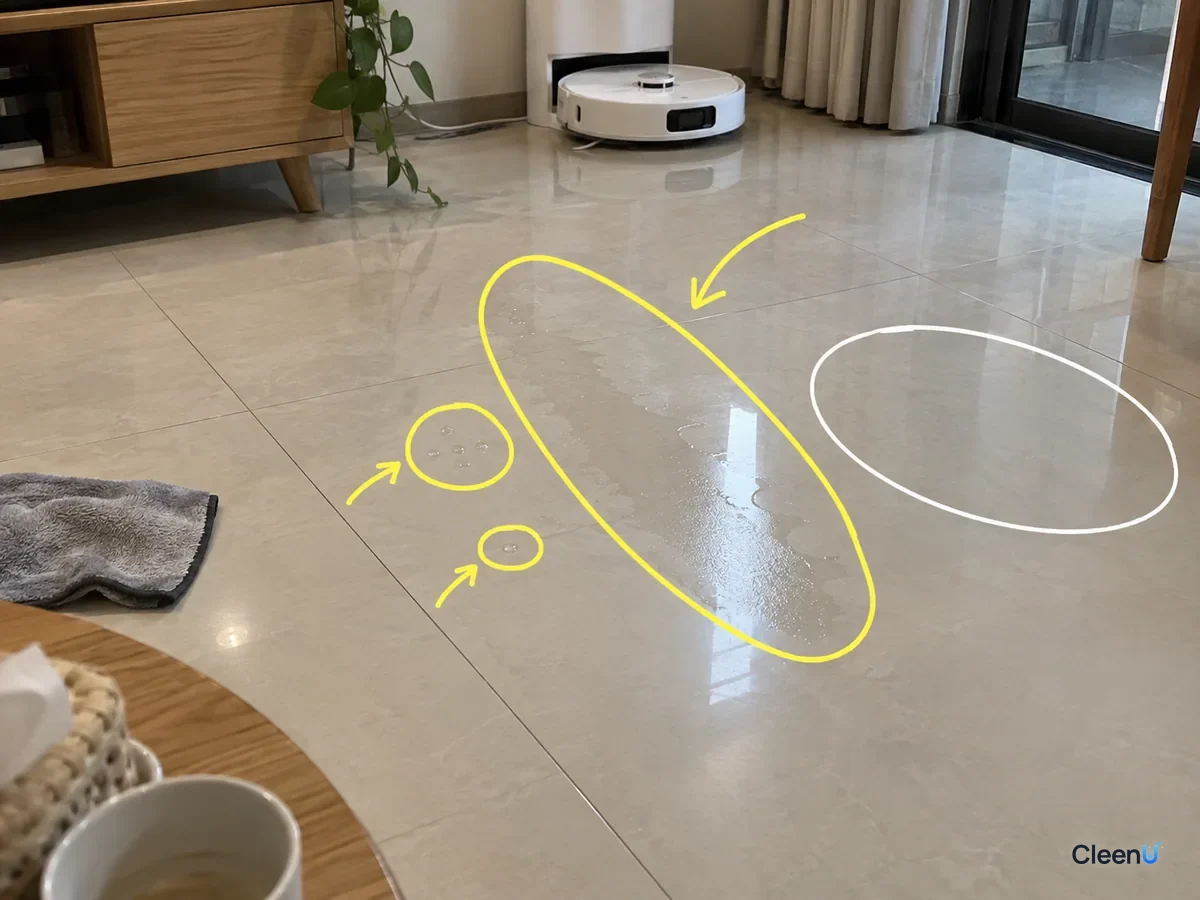
Chemistry, part two: temperature, humidity, and airflow
Drying speed depends on the difference in water vapor between the film's surface and the room, and on whether moving air carries the vapor away.
Terms in this article
- Saturation vapor pressure
- The most water vapor air can hold at a given temperature. It rises with temperature; near room temperature, every 18°F (10°C) increase raises it by roughly 80 percent, which is why floors dry noticeably faster when it's warm.
- Relative humidity
- How much water vapor the air holds compared with its maximum. The closer the air is to full, the harder it is for more water to evaporate into it.
- Boundary layer
- A thin layer of nearly still air right above the floor. Water vapor has to diffuse through it; a breeze or a fan thins it and speeds drying.
- Dew point
- The temperature at which air starts to condense water. If the floor is colder than the air's dew point, moisture condenses onto the floor instead of leaving it.
A rough way to see why humidity matters (a teaching approximation that assumes floor and air are the same temperature): the driving force for evaporation is roughly proportional to one minus the relative humidity. At 50 percent humidity that's 0.5; at 90 percent it's 0.1, about one-fifth as much. A floor that dries in ten minutes on a comfortable day can stay damp for a long time on a sticky one.
Humid weather can also wet floors on its own. When warm, moist air moves over tile or a concrete slab that's still cool, the floor can fall below the air's dew point and water condenses onto it, as in basements or on slab floors in spring. Then the floor isn't drying slowly; it's collecting water, and a mop film only makes it slicker. Run a dehumidifier or the AC and wait until the floor stops sweating, or vacuum only for a day or two.
In winter, indoor air is dry but cool and still, so the boundary layer stays thick and drying slows. Radiant floor heating speeds drying, though wood over radiant heat shouldn't get repeated heavy-water passes.
Tile, laminate, and hardwood dry in different ways
Glazed ceramic and polished porcelain tile absorb essentially no water, so drying comes down to film thickness and the air. Polished porcelain is unforgiving under low-angle light, where even a thin residue shows as haze. Use low-to-medium water flow and the low end of the ratio.
Laminate and finished engineered or solid hardwood have a finish that doesn't absorb water, but the seams are a weak point. Water sitting at a seam is wicked into the core by capillary action, and the core swells, leading to cupping and lifted edges. So the real question is how long water sits in the seams. Use low water flow so the floor dries quickly.
Oiled or waxed wood and natural stone are less sealed. Follow the flooring maker's care instructions, use the lowest water setting, and keep solution at the low end.
For setup details by floor type, see Can you use a robot mop on hardwood floors? and Robot mop settings for tile and vinyl plank.
Does cleaning solution slow drying? It depends on the dose
At about 1:50 to 1:100, cleaning solution is only about 1 to 2 percent of what's in the tank. Its surfactants spread the water thinner, and once the water evaporates, a trace of solids stays behind that, at the right dose, is too thin to see or feel.
Overdosing changes that. Double the dose and you roughly double what's left. Some ingredients are hygroscopic, pulling moisture from the air (glycol solvents, some surfactants, and salts do this). In humid conditions the residue keeps absorbing water, so the floor feels damp and tacky while a pressed paper towel comes up dry. That "fake damp" is residue. Typical signs:
- Bare feet still feel a slight tack or drag long after mopping.
- Polished tile shows a haze under side lighting that gets worse with each run.
- Tackiness is worst on humid days or after someone showers nearby.
If you see these, run one or two passes with plain water to lift the residue, and next time measure with the cap at the low end of the label ratio. For more troubleshooting, see Why your floor feels sticky after robot mopping and How to fix streaks and water marks after robot mopping.
One look-alike has nothing to do with the solution: hard water leaves white, powdery calcium and magnesium marks, most visible on dark floors. See White residue after robot mopping in hard-water areas.
How to tell a floor is dry, and whether solution makes a difference
Don't go by the clock. Use these three checks:
- Paper towel press. Lay a dry paper towel on the mopped area for a few seconds. No damp spot means the surface water is gone.
- Back of the hand or a sock. Cool but not wet is normal; tacky means residue.
- Low-angle light. Shine a phone flashlight across the floor. Wet edges and haze show up; a dry floor has an even sheen.
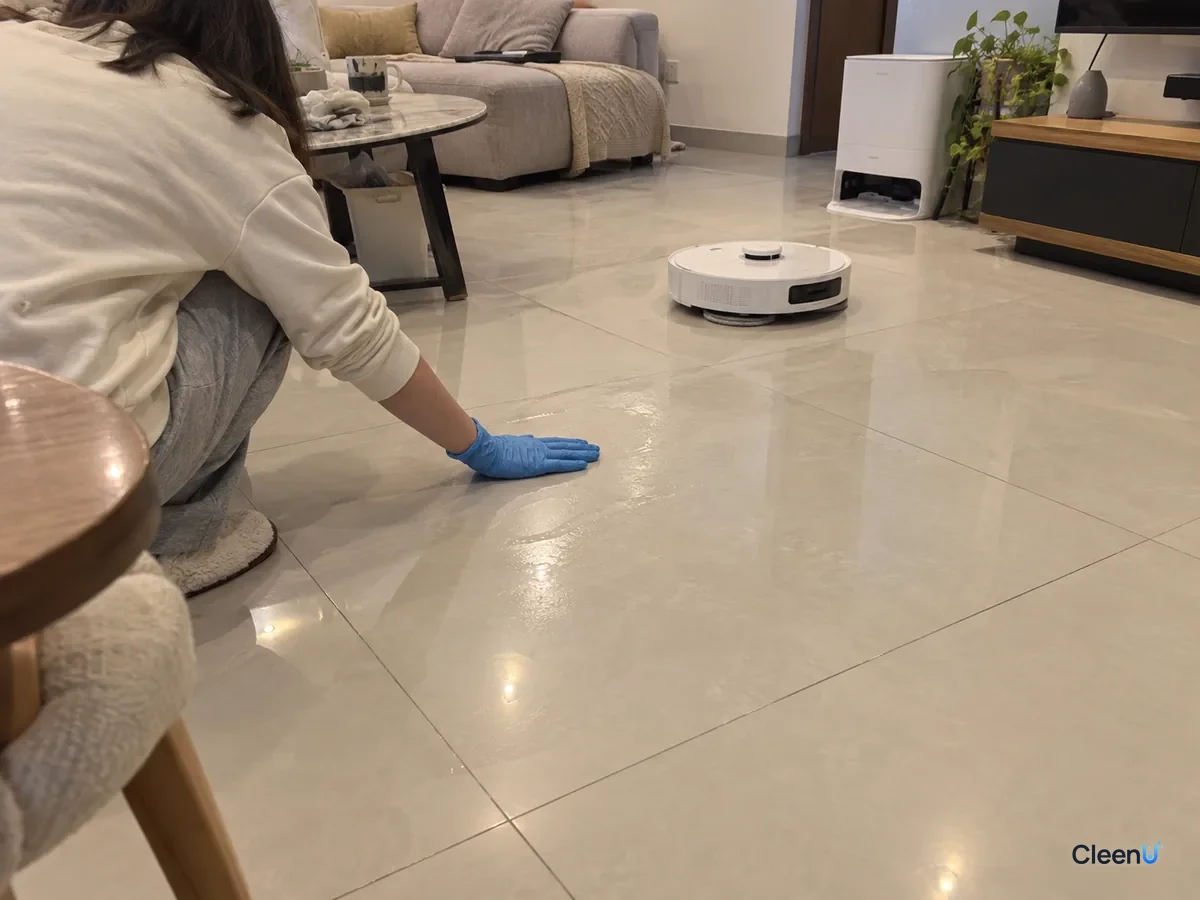
To see whether solution slows drying on your floors, run a side-by-side. Pick two similar areas in the same room. On the same day and water setting, mop one with plain water and the other with solution at the label ratio. Start a timer, press a paper towel on each every few minutes, note when each is dry, then check both under side lighting. Same time and no tack on the solution side means your dose is fine; slower and tacky means remeasure with the cap at the low end of the label ratio.
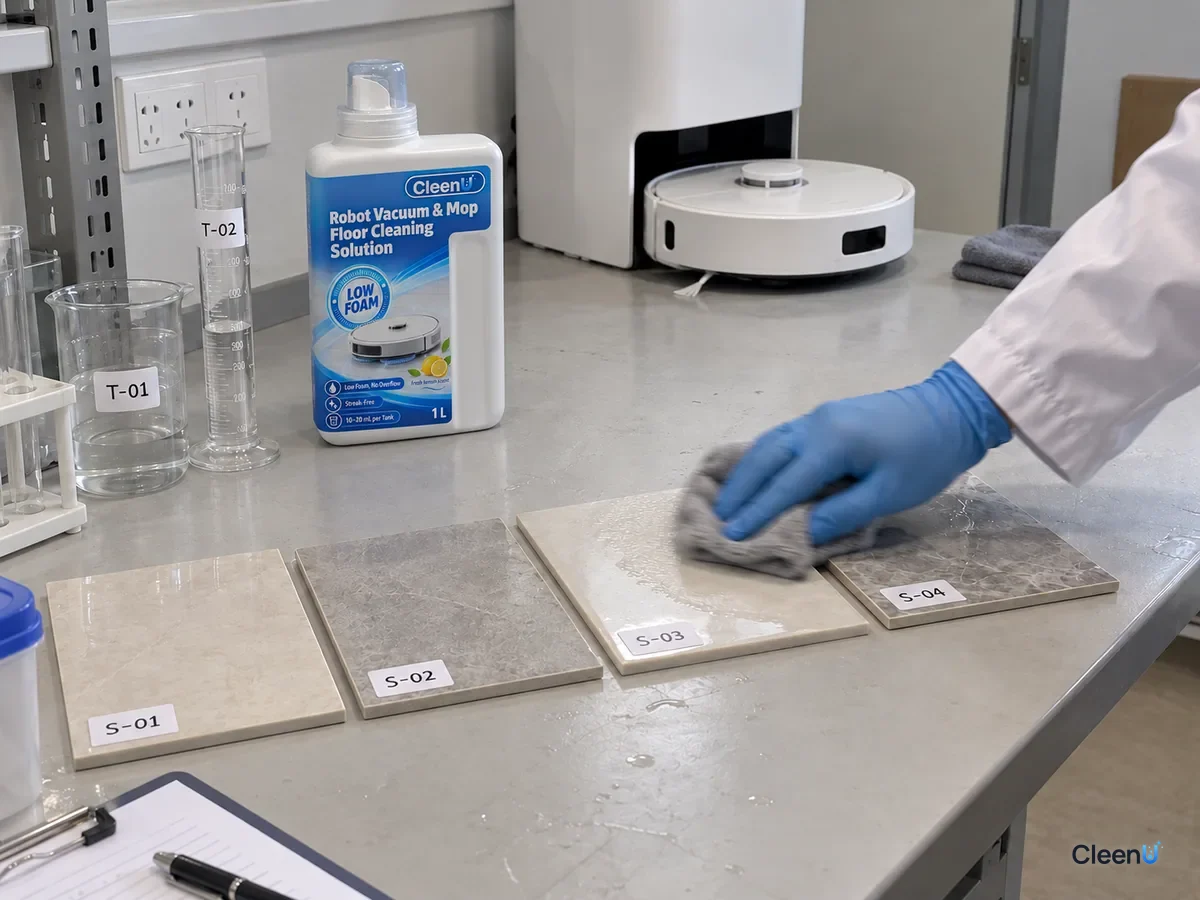
CleenU as an example: a formula built to leave less behind
CleenU Robot Mop Cleaning Solution is a neutral concentrate, pH 6.5–7.5 as a concentrate. It's built on low-foam nonionic surfactants with a defoamer, contains no wax, chlorine, particles, solvents, or optical brighteners, and has no disinfecting ingredients such as quats or phenols. For drying, two points matter. Low foam means the pads leave a liquid film, not a bubbly layer that dries into spots. No wax means no shine coat; at the right dose, when the water is gone, the floor is simply dry.
Each 1 L (about 34 oz) bottle comes with a measuring cap and dilutes about 1:50 to 1:100; 10 to 20 mL per fill is usually enough, so one bottle covers roughly 50 to 100 fills. The standard version has a lemon scent; the Pet Homes version is fragrance-free.
If you want a low-foam, neutral solution that dries without a tacky film at the label dose, take a look at our Robot Vacuum Cleaning Solution.
It works with most models from Roborock, iRobot Roomba Combo and Braava, Ecovacs Deebot, Dreame, Shark HydroVac, and Eufy RoboVac, and with most Tineco and Bissell CrossWave wet-dry vacuums. On Narwal robots, add it to the clean water tank. Follow your manual for where it goes; if your model's manual says otherwise, follow the manual. CleenU is not affiliated with these brands; names are used only to describe compatibility.
Adjusting for floors, weather, and heat
Water flow and solution settings by situation
- Everyday mopping, polished or ceramic tile
- Low to medium water flow; solution at about 1:50 to 1:100, low end for routine runs
- Wood floors (laminate, engineered, finished solid)
- Lowest or low water flow; solution at the low end; no water left sitting in seams
- Oiled or waxed wood, natural stone
- Lowest water flow, per the flooring maker; solution at the low end
- Humid day, floor sweating on its own
- Dehumidify first and mop once the floor stops collecting water, or vacuum only
- Winter, house closed up
- Drop the water flow one level; crack a window or run a fan while mopping
- Radiant floor heating on
- Floors dry faster; keep wood floors on low water and avoid repeated wet passes
- Greasy kitchen footprints
- Use the high end of the ratio or run a second pass instead of doubling the dose
A few habits help:
- Vacuum before mopping, or use a combined mode, so particles don't clog the pads.
- Let the dock finish drying the pads; drier pads leave less water next run.
- If your entryway always dries last, start the mopping route in a room you don't walk through.
For more on seasonal settings, see Robot mop settings for humid weather and Robot mopping over radiant floor heating.
Babies, pets, and when to walk on the floor
The immediate risk of a wet floor is slipping, especially for older adults, toddlers, and dogs sprinting across polished tile. Wait until the floor is fully dry, confirmed with a paper towel or the back of your hand. If a baby crawls or a pet licks the floor, dilute at the low end and run a plain-water pass over play areas if you're unsure; keep kids and pets in another room while the robot mops. See Robot mopping with a baby in the house and What to do if your dog licks the floor after mopping.
Pause mopping and check if you see any of these
Pause if the floor stays tacky or draggy long after mopping while a pressed paper towel comes up dry; polished tile or wood shows a haze that keeps building and doesn't clear with a water-only pass; wood seams turn whitish, cup, or lift; the floor is sweating on its own in humid weather and mopping makes it slicker; or anyone's skin turns red or itchy after contact, or there's a harsh smell. For tackiness or haze, run one or two water-only passes, then check your dose and mix at the low end of the label ratio. For swelling wood, stop wet mopping and contact the flooring maker. In humid weather, dehumidify before mopping. For skin irritation or harsh odors, pause mopping, ventilate, and check with a doctor if needed.
Drying time after robot mopping: common questions
How long does a floor take to dry after a robot mop?
Expect a few minutes to about 15 minutes with normal airflow and low-to-medium water flow. Humid weather, a closed-up house, or max water flow slows it down, so check with a paper towel instead of the clock.
Does cleaning solution make floors dry slower than plain water?
Not at the label ratio of about 1:50 to 1:100. Surfactants spread the water thinner, so the floor dries more evenly. Only an overdose leaves moisture-grabbing residue that feels damp.
Why does my floor feel damp when a paper towel comes up dry?
That's residue, not water. Too much solution leaves a film that pulls moisture from the air and feels damp or tacky. Run a water-only pass or two, and mix at the low end of the label ratio next time.
What's the first thing to change if my floors dry too slowly?
Turn down the water flow. How much water the robot leaves matters most. After that, improve airflow with an open window or a fan, and keep solution at the label ratio.
Should I robot mop on very humid days?
Not while the floor is collecting moisture. Run a dehumidifier or AC first, then mop on the lowest water setting once the floor stops sweating, or vacuum only for a day or two.
How fast should a wood floor dry after mopping?
As fast as possible, and no water should sit in the seams. Use low water flow and solution at the low end. If seams turn whitish or edges lift, stop wet mopping.
Why do doorways and corners always dry last?
The robot passes those spots several times, and pads are wettest right after a wash cycle. Schedule high-traffic areas last or lower the water flow there.
Why are there ring-shaped marks after the floor dries?
Those form when droplets dry and carry soil and minerals to their edges. Lower the water flow and use solution at the label ratio so the film spreads evenly. White, chalky marks usually point to hard water.
How long should kids and pets wait before walking on a mopped floor?
Until it's fully dry, confirmed with a paper towel or the back of your hand. Dilute at the low end, and run a water-only pass over play areas if you're unsure.
Will more solution clean better and dry faster?
No. Past a certain concentration, cleaning barely improves while residue and foam keep rising, so the floor turns tacky or hazy. Stick to the label dose, and run a second pass on dirty floors.
For more on dosing, see How much cleaning solution should you put in a robot mop? If wood floors look cloudy after mopping, see Why wood floors look hazy after robot mopping.
How fast a floor dries after robot mopping comes down to how much water the robot leaves, how evenly it spreads, and the temperature, humidity, and airflow in the room. To speed it up, lower the water flow first, then open a window, run a fan, or dehumidify. Cleaning solution at about 1:50 to 1:100 spreads the film thinner and doesn't meaningfully slow drying. If the floor feels damp while a paper towel comes up dry, it's overdose residue: run a plain-water pass and go back to the label ratio. Watch the seams on wood floors, dehumidify before mopping on sticky days, and let kids and pets back in once the floor is fully dry.