
Formulation Science
Homemade Robot Mop Solution: Do DIY Recipes Hold Up?
Direct answer
The popular mixes, vinegar plus dish soap, alcohol plus essential oils, baking soda water, and fermented citrus cleaner, create new problems once combined: foam, oily separation, crystals, and spoilage. Plain water is the safest substitute; for grease, use a low-foam, neutral robot mop solution.
What happens when vinegar meets soap-based cleaner
- Soap sits in water as fatty acid salts with one water-loving and one oil-loving end, able to hold grease
- Acetic acid in vinegar releases hydrogen ions that pair with the soap's carboxylate heads
- The soap reverts to free fatty acid, loses its water-loving head, and drops out of solution
- The mix clouds, oily film or curds form, and degreasing power falls
- Separated fatty acid sticks to the filter, tubing, and outlets, then dries on the floor as tacky film
- In hard water, calcium and magnesium bind the remaining soap into soap scum
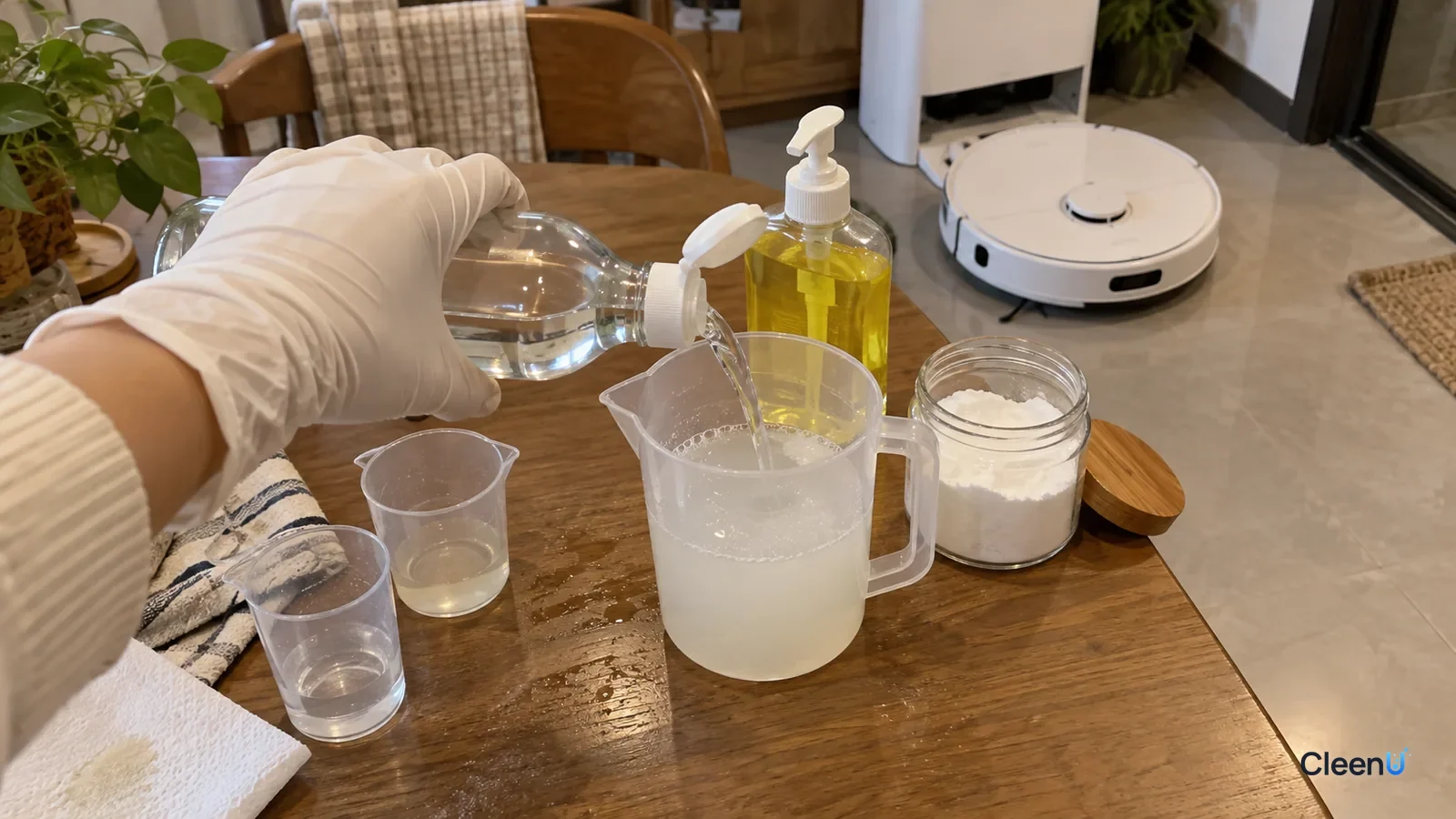
Search for a homemade robot mop solution and the same recipes come up. Vinegar and dish soap, pitched as degreaser and descaler in one. Alcohol, dish soap, and a few drops of essential oil for a fresh scent. Baking soda in water, or baking soda plus vinegar. And fermented citrus-peel cleaner, the DIY "enzyme" cleaner. The logic is to stack each ingredient's benefits, but chemistry doesn't add up that way. Ingredients react and cancel each other, and inside a robot mop's long, narrow, warm-then-cool water path they create problems none would cause alone.
The bottom line: we don't recommend putting any of these mixes in a robot mop. Plain water is the safest substitute and handles everyday dust. For kitchen grease or paw prints, a low-foam, neutral robot mop solution dosed by ratio goes a long way. Single ingredients on their own are covered in separate articles; this one is about mixing them.
The popular recipes, and what actually happens
What each DIY recipe promises vs. what the mix actually does
- Vinegar + dish soap
- Soap-based cleaners turn into insoluble greasy film; synthetic dish soap still foams, now with added acid
- Baking soda + vinegar
- The fizz is neutralization; both are used up, leaving dilute salt water
- Baking soda + water
- Undissolved grains hit the filter, and dissolved soda crusts at the outlets as water dries
- Alcohol + dish soap + essential oil
- Once diluted in the tank, the oil separates into a film that touches seals and tubing
- Fermented citrus "enzyme" cleaner
- Leftover sugar, organic acids, and live microbes go into the tank: sour smells, sticky floors
- Bleach + vinegar (the "extra-strength" hack)
- Releases chlorine gas; never mix
Each row gets its explanation below. First, the route a homemade mix travels.
Where a homemade mix goes inside a robot mop
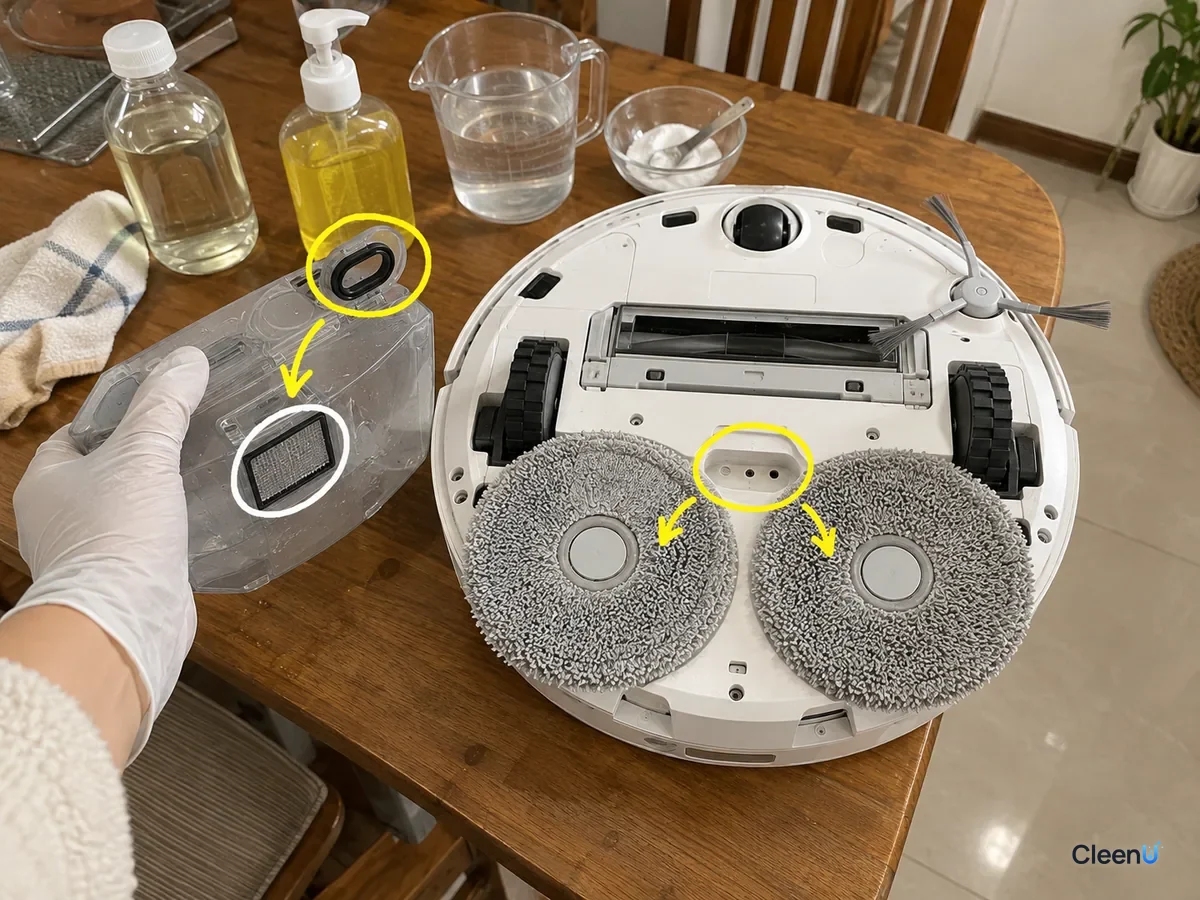
A robot mop's water system isn't an open bucket. After you pour a DIY mix into the clean water tank, it passes through:
- Clean water tank. Dock tanks are often filled once and used for days, so liquid sits at room temperature, sometimes warmer.
- Filter screen. A fine screen at the tank outlet or before the pump is the first thing grains and flakes clog.
- Pump and tubing. Pump valves, gaskets, and silicone or rubber lines soak in whatever you add.
- Outlet holes and mop pads. Tiny drip holes cycle between wet and dry, which is where crystals and scale form first.
- Dock wash tray and dirty tank. Pads get pressed and rinsed; some docks wash with hot water and dry with warm air, which concentrates residue.
- Auto-dosing compartment. Some docks hold concentrate for weeks in a separate compartment with narrow fittings.
The path is narrow, so particles clog it; contact is long, so rubber and plastic problems surface over time; and repeated temperature and wet-dry cycles make anything unstable crystallize, separate, or ferment. What's harmless in a mop bucket gets amplified here.
Vinegar plus dish soap: acid meets soap and the degreasing half disappears
The idea is that vinegar descales and dish soap degreases. What actually happens depends on the kind of dish soap.
Most mainstream dish soaps use synthetic anionic surfactants such as sodium alkylbenzene sulfonate and sodium laureth sulfate. Their sulfonate or sulfate heads aren't neutralized by a weak acid like vinegar, so the mix still foams. The claim that "vinegar cuts the suds" mostly doesn't apply here. You keep the foam a robot mop hates and add acid on top. For vinegar's own effects on metal, rubber, and stone, see can you put vinegar or bleach in a robot mop tank. For dish soap's foam problem alone, see can you put dish soap in a robot mop.
The other kind is true soap: bar soap dissolved in water, liquid castile soap, and some "plant-based soap" dish liquids. Chemically, soap is the sodium or potassium salt of a fatty acid, with a carboxylate head. Add vinegar and the acetic acid's hydrogen ions convert that carboxylate back into free fatty acid. Free fatty acid doesn't dissolve in water. It's essentially an oil. The mix turns cloudy, oily droplets float up, or white curds form. The soap that was supposed to remove grease becomes grease, coating the tank wall, the filter, and the lines, then landing on the floor as a dull, tacky film.
Hard water adds a third reaction. Calcium and magnesium bind with the remaining soap to form calcium soap, the same stuff as bathtub soap scum. Castile-and-vinegar recipes in hard-water areas end up stacking two kinds of residue.
Either way, the promise fails. Synthetic dish soap keeps the foam problem. Soap-based cleaner gets turned into the grease you were trying to remove.
Baking soda, and baking soda plus vinegar: fizz isn't cleaning
The baking soda and vinegar volcano is a simple neutralization: sodium bicarbonate and acetic acid form sodium acetate, water, and carbon dioxide, and the bubbles are CO2. Afterward, the vinegar's acidity and the baking soda's mild alkalinity are both gone. Dilute sodium acetate cleans about as well as weak salt water, and the fizz doesn't lift grease. Never mix it in a capped bottle; the gas can pop the cap and spray.
Baking soda alone has a solubility problem. It dissolves only so much, and slowly in cold water, so "a spoonful in a bottle" leaves grains that reach the filter and pump. The dissolved part recrystallizes around the drip holes as water evaporates between runs, forming a hard white crust that shrinks the holes until pads come out drier. Dark tile and wood can dry with a white haze.
In docks that wash pads with hot water, heat converts some bicarbonate to carbonate, which pairs with calcium in tap water to form calcium carbonate, the main component of limescale. The heater and lines scale faster.
Xiaomi's global support FAQs for some robot models do list baking soda water as a light odor-control option, but at a set dilution, no more than once a month, and "for reference only." Even there it's an occasional workaround, not an everyday formula.
Alcohol, dish soap, and essential oil: dilution makes the oil come back out
In a spray bottle this one is clear and smells great. Essential oils don't dissolve in water, so alcohol acts as a co-solvent and dish soap as an emulsifier. The trouble starts when you dilute it into a tank holding a liter or more.
Diluted dozens to hundreds of times, the alcohol and soap can't hold the oil. It separates into tiny droplets, the water turns milky, and a film floats on top. This is the ouzo effect, the same thing that clouds anise liqueur when you add water. The oil floats, clings to the tank wall, touches the lid gasket, and coats the tubing.
Essential oils are mostly terpenes, such as limonene in citrus oils, and terpenes are organic solvents. Rubber gaskets with long exposure usually swell and soften, and some plastics can crack under stress, a failure called environmental stress cracking. It tends to surface weeks later as leaks or uneven flow.
Alcohol doesn't help either. Diluted, it barely cleans and can't preserve the mix; at high strength it's flammable and doesn't belong in a dock with heaters and electronics. It also knocks down foam, so the mix looks fine at first.
If you have cats, there's one more consideration. The Merck Veterinary Manual notes that cats lack a liver enzyme, glucuronyl transferase, which makes them more sensitive to phenols and certain essential oils. Pet Poison Helpline lists essential oils linked to cat poisonings, including citrus oil, tea tree, eucalyptus, and peppermint. The ASPCA says risk depends on concentration and use, and that pets can be affected by stepping in oil or getting it on their fur. A robot mop spreads a thin oil film across every floor, and a cat walks through it and then grooms its paws, which is exactly that kind of exposure. If a pet drools, wobbles, or seems lethargic after contact, call your veterinarian or the ASPCA Animal Poison Control Center at (888) 426-4435 or Pet Poison Helpline at (855) 764-7661 (fees may apply). For essential oils on their own, see can you put essential oils in a robot mop.
Fermented citrus "enzyme" cleaner is a ferment, not an enzyme cleaner
The DIY version is citrus peels, sugar, and water fermented in a jar for weeks or months. Many people assume it equals a store-bought enzyme cleaner. By definition, it doesn't.
The jar holds a fermentation broth: acetic and lactic acids, leftover sugar, a little alcohol, live yeast and bacteria, and peel bits. It may contain some enzymes, but which, how much, and whether they act on floor soil is unknown and varies jar to jar. Commercial enzyme cleaners use specific purified enzymes, such as protease for protein stains and lipase for fats, with stabilizers and a checked pH range. It's home brew versus a beverage bottled to spec.
In a robot mop, sugar and microbes cause the trouble. Sugar dries sticky on floors and feeds microbes in the tank, which can sour within days and grow slimy film in the tubing. Peel bits clog the filter, and the acids bring vinegar's material concerns. For pet urine or vomit, spot-treat by hand with a labeled commercial enzyme cleaner rather than sending a robot over it.
The one you should never mix: bleach plus acid
Some posts suggest "boosting" disinfection by combining bleach with vinegar or with an acidic toilet bowl cleaner. That's dangerous. The Tennessee Poison Center explains that bleach mixed with acids such as vinegar releases chlorine gas, and bleach mixed with ammonia, including urine, forms chloramine gas, both of which irritate the eyes and airways. Never combine chlorine products with acids or ammonia, whether you're mopping or cleaning the machine. If it happens, open windows, leave the area, and call Poison Help at 800-222-1222 or seek medical care if coughing or breathing trouble persists.
Four variables you can't control at home
Even if you avoid every chemical conflict above, four variables are nearly impossible to control in a kitchen.
Concentration. Vinegar acidity and dish soap active content vary widely by brand, so "a capful" or "a few drops" can mean several times more or less active ingredient. A robot mop never rinses afterward, so a slightly high dose builds residue day after day.
Water hardness. Soap plus hard water makes soap scum, and baking soda plus hot water feeds scale. The same recipe behaves differently in Phoenix than in Seattle.
Foam. Robot mop solutions include a defoamer to keep foam within what the machine tolerates. DIY recipes skip that step, and every stage, from pad vibration to dock rinsing to dirty-water suction, whips up foam. Why low foam doesn't mean weaker cleaning is covered in does low-foam mean weaker cleaning.
Preservation. This is the one people miss. Dish soap contains a preservative system, but diluted a hundredfold in the tank, it's far below effective levels. Diluted vinegar isn't acidic enough to hold microbes back, and sugar-based ferments actively feed them. A dedicated solution can sit in a tank because its preservative system is designed and verified for diluted use with repeated dirty-water contact. More on that in why robot mop solutions need preservatives; to tell whether an older bottle is still good, see robot mop solution that has changed color or separated.
Terms in this article
- Fatty acid soap
- The active ingredient in bar soap and castile soap, a sodium or potassium salt of a fatty acid; acid turns it back into insoluble fatty acid, and hard water turns it into soap scum.
- Ouzo effect
- When oil dissolved in alcohol is diluted with lots of water, it spontaneously separates into fine droplets and clouds the liquid.
- Environmental stress cracking
- Fine cracks that form in plastic parts under stress when exposed to certain chemicals, often appearing only after weeks of use.
- Preservative challenge test
- A test that inoculates a product with bacteria and mold and checks whether microbial counts stay under control over time, verifying the preservative system works.
Five quick experiments you can run at home
Jar test. Mix your recipe at the ratio you'd use, pour it into a clear jar, and leave it 24 to 48 hours at room temperature. Layers, oily spots, sediment, cloudiness, or a sour smell will happen in your tank too.
Soap and vinegar test. Add a splash of vinegar to castile soap water and stir. It clouds within moments, with oily droplets or white curds.
Shake test. Add the recipe to 500 mL (about 17 fl oz) of water in a clear bottle, shake 10 times, and compare foam height and collapse speed against plain water.
Dark surface test. Wipe baking soda water on dark tile or a mirror next to a plain-water patch, let both dry, and look for white haze.
Gasket soak. Soak a spare rubber O-ring in the essential oil mix for a few days and check whether it softens, grows, or turns tacky. It's rough, but it shows the trend.
How a dedicated solution pins down those same variables
The hard part of DIY is the variables. A dedicated formula fixes each one in advance: low-foam nonionic surfactants with a defoamer keep foam within what the machine can handle; chelating agents tie up calcium and magnesium so hard water doesn't leave a white film; the preservative system is designed for diluted solution that keeps meeting dirty water; and the label gives a clear dilution ratio, so strength isn't guesswork. That's how a dedicated solution answers the questions a DIY recipe can't: will foam fill the dirty tank, will residue build up, and will the tank stay fresh for a few days.
What actually works as a substitute
Plain water is the cheapest and safest substitute. Dust, hair, and light footprints come up fine with water and a clean pad; for when solution is worth adding, see is plain water enough for robot mopping. Kitchen grease, paw prints, and dingy floors are where a cleaning solution helps, and that's where a dedicated formula's advantage is having those four variables already controlled. If you're tempted to reach for the floor cleaner under the sink instead, here's why regular floor cleaner doesn't belong in a robot mop. For what to look for in a dedicated solution, see how to choose a robot mop cleaning solution; for whether to add one at all, where it goes and how much, start with the robot mop cleaning solution guide.
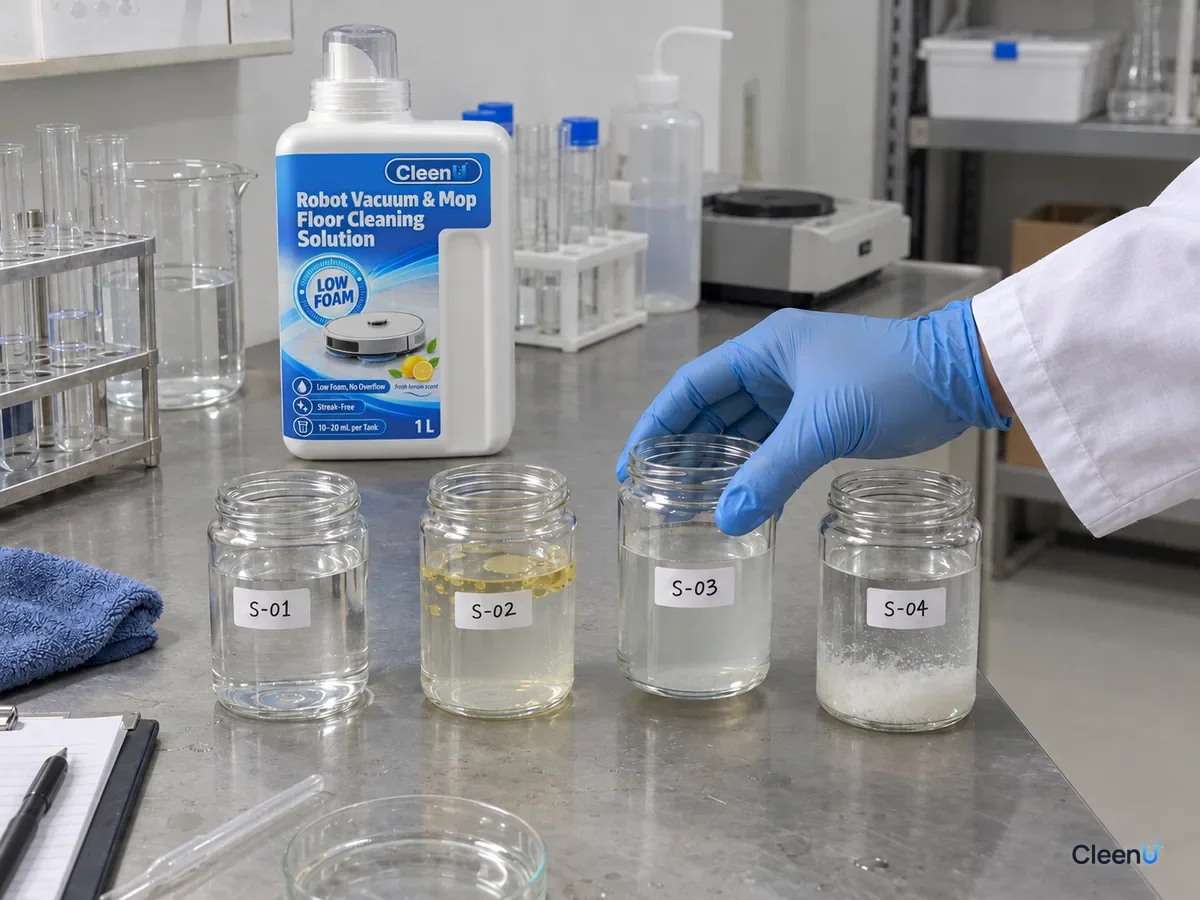
CleenU Robot Vacuum & Mop Floor Cleaning Solution is a neutral concentrate, pH 6.5 to 7.5, built on low-foam nonionic surfactants with a defoamer. It has no particles, no wax, and no chlorine, and it's solvent-free with no optical brighteners. The standard version is lemon-scented, and a fragrance-free pet formula is available. It dilutes at about 1:50 to 1:100; 10 to 20 mL per fill is usually enough, or 10 to 20 mL (2 to 4 tsp) per liter of water. Each 1 L bottle covers about 50 to 100 fills and keeps 24 months unopened. Add it to the clean water tank or the dock's designated dosing compartment, never the dirty tank. It works in most models of Roborock, iRobot (Roomba Combo and Braava), Ecovacs Deebot, Dreame, Narwal, Eufy RoboVac and Xiaomi robot mops, plus Tineco, Shark HydroVac and Bissell CrossWave wet-dry vacuums. Add it where the manual says, either the clean water tank or the dock's designated compartment; Narwal's auto-dosing box is a sealed cartridge, so add it to the clean water tank instead. If your model's manual says otherwise, follow the manual. CleenU is not affiliated with these brands; names are used only to describe compatibility.
If you're done mixing your own, take a look at our low-foam, neutral concentrate: Robot Vacuum & Mop Floor Cleaning Solution.
Already used a DIY mix? How to flush the machine
After a homemade mix, clean up in this order
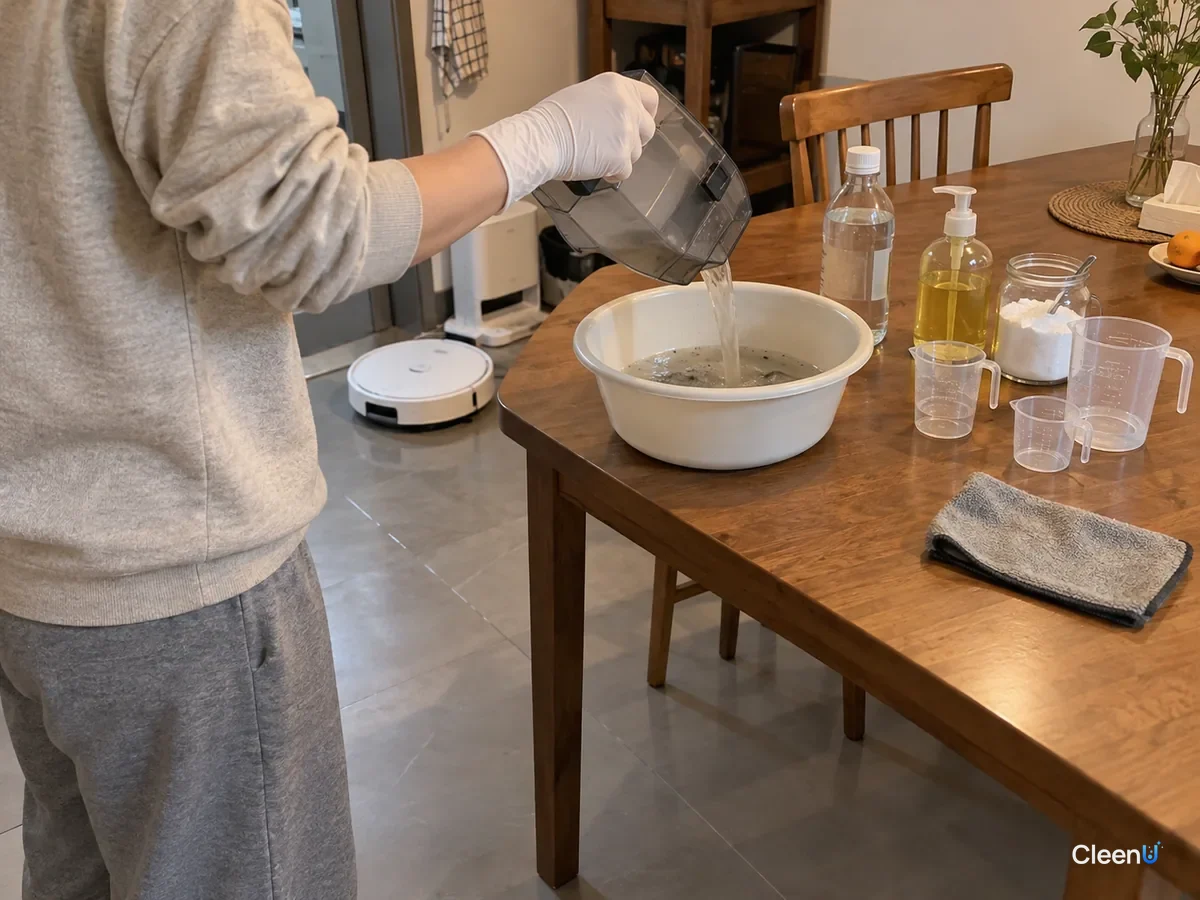
- Dump the leftover mix and rinse the clean tank two or three times; wipe oily film off the walls and lid gasket with a soft cloth
- Remove the outlet filter and rinse it; soak crusted screens in warm water first
- Fill the tank with plain water and run a mopping or dock rinse cycle to flush the lines
- If your dock has an auto-dosing compartment, empty it, rinse it, and let it dry; don't leave DIY mix inside
- Wash the mop pads separately and scrub the wash tray and dirty tank
- Mop the floor once or twice with plain water to lift any residue film
- When you switch back to a dedicated solution, rinse the clean tank and any dosing compartment first, and don't mix products
- Over the next few days, watch for uneven water flow or seepage at the gaskets
Stop and contact support if you see any of these
No water or noticeably less water after flushing; seepage around the tank lid, fittings, or base; gaskets that look deformed, tacky, or cracked; pump or water-system error codes; or an unusual smell when the dock heats or dries. These can mean the pump, tubing, or seals are already damaged, and continued use or DIY disassembly can make it worse. Contact the brand's support with proof of purchase and be upfront about what went in the tank.
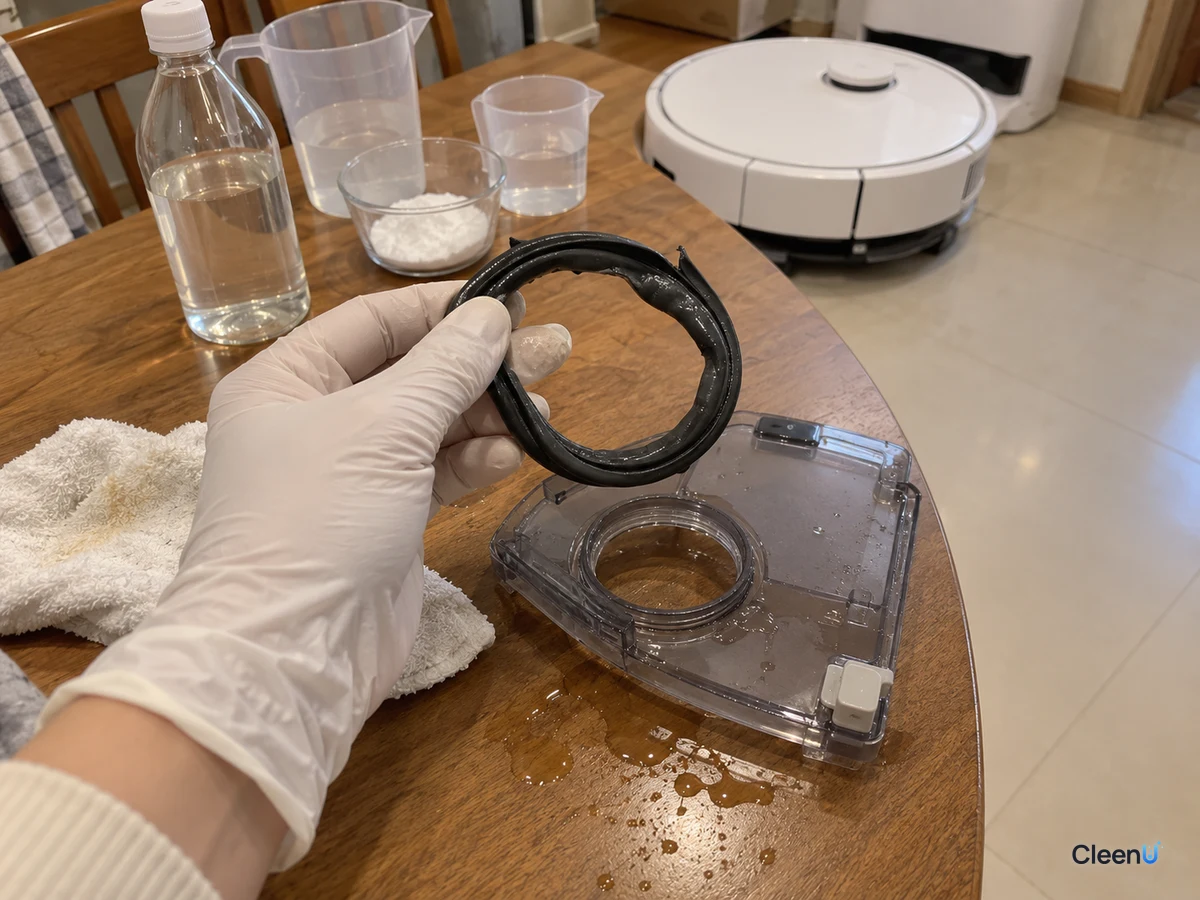
Once the machine is flushed, three daily habits keep the water path clean: mix solution fresh and use it the same day, empty and air-dry the dirty tank after every run, and scrub the filter and wash tray weekly. Rinse before switching brands, too; here's why mixing robot mop solutions is a bad idea. This guide is part of our Robot Vacuum Cleaning Solution & Maintenance Guide, which covers the full care schedule for tanks, dock and pads, plus troubleshooting for other problems.
Used a DIY recipe and something's off? Check in this order
Matching symptoms to the most likely cause:
- White crust on the drip holes or filter, pads getting drier: usually baking soda crystals or limescale. Soften with warm water and rinse.
- Tacky, dull floors: fatty acid from soap plus vinegar, soap scum, or sugar from a ferment. Mop with plain water a few times.
- Dirty tank "full" alerts but it's all foam: dish soap with no defoamer. Empty, rinse, and switch to water.
- Sour or rotten smell from the clean tank, slimy tubing: no preservation, or a sugar-based ferment. Flush thoroughly and air-dry; if a musty smell keeps coming back, see robot vacuum clean water tank smells musty.
- Lid seepage or erratic flow: essential oils or alcohol may have swollen a gasket. Stop using it and contact support if it continues.
Is DIY really cheaper?
Homemade mixes look nearly free, but the real cost shows up elsewhere: time spent mixing, time spent clearing filters and drip holes, and possible pump or gasket repairs. A dedicated concentrate is easy to cost out. Start with the dose for your tank at roughly 1:50 to 1:100:
| Clean water tank | Dedicated solution per fill |
|---|---|
| 0.5 L (17 oz) | about 5 to 10 mL |
| 1 L (34 oz) | about 10 to 20 mL (2 to 4 tsp) |
| 2 L (68 oz) | about 20 to 40 mL |
| 4 L (about 1 gal) dock tank | about 40 to 80 mL (1.4 to 2.7 oz) |
Then divide the bottle price by the number of fills it gives you. At 10 to 20 mL per fill, a 1 L (34 oz) concentrate covers roughly 50 to 100 fills; a big dock tank uses more per fill, so you get fewer. There's one more lever: add solution only on days you need grease cutting and use plain water the rest of the time, and the bottle lasts noticeably longer. Against that, a DIY mix only saves the cost of the solution, while you pay in mixing time, filter and drip-hole cleanup, and potential pump or gasket repairs.
The most economical setup is plain water for everyday mopping, a dose matched to your tank on greasy days, and no DIY mixes in the tank.
Homemade robot mop solution: common questions
What is a good substitute for mop solution?
For a robot mop, plain water is the best substitute. It handles dust, hair and light footprints, and it can't foam, crystallize or spoil in the tank. On greasy days, use a low-foam, neutral solution made for robot mops instead of a kitchen mix.
Is it okay to add baking soda to mop water?
Not in a robot mop. Baking soda dissolves only partly, grains reach the filter, and it recrystallizes into white crust at the drip holes. Brand FAQs that mention it limit it to a set dilution and occasional use.
Can I make my own Roborock floor cleaning solution?
We don't recommend it for a Roborock or any other robot mop. DIY mixes can foam, separate or spoil inside the tank and lines. Plain water, or a low-foam, neutral robot mop solution at about 1:50 to 1:100, is the better route.
Can homemade cleaning solution damage a robot vacuum?
Yes, in three main ways: baking soda crystals clog drip holes, essential oils and alcohol swell gaskets, and soap or sugar leaves film that smells in the lines. The damage often appears weeks later. Stick with plain water day to day and a low-foam, neutral robot mop solution when you need grease cleaning.
Can I use vinegar and dish soap in my robot mop?
We don't recommend it. Synthetic dish soap still foams with vinegar added, and soap-based cleaners react with vinegar to form insoluble fatty acid that leaves tacky film in the tank and on floors.
Does the fizz from baking soda and vinegar mean it's cleaning harder?
No. The fizz is neutralization that uses up both ingredients, leaving dilute sodium acetate that cleans about like weak salt water. Mixing in a capped bottle can also pop the lid.
Can I add a few drops of essential oil so the floor smells nice?
We don't recommend it. Diluted in the tank, the oil separates into a film that touches gaskets and tubing, and cat homes should avoid it because cats are more sensitive to some oils. Pick a solution with a built-in scent instead.
Will a splash of rubbing alcohol keep the tank from smelling?
No. Diluted in the tank, alcohol is far too weak to preserve anything, and at high strength it's flammable and hard on seals. Prevent odor by using the mix the same day and drying the tank.
Can fermented citrus cleaner work like an enzyme cleaner?
No. It's a ferment containing leftover sugar, organic acids, and live microbes, with no known enzyme type or amount. In a tank it sours and leaves floors sticky.
What if I use just a drop or two of dish soap?
Still not recommended. Robot mop vibration and suction amplify dish soap foam, "a drop or two" is hard to measure consistently, and residue builds up with daily mopping.
Can I use citric acid instead of vinegar?
We don't recommend it. Citric acid is still an acid that affects metal parts and marble, and it also turns soap into fatty acid. Descale removable parts separately instead.
Is bleach plus vinegar a stronger disinfectant?
Never mix them. Bleach plus acid releases chlorine gas, which irritates eyes and airways. Keep chlorine products out of robot mop tanks entirely.
What's the cheapest approach that won't hurt the machine?
Plain water every day, plus a measured dose of low-foam, neutral robot mop solution when floors are greasy. At 10 to 20 mL per fill, a bottle lasts a long time.
Sources: Merck Veterinary Manual, "Toxicoses From Essential Oils in Animals" (reviewed March 2025); Pet Poison Helpline, "Essential Oils and Cats"; ASPCA, "Is the Latest Home Trend Harmful to Your Pets?" (January 2018); Tennessee Poison Center, "Why shouldn't I mix household chemicals with bleach?" (November 2018); Xiaomi global support FAQs for Robot Vacuum 5 Pro and 6 Max. All accessed October 2026.
The safest homemade robot mop solution is plain water. Vinegar and dish soap, baking soda and vinegar, alcohol and essential oil, and fermented citrus cleaner each sound reasonable alone, but mixed together they cancel out or create new problems: vinegar turns soap into greasy film, baking soda and vinegar neutralize into salt water, diluted essential oils separate and work on gaskets, and the sugar in a ferment spoils the tank. Add concentration, water hardness, foam, and preservation, none of which you can control at home, and none of these recipes belong in a robot mop's water system. When you need grease cutting, use a low-foam, neutral solution at a measured dose, and never mix bleach with acids or ammonia.