
Comparison
Roller Mop vs Spinning Pads: How Cleaning Solution Use Differs
Direct answer
The difference is how each mop gets rinsed. A roller mop rinses its roller with clean water as it goes and uses more water, so its dirty water channel is more foam-sensitive. Spinning pads rely on dock washes and carry dirty water between them, so residue and wash intervals matter more. Both take a low-foam solution at the label ratio.
How to choose
-
Your robot has a roller mop
Choose A low-foam formula, starting at the low end of the label ratio, and regular cleaning of the roller ends, scraper and onboard dirty water channel
Roller mops use more water and send dirty water into a small space inside the robot, where foam and residue build up more easily.
-
Your robot has spinning pads and a self-cleaning dock
Choose Use the label ratio, shorten the wash interval and dry the pads every time
Pads carry dirty water between washes, so more frequent washes mean less residue and fewer swirl marks.
-
Your robot has flat or vibrating pads and no self-cleaning dock
Choose Dose at the low end and remove, wash and dry the pads after every run
The pad isn't rinsed during the run, so solution and soil stay in it, and overdosing leaves marks more easily.
-
Your dock has auto-dosing
Choose Set the dosing ratio in the app within the label range and fill the compartment with concentrate only
Auto-dosing draws solution at the set ratio, so a high setting overdoses every time, and adding water to the compartment dilutes the concentrate and weakens its preservative.
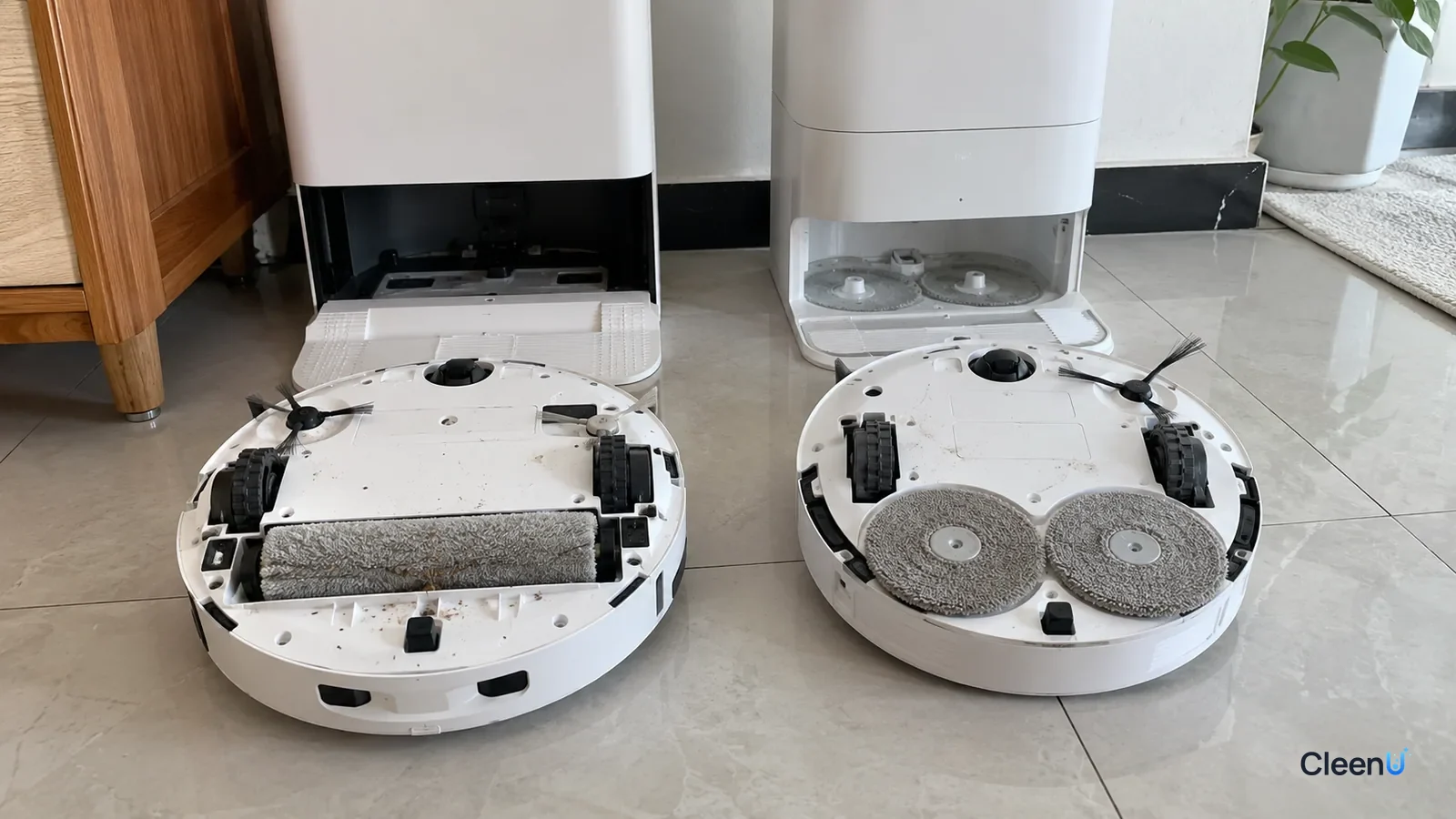
Robot mopping has changed a lot in a few years. Early models dragged a flat pad under the robot. Then two spinning pads became the norm. Now roller mops have arrived: a roller that scrubs the floor while it's rinsed and scraped inside the robot.
Different pads send water and cleaning solution along different paths through the machine, which changes how much solution to add, how much foam matters and where residue shows up. Knowing which type you have makes the robot easier to live with.
How each pad type works
Spinning pads: two round pads under the robot spin fast, driven by motors, and lift soil with pressure and friction. Water from the clean tank sprays through outlet holes onto the pads, which then mop the floor. After a stretch of floor, the robot returns to the dock, where the pads are rinsed with clean water in a wash tray and wrung out, and the dirty water goes to the dock's dirty tank. Between washes the pads hold more and more dirty water, so later in each stretch they're partly mopping with dirty water.
Roller mops: a horizontal roller wrapped in mop material runs under the robot. As it rolls across the floor, the robot sprays clean water onto it from inside, and a scraper on the other side squeezes dirty water off the roller and into an onboard channel or small dirty tank. The part of the roller touching the floor is always freshly rinsed and relatively clean. It washes as it mops.
There's also a flat or vibrating pad type, which slides or vibrates under the robot with little water and gets cleaned at the dock or by hand. Its solution use is closer to spinning pads.
What the difference means for cleaning solution
Water use and dilution: a roller mop rinses its roller continuously, so it usually uses more water than spinning pads. Cleaning solution is added to the clean tank and diluted to a ratio. More water means a tank of working solution runs out sooner, but every drop is at the same strength. So stick to the label ratio; you don't need extra because the robot uses more water.
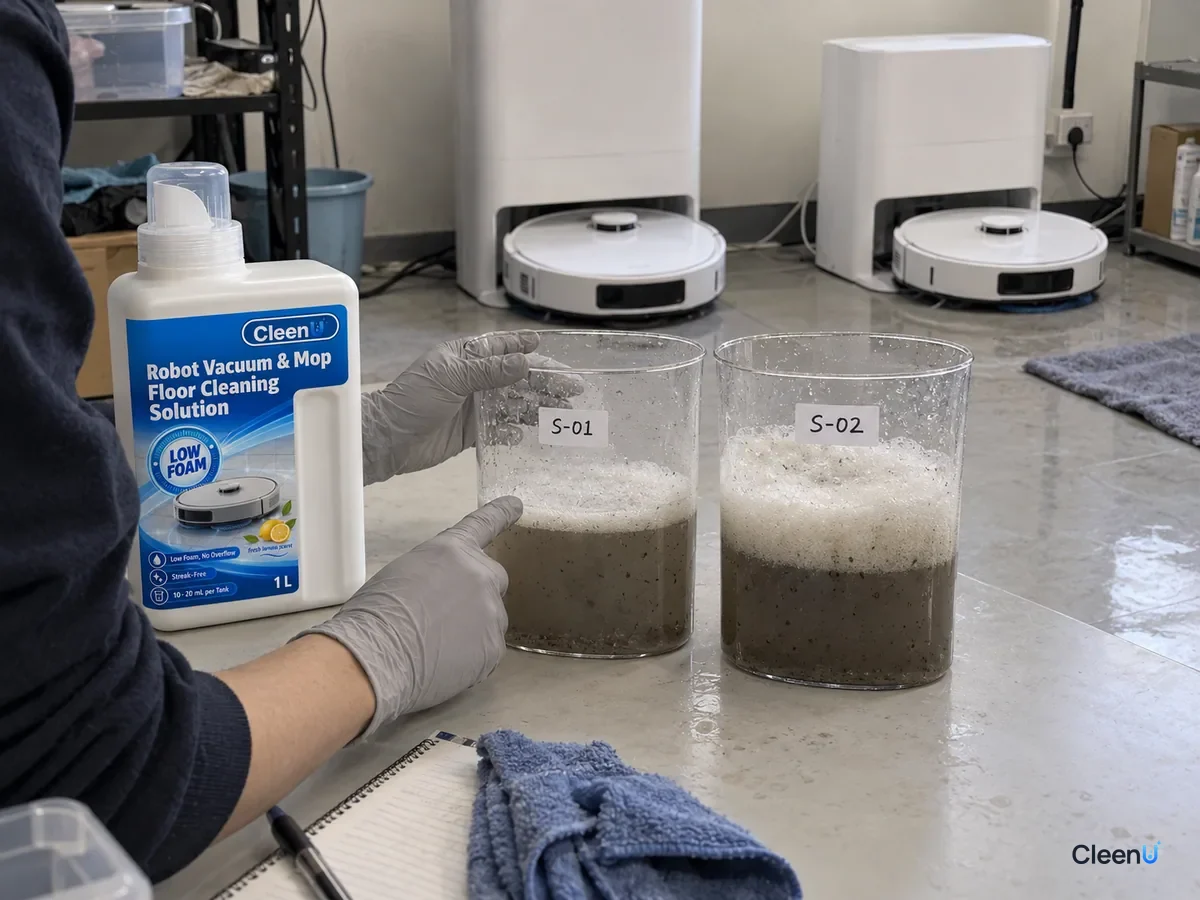
Foam: a roller mop scrapes dirty water into a channel or small tank inside the robot, far smaller than a dock's dirty tank, and it passes a scraper, suction inlet and lines on the way. If the solution foams, suds build up quickly in that tight space and can hurt water pickup, trigger the full-tank sensor or leak out of gaps. Spinning pads send dirty water to the dock's dirty tank, where foam also causes false full-tank alerts. Both need a low-foam formula, and roller mops are the more sensitive of the two. For why low foam matters, see why robot mop solution must be low foam.
Where residue shows up: between dock washes, dirty water and solution build up in spinning pads, so areas mopped later get a bit more residue and can show circular swirl marks. A roller touches the floor with a freshly rinsed surface, so floor residue is usually more even, but solution and grime tend to build up at the roller ends, on the scraper and in the onboard dirty water channel.
What to clean: with spinning pads, it's mostly the dock's wash tray, filter and the pads. With a roller mop, you also need to clean the roller, scraper and onboard dirty water channel regularly, following the manual.
Cleaning solution does the same job either way
Whatever the pad type, the solution works the same on the floor. Low-foam nonionic surfactants lower the water's surface tension so it spreads more evenly and wets dust and greasy footprints. The surfactant's oil-loving end attaches to oily soil and helps lift it off the floor and disperse it in water so the pad carries it away. A defoamer keeps suds down during mopping and rinsing.
CleenU Robot Vacuum Cleaning Solution, for example, is a neutral, low-foam concentrate at pH 6.5 to 7.5 with low-foam nonionic surfactants and a defoamer, no wax, no chlorine and no particles. It dilutes at about 1:50 to 1:100; 10 to 20 mL per fill is usually enough. That ratio applies to both roller and spinning-pad robots.
Roller mop vs spinning pads: cleaning solution use side by side
| Item | Roller mop | Spinning pads |
|---|---|---|
| How it mops | Roller scrubs the floor, rinsed and scraped inside the robot as it goes | Two round pads spin on the floor and are rinsed at the dock |
| Water use | Higher, from continuous roller rinsing | Lower, with pads just damp |
| Solution dose | Label ratio, no extra for higher water use | Label ratio |
| Foam sensitivity | Higher, since dirty water enters a small space inside the robot | High, since foam trips the dock's dirty tank sensor |
| Floor residue | More even, as the floor meets a freshly rinsed surface | More later in long wash intervals, with possible swirl marks |
| Parts to clean most | Roller, scraper, onboard dirty water channel, dock | Dock wash tray, filter, pads |
| Common problems | Grime and odor in the onboard channel, hair at the roller ends | Swirl marks, smelly pads, slime in the wash tray |
Getting the most from solution in a roller mop
Start at the low end: roller mops use a lot of water, so begin around 1:100 and see how the floor looks before going higher. For everyday light dust, plain water is fine.
Clean the roller and scraper weekly: remove the roller as the manual directs, rinse it and clear hair from both ends. Wipe grime off the scraper with a soft cloth.
Mind the onboard dirty water channel: on some models, dirty water goes first to a small tank or channel inside the robot. Empty and rinse it on the manual's schedule so a mix of solution and grime doesn't build up and smell.
Watch for foam: if you see obvious suds in the onboard channel or the dock's dirty tank, or get frequent full-tank alerts, stop using solution, run a few cycles with plain water, then check your dose and whether the solution is truly low-foam. For foam-triggered alerts, see robot says dirty tank is full when it isn't.
Getting the most from solution with spinning pads
Shorten the wash interval: set a shorter interval in the app, such as washing after each room. The less floor the pads mop with dirty water, the cleaner the result.
Control the water level: don't run spinning pads at maximum water. Overly wet pads leave water marks and swirl marks more easily.
Dry the pads every time: pads that stay damp start to smell, so turn on the dock's drying function after every run.
Deal with swirl marks: circular marks on dark tile usually mean too much solution or too long between washes. Mop once with plain water, then cut the dose. See robot mop swirl marks.
CleenU Robot Vacuum Cleaning Solution works in most robot mops from Roborock, iRobot (Roomba Combo and Braava), Ecovacs Deebot, Dreame and Narwal, and in floor washers such as Tineco. Add it to the clean water tank or the dock's designated detergent compartment as your manual directs. CleenU isn't affiliated with these brands; the names only indicate compatibility.
Floor washers work like roller mops. Can they share a solution?
A wet-dry floor washer also rinses a roller brush as it turns and sucks dirty water back into a tank, much like a roller-mop robot. The two need almost the same thing from a solution: low foam, low residue, no wax or particles, diluted to a ratio. CleenU Robot Vacuum Cleaning Solution also works in most Tineco and similar floor washers. For whether they're interchangeable, see robot mop vs wet-dry vacuum solution.
Choosing a robot: what pad type means for cleaning
If you haven't bought a robot yet and you're comparing, here's how pad type looks from a cleaning point of view.
Mostly tile or vinyl plank, with greasy footprints and a busy kitchen: a roller mop washes as it goes, so the floor always meets a relatively clean surface and large messes get cleaned more evenly, but there are more parts to maintain.
Lots of wood floor, or you want to use little water: spinning pads can run at a very low water level with just-damp pads, which is kinder to wood. With a short wash interval, they stay clean too.
Either way, check the manual's rules on cleaning solution before you buy: whether it allows solution, where it goes and whether there's a recommended dilution. If the manual forbids adding solution, don't.
This article is part of the Robot Vacuum Cleaning Solution & Maintenance Guide, which covers the full maintenance schedule and links to every troubleshooting guide.
Common questions about solution use in roller and spinning-pad robots
My roller mop uses more water. Should I add more solution?
No. Solution is diluted to a ratio in the clean tank, so more water just uses the working solution faster at the same strength. Stick to the label ratio and start at the low end.
Which pad type is more sensitive to foam?
Roller mops. Their dirty water goes into a small space inside the robot where suds build up easily. Both types need a low-foam formula.
My spinning pads leave circular marks. Is it the solution?
Usually it's too much solution or too long between washes. Mop once with plain water, then cut the dose and shorten the wash interval.
How often should I clean a roller mop's onboard dirty water channel?
Follow your manual, typically checking and rinsing it weekly. Clean it right away if it smells or builds up grime; don't wait for it to stink.
Can one solution work in both roller and spinning-pad robots?
Yes. If the manual allows solution, a low-foam, wax-free, particle-free solution made for robot mops works in both at the label ratio.
Can I add solution to a flat-pad robot with no dock?
If the manual allows it, yes. Dose at the low end and remove, wash and dry the pad after every run. If the manual forbids solution, use plain water only.
My roller mop foams after I add solution. Can that clog the filter?
Yes, it can, so cut the dose and make sure no other cleaner is mixed in. Roller robots pull dirty water back through a filter close to the roller, and foam gets drawn into that path. A low-foam solution at about 1:50–1:100 keeps foam in check.
For a low-foam, wax-free solution that works in both roller-mop and spinning-pad robots, choose Robot Vacuum Cleaning Solution.
Roller-mop and spinning-pad robots both need a low-foam, wax-free, particle-free solution dosed at the label ratio. What differs is where to focus. A roller mop rinses its roller with clean water as it goes, uses more water and sends dirty water into a small space inside the robot, so it's more foam-sensitive: start at the low end and clean the roller, scraper and onboard dirty water channel regularly. Spinning pads rely on dock washes and carry dirty water between them, so shorten the wash interval, keep the water level in check and dry the pads every time to cut residue and swirl marks. More water doesn't call for more solution; keeping the ratio steady is what counts.