
OEM/ODM
Robot Vacuum Brands Adding Their Own Cleaning Solution: What the Factory Needs
Direct answer
Start by giving the factory your device data: tank and dosing compartment materials, water delivery and flow, how water and detergent levels are sensed, target dilution and main floor types. The factory sets the low-foam formula around that, then validates foam, residue, lines and sensors on real machines.
Development process for a robot vacuum brand's bundled cleaning solution
-
Device data handoff
Share the device information above, ideally with a prototype plus tank and tubing samples. Agree on target dilution, target floors and target users.
-
Formula direction and first samples
Starting from a proven neutral, low-foam formula, we adjust the surfactant blend, defoamer system, viscosity and scent to your device requirements. Free samples ship in 3–5 days with a suggested test method.
3–5 days
-
Material compatibility testing
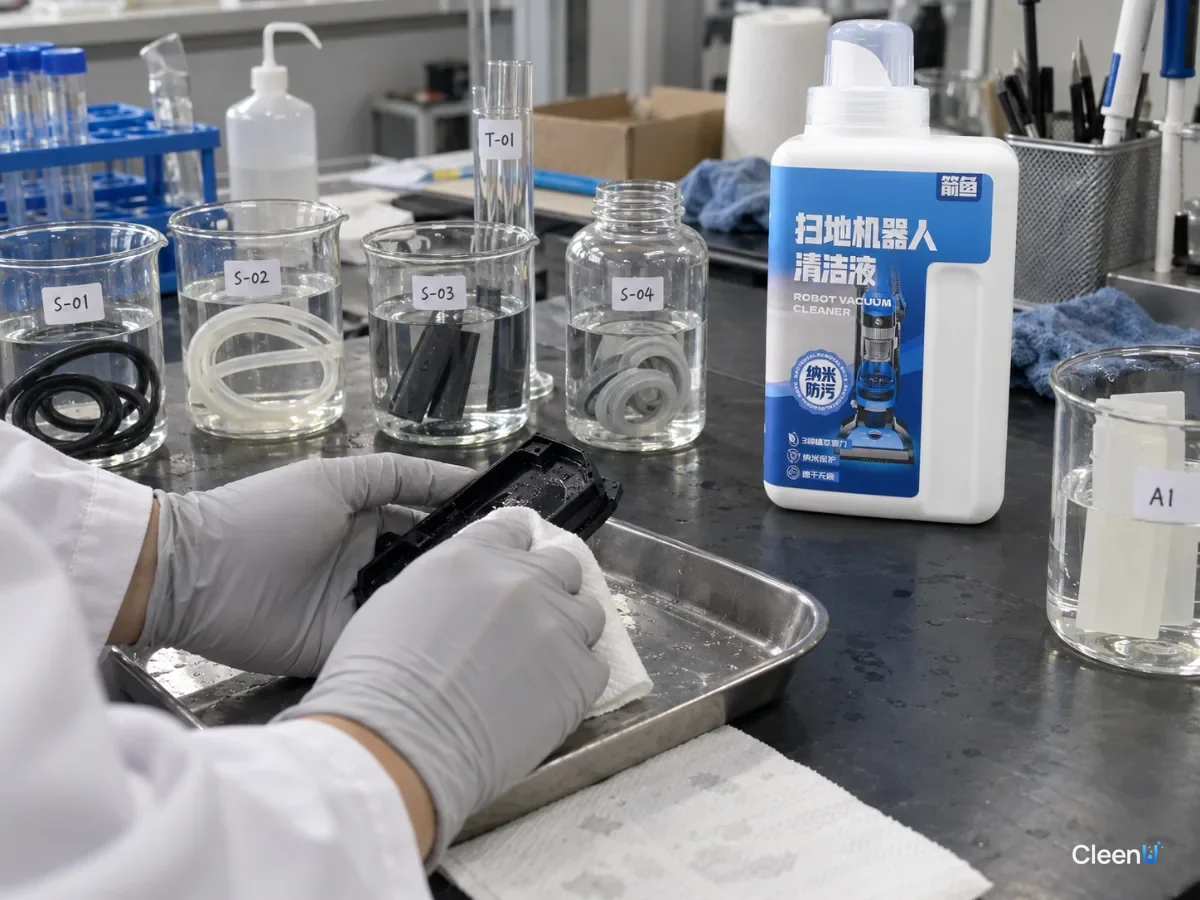
Tank plastics, seals and tubing samples soak in solution at working strength at set temperatures and times, checked for swelling, hardening, cracking and discoloration against a plain water control.
-
Real-machine testing
Run the prototype continuously at the target ratio and watch dirty tank foam, false level alerts, even water flow, dosing accuracy, and floor residue and feel over several days.
-
Stability and packaging
Check appearance, viscosity and smell under heat, cold and freeze-thaw conditions, and confirm how the bottle, measuring cap and spout fit the dosing compartment.
-
Label, manual and production
Put the confirmed ratio, fill location and exclusions into the label and manual. After packaging and labels are approved, bulk production is scheduled when the order is confirmed.
Scheduled with the order
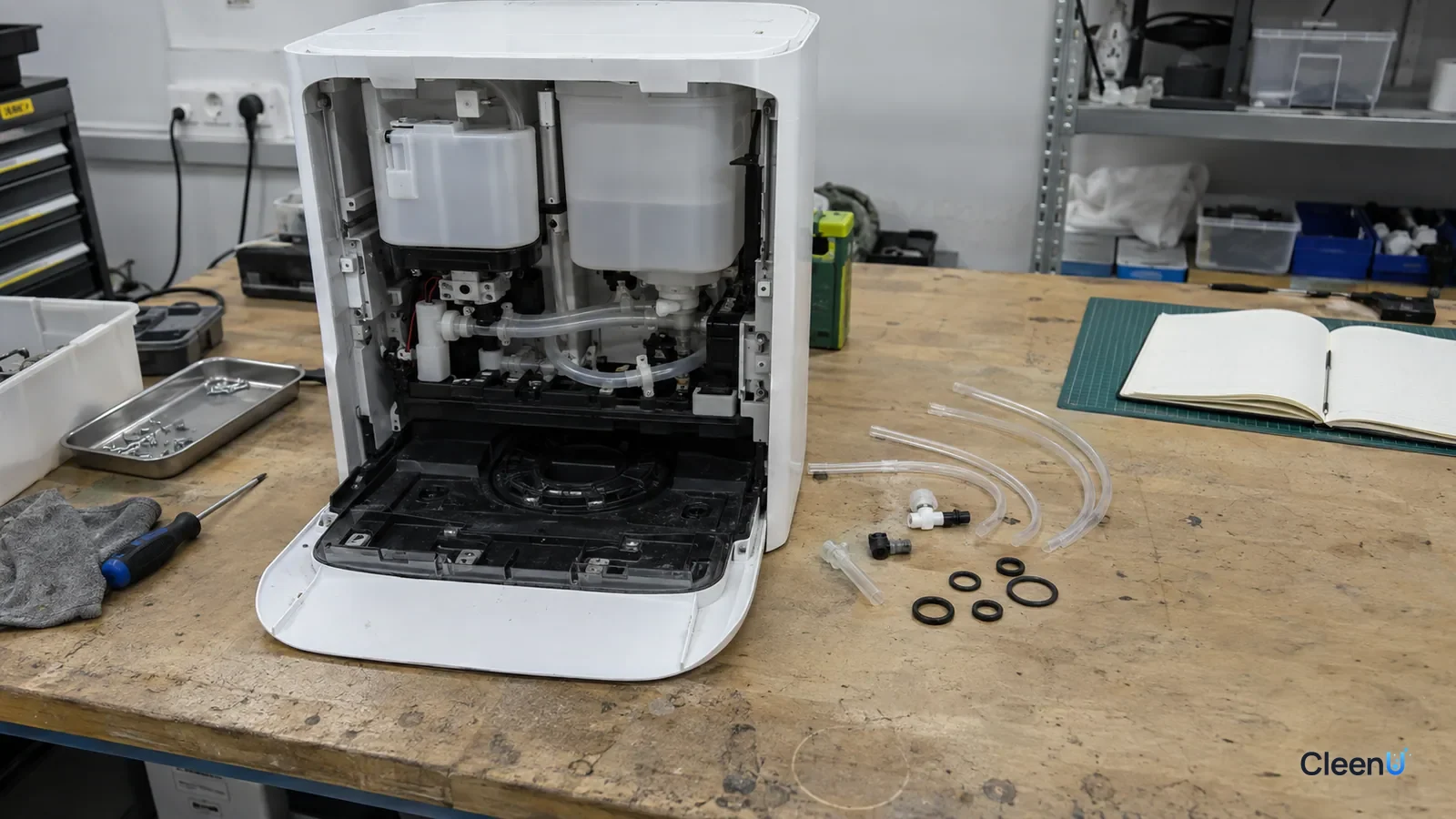
A robot vacuum brand developing its own cleaning solution faces a different job from a brand launching a universal one. Your solution will run in your own machines long term, appear in your manual and may tie into your warranty terms. If it triggers false alerts, clogs the dosing compartment or attacks seals, the damage isn't to one bottle's reviews but to the whole machine's user experience and your support costs.
So development doesn't start with "what scent?" It starts with "how does this machine work?" The more device information the factory has, the more targeted the formula and testing, and the fewer sample rounds you need.
Why does device data matter so much?
The same solution can behave very differently in different machines.
Pad washing varies, and so does foaming. High-speed spin scrubbing, roller squeezing and spray rinsing all produce different amounts of foam.
Level sensing varies, and so does sensitivity to foam. With electrode contacts, foam touching the contacts can trigger a false reading. Optical or pressure sensing reacts differently.
Auto-dosing metering varies, and so do viscosity needs. Peristaltic pumps, diaphragm pumps and gravity drip can each handle a different viscosity range, and they react differently in the cold.
Tank, tubing and seal materials vary, and so do compatibility needs. PP, ABS and polycarbonate plastics, and silicone, EPDM and nitrile rubbers, tolerate surfactants, fragrance and solvents differently.
Water flow and pad material vary, and so does residue. High-flow machines with absorbent pads leave less residue; low-flow machines demand a lower-residue formula.
That information sets how low the foam, viscosity and residue need to be, and which ingredients to avoid for your materials.
Device information to prepare
From device data to production
MOQ and lead time
MOQ starts at 500 bottles. Free samples ship in 3–5 days. After packaging and labels are approved, bulk orders are scheduled when the order is confirmed. Timing for material compatibility and real-machine testing depends on the device and the agreed test plan. Final pricing, MOQ and lead time follow the formal quote and order confirmation.
Current formula specs you can start from
- Type
- Neutral, low-foam concentrated robot mop cleaning solution
- pH
- 6.5 to 7.5 (25°C)
- Formula
- Low-foam nonionic surfactants with defoamer; no particles, no wax, no chlorine
- Dilution
- About 1:50 to 1:100; 10 to 20 mL per fill is usually enough
- Floors
- Tile, vinyl plank, laminate, sealed hardwood
- Versions
- Standard household; pet home with cyclodextrin odor control
- Default pack
- 1 L concentrate with measuring cap
- Shelf life
- 24 months unopened
What real-machine testing should focus on
Foam: dirty tank foam height when the dock washes the pads, whether repeated runs trigger false full alerts, and whether foam reaches the airflow path.
Sensing: whether low-water, full-tank and low-detergent alerts are accurate, and whether foam, liquid conductivity or wall cling interfere.
Water flow: whether flow stays even, whether residue builds in outlet holes and lines over time, and whether flow and dosing hold up in the cold.
Residue: whether the same floor turns tacky, slippery or streaky after several days of mopping, across different floor types.
Pads and dock: whether pads stiffen or smell sooner, and how much buildup forms in the wash tray and filter.
These have to be run on real machines and real floors over several consecutive days. Many problems, like residue buildup and film in the lines, don't show in a single run. For general sample evaluation, see how to evaluate robot mop cleaning solution samples.
Writing a user-friendly manual and label
Where it goes: clean tank or dosing compartment, never the dirty tank.
How much: an amount tied to tank size, such as "10 to 20 mL per 1-liter tank," matching the cap markings.
What not to do: don't mix with other cleaners or disinfectants, don't overdose, and which floors to avoid.
Storage: close tightly, store cool and out of light, and use within a reasonable time after opening.
Third-party liquids: if you allow them, state the basics (low-foam, made for robot mops, no wax or particles). If you require your own solution, say why and where it applies. Users care a lot about warranty; see does third-party cleaning solution void a robot vacuum warranty.
What CleenU brings
CleenU robot mop cleaning solution is confirmed compatible with most robot mops from Roborock, iRobot (Roomba Combo and Braava), Ecovacs Deebot, Dreame and Narwal, and floor washers such as Tineco. CleenU isn't affiliated with these brands; the names only indicate compatibility. That experience helps us spot quickly where a new machine may run into foam, sensing or dosing issues. We can start from a proven neutral, low-foam formula, adjust it to your device data, and support material compatibility and real-machine testing.
Making the manual and the solution say the same thing
The robot manual, solution label, product listing and support scripts should all use the same wording, or users won't know what to do.
Where it goes: clean tank or dosing compartment must match between manual and label. For models with auto-dosing, state clearly that concentrate goes in the compartment and plain water goes in the clean tank.
How much: the machine's auto-dosing setting, the manual dosing ratio and the cap markings must line up. If manual dosing is about 1:50 to 1:100, the compartment's default ratio should sit near that range.
What water: room-temperature tap water or distilled, matched to how the machine senses water level.
Third-party liquids: allowed or not, and why, stated clearly to cut support disputes.
Settle these details with the factory during development and write them into the brief, so the label and manual never contradict each other.
Collecting real-world feedback after launch
After launch, the most valuable information comes from users: which models, floors and water conditions produce foam, residue, odor or clogs. Tag solution-related support tickets separately and review them with the factory regularly. Is it unclear directions, a compatibility issue with one model, or a formula that needs fine-tuning? Iterating on that feedback is how a bundled solution earns better reviews over time.
This article is part of the Robot Vacuum Cleaning Solution & Maintenance Guide, which covers the full maintenance schedule and links to every troubleshooting guide.
What robot vacuum brands ask about bundled cleaning solution
Do we really need to provide a prototype?
Strongly recommended. Material samples cover compatibility, but foam, sensing, dosing and residue only show up in continuous runs on a real machine.
Should our bundled solution be exclusive to our machines?
You can tune foam, viscosity and scent to your machines. We also suggest keeping compatibility with leading models, which is easier for users to understand and helps with retail.
What matters for an auto-dose version?
Cold-temperature flow, long-term stability in the compartment, no crystallizing or wall cling, and accurate detergent level sensing, all validated on real machines.
What are the MOQ and lead time?
MOQ starts at 500 bottles, free samples take 3–5 days, and bulk is scheduled after packaging and labels are approved. Testing timelines depend on the device and test plan.
Can you make a pet-home version?
Yes. The pet-home version adds cyclodextrin odor control to the neutral, low-foam base with no added fragrance, a good match for a machine's pet edition.
Will our device data be used elsewhere?
Device data and test records are kept confidential per project, and specific confidentiality terms can be agreed before we start.
Should our manual tell users not to add solution to the dirty-water tank?
Yes, say it plainly. Users often ask whether the dirty tank needs solution, and adding it there raises foam and can confuse the full-tank sensor. In both the manual and on the label, state that solution goes only in the clean-water tank or the designated detergent compartment, and give a per-fill dose that matches the cap markings.
How many prototype units should the factory test with?
There is no fixed number; base it on the models you plan to cover. Give each model with a different tank, dosing compartment or level-sensing design at least one unit for continuous runs. Watch dirty-tank foam, false level alerts, flow evenness, auto-dose accuracy, and floor residue and feel after several days.
To develop a bundled solution for your machines starting from a neutral, low-foam formula confirmed compatible with several brands, see the CleenU Robot Vacuum Cleaning Solution.
When a robot vacuum brand develops its own cleaning solution, the factory needs device data first: tank, dosing compartment and seal materials; water delivery and flow; pad washing method; how water and detergent levels are sensed; auto-dosing metering; and the target ratio, floors and users. That sets targets for foam, viscosity, residue and material compatibility, which are then proven through soak tests and continuous real-machine runs. CleenU can start from a proven neutral, low-foam formula and support compatibility and real-machine testing, with free samples in 3–5 days and bulk scheduled when the order is confirmed. Send your device data and intended use to begin.