
Q&A
Can You Swap Out Tineco Cleaning Solution? Where a Third-Party Formula Goes and How Much to Add
Direct answer
Yes. The key is picking the right one and adding it in the right place: a low-foam, neutral concentrate with no disinfectants, only in the clean water tank, scaled to the tank at about 1:50 to 1:100, erring on the low side.
What can go in a Tineco clean water tank
Yes
- A low-foam, neutral, particle-free concentrate made for floor washers or robot mops, diluted to the tank size
- Room-temperature tap water; Tineco lists 41 to 140°F (5 to 60°C) and says distilled water isn't needed
No
- Dish soap, laundry detergent, body wash, or other high-sudsing products
- Bleach; the FLOOR ONE S3 FAQ warns it may damage the machine
- Vinegar, rubbing alcohol, essential oils, or homemade mixes
- Hot water; Tineco warns it can damage the internal water lines
- Any cleaning solution in the dirty water tank
It depends
- Your manual gives a specific ratio or water temperature: follow it for where and how much, and choose a low-foam, neutral formula
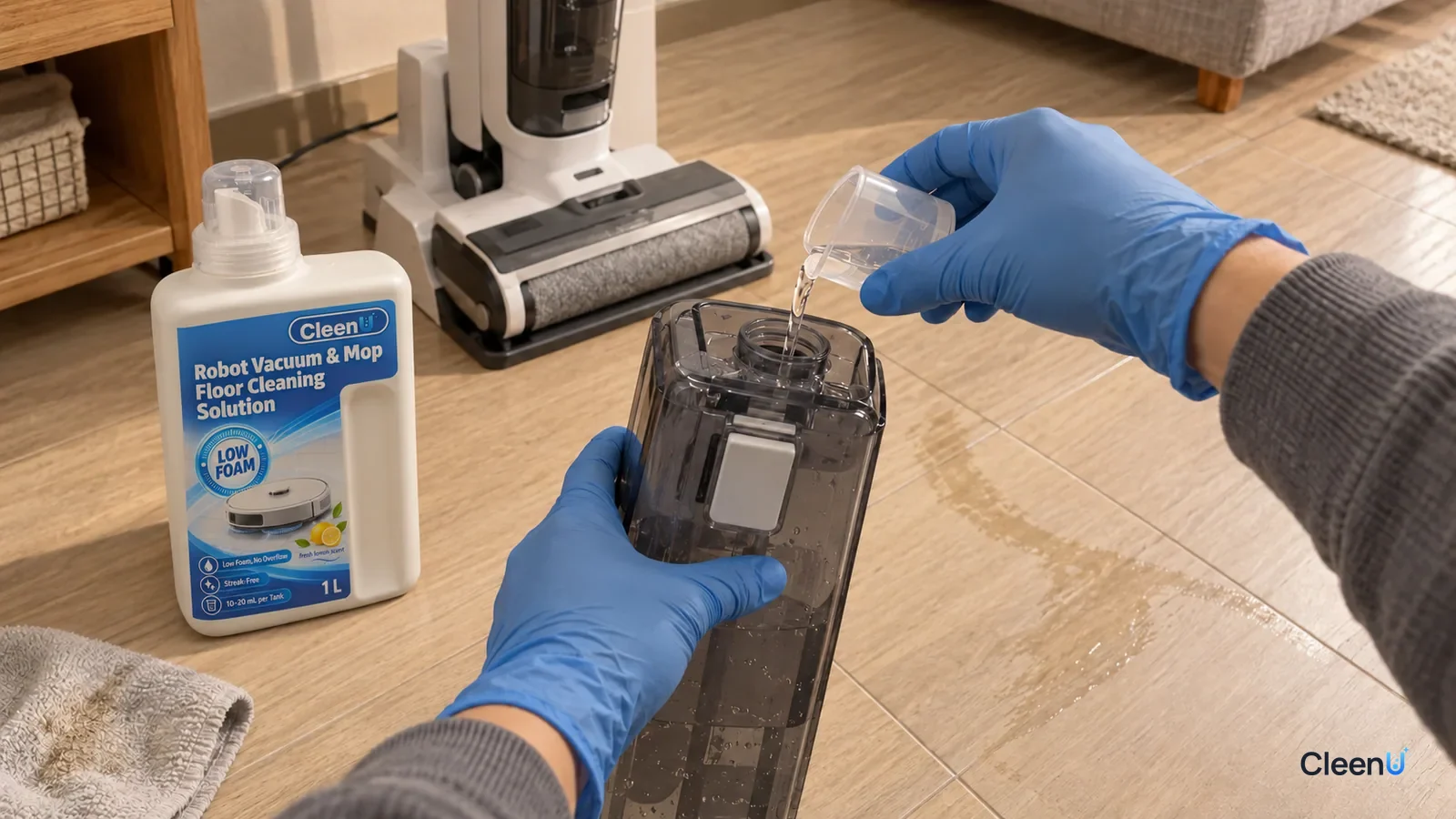
Can you replace Tineco cleaning solution with something else? Yes, and the key is picking the right one and adding it in the right place. A Tineco floor washer mops and vacuums in one pass, and its dirty tank doubles as an air-water separator, so the first thing to look for is low foam, including in dirty water, with bubbles that break fast. Add a neutral pH, no particles, and no wax or disinfectants, and the roller stays free of film.
Adding it is simple too. The Tineco models we checked have no separate solution reservoir, so everything goes into the clean water tank at about 1:50 to 1:100, and the dose is entirely up to you.
Know your Tineco: the models and the clean tank
This guide draws on the model FAQs on Tineco's US support site for the FLOOR ONE S3, S5 STRETCH Extreme, S7 PRO, S7 STRETCH STEAM, S9 ARTIST STEAM and STEAM PRO, iFloor 3 and 5, and the FloorWasher 5 Series. What they share: they mop and vacuum in one pass, their clean tanks hold about 20 to 29 oz (0.6 to 0.85 L), and solution goes into the clean tank.
Lineups vary by region, and everything here comes from US model FAQs.
Where Tineco cleaning solution goes: the clean water tank, and only there
Tineco's FAQs describe one method: measure one capful with the bottle cap, pour it into the clean water tank, then add water to the Max line. Every model we checked works that way.
Some owners assume Tineco doses automatically. The "automatic" feature in the FAQs is different: the machine senses how dirty the floor is and adjusts how much solution-and-water mix it releases, along with roller pressure and suction. It doesn't meter concentrate from a separate reservoir, and we found no Tineco documentation describing one. So any solution goes in the clean water tank, and whatever you mix there is exactly what reaches the floor. The dirty water tank never gets solution; it just makes more foam there.
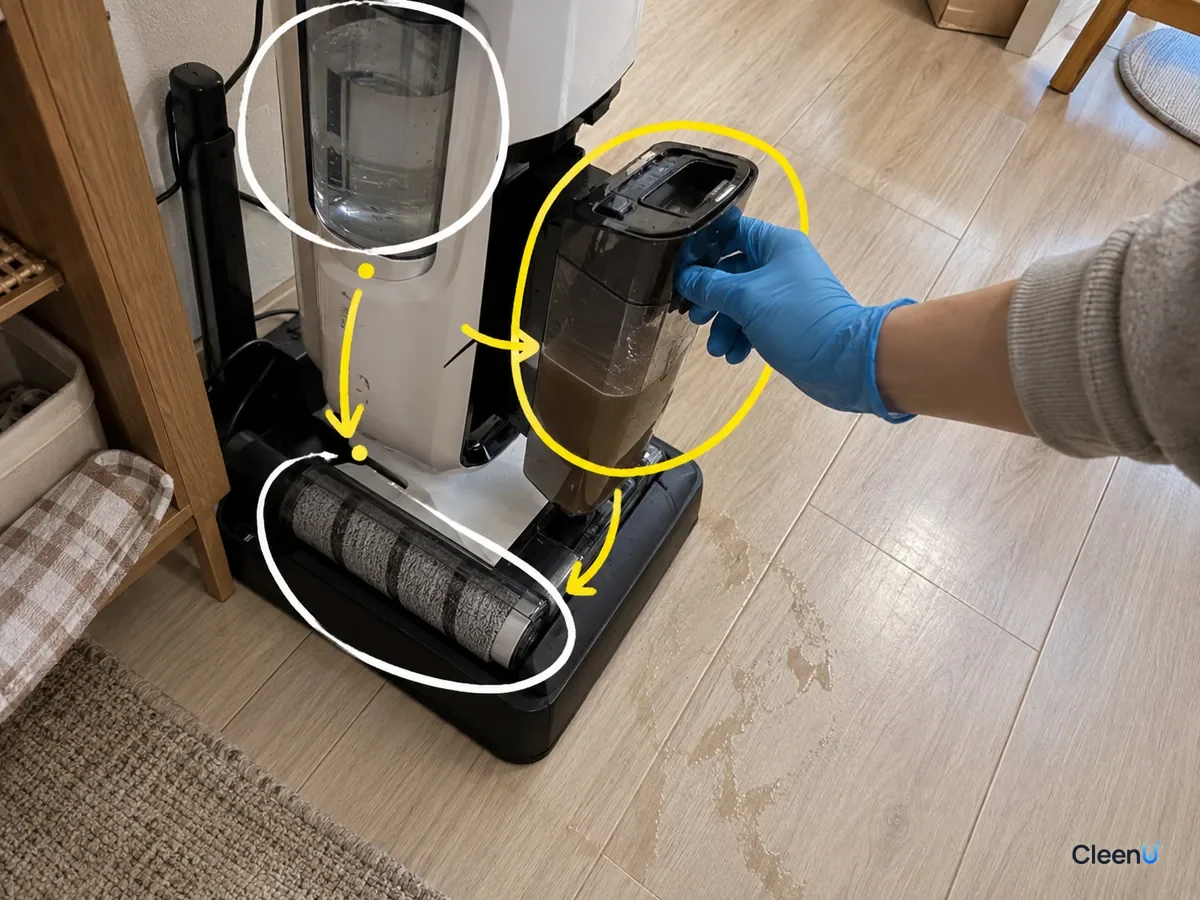
How liquid moves through a floor washer: spray, scrub, suck, separate
An upright floor washer runs a four-step loop:
- Spray: a small pump sends working solution from the clean tank to the brush roller.
- Scrub: the roller spins, presses solution against the floor, loosens soil, and pulls dirty water and grit into its fibers.
- Suck: the nozzle sits against the roller and pulls off dirty water, debris, and a lot of air together.
- Separate: that mix enters the dirty water tank, slows, and changes direction. Water drops to the bottom; air continues through the filter to the motor.
Steps three and four are why floor washers are so sensitive to foam. Every gulp is liquid plus air, and the dirty tank doubles as an air-water separator. The FLOOR ONE S5 FAQ notes that the machine shuts off automatically when the dirty tank is full, and that an indicator and voice prompt warn of a blocked air duct. Both keep water away from the motor.
On the dock, the water path runs again. Per Tineco's FAQs, empty the dirty tank, make sure the clean tank is at least one-third full, and press self-clean. The S7 STRETCH STEAM and S9 ARTIST STEAM run about 120 seconds in quick mode and 360 in deep mode; the S3 and iFloor 3 run about 40 seconds. Self-cleaning uses clean-tank water, so your mix flushes the roller and lines at the same strength. Tineco's US store page for the FLOOR ONE S9 Artist Steam describes rinsing with heated clean water, then drying with 185°F (85°C) hot air.
Why foam causes so much trouble in a floor washer
The dirty water tank separates liquid from air by density: water falls, air keeps moving. Foam is air trapped in thin water films, so its density sits in between. It doesn't sink, and it doesn't pop the moment the airflow carries it. It stacks up in the top of the tank, filling the space the airflow needs.
Foam lasts because surfactant molecules line each bubble wall, and when a wall stretches thin, surrounding liquid flows in to repair it. A floor washer is close to an ideal foam generator: the roller spins hard, the nozzle pulls hard, and air is constantly beaten into liquid. What it picks up is dirty water, too, and food residue, pet drool, and other protein soils make bubble walls tougher. A solution that looks tame when you shake it in a cup can multiply in the dirty tank.
That's why the right low-foam formula pays off so clearly in a floor washer: the dirty tank holds liquid instead of foam, so it doesn't call itself full when it's half empty, and the filter and air duct stay dry, which keeps suction steady.
Low-foam formulas handle this in the recipe: nonionic surfactants that make little, unstable foam, plus a small amount of defoamer that creates weak spots in bubble walls. Low foam doesn't mean weak cleaning. Cleaning comes from wetting, emulsifying, and dispersing soil; suds are mostly a visual cue. More in Why robot mop cleaning solution has to be low-foam.
How foam builds up from the roller to a full-tank shutoff
- The spinning roller and strong suction keep forcing air into the working solution
- Surfactants line each bubble wall, and thinned spots repair themselves
- Protein soils dissolved in the dirty water toughen the bubble walls
- Foam neither sinks nor pops right away, so it piles up in the tank and trips the shutoff
- A low-foam formula lets bubbles collapse soon after they enter the tank
Where residue goes during self-cleaning and hot-air drying
Each self-clean pulls most of the liquid back into the dirty tank, but a little stays in roller fibers, the roller housing, and bends in the tubing. If your model dries with heated air, the water evaporates and leaves what doesn't: surfactants, film formers, fragrance carriers, and the calcium and magnesium salts in tap water.
After dozens of cycles, that can build a film in the roller. It feels stiff or tacky, carries away less dirt, attracts dust and hair, and gives odors a place to start when damp. That's one reason Tineco recommends washing the roller after every use and fully drying the filter.
Two rules follow. Choose a formula that rinses clean, with no particles, wax, or film formers. And use the low end of the dose range day to day, because self-cleaning uses the same tank, so a stronger mix leaves more in the roller. We also suggest a plain-water self-clean once a week or before storage. That's our recommendation based on how residue behaves, not a Tineco instruction.
Tineco cleaning solution ratio, and scaling a third-party dose to a small tank
Tineco gives a number for only some models: the FLOOR ONE S3 and iFloor 3/5 FAQs say 1:50, one capful to a full clean tank. Others just say one capful, then water to Max. Tanks differ too: the S5 STRETCH Extreme, S7 PRO, and S9 series hold about 0.85 L (29 oz); the iFloor 3 about 0.6 L (20 oz). So 1:50 isn't a universal Tineco ratio.
With a third-party formula, follow its label. CleenU Robot Mop Cleaning Solution dilutes at about 1:50 to 1:100. Scaled to Tineco tanks:
CleenU Robot Mop Cleaning Solution in a Tineco clean tank (about 1:50 to 1:100)
- About 0.6 L (20 oz)
- About 6 to 12 mL (1¼ to 2½ tsp)
- About 0.85 L (29 oz)
- About 8.5 to 17 mL (1¾ to 3½ tsp)
- 1 L (33.8 oz)
- About 10 to 20 mL (2 to 4 tsp)
You'll often see "10 to 20 mL per fill" for robot mop solution. That's written for robot dock tanks, which are much larger. Pour 20 mL into a 20 oz floor washer tank and you're near 1:30, with noticeably more foam and residue. Check how much water is actually in the tank, then measure; a 10 mL oral syringe from the pharmacy makes it easy.
If two solutions both say 1:50, are they the same strength? Not necessarily. A ratio is just concentrate to water by volume, and every concentrate carries a different amount of actives. What matters is the in-use strength: divide active content by the dilution ratio. At about 2% active, a 1:200 mix leaves only about 0.01% active in the tank, and a 1:500 mix about 0.004%. At 15% active, CleenU diluted 1:100 still delivers about 0.15%: about 15 times the 1:200 mix and nearly 40 times the 1:500 one. Then mix each to its own label and compare results: how the dry floor feels, how much foam reaches the dirty tank, and whether the roller stays clean.
What cleaner can I use in my Tineco? Five checks for an alternative
Shopping for a Tineco cleaning solution alternative? Screen for these before scent or price:
- Low foam, including in dirty water. A floor washer pulls up dirty water, so this matters most.
- Neutral pH. Gaskets, plastic tanks, the pump, and roller fibers touch the solution for years, and acidic or strongly alkaline liquids are harder on rubber over time.
- No particles, wax, or film formers. Polishes are meant to leave a coating, and inside a floor washer it builds on the roller, lines, and filter.
- No solvents or disinfectants. Alcohol can swell some rubbers; chlorine oxidizes rubber and metal.
- Made for machine mopping, with a clear dilution ratio. "Use as needed" is hardest to control in a small tank.
Dish soap and laundry detergent are out, since they're built for rich suds in a sink; see Can you mop with dish soap, vinegar, or bleach? On swapping robot mop and floor washer solutions, see Robot mop vs wet-dry vacuum cleaning solution.
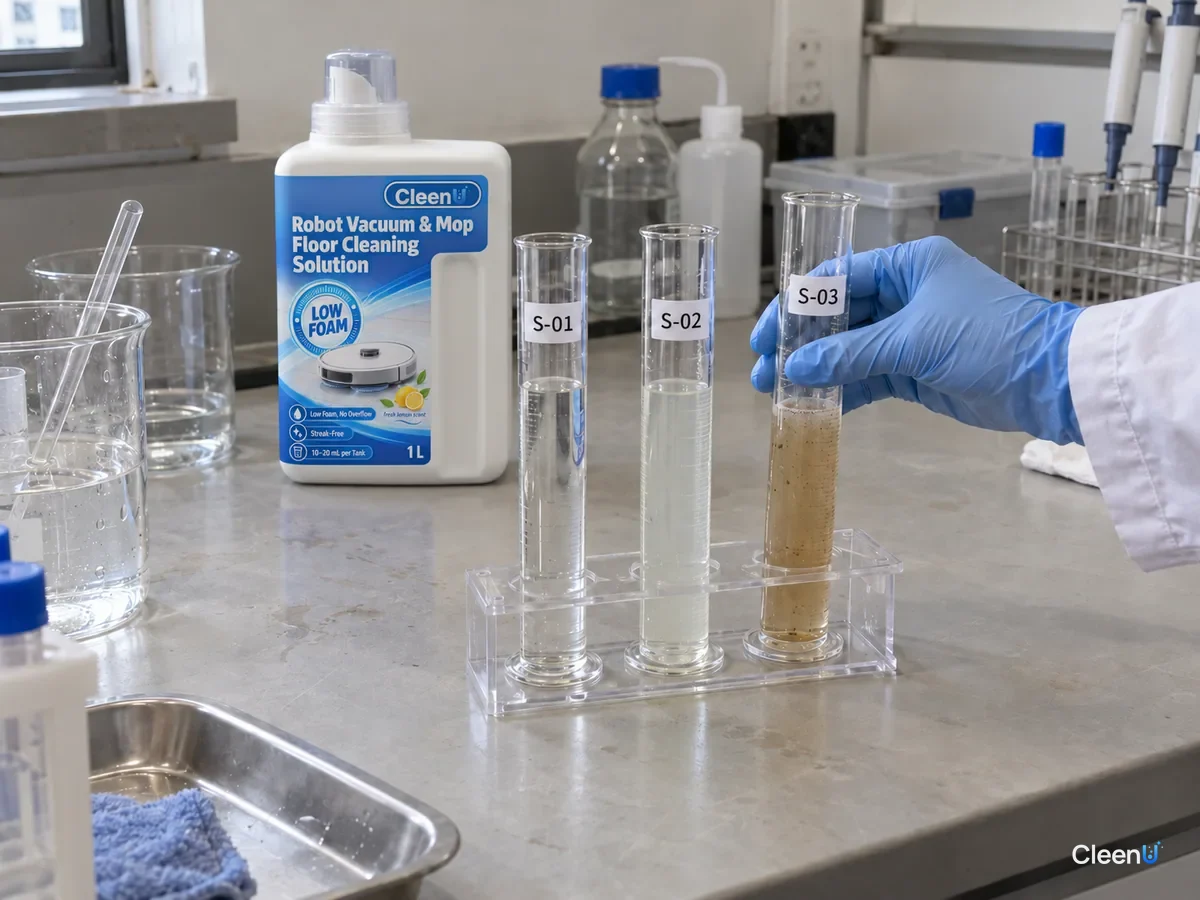
Three quick tests before anything new goes in your Tineco
Shake test for foam. Put 300 mL (about 10 oz) of water in a clear bottle, add 3 to 6 mL of solution, cap it, shake hard 10 times, and watch. A thin layer that clearly shrinks within a minute or two is a good sign. Compare with dish soap at the same strength, then add a pinch of flour to imitate dirty water and see whether foam grows. Full method: A simple shake test for robot mop cleaning solution foam.
Mirror test for residue. Wipe working solution on a mirror with plain water beside it, let both dry, and look at an angle. A hazy, draggy film will build up on the roller too.
One-room trial. First time out, clean one room only, stop after three to five minutes, and check the top of the dirty tank. Foam builds fastest in a floor washer's first few minutes, so that's the best time to look. A thin layer and mostly liquid means you can finish the house.
When you run the shake test, do it twice: once in clean water and once with the flour "dirty water." A floor washer pulls up dirty water, so a formula that stays low-foam with soil in it will stay low-foam in the dirty tank. If all three tests look good, you can switch with confidence.
Switching solutions: from emptying the old mix to your first trial run
- Empty and rinse both tanks. One product per tank keeps the results easy to read.
- Rinse the brush roller and wash the filter, then let the filter dry completely so old residue doesn't skew the trial.
- Fill the clean tank with room-temperature tap water and note how much is in it.
- Add solution to match: about 6 to 12 mL for 20 oz, 8.5 to 17 mL for 29 oz, starting low. Water first, then solution; swirl gently.
- Clean one room, stop after three to five minutes, and check the dirty tank for heavy foam.
- Dock it, empty the dirty tank, and run self-clean. Once dry, feel the roller for stiffness or tackiness.
- No sticky floor, little foam, normal roller? Keep that dose. Foam or tackiness? Drop to the low end and retest.
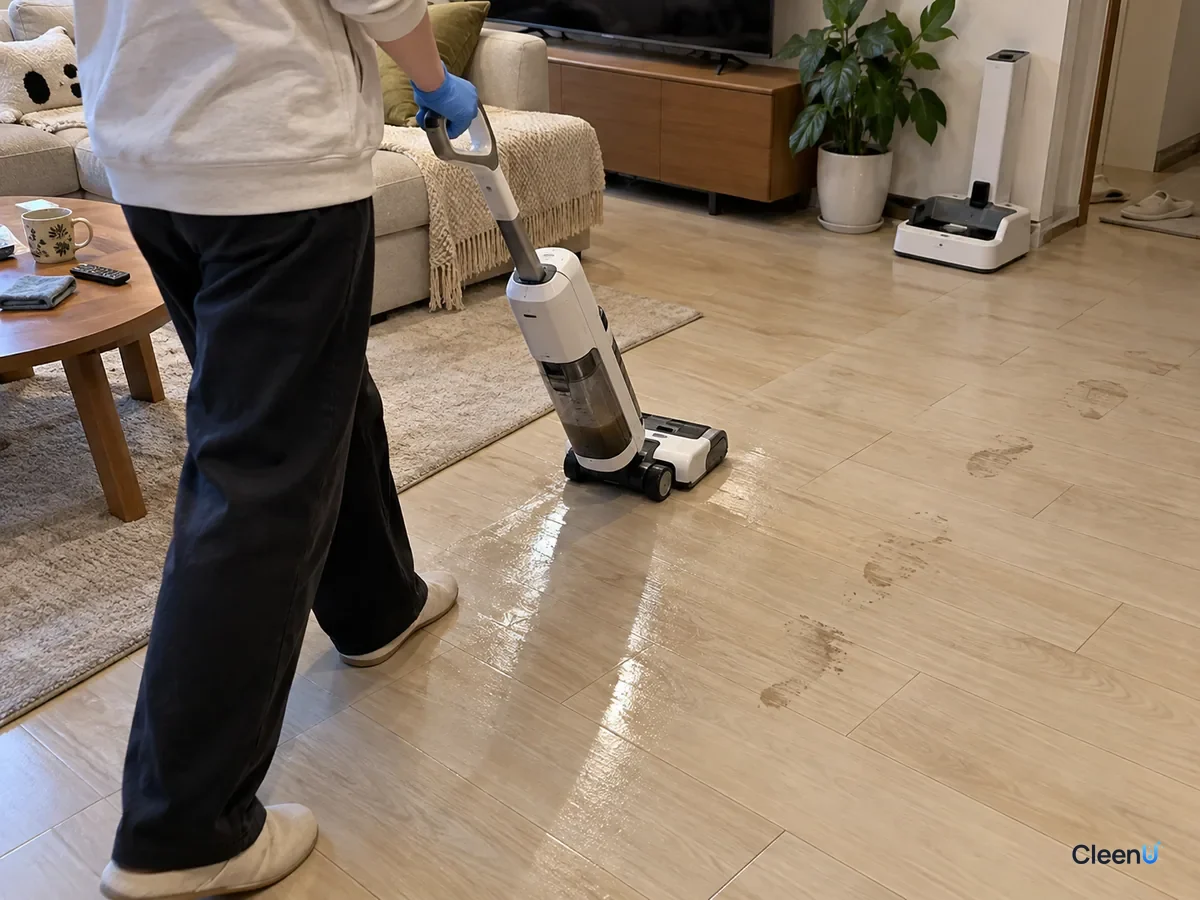
Foamy dirty tank or sticky floors? Adjust in this order
A dirty tank that calls itself full within minutes and turns out to be mostly foam, or floors that dry sticky or slippery, means too much solution is reaching the floor or old dish soap is still in a tank. Step one: empty both tanks, rinse them, and wash and fully dry the filter. Step two: run a plain-water self-clean to flush extra solution out of the roller and lines. Step three: remix at the low end and clean one room to check. If the air duct indicator flashes, clear the duct opening under the dirty tank before you retest.
Still foamy or sticky after switching? Likely causes, most common first
- Too much solution. A robot-dock habit of 20 mL in a small floor washer tank doubles the strength. Drop to the low end.
- Old product in the tanks. Leftover dish soap makes any new formula look sudsy. Rinse thoroughly and retest.
- A heavily soiled floor. Grease, pet drool, and crumbs stabilize foam. Vacuum dry debris first and go over the worst areas twice instead of mixing stronger.
- Film already in the roller and filter. After a high-residue product, the roller keeps releasing surfactant. Wash, dry, and run a plain-water self-clean.
- A blocked air duct. Tineco's S5 and S3 FAQs say to clean the duct opening under the dirty tank when the dirt indicator flashes abnormally.
- A higher-foaming formula. If nothing above explains it, switch to one that stays low-foam in dirty water and rinses clean with no wax.
Adjusting for different floors and messes
When to add solution, how much, and how to clean
- Everyday dust and light footprints
- The low end of the ratio
- Kitchen grease and spills
- High end of the ratio; clean the greasy area first and check the dirty tank for foam
- Pet paw prints and drool
- Middle of the ratio; fragrance-free pet formula if you're scent-sensitive
- Dried juice or coffee
- Soften it under a damp cloth for a few minutes, then clean; don't mix stronger
- Sealed hardwood and laminate
- Low end of the ratio, lower water flow, quick drying
- Unsealed wood, waxed floors, carpet
- Don't wet clean them with a floor washer or this type of solution
- Pet urine or vomit
- Clean it up by hand first, then run the floor washer around it, not through it
How much to add depends on the soil. Dust and grit come up with the roller and suction, so the low end of the ratio is enough; the surfactant wets fine dust so it doesn't dry into a gray film. Grease, sticky spills, and protein soils need full wetting and emulsifying, so go to the high end or make a second pass.
Two things that surprise most owners
More solution doesn't mean cleaner floors. Past a certain concentration, surfactants stop lifting more soil, but foam and residue keep climbing. In a 20 to 29 oz tank, an extra teaspoon matters far more than in a big robot dock tank.
More suds don't mean more cleaning power. Foam is surfactant sitting at the air-water boundary and says little about whether soil is moving. A floor washer needs a formula that cleans without sudsing.
Choosing an alternative: three situations
- Tineco solution is hard to find, or you use a lot: switch to a low-foam, neutral alternative and do a one-room trial first.
- DIY dish soap or vinegar mixes: not worth it. You can't control foam, corrosion, or residue.
- You want to get it right the first time: look for low foam even in dirty water, a neutral pH, and a rinse-clean recipe with no particles or wax, mixed at about 1:50 to 1:100 in the clean tank. If your model's manual says otherwise, follow the manual.
What that looks like in a bottle: CleenU as an example
To see those three points in an actual product, take CleenU Robot Mop Cleaning Solution: a neutral concentrate, pH 6.5 to 7.5, built on low-foaming nonionic surfactants with a defoamer. It has no particles, no wax, and no chlorine, and it's solvent-free with no optical brighteners. The regular formula has a lemon scent; the pet-home formula is fragrance-free and uses cyclodextrin-based odor control. Each 1 L (33.8 oz) bottle has a measuring cap, and shelf life is 24 months unopened. It's for tile, vinyl, laminate, and sealed hardwood, not unsealed wood, waxed floors, or carpet.
In a Tineco floor washer there's one way to use it: about 1:50 to 1:100 in the clean water tank, roughly 8.5 to 17 mL for 29 oz and 6 to 12 mL for 20 oz. Measure by your label's ratio, and a one-room trial comes first. It cleans footprints, greasy marks, and dull film; it isn't a disinfectant, and we make no germ-killing claims.
It works with most Tineco floor washer models and with most robot mops from Roborock, Ecovacs Deebot, Dreame, and Narwal. CleenU is not affiliated with these brands; brand names are used only to describe compatibility.
Looking for a low-foam, neutral concentrate for a Tineco floor washer? Take a look at Robot Mop Cleaning Solution.
Sources for the Tineco details: Tineco US model FAQs for the FLOOR ONE S3, FLOOR ONE S5, FLOOR ONE S7 STRETCH STEAM, and iFloor 3; and the FLOOR ONE S9 Artist Steam page on Tineco's US store. Checked October 2026.
Questions owners ask about switching Tineco cleaning solution
Can you use a third-party solution in a Tineco?
Yes, as long as you pick the right one and add it the right way: a low-foam, neutral concentrate with no disinfectants, added only to the clean water tank at about 1:50 to 1:100 for your tank size, on the light side. Do a one-room trial the first time.
Do you have to use Tineco solution?
No, choose a low-foam neutral formula instead: one that stays low-foam in dirty water, with no particles, wax, or disinfectants, mixed at about 1:50 to 1:100 in the clean tank. Do a one-room trial the first time.
Can I use vinegar in a Tineco?
No. Vinegar is an acid that can age rubber and metal parts, it does little for grease, and a homemade mix gives you no control over strength or foam.
How much Tineco solution should I use?
For Tineco's formula, one capful in the clean tank, then water to Max; the S3 and iFloor 3/5 FAQs put that at 1:50. For another brand, follow its label; CleenU works out to about 8.5 to 17 mL in a 29 oz tank.
Where does cleaning solution go in a Tineco floor washer?
In the clean water tank. We found no official mention of a separate solution reservoir, and nothing goes in the dirty tank.
How much solution should I add for everyday cleaning in a Tineco?
Use the low end of the ratio for dust and light footprints. Go to the high end, or make a second pass, for grease, sticky spills, and paw prints.
Can I put bleach or a disinfectant in my Tineco?
Don't. Chlorine attacks rubber and metal parts and is used up fast by soil on the floor. Disinfect specific spots by hand if needed.
Can I use hot water or distilled water in a Tineco?
Skip hot water; plain tap water is fine. Tineco lists 41 to 140°F and warns hot water can damage internal lines. Distilled water isn't required.
My Tineco's dirty tank says full after a few minutes. What should I check first?
Check the dose and look for leftover dish soap in the tanks. Rinse, remix at the low end, and retest with a formula that stays low-foam in dirty water; vacuum heavy debris before wet cleaning.
My Tineco brush roller feels stiff and smells. How do I fix it?
Wash the roller after each use, let it dry, and run a plain-water self-clean weekly. Dose at the low end with a rinse-clean formula that has no wax or film formers, and the roller stays soft.
What should pet owners use in a Tineco?
A fragrance-free, low-foam, neutral formula in the clean tank, with pets kept off the floor until it's dry. CleenU's pet-home formula has no added fragrance and uses cyclodextrin-based odor control.
You can replace Tineco cleaning solution. The key is picking the right one and adding it in the right place: a low-foam, neutral concentrate with no particles, solvents, or disinfectants, add it only to the clean water tank, and scale it to the water actually in the tank, about 1:50 to 1:100, starting low. Run one room first and check the dirty tank, the dry floor, and the roller before making it routine.