
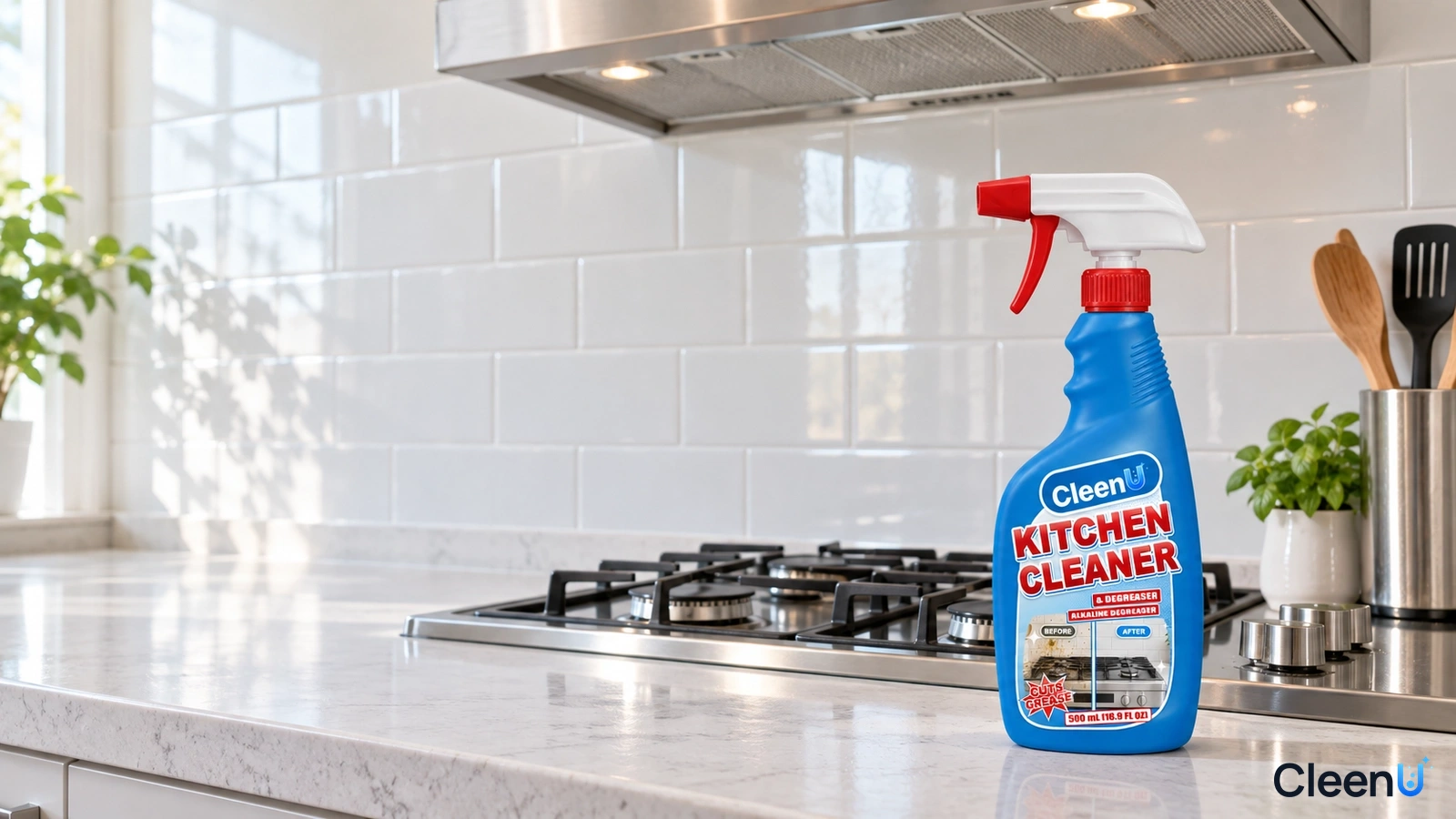
Product and application illustrations. Follow the product label and written use guidance.
CleenU product solution
Kitchen Degreaser & Cleaner
Alkaline degreaser · Cuts yellowed grease · Private label
Yellow, sticky grease on the backsplash and a tacky range hood? Spray and wait 1–3 minutes (5 for heavy buildup) while the alkaline degreaser saponifies old grease, then sponge it off for white tile and a dry feel. Private label from 500 bottles.
- Unsaturated fats in cooking oil slowly oxidize and cross-link with heat and air, linking into larger networks that turn free-flowing oil into a sticky, yellow, eventually hard film. Fresh spatter wipes off with dish soap; a week old, it’s tacky; a month old, it needs a degreaser. The alkali in this cleaner saponifies the triglycerides into water-soluble soap, and surfactants emulsify what remains so the film lets go.
- Saponification takes a moment; wipe immediately and you only take the top layer. Wait 1 to 3 minutes, 5 for tacky old grease, and wipe once the film turns cloudy. Then go over it with a clean, damp cloth to remove the soap and leftover alkali so the surface doesn’t feel dull or sticky, especially on stovetops and counters near food.
- MOQ
- 500 bottles
- Free samples
- 3–5 days
- Bulk lead time
- Scheduled with the order

Product value
What does Kitchen Cleaner & Degreaser clean?
Kitchen Cleaner & Degreaser tackles grease spatter, sticky film, and yellowed residue on stovetops, range hood exteriors, backsplashes, cabinet doors, and counters.
View product detailsProduct summary
- Product type
- Alkaline kitchen degreasing spray
- Intended use
- Grease spatter, sticky film, and yellowed residue on stovetops, hoods, backsplashes, cabinets, and counters
- Formula
- Alkaline builders with nonionic surfactants and glycol ether solvent, pH 10.0–11.5; no chlorine or abrasives; ready to use.
- For
- Cleaning product brands, cookware and appliance-accessory brands, supermarket and household-care channels, ecommerce sellers
Before & after
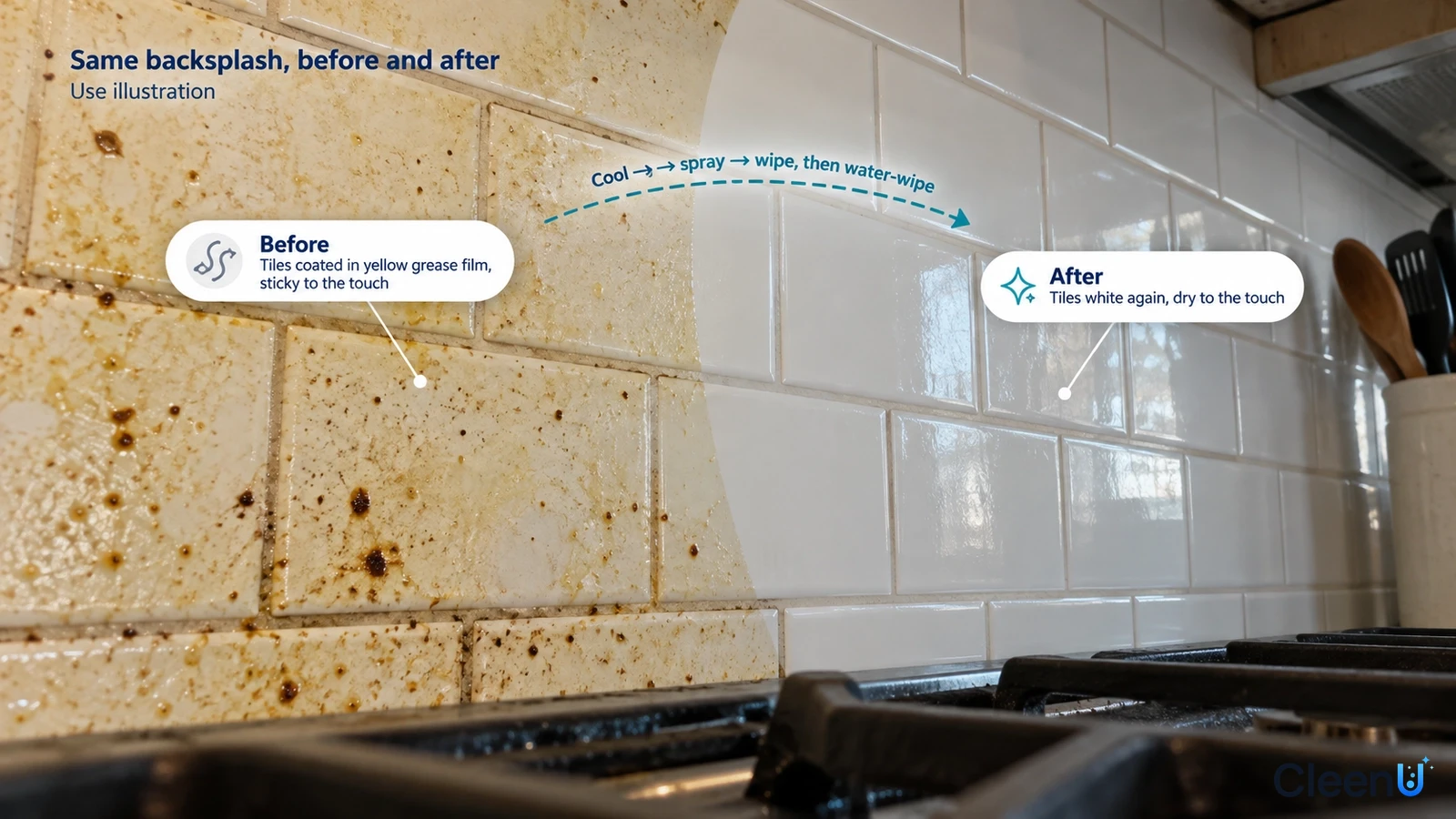
Before and after (use illustration)
Before: the white tile behind the stove has a yellow, tacky grease film with darker spots. After: sprayed, left 3 minutes, sponged, and wiped with clean water, the tile is white again and feels clean.
- Before: a yellow, sticky film and dark spots on white backsplash tile
- After: white tile that feels dry to the touch
- Finish with a clean damp cloth to remove residue
How it works
How Sticky Grease Wipes Away
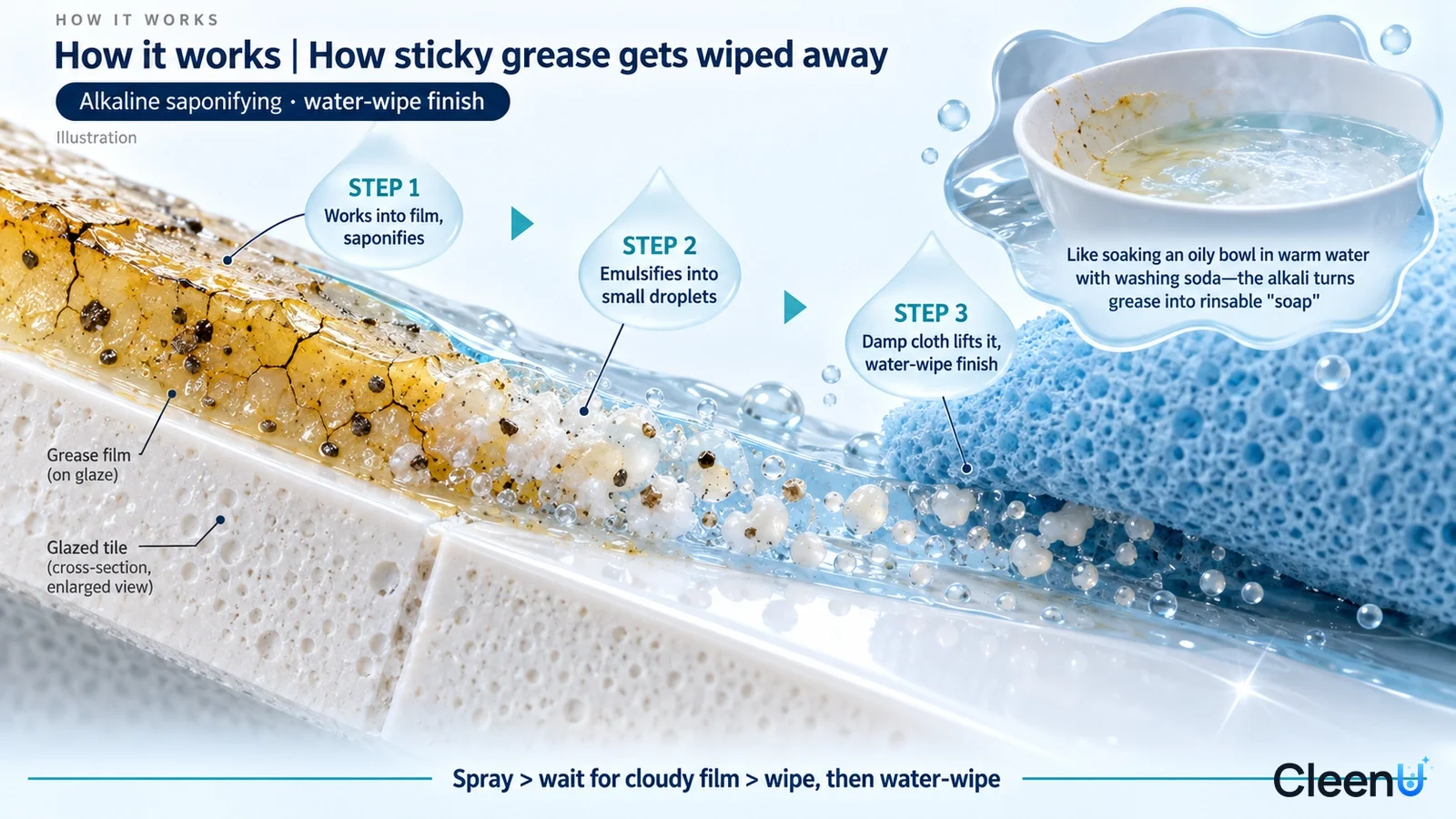
Kitchen grease is mostly triglycerides and their oxidized polymers. Alkaline builders attack the ester bonds (saponification), producing fatty-acid salts (soap) and glycerol, both water-soluble. That soap also acts as a surfactant and, with the formula’s surfactants, emulsifies the remaining oil into tiny droplets, while a solvent helps penetrate polymerized film. A damp cloth lifts the emulsion and a clean-water wipe removes leftover alkali and soap.
- Alkali saponifies triglycerides
- Water-soluble soap forms
- Surfactants emulsify the rest
- Cloth lifts
- Water removes residue
Usage guidance
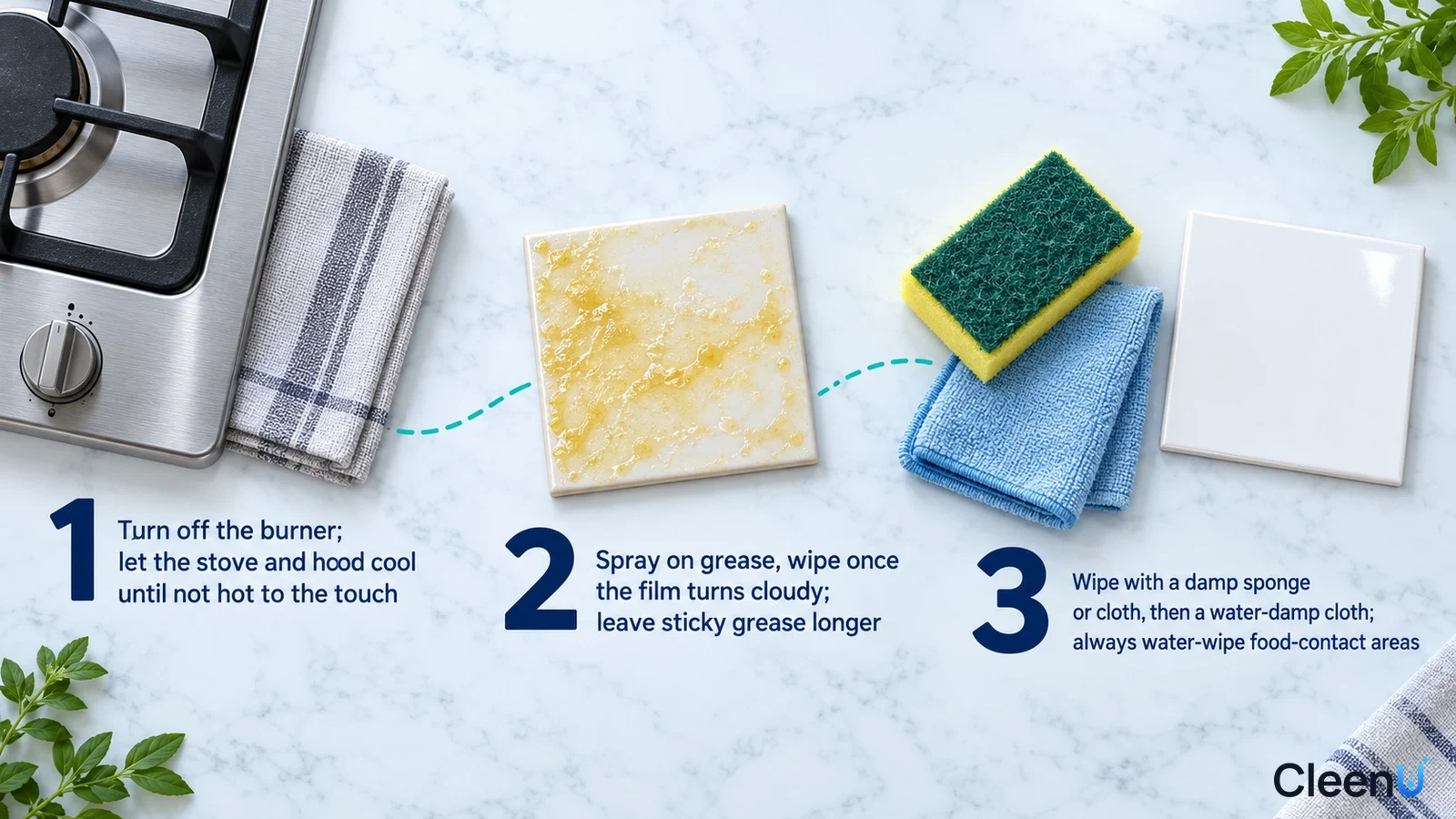
Use guidance
- Turn off the heat and let the stove and hood cool to the touch.
- Spray the grease and wait 1 to 3 minutes, 5 for sticky film, until it turns cloudy.
- Wipe with a damp sponge or cloth, then wipe again with clean water, always on food-contact areas.
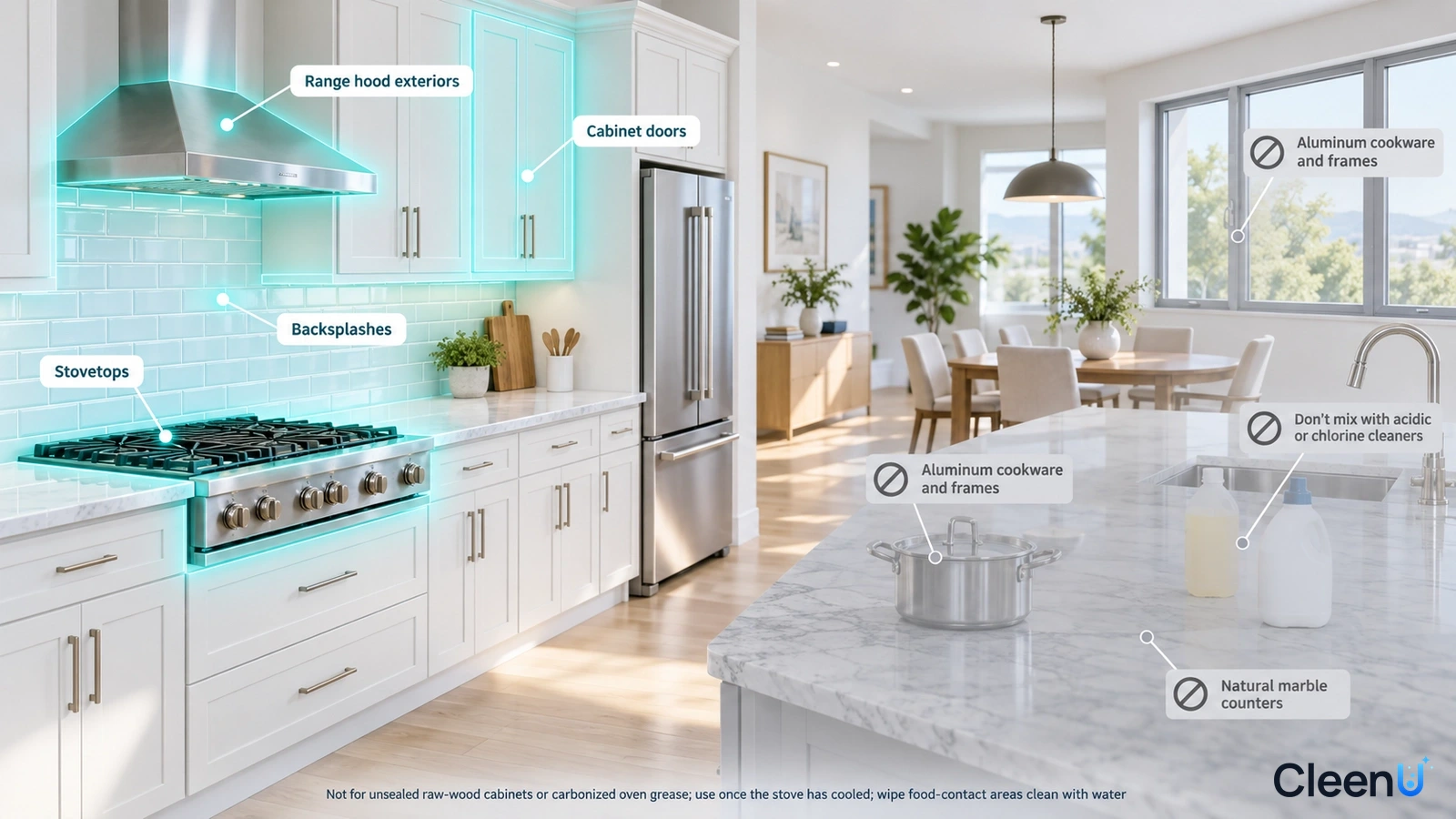
Before you use it
Important notes
- Not for: Aluminum cookware and frames
- Not for: Unsealed wood cabinets
- Not for: Natural marble counters
- Not for: Hot stovetops
- Not for: Carbonized oven grease
Product comparison
How to choose a Kitchen Cleaner & Degreaser
Everyday and sticky grease on stovetops, hood exteriors, and backsplashes: Kitchen Cleaner & Degreaser. Carbonized grease inside ovens and on trays: Oven Cleaner & Degreaser. Grill grates and fireboxes: BBQ Grill Cleaner & Degreaser.
View product comparison
| Decision point | Kitchen Degreaser & Cleaner | Dish soap and water |
|---|---|---|
| Aged sticky grease | Saponified and wiped off | Won’t budge |
| Method | Spray, wait, wipe | Repeated scrubbing |
| Vertical backsplash | Spray clings | Runs off |
| Finish | One water wipe | Sudsy, many rinses |
Where Kitchen Degreaser & Cleaner stands out
Aged Grease Polymerizes, So It Gets Stickier
Unsaturated fats in cooking oil slowly oxidize and cross-link with heat and air, linking into larger networks that turn free-flowing oil into a sticky, yellow, eventually hard film. Fresh spatter wipes off with dish soap; a week old, it’s tacky; a month old, it needs a degreaser. The alkali in this cleaner saponifies the triglycerides into water-soluble soap, and surfactants emulsify what remains so the film lets go.
Give It 1 to 3 Minutes, Then Finish With Water
Saponification takes a moment; wipe immediately and you only take the top layer. Wait 1 to 3 minutes, 5 for tacky old grease, and wipe once the film turns cloudy. Then go over it with a clean, damp cloth to remove the soap and leftover alkali so the surface doesn’t feel dull or sticky, especially on stovetops and counters near food.
Who it's for, where it's used, and when not to use it
For
End-use scenarios
When not to use it
Product Specifications and Custom Options
Key product details and custom options for your project.
Product specifications
Product type, cleaning scope, and format.
| Product type | Alkaline kitchen degreasing spray |
| Surfaces | Stovetops, range hood exteriors, backsplashes, cabinet doors, and kitchen counters |
| Use scenarios | Weekly kitchen clean; High-heat wok cooking; Move-in and move-out |
| Target soils | Grease spatter, sticky film, and yellowed residue on stovetops, hoods, backsplashes, cabinets, and counters |
| Directions | Ready to use, no dilution; 1–3 min dwell, 5 on sticky grease; wipe, then wipe with water |
| Not for | Aluminum cookware and frames; Unsealed wood cabinets; Natural marble counters; Hot stovetops; Carbonized oven grease; Use with acids or bleach |
| Size and packaging | 500 mL trigger spray bottle |
| pH | pH 10.0–11.5 at 25°C |
| Scent | Fresh lemon scent |
| Shelf life and storage | 24 months unopened; keep tightly closed in a cool, dry, well-ventilated place. Protect from heat, direct sunlight, and freezing |
B2B custom options
Private label, packaging, MOQ, samples, and delivery.
| OEM/ODM and private label | From product direction and sample review to packaging, production, and delivery for your Kitchen Cleaner & Degreaser project. |
| Packaging and labels | Mist trigger / foam trigger, fill size, labels, and retail sets can be customized |
| Case pack | 12 × 500 mL per case |
| MOQ | 500 bottles |
| Sample time | Free sample: 3–5 days |
| Bulk lead time | Scheduled with the order after packaging and label approval |
| Documents | SDS/MSDS, TDS, and batch COA provided per project on inquiry |
OEM/ODM project process
Move from product direction and sample review to packaging, production, and delivery for Kitchen Degreaser & Cleaner.
Define the target kitchen
Decide heavy wok cooking or everyday Western kitchens; alkalinity and solvents follow.
Free sample
A free sample is usually ready in 3–5 days for project review.
Packaging and labels
Set fill size, trigger type, label language, the warnings your market requires, and rinse-food-contact-areas, no-aluminum, and wear-gloves instructions.
Bulk delivery
Standard MOQ is 500 bottles; bulk orders are scheduled after packaging and labels are approved.
Why choose CleenU for Kitchen Degreaser & Cleaner?
From product positioning and samples to packaging and repeat supply, CleenU supports OEM/ODM projects built around Kitchen Degreaser & Cleaner.
Grease speed balanced with compatibility
Higher alkalinity cuts faster but is harder on lacquer, aluminum, and natural stone.
Mist or foam
Mist covers counters; foam clings to backsplashes and hoods.
Sample reviews with clear criteria
Review samples on your tile, stainless, and lacquer panels with aged grease film against clear points: aged grease removal speed, feel after water wipe, and effect on lacquer and stainless.
Lemon fresh
Lemon is the kitchen classic; unscented is also available.
Labels and documents
We supply bilingual labels, SDS/MSDS, TDS, and batch COAs, with rinse-food-contact-areas, no-aluminum, and wear-gloves instructions on the label, and can arrange third-party testing for your market.
Consistent supply and reorders
Each batch is retained and ships with a COA, so reorders match in color, scent, and feel.
Packaging and labeling options
Plan packaging format, label language, and shelf presentation around Kitchen Degreaser & Cleaner and your target channel.
Show packaging and label options
Packaging options
Core size: 500 mL trigger spray bottle. Also available: 1 L household refill, channel case packs, and ecommerce bundles with sponges and microfiber cloths. Mist trigger or foam trigger options, with labels and cartons made to your brand.
Supporting Documents and Materials
Purchasers usually confirm whether the materials are complete before formal cooperation. Preparing documents in advance helps with quoting, sampling, and channel review.
Show available documents
Project documents
When you inquire, we provide SDS/MSDS, a TDS, batch COAs, label directions, and packaging files for your project.
Related products, solutions, and articles
Explore related cleaning products, application guidance, and OEM/ODM resources for Kitchen Degreaser & Cleaner.
Frequently asked questions (FAQ)
Find practical answers about Kitchen Degreaser & Cleaner, private label, samples, MOQ, documents, and delivery.
How to use
How do I clean sticky grease on a range hood?
Turn it off and let it cool, spray, wait 5 minutes until the film clouds and softens, sponge it off, and wipe with water. On stainless, wipe with the grain.
Can I use it on high-gloss cabinet doors?
Yes, but test first, spray the cloth, keep dwell under a minute, and follow right away with a clean-water wipe.
Can I use it inside the oven?
Oven interiors carry carbonized, baked-on grease; an oven cleaner works better. This is for everyday grease on stovetops and hood exteriors.
How do I remove years of grease from wood kitchen cabinets?
On sealed wood cabinets, spray it onto a soft cloth rather than the door, hold it on the greasy area for 1–3 minutes, wipe with the grain, then wipe with a damp cloth and dry. Work heavy buildup in two or three rounds, and skip steel wool. Don't use an alkaline degreaser on unsealed raw wood.
Surfaces and common questions
Do I need to rinse after?
Yes. Follow with a clean-water wipe to remove alkali and soap so the surface isn’t dull or tacky, especially where food touches.
Can I use it on aluminum?
No; alkali darkens and corrodes aluminum. Use a neutral cleaner on aluminum pans, frames, and hood filters.
Can I use it on stone counters?
Not on natural marble or limestone; alkali can dull them. Quartz, sintered stone, stainless, and tile are fine.
Can I use it on range-hood filters?
Yes. Pull the filter, spray it thoroughly in the sink, wait 5–10 minutes, brush along the mesh, and rinse with hot water. Shorten the dwell for aluminum filters and test a small area first so they don’t darken.
It runs down the wall before it can work.
On vertical surfaces, spray lightly in several passes or apply with a sponge; a foam trigger clings better. Don’t let runs dry on the cooktop or counter below.
How often should I clean to keep it easy?
Wipe the stove and backsplash after cooking while grease is fresh, and do a full clean weekly. Once grease turns yellow and sticky, it takes longer dwell and more passes.
Can I use it on grease stains on clothes?
Better not. A kitchen degreaser is alkaline and can fade colored fabric or damage wool and silk. Pretreat the grease spot with laundry detergent or a laundry stain remover for 10 minutes, then wash as the care label says.
Does baking soda remove kitchen grease?
Only on light spots. Baking soda works mainly by scrubbing, so it does little on sticky film around the stove and range hood and tends to leave white residue. For sticky grease, let an alkaline degreaser sit 1–3 minutes, then wipe; it's faster and cleaner.
Buying and private label
What should we decide first for a private-label kitchen cleaner & degreaser?
Three things: heavy wok-style kitchens or everyday Western kitchens (different alkalinity), mist or foam trigger (foam suits backsplashes), and lemon or unscented. Kitchen degreaser is one of the largest single items in cleaning; speed and smell set brands apart.
What are the sample, MOQ, and lead-time terms?
Free samples are usually ready in 3–5 days. Standard MOQ is 500 bottles, and bulk orders are scheduled after packaging and labels are approved.
What can be customized?
All of it: formula direction, scent, fill size (500 mL spray, 1 L refill, and more), mist or foam trigger, label design and language, and ecommerce bundles with sponges and microfiber cloths.
Can we test samples first?
Yes, we ship samples first. Test them on tile, stainless, and lacquer panels with aged grease film like the ones your customers handle, and record aged grease removal speed, feel after water wipe, and effect on lacquer and stainless. That tells you more than a before-and-after photo.
Which documents can you provide?
We provide SDS/MSDS, a TDS, and batch COAs, plus bilingual label content for your target market. They aren’t posted publicly; we send them per project on inquiry.
How is private-label pricing quoted?
Pricing is tiered by packaging, trigger or cap, label, and order quantity, starting at the 500-bottle MOQ. Send your target quantity, fill size, and packaging needs, and we’ll quote unit prices by volume tier with sample and lead-time details.
Launching your own Kitchen Cleaner & Degreaser?
Send us your market, kitchen type, trigger, and estimated volume. We will tune alkalinity and scent with you.