
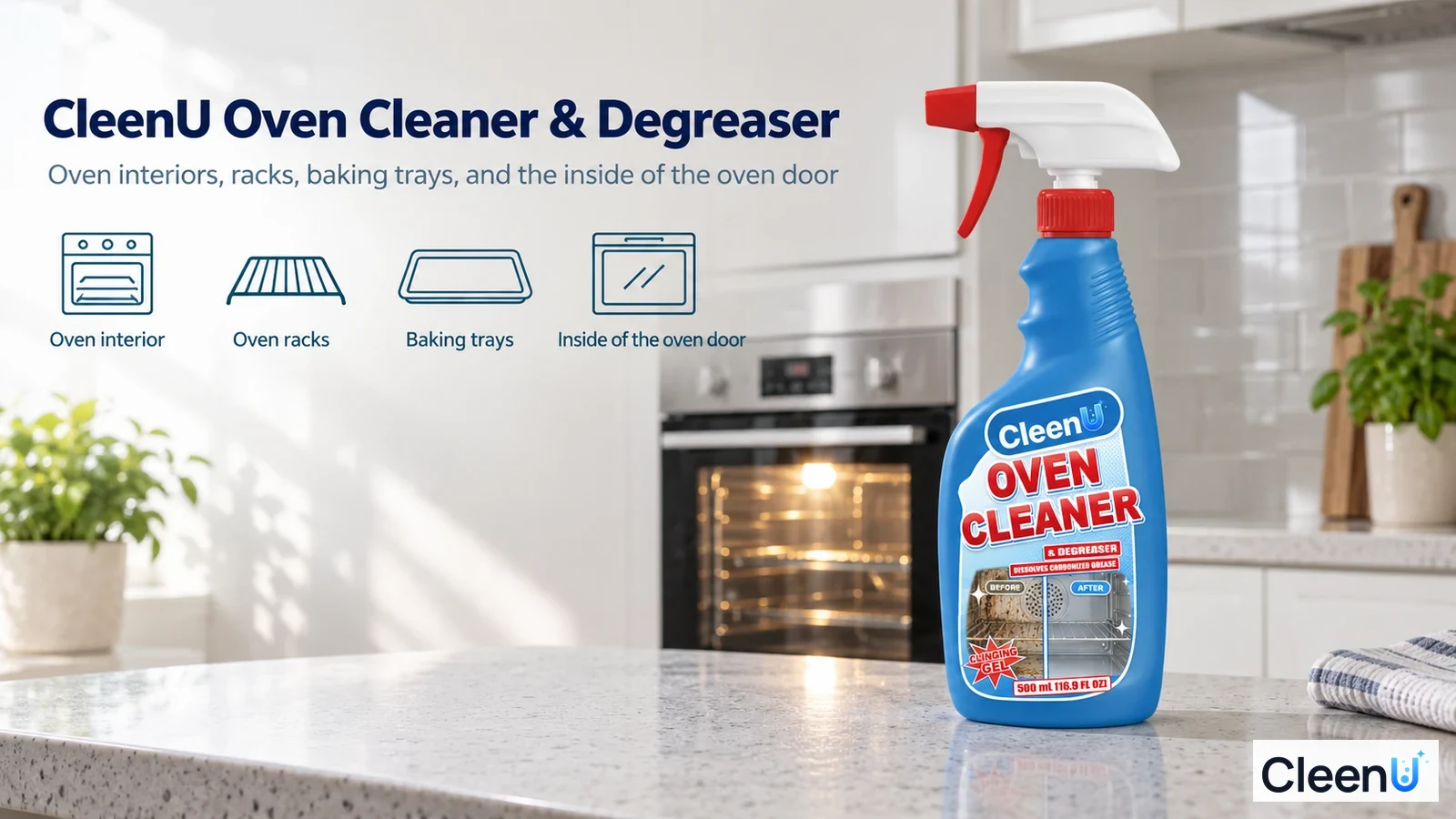
Product and application illustrations. Follow the product label and written use guidance.
CleenU product solution
Oven Cleaner & Degreaser
Clinging gel · Dissolves carbonized grease · Private label
Flaking black carbon on the oven floor and walls? In a cold oven, spray the gel, close the door for 15–30 minutes, scrape with a plastic scraper, and wipe repeatedly down to the enamel. The gel clings; private label from 500 bottles.
- Fat heated over and over at oven temperatures first oxidizes and polymerizes into a tacky film, then partially carbonizes into a hard, black, glossy crust fused to the enamel. At that point it isn’t really grease anymore, and ordinary degreasers only reach the surface. This strongly alkaline system re-saponifies and breaks down the polymerized fat and loosens the bond between the carbon layer and the enamel, so after enough time the crust turns into a soft sludge you can scrape away.
- Oven interiors have sides and a roof, and liquids run to the floor fast. The gel stays on vertical surfaces and keeps working for 30 minutes or more. Always start with a cold oven and close the door to let it work; heavy buildup can go to an hour. After scraping, wipe several times with a damp cloth and clean water to remove all alkaline residue so there’s no smell the next time you heat it.
- MOQ
- 500 bottles
- Free samples
- 3–5 days
- Bulk lead time
- Scheduled with the order

Product value
What does Oven Cleaner & Degreaser clean?
Oven Cleaner & Degreaser removes carbonized, baked-on grease from oven interiors, racks, trays, and the inside of oven doors.
View product detailsProduct summary
- Product type
- Heavy-duty alkaline oven cleaning gel spray
- Intended use
- Carbonized, baked-on grease on oven interiors, racks, trays, and door insides
- Formula
- Strong alkali (hydroxide type) with a thickener, alkali-stable surfactants, and solvent, pH 12.5–13.5; unscented; ready-to-use gel spray.
- For
- Cleaning product brands, cookware and appliance-accessory brands, supermarket and household-care channels, ecommerce sellers
Before & after
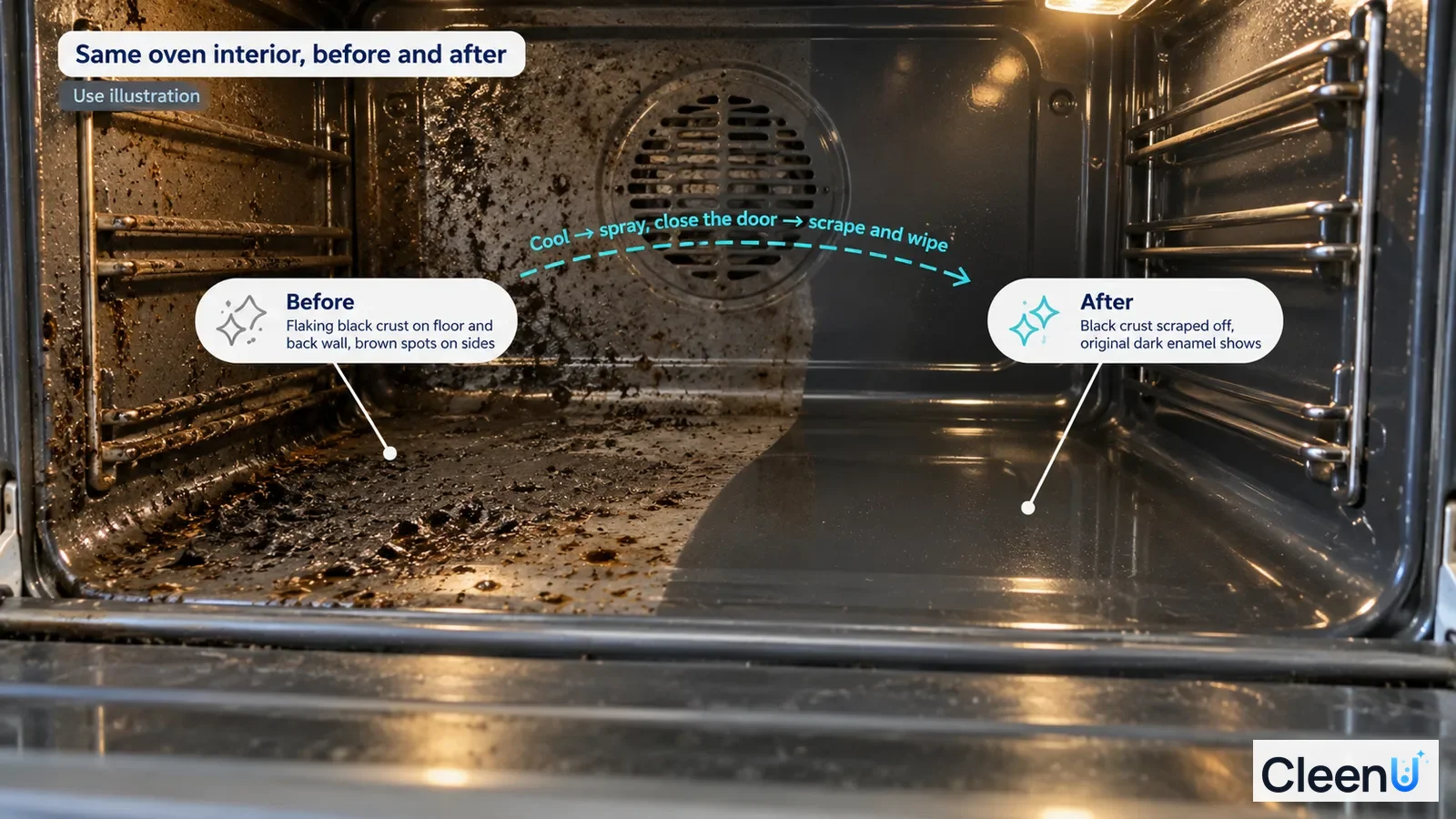
Before and after (use illustration)
Before: the floor and back wall are covered in black carbonized grease, flaking where it’s thick, with brown spots on the sides. After: gel on a cold oven for 30 minutes, a plastic scraper, and repeated damp-cloth wipes leave the floor and walls showing their original dark enamel with no crust left.
- Before: black carbon so thick on the floor and back wall it flakes
- After: the original dark enamel with no crust left
- The gel clings to side walls and the ceiling
How it works
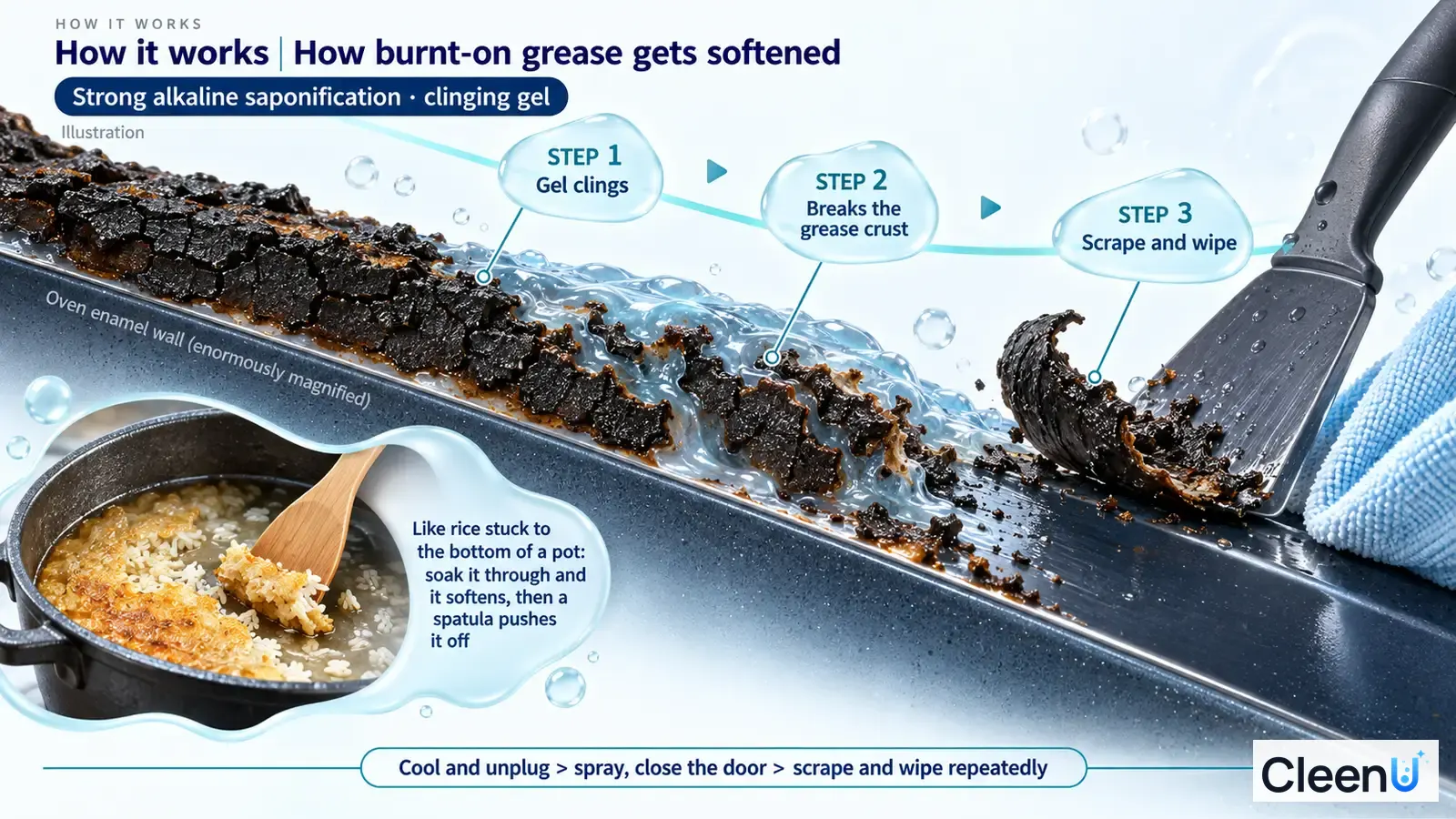
How Carbonized Grease Softens
Oven black is a network of oxidized, polymerized triglycerides with partly carbonized products. Strong alkali such as sodium or potassium hydroxide keeps saponifying the ester bonds in that network at high pH, cutting it into soluble fatty-acid salts. The solution also soaks into the carbon layer so it swells and weakens, and breaks down residual fat at the interface with the enamel so the crust loosens. A thickener forms the gel that keeps the solution wet and reacting on vertical surfaces, and surfactants aid wetting and penetration. A plastic scraper removes it, and repeated water wipes clear the alkaline residue.
- Strong alkali saponifies polymerized fat
- Swells carbon layer
- Loosens the bond
- Gel keeps it wet and working
- Scrape and wipe with water
Usage guidance
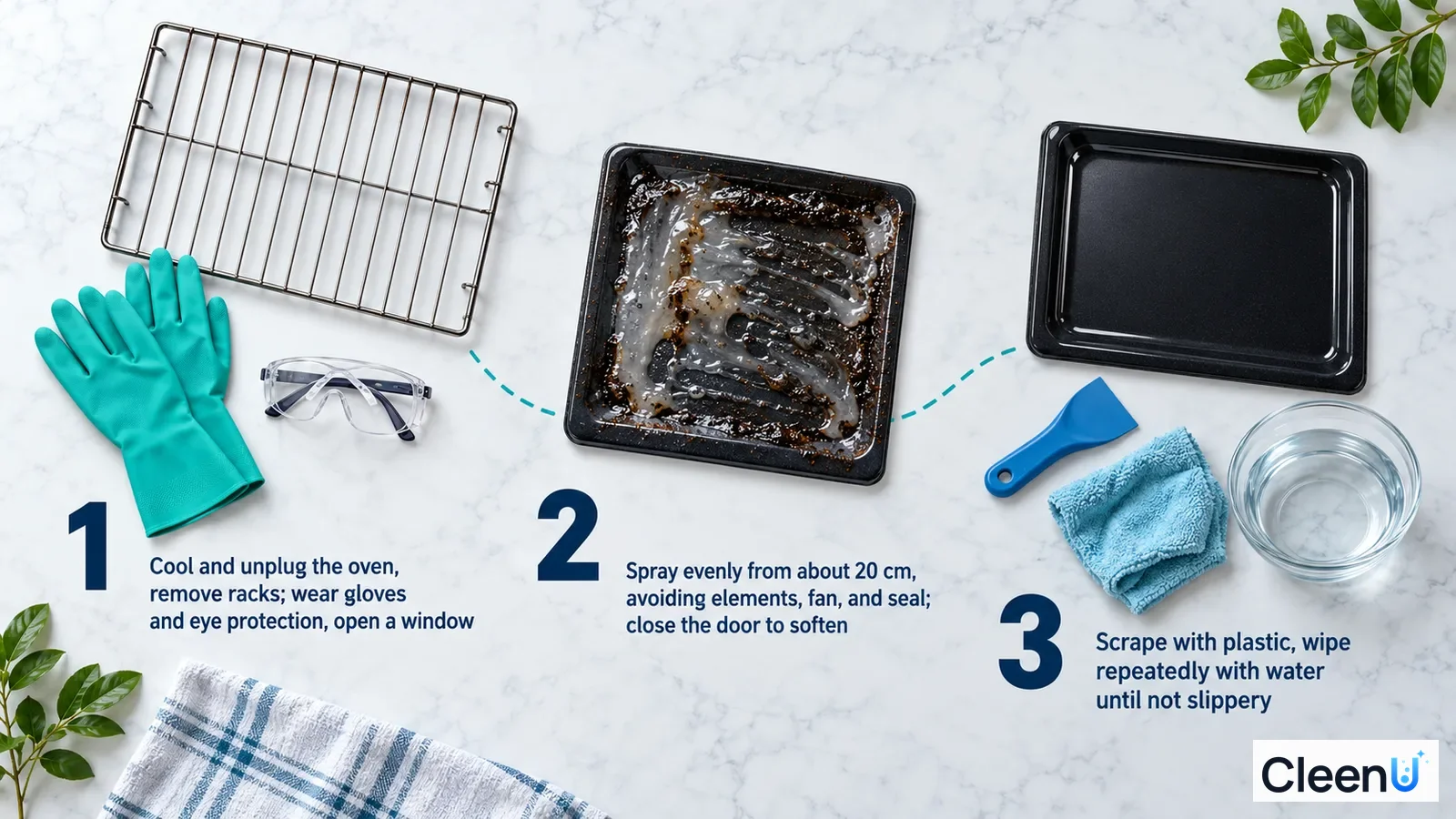
Use guidance
- Make sure the oven is cold and switched off; remove racks and trays to treat separately; wear alkali-resistant gloves and goggles and open a window.
- Spray evenly from 20 cm onto grease on the interior, racks, and trays, avoiding elements, the fan, the temperature probe, and the door seal; close the door for 15 to 30 minutes, up to an hour for heavy buildup.
- Scrape off the softened grime with a plastic scraper, wipe with a damp cloth and clean water at least three times until nothing feels slippery, then heat the empty oven at 200°C for 10 minutes to clear any smell.
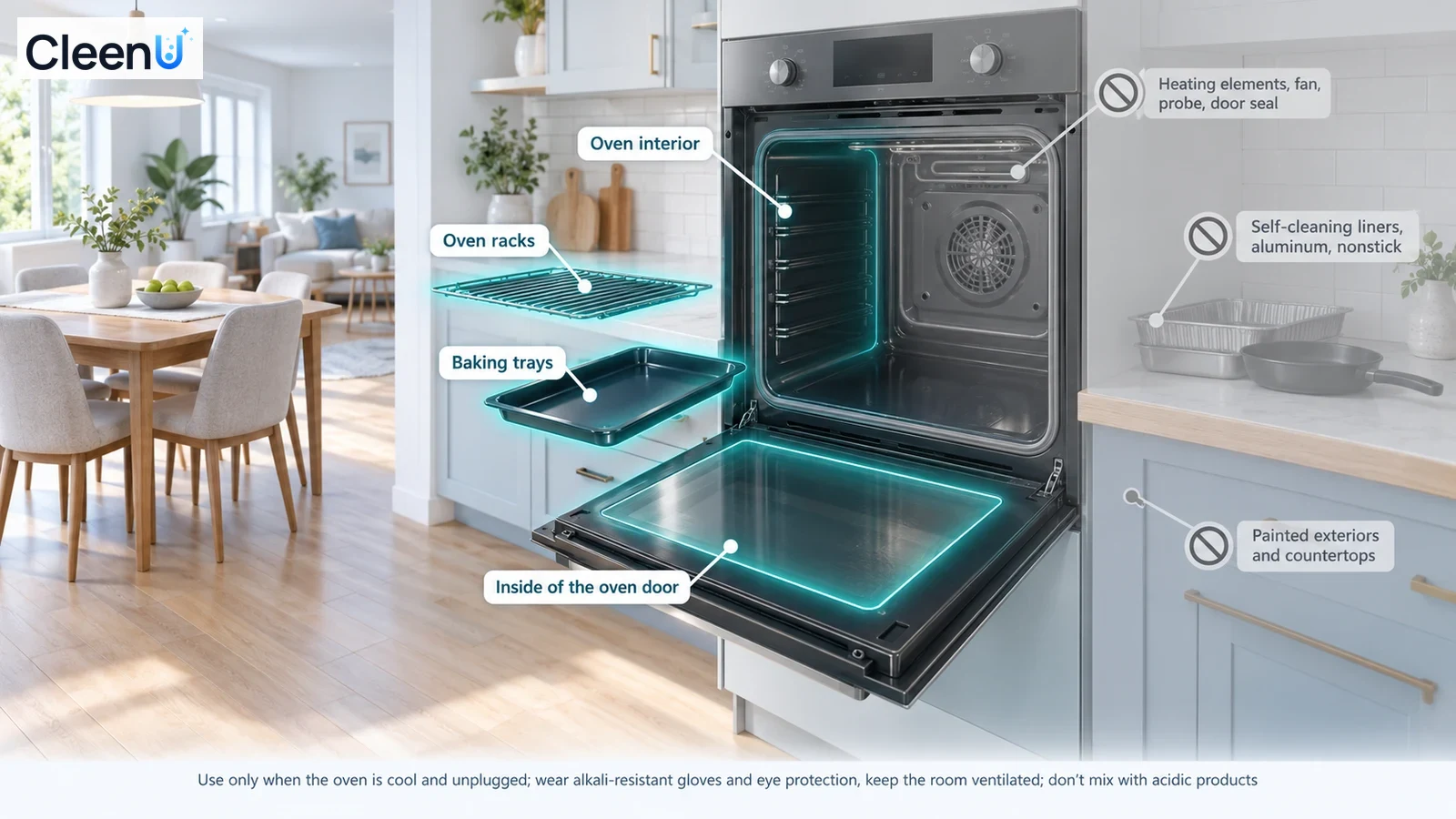
Before you use it
Important notes
- Not for: Warm ovens
- Not for: Elements, fans, probes, and door seals
- Not for: Catalytic self-cleaning liners
- Not for: Aluminum and non-stick trays
- Not for: Painted exteriors and counters
Product comparison
How to choose an Oven Cleaner & Degreaser
Carbonized grease inside ovens and on racks: Oven Cleaner & Degreaser. Baked-on film on oven door glass: Oven Glass Cleaner. Everyday sticky grease on stovetops and hoods: Kitchen Cleaner & Degreaser.
View product comparison
| Decision point | Oven Cleaner & Degreaser | Baking soda paste and vinegar |
|---|---|---|
| Carbonized crust | Softened by strong alkali | Limited |
| Time | 15–30 minutes | Usually overnight |
| On walls | Gel clings | Paste slides off |
| Precautions | Gloves and goggles required | Lower |
Where Oven Cleaner & Degreaser stands out
Oven Black Is Grease That Has Been Cooked
Fat heated over and over at oven temperatures first oxidizes and polymerizes into a tacky film, then partially carbonizes into a hard, black, glossy crust fused to the enamel. At that point it isn’t really grease anymore, and ordinary degreasers only reach the surface. This strongly alkaline system re-saponifies and breaks down the polymerized fat and loosens the bond between the carbon layer and the enamel, so after enough time the crust turns into a soft sludge you can scrape away.
Gel That Clings, Enough Time, and a Thorough Water Wipe
Oven interiors have sides and a roof, and liquids run to the floor fast. The gel stays on vertical surfaces and keeps working for 30 minutes or more. Always start with a cold oven and close the door to let it work; heavy buildup can go to an hour. After scraping, wipe several times with a damp cloth and clean water to remove all alkaline residue so there’s no smell the next time you heat it.
Who it's for, where it's used, and when not to use it
For
End-use scenarios
When not to use it
Product Specifications and Custom Options
Key product details and custom options for your project.
Product specifications
Product type, cleaning scope, and format.
| Product type | Heavy-duty alkaline oven cleaning gel spray |
| Surfaces | Oven interiors, racks, baking trays, and the inside of oven doors |
| Use scenarios | After holiday roasts; Move-out cleaning; Restaurants and bakeries |
| Target soils | Carbonized, baked-on grease on oven interiors, racks, trays, and door insides |
| Directions | Ready to use, no dilution; 15–30 min on a cold oven, longer for heavy buildup; scrape, then wipe with water |
| Not for | Warm ovens; Elements, fans, probes, and door seals; Catalytic self-cleaning liners; Aluminum and non-stick trays; Painted exteriors and counters; Mixing with acids |
| Size and packaging | 500 mL trigger spray bottle |
| pH | pH 12.5–13.5 at 25°C |
| Scent | Unscented |
| Shelf life and storage | 24 months unopened; keep tightly closed in a cool, dry, well-ventilated place. Protect from heat, direct sunlight, and freezing |
B2B custom options
Private label, packaging, MOQ, samples, and delivery.
| OEM/ODM and private label | From product direction and sample review to packaging, production, and delivery for your Oven Cleaner & Degreaser project. |
| Packaging and labels | Mist trigger / foam trigger, fill size, labels, and retail sets can be customized |
| Case pack | 12 × 500 mL per case |
| MOQ | 500 bottles |
| Sample time | Free sample: 3–5 days |
| Bulk lead time | Scheduled with the order after packaging and label approval |
| Documents | SDS/MSDS, TDS, and batch COA provided per project on inquiry |
OEM/ODM project process
Move from product direction and sample review to packaging, production, and delivery for Oven Cleaner & Degreaser.
Define format and regulations
Choose gel trigger or aerosol and check strong-alkali labeling and child-resistant packaging rules.
Free sample
A free sample is usually ready in 3–5 days for project review.
Packaging and labels
Set fill size, trigger type, label language, the warnings your market requires, and strong-alkali corrosive warnings, PPE requirements, and cold-oven-only and avoid-elements-and-liners instructions.
Bulk delivery
Standard MOQ is 500 bottles; bulk orders are scheduled after packaging and labels are approved.
Why choose CleenU for Oven Cleaner & Degreaser?
From product positioning and samples to packaging and repeat supply, CleenU supports OEM/ODM projects built around Oven Cleaner & Degreaser.
Strength balanced with safety
Alkalinity sets speed and also hazard class and labeling; we can make a standard and a milder fume-free version.
Gel trigger or aerosol
Gel triggers must resist strong alkali; aerosols give thick, clinging foam but ship as dangerous goods.
Sample reviews with clear criteria
Review samples on your enamel oven panels and chrome racks with carbonized grease against clear points: carbonized grease softening time, cling time, and residue after water wipes.
Unscented
No fragrance for food-heating appliances.
Labels and documents
We supply bilingual labels, SDS/MSDS, TDS, and batch COAs, with strong-alkali corrosive warnings, PPE requirements, and cold-oven-only and avoid-elements-and-liners instructions on the label, and can arrange third-party testing for your market.
Consistent supply and reorders
Each batch is retained and ships with a COA, so reorders match in color, scent, and feel.
Packaging and labeling options
Plan packaging format, label language, and shelf presentation around Oven Cleaner & Degreaser and your target channel.
Show packaging and label options
Packaging options
Core size: 500 mL trigger spray bottle. Also available: 1 L household refill, channel case packs, and ecommerce bundles with the oven glass cleaner, a scraper, and gloves. Mist trigger or foam trigger options, with labels and cartons made to your brand.
Supporting Documents and Materials
Purchasers usually confirm whether the materials are complete before formal cooperation. Preparing documents in advance helps with quoting, sampling, and channel review.
Show available documents
Project documents
When you inquire, we provide SDS/MSDS, a TDS, batch COAs, label directions, and packaging files for your project.
Related products, solutions, and articles
Explore related cleaning products, application guidance, and OEM/ODM resources for Oven Cleaner & Degreaser.
Frequently asked questions (FAQ)
Find practical answers about Oven Cleaner & Degreaser, private label, samples, MOQ, documents, and delivery.
How to use
Will it remove black, baked-on crust?
Yes. Gel a cold oven for 30 minutes, up to an hour for thick crust, and it softens so a plastic scraper lifts it; then wipe with water.
Why must the oven be cold?
Heat dries the gel so it stops working, creates irritating vapor, and risks burns. Always start cold.
Can I use it in a self-cleaning oven?
Not on catalytic liners (the rough, absorbent panels); it damages them. For pyrolytic ovens, use the self-clean cycle per the manual, and use this only on plain enamel.
Do you need a mask with oven cleaner?
Yes, wear one. This is a strongly alkaline gel and spraying creates fine droplets, so wear a mask, rubber gloves, and eye protection, and open a window or run the range hood. Spray only inside a cold oven, never toward your face, and close the door while it works.
Surfaces and common questions
How do I clean the racks?
Take them out, lay them on a trash bag or newspaper, coat with gel, seal them in the bag for an hour, then scrub and rinse.
Can I use it on aluminum trays?
No; strong alkali corrodes aluminum. Soak aluminum and non-stick trays in a neutral cleaner.
Will the oven smell afterward?
It’s unscented; wipe with water at least three times, then heat the empty oven for 10 minutes, and nothing carries over to food.
There’s a white residue in the oven after wiping.
That’s leftover alkaline product. Wipe several more times with a clean damp cloth until nothing feels slippery, and wipe once more before heating so no residue bakes on.
Can I use it on the inside of the oven door glass?
Yes—avoid the gasket. Let it dwell, scrape at a low angle, and polish. For glass-only jobs, an oven glass cleaner is handier.
How often should I deep-clean the oven?
Every 1–3 months for home use, depending on how often you bake. Wipe up spills once the oven cools after each use so carbon doesn’t keep building.
Do baking soda and vinegar really clean ovens?
Only light grease and fresh spills. A baking soda paste left overnight softens a thin film; mixed with vinegar, the two mostly neutralize each other, so you get fizz but little cleaning. For black, baked-on carbon on the oven floor and back wall, a strongly alkaline gel left 15–30 minutes in a cold oven scrapes off far faster.
Can I use oven cleaner as an everyday degreaser?
No. Oven cleaner is strongly alkaline and made for carbonized, baked-on grease; on counters, painted appliance panels, or aluminum it can whiten, discolor, or corrode the surface. For everyday grease on the stovetop, range hood, and backsplash, use a kitchen degreaser.
Buying and private label
What should we decide first for a private-label oven cleaner & degreaser?
Three things: gel trigger or aerosol (aerosol foam is thicker and clings better), your market’s warning-label and child-resistant packaging rules for strong alkalis, and whether to bundle with the oven glass cleaner as a deep-clean kit. Oven cleaner is a mature, high-volume item in Western kitchens.
What are the sample, MOQ, and lead-time terms?
Free samples are usually ready in 3–5 days. Standard MOQ is 500 bottles, and bulk orders are scheduled after packaging and labels are approved.
What can be customized?
All of it: formula direction, scent, fill size (500 mL spray, 1 L refill, and more), mist or foam trigger, label design and language, and ecommerce bundles with the oven glass cleaner, a scraper, and gloves.
Can we test samples first?
Yes, we ship samples first. Test them on enamel oven panels and chrome racks with carbonized grease like the ones your customers handle, and record carbonized grease softening time, cling time, and residue after water wipes. That tells you more than a before-and-after photo.
Which documents can you provide?
We provide SDS/MSDS, a TDS, and batch COAs, plus bilingual label content for your target market. They aren’t posted publicly; we send them per project on inquiry.
How is private-label pricing quoted?
Pricing is tiered by packaging, trigger or cap, label, and order quantity, starting at the 500-bottle MOQ. Send your target quantity, fill size, and packaging needs, and we’ll quote unit prices by volume tier with sample and lead-time details.
Launching your own Oven Cleaner & Degreaser?
Send us your market, format, packaging, and estimated volume. We will work through the strong-alkali formula and warning labels with you.