
Q&A
Can You Use a Different Cleaning Solution in an iRobot Roomba Combo or Braava?
Direct answer
Yes, if you pick the right one: a low-foam, neutral, particle-free concentrate that redissolves after drying, diluted about 1:50 to 1:100, with no hot water or vinegar.
What iRobot's support site approves, model by model
Yes
- Plain water: approved for the Roomba Combo i and j series, Combo 10 Max, Braava jet m6, and Braava jet 240
- iRobot's own solutions: Braava Jet Fresh (6 caps in the m6, 2 caps in the jet 240), plus StayClean concentrate for the Combo 10 Max
No
- Hot water: not allowed in any of the listed models
- Water plus vinegar: iRobot rules it out because it corrodes internal parts
It depends
- Bona Hardwood Floor Cleaner and Bona Hard-Surface Floor Cleaner: approved for the Combo i and j series, Braava jet m6, and jet 240, used straight with no water; not approved for the Combo 10 Max because of excess suds
- Third-party solutions: low-foam, neutral, particle-free ones that redissolve after drying work, diluted about 1:50 to 1:100
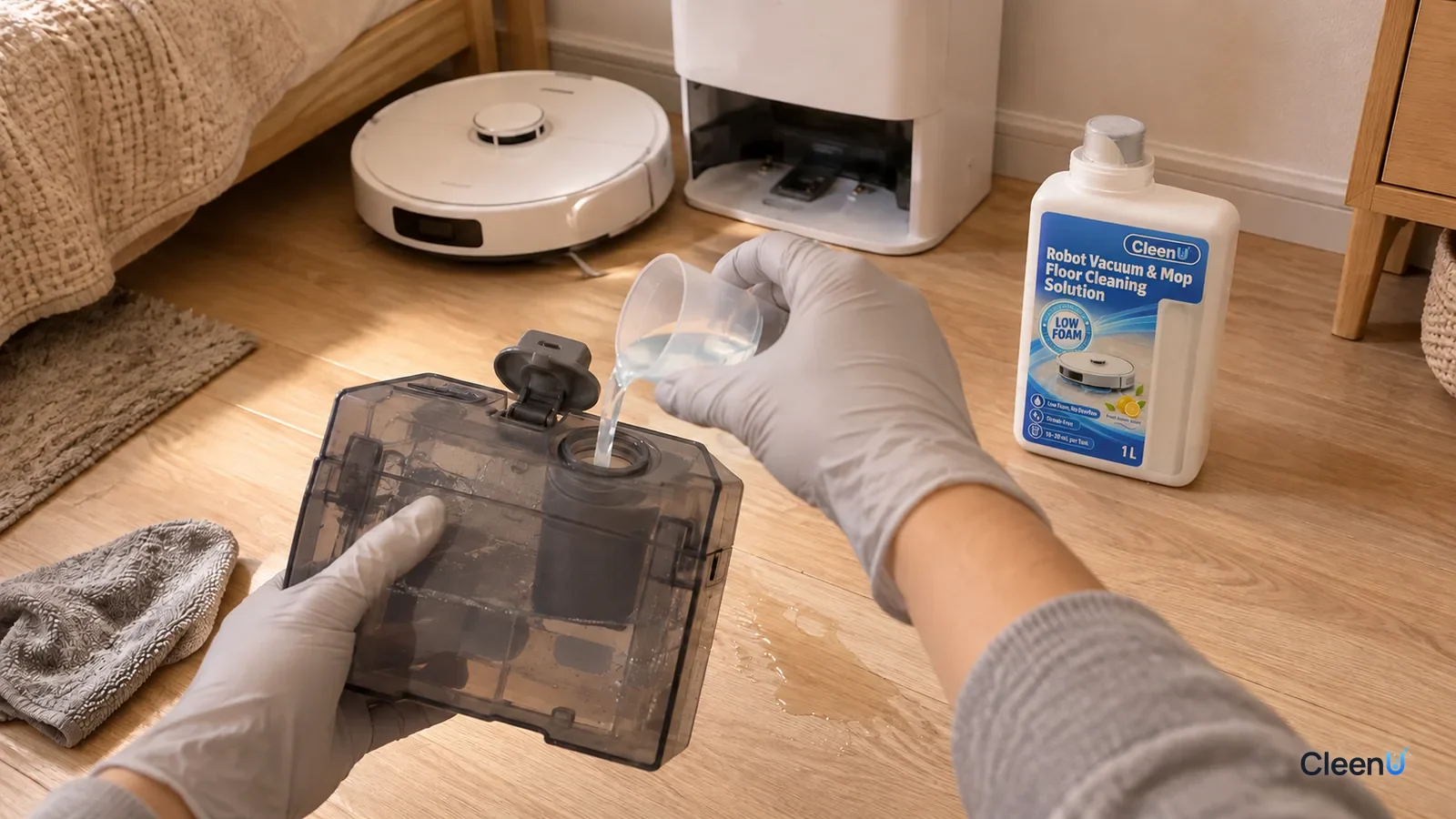
If iRobot's own solution is out of stock, used up, or just pricey, switching to another one is doable. The key is picking the right liquid. iRobot's support site has an article on what to use in Roomba Combo and Braava robots, and that list doubles as a spec sheet. It rules out vinegar (an acid) and hot water by name, and the one reason it gives for rejecting Bona in the Combo 10 Max is foam. A third-party solution has to clear the same bars: foam low enough that a mop-washing dock doesn't suds up, chemistry mild enough to leave metal and seals alone, and nothing that dries into a crust in a Braava's small spray nozzle.
The criteria themselves are simple: low foam, neutral pH, no particles, and a residue that redissolves instead of crusting, mixed at about 1:50 to 1:100 based on what your tank actually holds. Below: the official list, how liquid moves through each robot, the chemistry at the nozzle and pad, home tests, setup, and how to fine-tune.
iRobot's approved list is really three buying rules
Here's what iRobot's US support article says, limited to the models we verified:
- Roomba Combo i series and j series: plain water, Braava Jet Fresh, Bona Hardwood Floor Cleaner, or Bona Hard-Surface Floor Cleaner.
- Roomba Combo 10 Max: StayClean concentrate (2 caps in the AutoWash dock), Braava Jet Fresh (400 mL, about 13.5 oz, topped up with water), or plain water. iRobot singles out Bona as not approved here: it causes excessive sudsing that can lead to water getting onto the floor. iRobot adds that this won't damage the robot or dock but could affect the floor.
- Braava jet m6: plain water, Braava Jet Fresh (6 caps), or Bona.
- Braava jet 240: Braava Jet Fresh (2 caps), Bona, or plain water.
- Where Bona is approved, it's pre-mixed: you pour it in straight and add no water.
- No hot water in any listed model. No vinegar: iRobot says it corrodes internal parts.
The most telling line is the Combo 10 Max ruling. The same bottle of Bona is approved for the Braava jet m6 and rejected for the Combo 10 Max, and the reason isn't corrosion or floor damage. It's foam. That tells you something important: whether a liquid works depends on the machine it goes into and how hard that machine churns it. A Braava sprays liquid onto the floor and wipes it with a pad, which is a single, gentle pass. The Combo 10 Max has an AutoWash dock that scrubs and squeezes the mop pad over and over, so there are many more chances to whip air into the liquid. Foam that's irrelevant in the first design can overflow in the second. That's our reading of the hardware; iRobot's wording only says "excessive sudsing" and water reaching the floor.
So judge foam against the most foam-prone step in your robot (a Combo 10 Max dock is far more sensitive than a Braava), avoid acids and heat, and avoid anything that leaves solids in a small nozzle or open fibers.
How liquid moves through a Braava and a Roomba Combo
iRobot's two lines deliver water in very different ways, and that decides what to look for in a solution.
Braava jet models (like the m6 and jet 240) spray. The clean water tank sits in the robot. A pump pushes liquid to a nozzle at the front, which sprays it onto the floor ahead, and the pad underneath wipes over it. The nozzle opening is small, and liquid sits in it and in the line until the next run. Leave the robot for a few days and that bit of liquid at the opening slowly evaporates. With plain water, the worst you get is a trace of scale. With a high-solids solution, you get a dried film of salts, polymers, or surfactant right on the opening. A nozzle that's partly blocked or deflected shows up on the floor as one side wet and one side dry, or a narrow stripe instead of an even spray.
Roomba Combo robots feed a pad. Liquid from the tank is delivered to the mop pad, the microfiber holds it, and the pad releases it gradually as it mops. The Combo 10 Max adds the AutoWash dock, where the pad is washed. Here what matters isn't the nozzle. It's two other things: residue gumming up the pad's fibers so it absorbs and releases less evenly, and foam during washing and squeezing on dock models.
In both designs, whatever goes into the clean tank only moves forward, through the pump, line, and outlet to the floor or pad. That's why iRobot is strict about what goes in it.
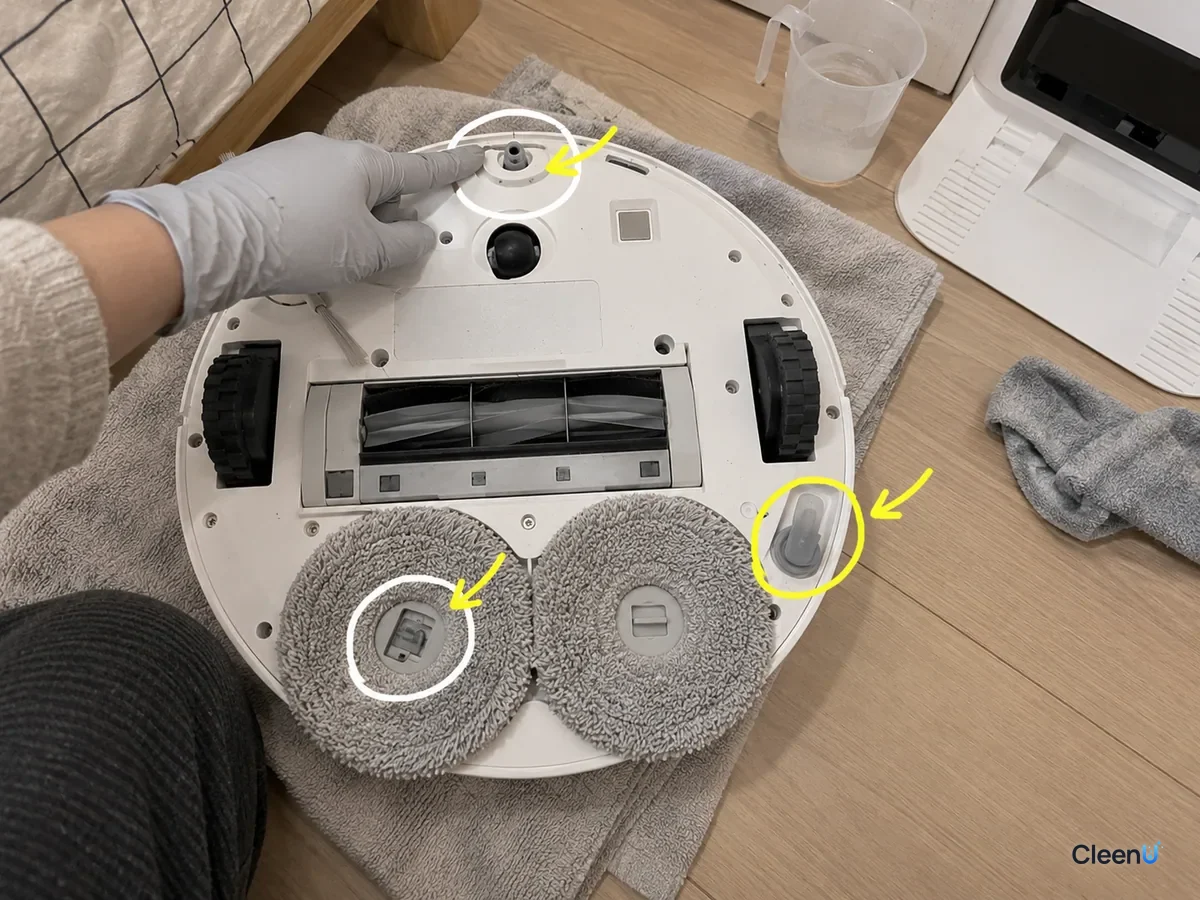
Why a small nozzle hates solids: evaporation, crystals, and films
People assume a solution clogs a nozzle because it's too thick. More often it's what's left when it dries. Diluted solution is mostly water; the rest (surfactants, builders, fragrance, preservatives, sometimes polymers or salts) is the "solids content," and it stays when the water goes.
At a tiny opening, evaporation works against you twice. While the robot sits idle, liquid at the tip keeps evaporating and being replaced from the line, so solids pile up right at the opening. And a drying film loses water fastest at its edge, so liquid flows outward and carries dissolved solids to the rim, the "coffee-ring effect." A nozzle's rim is exactly that edge.
What the residue is made of decides whether it clogs:
- Inorganic salts and hard-water minerals dry into white crystals that are hard and brittle and form small crusts at the opening.
- Film-forming polymers and waxes, common in "shine" or "protect" floor products, dry into a continuous, somewhat tough film that the next flush of water can't easily redissolve.
- Anionic surfactants in hard water react with calcium and magnesium to form calcium soap, an insoluble, sticky solid that both blocks and resists rinsing.
- Readily soluble nonionic surfactants usually dry into a soft, tacky film that the next flow of water redissolves fairly quickly.
So for a Braava, the key question isn't "Is this strong enough?" It's "If this dries in the nozzle, will the next spray wash it away?" Call it redissolvability. A formula that redissolves well can dry at the tip once and still clear on the next run, instead of building up layer by layer.
How a small nozzle gets blocked, one idle day at a time
- The robot sits idle with a little working solution in the nozzle and the end of the line
- Water at the opening keeps evaporating, more liquid flows in, and dissolved solids are carried to the rim
- The water leaves and the solids stay: salts crystallize, polymers form films, calcium soap sticks
- On the next run, residue that won't redissolve narrows or deflects the spray
- After a few cycles you get uneven spraying, one dry side, or almost no flow
Why a mop pad hates residue: microfiber wicking and cationic films
A Roomba Combo's results depend heavily on its pad. Microfiber is made by splitting fine fibers into even finer wedge-shaped strands, which leaves countless tiny gaps between them. Water is pulled into those gaps by capillary action, so the pad can hold a lot of water and release it slowly. The sharp fiber edges also lift dust film off the floor and trap it.
Cleaning solution helps in two ways. It lowers the water's surface tension so it spreads and penetrates the fibers and the floor's fine texture, which is called wetting. And it helps oily soils like skin oil and greasy footprints move off the floor and stay dispersed in the water rather than re-depositing. A low concentration of nonionic surfactant does both jobs well. No pile of suds is needed.
The trouble comes from ingredients that coat the fibers:
- Cationic ingredients, such as quat disinfectants and fabric softener. Fibers usually carry a slight negative charge in water, so positively charged molecules cling to them and leave a water-repelling layer. The pad absorbs slowly, feels slick, and releases water unevenly, which is why pad-washing advice says to skip fabric softener.
- Waxes and film-forming polymers fill the gaps and stiffen the pad over time.
- Calcium soap from hard water leaves sticky deposits that hold odors.
On light bedroom laminate, a gummed-up pad shows as alternating wet and dry stripes, hazy swipe marks, and a stale smell. Adding more solution makes it worse. Wash the pad in plain water, let it dry, and come back with a smaller dose.
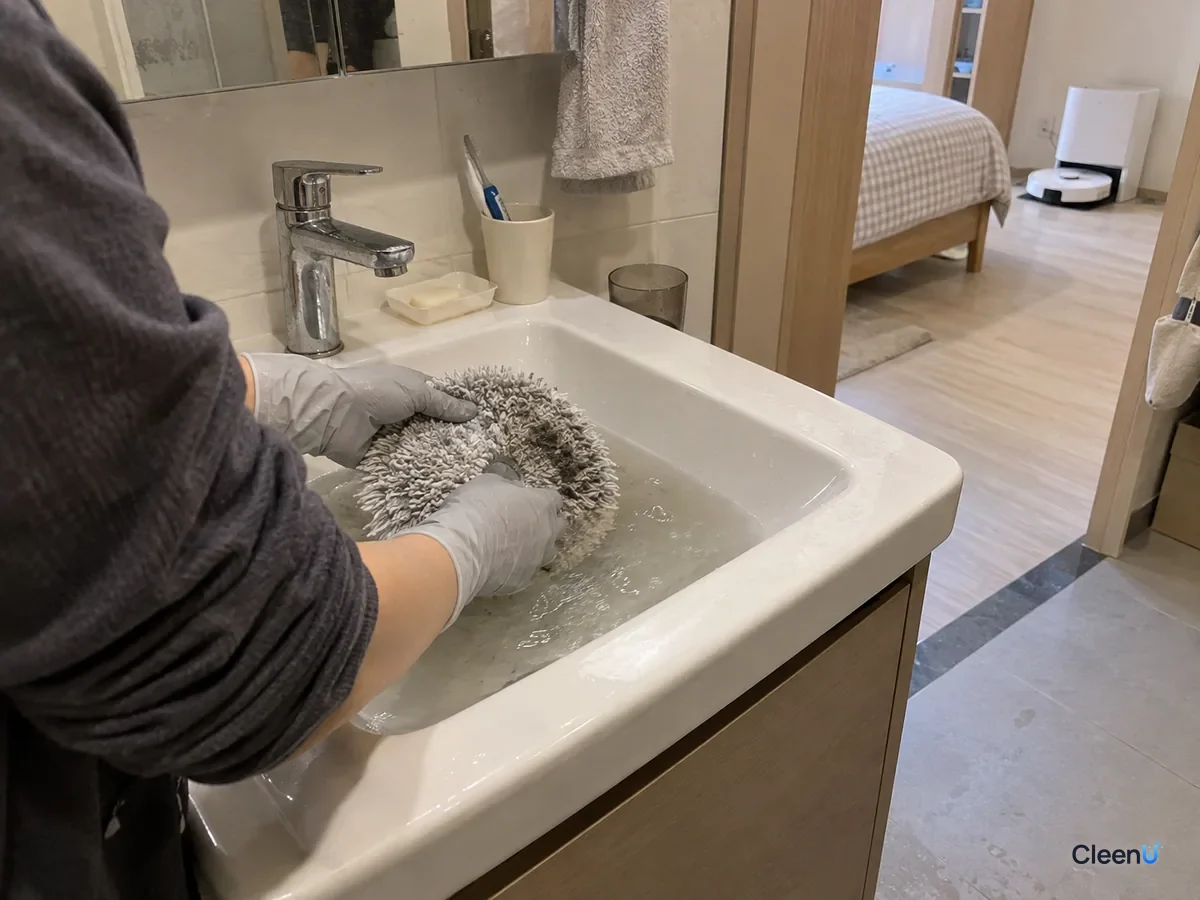
Why vinegar and hot water are named: risks to the robot and the floor
iRobot names only two things to avoid outright: hot water and water plus vinegar. Between them, they cover the two most common material risks inside a robot.
Vinegar is dilute acetic acid. Pump internals, fasteners, and contacts that sit in acid slowly corrode, and some rubbers harden and crack faster. Citric acid mixes, acidic descalers, and some "natural" cleaners belong in the same risk group.
Hot water is a problem because the tank, lines, and seals are designed for room-temperature liquid; heat can warp some plastics and age rubber faster, and it makes the nozzle tip dry out faster too. Use room-temperature water, as the manual says.
The floor matters too. Laminate's wear layer handles water well, but seams and edges expose the core, which swells if water sits there. That's why we recommend low water flow and a light dose on wood-look floors, so the film dries within minutes.
Three home tests aimed at iRobot's two designs
No lab gear needed, about 15 minutes of hands-on time, each one aimed at a specific weak point.
The dry-down test (for Braava nozzles). Put three or four drops of solution, mixed at its label ratio, on a piece of dark glass or a black ceramic plate, with the same number of plain-water drops beside them. Let them dry overnight. Next day, look at them against the light. Water leaves a faint mark. If the solution side leaves an obvious white ring, a crust, or a tacky film, it's high in solids or hard to redissolve. Then touch each spot with a wet fingertip. If it melts away immediately, it redissolves well. If it stays draggy or sticky, it's a buildup risk in a Braava nozzle. Use tap water for the mix: hard-water minerals react with anionic surfactants to form calcium soap, so tap water gives a more honest result than bottled water.
The pad absorbency test (for Combo pads). Take two identical old pads or microfiber cloths. Soak one in plain water and one in mixed solution, wring both out, and let them dry. Put a drop of water on each. A healthy cloth pulls the drop in within a few seconds. If the drop just sits on top, something in that solution is making the fibers water-repellent, and it's not a good match for Combo pads.
The shake test (for the Combo 10 Max's AutoWash dock). Fill a clear plastic bottle with about 500 mL (17 oz) of water, add solution at its label ratio, cap it, shake hard 10 times, and watch the foam. A thin layer that collapses noticeably within a short time usually won't overflow during mop washing. Thick, lingering foam is a reason to keep that product out of a Combo 10 Max.
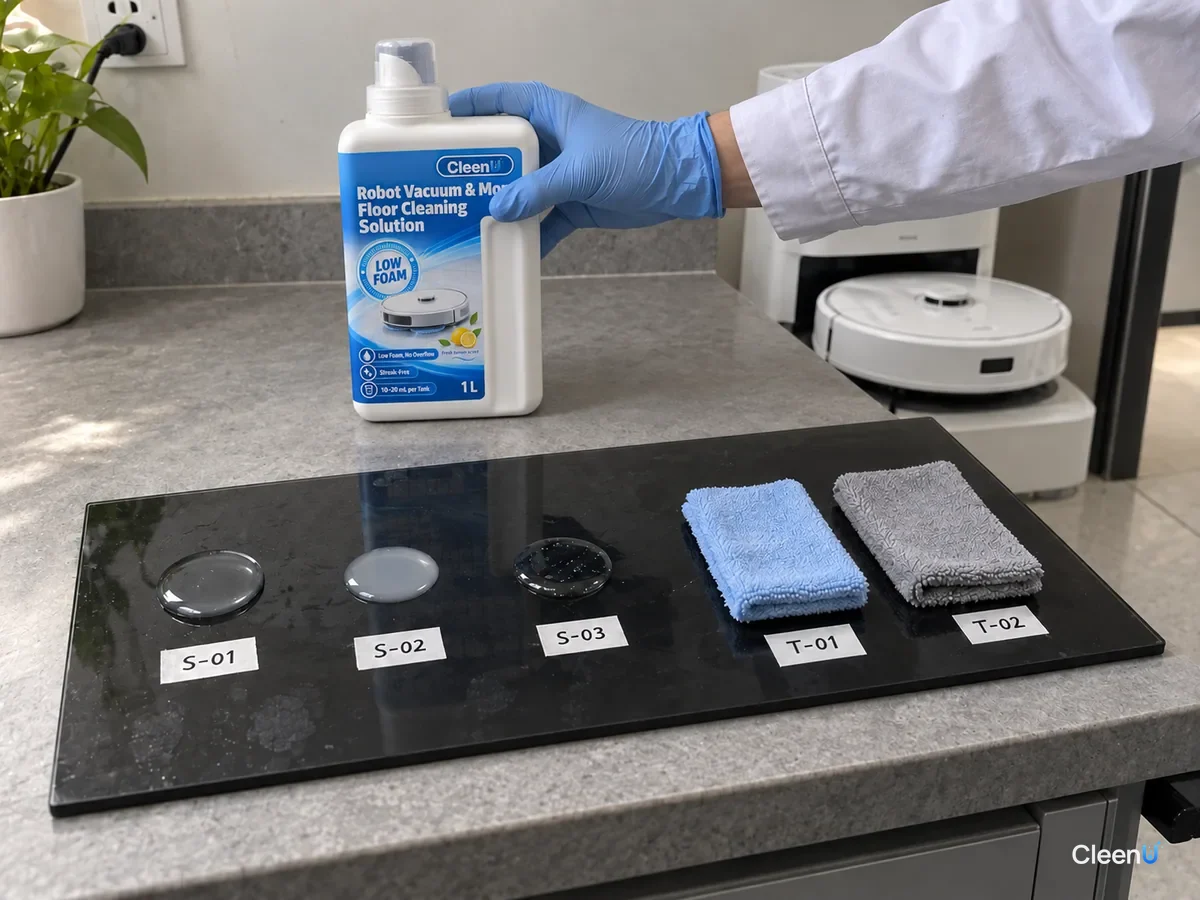
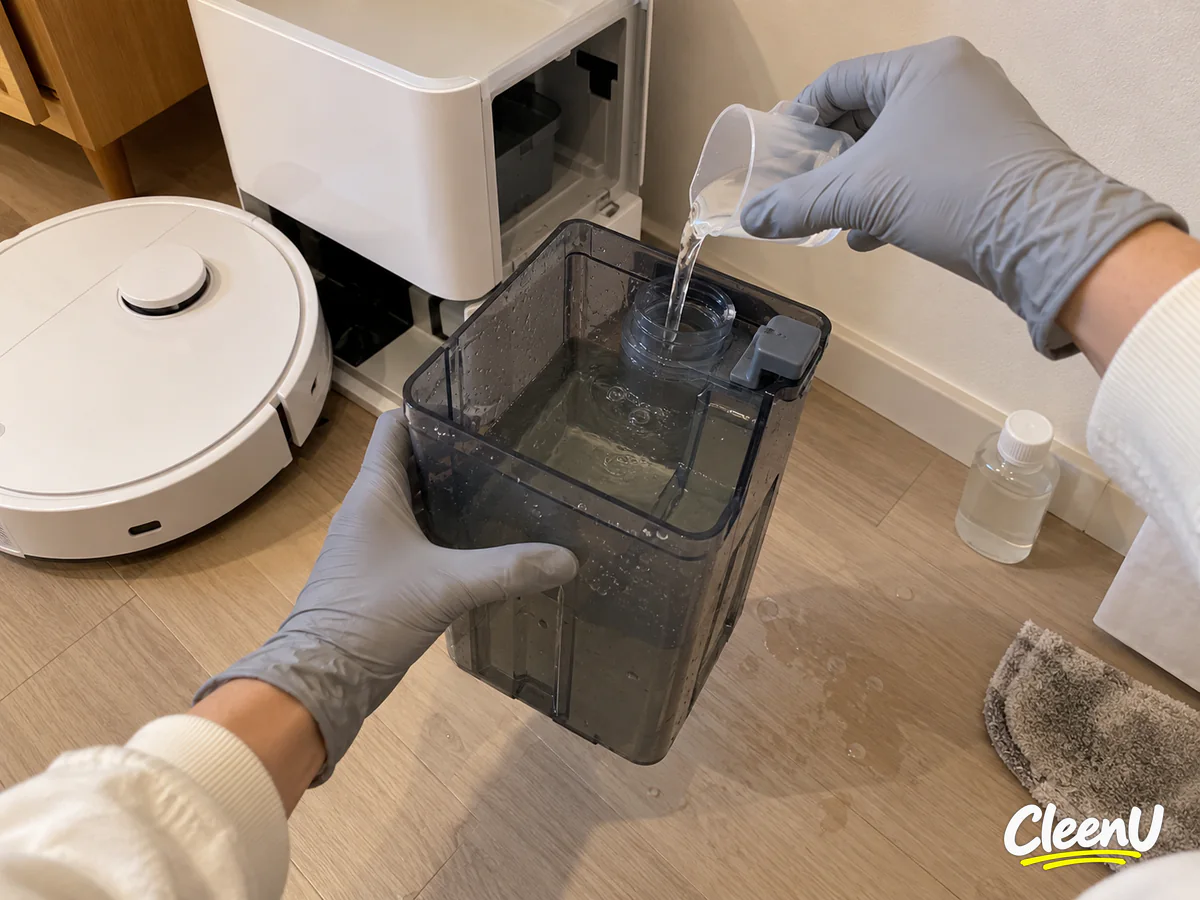
What that looks like in a bottle: CleenU as an example
To see the three criteria in an actual product, take CleenU Robot Mop Cleaning Solution: a neutral concentrate, pH 6.5–7.5 as a concentrate, with no acids to work on pumps and seals. It's built on low-foam nonionic surfactants with a defoamer, so it makes little foam and the foam breaks quickly. It contains no wax, no chlorine, and no particles, and no quats or phenols, so it won't leave a cationic film on microfiber or a polymer crust when it dries. Each 1 L (about 34 oz) bottle comes with a measuring cap and dilutes about 1:50 to 1:100; 10 to 20 mL per fill is usually enough, so one bottle covers roughly 50 to 100 fills. The standard version has a lemon scent, and the Pet Homes version is fragrance-free with a cyclodextrin-based odor neutralizer. Unopened, it keeps for 24 months.
It's a cleaning solution that lifts dust film, skin oil, and everyday soil from sealed hard floors, not a disinfectant. It works with most iRobot Roomba Combo and Braava models and most robot mops and wet-dry vacuums from Roborock, Ecovacs Deebot, Dreame, Narwal, Tineco, Shark HydroVac, Eufy RoboVac, and Bissell CrossWave. CleenU is not affiliated with these brands; brand names are used only to describe compatibility.
If you've run out of iRobot solution and want a low-foam, neutral alternative, take a look at our Robot Vacuum & Mop Floor Cleaning Solution.
How to switch smoothly: measure the tank, then dose by ratio
iRobot gives its own solutions in caps because it knows each model's tank size. A third-party concentrate is dosed by ratio, so step one is knowing how much water your tank actually holds.
Switching an iRobot to a third-party solution
- Empty the clean tank and rinse it twice with water; one product per tank keeps results easy to read
- Fill the empty tank to the max line with a measuring cup and note how much it actually holds; use that number from now on
- Work out the dose at about 1:50 to 1:100; for a tank that holds 0.5 L (about 17 oz), that's about 5–10 mL, and the low end is fine for routine mopping
- Add water first, then solution from the measuring cap; swirl gently instead of shaking
- On the Combo 10 Max, add it to the dock's clean water tank as the manual describes, never the dirty water tank
- Mop just one room the first time; check that the spray or pad is evenly wet and that the dried floor isn't tacky or hazy
- Pour out leftover mix after each run instead of letting it sit in the tank for days
Pouring out leftover mix matters most for a Braava. A mix that sits for days gives the nozzle tip more time to dry and build up, and diluted solution spoils more easily than concentrate. Mixing fresh, then emptying and air-drying the tank, cuts down on both nozzle buildup and tank odor.
Use this table to convert:
Dose by your tank's measured capacity (about 1:50 to 1:100)
- 0.3 L (about 10 oz)
- about 3–6 mL
- 0.5 L (about 17 oz)
- about 5–10 mL
- 1 L (about 34 oz)
- about 10–20 mL
- 2 L (about 68 oz)
- about 20–40 mL
Fine-tuning when results aren't right
Uneven spray, slick pads, or suds? Adjust in this order
A Braava that sprays unevenly or in a narrow line usually has dried film at the nozzle tip. A Combo pad that feels slick, absorbs slowly, or leaves alternating wet and dry stripes has residue in its fibers. Extra suds in a Combo 10 Max dock mean the mix is too strong or not low-foam enough. Step one: empty the clean tank, rinse it twice with water, and wipe around the nozzle with a damp cloth. Step two: wash the pad thoroughly in plain water with no fabric softener and let it dry. Step three: remix at the low end of the ratio and mop one room to check. If laminate seams look whitish, turn water flow down a level and wipe seams dry with a soft cloth.
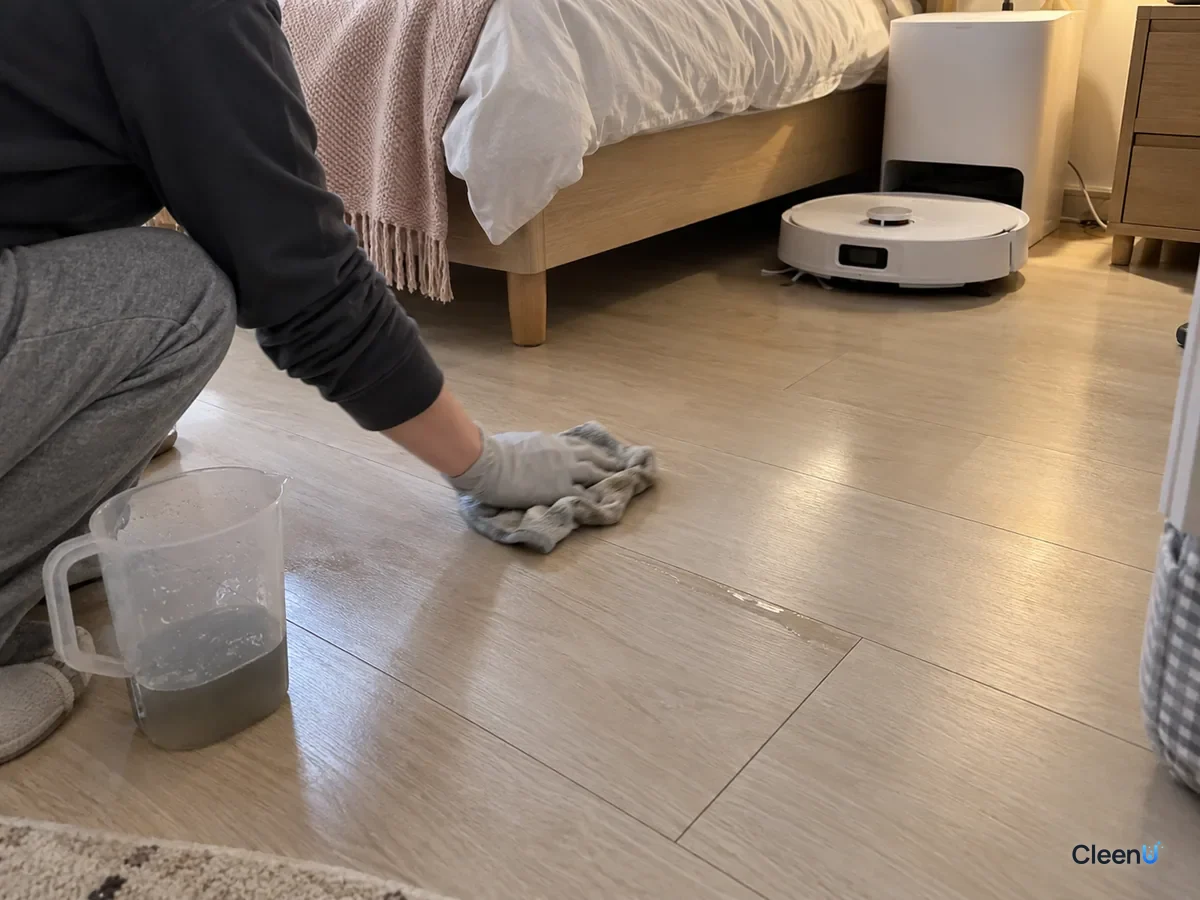
Switching cleaning solutions in a Roomba Combo or Braava
Can I use a third-party cleaning solution in my iRobot?
Yes, if you pick the right one: a low-foam, neutral, particle-free concentrate that redissolves after drying, diluted about 1:50 to 1:100. Skip hot water and vinegar, and remember the Combo 10 Max with its AutoWash dock is the most sensitive to foam.
Why can't I use Bona in a Roomba Combo 10 Max?
iRobot says Bona causes excessive sudsing in that robot, which can lead to water on the floor. It also says this won't damage the robot or dock, but it isn't approved for now.
Can I use Bona in a Braava jet m6?
Yes. iRobot lists Bona Hardwood Floor Cleaner and Bona Hard-Surface Floor Cleaner as approved for the Braava jet m6. Bona is pre-mixed, so pour it in straight without adding water.
Can I add vinegar to an iRobot tank to fight odor or scale?
No. iRobot rules out vinegar because it corrodes internal parts; acid is hard on pump components and seals.
Can I use hot water in a Braava or Combo in winter?
No. iRobot doesn't allow hot water in any of the listed models. Use room-temperature water; heat can warp plastic parts and age seals faster.
Where does CleenU Robot Mop Cleaning Solution go in a Braava?
In the robot's clean water tank. Add water first, then solution at about 1:50 to 1:100, such as 5–10 mL for 0.5 L (about 17 oz) of water. Pour out leftover mix after each run.
My Braava's spray looks uneven. What should I do?
Empty and rinse the tank, wipe dried film from around the nozzle with a damp cloth, and run one cycle to clear the tip. Then use a low-foam solution that redissolves easily, mixed fresh at the low end of the ratio.
My Combo pads are getting stiff and don't absorb well. How do I fix them?
Wash out residue and hard-water buildup, the likely cause. Wash the pads thoroughly in plain water without fabric softener, then use the low end of the ratio and avoid products with quats, waxes, or film-formers.
Which iRobot models does CleenU Robot Mop Cleaning Solution work with?
It works with most Roomba Combo and Braava models, and we've run foam, residue, and water-path tests on common robot mops. Add it to the clean water tank at about 1:50 to 1:100.
Can I leave mixed solution in a Braava tank until tomorrow?
We don't recommend it. Diluted solution spoils more easily and the nozzle tip keeps drying out, so mix fresh before each run and empty the tank afterward.
For why vinegar and bleach don't belong in a tank, see Can you put vinegar or bleach in a robot mop tank? For water and dosing on wood floors, see Can you robot-mop hardwood floors? If floors look hazy afterward, see Hazy wood floors after robot mopping, and if pads stay dry, see Robot mop pads staying dry after adding solution.
You can switch cleaning solutions in an iRobot. Shop against the weak points of each design. A Braava's small nozzle needs a low-solids formula that redissolves after drying. A Combo pad needs a formula with no quats, waxes, or film-formers. A Combo 10 Max with an AutoWash dock needs truly low foam. Measure your tank, dilute about 1:50 to 1:100, mix fresh each time, and mop one room first. If the spray is even, the pad isn't slick, and the floor isn't tacky, make it your routine. Hot water and vinegar stay off-limits in every model.