
Formulation Science
How Is a Low-Foam Robot Mop Solution Made? Low-Foaming Surfactants vs. Defoamers
Direct answer
Low foam usually comes from two layers. The main surfactants are nonionics that foam weakly and make unstable bubbles, which sets a low baseline. A small amount of defoamer then handles extra foam from soil and agitation. Using lots of defoamer to tame a high-foam base causes residue, separation, and sensor film.
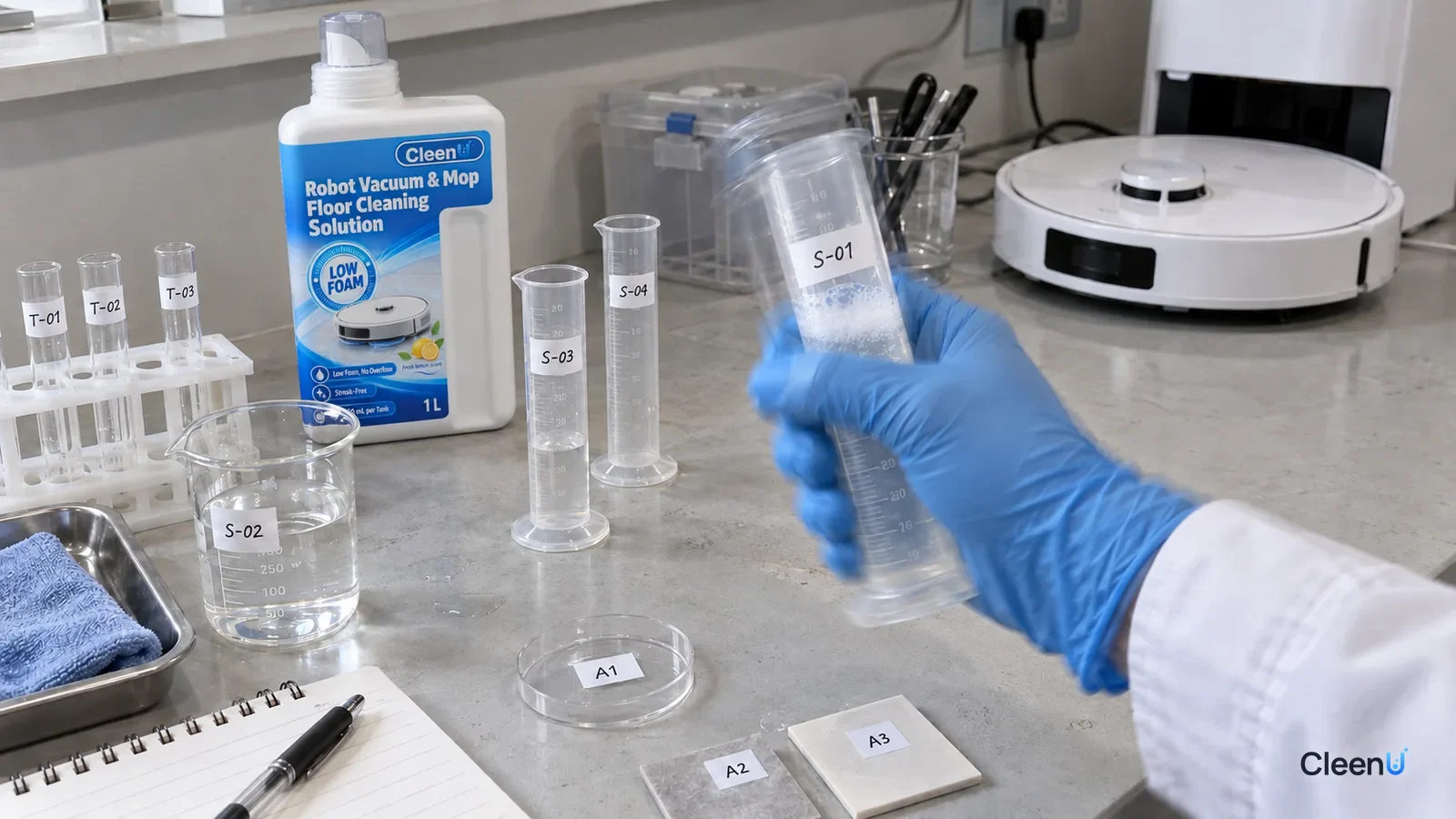
Brands developing a robot mop cleaning solution often end up with two opposite samples. One cleans well but fills the dirty water tank with foam. The other barely foams but leaves floors hazy or slick, or starts foaming again after a couple of months on the shelf. Both problems come from the same trade-off: is low foam built into the surfactants themselves, or is foam being knocked down by a defoamer?
Our view is that the baseline should come from the surfactant system and the defoamer should be the backup. Low-foaming nonionic surfactants decide how much foam you start with in clean water. The defoamer handles the extra foam drivers inside a robot, like protein soil from the floor and the high-speed rinsing and suction in the dock. Flip that around, using a high-foam anionic system for cleaning and piling on defoamer to hold the foam down, and early tests can look fine while residue, stability, and performance after dilution suffer later. This article covers the chemistry of both routes, what each costs, and how to test for the difference. It sticks to general industry principles and doesn't disclose any formula ratios.
Where foam forms inside a robot mop
Low-foam design starts with knowing where a robot and its dock pull air into the liquid.
Between the mop and the floor. Working solution flows from the clean water tank to the mop, and vibrating, spinning, or rolling pads churn it with air. Foam left here dries into streaks and water marks.
In the dock's wash tray. Back at the dock, scrapers and the wash tray squeeze and flush the pads. This is the highest-shear, most turbulent spot in the system, and the dirtiest: dust, greasy footprints, food bits, and pet saliva from the pads all end up in a small pool of water.
During dirty water recovery. Suction pulls dirty water into the tank at high speed, mixing air and liquid. Dirty tanks often use electrode or float level sensing. Foam can bridge electrodes or lift floats, so the dock reports a full tank when it isn't. Foam near the suction inlet can also be drawn toward the airflow path. For troubleshooting false full-tank alerts, see Robot vacuum says the dirty water tank is full when it isn't.
Conditions differ: near room temperature with little soil at the pad, heavy soil and maybe hot water in the wash tray, and foam that has been building all the way by the dirty tank. A quick clean-water shake can't tell you how a solution behaves at all three.
Route one: surfactants that don't like to foam
Whether foam lasts depends on the liquid film around each bubble. Surfactant molecules have a water-loving head and an oil-loving tail, and they line up on both faces of that film. When part of the film stretches thin, surfactant there gets sparse, surface tension rises, and liquid flows in to patch it. That's the Marangoni effect, and it's what makes foam self-healing. The tighter and more orderly the molecules pack, the more elastic the film, and the more stable the foam.
Low-foaming surfactants share one trait: they don't pack neatly in that film. Common types include:
- Fatty alcohol ethoxylates with a low EO count. EO stands for ethylene oxide units. Fewer EO units make the molecule more oil-loving and closer to the edge of water solubility, which gives a less elastic film. These cut grease well and aren't bothered by hard water, so they're workhorses in low-foam cleaners.
- EO/PO block copolymers. They combine water-loving EO segments with more water-repelling propylene oxide (PO) segments. The PO block acts like a loose tail that keeps molecules from packing tightly, so these are low-foam or even defoaming nonionics on their own.
- End-capped ethoxylates. Swapping the hydroxyl at the end of the polyether chain for another group weakens hydrogen bonding between molecules and weakens the film further.
- Alkyl polyglucosides (APG). They're mild, readily biodegradable, and alkali-tolerant, but they foam moderately, so they usually need lower-foaming partners.
This route has its own trade-offs.
Cloud point and temperature. Nonionics have a cloud point. Above it, the surfactant separates from water and the solution turns hazy. Low-EO types have lower cloud points. That can help during hot mop washing, because the tiny droplets that separate out break bubbles themselves, often called cloud-point defoaming. In cool water, though, the surfactant redissolves and that effect disappears. A formula that's quiet at 140°F (60°C) but foams in a cold winter mop run often has this behind it.
Solubility in a concentrate. Oil-leaning low-foam ingredients don't always stay dissolved at concentrate strength. They can cloud or separate and may need a hydrotrope, which adds solids and residue of its own. That's one reason concentrates are harder to formulate than ready-to-use solutions.
Cleaning coverage. Surfactants with different HLB values (hydrophile-lipophile balance) handle different soils. A single very oil-loving, very low-foam ingredient may handle greasy footprints but disperse dust film and sugary spills poorly. So the base is usually a blend of nonionics with different HLB values, not one ingredient doing everything. For more on whether low foam means weaker cleaning, see Does a low-foam robot mop solution clean less?
Terms used in this article
- Cloud point
- The temperature at which a nonionic surfactant solution turns hazy; above it the surfactant separates into fine droplets that can break foam.
- HLB
- Hydrophile-lipophile balance. Lower values are more oil-loving. Different oily soils need different HLB values, and blends cover mixed soils.
- Marangoni effect
- Liquid flowing toward a thinned spot in a film where surface tension has risen; the main reason foam heals itself.
- Entering and spreading coefficients
- Two thermodynamic measures of whether a defoamer droplet can enter a film surface and spread across it; defoaming works best when both are positive.
Route two: how a defoamer breaks bubbles
Defoamers are usually water-insoluble materials with lower surface tension than the working solution, dispersed as tiny droplets or particles. They work in roughly three steps. A droplet reaches the bubble film and enters its surface. It spreads quickly across that surface, pushing aside the orderly surfactant layer. Then the droplet, or hydrophobic particles inside it, touches both faces of the film and forms a bridge; the film thins and dewets around that bridge and ruptures. Two broad families dominate:
Silicone defoamers. These are built on polydimethylsiloxane (silicone oil), often with hydrophobic silica, and added as an emulsion. Very low surface tension and fast spreading make them effective at very low levels and long-lasting. The cost is that silicone oil doesn't dissolve in water, so it stays on the floor with the working solution. Too much can make floors slick or hazy or cause fish-eye spots, and it's unfriendly to floors that will later be waxed or coated. Inside the robot, it can build a water-repellent film on electrodes, optical windows, and plastic walls that shifts sensor readings.
Non-silicone defoamers. These include mineral- or vegetable-oil-based defoamers, fatty alcohols, polyethers, and modified polyethers. Residue risk is lower and they're gentler on surfaces, but they're usually less effective per unit and less persistent, so they need higher use levels or blending. Polyether-modified siloxanes sit between the two, with some water dispersibility and decent knockdown.
One trade-off often gets missed: surfactants can use up the defoamer. The more surfactant and solubilizing power a formula has, the more it pulls defoamer droplets into micelles and emulsifies them into ever-finer particles. Droplets that are too fine can't enter the film, so knockdown fades. It's most obvious in concentrate. A fresh batch tests very low-foam, but after a few weeks the defoamer has been slowly emulsified or has creamed to the top, and the foam comes back. Defoamer evaluation always needs a retest after storage.
How one defoamer droplet pops one bubble
- Agitation traps air, surfactants line the bubble film, and the Marangoni effect keeps the film intact
- A defoamer droplet drifts to the film and, with its lower surface tension, enters the film surface
- It spreads fast across the surface, pushes the orderly surfactant layer aside, and the spot loses its ability to self-heal
- The droplet or its hydrophobic particles touch both faces of the film and form a bridge, and the film thins and dewets around it
- The film ruptures, the bubble pops, and the droplet returns to the liquid for the next bubble
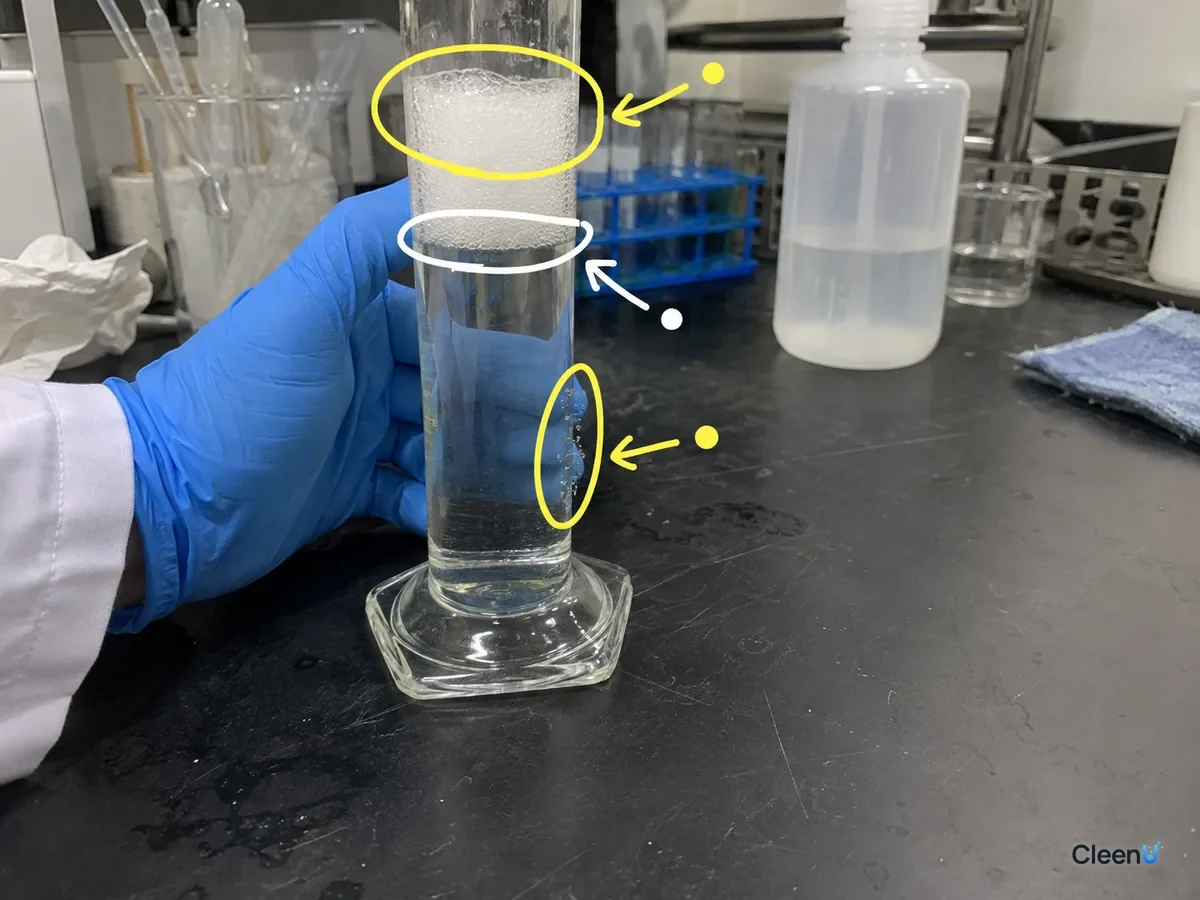
Choosing between the routes: reading the symptoms
The two routes solve different problems and carry different costs. Here are five common symptoms, what's behind each, and what it means for the formula:
- Almost no foam in a clean-water shake test, but the dirty tank fills with foam after mopping a kitchen. Why: Proteins and fatty acid soaps from the floor reinforce the bubble film; the clean-water test didn't include soil. What it means: Test foam with simulated soil, keep the surfactant baseline low, and give the defoamer enough headroom for soil.
- A fresh sample is low-foam, but foam climbs noticeably after two months. Why: Surfactants gradually emulsify the defoamer in the concentrate, or it creams to the top, leaving fewer effective droplets. What it means: Rely less on defoamer, retest foam after storage, and check the concentrate for separation.
- Foam is well controlled, but dark tile dries hazy and feels slick underfoot. Why: A lot of silicone or oil-based defoamer was used to hold down a high-foam base, and it stays on the floor. What it means: Lower the surfactant system's own foaming first, then cut defoamer back to a backup role; run residue and foam tests together.
- Quiet during hot mop washing, foamy in cold-water mopping. Why: Low foam depends on cloud-point defoaming, and at low temperature the surfactant redissolves. What it means: Test foam at both cold and hot temperatures, never at just one.
- Frequent false full-tank alerts that come back soon after cleaning. Why: Water-repellent defoamer components or dried residue film the electrodes or optical windows and change the readings. What it means: Run multiple cycles on real robots and inspect the sensor area for film.
Truly low-foam or just held down: from symptom to formula
What you see
A fresh sample barely foams in a clean-water shake, but foam comes back with soil, in cold water, or after storage, or floors dry hazy and slick.
Why it happens
The foam baseline wasn't lowered by the surfactant system; heavy defoamer is holding it down, and soil, cold, dilution, and storage all erode that headroom while extra defoamer stays on floors and sensors.
What it means for use
Lower the surfactant system's own foaming first, cut defoamer back to a backup role, and retest foam and residue with soil, at both temperatures, and after storage.
In one line: surfactants set the foam baseline; the defoamer sets the headroom. A high baseline propped up with heavy defoamer looks great in simple tests and causes trouble in real use. A low baseline with defoamer only as backup constrains cleaning breadth and cost somewhat, but keeps residue, stability, and long-term behavior under control. Robot mop solution fits the second approach: there's no rinse step, the working solution dries right on the floor, and it sits for long periods next to the robot's water path and sensors.
After dilution, how much defoamer is left?
A concentrated robot mop solution used at about 1:50 to 1:100 means every ingredient is diluted 50 to 100 times in the working solution. That affects the two routes differently.
- A low-foaming surfactant's low foam comes from its molecular structure. Diluted, it's present at a lower concentration and foams even less, so the baseline doesn't get worse.
- A defoamer depends on having enough effective droplets in the liquid. Dilution cuts the droplet count in proportion. If the defoamer in the concentrate is only just enough to control foam when the concentrate itself is shaken, it can fall short in the working solution, especially in a heavily soiled wash tray.
That's why foam tests belong in working solution diluted per the label, not in concentrate. User dosing is another variable. If someone pours twice the dose, surfactant concentration doubles and foaming goes up, but the defoamer's relative headroom doesn't improve. Build in room for heavy hands and retest at the top of the label range or a bit above it.
Soil brings foam back
Many samples are low-foam in clean lab water, and then a week of kitchen mopping brings complaints about false full-tank alerts. Soil is the reason.
Proteins. Food residue, mucins in pet saliva, and protein from foot sweat dissolve into the water and form an elastic layer on the bubble film. It's the same reason egg whites whip.
Fatty acid soaps. Fatty acids from kitchen grease can form small amounts of soap with sodium or under alkaline conditions, and soap foams.
Hard water cuts both ways. Calcium and magnesium bind fatty acid soaps into insoluble calcium soap, and those particles actually suppress foam somewhat. But calcium soap also deposits on floors and pads as white marks and a dragging feel. In hard-water areas, less foam isn't automatically good news.
So evaluate foam in working solution with simulated soil that includes both protein and oily components, once in soft water and once in hard water.
How to test low foam, at your desk and at the factory
A product team can run a few quick comparisons on samples before formal evaluation.
Clean vs. soiled shake. Fill two identical clear bottles with about 500 mL (17 oz) of water and add the sample at the label ratio (5 to 10 mL at about 1:50 to 1:100). Add a small spoonful of milk to one bottle to simulate protein soil. Cap both, shake hard 10 times, and compare foam height and how fast it collapses. If the soiled bottle holds noticeably more foam for a long time, the dock's dirty tank will likely see it too. Full shake-test method: How to tell if a robot mop solution is low-foam.
Cold vs. warm. Shake the same working solution once in cold water and once in warm water (no hotter than is comfortable to the touch). Much more foam in cold water can mean more winter complaints.
Retest after storage. Set the concentrate aside for a month, shake again the same way, and check whether foam has climbed and whether the concentrate shows oily streaks, separation, or haze.
Mirror residue. Wipe working solution on a mirror or dark glass next to a plain-water patch and check the dried surface against the light. If foam is well controlled but the mirror goes hazy, suspect too much defoamer.
Factory evaluation builds on this. Static foam is commonly measured with the Ross-Miles method, described in standards such as ASTM D1173, ISO 696, and GB/T 7462 (verify current versions before citing): a set volume of solution falls from a fixed height into the same solution, and foam height is recorded right away and after a set time. That reflects static foaming, which isn't enough for robots, so dynamic methods such as recirculating pumps or gas sparging are usually added to mimic constant agitation in the dock.
Conditions a low-foam robot mop solution evaluation should cover
- Samples: working solution diluted per label, plus the top of the label range
- Water: one soft-water set and one hard-water set
- Soil: clean water and water with simulated protein and oily soil
- Temperature: cold water and a simulated hot mop-wash temperature
- Methods: cylinder shake or Ross-Miles static foam, plus recirculation or sparging for dynamic foam
- Time: fresh and stored samples, checking the concentrate for separation or oily streaks
- Residue: mirror or dark tile against a plain-water control, checking haze, spots, and feel
- Real runs: multiple cycles on common robot mops and self-cleaning docks, watching for false full-tank alerts and film near sensors
- Pass criteria: low foam that collapses fast, no clear rise with soil, cold water, or storage, and no haze or slickness
Soil plus storage separates samples best; a defoamer-dependent sample can match a true low-foam system fresh in clean water and fall apart here. For full sample acceptance methods, see How to evaluate robot mop solution samples.
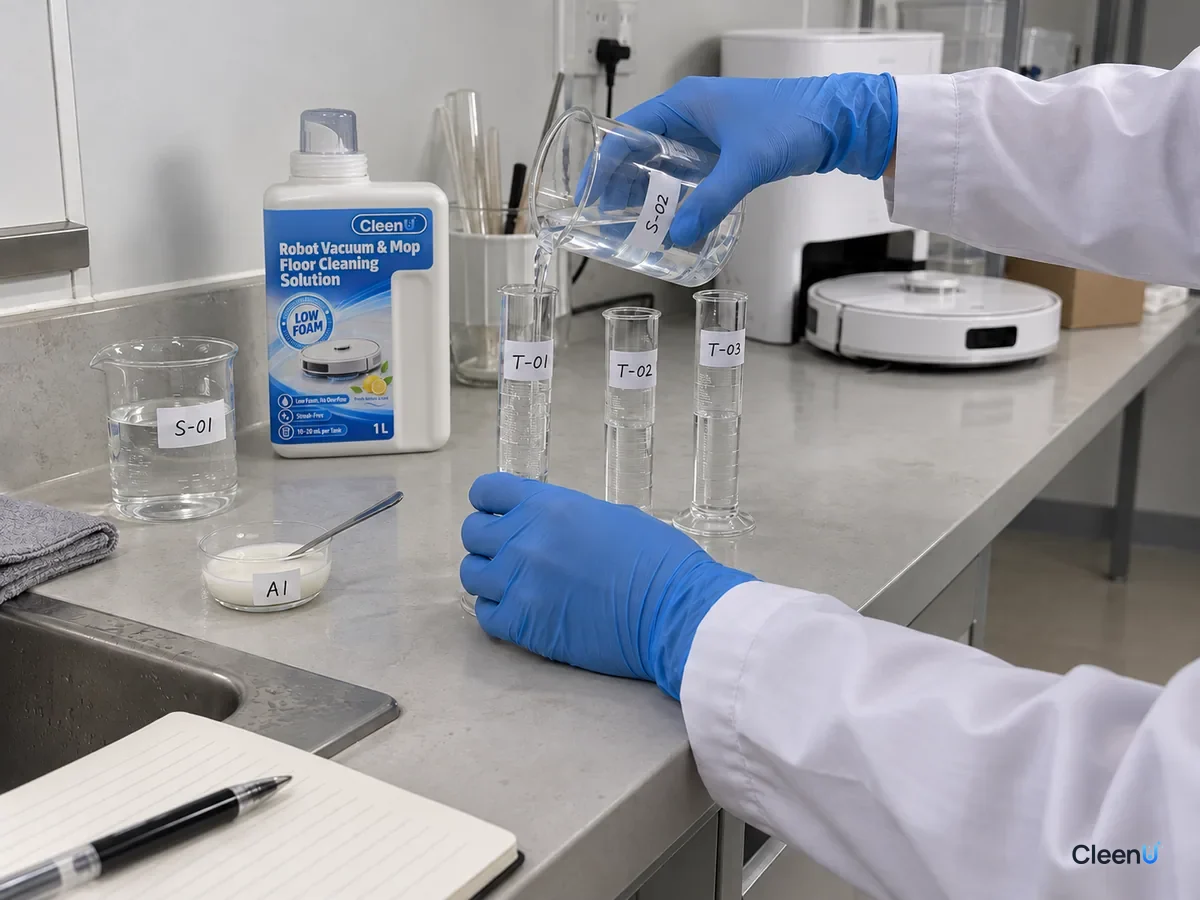
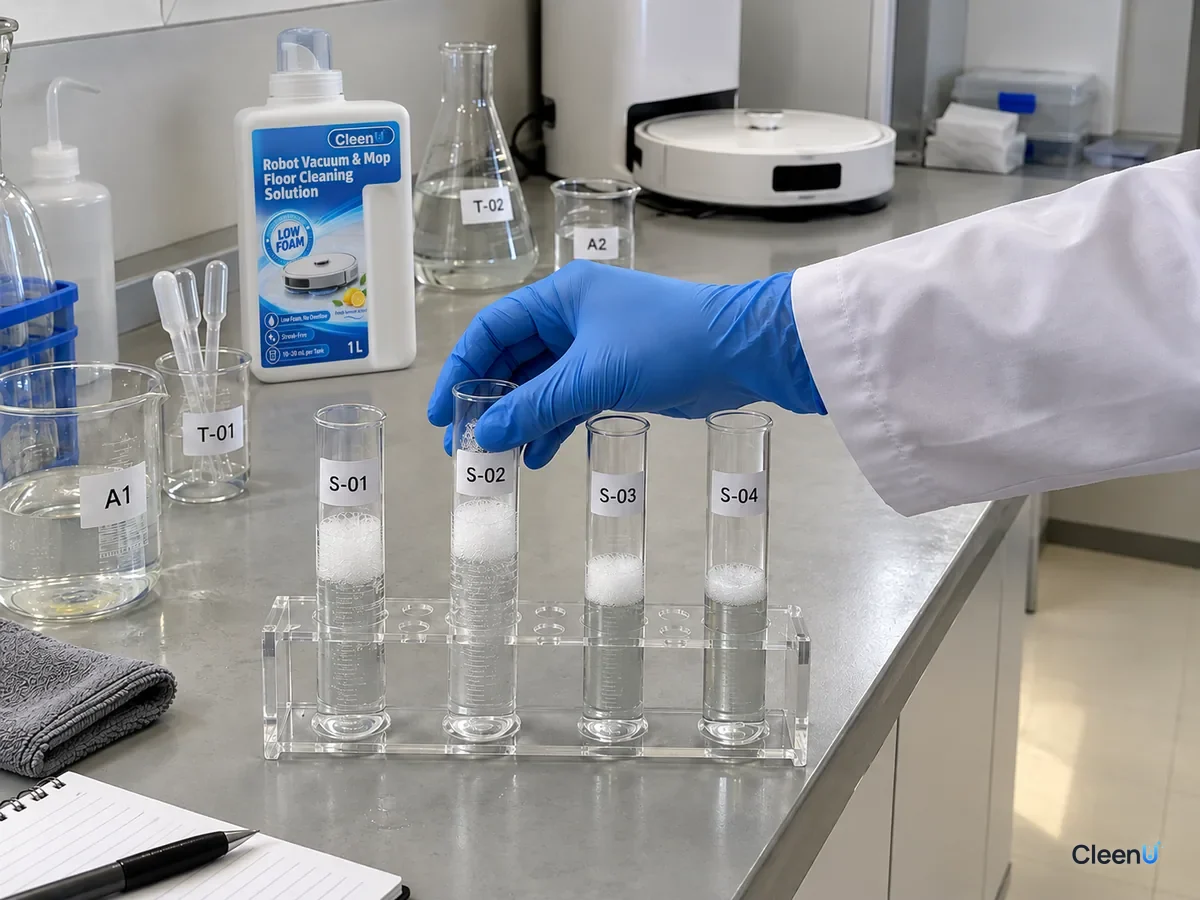
How CleenU balances low foam and cleaning
CleenU Robot Mop Cleaning Solution is a neutral concentrate, pH 6.5–7.5 as a concentrate, with 15% active surfactant, built on low-foam nonionic surfactants with a defoamer. It contains no wax, no chlorine, and no particles, and no quats or phenols. In other words, it follows the route described above: surfactants set the baseline and the defoamer backs it up. The specific raw materials and their amounts are formulation details we don't publish.
It dilutes about 1:50 to 1:100, and 10 to 20 mL per fill is usually enough. Each 1 L (33.8 fl oz) bottle comes with a measuring cap, and its viscosity is designed for dock auto-dosing compartments. The standard version has a lemon scent; the Pet Homes version is fragrance-free with a cyclodextrin-based odor neutralizer. We've run foam, residue, and water-path tests on common robot mops and wet-dry vacuums, covering most models from Roborock, iRobot, Ecovacs, Dreame, Narwal, Shark, and Eufy, plus Tineco and Bissell floor washers. Add it to the clean water tank or the dock's designated compartment as the manual directs; for Narwal, it goes in the clean water tank. CleenU is not affiliated with any of these brands; names are used only to describe compatibility.
Every batch passes five quality checkpoints: incoming materials, weighing verification before batching, an in-process check before filling, first-piece and patrol checks during filling, and finished-goods inspection, with batch traceability. For a low-foam product, weighing verification matters most. A defoamer is used in small amounts and has a big effect, so a dosing error at batching shows up directly in foam behavior.
To start your private-label line from a neutral, low-foam nonionic concentrate with no quats or phenols, take a look at our Robot Mop Cleaning Solution.
If you want to adjust scent or verify foam and residue on your target robots, CleenU can help. MOQ is 500 bottles, free samples ship in about 3 days, bulk production takes about 7 days after packaging and labels are approved, and SDS, TDS, and COA are provided per project. For why private-label samples keep going back and forth on foam and residue, see Why private-label robot mop solution samples keep getting revised. Single-product specs are on the CleenU Robot Mop Cleaning Solution product page.
Hold sample approval if you see any of these
Hold approval if foam is low in a clean-water shake but rises clearly and lingers once simulated soil is added; a fresh sample is low-foam but foam returns after storage, or the concentrate shows oily streaks, separation, or haze; cold water foams much more than warm; mirrors or dark tile dry hazy or spotty, or floors feel slick once dry; or real-robot cycles bring repeated false full-tank alerts or a water-repellent film near sensors. Rework the surfactant system and defoamer level first, then retest with soil, at both temperatures, and after storage before moving on.
Low-foam formulas and defoamers: questions brands ask
Is adding a defoamer enough to make a solution low-foam?
No. The surfactant system should set the low-foam baseline, and the defoamer should only handle extra foam from soil and agitation. Holding down a high-foam base with defoamer makes residue and storage stability harder to control.
Can silicone defoamers go in robot mop solution?
Yes, in small amounts, paired with residue testing. Silicone is efficient and long-lasting, but too much can leave a slick or hazy film on floors and build up on sensor surfaces.
Are non-silicone defoamers always better?
They're a different trade-off, not automatically better. Residue risk is lower and they're gentler on surfaces, but they're usually less effective per unit and less persistent, so they need higher levels or blending.
Why does a sample foam more after sitting for a while?
Check the defoamer first; it is likely being emulsified by the surfactants in the concentrate or is creaming to the top. Retest foam after storage and reduce reliance on the defoamer.
Does low foam hurt cleaning?
No, provided the formula is designed well. Cleaning comes from wetting, emulsifying, and dispersing, and a blend of nonionics with different HLB values covers greasy footprints and dust film. Suds are only a visual cue.
Is cloud-point defoaming reliable?
Only above the cloud point. It helps during hot mop washing and fades in cold-water mopping, so test at both temperatures.
Why add soil to a foam test?
Because soil stabilizes foam. Proteins and fatty acid soaps in dirty water reinforce bubble films, so clean-water tests underestimate real foam in the robot.
Is a Ross-Miles test enough?
No, it measures static foam. Robot mop solutions also need dynamic tests like recirculation or sparging, plus multiple cycles on real robots.
Is less foam in hard water a good sign?
Look at both sides. Calcium soap formed from hard-water minerals and fatty acids suppresses foam somewhat, but it also deposits on floors and pads as white marks.
What happens to foam if users overdose?
Foam goes up. Doubling the dose doubles surfactant concentration, and the defoamer's relative headroom doesn't keep pace, so retest at the top of the label range and above.
Will CleenU share the exact ratios in its low-foam formula?
No. We describe the system: low-foam nonionic surfactants with a defoamer, neutral, no wax or chlorine, no particles, and no quats or phenols. Specific raw materials and amounts are formulation details.
The most reliable way to make a robot mop solution low-foam is to set a low foam baseline with low-foaming nonionic surfactants and use a small amount of defoamer to handle extra foam from soil and agitation. Doing it the other way around, with a high-foam base and lots of defoamer, looks good in quick tests and costs you in residue, separation, sensor film, and thin headroom after dilution. Don't stop at a clean-water shake. Test working solution at label strength, with simulated soil, in cold and warm water, fresh and after storage, alongside mirror residue checks and repeated real-robot runs. That's how you tell a truly low-foam sample from one that's just being held down.