
Comparison
Scented or Fragrance-Free Robot Mop Cleaning Solution? How to Choose for Your Home
Direct answer
If you have babies, pets or anyone sensitive to smells, go fragrance-free or very lightly scented. If you like a fresh smell after mopping, a light scent is fine, as long as you dose by the label. A strong scent doesn't mean a cleaner floor; it usually means you added too much.
Who should choose what
-
Homes with a baby or toddler who crawls on the floor
Choose Fragrance-free, or a very lightly scented solution
Kids are closest to the floor and in contact with it longest. Keep residue low, too, by dosing at the low end of the label.
-
Homes with cats or dogs that lie on and lick the floor
Choose Fragrance-free, or a pet-home formula with a very light scent
Pets have sensitive noses and may avoid strongly scented areas. What pet homes really need is a formula that handles paw prints, drool marks and pet odor.
-
Anyone with scent sensitivity, allergic rhinitis or asthma
Choose Fragrance-free
Fragrance is a common irritant, so leaving it out is the safest bet. If there's a known allergy, check the ingredients and test a small area first.
-
Typical households that like a fresh smell after mopping
Choose Light scent
Dosed by the label, it smells clean right after mopping and fades naturally within an hour or two.
-
Homes with mild pet or cooking odors you'd like to cover up
Choose Don't count on fragrance; choose an odor-control formula and clean the source
Scent only masks odor for a while and can mix with it. Wash mop pads, empty the dirty tank and clean pet areas first.
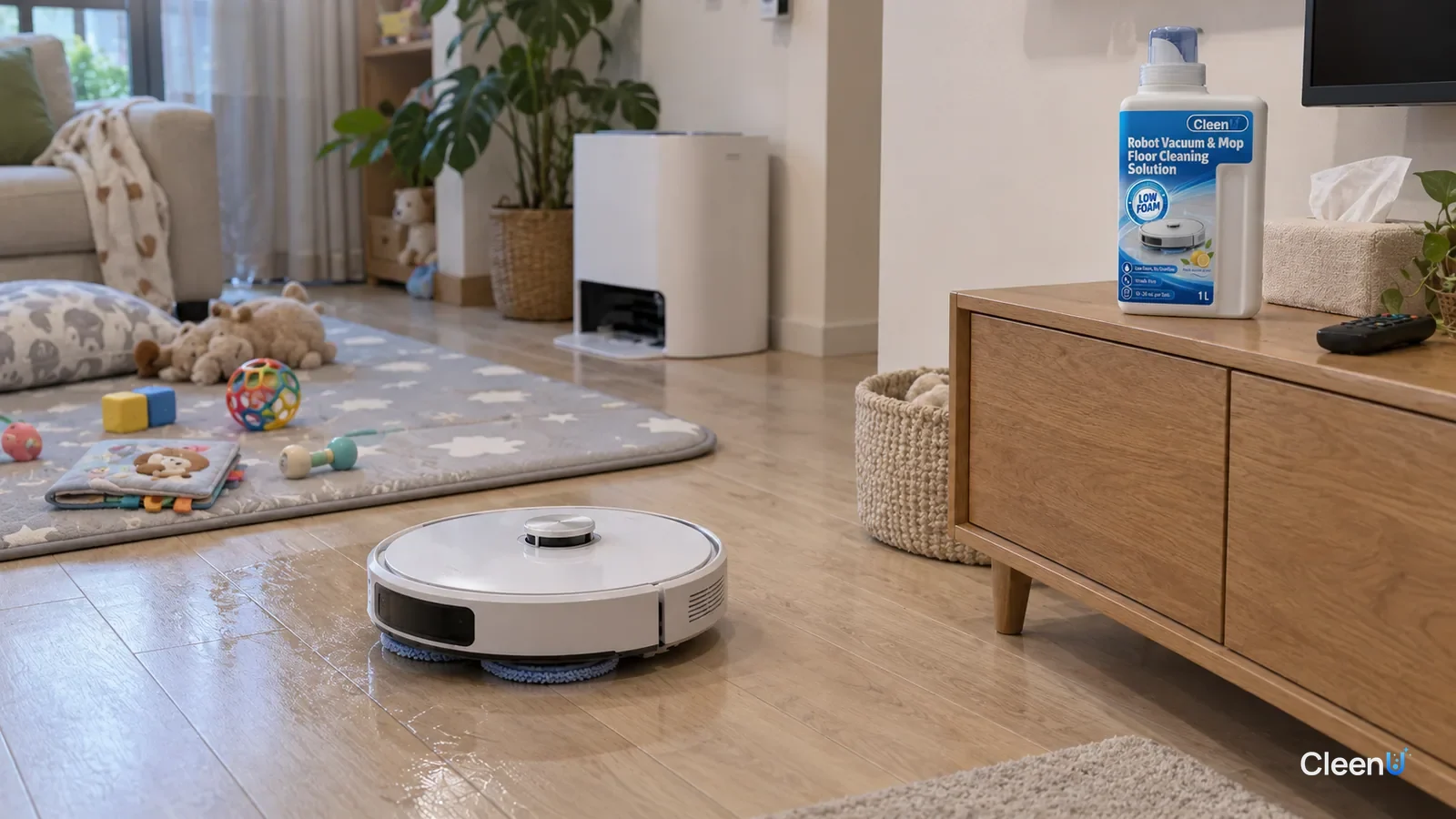
A robot mop runs through the whole house once or twice a day, and the few milliliters of solution in its clean water tank end up spread across every square foot of floor. That floor is where babies crawl, dogs nap and people walk barefoot. So choosing between scented and fragrance-free isn't only about taste. It decides how long a smell hangs around, whether anyone at home gets a stuffy nose, and whether your cat starts avoiding the hallway.
Here's the short version: fragrance and cleaning power are separate things. What lifts footprints and greasy marks off the floor is the surfactant system. Fragrance only changes how the room smells. Pick your scent level based on who lives with you, how sensitive they are, and how carefully you're willing to measure.
How does scent end up on your floors?
Fragrance in a cleaner is a blend of dozens of aroma molecules. Some evaporate fast; they're the "top notes" you smell the moment you open the cap. Others evaporate slowly and linger on surfaces for hours, which is the smell you still notice long after the robot docks.
When a robot mop lays down diluted solution, the water evaporates and leaves behind surfactant and part of the fragrance. A floor has a huge surface area, so the same small amount of fragrance smells much stronger spread across a room than it does in the bottle. Small rooms, closed windows and radiant floor heat all make it stronger and longer-lasting.
The dock is the spot people forget. A self-cleaning base station washes the mop pads over and over, and both the wash water and the warm-air drying cycle carry scent out. The corner where the dock sits is often the most fragrant spot in the house.
Why do some people react to fragrance?
Fragrance is one of the more common sources of irritation in household products. A few aroma compounds can trigger contact allergies in people with sensitive skin, and people who are sensitive to smell may get headaches, sneezing or an itchy nose when a scent is strong. Reactions vary a lot: the same bottle smells "fresh" to one person and "overpowering" to another.
Babies and pets are special cases.
Babies crawl, put their hands in their mouths and spend more time in direct contact with the floor than anyone else. A fragrance-free formula removes one category of ingredients that could bother them.
Dogs and cats have far more sensitive noses than we do. A smell that seems faint to you can be intense to them. Some cats steer clear of strongly scented areas, and some dogs lick the floor. For pet homes, the bigger questions are whether the formula is mild and how little residue it leaves behind.
To be clear, "fragrance-free" doesn't mean nobody could ever react. Cleaners still contain surfactants and preservatives. If someone at home has a known allergy, read the ingredient list and test a small area first.
Fragrance-free vs light scent vs strong scent
Three scent levels of robot mop cleaning solution, side by side
| What to compare | Fragrance-free | Light scent | Strong scent |
|---|---|---|---|
| Smell after mopping | Just a clean, damp smell | A faint fresh smell that fades within an hour or two | Noticeable throughout the house for a long time |
| People sensitive to smell | Most comfortable | Usually acceptable | Often feels too strong |
| Homes with babies or pets | First choice | Fine if you dose on the low side | Not recommended |
| Covering odors | Doesn't cover them; fix the source | Briefly masks mild odors | Masks them, but can mix into something worse |
| If you add too much | Residue and stickiness | Residue plus a heavy scent | Residue, harsh scent, strong smell by the dock |
| Best fit | Baby homes, allergy-prone people, small apartments | Most households that want a hint of fresh | Large, well-ventilated homes with no sensitive noses |
Which one fits your household?
Get the dose right before you worry about scent
A lot of people think a fragrance-free solution "isn't doing anything" and pour in more, or add extra to a lightly scented one because they can't smell it. That's the most common mistake with robot mop solution.
Robot mop cleaning solutions are designed to work at low concentration. CleenU Robot Vacuum Cleaning Solution, for example, dilutes at about 1:50 to 1:100; 10 to 20 mL per fill is usually enough, or about 10 to 20 mL for a 1-liter clean water tank. Overdosing causes three problems right away:
More residue on the floor. Once it dries, the floor feels tacky, picks up dust faster and shows streaks in side light.
More foam. Even a low-foam formula makes more foam at double strength when the dock washes the pads, which can trigger false "tank full" alerts.
A scent that's too strong. What should be a faint fresh smell becomes a fragrance cloud, especially near the dock.
Whatever scent level you choose, stay within the label range. A dry floor that isn't tacky and smells only faintly means your dose is right. If the scent lingers for hours, use less next time. For help measuring, see how much cleaning solution to put in a robot mop.
Smelling clean isn't the same as being clean
Scent makes a floor feel clean, but it doesn't remove anything. Three different jobs get mixed up here.
Cleaning is done by surfactants. Each surfactant molecule has a water-loving end and an oil-loving end. It lowers water's surface tension so the solution wets the floor, then emulsifies the skin oil in footprints and the grease tracked out of the kitchen so the pad can carry it away. How clean the floor gets depends on the surfactant type and concentration, how well the pad picks up soil, the water flow setting and the number of passes.
Odor control is done by odor-control ingredients, not fragrance. Some pet-home solutions include cyclodextrins. A cyclodextrin is a ring-shaped sugar molecule with a water-repelling pocket in the middle that can hold some odor molecules and keep them from escaping into the air. That's capturing odor. Fragrance just puts a different smell on top.
Fragrance mostly shapes how the room feels. A little makes a home feel fresh. Too much can hide the warning signs that the floor has residue, the pads need washing or the dirty tank needs emptying.
Does a scented solution leave more residue?
Fragrance is a very small share of the formula, and once the solution is diluted to label strength it usually adds little to floor residue. Tacky floors mostly come from overdosing or from film-forming and thickening ingredients in the formula.
Two cases are worth watching. Heavily scented products often contain more fragrance oil plus extra solubilizers to keep that oil dissolved, and those ingredients stay on the floor too. And "long-lasting scent" products sometimes add fixatives that evaporate very slowly, so they sit on the floor longer on purpose.
For a robot mop, a floor that dries clean with no tacky film matters more than how long the scent lasts.
What scent does CleenU robot mop solution have?
CleenU Robot Vacuum Cleaning Solution is a pH-neutral, low-foam concentrate at pH 6.5 to 7.5. It uses low-foam nonionic surfactants with a defoamer and contains no wax, no chlorine and no particles. The standard version has a lemon scent. The pet-home version is unscented and adds cyclodextrin-based odor control for paw prints, drool marks and pet smells.
Diluted at about 1:50 to 1:100, the standard version leaves a faint lemon smell that is mostly gone within an hour or two in a ventilated room. If anyone at home is sensitive to any scent, start at the low end, about 1:100, and watch how people and pets react. Brands that need a fully fragrance-free version can choose unscented or another scent when customizing the formula.
It works in most robot mops from Roborock, iRobot (Roomba Combo and Braava), Ecovacs Deebot, Dreame and Narwal, and in floor washers such as Tineco. Add it to the clean water tank or the dock's designated detergent compartment as your manual directs. CleenU isn't affiliated with these brands; the names only indicate compatibility.
How to trial a new solution
When you switch solutions, scented or not, give it a week:
Start at the low end of the label, mop one room, then close the windows for half an hour and walk back in. Is the smell comfortable?
Watch for sneezing, itchy noses or headaches, and notice whether pets avoid freshly mopped areas or keep licking the floor.
Walk barefoot to check for tackiness, and look for streaks in side light.
Sniff the dock corner and the dirty tank. Is fragrance mixing with a dirty-water smell?
If nobody has a reaction after a week and the floor dries clean, keep that dose. If someone does react, stop, mop with water only, and switch to a milder, lighter-scented product. For more pet-home tips, see robot mopping in homes with cats and dogs.
This article is part of the Robot Vacuum Cleaning Solution & Maintenance Guide, which covers the full maintenance schedule and links to every troubleshooting guide.
Common questions about scent in robot mop cleaning solution
Is fragrance-free solution weaker at cleaning?
No. Cleaning power comes from surfactants, and fragrance only affects smell. With the right formula and dose, fragrance-free and scented versions can clean the same.
Is scented solution OK in a home with a baby?
Choose fragrance-free or very lightly scented, dose on the low side, and open a window after mopping. For a crawling baby, less residue is better.
The scent is too strong after mopping. What should I do?
Use less next time, at the low end of the label. For now, run the robot once more with plain water to pick up extra residue, and air out the room.
Can I add a few drops of essential oil to the clean water tank?
Don't. Essential oils don't mix with water. They float, cling to the tank and lines, can damage seals and may bother pets.
Will a stronger scent cover up pet odor?
Not for long. Deal with the source: wash the pads and dirty tank, clean pet areas, then use a formula with odor-control ingredients.
Does fragrance-free mean zero smell?
There's a very faint smell from the raw ingredients that fades quickly. If you notice a sour or foul smell, check whether the pads and dirty tank need cleaning.
What is the best-smelling solution for a robot mop?
For most homes, the best choice is a light scent or none at all. A sealed tank and a damp floor concentrate fragrance, so a scent that seems mild in the bottle can feel heavy in a closed room. Choose fragrance-free for babies, pets, or scent-sensitive people, and dose at the low end of the label ratio.
My cat seems bothered by the smell of the solution. What should I switch to?
Switch to a fragrance-free solution and use the low end of the dilution, about 10 mL per liter of water. Cats are more sensitive to scent than people, and fragrance builds up in a closed tank. Ventilate after mopping and keep the cat out until the floor is fully dry.
For a low-foam robot mop solution that won't clog your machine and leaves only a faint lemon scent at label dilution, try Robot Vacuum Cleaning Solution.
To choose between scented and fragrance-free robot mop cleaning solution, start with who lives in your home. With babies, pets or scent-sensitive people, go fragrance-free or very lightly scented. If you want a hint of fresh, a light scent works. Either way, scent doesn't decide how clean the floor gets: surfactants do the cleaning and odor-control ingredients handle smells. Dose by the label, and aim for a floor that dries clean, isn't tacky and smells only faintly.