
Q&A
Can You Put Dish Soap in a Robot Mop? How It Differs from Robot Mop Solution
Direct answer
It's not a good idea. Dish soap is a high-foam formula, and inside a robot mop it gets churned until the dirty tank fills with foam, the level sensor throws false "full" alerts and foam can overflow. It also leaves a sticky film on floors. Use a low-foam robot mop cleaning solution instead.
What can and can't go in a robot mop tank
Yes
- Plain water
- A low-foam robot mop cleaning solution, at the label ratio
No
- Dish soap
- Regular high-foam floor cleaners and all-purpose cleaners
- Laundry detergent, body wash, shampoo
- Bleach, vinegar, alcohol, essential oils
It depends
- A solution the maker specifically approves for your model: follow the manual
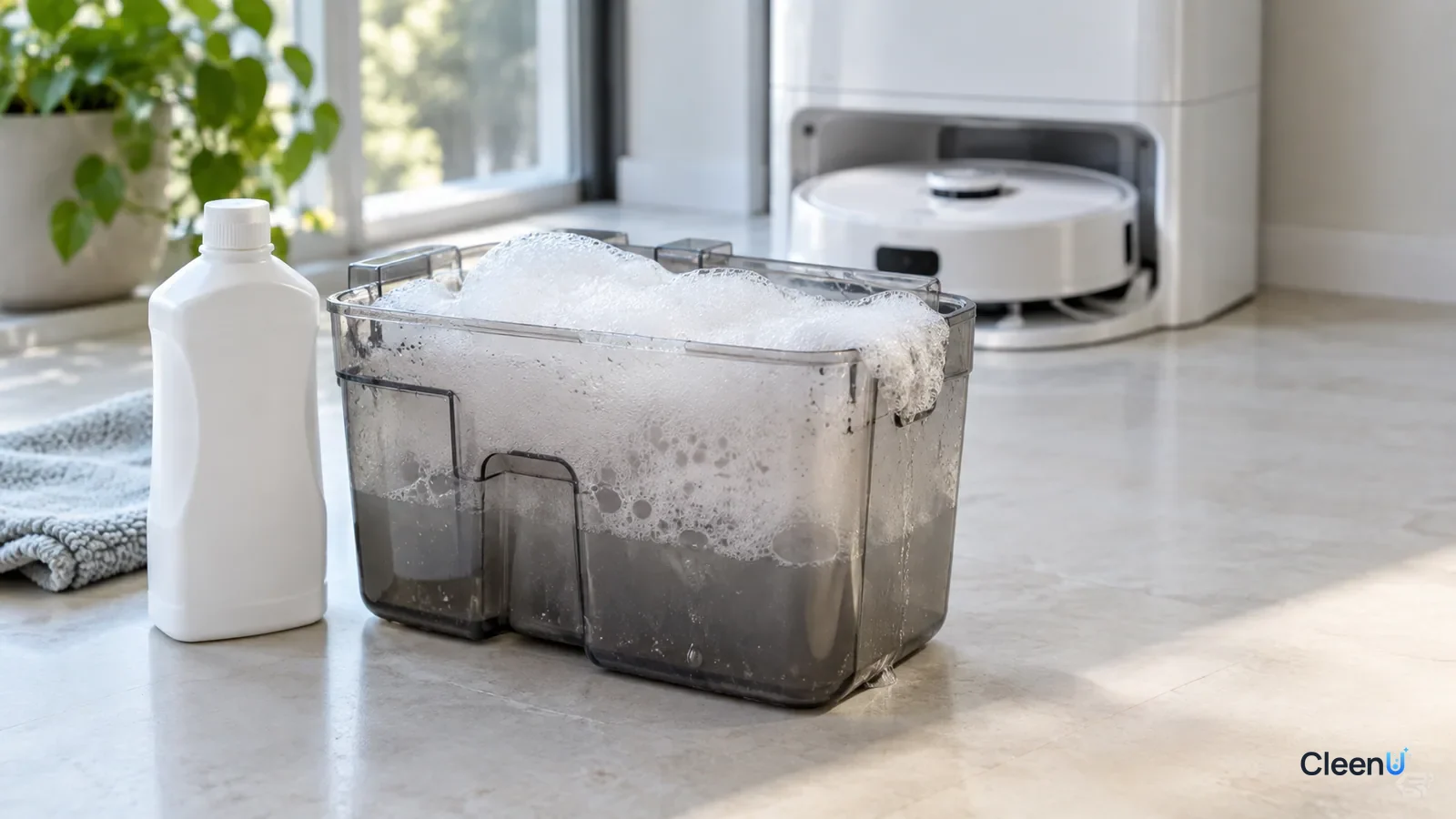
Dish soap is in every kitchen. It cuts grease well and it's cheap. When a new robot mop arrives and there's no robot solution in the house, plenty of people squeeze a little dish soap into the tank, figuring that if it cleans dishes it can clean floors.
The trouble is that dish soap is designed for washing dishes by hand. Its formula aims for rich, long-lasting suds, and a robot mop needs almost none. Once or twice, you might just see some extra foam in the dirty tank. Over time, the foam, residue and clogging problems pile up.
Why does dish soap foam so much?
Dish soap is built mainly on anionic surfactants, usually with foam boosters added. It's designed so a small squirt in a sink of water produces a lot of fine, lasting suds. The suds make washing feel effective and help hold grease in suspension.
A robot mop multiplies that foam several times over. The pump draws the mixture out of the clean tank and sprays it through tiny outlets onto the pads. In a self-cleaning dock, the pads spin and scrub in the wash tray. Then the dirty water gets pumped into the dirty tank. Every one of those steps whips air into the liquid.
Even a few drops of ordinary dish soap, churned like that over and over, can produce a tank that's half foam.
What happens if you put dish soap in a robot mop?
False "dirty tank full" alerts: many docks detect the dirty tank level with contacts or a sensor. Foam is mostly water and conducts electricity, so when it piles up to the contacts, the robot thinks the tank is full and stops mid-run with an error.
Foam overflow: foam takes up a lot of room and can creep out through the lid gap or the suction line and wet the inside of the dock. On some models the dirty tank sits near the airflow path, and foam that gets in there can affect the motor.
Sticky floors and film: dish soap leaves more residue than a robot solution. Once dry, it forms a tacky film that holds dust and hair, feels sticky underfoot and shows wipe marks in side light.
Buildup in the pads and water lines: leftover soap collects in pad fibers, water outlets and tubing, stiffening the pads, making them smell and restricting water flow.
Warranty trouble: many robot makers say in the manual to use only water or a specified solution, and damage caused by using something else may not be covered.
Are all robot mops affected the same way?
Robots with a self-cleaning dock are hit hardest. The dock's high-speed pad scrubbing and pumping is the strongest foam-maker in the whole system, and all that foam ends up in the dirty tank, where it's most likely to trigger false alerts and overflow.
Robots with an auto-dosing compartment face an even bigger risk. Dish soap concentrate is fairly thick, and in an auto-dosing compartment it can dry and clog the narrow tubing and pump, so dispensing slows or stops. And because auto-dosing keeps dispensing on schedule, the foam problem repeats every day.
Robots without a dock, with the tank on board, don't get false dirty-tank alerts. But the dish soap still sprays onto the pads through the water outlets, foams on the floor as the robot mops, leaves residue behind, and can clog the outlets over time.
Wet-dry floor washers are a different kind of machine, but dish soap is still a bad idea there. Their dirty tanks are bigger, and foam can still reach the motor's airflow path.
"A little is fine": should you trust that advice?
You'll often hear, "I added a drop and it's been fine for months." That kind of experience has two problems.
First, how much foam you get depends on the model, the water, the amount and the area mopped. The same drop might barely foam in a small onboard tank with no dock and fill half a dirty tank in a robot with a self-cleaning dock. Someone else's robot being fine doesn't mean yours will be.
Second, a lot of the damage builds slowly. Stiff pads, clogged outlets and layer after layer of floor residue are hard to notice in the short term, and by the time you do, it usually takes a thorough cleanup or even a repair.
Rather than take the chance, use plain water until you have a proper robot solution. It handles everyday dust just fine.
Taking dish soap apart: what its formula is designed to do
A typical hand dishwashing liquid is built roughly like this.
The backbone is anionic surfactants, such as linear alkylbenzene sulfonate (LAS) and sodium laureth sulfate (AES/SLES). They cut grease well, foam quickly and cost little, the classic combination for washing dishes by hand.
Foam boosters and stabilizers, such as fatty acid alkanolamides and amine oxides, make the suds finer and longer-lasting, so they don't collapse the moment you start washing.
Salt thickens it. An AES system thickens when sodium chloride is added, so it pours out as a thick liquid that looks concentrated and is easy to control.
Why does dishwashing need foam? Partly because foam helps hold some of the emulsified grease so less of it lands back on the dishes, and partly because as long as there are suds, you know the solution is still working; when they're gone, it's time for fresh water. For dish soap, foam is both a function and an indicator light.
A robot mop is the opposite. Nobody watches the foam to judge cleaning, and foam only causes trouble for the pump, the sensors and the dirty tank. That's why "great for dishes" and "right for a robot mop" are two different things.
Dish soap's dose is also designed for "a squirt in a sink of water," which isn't a low concentration. Inside a robot, the pump and the dock churn it again and again, driving air in constantly, so it foams far more than it ever would in the sink.
How low-foam formulas are made
Low foam doesn't mean weak cleaning. It just means a different combination of surfactants and additives. Formulators usually take a few approaches.
Use nonionic surfactants that are low-foaming by nature: low-ethoxylate fatty alcohol ethoxylates, EO/PO block copolymers or end-capped ethoxylates. They wet and emulsify grease just as well but pack loosely at the bubble film, so foam breaks easily.
Limit the anionic share: use little or none of the high-foaming anionic surfactants.
Add a defoamer: defoamer molecules spread quickly across the bubble film and thin it locally until it breaks. Defoamers come in silicone and non-silicone types. Silicone defoamers are very efficient, but residue on floors can add slipperiness and affect gloss, so floor products use them with extra care.
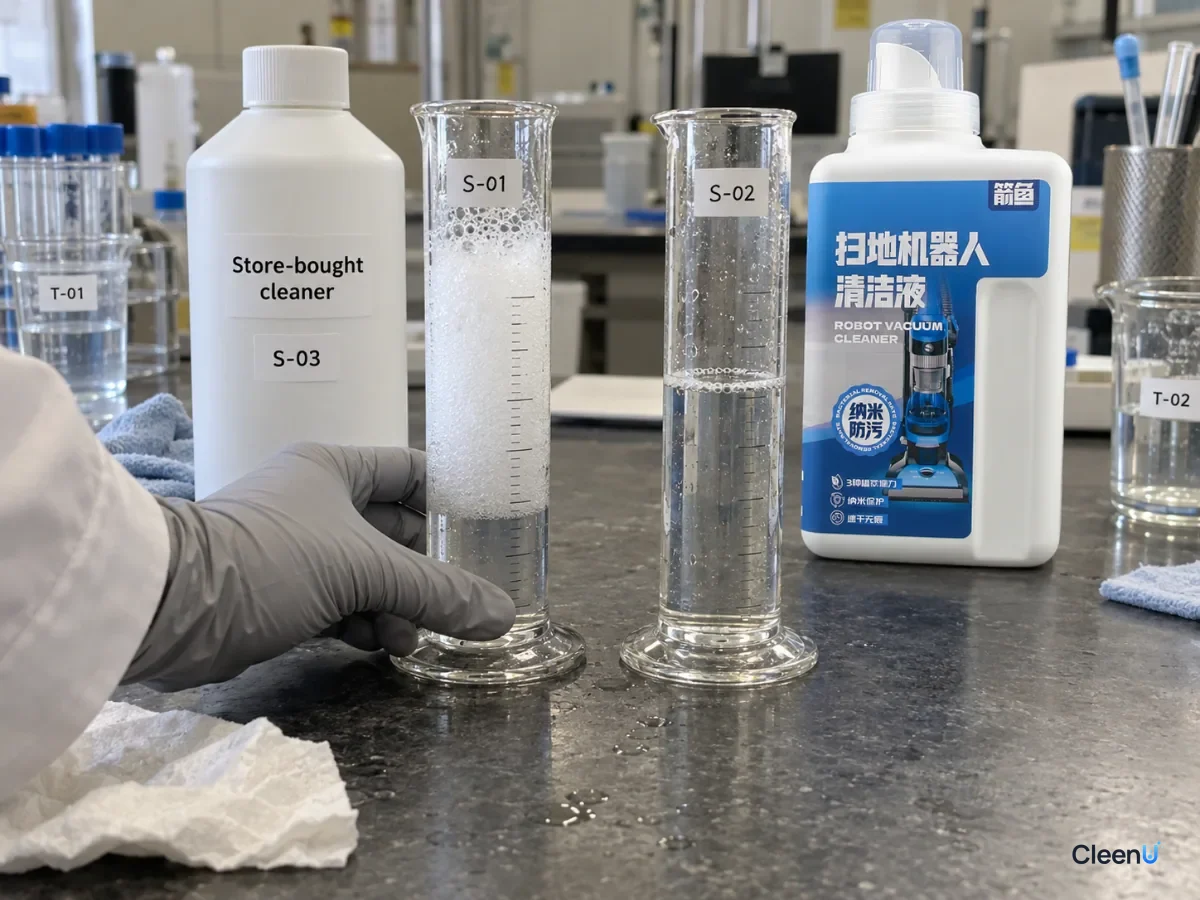
A low-foam product can clean as well as a high-foam one; it just doesn't rely on suds as a visual cue that it's working. CleenU Robot Vacuum Cleaning Solution combines low-foam nonionic surfactants with a defoamer, with a pH of 6.5 to 7.5, and contains no wax or chlorine.
If you have a Roborock, iRobot, Ecovacs, Dreame or Narwal robot mop, or a Tineco-style floor washer, CleenU robot mop cleaning solution works in most models; add it to the clean tank or dosing compartment as the manual directs. (CleenU isn't affiliated with these brands.)
How a robot mop solution differs from dish soap
Both clean with surfactants. The difference is what they're designed for.
Foam: dish soap is made to foam. A robot mop solution uses low-foam surfactants plus a defoaming ingredient, so it barely foams even when churned inside the robot.
Residue: dish soap is hard to dose precisely and leaves more behind. A robot solution is designed for low concentrations and needs no rinse, so floors dry clean.
Compatibility: a robot solution is designed with the tank seals, pump, sensors and different floor types in mind. Dish soap wasn't.
CleenU Robot Vacuum Cleaning Solution, for example, is a neutral, low-foam concentrate with a pH of 6.5 to 7.5, made with low-foam nonionic surfactants and a defoaming ingredient, and it's wax-free, chlorine-free and free of particles. It dilutes at about 1:50 to 1:100, usually 10 to 20 mL per fill, measured with the cap. For why a regular floor cleaner doesn't belong in the robot either, see can you use floor cleaner in a robot mop.
Already added dish soap? Here's how to fix it
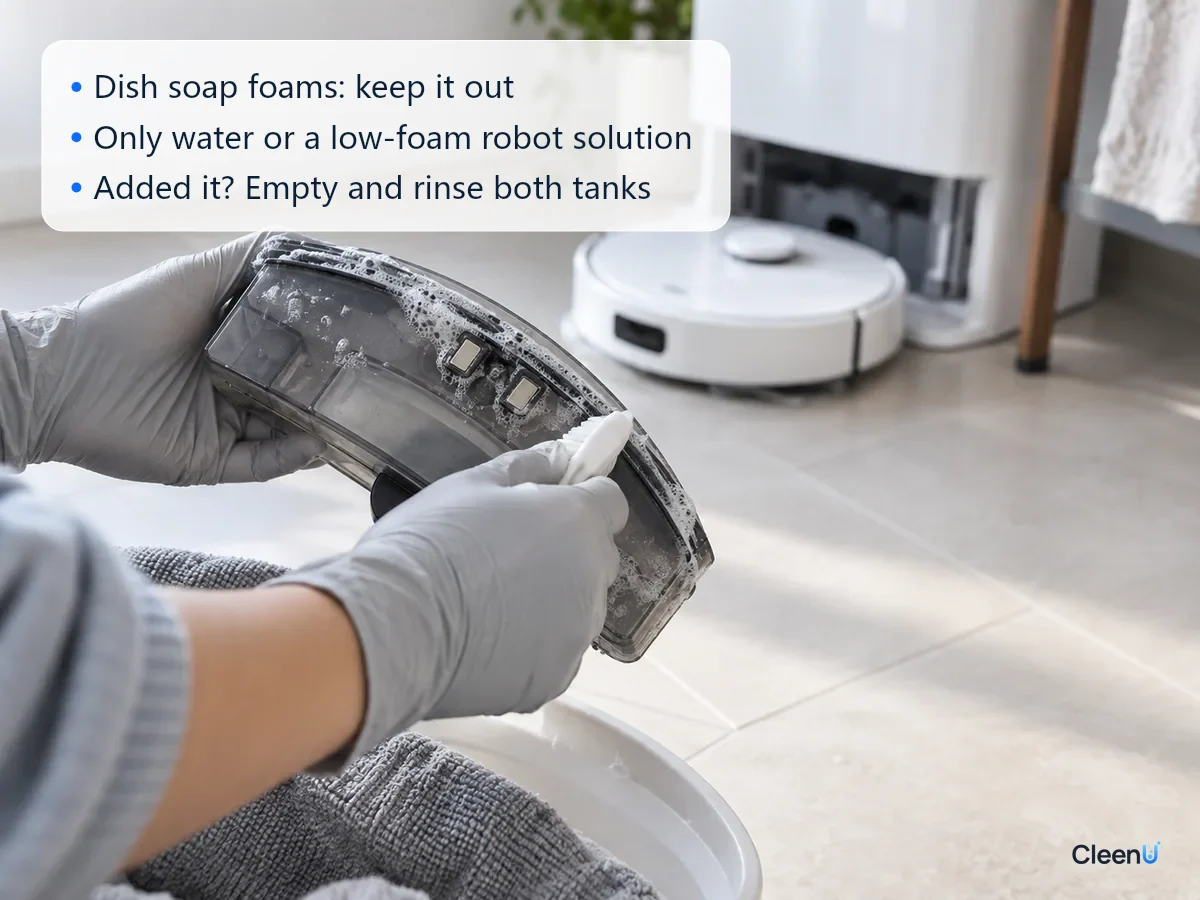
Stop the robot. Pour out the mixture in the clean tank and rinse it two or three times until no suds remain.
Empty and rinse the dirty tank, and wipe the level contacts and sensor window with a barely damp soft cloth.
Take the pads off and rinse them in plain water until squeezing them no longer produces suds. Rinse the dock's wash tray and filter too.
Run the robot once with plain water only to confirm the foam and false alerts are gone, then add a low-foam robot solution at the label ratio.
If the floor already feels sticky, one or two water-only runs will lift the residue. For tracking down stickiness and streaks, see robot mop leaving streaks.
Can I use dish soap to wash the mop pads?
A little dish soap is fine for hand-washing very greasy pads, but rinse them several times in plain water until squeezing them no longer produces suds. Otherwise the leftover soap washes into the dirty tank and foams on the next run, or transfers to the floor and turns sticky. The safer choice is plain water or a little laundry detergent, with no fabric softener.
For a big grease spill on the kitchen floor, wipe it up by hand with diluted dish soap, wipe again with plain water, then let the robot mop as usual. You get the grease-cutting power of dish soap without putting it inside the robot.
This article is part of the Robot Vacuum Cleaning Solution & Maintenance Guide, which covers the full maintenance schedule and links to every troubleshooting guide.
Stop if you see any of these
The dirty tank is full of foam and keeps reporting full; foam is overflowing or the dock is leaking; the robot makes unusual noises, smells burnt or shows errors that won't clear. Stop it right away, empty and rinse both tanks, dry the contacts and run with plain water only. If the fault persists, contact the manufacturer's support and don't take the robot apart yourself.
Dish soap and robot mop questions people ask most
What about just a drop or two of dish soap?
Still not recommended. The pump and dock churn the mixture over and over, so a few drops can make plenty of foam, and regular use leaves residue behind.
Will dish soap break my robot mop?
One time probably won't break it right away, but it can cause false alerts and overflow. Regular use can clog the lines, stiffen the pads and may affect your warranty.
Why do floors get stickier when I mop with dish soap?
Dish soap leaves more residue, which dries into a tacky film. One or two water-only runs will remove it.
What can I use if I don't have robot mop solution yet?
Just water. It handles everyday dust fine. Once you have a low-foam robot mop solution, add it at the label ratio.
Can I use laundry detergent or body wash instead?
No. They're high-foam formulas too and cause the same problems as dish soap.
How do I know a cleaning solution is right for a robot mop?
Check that the label says it's for robot mops and low-foam and gives a dilution ratio, then compare it with what your robot's manual allows.
Can I use regular floor cleaner in my robot mop?
It is not a good idea. Most floor cleaners are made for hand mopping, so their foam and residue are not controlled for a machine. Foam can pile up in the dirty tank, trigger false full alerts or get pulled toward the fan, and shine or care ingredients can leave floors sticky or slippery. Use a low-foam, pH-neutral robot mop solution at about 1:50 to 1:100.
For a low-foam robot mop solution that won't pile up foam in the dirty tank and measures easily with the cap, try Robot Vacuum Cleaning Solution.
Dish soap doesn't belong in a robot mop. It's a high-foam formula made for washing dishes by hand, and the pump, outlets and dock washing churn it into foam that fills the dirty tank, trips false "full" alerts and can overflow, while leaving sticky film on floors and buildup in the pads and water lines. If you've already added it, empty and rinse both tanks, wipe the contacts, rinse the pads and test with plain water. From then on, use a low-foam robot mop solution at the label ratio.