
Q&A
Can You Use Laundry Detergent in a Robot Mop? How It Differs From Robot Mop Cleaning Solution
Direct answer
No. Laundry detergent is designed for a washer that dilutes it in gallons of water and rinses it out. It foams heavily and often carries optical brighteners, enzymes, and long-lasting fragrance. A robot mop never rinses, so the foam trips dirty-tank sensors and the residue dries on your floor.
Common household cleaners: can they go in a robot mop tank?
Yes
- Plain water, for rinsing tanks and flushing out residue before a switch
- A low-foam, neutral robot mop cleaning solution with no wax or particles, diluted per the label
No
- Laundry detergent, including liquid from laundry pods
- Detergent with built-in fabric softener, or fabric softener itself
- Dish soap, hand soap, body wash, and other high-suds products
It depends
- Regular floor cleaner: only if it's labeled low-foam with no wax or shine agents and your manual allows it; test one room first
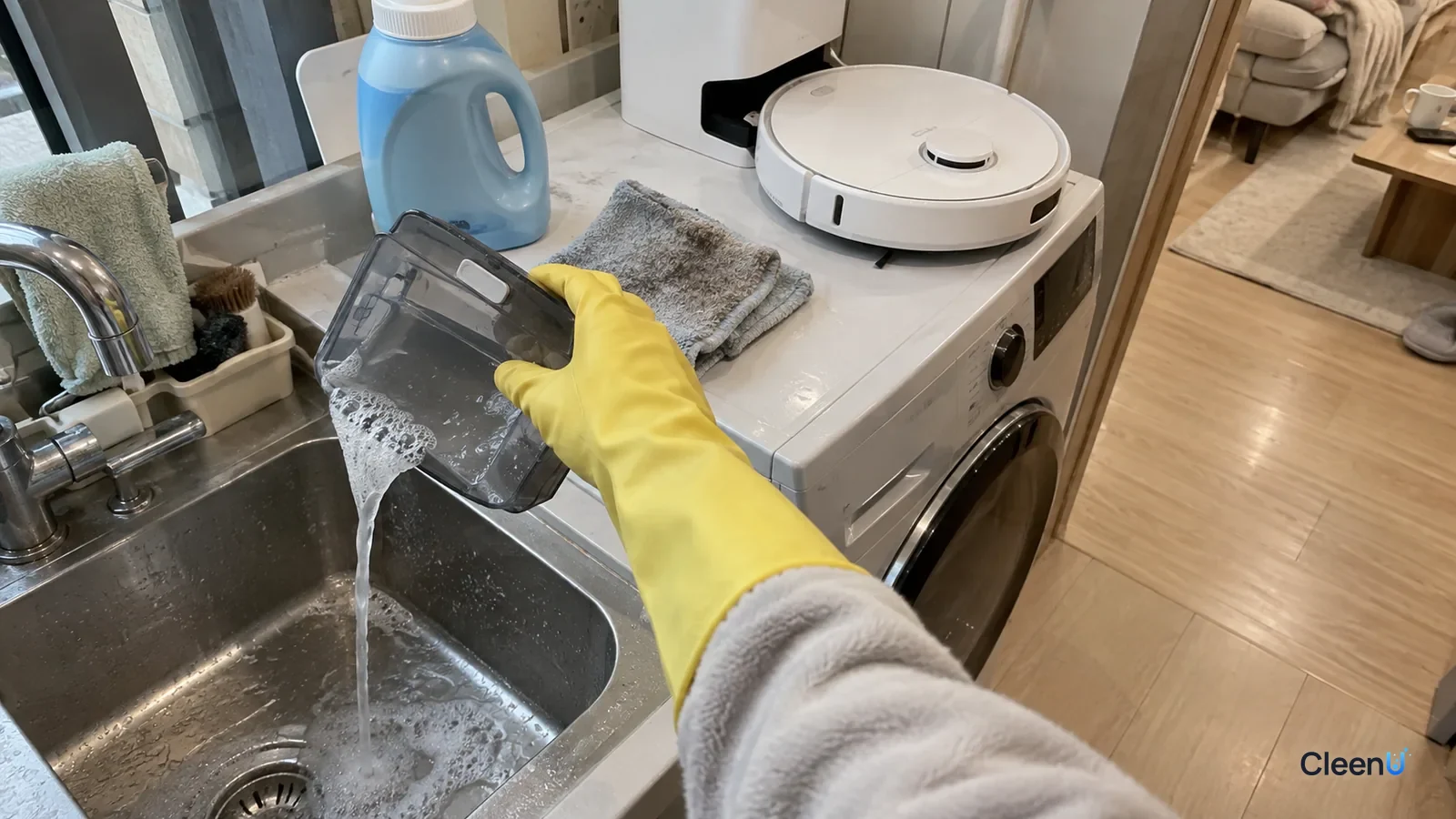
It's an easy shortcut: the laundry room is right there, and a squirt of detergent seems close enough. It isn't. One accidental fill usually won't ruin a robot, but laundry detergent causes three problems you'll notice fast: the dirty water tank fills with foam and throws a "tank full" alert, the floor dries tacky or streaky, and brightener and fragrance build up on the mop pads and floor because nothing ever washes them away.
Laundry detergent isn't a bad product. It's engineered around a step a robot mop doesn't have: its high suds, fiber-clinging ingredients, and lasting scent all assume a big final rinse. A robot mop spreads a thin film of solution and lets it evaporate, so whatever was dissolved in it stays put. Below: what's in detergent, the liquid's path through a robot, the chemistry behind the foam and film, at-home tests, cleanup, and what to use instead.
What's in laundry detergent, and why each part is built for a washer
Formulas vary, but most liquid detergents share a familiar set of ingredients, each with a job that depends on the washer:
- Anionic surfactants. Common examples are linear alkylbenzene sulfonate (LAS) and sodium laureth sulfate (SLES). They do most of the cleaning, and they're also the main source of suds. Many formulas add some soap as well.
- Nonionic surfactants, such as alcohol ethoxylates, which help with oily soil.
- Enzymes, such as protease, amylase, and lipase, which break down sweat, food, and starch stains given warm water and a long wash cycle.
- Optical brighteners, which absorb ultraviolet light and give off a blue-white glow so whites look whiter. They're designed to cling to fibers and survive the rinse.
- Fragrance, often engineered to last on fabric for days.
- Supporting ingredients: builders and chelators for hard water, anti-redeposition polymers, preservatives, and dyes. "2-in-1" products add fabric softening agents, which are usually cationic.
Now look at how a washer uses all that. The load sits in gallons of water, so detergent is heavily diluted. The drum agitates for a long cycle, then the wash water drains, one or two rinses follow, and a fast spin pulls out what's left. High suds are fine because the rinse handles them. Brighteners and fragrance staying on fabric is the goal. Enzymes get the time and warmth they need.
A robot mop flips every one of those assumptions. The tank is small, liquid reaches the floor within seconds, and there's no rinse at all. Each feature that makes detergent work in a washer turns into a side effect on your floor.
Where the liquid goes inside a robot mop
To see where the trouble starts, follow the liquid through a typical round robot mop with a self-cleaning dock:
- Clean water tank. Holds the mixed solution. People tend to swirl it after adding detergent, so foam starts here.
- Pump and outlets. A small pump, often solenoid or peristaltic, pushes liquid to outlets above the pads at the flow level set in the app. With foam, it pulls in air and flow turns uneven.
- Mop pads and floor. The pads spread the solution into a thin film, pick up dust, and leave the film to evaporate.
- Dock mop washing. The pads are scrubbed against a ribbed tray and rinsed, and dirty water is suctioned away. This is the most foam-generating step in the system.
- Dirty water tank. Dirty water and foam arrive together. Level sensing is often electrode- or float-based, and foam can fool both.
Laundry detergent creates three outcomes along that path:
- False "tank full" alerts. Stable foam fills the dirty tank before the water does, reaching the electrodes or lifting the float. Open the tank and it's mostly bubbles. Foam also gets pulled into the filter and dries into a soft sludge.
- Tacky floors. Once the film evaporates, surfactant and hard-water soap scum stay behind. Floors feel draggy underfoot, and dark or polished tile shows hazy swipe marks.
- Brightener and fragrance buildup. Both are designed to stay on surfaces, and nothing in a robot mop removes them, so pads get more perfumed and more slippery over time.
Why detergent foam is so stubborn: charge, micelles, and thin films
Foam is air trapped in thin liquid films. How long it lasts depends on how quickly those films drain and pop. Laundry detergent foam is unusually durable for two reasons tied to its anionic surfactants.
The first is electrical repulsion. In water, the water-loving end of an anionic surfactant carries a negative charge. When those molecules line both faces of a bubble film, the two negatively charged surfaces push against each other, a bit like a spring holding the film open. Liquid drains out of the film more slowly, so it takes longer to thin to the breaking point. Chemists call this film-stabilizing push disjoining pressure. The nonionic surfactants used in robot mop solutions carry no charge, so that spring is missing. Films drain fast and bubbles don't last.
The second is concentration far above the critical micelle concentration. The critical micelle concentration, or CMC, is the point where surfactant molecules start clustering into micelles. Beyond it, extra surfactant sits in the water as a reserve. When a bubble starts to tear, nearby micelles break apart and patch the new surface, so the foam keeps getting reinforced. In a washer, detergent is spread through gallons of water. Squeeze the same detergent into a robot tank that holds a liter or two (roughly 34 to 68 oz) and the concentration is usually much higher, which means more reserve surfactant and more persistent foam.
Floor soil makes it worse. Protein from food crumbs, pet saliva, and foot sweat settles on bubble surfaces and makes the films more elastic, so detergent foams even more in dirty mop-wash water.
How laundry detergent ends up as a false full-tank alert
- The dock scrubs and rinses the mop pads, whipping air into detergent-laden dirty water
- Anionic surfactant lines both faces of each bubble film, and the negative charges slow drainage
- Surfactant far above its CMC keeps patching weak spots, so the foam persists
- Protein from floor soil settles on the bubbles and strengthens them further
- Foam fills the dirty tank ahead of the liquid, reaches the sensor, and the dock reports full
Why floors turn sticky: soap scum, brighteners, and leftover film
A sticky floor after a detergent mop isn't dirt left behind. It's the detergent itself. Three things stack up.
First, film thickness. Every pass of the pad leaves a thin layer of solution on the floor, and when the water evaporates, everything dissolved in it stays. The residue is roughly the solution's concentration times the amount of liquid left on the floor. Stronger solution means more residue, and with no rinse, each mopping adds another layer.
Second, hard water and soap scum. Calcium and magnesium in tap water bind with anionic surfactants and soap to form insoluble calcium and magnesium salts, the same grayish, slightly tacky scum that makes laundry feel stiff in hard-water areas. In a washer, builders and chelators tie up some of those minerals and the rinse carries the rest away. In a robot mop, that scum simply dries in place on the floor and in the pad fibers. You feel it as drag underfoot and see it as haze on dark floors.
Third, ingredients that are meant to stay. Optical brighteners have a strong affinity for fibers, and they only work if they remain on the fabric after the wash. A mop pad is fabric, so brightener builds up on it and gets spread back across the floor. Long-lasting fragrance works the same way. Cationic softening agents in 2-in-1 detergents coat surfaces with a slippery film. That's what makes towels feel soft, and on a floor it means slipping, which matters in homes with toddlers or older adults.
Enzymes aren't behind the stickiness, but they're mostly wasted in a robot: they need warmth and minutes of contact, and the floor dries long before that.
A few terms used here
- Anionic surfactant
- A surfactant with a negatively charged water-loving end. Strong cleaner, heavy foamer.
- Critical micelle concentration
- The concentration where surfactant starts forming micelles. Above it, cleaning gains level off while foam and residue keep rising.
- Soap scum
- Insoluble salts formed when calcium and magnesium in hard water react with anionic surfactant or soap. Dries gray-white and draggy.
- Optical brightener
- An ingredient that absorbs UV light and glows blue-white, designed to bind to fibers.
Try it at home: a shake test, a UV light, and a mirror
No lab gear needed. Fill three identical clear plastic bottles with about 500 mL (17 oz) of tap water each.
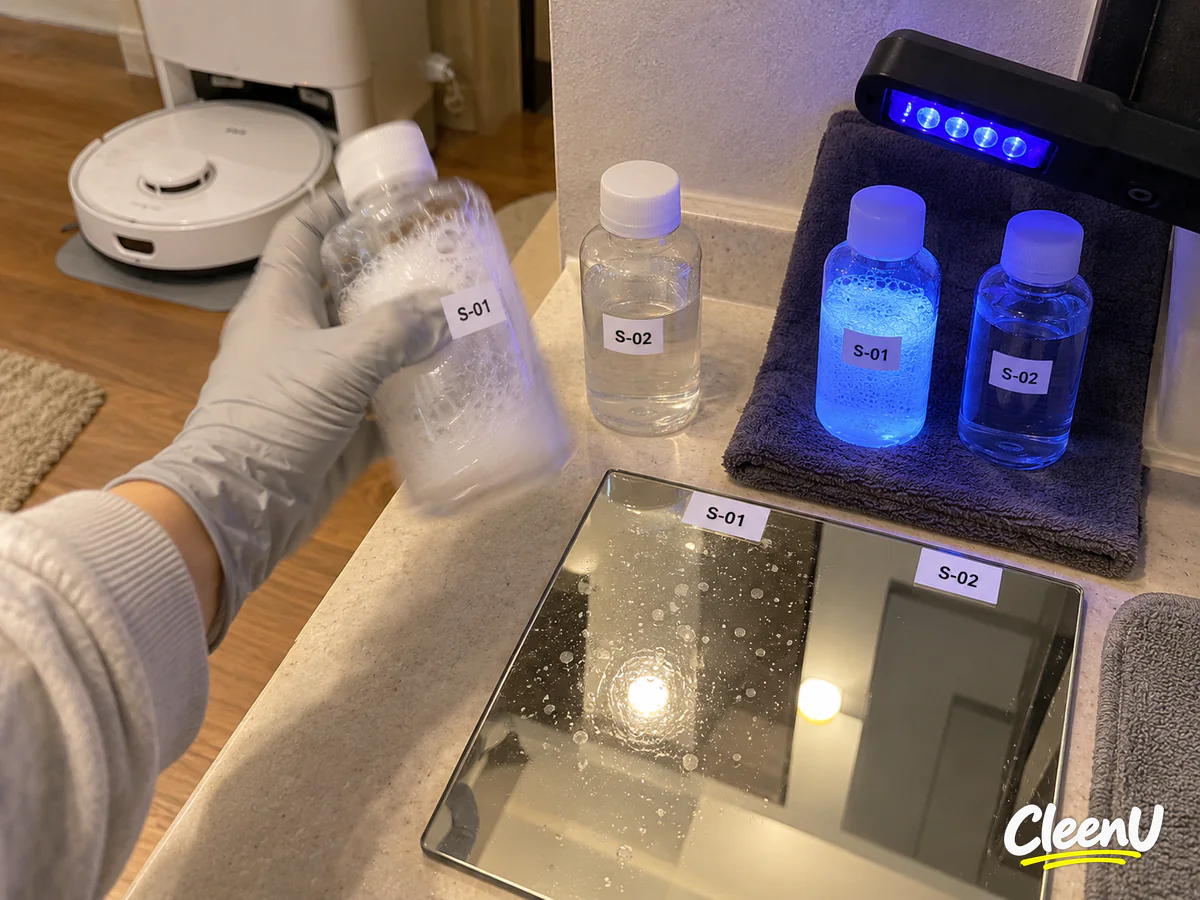
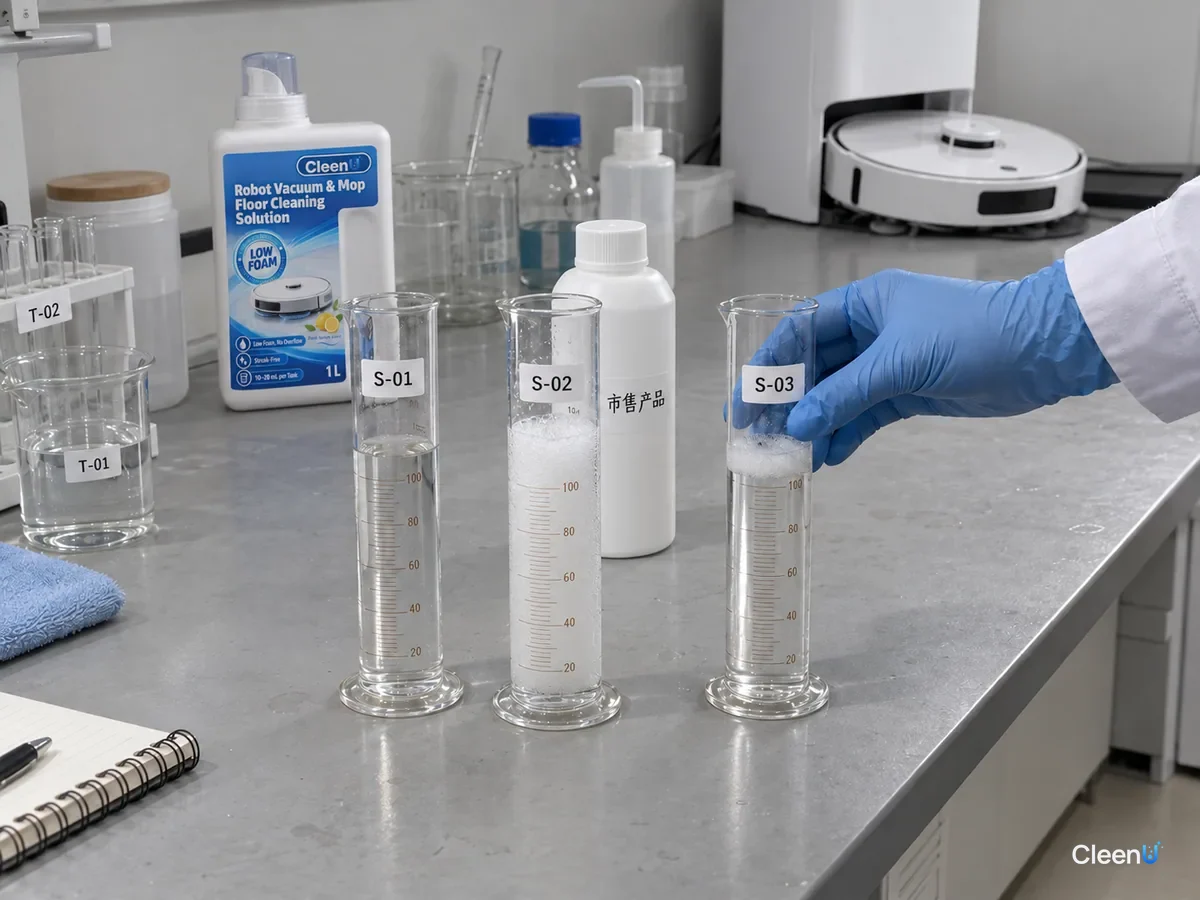
Shake test for foam. Leave the first bottle as plain water. In the second, squeeze in laundry detergent the way most people do when they add it to a tank. In the third, add robot mop cleaning solution at its label ratio; at about 1:50 to 1:100, that's 5 to 10 mL. Cap all three, shake each one hard 10 times, and set them down. The low-foam robot solution leaves a thin layer that drops quickly. The detergent bottle holds thick, fine foam that hangs around. That's what your dirty water tank sees.
UV light for brighteners. Dip one small white cotton washcloth in the detergent water and another in the robot solution, wring them out, and let them dry. Turn off the lights and shine a UV flashlight on them. A cloth carrying optical brightener glows a distinct blue-white. No glow doesn't make a detergent safe for a robot; some "free and clear" detergents skip brighteners, but they still foam and leave residue.
Mirror test for residue. With a clean soft cloth, wipe a small patch of each solution onto a mirror or dark glass, plus a patch of plain water as a control. Let them air-dry and look at them from an angle. The high-residue patch shows a hazy film and feels draggy. A mirror is far more sensitive than a floor, so residue you see here eventually shows up as streaks and stickiness on dark floors.
If you have hard water, run the shake test once more after adding a few drops of dirty mop water to each bottle. A high-foam liquid that looked fine in clean water foams and clouds up more with soil in it, which is closer to what happens when the dock washes the pads.
For the full shake-test method, see How to tell if a robot mop solution is low-foam.
Already used laundry detergent? Here's the cleanup
If you've filled the tank with detergent, or even mopped a few times with it, work through these steps. In most cases the robot goes back to normal.
Cleanup after laundry detergent, in order
- Stop the job and send the robot back to the dock; don't keep mopping
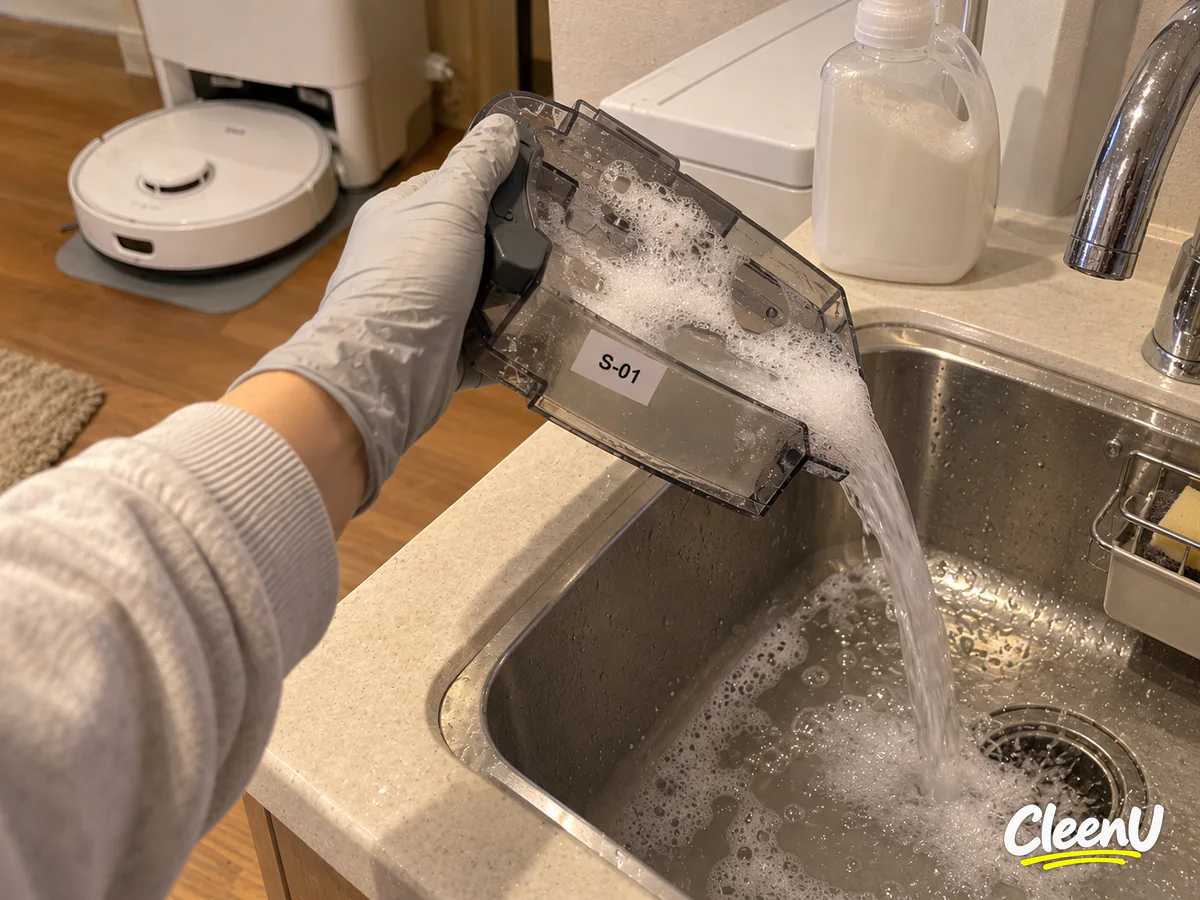
- Empty the clean water tank and rinse it with fresh water until swirling it no longer makes foam
- Empty the dirty water tank, rinse the tank and lid, and wipe dry around the level-sensing electrodes or float
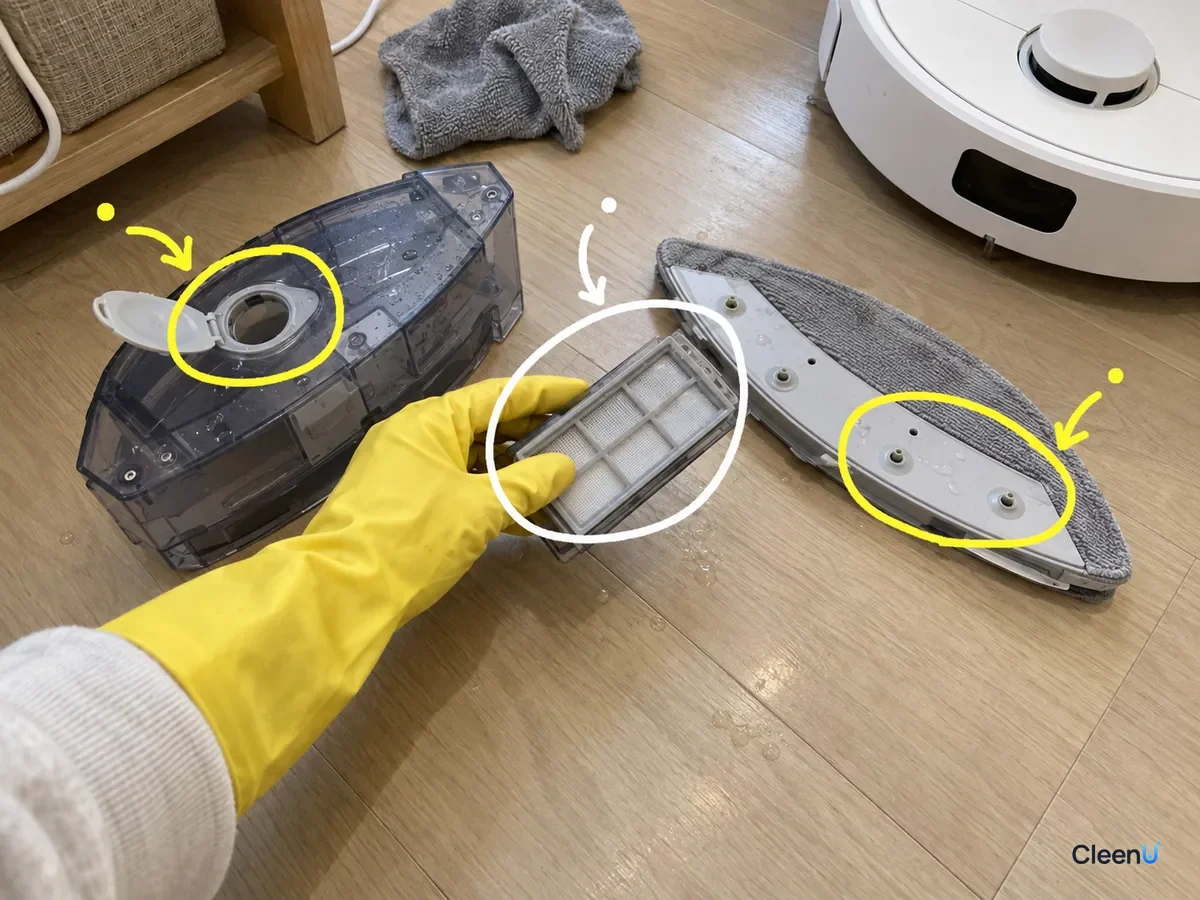
- Remove the dirty-tank filter and the dock's wash tray, rinse off foam and sludge, and let them dry before reinstalling
- Fill the clean tank with plain water and run one or two manual mop-wash cycles until the dirty tank shows no obvious foam
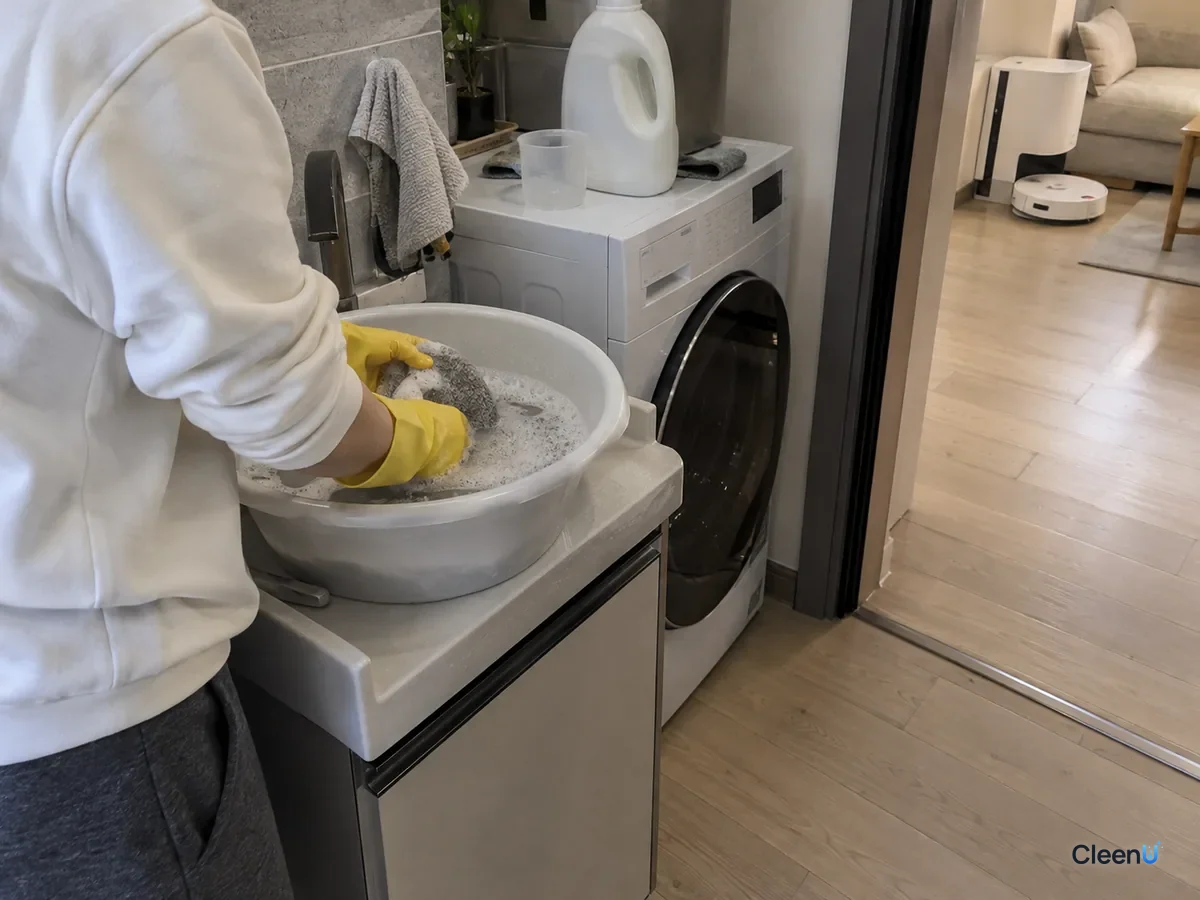
- Hand-wash the mop pads in plain water, no detergent or softener, squeezing until they stop sudsing, then air-dry or dock-dry them
- Mop once with plain water, then check dark or polished floors for haze once dry
If the pads still feel slick or absorb poorly, they've likely soaked up brightener and softener that water won't remove. Replacing them is the faster fix.
Still seeing these after cleanup? Stop and contact the robot maker
Stop if the dirty tank keeps reporting full after several plain-water cycles, the pump sounds wrong or flow stops, the dock shows an error code, you notice a burning smell or odd noise near the motor, or a connector leaks. Foam may have reached the air path, tubing, or sensors. Don't open the unit yourself; contact the manufacturer's support as your manual directs.
Trying to save money? Do the math on a real solution
Most people reach for detergent because dedicated solution sounds expensive. The math is closer than you'd think. At about 1:50 to 1:100, 10 to 20 mL per fill is usually enough, so a 1 L (about 34 oz) bottle covers roughly 50 to 100 fills, or several months at three mops a week. Whatever detergent saves gets paid back in clogged filters, worn pads, and re-mopping. Use the low end for routine mopping and the high end, or a second pass, for dirtier floors.
When you compare prices, don't stop at the ratio on the label. Work out how much active ingredient is left in the tank: active content divided by the dilution ratio. Many robot mop solutions carry about 2% active surfactant. At 1:200 that leaves about 0.01%, and at 1:500 only about 0.004%. CleenU Robot Mop Cleaning Solution, for example, carries 15% active surfactant, so at 1:100 it still leaves about 0.15%: about 15 times the first case and nearly 40 times the 1:500 case. The 2% figure is a typical level used for illustration, not any particular brand. A bigger ratio isn't automatically cheaper; a mix that cleans the first time is.
Dose by water volume (about 1:50 to 1:100)
- 1 L (about 34 oz)
- about 10–20 mL
- 2 L (about 68 oz)
- about 20–40 mL
- 4 L (about 1 gal)
- about 40–80 mL
What to look for in a robot mop cleaning solution
Detergent fails on foam, film, and lingering scent, so flip those three:
- Low foam. Built on low-foam nonionic surfactants with foam control, so a shake test leaves a thin layer that collapses quickly.
- Low residue. No wax, shine-boosting film-formers, or particles, so a mirror test stays clear. Robot mop solutions generally skip optical brighteners and softening agents too.
- Neutral pH, which is gentler on sealed wood, tile, vinyl plank, and the seals inside the robot.
- Restrained scent; homes with babies or pets may prefer fragrance-free.
- A measuring cap and a clearly stated ratio.
CleenU Robot Mop Cleaning Solution is built to that checklist. It's a neutral concentrate, pH 6.5–7.5 as a concentrate, made with low-foam nonionic surfactants and a defoamer, with no wax, no chlorine, no particles, no quats or phenols, no solvents, and no optical brighteners. Its viscosity is suited to dock auto-dosing compartments. Each 1 L bottle comes with a measuring cap and dilutes about 1:50 to 1:100; 10 to 20 mL per fill is usually enough. The standard version has a lemon scent. The Pet Homes version is fragrance-free and uses a cyclodextrin-based odor neutralizer for pet odors. Shelf life is 24 months unopened. It's a cleaning solution that lifts dust film, greasy footprints, and everyday soil. It isn't a disinfectant.
It works in most models from Roborock, iRobot (Roomba Combo and Braava), Ecovacs Deebot, Dreame, Shark, and Eufy RoboVac, as well as wet-dry vacuums such as Tineco and Bissell CrossWave. Add it to the clean water tank or the dock's designated solution compartment as your manual directs; on Narwal robots, add it to the clean water tank. If your model's manual says otherwise, follow the manual. CleenU is not affiliated with any of these brands; names are used only to describe compatibility.
If you're ready to swap detergent for a low-foam, neutral solution, take a look at our Robot Vacuum & Mop Floor Cleaning Solution.
For a fragrance-free option in homes with cats or dogs, see CleenU Robot Mop Cleaning Solution for Pet Homes.
Laundry detergent in a robot mop: common questions
I used laundry detergent once. Did I damage my robot mop?
One fill usually doesn't cause damage, but clean up promptly. Empty both tanks, rinse the filter, and run plain-water mop-wash cycles until the dirty tank shows no obvious foam.
What if I use just a few drops of detergent?
Skip it anyway. Fewer drops mean less foam, but brightener, fragrance, and soap scum still build up on pads and floors with repeated use.
My dock keeps saying the dirty tank is full after I used detergent. What do I do?
Empty the dirty tank, wipe the level-sensing area dry, and run one or two plain-water mop-wash cycles. If false alerts continue once the foam is gone, contact the robot maker's support.
How do I fix floors that feel sticky after mopping with detergent?
Mop once or twice with plain water and change or rinse the pads often. If dark or polished floors still look hazy when dry, wipe along the grain or grout lines with a well-wrung soft cloth.
Is a free-and-clear or baby detergent OK?
No. It's still built on anionic surfactants, so foam and residue remain. It just leaves out brighteners or dyes.
Can I break open a laundry pod and use that?
Don't. Pods are highly concentrated detergent, so foam and residue get worse, and dissolved film from the pod can also clog filters.
Will fabric softener make my floors shinier?
No. It tends to make them slippery. Its cationic ingredients leave a lubricating film, which is a real concern with toddlers or older adults at home.
Can I hand-wash mop pads with laundry detergent?
Yes, as long as you rinse until no suds come out before reattaching them. Skip fabric softener; it reduces how well microfiber pads absorb water.
Detergent has enzymes. Won't that help with floor stains?
Not in a robot mop. Enzymes need warmth and several minutes of contact, and the solution dries on the floor long before that.
Do I need to clean the tank before switching to a robot mop solution?
Yes. Rinse the clean water tank until swirling it makes no foam, then add the new solution so leftover detergent doesn't mix with the new formula.
If not laundry detergent, what should go in my robot mop tank?
A low-foam, neutral robot mop cleaning solution with no wax or particles. Dilute it about 1:50 to 1:100, usually 10 to 20 mL per fill, and test one room first to check for streaks or tackiness once dry.
If you're wondering about dish soap specifically, see Can you put dish soap in a robot mop? For a full walkthrough of false full alerts, see Robot mop says the dirty tank is full when it isn't. Already dealing with tacky floors? Read Sticky floors after robot mopping, and for white marks in hard-water areas, see White residue after robot mopping with hard water.
Keep laundry detergent out of your robot mop. Its heavy foam, fiber-clinging ingredients, and long-lasting fragrance all assume a washer that rinses everything away. A robot mop doesn't, so the foam triggers false full alerts and clogs filters, while surfactant, soap scum, brightener, and fragrance dry on your floor and pads. If you've already used it, empty both tanks, rinse the filter, run plain-water cycles, and hand-wash the pads. For everyday mopping, use a low-foam, neutral robot mop solution with no wax or particles at about 1:50 to 1:100, usually 10 to 20 mL per fill, as the label directs.