
Comparison
Neutral vs Mildly Alkaline Robot Mop Cleaning Solution
Direct answer
Choose neutral for hardwood, natural stone and everyday upkeep. Choose mildly alkaline for tile-heavy homes with lots of greasy kitchen footprints. pH is a guide, not the whole story, so also check the label's floor list and ratio. No robot mop solution should be strongly alkaline once diluted.
How to choose
-
Mostly solid hardwood, engineered wood or bamboo, or natural stone like marble or terrazzo
Choose Neutral
Wood finishes and stone are sensitive to both alkalis and acids, so neutral is the safest.
-
Mostly tile, with lots of greasy kitchen footprints and daily cooking
Choose Mildly alkaline, or neutral plus an extra kitchen pass
Mild alkalinity helps with grease, and glazed tile tolerates it well.
-
Mixed floors, with both wood and tile
Choose Neutral
One bottle works throughout, and heavy grease gets hand prep and an extra pass.
-
Babies, pets or anyone sensitive to irritants at home
Choose Neutral, at the low end of the label
Less irritation and less residue.
-
Waxed or oil-finished wood floors
Choose Don't wet-mop
Neutral or alkaline, wet mopping slowly strips wax and oil finishes.
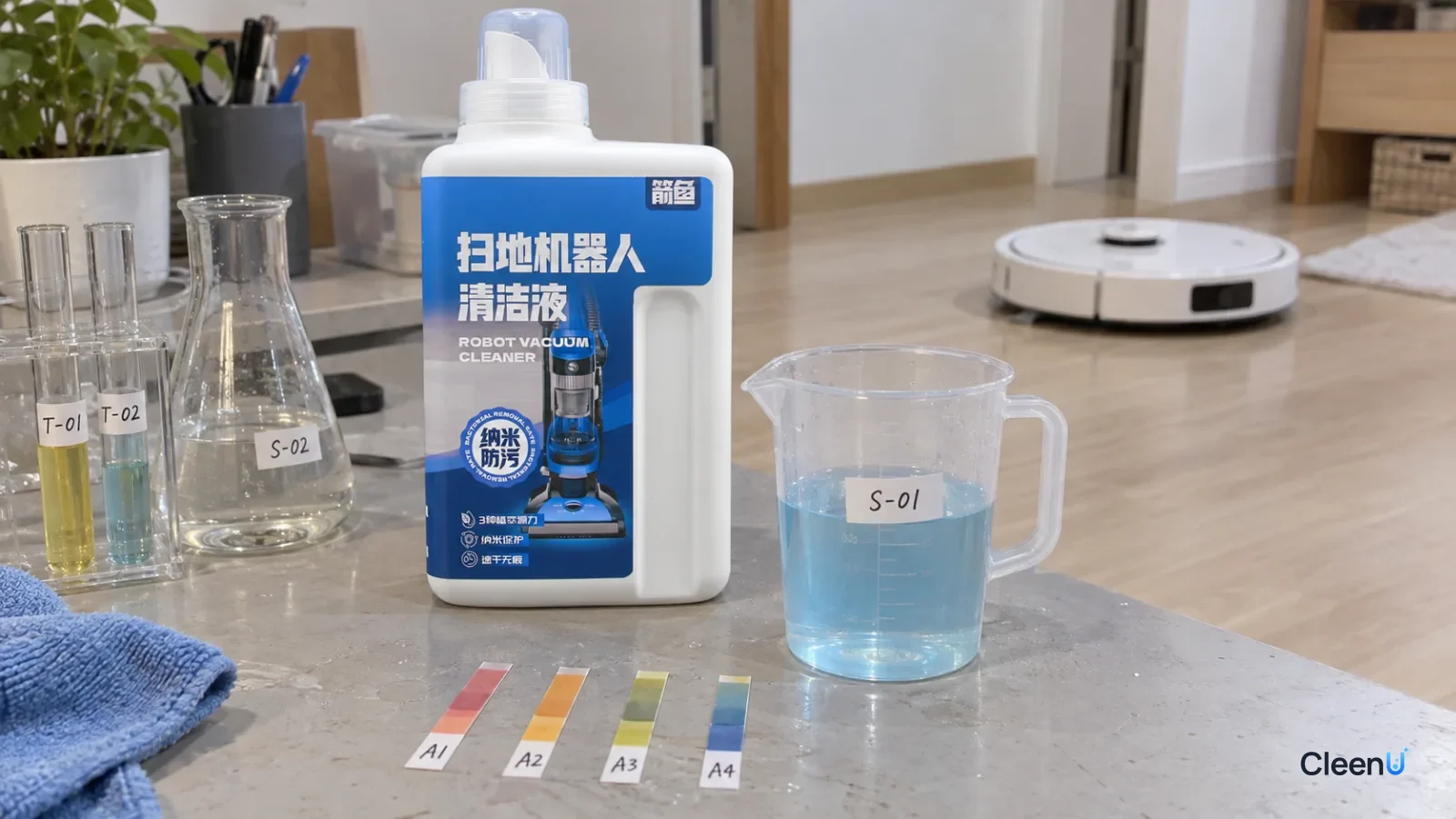
Robot mop solution labels often say "neutral," "mildly alkaline" or "pH 7–8." Most people know acids and alkalis can hurt floors, but not what separates neutral from mildly alkaline, or which one suits their home.
In short, pH decides which kinds of soil a cleaner leans toward and which floors it's gentlest on. Get it right and mopping is easier and your floors last longer.
What is pH, and why does it matter for cleaning?
pH measures how acidic or alkaline a solution is on a scale of roughly 0 to 14. Seven is neutral, below 7 is acidic and above 7 is alkaline. The scale is logarithmic, so each step is a tenfold change. pH 9 looks only two steps from pH 7 but is about 100 times more alkaline.
Roughly speaking, cleaners fall into these bands:
Neutral, about 6 to 8: everyday maintenance, gentlest on most floors.
Mildly alkaline, about 8 to 10: better on oils, skin grease and protein-based soil.
Strongly alkaline, above 11: heavy grease, ovens and range hoods. Not for everyday floor cleaning, and not for robot mops.
Acidic, below 6: scale, soap scum and urine scale. They etch marble and cement grout and don't belong in a robot mop for daily use.
Why does alkalinity help with grease?
Greasy footprints and kitchen grease are mostly triglycerides and fatty acids. An alkaline environment helps in several ways.
It neutralizes fatty acids. As fats oxidize and break down, they release free fatty acids. Alkali reacts with them to form fatty acid salts, essentially soap, which rinse away more easily.
Saponification. With stronger alkali and heat, triglycerides split into glycerol and fatty acid salts. That's saponification, and it's why strong degreasers can handle baked-on grease. At mild alkalinity, room temperature and brief contact, very little saponification happens, so floor cleaning still relies mainly on surfactants emulsifying the soil.
It loosens proteins. Alkaline conditions help protein soils like drool and milk swell and let go.
It builds negative charge. Under alkaline conditions, both soil and floor surfaces tend to pick up negative charge. Like charges repel, so soil is pushed off and less likely to settle back.
So on grease-heavy kitchen floors, a mildly alkaline formula often takes less effort.
Why is neutral better for hardwood and stone?
Wood finishes. Most hardwood finishes are polyurethane-type coatings that handle everyday neutral or mildly alkaline cleaners fine. But the stronger the alkali and the more frequent the contact, the more likely some finishes are to haze or dull. A robot mops daily without rinsing, so residue sits on the finish long term, which is why neutral suits wood-floor homes.
Waxed and oiled floors. Wax and oil are emulsified and stripped more easily by alkali, so the floor slowly clouds and loses protection. Don't wet-mop them.
Natural stone. Marble and terrazzo are mostly calcium carbonate and are etched by acid, and some stones and stone sealers are sensitive to alkali too, dulling with long exposure. Neutral is the safest choice.
Cement grout. Strong alkalis and acids both age grout faster. Mild alkalinity is fine, neutral is better.
Why don't strong alkalis or acids belong in a robot mop?
For the machine: they can corrode metal contacts and age seals faster, and they linger in the tank and lines.
For floors: a robot doesn't rinse, so whatever's in the liquid stays on the floor and keeps acting on it.
For people and pets: strong alkalis and acids irritate skin and mucous membranes, and pets and babies have the most floor contact.
That's why robot mop solutions are generally designed in the neutral range, and once diluted at the label ratio the working solution sits even closer to neutral.
How to test a solution's pH at home
If the label doesn't list a pH, or you want to check, household pH strips give you an answer in a few minutes.
You'll need wide-range pH strips (1 to 14), two clean clear cups, a measuring cup and tap water.
Test the concentrate. Pour a little into the first cup, dip a strip and read it against the color chart within about 30 seconds.
Test the working solution. Mix a batch at the label ratio in the second cup, for example 5 to 10 mL of concentrate in 500 mL of water, stir and test the same way.
Test your tap water. That shows how much of the diluted reading comes from the water itself.
Keep in mind that household strips are usually accurate to half a unit or a full unit, so they're good for telling neutral, mildly alkaline, strongly alkaline and acidic apart, not for exact values. Strongly colored liquids can throw off the reading, and you need to read within the stated time. For precise numbers, use a calibrated pH meter.
A concentrate between 7 and 10 that dilutes to about 7 to 8 is in the right range for everyday robot mopping. Anything above 11 or below 5 shouldn't go in a robot mop.
Does alkalinity affect the robot's metal parts?
Robot tanks and lines are mostly plastic, but the dirty tank's level contacts and some fittings and springs are metal. A mildly alkaline working solution at the label ratio has little effect on typical stainless steel contacts. Strong alkalis, though, corrode reactive metals like aluminum and zinc, and residue left on contacts can react with carbon dioxide in the air to form white crystals. That's another reason robot mop solutions stay in a gentle pH range, and why you should empty and dry the tanks rather than leave working solution sitting on metal parts.
Does pH change after dilution?
It moves toward neutral, but not by simply dividing by the dilution factor. A concentrate at pH 9 diluted 100 times drops noticeably but usually stays a bit above 7. The exact value depends on the formula's buffer system and on the pH and hardness of your tap water.
Two takeaways. The pH on a label usually refers to the concentrate, so the working solution on your floor is much milder. And overdosing raises both the pH and the concentration of the working solution, which increases the effect on sensitive floors. Neutral or alkaline, dose at the label ratio.
Neutral vs mildly alkaline robot mop cleaning solution, point by point
| What to compare | Neutral (about pH 6 to 8) | Mildly alkaline (about pH 8 to 10) |
|---|---|---|
| Best on | Everyday dust, footprints, light greasy marks | Greasy footprints, skin oil, protein soils |
| Hardwood finish | Safest | Usually fine; sensitive finishes may dull over time |
| Natural stone | Recommended | Use caution; check the stone care guide |
| Tile | Works well | Works well, with easier grease removal |
| Vinyl plank and laminate | Works well | Usually fine; check the flooring maker's guidance |
| Irritation | Lower | Slightly higher, still far below strong alkalis |
| Best fit | Wood, stone, mixed floors, babies and pets | Tile-heavy homes that cook a lot |
Where does CleenU robot mop solution fit?
CleenU Robot Vacuum Cleaning Solution has a pH of 6.5 to 7.5 at 25°C, between neutral and mildly alkaline. It's a neutral, low-foam concentrate with low-foam nonionic surfactants and a defoamer, no wax, no chlorine and no particles, made for tile, vinyl plank, laminate and sealed hardwood, and not for unsealed or waxed wood or carpet. It dilutes at about 1:50 to 1:100; 10 to 20 mL per fill is usually enough, and the working solution sits closer to neutral.
The idea is a gentle pH that suits homes with both wood and tile, leaving more of the grease work to surfactant wetting and emulsifying rather than higher alkalinity. For heavy kitchen grease, clean it by hand first and give the kitchen an extra pass. See using a robot mop on a greasy kitchen floor.
It works in most robot mops from Roborock, iRobot (Roomba Combo and Braava), Ecovacs Deebot, Dreame and Narwal, and in floor washers such as Tineco. Add it to the clean water tank or the dock's designated detergent compartment as your manual directs. CleenU isn't affiliated with these brands; the names only indicate compatibility.
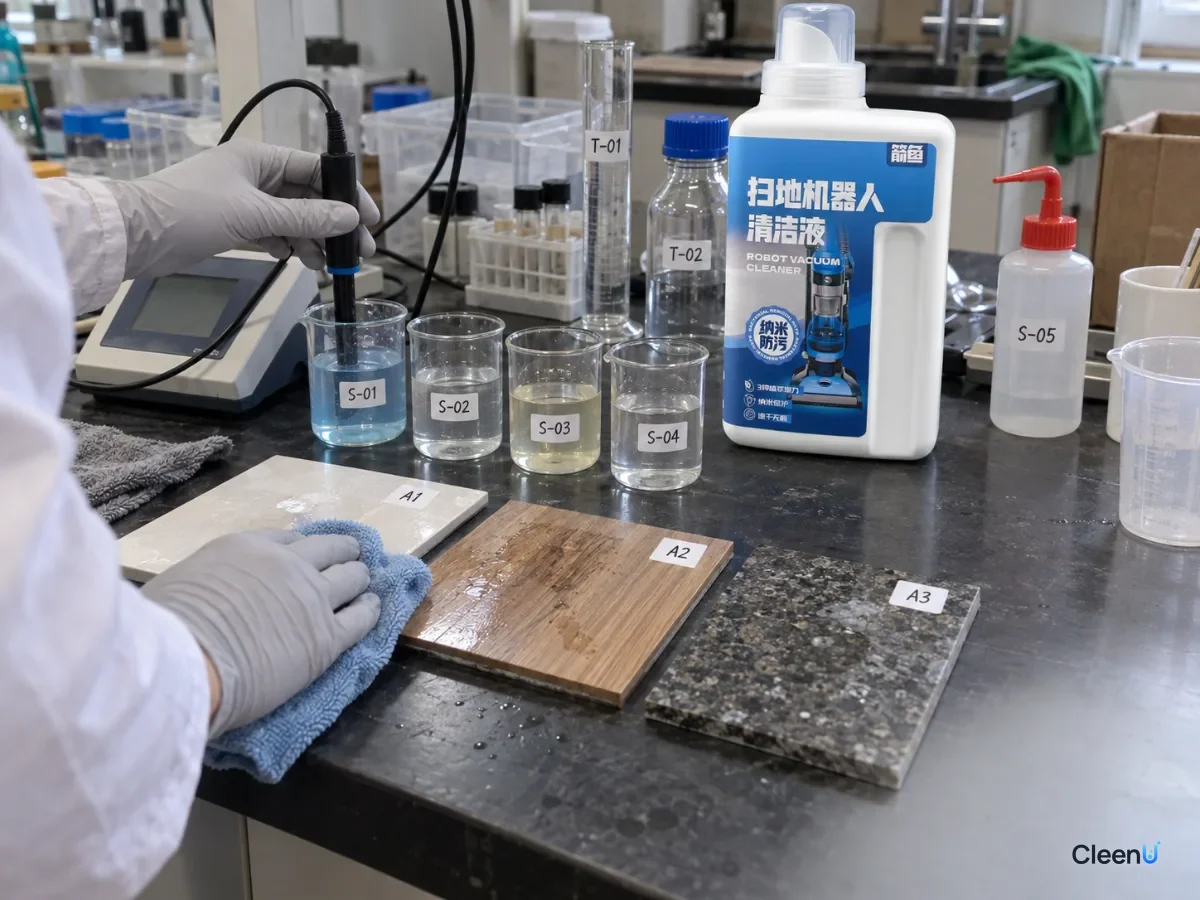
Can the kitchen and living room use different pH solutions?
You might think: mildly alkaline for the greasy kitchen, neutral for the hardwood living room. But one robot mops the whole house, so two liquids means separate runs, switching solutions midway and rinsing the tank between them. It's a hassle and invites mixing.
It's more practical to use one neutral, low-foam solution with enough emulsifying power for grease throughout the house, clean heavy kitchen grease by hand, and set the kitchen as a priority zone for an extra pass. That protects the wood and handles everyday kitchen footprints. Consider a mildly alkaline formula only for all-tile homes with very heavy kitchen grease.
This article is part of the Robot Vacuum Cleaning Solution & Maintenance Guide, which covers the full maintenance schedule and links to every troubleshooting guide.
Common questions about neutral vs mildly alkaline robot mop solution
Will a mildly alkaline solution hurt hardwood?
On hardwood with an intact finish, a mildly alkaline solution at the label ratio is usually fine. Sensitive finishes may dull with long use, so wood-floor homes are safer with neutral.
Is neutral strong enough for grease?
For everyday greasy footprints, yes; surfactants emulsify them. Clean heavy grease by hand and give the kitchen an extra pass, which is safer than going to a strong alkali.
How can I tell whether a solution is neutral or mildly alkaline?
Check the label for a pH or the words "neutral" or "mildly alkaline." If it doesn't say, test the concentrate and a diluted sample with pH strips.
Can I use a mildly alkaline solution on marble?
Use caution. Marble is etched by acid, and some stones and sealers are sensitive to alkali too. Check your stone care guide, and use neutral if you're unsure.
Can I put kitchen degreaser in my robot mop?
No. Kitchen degreasers are usually strongly alkaline and some foam heavily, so they don't belong in the machine or in daily floor care.
Does a higher pH clean better?
For greasy soil, alkalinity helps, but it's also harder on floors, machines and people. For everyday robot mopping, neutral is enough.
For homes with both wood and tile, if you want one gentle-pH, low-foam, wax-free robot mop solution for the whole house, try Robot Vacuum Cleaning Solution.
Choosing between neutral and mildly alkaline robot mop cleaning solution comes down to your floors and soil. Hardwood, engineered wood, bamboo, natural stone and mixed wood-and-tile homes are safest with neutral. Tile-heavy homes with greasy kitchens can go mildly alkaline for easier grease and protein removal. Strong alkalis and acids don't belong in a robot mop. The pH on the label usually describes the concentrate, and the diluted solution sits closer to neutral. Either way, dose at the label ratio, clean heavy grease by hand and give the kitchen an extra pass.