
Troubleshooting
Floors Slippery After Robot Mopping, Even When Dry? Check for Residue
Direct answer
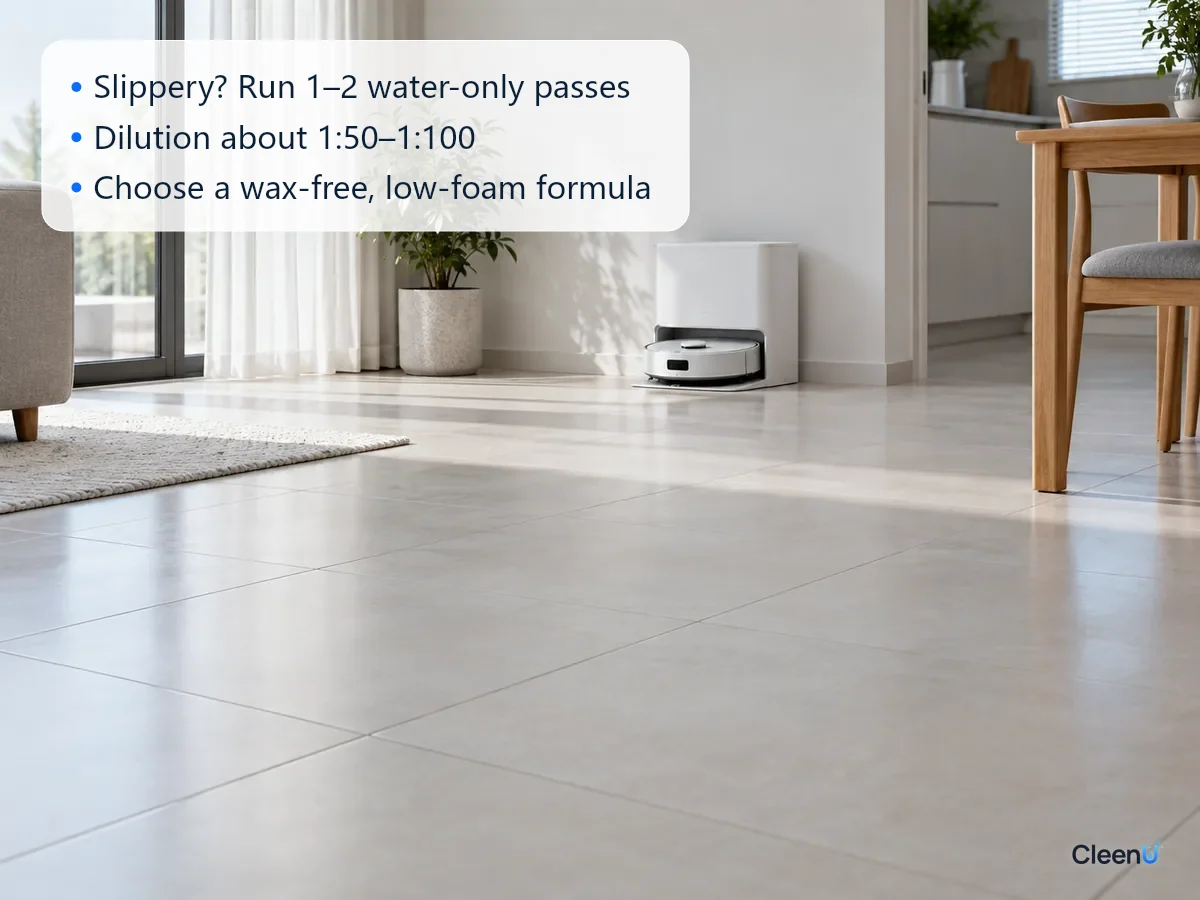
If the floor is slippery while it's still wet, let it dry. If it's still slippery once dry, the cleaning solution has most likely left a slick film. Run one or two water-only passes, then cut back to the label dose. If it stays slippery at the normal dose, switch to a wax-free, low-residue robot mop solution.
What you see
The robot finishes and the floor looks shiny, but walking on it in socks feels like skating, and slippers slide too. Hours later, long after the floor has dried, it's still slippery, and it seems to get a little worse after every run.
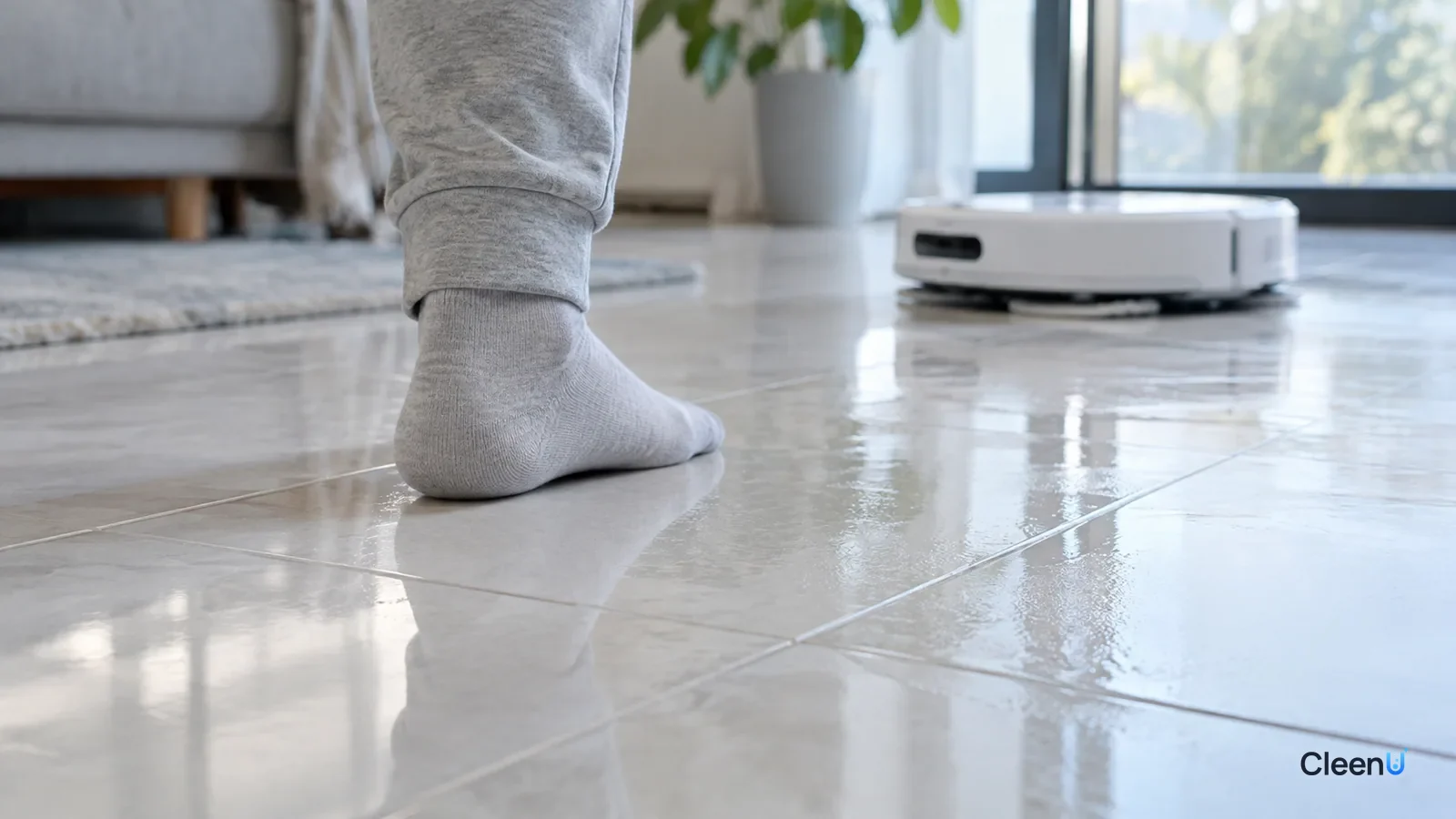
A slippery floor deserves more attention than a sticky or streaky one. With older family members, small children or pets in the house, a slick floor is a fall waiting to happen. Many people assume "slippery" means the floor is extra clean and shiny. It usually means the opposite: if the floor is slippery once it's dry, something extra has been left on it.
Why does the floor get more slippery with every run?
Start by separating two kinds of slippery.
Slippery right after mopping, while the floor is still wet, is a water-film problem. A layer of water between your feet and the floor cuts the friction. That's normal, and it goes away once the floor dries. If the robot's water flow is set high or the room is poorly ventilated, the floor stays wet and slick for longer.
Slippery after the floor has dried is the one to track down. It almost always comes from a thin film left on the surface. Surfactants in the cleaning solution, wax or shine additives meant to make the floor gleam, and certain silicone-type ingredients can all dry into a lubricating layer. It can make the floor look glossier, but it makes it slicker underfoot.
A robot mops the same routes day after day. If each run leaves a little behind, the film builds up and the floor gets "more slippery every time."
What makes floors slippery most often?
Too much solution: the extra surfactant doesn't get picked up by the pads and stays on the floor once it dries. CleenU Robot Vacuum Cleaning Solution, for example, dilutes at about 1:50 to 1:100, usually 10 to 20 mL per fill. At several times that, residue climbs quickly.
If you have a Roborock, iRobot, Ecovacs, Dreame or Narwal robot mop, or a Tineco-style floor washer, CleenU robot mop cleaning solution works in most models; add it to the clean tank or dosing compartment as the manual directs. (CleenU isn't affiliated with these brands.)
Wax or shine ingredients: some "shine" floor cleaners add wax, resins or polish. They're meant for hand mopping on floors that get periodic maintenance. Run them through a robot every day and the film just keeps getting thicker.
Mixing products: floor polish, essential oils, furniture polish or a high-foaming cleaner layered on top of a robot solution can combine into a slippery film.
Kitchen grease being spread around: cooking film settles on kitchen floors, and a robot only dissolves part of it, spreading the rest over a wider area.
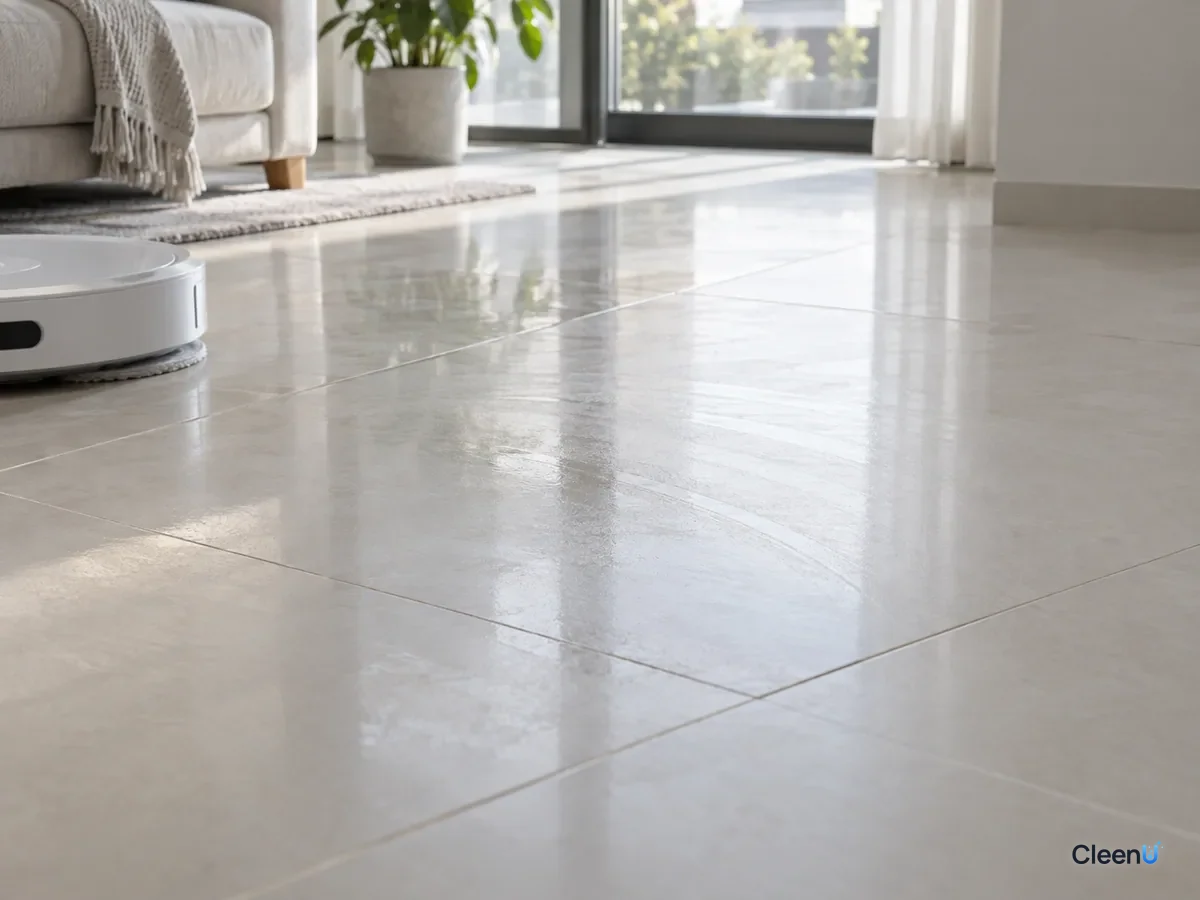
The floor itself: polished porcelain and high-gloss glazed tile start with low friction, so a little residue makes them noticeably slicker. Matte tile and wood floors show it less.
Can "slippery" be measured? Friction and boundary lubrication
In materials science, slipperiness is described by the coefficient of friction: the sideways force needed to start something sliding across a floor, divided by the weight pressing down on it. The lower the number, the easier it is to slip. The flooring industry measures slip resistance with methods such as pendulum testers and tribometers, usually in both dry and wet conditions.
The same tile has its highest friction when it's clean and dry. A layer of water lowers friction sharply, which is the wet kind of slippery. Once the water evaporates but leaves a thin film behind, friction depends on what that film is made of.
Why can an invisible film make a floor slippery? It's the same principle as boundary lubrication in machinery: a layer of lubricant just a few molecules thick, such as oil, wax or silicone, between two surfaces cuts friction noticeably. With that film between your sock or shoe and the floor, it's like oil on a bearing.
Ingredients most likely to make floors slippery
Wax and film-forming polymers: some floor care products and "shine" floor cleaners add wax or acrylic emulsions that dry into a clear film. You get gloss and slipperiness together, and the film builds up layer by layer.
Silicone oils: some products add a little silicone for shine or foam control. Silicone spreads extremely well and has very low friction, so even a trace of residue makes a floor noticeably slicker.
Cationic ingredients: quaternary ammonium surfactants, used for softening and killing germs, carry a positive charge and cling tightly to negatively charged floors and fibers, forming a slick molecular layer. It's the same principle that makes fabric softener work on clothes, and pads washed with softener carry that layer onto the floor.
Excess surfactant and oil: surfactants lubricate a little on their own. When the dose is too high, leftover surfactant and the oil it emulsified but didn't carry away stay on the floor together.
Low-residue floor formulas usually avoid all of these: an easy-rinsing nonionic surfactant base, low solids, no wax or film formers, and careful use of silicone defoamers. CleenU Robot Vacuum Cleaning Solution is wax-free and built on low-foam nonionic surfactants with a defoamer, used at about 1:50 to 1:100, following exactly that approach.
Why glossier tile needs extra care
Polished porcelain and high-gloss glazed tile are extremely smooth at the microscopic level and start out with lower friction than matte or textured tile. The smoother the surface, the more completely a thin film spreads across it and the better it lubricates. So the same residue usually feels far more slippery on polished tile than on matte tile or wood.
If your home has polished tile, dose at the low end of the label range, keep the water flow moderate and ventilate after mopping. Put non-slip mats at the kitchen and bathroom doors, where water and grease tend to collect.
Four checks to find out why the floor is slippery
Work through these four checks to find the cause of a slippery dry floor
-
Step 1 Is the floor actually dry yet? Touch it, or wait an hour or two and walk on it again. Is it still slippery?
- Yes
- If it stops being slippery once fully dry, it's only a water film. Lower the water flow one level and open a window after mopping so the floor dries faster.
- No
- Go to the next check
-
Step 2 Have you been adding more solution than the label says, or does your solution say "shine," "polish," "care" or "contains wax"?
- Yes
- Empty the clean tank and run one or two passes with plain water to lift the residue. Then switch to a wax-free, low-foam robot solution and measure it to the label.
- No
- Go to the next check
-
Step 3 Is it only slippery in the kitchen or around the dining table?
- Yes
- It's most likely grease being spread. Wipe those areas by hand with warm water and a little neutral cleaner, then let the robot mop as usual.
- No
- Go to the next check
-
Step 4 Has the floor ever been waxed or treated with a floor oil or polish?
- Yes
- The slickness may come from built-up finish. Follow the flooring maker's instructions to deal with it, and don't run the robot over that floor every day.
- No
- If two water-only passes don't help, stop using the current solution and check whether the pads are carrying fabric softener or other detergent.
How to get the slippery film off
The approach is the same as for a sticky floor: don't reach for a stronger cleaner. Take the residue off.
Empty and rinse the clean tank, then fill it with plain water only. If your dock doses automatically, turn that off for now. Take the pads off and rinse them in clean water until squeezing them no longer produces suds, and skip fabric softener.
Run a normal mopping cycle with the water flow at a medium setting, and open a window afterward. Once the floor is completely dry, walk on it barefoot or in socks. If it feels clearly less slippery, residue was the problem, and one more water-only pass usually finishes the job.
For especially slick spots, like the kitchen doorway, wipe twice by hand with a wrung-out cloth and warm water, then dry the area with a dry cloth.
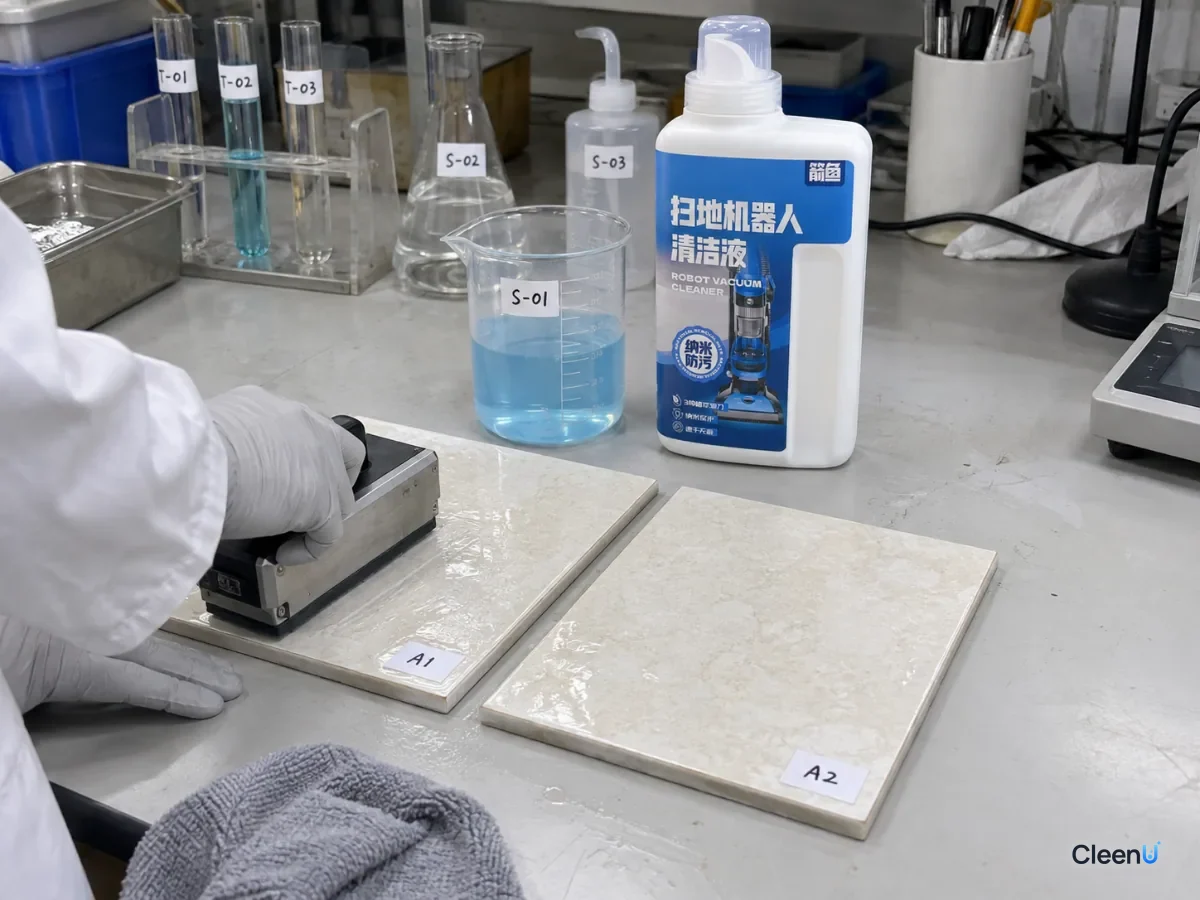
When you go back to using a solution, pick a wax-free robot mop formula with no shine additives and measure it every time. CleenU Robot Vacuum Cleaning Solution is a neutral, low-foam concentrate with a pH of 6.5 to 7.5, wax-free, chlorine-free and free of particles, and it needs no rinse. Because it contains no wax, it doesn't build up in layers, and at the label dose it won't make the floor more slippery run after run.
Why robot mop solutions shouldn't contain wax
Back when every floor was mopped by hand, some floor cleaners added a little wax or resin that dried into a thin protective film and made floors look shinier. Those products assumed a certain routine: mop every so often, let the film wear, top it up, and periodically strip and rewax the floor.
A robot mop works nothing like that. It mops the same floor every day, sometimes several times a day, with very little water, and nothing ever strips the old layers off. Put a wax-containing formula in a robot and the film only gets thicker, so the floor gets more slippery and blotchy over time and holds on to dust and footprints.
Wax and resin can also cause trouble inside the robot. Once dry, they cling to the tank walls, the water outlets and the pad fibers, slowly restricting water flow and stiffening the pads. That's why a robot mop solution should be wax-free. Its only job is to carry soil away, not to leave anything on the floor that has to be removed later.
How to tell the floor is back to normal
Once dry, the floor feels secure underfoot in socks, not skiddy. In side light it shows the tile's or wood's own finish instead of an even oily gloss. Drag a fingertip across it and it feels dry and grippy rather than slick.
If the floor is also sticky or streaky, see robot mop leaving streaks. For how much solution to add and how to scale it to your tank, see how much cleaning solution to put in a robot mop.
Extra care with seniors, kids and pets
Schedule mopping for when family members are out or resting, and let the floor dry completely before anyone walks on it. Put non-slip mats at the bathroom door, in the kitchen and at the entry, where water tends to collect.
Cats and dogs running on a slick floor slip easily, which strains their joints, especially in older pets. If your pet starts walking gingerly or keeps slipping, check the floor for residue first.
Don't put a wax or shine cleaner in a robot mop to get a glossier floor. What you want from robot mopping is clean and dry, not shiny.
This article is part of the Robot Vacuum Cleaning Solution & Maintenance Guide, which covers the full maintenance schedule and links to every troubleshooting guide.
Stop if you see any of these
Someone in the family, or a pet, slips or falls on a freshly mopped floor; the floor stays clearly slippery after two water-only passes; the floor turns whitish, dull or blotchy. Stop using the current solution right away, mop with water only or pause wet mopping, get medical care for any injury, and call your veterinarian if a pet seems hurt.
Slippery floor questions from robot mop owners
Is my robot mop solution making the floor slippery?
If the floor is slippery once it's dry, residue from the solution is the usual cause, most often overdosing or a formula with wax or shine additives. Run water-only passes, then use a wax-free robot solution at the label dose.
Is it normal for the floor to be slippery while it's wet?
Yes. A wet floor carries a water film that disappears once it dries. Lowering the water flow and opening a window shortens that time a lot.
Can I add vinegar to cut the slippery film?
Don't put vinegar in a robot mop. It's acidic and can wear down tank seals and damage natural stone and wood finishes. One or two water-only passes remove the residue.
Why are polished porcelain tiles so slippery?
Their smooth, low-friction surface makes even a little residue noticeable. Run water-only passes, dose at the low end of the label range, and keep the water flow moderate.
Can the mop pads make the floor slippery?
Yes. Pads washed with fabric softener, or with detergent that wasn't rinsed out, transfer an oily residue to the floor. Wash pads in plain water or a little laundry detergent and rinse them well.
How do I choose a robot mop solution that won't make floors slippery?
Look for three things: labeled for robot mops and low-foam; no wax or shine additives; and no rinse needed at the label dose.
For a neutral, low-foam, wax-free robot mop cleaning solution that leaves floors dry and grippy at the label dose, try Robot Vacuum Cleaning Solution.
When floors are slippery after robot mopping, first tell wet-slippery from dry-slippery. Wet floors just need to dry. A floor that's slippery once dry usually has a film from the cleaning solution, caused by overdosing, wax or shine additives, mixed products or kitchen grease spread around. Empty the tank and run one or two water-only passes, rinse the pads, then use a wax-free, low-foam robot solution at the label dose. With seniors, kids or pets at home, a floor that's safe to walk on matters more than one that shines.