
Q&A
Is Robot Mop Solution Safe for Cats? Quats, Phenols, and What to Check
Direct answer
For routine mopping in a cat home, choose a solution without quaternary ammonium compounds (quats) or phenols, and check the ingredient list for both. Dilute the solution as directed, let floors dry before your cat walks on them, and store the concentrate out of reach. If your cat has kidney disease or another condition, ask your vet first.
In a home with cats: yes or no
Yes
- A neutral, low-foam solution with no quats or phenols, diluted as directed, with cats back only after the floor dries
No
- Routine mopping with a quat-based disinfecting floor solution while cats walk on wet floors and lick their paws
- Phenol-based disinfectants, such as PCMX (chloroxylenol), on floors where cats roam
- Essential oils or fragrance added to the robot's water tank
- Concentrate left where a cat can reach it or knock it over
It depends
- Disinfecting when you really need to: dilute per the label, rinse-mop with water, and keep cats out until the floor is dry
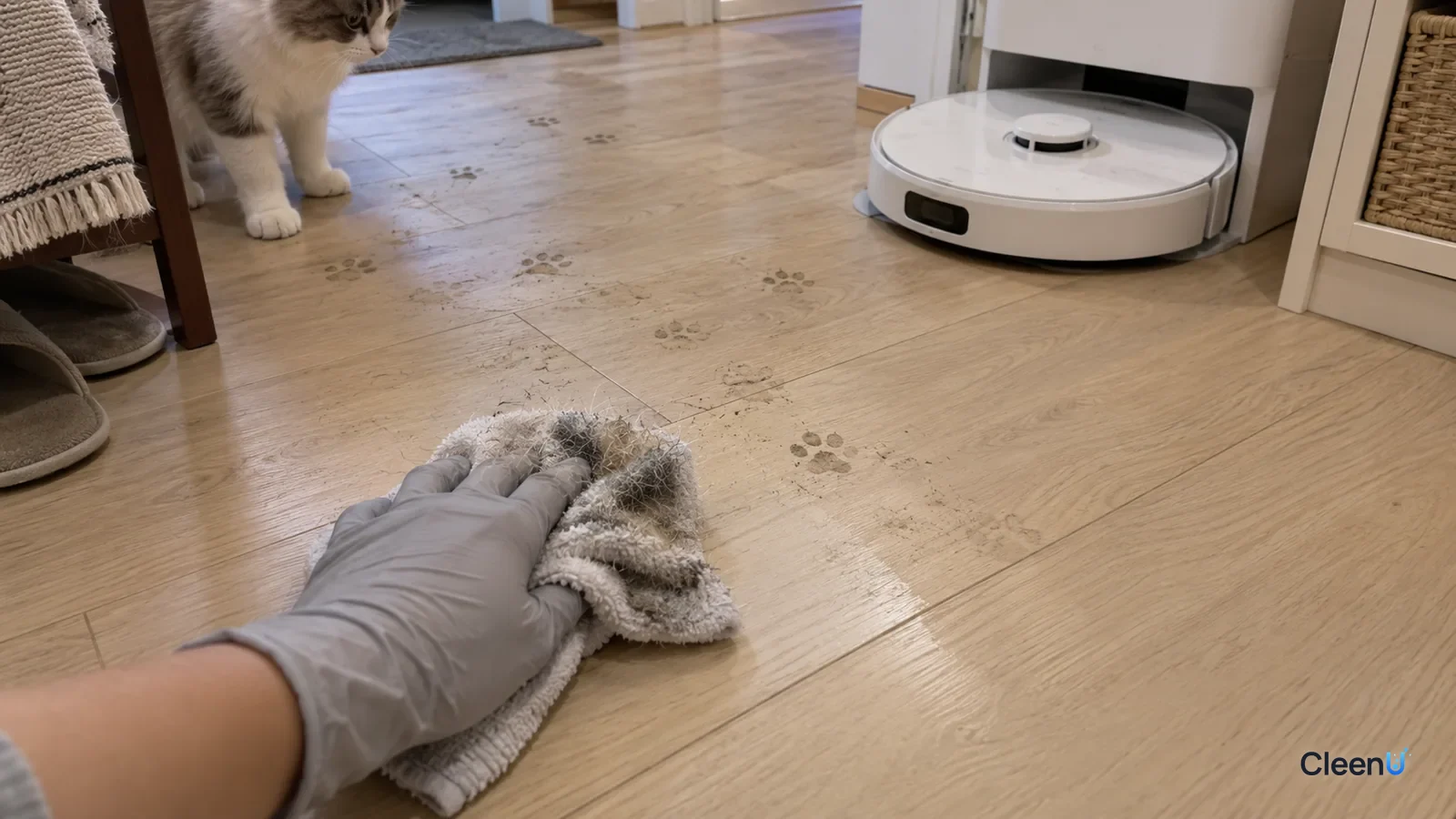
In spring 2026, a claim that "robot mop solution caused kidney failure in cats" spread widely on social media, and a lot of cat owners started reading ingredient labels and searching "are quats bad for cats." Parts of that story were overblown, and parts deserve to be taken seriously. Here's what's actually known.
What quats are and why people worry about them
Quats, short for quaternary ammonium compounds, are a large family of cationic surfactants. Common ones include benzalkonium chloride and didecyldimethylammonium chloride. Their positive charge lets them latch onto negatively charged bacterial membranes and disrupt them, which is why they're widely used as disinfectants and sanitizers, and in fabric softeners too. Many floor cleaners, mopping solutions, and wipes labeled "antibacterial" or "sanitizing" use quats as the active ingredient.
The concerns with quats and cats come down to a few things.
Irritation. Quats at higher concentrations irritate skin and mucous membranes. A cat walking on a wet floor and then licking its paws can be exposed. Veterinary literature includes reports of cats developing mouth ulcers, drooling, and vomiting after licking quat disinfectants, mostly linked to higher concentrations, inadequate dilution, or floors that weren't dry.
Residue. Because quats are cationic, they cling to floors and fabrics, and without a rinse, a layer stays on the floor.
As for a direct link between floor solution and kidney failure in cats, there's no reliable public evidence tying properly diluted everyday mopping solutions to chronic kidney disease in cats. Feline kidney disease has many causes, including age, genetics, hydration, and diet. That doesn't mean you should shrug it off. For cats, less exposure to unnecessary disinfectants is always the safer choice.
Why cats are especially sensitive to phenols
Phenolic disinfectants such as phenol and PCMX (chloroxylenol) show up in some disinfectant products. Cats have very low activity in a liver detoxification pathway called glucuronidation, which handles phenolic compounds, so they clear phenols less efficiently than dogs or people and phenols can build up. That's well established in veterinary medicine and is why many vets tell cat owners to be careful with phenol-based disinfectants.
Some components of essential oils, including certain phenols and terpenes, rely on similar pathways, which is another reason not to add essential oils to mop water or a robot's tank in a cat home.
From the tank to your cat's paws: how residue gets there
Worrying about a floor cleaner really means worrying about how much of it your cat ends up touching. The path is easy to trace. Concentrate goes into the clean-water tank at a set ratio. The mop pad spreads that diluted liquid into a very thin film on the floor. The water evaporates, and whatever was dissolved in it, mostly surfactant, stays behind. Your cat walks across, picks some up on its paw pads, and licks it off later. So exposure comes down to three things: how dilute the working solution is, how much solid residue is left on the floor, and whether your cat walks on it wet or dry.
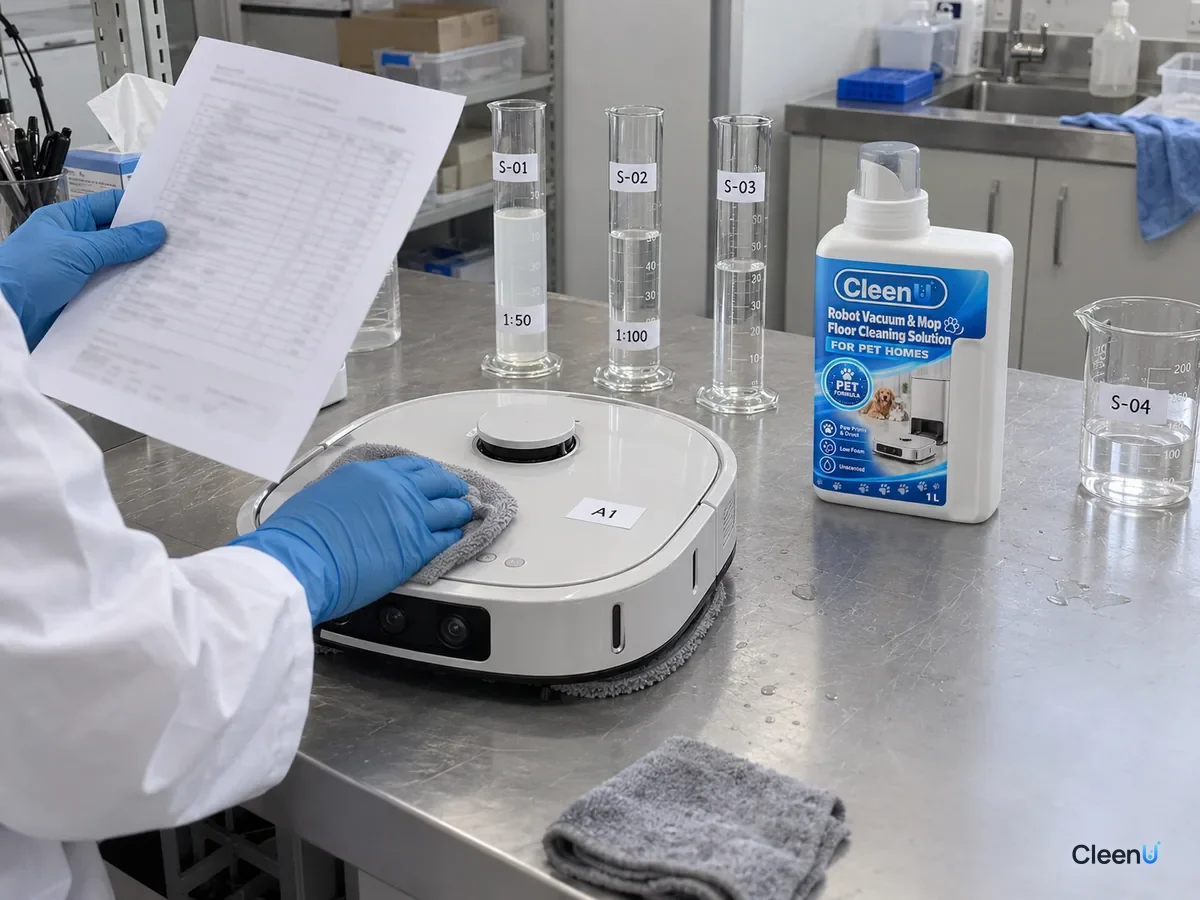
Dilution is the first gate. At about 1:50 to 1:100, a 1-liter tank usually gets only 10 to 20 mL of concentrate, so what reaches the floor is already a weak solution. Double the dose by eye and you roughly double what dries on the floor. That's why "less is more" does more practical good than any ingredient claim.
Charge decides how easily residue comes back off. Quats carry a positive charge. Glazed tile, finished wood, and the keratin on a cat's paw pads tend to carry a negative charge when damp, so the two attract each other. Without a rinse, quats leave a film that the next mopping pass doesn't readily pick up. Nonionic surfactants carry no charge. They work by lowering the tension between grease and water, leave less behind when the film dries, and redissolve easily on the next run. That's the chemistry behind choosing a nonionic, low-residue system, not just a marketing line.
Wet versus dry matters even more. On a wet floor, one step picks up a coat of liquid. Once it's fully dry, all that's left is a very thin solid layer, and paws carry away far less of it. Waiting for the floor to dry does about as much as choosing the right bottle.
What actually needs mopping up in a cat home
Cat-home floors have their own mix of soil. Around the litter box there's tracked litter and dust that settles into grout lines and wood grain. Around the food and water bowls there's kibble oil and drool; dried saliva mucin leaves a shiny, slightly tacky film. Cats leave skin-oil marks where they like to lie, and shed hair tangles with all of it on the mop pad.
That soil comes off through wetting and emulsifying. Surfactant helps water spread and get under the oil film and grit, breaks the oil into tiny droplets, lifts the particles, and the pad's friction carries everything into the dirty tank. No disinfectant is needed for any of that. What you do need to avoid is overdosing: too much solution means more foam, false "tank full" alerts, and a tacky floor that grabs more hair and litter.
Odor is a separate job. Cyclodextrin is a ring-shaped molecule made of linked glucose units, with a water-loving outside and a water-avoiding cavity. Volatile odor molecules such as amines and thiols can tuck into that cavity and form inclusion complexes, so less of them evaporates. It deals with odor molecules left on the floor without covering them with fragrance and without any germ-killing claim, which suits cats that are sensitive to strong smells.
When things change, adjust the routine
If your cat just had surgery, is on medication, or has been diagnosed with kidney disease, you can simply mop with plain water for a while and go back to the diluted solution once things settle. In multi-cat homes, or where the litter box sits inside the mopping area, set a no-go zone around the box and vacuum up litter first; otherwise grit scratches across the floor and saturates the pad fast. On wood floors or floors with lots of seams, set the water flow to low or medium so the floor dries sooner and your cat waits less. And if your cat starts licking its paws a lot or sneezes after sniffing the floor after you switch products, stop using the new one and check its ingredient list.
This article is part of the Robot Vacuum Cleaning Solution & Maintenance Guide, which covers the full maintenance schedule and links to every troubleshooting guide.
How to choose a robot mop solution for a cat home
Read the ingredients. If you see "quaternary ammonium," "benzalkonium chloride," "didecyldimethylammonium chloride," "chloroxylenol," or "PCMX," it's a disinfecting product, and you don't need it for routine mopping.
Know what you need. Everyday mopping is about cleaning: removing grease film, skin oil, dust, and drool marks. Disinfecting is a situational need, such as when someone in the house is sick, and it's better handled separately.
Look for low foam and low residue, so nothing tacky is left on the floor for paws to pick up.
Choose fragrance-free or very lightly scented, with no heavy fragrance or essential oils.
Check the dose. A concentrate diluted as directed means a small amount per use and less left on the floor.
Take CleenU Robot Mop Cleaning Solution as an example. Both the standard and pet-home versions contain no quats and no phenols. They're neutral (pH 6.5 to 7.5 as a concentrate), low-foam formulas built on low-foam nonionic surfactants with a defoamer, with no wax, no chlorine, and no particles, diluted at about 1:50 to 1:100, usually 10 to 20 mL per fill. The pet-home version is fragrance-free with no added fragrance and uses a cyclodextrin-based odor neutralizer to handle pet odors.
To be clear, it's a cleaner, not a disinfectant. We don't claim it kills germs, and we don't claim it carries no risk for pets. Using it correctly matters more than the product itself. For the difference between cleaning and disinfecting, see Does robot mop solution disinfect?.
On compatibility: CleenU Robot Mop Cleaning Solution has been tested on common models, such as Roborock, Roomba, Ecovacs, Dreame, Narwal, and Tineco. Add it to the clean-water tank or the designated dosing tank per your manual. If your manual specifies the brand's own solution or the machine is still under warranty, follow the manual and warranty terms first.
Even the right solution needs the right habits
Dilute as directed instead of pouring by eye. Higher concentration means more residue on the floor and more for your cat to contact.
Let the floor dry completely before your cat comes back. Mop while your cat is napping or in another room, or close the door for a while and open a window.
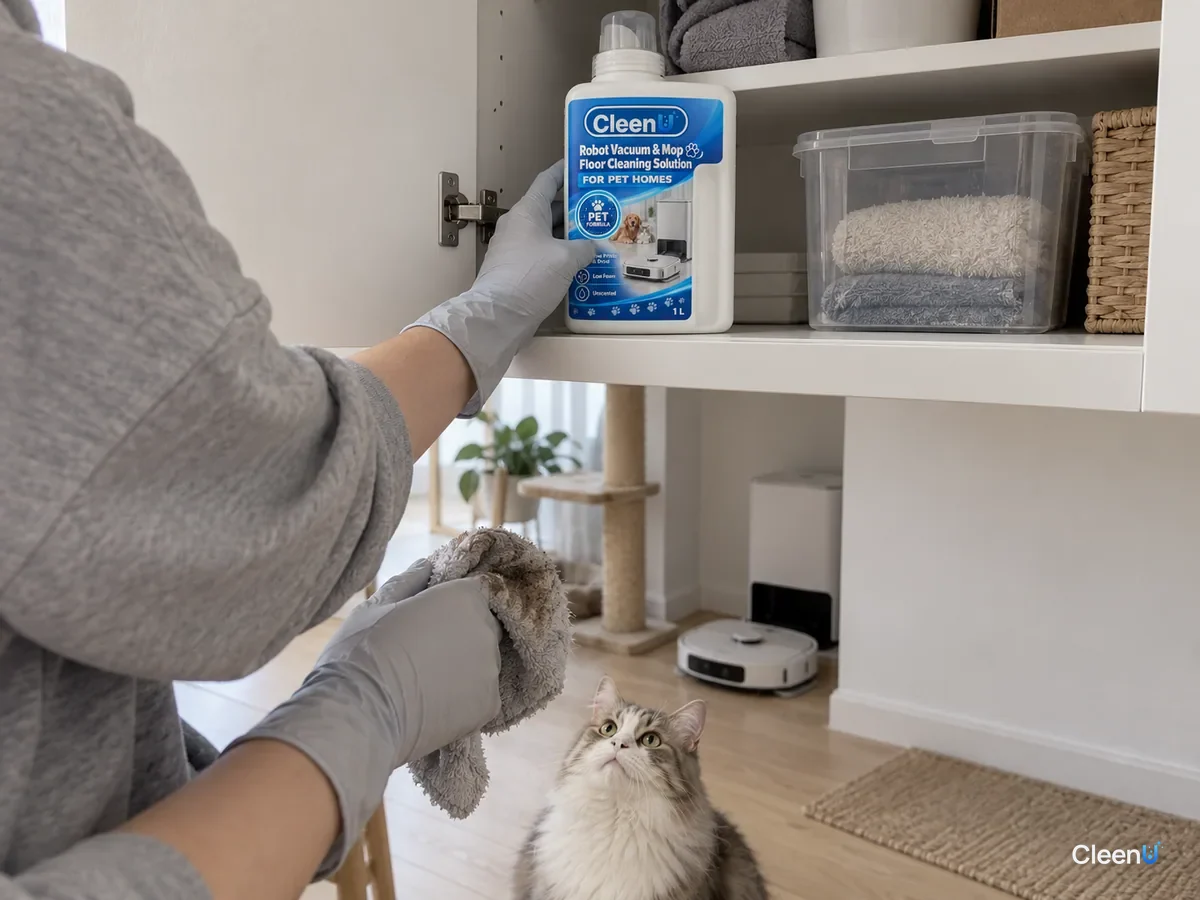
Keep the concentrate capped in a cabinet your cat can't reach or knock over. Cats jump on counters and paw bottles off shelves, and drinking or stepping in concentrate is a much bigger risk than a mopped floor.
Handle the food and water area separately: move the bowls, clean, let it dry, then put them back.
Clean up cat urine and vomit by hand. Don't let the robot mop over it.
If your cat is sick, elderly, or has kidney disease, watch how it does after you mop, and if you have questions about a cleaning product, bring the label to your vet.
For more on robot mops with pets, see Robot mopping in a home with cats and dogs. For scented versus fragrance-free, see Scented vs. fragrance-free robot mop solution.
If your cat shows these signs, stop and call your vet
Your cat licked undiluted cleaner or disinfectant, or after mopping it's drooling, has a red or ulcerated mouth, is vomiting, lethargic, not eating, or keeps licking its paws or pawing at its face. Stop using the product, mop the floor with plain water, and call your vet with the product label in hand. In the U.S., you can also call the ASPCA Animal Poison Control Center at (888) 426-4435. Don't induce vomiting or give medication on your own.
Cleaning solutions and cats: common questions
Are quats bad for cats?
Quats at higher concentrations irritate a cat's skin and mouth, and licking them can cause drooling, mouth ulcers, and vomiting. You don't need a quat-based disinfecting product for routine mopping.
Can robot mop solution cause kidney failure in cats?
There's no reliable evidence linking properly diluted everyday mopping solution to feline kidney disease. Still, limiting unnecessary disinfectants is the safer choice, and if your cat has kidney disease, ask your vet first.
How do I tell if a solution contains quats?
Read the ingredient list or label. "Quaternary ammonium," "benzalkonium chloride," or "didecyldimethylammonium chloride" means it does. Floor solutions labeled "antibacterial" or "sanitizing" often contain them.
Does CleenU Robot Mop Cleaning Solution contain quats?
No. Both the standard and pet-home versions contain no quats and no phenols. They're neutral, low-foam cleaners, not disinfectants.
How long after mopping can my cat walk on the floor?
Once it's completely dry. With windows open, that's usually 10 to 30 minutes; go by whether the floor feels fully dry to the touch.
Can I mop with bleach if I have cats?
Not as a routine. If you need to disinfect, dilute per the label, rinse-mop with water, and keep your cat out until the floor is dry and the smell is gone.
For a neutral, low-foam robot mop solution with no quats or phenols, no added fragrance, and a cyclodextrin odor neutralizer, take a look at our Robot Vacuum & Mop Floor Cleaning Solution for Pet Homes.
When choosing a robot mop solution for a cat home, start with the ingredient list. Quats and phenols are disinfecting ingredients you don't need for routine mopping, and phenols in particular are worth avoiding around cats; skip essential oils too. There's no reliable evidence that mopping solution causes kidney failure in cats, but less exposure to unnecessary disinfectants is always safer. Choose a low-foam, low-residue, fragrance-free solution, dilute it as directed, let floors dry before your cat walks on them, and store the concentrate out of reach. If your cat has a health condition or shows drooling, vomiting, or other signs, stop and call your vet.