
How-to
Robot Mop Cleaning Solution Guide: What to Use, How Much to Add, and What Goes Wrong
Direct answer
Plain water is enough for light dust. For greasy footprints, kitchen spatter, paw prints and pet drool, add a low-foam robot mop cleaning solution. It goes in the clean water tank or the dock's auto-dosing compartment, never the dirty tank, at the label dose. When in doubt, use less.
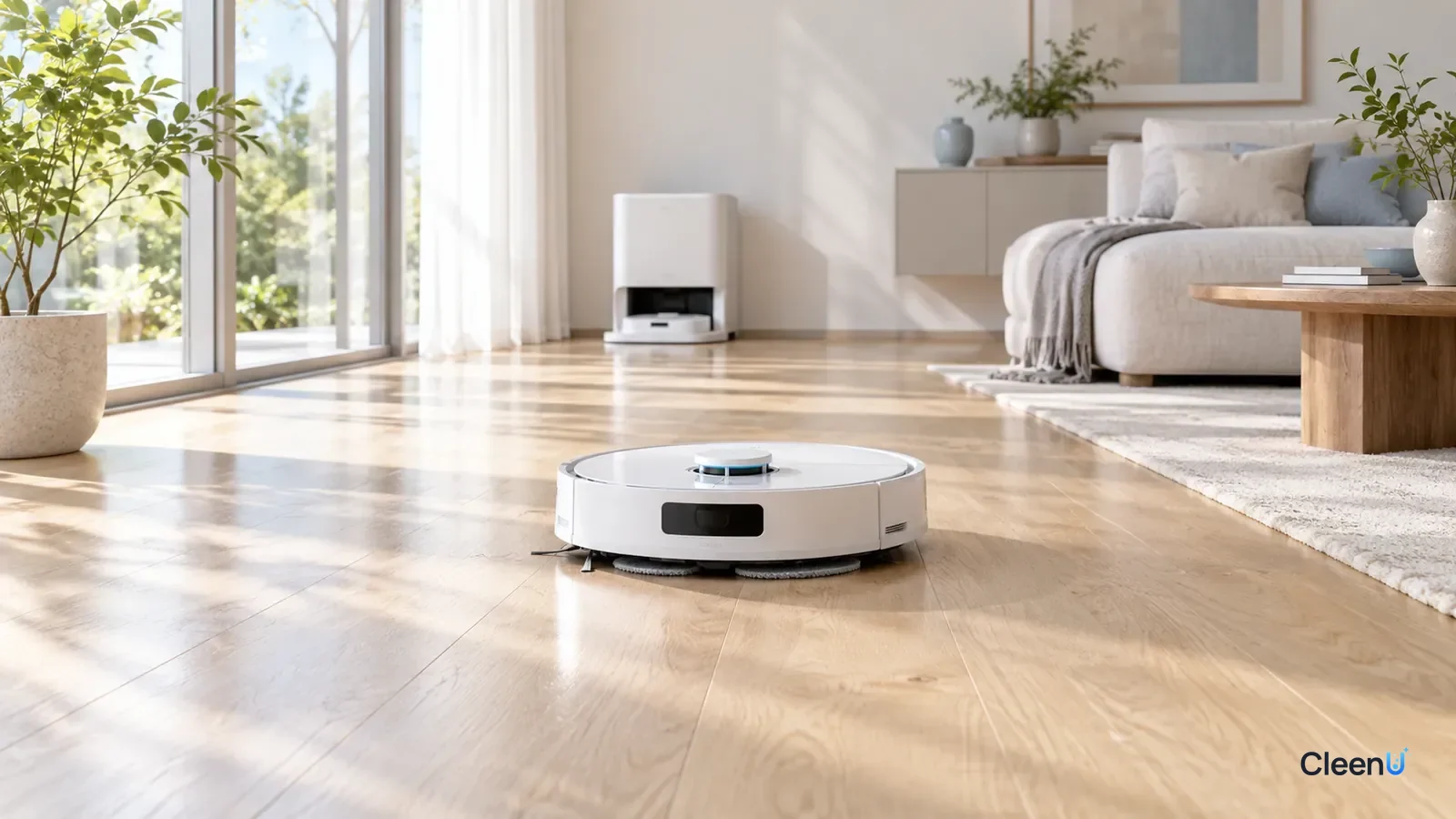
A robot mop turns daily mopping into something you barely think about. Whether your floors actually come out clean, though, depends heavily on what goes into the tank and how much of it. Most of the streaks, sticky patches, foam overflows and smelly tanks people run into are not hardware failures. They come from the wrong cleaner, the wrong compartment or simply too much product.
It covers choosing a solution, dosing it, running the robot and cleaning up afterward, then lays out the most common problems and what to do about each one, so you can come back to it when something goes wrong.
What a robot mop is actually picking up
Robot mops deal with three kinds of soil, and each one sticks to the floor in a different way. That is why plain water works well on some of them and barely touches others.
The first kind is dust and fine grit. It just sits on the surface. The vacuum pass removes most of it, and a damp pad picks up the rest without any help. Water is all you need here.
The second kind is oily film: footprints and body oil. Bare feet and socks leave a thin layer of skin oil and sweat on the floor, and shoes carry cooking spatter from the kitchen into the living room. The film is so thin it just looks like a dull, grayish print. But oil and water do not mix, so a water-only pass pushes the film around and thins it out. Once it dries, the print is still there and often looks streakier than before. To remove it, surfactants have to wet the film and emulsify it so the oil disperses into the water and the pad can carry it away.
The third kind is mixed residue: pet drool marks, crumbs around the food bowl, dried drips from juice or coffee. These contain water-soluble sugars and proteins along with fats, and once they dry they grip the floor firmly. Water softens part of them, but not all. They usually need a cleaning solution plus a second pass.
So the answer to "do I need cleaning solution?" is concrete. If your floors mostly collect dust, water is fine. If you regularly see footprints, kitchen grease or pet messes, add a solution made for robot mops.
Why the solution has to be low-foam
A robot's water system is nothing like a bucket and mop. Liquid from the clean tank runs through a small pump and tiny outlets to the pad. Dirty water is pulled back into a recovery tank, and a level sensor in that tank decides when it is full. Most regular floor cleaners and dish soaps are high-foam formulas. Once the pump agitates them, they whip up a lot of suds. Foam is lighter than water, so it reaches the sensor first and triggers a false "tank full" alert. It can also seep through gaps and leave residue in the lines and on the floor.
Cleaners made for robot mops use low-foam nonionic surfactants plus a defoamer, so they cut grease while keeping suds to a minimum. CleenU Robot Vacuum Cleaning Solution, for example, is a neutral, low-foam concentrate with a pH of 6.5–7.5. It contains no wax, no chlorine and no particles, and it does not need a rinse afterward. A neutral pH is gentle on sealed hardwood, tile and luxury vinyl plank. Because there is no wax, nothing builds up layer after layer, so floors do not get slicker over time.
More suds do not mean cleaner floors. Surfactants remove soil by emulsifying and dispersing it; the foam itself does no cleaning. Inside a robot, foam only causes false alerts, overflows and residue.
The chemistry behind robot mopping: what a drop of solution does
Robot mopping looks like a damp cloth wiping the floor, but on every pass the solution works through four steps in a row.
Wetting: water has fairly high surface tension, so on a floor with an oily film it beads up instead of spreading. Surfactants lower that surface tension so water spreads evenly and works into wood grain, grout lines and the texture of vinyl plank, reaching the bottom of the soil.
Emulsifying: skin oil in footprints and grease on the kitchen floor don't mix with water. A surfactant molecule has an oil-loving end and a water-loving end. The oil-loving end digs into the oily film and the water-loving end faces the water, prying the film apart into tiny droplets dispersed in the water. At high enough concentration, surfactants also form micelles that hold oil inside them.
Dispersing and suspending: dust and fine grit coated by surfactant pick up the same electrical charge, repel each other and stay suspended in the water instead of settling back onto the floor.
Carrying away: the microfiber pad soaks up the water holding those oil droplets and particles, and the dock washes the pad clean.
Skip the first three steps and only the last one is left. The pad picks up loose dust, but the oily film just gets pushed around and spread out, drying into a gray haze. That's why plain water handles dust but never quite gets footprints and grease marks.
Why most robot mop solutions are near neutral
pH measures acidity or alkalinity. Kitchen degreasers are often alkaline, because alkalinity helps emulsify grease and strong alkali can even saponify old, baked-on fat. Bathroom descalers are often acidic, because acid dissolves limescale. They clean hard, but they're pickier about surfaces.
A robot mop solution has to work across every floor in the house: sealed hardwood, laminate, tile, vinyl plank and sometimes marble. It also sits for long periods inside the robot, in contact with rubber seals, the pump and sensors. A formula near neutral is gentlest on all of these, and everyday footprints and grease marks can be handled by surfactants alone, without strong acids or alkalis.
CleenU Robot Vacuum Cleaning Solution has a pH of 6.5 to 7.5, neutral, balancing everyday grease removal with gentleness on floors and on the robot.
Where the solution goes and how much to add
Add cleaning solution to the clean water tank or the dock's auto-dosing compartment. Never put it in the dirty water tank. That tank collects wastewater, so a cleaner there does nothing useful and only creates foam that confuses the sensor. Exact placement varies by model, so check your manual first. Some manufacturers specify water only or their own solution, and in that case the manual takes priority.
Follow the dose on the label. For CleenU Robot Vacuum Cleaning Solution, the ratio is about 1:50 to 1:100, and 10 to 20 mL per fill is usually enough, measured with the marked cap. A 1-liter bottle covers about 50 to 100 runs. When the floor is especially dirty, run the robot a second time instead of doubling the dose. Extra product adds foam and residue, which is exactly what makes floors sticky and streaky.
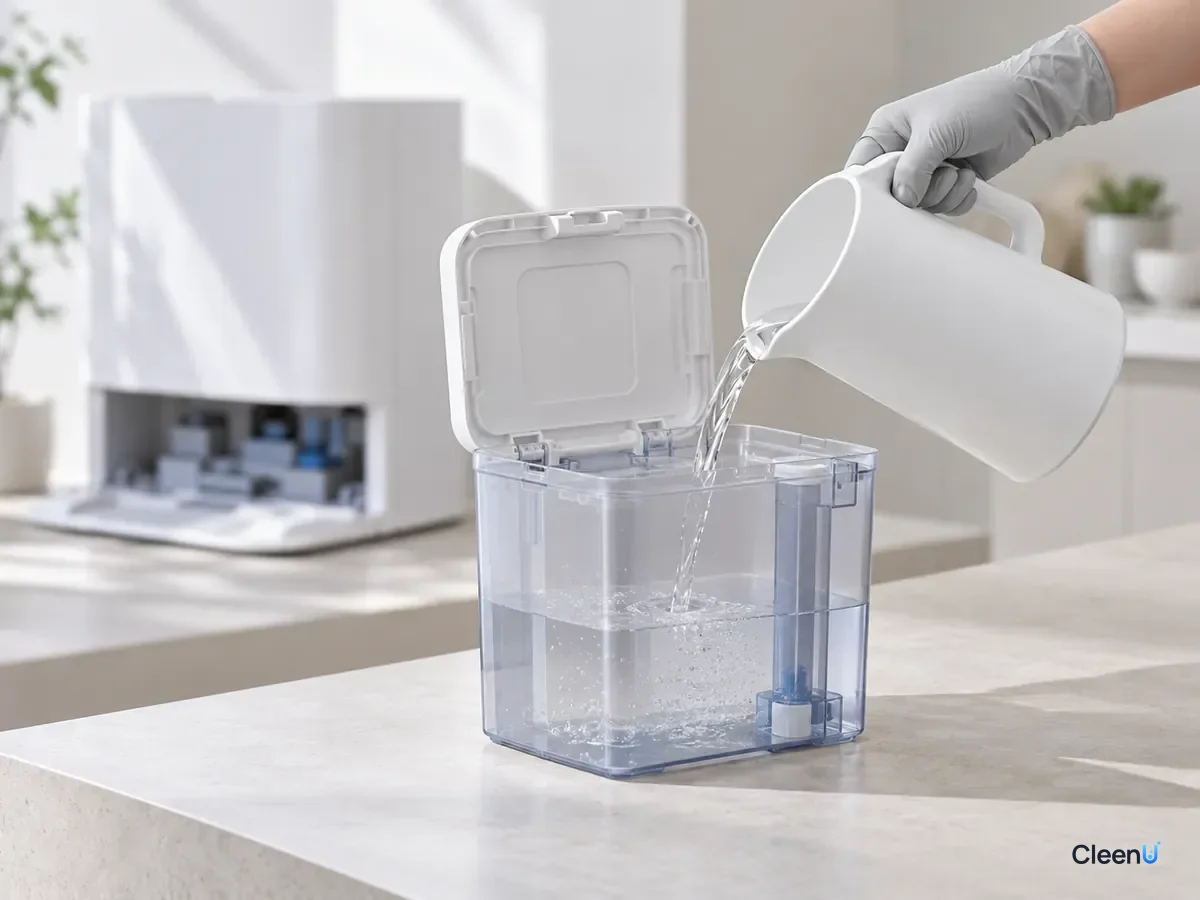
Order matters too. Fill the tank with water first, then add the solution and swirl gently. Pouring the concentrate in first and then blasting water on top tends to create foam in the tank. Use the mixed solution the same day; do not leave it sitting in the tank for days.
One run, room by room: living areas, kitchen and pet zones
The same robot faces different messes in different rooms, and the order of work should change with them. Here is one complete run broken into steps by area.
How to set up one run for living areas, the kitchen and pet zones
Living room and bedrooms
Vacuum before you mop
Use vacuum-and-mop mode or run a vacuum-only pass first. Grit trapped under a pad acts like fine sandpaper, and hair wrapped in the pad drags dirty water around.
Dose to the label and start at a medium water level
Fill the clean tank with water, then add solution at the label dose. Use a low-to-medium water level on sealed hardwood and laminate and medium on tile. If the floor dries within a minute or two, the water level is right.
Caution:Do not wet-mop wood floors with open seams, cupping or no finish; vacuum only.
Kitchen
Hand-clean heavy grease first
Wipe heavy spots in front of the range or by the trash can with a cloth dampened with diluted solution, so the robot handles upkeep rather than thick grease.
Caution:Letting the robot tackle heavy grease alone spreads it into other rooms and saturates the pad fast.
Mark the kitchen for an extra pass
Set the kitchen as a focus zone in the app or schedule a second pass there. Oily footprints need time for the solution to wet and emulsify them, and a second pass works better than a double dose.
Pet zones
Pick up hair and accidents first
Clear pet hair, vomit and waste by hand before the robot runs. Driving over them smears the mess and contaminates the pad and water lines.
Focus on the food bowl and entryway, then keep pets off until it dries
Set the food bowl area and entryway as focus zones for drool marks and paw prints. Let the floor dry fully before pets come back, so they are not licking or tracking across a damp floor.
I have a Roborock, Roomba, Ecovacs, Dreame... will it work?
Robot mop brands differ, but where solution goes is much the same: nearly all robot mops take it in the clean water tank, some self-cleaning docks have a separate auto-dosing compartment, and nothing ever goes in the dirty tank. The real difference is what the manual allows. Some recommend only the maker's own solution; others allow any low-foam solution labeled for robot mops.
CleenU robot mop cleaning solution, standard and pet-home, works in most robot mops from Roborock, iRobot (Roomba Combo and Braava), Ecovacs (Deebot), Dreame and Narwal, and in Tineco-type floor washers. Add it to the clean water tank or the compartment your manual specifies, at about 1:50 to 1:100 (10 to 20 mL per fill is usually enough). If the manual requires the maker's solution or the robot is under warranty, follow the manual first; whether auto-dosing can be used depends on the model's manual. CleenU isn't affiliated with any of these brands.
After the run: cleanup decides how clean the next run is
Many odors and streaks start after the mopping is done, not during it. After every run, the dirty tank holds water full of skin oil, food bits and hair. Leave it overnight and bacteria multiply and it starts to smell. A pad that stays damp slowly turns gray and sour, and the next run spreads that odor and grime back onto the floor.
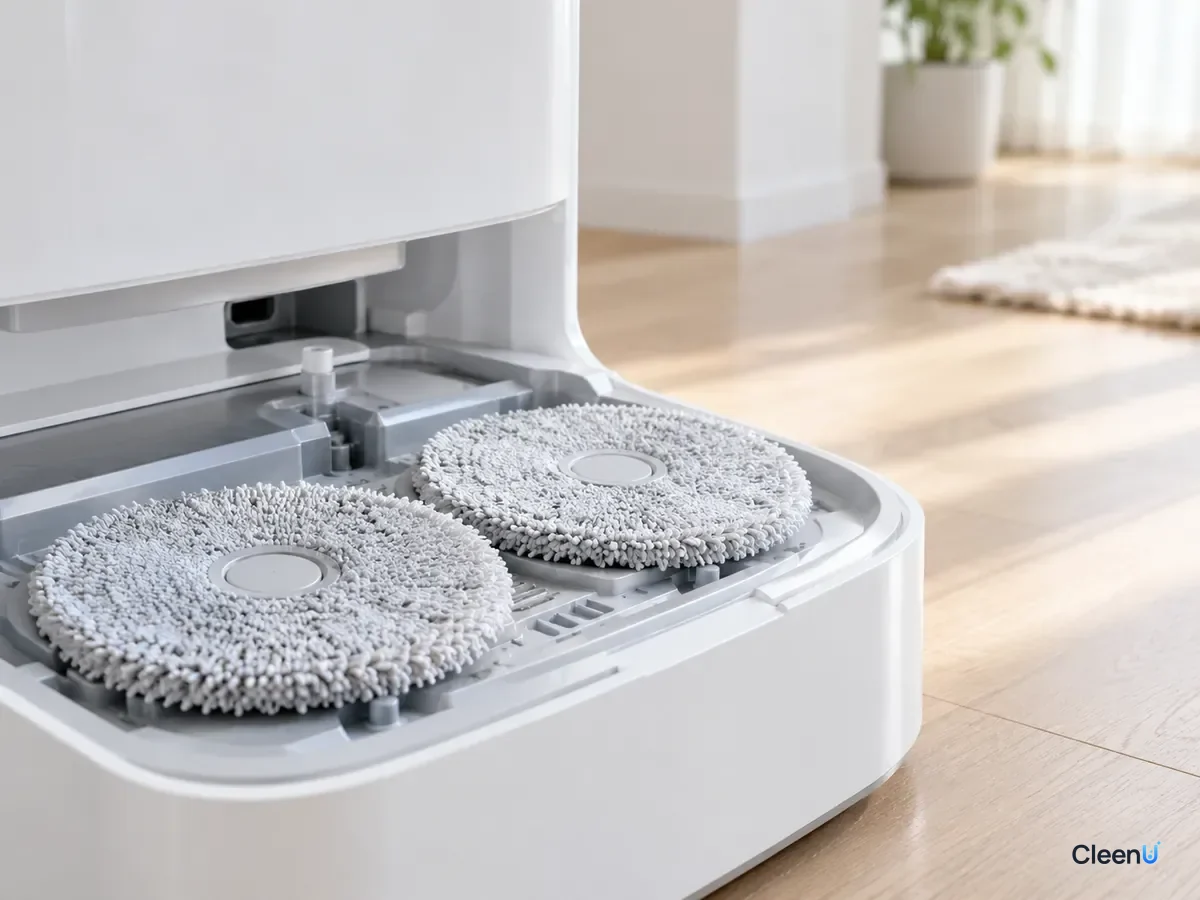
So cleanup comes down to three things. Empty and rinse the dirty tank, then leave the lid open to dry. Wash the pads and dry them completely, using the dock's drying function if it has one. Use up or pour out any leftover mix in the clean tank the same day. Once a week, clean the dock's wash tray and filter, and do it more often if you have a shedding pet.
A one-minute check after every run
- Dirty tank emptied, rinsed and left open to dry
- Mop pads washed and dried, with no sour smell
- Leftover mix in the clean tank used up or poured out
- Main brush and side brushes free of wrapped hair
- Floor dry, with no streaks, tackiness or slippery film
When something goes wrong, start here
These are the most common problems after adding a cleaning solution. Most of them clear up once you correct the dose and clean the pad. If a problem keeps coming back even at the label dose with a clean pad, the solution itself is probably a poor match for your robot or your floors.
Streaks or water marks. The usual causes, in order, are too much solution, a dirty pad, a high water level and hard tap water. Bring the dose back to the label amount, wash the pad, drop the water level one step and check again.
Sticky floors. Usually too much solution, or laundry detergent left in the pad. Cut the dose and do a water-only pass for comparison. If floors are still tacky at a normal dose, the formula is leaving too much residue for your floor type, so switch to a low-residue robot solution.
Floors that get slicker once dry. This is a safety issue, not just a feel issue. First make sure the floor has actually dried. If it is still slick when dry, the cleaner has probably left a lubricating film, which is common with regular floor products that contain wax or conditioning agents. Do a water-only pass, then switch to a wax-free robot solution.
"Dirty tank full" when it is not. Foam has almost certainly reached the sensor. Empty and rinse the tank, wipe the sensor contacts, and switch to a low-foam solution at the label dose.
A smelly tank or pad. That smell is bacteria feeding on wastewater and organic residue, and fragrance will not fix it. Clean and dry the tank and pads and clean them more often. The solution's preservative system matters too, so store an opened bottle as the label directs.
Stop using the solution if you notice any of these
Stop if you notice a sharp chemical smell after mopping, or stinging or burning skin after contact. Stop if the solution turns thin, changes color or separates, or the bottle bulges. Stop if stone or wood floors look dull, hazy or start to lift. Air out the room, run the robot with water only, and check the product label and your robot's manual.
Written for: Owners of vacuum-and-mop robots who want to know whether to add a solution, how to add it and how to troubleshoot, especially homes with pets or kitchen grease tracked onto floorsNot for: Unfinished or gapped solid wood floors, homes that are mostly carpet, and situations that call for disinfection (a cleaning solution is not a disinfectant)
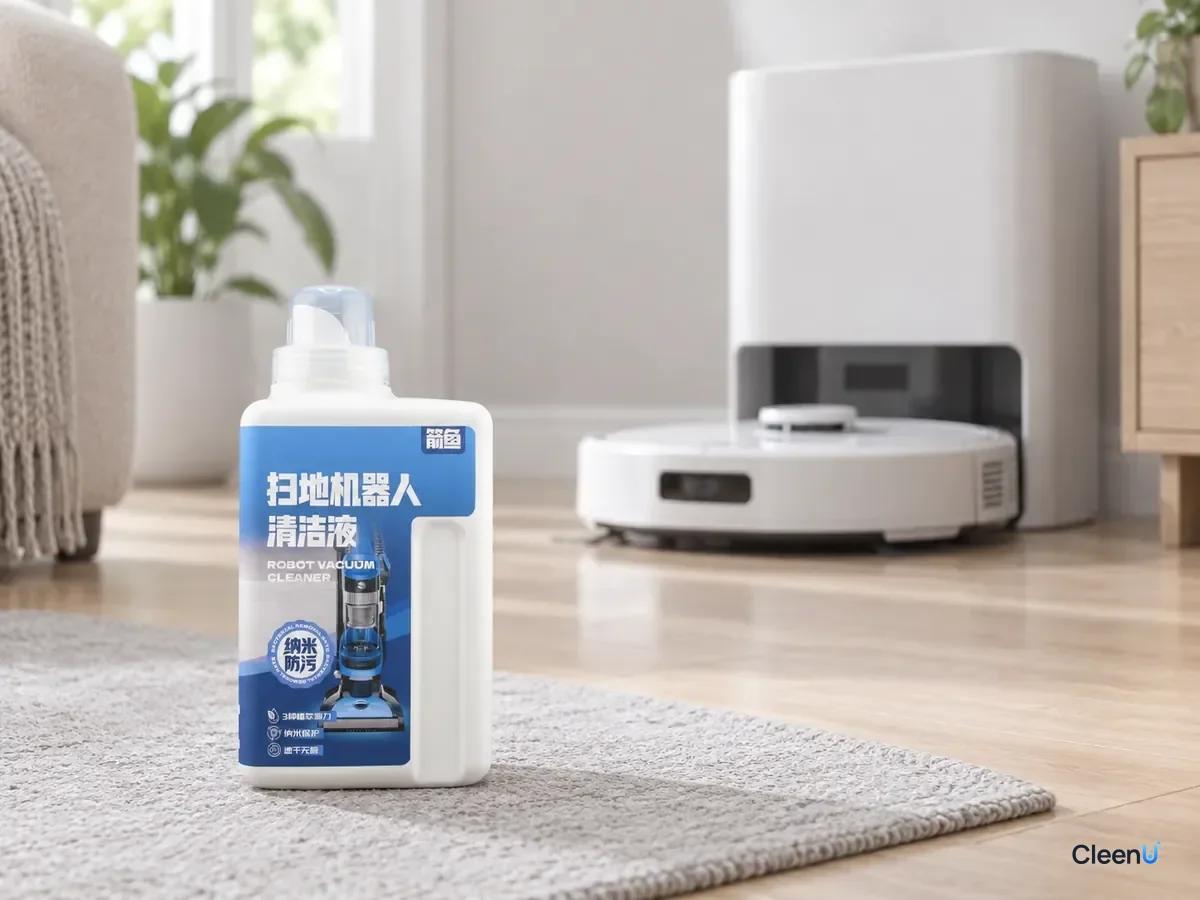
For a low-foam, neutral, no-rinse solution built for robot mops, we recommend our Robot Vacuum Cleaning Solution.
With cats or dogs at home, there is a pet-home version. It is the same neutral, low-foam formula with an added odor-control ingredient aimed at pet smells and no added fragrance.
Cats or dogs at home? Try our Robot Vacuum Cleaning Solution for Pet Homes.
For more specific questions, read where cleaning solution goes in a robot vacuum, how much solution to add, and whether regular floor cleaner works in a robot mop.
This article is part of the Robot Vacuum Cleaning Solution & Maintenance Guide, which covers the full maintenance schedule and links to every troubleshooting guide.
Before you add cleaning solution: eight quick answers
Do I need to add cleaning solution every time the robot mops?
No. Water is fine for routine dust. Add a low-foam robot solution for kitchen floors, pet areas, greasy footprints or floors that have gone a few days without mopping.
Does more solution mean cleaner floors?
No. Going over the label dose adds foam and residue, which leaves floors sticky or streaky and can trigger a false tank-full alert. On very dirty floors, run a second pass.
Can I use regular floor cleaner or dish soap instead?
It is not a good idea. Most of them are high-foam, which can trip the level sensor, clog the outlets and leave a film on the floor.
Does robot mop cleaning solution disinfect?
A cleaning solution removes soil; that is not the same as disinfecting. Only products tested and registered for disinfection can make that claim.
Do I need to rinse with plain water afterward?
Not with CleenU Robot Vacuum Cleaning Solution at the label dose. If floors feel tacky after another product, a water-only pass is a good way to compare.
Can a robot mop be used on hardwood?
Yes on sealed solid hardwood, engineered wood and laminate at a low-to-medium water level. For gapped, cupped or unfinished wood, vacuum only.
How do I use robot mop cleaning solution?
Add it to the clean water tank or the dock's designated detergent compartment as your manual directs—about 1:50 to 1:100; 10 to 20 mL per fill is usually enough—then top up with water. Never put it in the dirty water tank or mix it with other cleaners. If your manual allows only the brand's own solution, follow the manual.
Is CleenU robot mop solution scented?
The standard formula has a lemon scent; the pet-home formula is fragrance-free and relies on odor-neutralizing ingredients instead. Choose fragrance-free if anyone at home is sensitive to scent, and stay within about 1:50 to 1:100—overdosing makes any scent stronger.
Whether to add cleaning solution depends on what is on your floors. Water handles dust; greasy footprints, kitchens and pet zones call for a low-foam robot solution. Put it in the clean tank or auto-dosing compartment at the label dose, and run a second pass instead of doubling up. After each run, empty the dirty tank and dry the pads. If streaks, stickiness, foam or odors show up, adjust the dose and clean the parts first. If the problem keeps coming back, switch to a better-matched formula.