
Q&A
Can You Use a Third-Party Cleaning Solution in a Shark HydroVac? Where It Goes and How to Mix It
Direct answer
Yes. The key is picking the right one and adding it the right way: a low-foam, neutral, particle-free concentrate with a defoamer that won't leave crusty buildup, diluted about 1:50 to 1:100 in the clean water tank, usually 10 to 20 mL per fill. Check the dirty tank on your first run.
What can go in a HydroVac clean water tank
Yes
- A low-foam, neutral, particle-free concentrate made for wet-dry floor cleaners or robot mops, diluted per its label, with no disinfectants
No
- High-sudsing products like dish soap, laundry detergent, or body wash
- Floor polish, shine boosters, or anything with particles or film-formers
- Chlorine bleach, vinegar, rubbing alcohol, or solvent-based cleaners
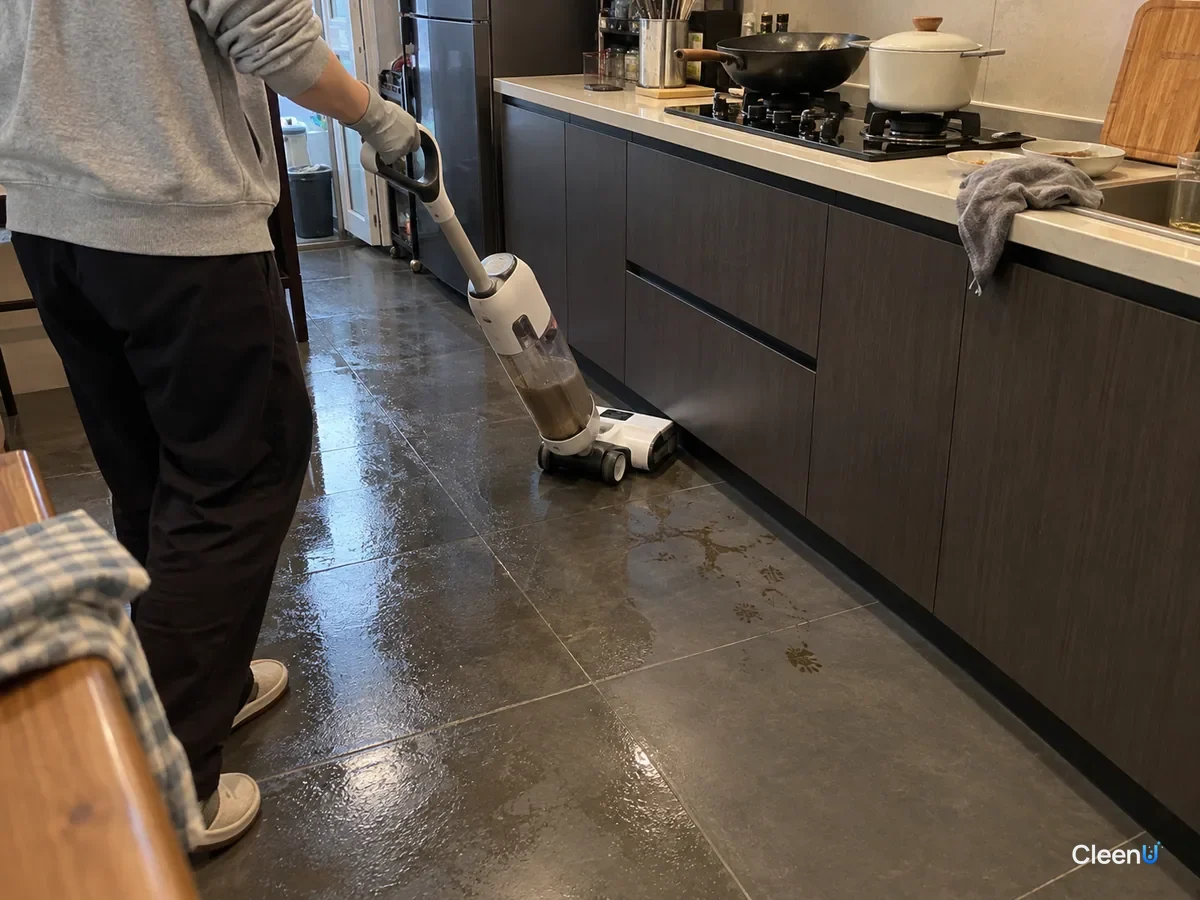
The Shark HydroVac is an upright wet-dry floor cleaner. It scrubs with a wet brushroll, pulls dirty water back into an onboard tank, and cleans itself on its dock when you're done. Like a robot mop, it uses cleaning solution, but its design is completely different, so the question of third-party solution starts with how water and air move through the machine.
The short answer: yes, and the key is picking the right one. One property matters more than anything else: low foam that collapses fast. A wet-dry vacuum pulls water and air into its dirty tank with strong suction, so a solution with low, fast-collapsing foam keeps the tank, filter, and floor trouble-free. Below we cover why, where solution goes, how much to use, and how to test a product at home.
Three tests a floor cleaner solution has to pass
What an upright wet-dry floor cleaner asks of a solution comes down to three things: foam, streaks, and the dirty tank's full-level detection. Turned into a shopping checklist:
- Foam: little foam under a fast-spinning brushroll and strong suction, and the foam should collapse quickly.
- Streaks: nothing that dries into white lines or haze on dark or polished tile.
- False sensor triggers: no foam layer building up in the dirty tank and pushing on the level detection.
Foam is the root of all three.
How water and air move through a wet-dry floor cleaner
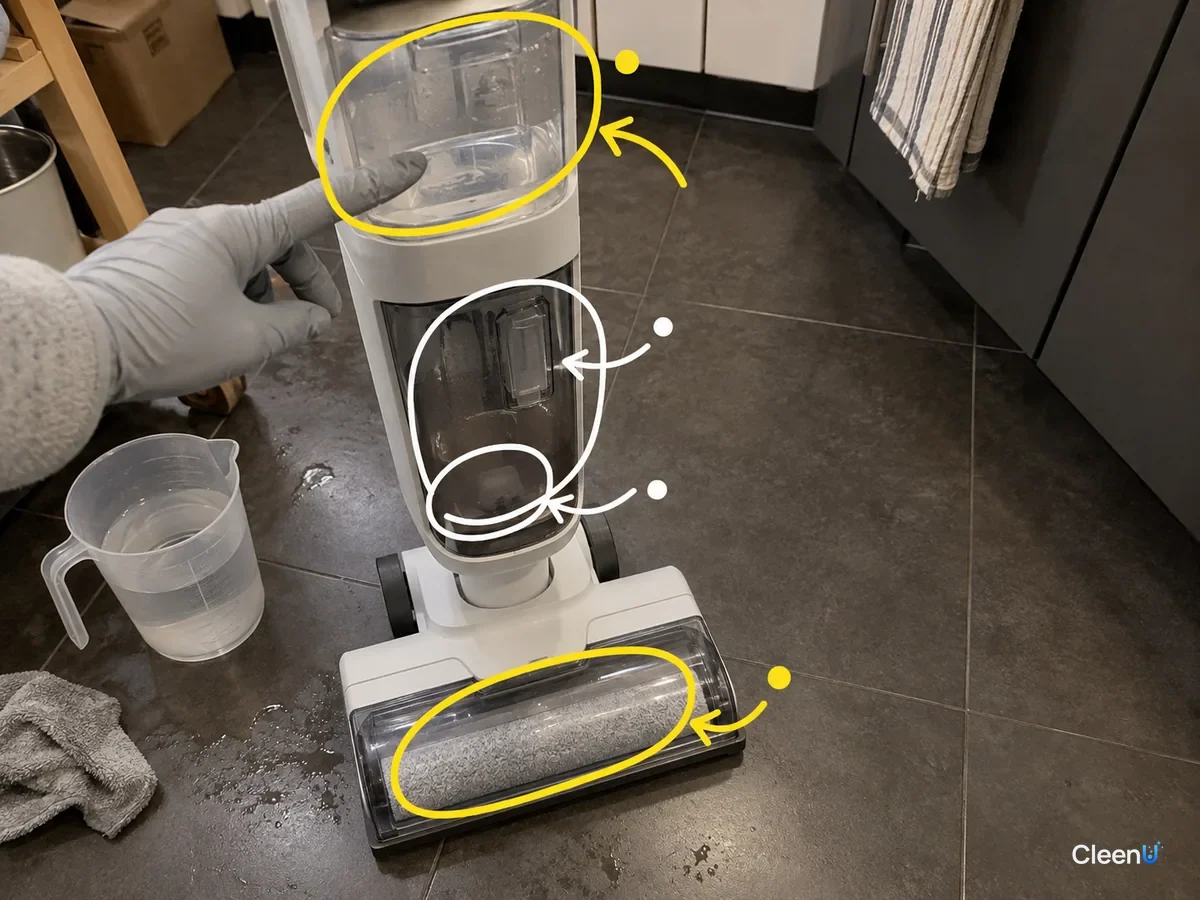
A robot mop's pads turn slowly against the floor, use little water, and have limited suction. An upright wet-dry floor cleaner sprays, scrubs, and vacuums all at once. In a machine like the HydroVac, liquid and air move roughly like this:
- Clean water tank: holds water or diluted solution.
- Pump and outlet: send working solution to the brushroll to wet it.
- Brushroll: spins fast, lifts soil off the floor, and whips air into its wet bristles.
- Suction inlet and recovery channel: strong airflow from the motor pulls dirty water, debris, and lots of air up the channel.
- Dirty tank and separator: the air-water mix enters the tank. Water and debris drop out by gravity and baffles; air keeps rising, passes a filter, and exits through the motor's airflow path.
- Full-tank detection: once dirty water reaches a set level, the machine stops picking up or tells you to empty it.
- Self-cleaning dock: back on the dock, self-clean spins the brushroll with clean water while suction runs, flushing the brushroll, floor head, and internal tubing. Some models also dry.
The key step is air-water separation. The dirty tank is designed on a simple premise: water is heavy and falls, air is light and rises. Liquid water cooperates. Foam doesn't. Foam is air wrapped in liquid film, with a fraction of the density of water, so it doesn't settle. It rides the airflow upward and stacks higher and higher. That leads to three problems:
- Foam reaches the full-tank detection while the tank holds only a little water, so the machine thinks it's full: a false sensor trigger.
- Airflow carries foam past the baffles onto the filter, which gets wet and dirty, and suction drops.
- Foam keeps climbing the airflow path, carrying moisture toward the motor. These machines have protective designs, but repeatedly testing that barrier with foam isn't a good idea.
Self-cleaning is where foam peaks. The brushroll spins hard in the dock while suction runs at full power, which is basically an aggressive foam test, using the same solution-laced water from your clean tank. Many people see no problem while mopping, then find the dirty tank full of foam after self-clean. This is why.
How a defoamer collapses foam in the dirty tank
If foam is the root problem, it's worth knowing how a low-foam formula keeps foam both low and short-lived. Here's the mechanism from the defoamer's side.
Foam lasts because of the thin liquid film between neighboring bubbles. Surfactant molecules line both faces of that film, and the more stable the film, the longer the foam lasts. Defoamers are usually tiny droplets or particles that don't dissolve in water and have very low surface tension, such as certain silicone or polyether ingredients. They break bubbles in three steps:
- Entering: carried along by the liquid, a defoamer droplet reaches the film. Because its surface tension is lower than the film's, it pushes into the film surface.
- Spreading and bridging: once in, it pokes through both faces of the film like a tiny bridge, and the surface tension difference pulls liquid away from the bridge.
- Rupture: the film around the bridge thins, dewets, and breaks, and the bubble pops.
That's why two "low-foam" products can behave very differently. One foams and collapses quickly because it has a working defoamer system. Another makes less foam but holds onto what it makes, because its main surfactant simply foams weakly. For a wet-dry vacuum, the first type matters more: once foam forms, it has to collapse before the airflow lifts it.
Kitchens add a twist. Kitchen floor soil contains oil and protein from crumbs, spills, and milk. Proteins settle into bubble films and stabilize foam. Oil droplets can knock foam down a bit, but you can't control how much or in what form. So the same solution can foam very differently in front of the stove than in a bedroom. Always judge foam with soil present, which the home test below builds in.
How a defoamer breaks foam in three steps
- The brushroll and suction pull air into the working solution; surfactants line the bubble films and foam starts to stack
- Defoamer droplets with low surface tension reach the film and push into its surface
- Each droplet pokes through both faces of the film like a bridge and pulls the surrounding liquid away
- The film beside the bridge thins, dewets, and breaks, and the bubble pops
- Foam collapses back into liquid before the airflow can lift it, settles in the tank, and stops reaching the full-level detection
For more on foam and false full-tank alerts, see Why a robot vacuum says the dirty tank is full when it isn't and Why robot mop solution has to be low-foam.
Where streaks on dark tile come from
Streaking is the second test, and dark kitchen tile, the setting for this guide, is where it shows most.
The brushroll recovers most of the dirty water, but a very thin film stays on the floor and dries within minutes. Whatever is dissolved in that film stays on the tile. Streaks usually come from three sources:
- Surfactant residue. Too much solution, or a surfactant that doesn't rinse easily, dries into a hazy, draggy film, and you see lines in the direction the brushroll traveled.
- Hard-water minerals. Calcium and magnesium in tap water come out of the film as it dries and leave white marks. With anionic surfactants, they can also form calcium soap, which is harder to wipe off.
- Film-formers and polishes. Some floor cleaners add polymers or wax to make floors shine. In a wet-dry vacuum, the brushroll spreads them unevenly, and on dark tile that dries as streaks.
So "streak-free" means the right dose, easy-rinsing surfactants, and no wax or film-formers on the formula side. On the use side, it means mixing at the label ratio, staying at the low end with hard water, and keeping the brushroll and dirty tank clean so dirty water isn't spread back onto the floor. If your water is hard and white marks are the issue, see Fixing white residue from hard water after robot mopping.
Greasy kitchen footprints are a separate job. A neutral solution wets and emulsifies thin oil films and lifts them off tile, which handles everyday footprints. For grease that's built up in front of the stove, spot-treat with a kitchen degreaser first, then run the floor cleaner. That works better than doubling the solution, which also doubles foam and residue. For the order of steps, see How to get greasy footprints off a kitchen floor with a robot mop.
Where it goes and how to mix it
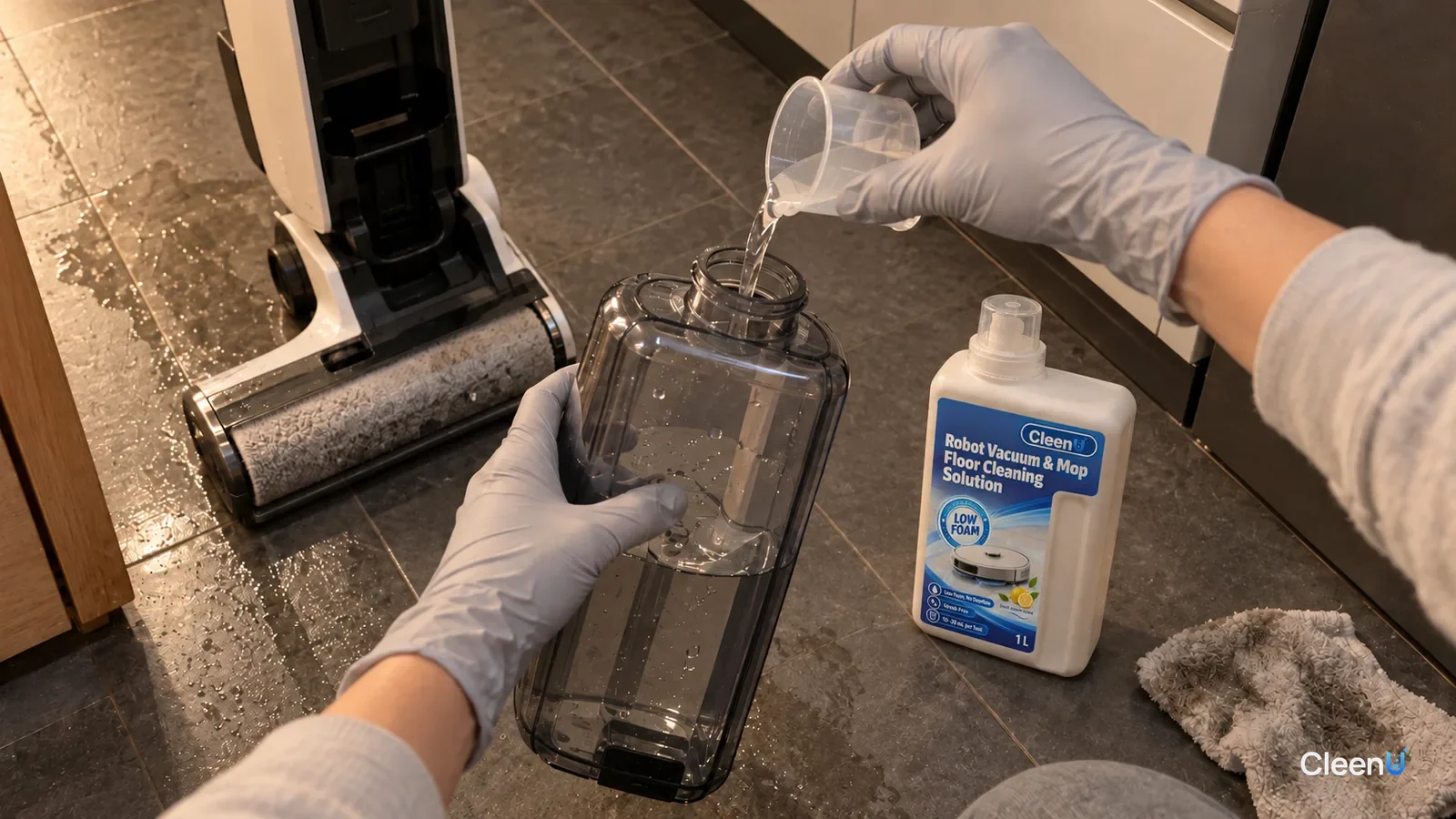
It goes in the clean water tank. On the HydroVac, cleaning solution and water go into the clean water tank together, and the machine sprays the mix onto the brushroll. Never put solution in the dirty tank. Follow your model's manual for fill marks and order.
How much. CleenU Robot Mop Cleaning Solution dilutes at about 1:50 to 1:100. By water volume:
Dose by water volume (about 1:50 to 1:100)
- 0.5 L (about 17 oz)
- about 5–10 mL
- 0.8 L (about 27 oz)
- about 8–16 mL
- 1 L (about 34 oz)
- about 10–20 mL
- 2 L (about 68 oz)
- about 20–40 mL
Check the tank markings to see how much water you added, then measure with the cap. Use the low end for routine cleaning and the high end, or a second pass, for greasy kitchen footprints. Start low on dark tile or with hard water.
Judge a ratio by what's left in the tank. A dilution ratio only means something next to the concentrate's strength: active content divided by the dilution ratio. Many solutions carry about 2% active surfactant. At 1:200 that leaves about 0.01%, and at 1:500 only about 0.004%. CleenU Robot Mop Cleaning Solution, for example, carries 15% active surfactant, so at 1:100 it still leaves about 0.15%: about 15 times the first case and nearly 40 times the 1:500 case. The 2% figure is a typical level used for illustration, not any particular brand. Measuring the label dose accurately does more than topping up by feel.
Use the cap, not a guess. A HydroVac tank isn't large, so a few milliliters changes the ratio noticeably. Going past the label dose doesn't clean better. It adds foam and streaks, and then gets whipped up again during self-clean.
Water first, then a gentle swirl. Add water, then pour solution down the side of the tank. Cap it and swirl gently. Shaking hard puts foam in the tank before you even start.
Use it the same day. Don't leave mixed solution in the clean tank overnight. Mixed solution left sitting can turn sour or slimy. Empty, rinse, and air-dry the tank after use.
Your first run with a new solution: check in this order
- Clean one section of kitchen floor, then look at the dirty tank. Dirty water at the bottom with a thin layer of fine bubbles that fade fast is normal. If foam stacks past the halfway point, check your dose against the label first, then try a lower-foam product.
- Dock the machine and run self-clean, then check the dirty tank again. This is where foam peaks. If it's fine here, everyday use will usually be fine too.
- Once the floor is dry, crouch down and look across the dark tile at a low angle for white lines. Walk on it barefoot and feel for drag or tackiness.
- Pull the filter and look. Dry or barely damp is normal. Soaking wet or coated with foam means foam is getting past the separator; pause and work through the box below.
Pause and check your mix if you see any of these
Pause if foam fills more than half the dirty tank, or the machine keeps reporting a full tank when there's little water in it; the filter is soaking wet or foamy after self-clean; suction drops noticeably or you hear unusual noise or smell anything odd; white streaks keep showing on dark tile after drying, or floors feel tacky or slippery; or whitish, tacky buildup appears around the clean tank or outlet. Empty both tanks and rinse them, wash the filter and let it air-dry, then run self-clean and clean a section of floor with plain water only. If the problem clears, remix at the low end of the label ratio or switch to a lower-foam product. If it persists with plain water, contact Shark support.
A home test built for wet-dry vacuums: the shake test with soil
You may have seen the basic shake test. Here it's adjusted for a wet-dry vacuum in two ways: more air in the bottle to mimic strong suction, and a little "soil" to mimic a kitchen floor.
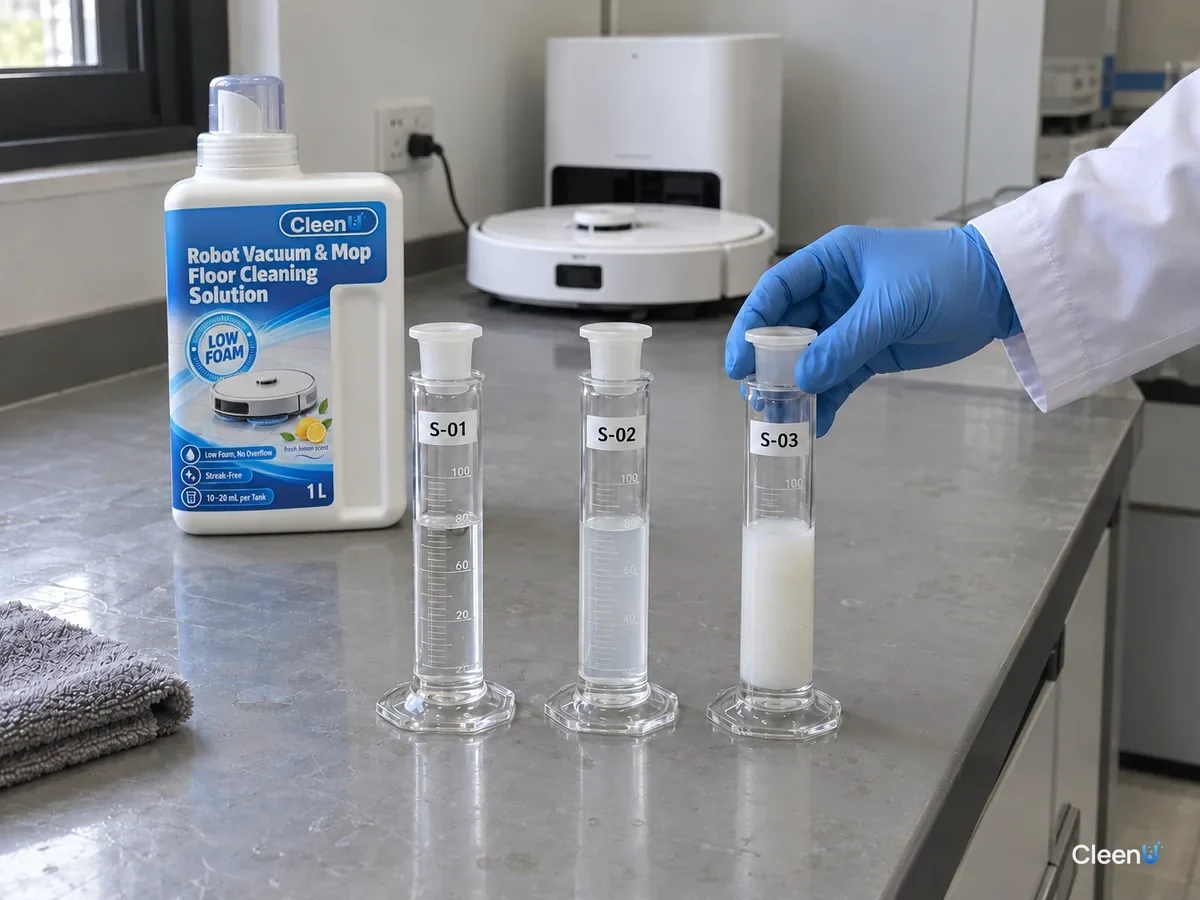
Take two identical clear plastic bottles and add about 300 mL (10 oz) of water to each, filling only about a third of the bottle so there's plenty of air. Add the solution you're testing to one at its label ratio (about 3–6 mL). Add dish soap at the same ratio to the other as a comparison. Then add two or three drops of milk to each bottle to stand in for protein soil. Cap them, shake hard 15 times, and set them down.
Watch two things: how high the foam is right after shaking, and how much is left after a minute or two. A solution that suits a wet-dry vacuum makes a thin foam layer that visibly collapses. The dish soap bottle will usually be full of foam that just sits there. If your test product behaves like the dish soap, keep it out of your HydroVac.
For residue, test in a corner of the dark tile: wipe a patch with working solution and a patch with plain water, let both dry, and look at a low angle. If you can't tell them apart, you're fine. Full shake-test method: How to tell if a robot mop solution is low-foam.
These tests screen out obvious mismatches. They don't replace watching the real machine, so still follow the four-step check above on your first run.
CleenU as an example: a formula built around the three tests
CleenU Robot Mop Cleaning Solution works in most Shark HydroVac-type floor cleaners, added to the clean water tank as the manual directs. It's a neutral concentrate, pH 6.5–7.5 as a concentrate, built on low-foam nonionic surfactants with a defoamer. It contains no wax, no chlorine, no particles, and no quats or phenols. In a wet-dry vacuum, low foam plus a defoamer addresses dirty-tank foam and false sensor triggers. No wax or film-formers addresses streaks on dark tile. Neutral and chlorine-free keeps it gentle on the brushroll, seals, and tubing.
Each 1 L bottle comes with a measuring cap and dilutes about 1:50 to 1:100; 10 to 20 mL per fill is usually enough, so one bottle covers roughly 50 to 100 fills. The standard version has a lemon scent, and the Pet Homes version is fragrance-free. Unopened, it keeps for 24 months. It's a cleaning solution that lifts dust film, greasy footprints, and everyday soil. It isn't a disinfectant.
Beyond most Shark HydroVac models, it also suits robot mops and wet-dry floor cleaners from Roborock, iRobot Roomba Combo and Braava, Ecovacs Deebot, Dreame, Narwal, Eufy RoboVac, Tineco, and Bissell CrossWave. CleenU is not affiliated with Shark; brand names are used only to describe compatibility.
If you want a low-foam, neutral, streak-conscious concentrate for your wet-dry floor cleaner, take a look at our Robot Vacuum & Mop Floor Cleaning Solution.
Wondering whether one bottle can serve both a robot mop and a floor cleaner? See Can robot mop solution and wet-dry vacuum solution be swapped?
Switching cleaning solution in a Shark HydroVac: common questions
Can I use a third-party cleaning solution in my Shark HydroVac?
Yes, if you pick the right one: a low-foam, neutral concentrate with a defoamer and no wax or film-formers, diluted about 1:50 to 1:100 in the clean water tank, usually 10 to 20 mL per fill. Check the dirty tank after cleaning and again after self-clean on your first run.
Which tank does cleaning solution go in?
The clean water tank, mixed with water, so the machine sprays it onto the brushroll. Never add solution to the dirty tank. Follow your manual's fill marks.
How much solution should I add to a HydroVac clean water tank?
For CleenU Robot Mop Cleaning Solution, about 1:50 to 1:100: 5–10 mL per 0.5 L (about 17 oz) or 10–20 mL per liter. Use the low end for routine cleaning and dark tile.
The dirty tank says full but barely has any water. Why?
Most likely foam is reaching the full-level detection. Empty the tank and remix at the low end of the label ratio. If it keeps happening, switch to a lower-foam product with a defoamer.
Why is the tank fine while cleaning but full of foam after self-clean?
Self-clean spins the brushroll fast under full suction, the most aggressive foaming step. Foam there means more solution than the label calls for, or a product that isn't low-foam enough. Remix at the low end first.
Can I use dish soap instead of floor cleaner solution?
No. Dish soap is high-foaming and foams heavily under strong suction, a classic cause of dirty-tank foam and false sensor triggers.
How do I get rid of white streaks on dark tile?
Remix at the low end of the label ratio, then make one pass with plain water to compare. If white marks remain after water, it's likely hard-water minerals; if they disappear, the solution dose or residue was too high.
Can I put disinfectant in a wet-dry floor cleaner?
Don't. Chlorine can damage rubber parts and the brushroll and gets used up quickly by organic soil. Disinfect specific spots by hand.
Is it normal for the filter to be wet after self-clean?
Slightly damp is normal; soaking wet or foamy isn't. It means foam got past the separator. Rinse and air-dry the filter, then remix at the low end of the label ratio or switch to a lower-foam product.
Can I leave mixed solution in the clean tank for next time?
No. Use it the same day, then empty, rinse, and air-dry the tank. Diluted solution left standing can turn sour or slimy.
Which Shark floor cleaners does CleenU Robot Mop Cleaning Solution work with?
It works in most Shark HydroVac-type floor cleaners. Add it to the clean water tank at about 1:50 to 1:100; if your model's manual says otherwise, follow the manual.
For a full streak troubleshooting guide, see Robot mop leaving streaks or water marks?
You can use a third-party solution in a Shark HydroVac if you focus on what matters in a wet-dry vacuum: strong suction pushes foam toward the air-water separator, so foam has to stay low and collapse fast. Pick a low-foam, neutral concentrate with a defoamer and no wax or film-formers, and dilute it about 1:50 to 1:100 in the clean water tank, usually 10 to 20 mL per fill. On your first run, check the dirty tank after cleaning and again after self-clean, then look for streaks on dark tile and a dry filter. If everything checks out, make it your routine.