
Q&A
Can You Mix Different Brands of Robot Mop Cleaning Solution?
Direct answer
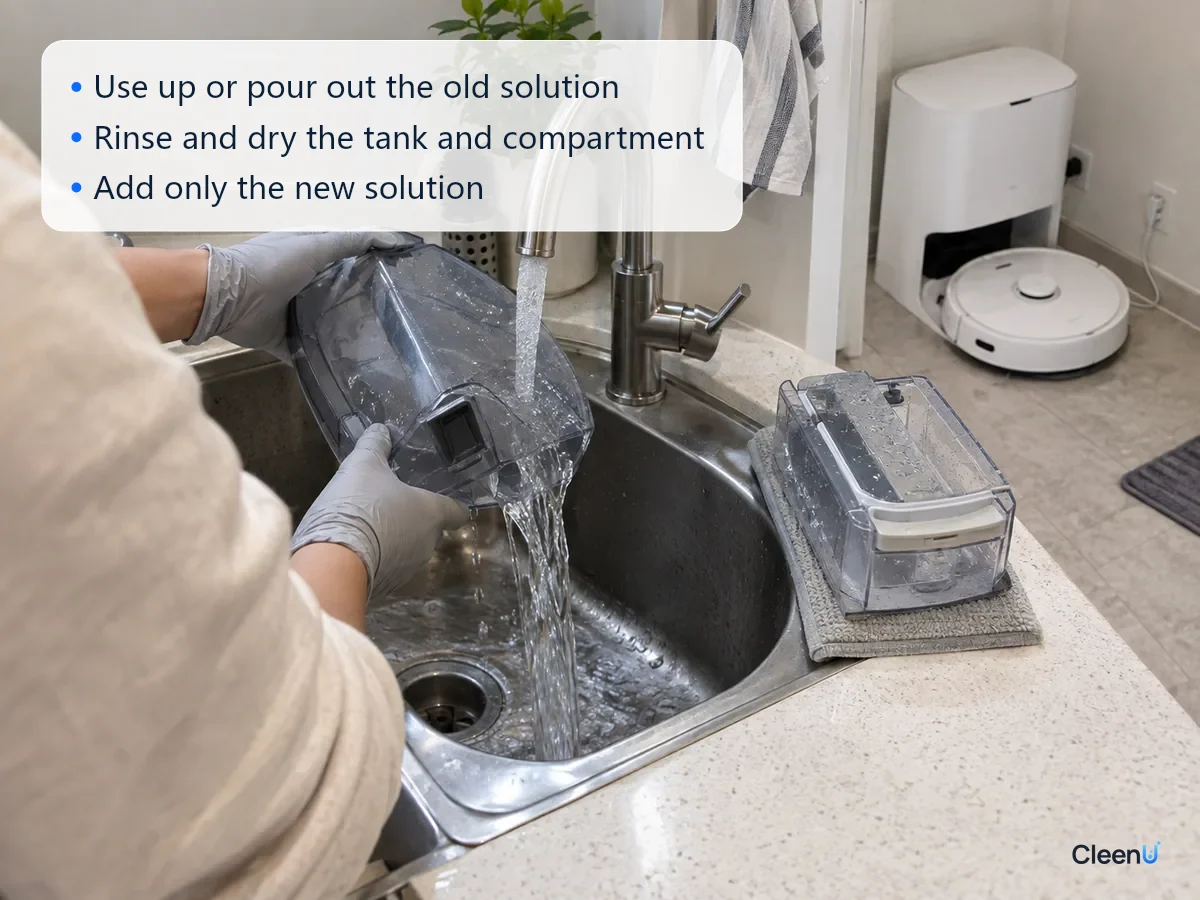
Don't mix them. Different brands use different formula systems, and together they can turn cloudy, foam more, drop crystals or thicken, clogging outlet holes and the dosing compartment. Before switching brands, empty, clean and dry the clean tank and dosing compartment, then add only the new one.
Can you mix in these situations?
Yes
- Switching to another brand after the old one is used up and the tank is rinsed
- A new bottle of the same product after the old one, if both look and smell normal
No
- Two brands of robot mop solution in the same clean tank
- New solution from another brand poured on top of what's left in the dosing compartment
- The maker's solution plus a third-party one, hoping to double the effect
- Robot mop solution with dish soap, floor cleaner or disinfectant
It depends
- The same brand's standard and pet versions: follow the maker's guidance; if there's none, clean before switching
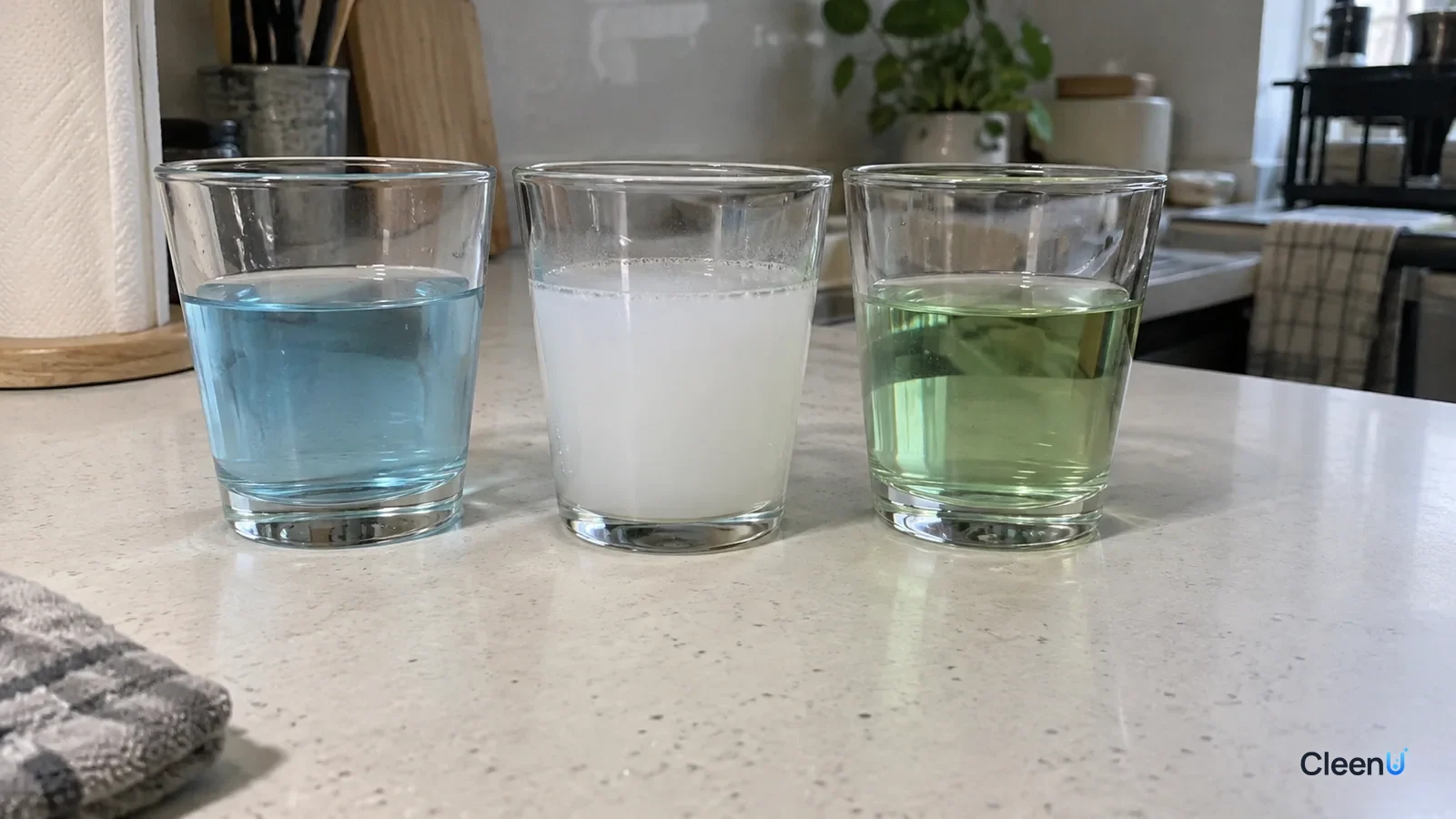
Plenty of homes end up with two bottles of robot mop solution: the maker's and another brand, or a standard and a pet version. When one runs low, it's tempting to top up with the other, or add both for "extra cleaning" and a nicer smell.
The risk is bigger than most people expect.
Why do mixed formulas cause problems?
A cleaning solution is built around a balance: the types and ratios of surfactants, defoamer, solubilizer, preservative, fragrance and pH adjusters all matched so the liquid stays clear and even, foams little and leaves little residue. Two brands each have their own balance point, and mixing them can knock both off.
Surfactants that don't get along. Surfactants are grouped by the charge on their water-loving end: anionic, cationic, nonionic and amphoteric. Anionics and cationics attract each other and bind into insoluble complexes, so the liquid clouds and drops sediment. If one product contains a little cationic material, such as a quaternary ammonium antimicrobial or a conditioning agent, and the other is mostly anionic, trouble follows.
Diluted defoamer. Low-foam products rely on a defoamer dosed for their own formula. Mixed with another liquid it gets diluted and may not work on the other formula's surfactants, so foam can jump and the dock may report a full dirty tank.
Unbalanced solubilizer. Fragrance is held in water by solubilizers. In a mix there may not be enough, so fragrance separates into tiny droplets, the liquid clouds and oil clings inside the lines.
Changed viscosity. Two surfactant systems combined can form a thicker structure that the dosing pump can't draw and that narrows outlet holes.
Weakened preservation. Each preservative system dilutes the other, dropping both below effective levels, so the mix grows microbes and smells sooner.
pH conflict. Mix a near-neutral product with a mildly alkaline one and the pH shifts, affecting the stability and performance of some ingredients.
Some of these changes are visible, like cloudiness, sediment or separation. Others, like weaker defoaming or preservation, don't show until the mix is in the machine.
What mixing usually leads to
Foam and false "tank full" alerts, because the defoaming balance is off and foam piles up when the dock washes the pads. See a "dirty tank full" alert when the tank isn't full.
"Detergent low" alerts and dosing failures, because thickened or separated liquid blocks the compartment opening and outlet.
Lower water flow, because crystals and sediment catch in the filter and outlet holes.
Tacky or slippery floors, because the residues stack up.
Odd smells, from two fragrances clashing or a mix that's starting to sour.
How do labs decide whether two liquids can share a tank?
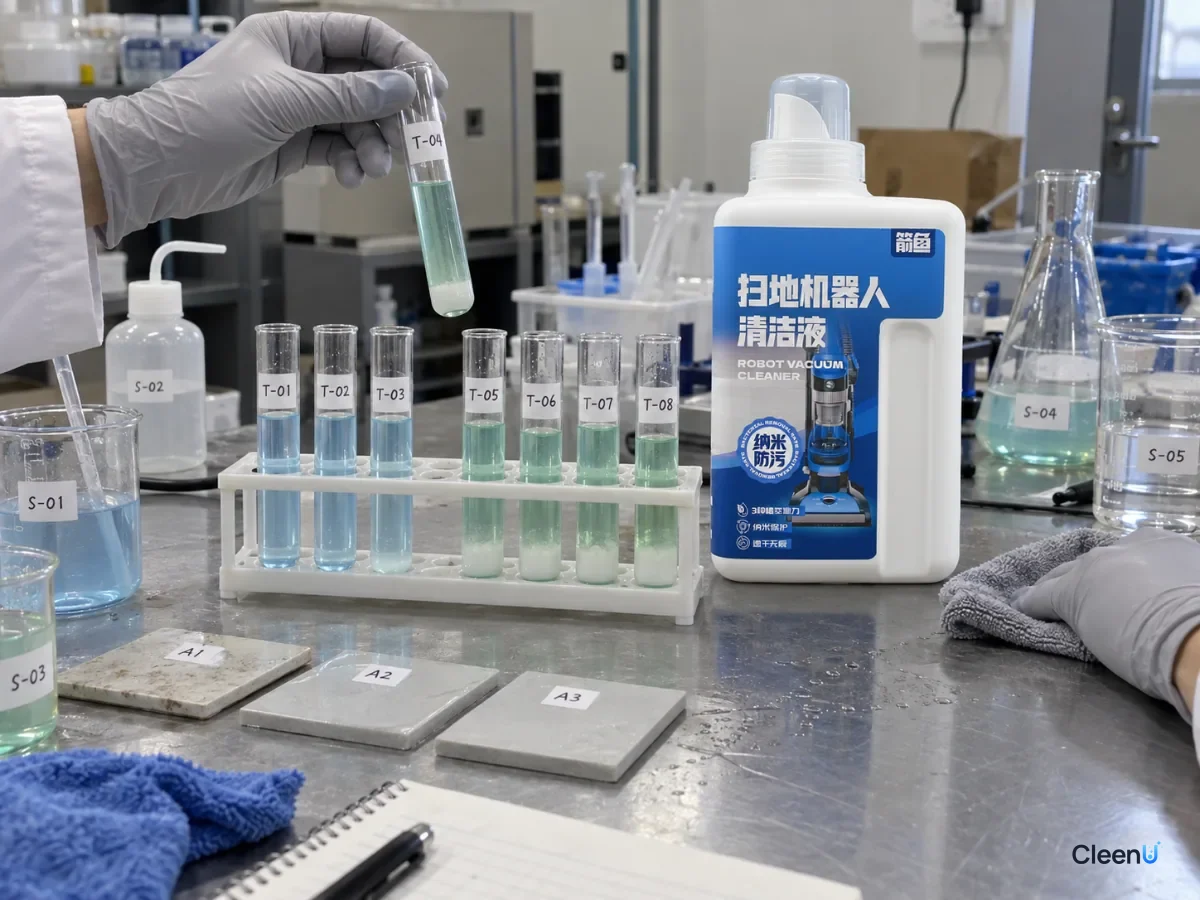
When formulas are developed or raw materials are swapped, labs run compatibility tests. A common method is to blend two liquids at several ratios, such as 1:9, 1:1 and 9:1, in clear containers, hold them at room temperature, high heat and cold for a period, and watch for cloudiness, separation, sediment or crystals. Then they measure changes in viscosity, pH and foam height. Only if every ratio stays stable at every temperature are the two considered compatible.
Two takeaways. First, compatibility has to be confirmed by testing; you can't infer it from "neutral" or "low-foam" on the label. Second, a mix that looks fine at first can change after a few days or a few hot and cold swings, and a clean tank or dosing compartment is exactly where liquid sits for days through temperature changes.
Households don't need to run these tests and usually can't. The simple, reliable rule is: don't mix, and clean before you switch.
Why "dilute first, then mix" isn't safe either
Some people figure that if concentrates can't be mixed, diluting each one first and then combining them should be fine at such low strength.
Dilution does reduce some reactions, but it doesn't eliminate them. Anionic and cationic surfactants still bind at low concentration; less precipitates, but it forms fine particles that stay suspended and end up in the filter, outlet holes and pad fibers. How well one product's defoamer controls the other's foam is still uncertain. And a diluted mix is even less protected against microbes, so it spoils faster in the tank.
So whether concentrate or diluted, don't put two brands in the same tank.
The right way to switch brands
Before switching to another brand, do this in order
- Use up the old solution, or pour out what's left in the clean tank and dosing compartment
- Clean tank: rinse two or three times with warm water and brush the filter at the bottom
- Auto-dosing compartment: empty it, soak in warm water for about ten minutes, clear crystals from the opening and outlet, and rinse
- Run the robot once with plain water to flush old solution out of the lines
- Let everything dry, then add the new solution at its label ratio
- For the first few runs, check the dirty tank for foam and the floor for residue
For compartment cleaning steps, see how to clean the auto-dosing tank on a robot vacuum base station.
Want a stronger effect? Try this instead
Better kitchen grease removal: instead of adding another product, clean heavy grease by hand first and give the kitchen an extra pass.
Pet odor control: use a pet-home robot solution rather than adding odor spray to a standard one.
A stronger scent: scent has nothing to do with cleaning. A lightly scented product at the label ratio is enough; two fragrances just make the smell muddier.
Disinfecting: robot mop solution isn't a disinfectant, and mixing two of them won't make one. Treat areas that need disinfecting by hand with a proper product, and keep it out of the machine.
Can you alternate standard and pet versions?
Different versions from the same brand usually share a similar formula system. CleenU Robot Vacuum Cleaning Solution and its pet-home version are both neutral, low-foam concentrates at pH 6.5 to 7.5 with low-foam nonionic surfactants and a defoamer, no wax, no chlorine and no particles. The pet-home version adds cyclodextrin-based odor control and a lighter lemon scent. Both dilute at about 1:50 to 1:100, with 10 to 20 mL per fill usually enough.
Even so, it's best to use one at a time: finish one, rinse the tank, then switch, rather than splitting a tank half and half. Dosing stays accurate, and if something goes wrong you know which product caused it.
It works in most robot mops from Roborock, iRobot (Roomba Combo and Braava), Ecovacs Deebot, Dreame and Narwal, and in floor washers such as Tineco. Add it to the clean water tank or the dock's designated detergent compartment as your manual directs. CleenU isn't affiliated with these brands; the names only indicate compatibility. For choosing between brand-name and universal solutions, see brand-name vs universal robot vacuum cleaning solution.
Already mixed them? Here's the fix
Stop the robot and pour out the mix from the clean tank and dosing compartment. Don't keep using it.
Rinse the clean tank with warm water, and soak and brush the compartment opening and outlet until there's no cloudiness or crystals.
Empty and scrub the dirty tank, clean the dock's wash tray and filter, and hand wash the pads.
Run the robot once or twice with plain water, and check that water flows normally, with no foam and no errors.
Once everything's dry, add a single solution at its label ratio.
If the mix included disinfectant or a toilet bowl cleaner and you smell something harsh, open the windows and get people and pets out of the room before you handle it with gloves.
Watch the measuring cap when you switch
Different brands and versions may dilute at different ratios, and their caps are marked differently. When you switch, measure by the new product's label, not the old habit of "one capful."
Likewise, don't use the old product's cap to measure the new one. The markings correspond to a different ratio, and leftover old solution mixes with the new. Dry each cap after use and keep it with its own bottle.
This article is part of the Robot Vacuum Cleaning Solution & Maintenance Guide, which covers the full maintenance schedule and links to every troubleshooting guide.
Common questions about mixing robot mop cleaning solutions
Both brands say low-foam and neutral. Still can't mix them?
Still better not. The same label claims don't mean the same formula. Defoamers, solubilizers and preservatives differ, so foam and stability become unpredictable.
There's a little old solution left in the dosing compartment. Can I just add new?
If it's the same product and it looks and smells normal, yes. If you're switching brands, empty, clean and dry it first.
If the mix doesn't turn cloudy, is it fine?
No, you can't tell from that. Weaker defoaming and preservation don't show, and only appear later as foam or odor in the machine.
Can I add the maker's solution and a third-party one together?
No. Pick one, and clean the tank and compartment when you switch.
Can robot mop solution be mixed with regular floor cleaner?
No. Regular floor cleaners are often high-foam or contain wax, so mixing raises both foam and residue.
Should I wash the pads when I switch brands?
It's a good idea. Old solution trapped in the fibers mixes with the new one while mopping, so hand wash and rinse them first.
Can I leave diluted solution in the tank for several days?
It's better not to. Use diluted solution the same day, pour out what's left, rinse the clean tank and let it air-dry. Diluted solution that sits picks up odor and microbial growth, and days of warm and cool swings make cloudiness or residue more likely, especially with leftovers from another product.
Can I use the same solution in a floor washer and a robot mop?
Yes, if it is a low-foam solution labeled for both. Finish or empty the old solution and rinse the tank before switching, rather than topping one up with the other. CleenU Robot Mop Cleaning Solution works with Tineco floor washers and most robot mops; add it to the clean-water tank per the manual.
If you're switching solutions, once the tank and dosing compartment are clean, try the neutral, low-foam, wax-free Robot Vacuum Cleaning Solution.
Don't mix different brands of robot mop cleaning solution. Each formula balances its surfactants, defoamer, solubilizer and preservative its own way, and a mix can cloud, drop sediment, foam more or thicken, clogging outlet holes and dosing compartments while weakening preservation. Before switching, empty, clean and dry the clean tank and dosing compartment, run once with plain water, then add the new solution alone. For better grease removal, odor control or scent, pick the right purpose-made product at its label ratio instead of stacking two.