
Q&A
Is Plain Water Enough for Robot Mopping?
Direct answer
Yes, for some jobs. Plain water handles everyday dust and light water marks. Greasy footprints, kitchen floors, paw prints and drool marks only fade with water; a small dose of low-foam robot mop cleaning solution gets them clean. When you do add solution, less is better than more.
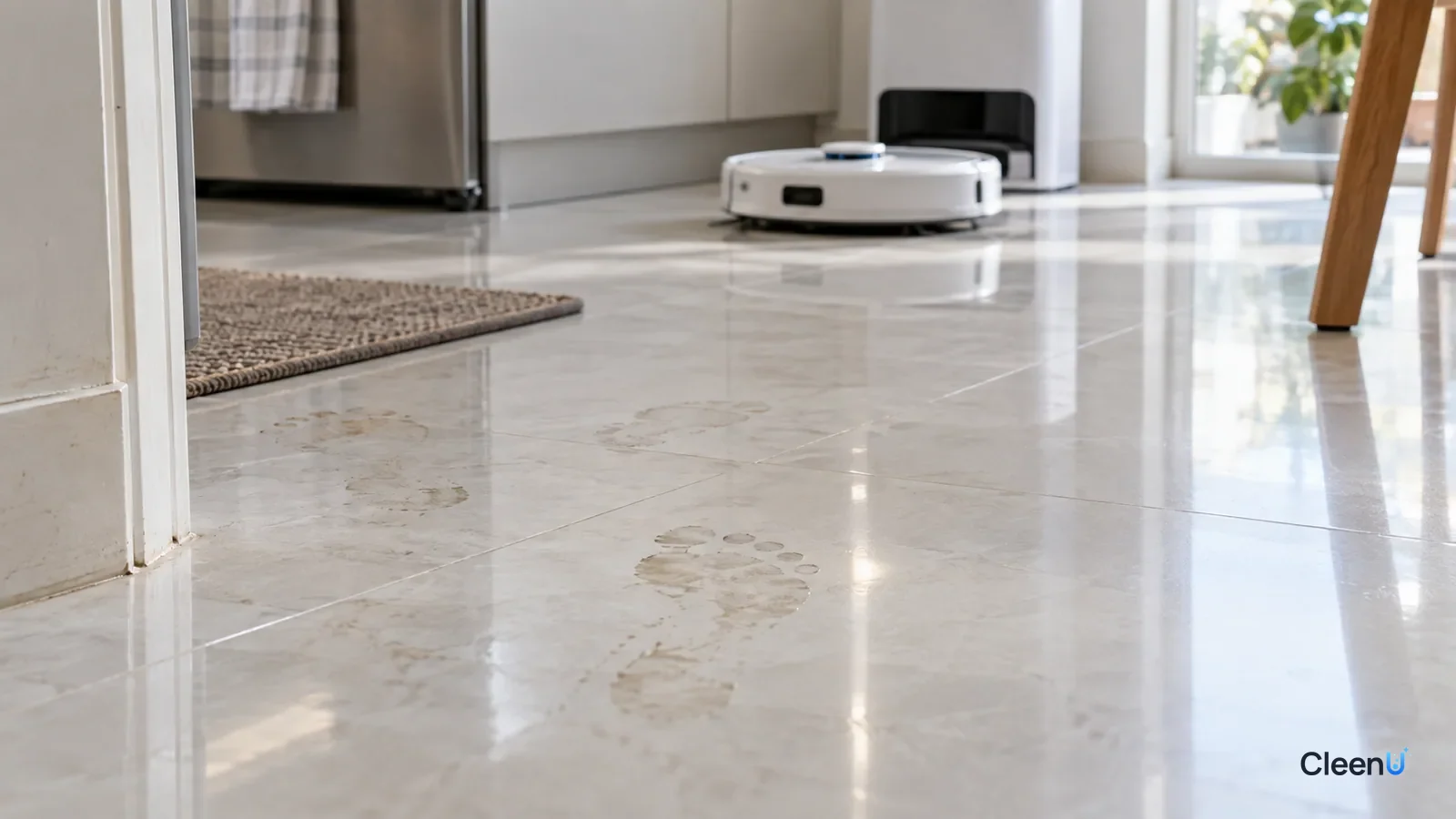
Water only, or add solution?
Yes
- Everyday dust and light water marks: plain water is enough
- Oily footprints, kitchen floors, pet paw prints and drool marks: a little low-foam robot mop solution cleans them more easily
No
- Adding anything else to the clean tank: see the article's section on what not to add
It depends
- How much solution: follow the label ratio; less is better than more
The questions people ask first
Isn't plain water better for the robot?
Water is the least hassle for the machine, with no foam or residue to worry about. But if your floors regularly get greasy marks, water alone won't get them clean and the pads will smell sooner. A low-foam robot solution at the label ratio is just as easy on the machine.
Is a floor mopped with water actually clean?
Visible dust and most water-soluble spills come up. Skin oil and grease don't dissolve in water, so they only fade and still show in side light.
Does solution mean fewer passes?
Often, yes. Once solution emulsifies greasy soil, one or two passes pick it up. With water alone, the same greasy print can take several passes and still leave a trace.
My manual says water only. Can I still add solution?
Follow the manual. If it prohibits additives, or the warranty limits you to the maker's own solution, stick with that.
Does more solution mean a cleaner floor?
No. More solution means more residue, a tacky or slippery floor and more foam in the dirty tank. Dose at the label ratio and add a pass where it's really dirty.
Do I need to add solution every day?
No, you don't have to. Use water most days and add solution when the kitchen, entry or pet areas get dirty, or add a small dose daily if your floors need it.
Can I use Pine-Sol or dish soap in my robot mop?
No. Household floor cleaners like Pine-Sol and dish soap are made for buckets, not robot tanks; they foam, can clog outlet holes, and leave a sticky film. Plain water handles daily dust. For grease, footprints, or pet marks, use a low-foam, neutral robot mop solution.
Does a Roomba mop need cleaning solution?
Not for every run. Plain water handles light dust, while a robot-safe solution helps with greasy footprints, kitchen traffic, and pet marks. If you add one, follow the robot's manual and use a low dose; for CleenU's solution that is about 1:50 to 1:100, or 10 to 20 mL per fill.
Whether to put anything in a robot mop's clean water tank is one of the first questions new owners ask. Some people use nothing but water from day one because it feels cleanest and safest. Others add solution every time because "otherwise the robot is just pushing water around." Both have a point, and both have blind spots. What matters is whether plain water can actually handle the soil on your floors.
What water removes, and what it doesn't
Water is a strongly polar solvent, good at dissolving other polar things: salt, sugar, juice, coffee, and most of the soluble material in household dust. So dust, dried water spots, spilled drinks and the fine dust around a litter box all come up with water.
But a big category of floor soil is oily: skin oil from bare feet, cooking grease and splatter on kitchen floors, oil from pets' paw pads, and dried pet drool, which mixes proteins and oils. That soil is nonpolar or only weakly polar, and water and oil don't mix. A water-only pass takes a little off the top and smears the rest into an even film that reflects light. That's the "I just mopped and I can still see footprints" effect.
There's another detail: water has high surface tension, so on greasy soil it beads up and doesn't make good contact. That's why some spots look like the water just slid over them.
How does cleaning solution help?
Cleaning solution is mostly surfactant. Each surfactant molecule has a water-loving end and an oil-loving end, which lets it do two things water can't.
It lowers water's surface tension so the water spreads over the floor and the grease instead of beading up. That's wetting.
It pulls oily soil loose and disperses it in the water. The oil-loving end works into the grease while the water-loving end faces out, packaging the grease into tiny droplets that stay suspended. That's emulsification and solubilization. The pad picks up those droplets, and no oily film is left behind.
That's why one pass with a little solution cleans greasy footprints that water alone can't.
Why does a robot mop rely on chemistry more than you do?
Cleaning professionals often explain results with Sinner's circle: cleaning comes from four factors working together, which are chemistry (the cleaner), mechanical action (scrubbing), temperature and time. When one is weak, the others have to make up for it.
When you mop by hand, you push hard, stop to scrub dirty spots and sometimes use warm water. You bring plenty of mechanical action and time, so water plus elbow grease can get a greasy print off.
A robot mop is different. The pad presses on the floor with a fixed and fairly light force. Each patch of floor gets one or two passes with very little dwell time. The water in the tank is room temperature. Mechanical action, temperature and time are all on the weak side, which leaves chemistry as the one factor you can adjust.
So for a robot, a small dose of the right solution is the most direct way to raise cleaning performance without more water or more passes. It's also why robot mop solutions are designed for low concentration, low foam and low residue: they have to work with very little scrubbing and still stay out of the way of the machine and the floor.
Why do pads smell sooner with water only?
One thing people overlook is that the oily soil water can't remove doesn't disappear. Some stays on the floor and some moves onto the pad.
The dock washes the pads with plain water too. Grease doesn't dissolve in water, so the wash water can't carry it off either, and it builds up deep in the pad fibers. Mixed with skin flakes and proteins, that grease is excellent food for bacteria, and the pads sit damp in the dock. Bacteria multiply, break down the fats and release sour-smelling fatty acids. That's often how pads start turning gray, stiff and smelly.
With a little solution, some of that grease gets emulsified while mopping and ends up in the dirty tank, less stays in the pads, and the dock can wash them cleaner. Pad odor also depends on drying and washing frequency; see how to clean smelly robot mop pads.
When plain water is enough
Small households where people wear slippers and the floor mostly collects dust and hair.
Homes where the robot mops daily and floors stay clean enough that grease doesn't build up.
Bedrooms, offices and other low-traffic rooms away from the kitchen.
A follow-up pass after mopping with solution, to lift any possible residue.
Machines whose manual prohibits additives, or that are under a warranty limited to the maker's solution.
When to add solution
Kitchen and dining floors. Cooking fumes settle on the floor over time, and splatter and spills collect in front of the stove and under the table. Water alone struggles there.
Entryways and mudrooms. Shoes track in greasy grime, bits of asphalt and muddy water, and water-only mopping often leaves gray marks.
Homes where people go barefoot. Skin oil leaves distinct greasy footprints, especially on light polished tile and vinyl plank.
Pet homes. Paw prints, drool marks and residue around food bowls contain both oils and proteins, and water-only mopping tends to leave marks and smells. For more, see robot mopping in homes with cats and dogs.
Pads that are starting to smell. Oily soil trapped in pad fibers feeds bacteria, and a little solution helps the dock wash the pads clean.
When you add solution, dose is everything
Robot mop cleaning solutions are designed to work at low concentration. CleenU Robot Vacuum Cleaning Solution, for example, dilutes at about 1:50 to 1:100; 10 to 20 mL per fill is usually enough, or about 10 to 20 mL for a 1-liter tank.
Why not add more? Because a robot mop never follows up with a rinse pass. The surfactants stay on the floor as the water evaporates. At the right dose, the film is too thin to notice. Overdose and it builds up day after day, leaving floors tacky, slippery and dusty, so they look dirtier. Foam rises with concentration too, and when the dock washes the pads, that foam can end up in the dirty tank and trigger false "full" alerts.
A practical check: walk barefoot after mopping. If the floor isn't tacky or slippery and shows no streaks or haze in side light, your dose is right. For measuring tips, see how much cleaning solution to put in a robot mop.
You can mix and match water and solution
Many homes use water most of the time and solution where it counts. A few common routines:
Water-only on weekdays, a whole-house pass with solution on the weekend.
A small daily dose, with the kitchen and entry set as priority zones for an extra pass.
A pet-home solution every day in homes with pets, every two or three days in homes without.
For a new solution, the low end of the label (about 1:100) for the first week while you watch the floors and the machine, then settle on a routine.
None of these is right or wrong. It depends on what kind of soil your floors pick up and how clean you want them.
What kind of solution belongs in a robot mop?
However much or little you use, it should be:
Low-foam. The robot and dock churn the mix repeatedly, and high-foam products fill the dirty tank with bubbles. Dish soap and ordinary floor cleaners don't qualify; see can you put dish soap in a robot mop.
Neutral or near-neutral, with no wax and no particles. That's easier on floor finishes, seals and water lines.
Low-residue, with no rinse needed.
CleenU Robot Vacuum Cleaning Solution is a neutral, low-foam concentrate at pH 6.5 to 7.5 with low-foam nonionic surfactants and a defoamer, no wax, no chlorine and no particles, made for tile, vinyl plank, laminate and sealed hardwood. It works in most robot mops from Roborock, iRobot (Roomba Combo and Braava), Ecovacs Deebot, Dreame and Narwal, and in floor washers such as Tineco. Add it to the clean water tank or the dock's designated detergent compartment as your manual directs. CleenU isn't affiliated with these brands; the names only indicate compatibility.
What else shouldn't go in the clean water tank?
Vinegar and citric acid, which can corrode metal parts and etch natural stone and cement grout.
Bleach and chlorine cleaners, which can damage seals, discolor floors and release irritating gases if they meet other cleaners.
Rubbing alcohol and essential oils, which can damage plastics and seals; essential oils also float and cling inside the lines.
Dish soap, laundry detergent and body wash, all high-foam formulas.
For details, see can you put vinegar or bleach in a robot mop tank.
This article is part of the Robot Vacuum Cleaning Solution & Maintenance Guide, which covers the full maintenance schedule and links to every troubleshooting guide.
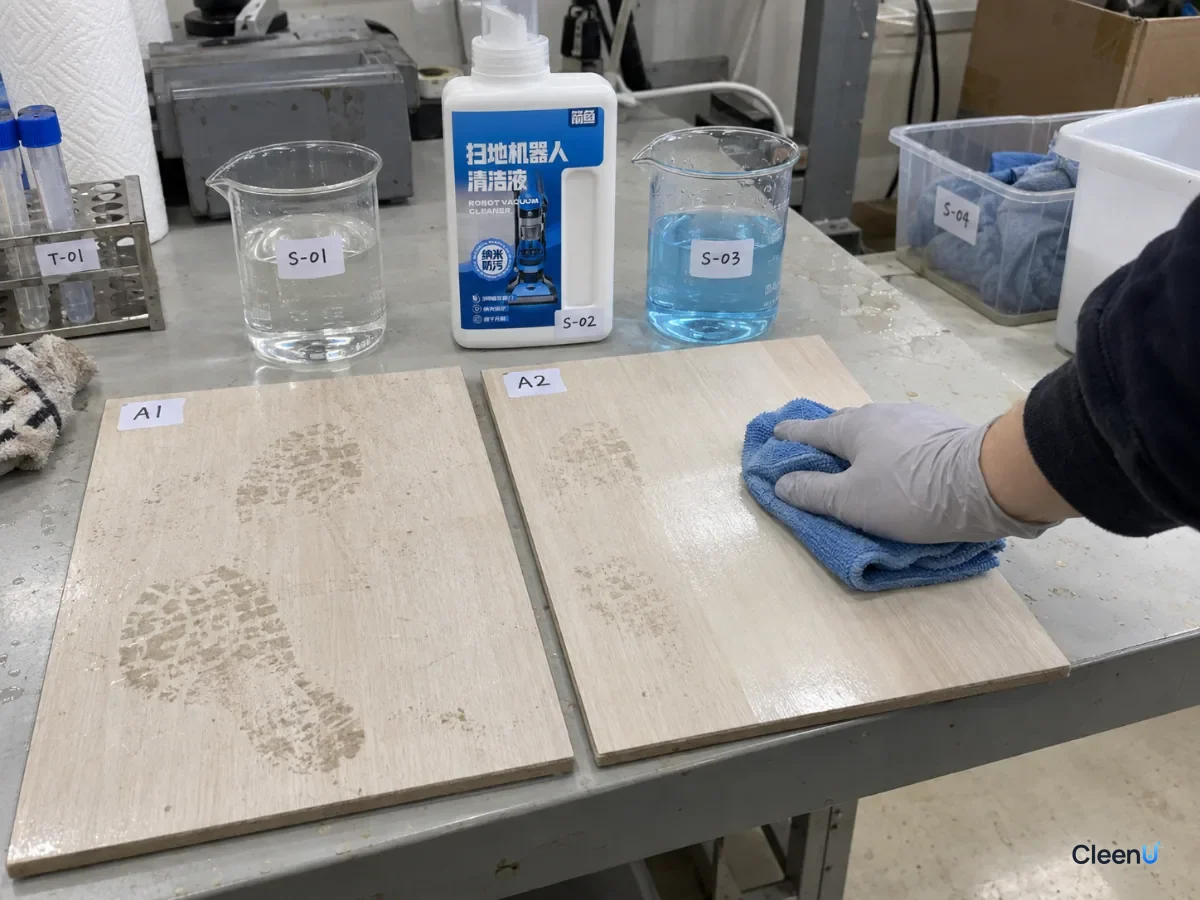
If you mop with water most days and just need a little help with kitchen grease, entry footprints and paw prints, measure it out by the cap with a low-foam Robot Vacuum Cleaning Solution.
Plain water works for robot mopping: dust, water spots and light messes come right up. Greasy footprints, kitchen grease, paw prints and drool are oily or protein-based, so water only fades them. A small dose of low-foam robot mop cleaning solution wets and emulsifies that soil so one or two passes get it clean. Dose is what matters. Use the label ratio, go light, and look for a floor that isn't tacky or slippery. Water most days and solution where it counts is the easiest routine for most homes.