
OEM/ODM
Private-Label Robot Mop Cleaning Solution: Concentrate, Ready-to-Use, or Auto-Dose First?
Direct answer
In markets with lots of auto-dosing docks and repeat buyers, start with a concentrate and validate it in the leading models' dosing compartments; for channels full of first-time users who want to open and pour, consider ready-to-use. Choose by channel and target machines, because the three formats differ in formula strength, packaging and testing.
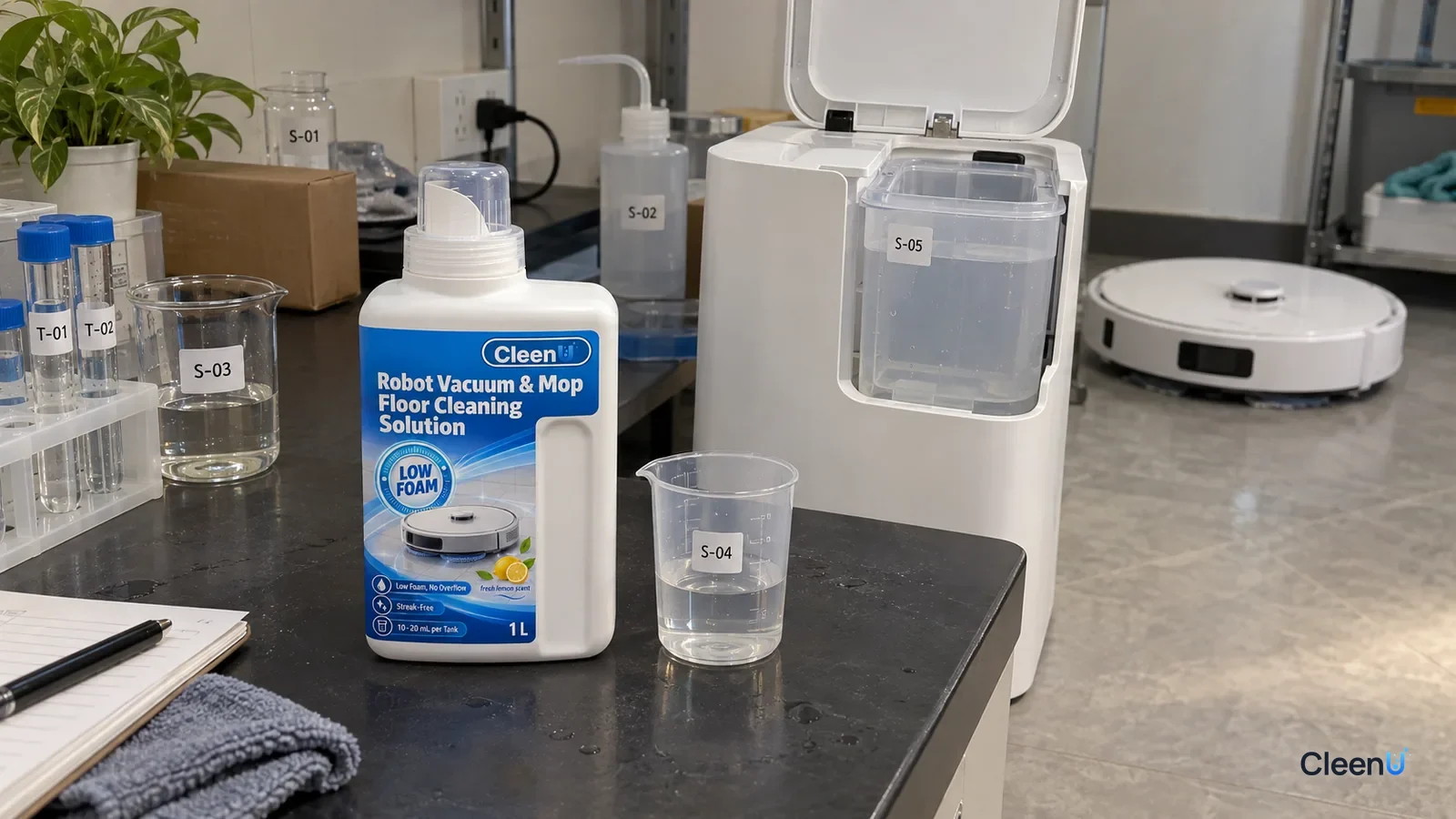
When brands decide to launch a robot mop cleaning solution, the first question often isn't the formula but the format. A concentrate stretches one bottle across many fills at a low cost per run. A ready-to-use version just pours in with no measuring. And an auto-dose version goes straight into the dock's detergent compartment and lets the machine do the mixing.
They look like different ways to use the same thing, but they differ in formula, packaging, testing and channel fit. Pick the wrong first format and a familiar story follows: the sample works fine in the robot you own, then after launch the reviews pile up about foam, clogged dosing compartments or bottles running out too fast.
How do the three formats differ?
Concentrate. Users measure a small amount with a cap or cup into the clean water tank. CleenU Robot Vacuum Cleaning Solution, for example, comes as a 1-liter concentrate with a measuring cap and dilutes at about 1:50 to 1:100; at 10 to 20 mL per fill, one bottle lasts roughly 50 to 100 runs. The upside is low cost per run, small shipping volume and strong repeat purchase. The challenge is that users have to measure, and overdosing causes residue and foam, so the measuring cap and label directions matter a lot.
Ready-to-use. It's already diluted to working strength, and users pour it into the clean tank or add it per the manual. The upside is the lowest barrier, with no way to get the ratio wrong. The challenge is that the same number of runs means far more liquid to ship and store, so cost per run is higher, and a diluted product puts more pressure on the preservative system.
Auto-dose. It's for docks with an auto-dosing compartment: users pour concentrate into the compartment and the dock meters it out. It's still a concentrate at heart, but it faces stricter demands on flow, viscosity across temperatures, stability over weeks in the compartment and resistance to crystallizing or clinging. And every brand's compartment and metering work differently, so compatibility has to be validated model by model.
How to decide which to launch first
Start with your customers' machines. If mid- and high-end models with auto-dosing docks make up a big share of your target market and buyers want to pour it in and forget it, your concentrate must work reliably in the leading compartments, or you'll shut out your largest group of users.
Then look at channel and habits. Repeat buyers on Amazon, Shopify or TikTok Shop are sensitive to cost per run, so "one bottle lasts a long time" sells the concentrate. Retail, gifting and bundling with new robots put more weight on ready-to-use convenience.
Then consider logistics and cost. Cross-border shipping is billed by size and weight, so a concentrate has a clear advantage. Ready-to-use is bulky and costly to ship and fits local warehouses or retail.
Finally, think about your product line. A common path is to launch one concentrate that covers manual dosing plus the main dosing compartments, build reviews and repeat purchases, then add a ready-to-use or trial size based on customer feedback to lower the barrier for new users.
Run the numbers: per mopping run and per shipment
The format choice ultimately shows up in two sets of numbers: what the shopper pays per run and what you pay per shipment.
The shopper's math. A concentrate at about 1:50 to 1:100, usually 10 to 20 mL per fill, gets roughly 50 to 100 runs from a liter. A ready-to-use product needs dozens of times that volume for the same number of runs. Even if the ready-to-use bottle is cheaper, its cost per run is usually much higher. Stating "about X runs per bottle" clearly on the listing and pack is one of the strongest selling points a concentrate has.
The brand's math. Liquids are shipped and stored by volume and weight, from ocean or air freight to 3PL or FBA storage fees to last-mile delivery. A concentrate that covers dozens of runs is one bottle; the ready-to-use equivalent may be a whole case. Liquids also need leak-proof packaging, and more volume and more bottles mean more breakage and leak risk.
The packaging math. A concentrate needs a clearly marked, spill-resistant measuring cap. Ready-to-use needs a spout that pours easily into the clean tank and a size that matches common tanks. Auto-dose needs a spout that lines up with the compartment's fill opening without splashing the rim. All of these drive packaging choices and cost.
Once those three are worked out, many brands land naturally on launching a concentrate first and adding ready-to-use or trial sizes by channel.
What can be customized or evaluated
MOQ and lead time
MOQ starts at 500 bottles. Free samples ship in 3–5 days. After packaging and labels are approved, bulk orders are scheduled when the order is confirmed. For formats that need evaluation and sampling, such as ready-to-use or auto-dose, timing follows the plan both sides confirm. Final pricing, MOQ and lead time follow the formal quote and order confirmation.
Base specifications of the current concentrate
- Type
- Neutral, low-foam concentrated robot mop cleaning solution
- pH
- 6.5 to 7.5 (25°C)
- Formula
- Low-foam nonionic surfactants with defoamer; no particles, no wax, no chlorine
- Dilution
- About 1:50 to 1:100; 10 to 20 mL per fill is usually enough
- Floors
- Tile, vinyl plank, laminate, sealed hardwood
- Default pack
- 1 L concentrate with measuring cap
- Shelf life
- 24 months unopened
What each format needs to be tested for
Concentrate: foam, residue and cleaning at the label dilution; whether the cap markings match the label ratio; and whether foam and residue stay acceptable when users add "a bit extra," as many will.
Ready-to-use: preservation and stability at working strength, since the preservative is diluted too, and whether the packaging pours easily into the clean tank without spills.
Auto-dose: long-term behavior in the target models' compartments, including flow at room temperature and in the cold, whether it separates, crystallizes or clings after weeks in the compartment, whether the dock's level sensing misreads, and whether dosing stays accurate. This has to be validated in real machines, not just the lab.
All three share the same floor: low foam and low residue in the robot and dock, and no clogged lines. For why samples keep bouncing on foam and residue, see why private-label robot mop solution samples keep failing on foam and residue.
How to state compatibility on the label
List the brands you've tested or confirmed, qualified with "most models" and "follow your manual." CleenU Robot Vacuum Cleaning Solution, for example, works in most robot mops from Roborock, iRobot (Roomba Combo and Braava), Ecovacs Deebot, Dreame and Narwal, and in floor washers such as Tineco, added to the clean water tank or the dock's designated compartment as the manual directs. CleenU isn't affiliated with these brands; the names only indicate compatibility. Whether it can go in a specific auto-dosing compartment depends on that model's manual, so don't claim it fits every auto-dosing dock.
What to include in your inquiry
Your target market and channel; the robot mop and floor washer brands and models you most want to support, and which have auto-dosing; the format, size and dilution ratio you want; scent preference; label language; and an estimated first-order quantity. The more specific you are, the closer the first sample lands to final.
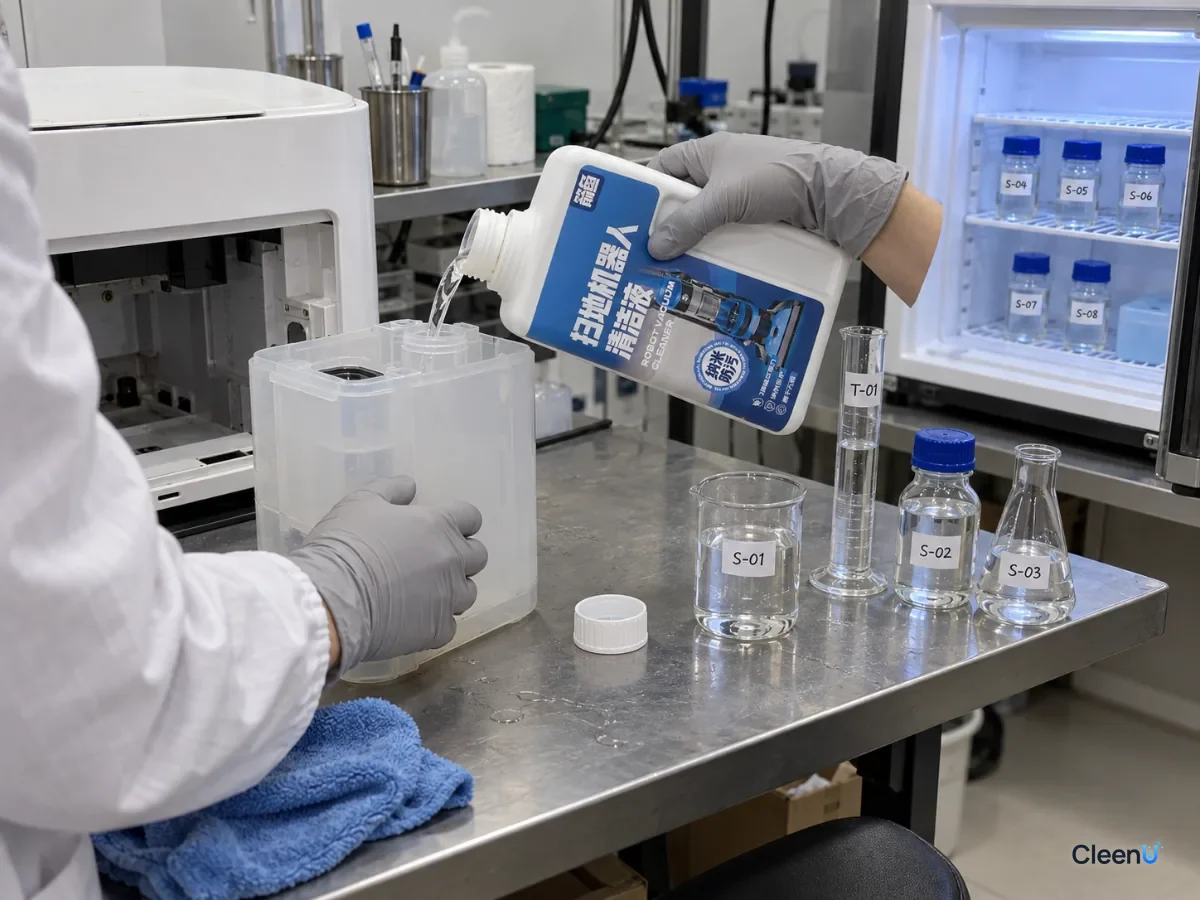
How channels shape format and size
Cross-border marketplaces: mostly concentrate, commonly around 1 liter, sold on "about X runs per bottle," with an optional trial size to win first purchases.
Domestic e-commerce: shoppers care about cost per run and convenience. A concentrate with a clear measuring cap, or a concentrate-plus-small-bottle bundle, works well.
Retail and gifting: packaging feel and open-and-pour convenience matter more, so ready-to-use or small concentrates are easier sells.
Robot brand bundles: size should match your models' dosing compartments, the spout should line up with the fill opening, and directions must match your manual.
Pick your main channel first, then decide the launch format and size. That's safer than rolling out many SKUs at once.
This article is part of the Robot Vacuum Cleaning Solution & Maintenance Guide, which covers the full maintenance schedule and links to every troubleshooting guide.
What brands ask about choosing a private-label robot mop solution format
Should our first product be concentrate or ready-to-use?
For online repeat buyers and cross-border channels, start with a concentrate. For retail, gifting or bundling with new robots, evaluate ready-to-use. Many brands launch a concentrate first to build reviews, then add a ready-to-use or trial size.
Can we sell the concentrate as an auto-dose product?
Not without validation. Test flow, level sensing and long-term stability in your target models' compartments, and only then state which models' auto-dosing it works with.
Is ready-to-use just the concentrate with water added?
No. Preservation and stability requirements change at working strength, so it has to be designed and validated for that state.
What are the MOQ and lead time?
MOQ starts at 500 bottles, free samples take 3–5 days, and bulk is scheduled after packaging and labels are approved. New formats that need evaluation follow the confirmed plan.
Should the pet version be a separate SKU?
If many of your buyers have pets, yes. The pet-home version adds cyclodextrin odor control to the neutral, low-foam base with no added fragrance.
Can our label claim a universal fit?
We don't recommend it. List confirmed brands with "most models, follow your manual," and state the exclusions.
What dilution ratio should our private-label robot solution use?
Start from how much users will add per fill for your target machines, then set the ratio and active content to match. CleenU's concentrate runs about 1:50 to 1:100, with 10 to 20 mL per fill, so a measuring cap gets it right. A thinner ratio needs more active content and a fresh round of foam and residue testing.
Should our first product be fragrance-free?
If you are positioning for pet homes or scent-sensitive users, launch fragrance-free. For general households, a lemon or light lemon scent works. Scent is customizable, but each change calls for repeat foam, residue and stability checks, so keep the first launch to one or two scents.
To build your own brand of robot mop solution on a proven neutral, low-foam concentrate, start with the CleenU Robot Vacuum Cleaning Solution.
Which private-label robot mop cleaning solution format to launch first depends on your channel and target machines. For online repeat buyers, cross-border sales and markets heavy on auto-dosing docks, start with a concentrate and validate it in the leading dosing compartments. For retail, gifting and bundles that value open-and-pour, evaluate ready-to-use. The three formats differ in strength, preservation, packaging and testing, so one can't simply stand in for another. CleenU can start from a proven neutral, low-foam concentrate with free samples in 3–5 days and bulk scheduled when the order is confirmed. Send us your market, channel, machines, format and estimated quantity to begin.