
Comparison
Concentrated vs Ready-to-Use Robot Mop Cleaning Solution: Which Costs Less per Run?
Direct answer
Per run, concentrated robot mop solution usually costs less: each fill takes only a dozen or so milliliters, so one bottle lasts dozens to about a hundred runs, and it suits auto-dosing. Ready-to-use needs no measuring and suits homes that mop occasionally. Compare cost per run, not bottle price.
How to choose
-
You mop daily or every other day and go through a lot of solution
Choose Concentrate
Lower cost per run, a bottle lasts longer, and you restock less often.
-
Your dock has auto-dosing and the manual allows concentrate
Choose Concentrate
Most auto-dosing systems are built to dispense small amounts of concentrate.
-
You mop once or twice a week, or don't want to measure
Choose Ready-to-use
Pour and go, with no ratio to figure and less chance of getting it wrong.
-
You're short on storage space
Choose A small bottle of concentrate
For the same number of runs, concentrate takes up far less room.
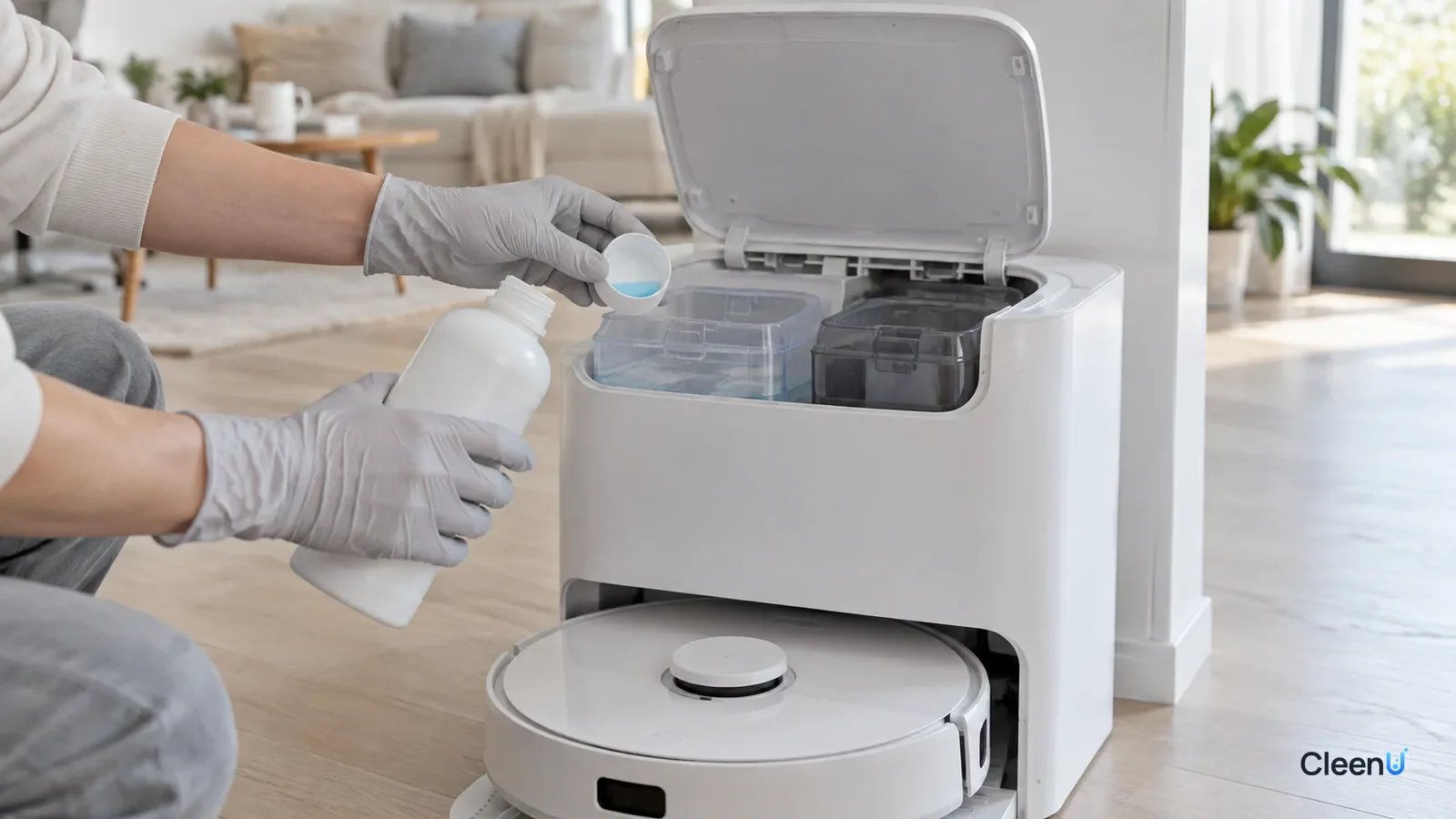
Shop for robot mop cleaning solution online and you'll see two kinds. One says "concentrate," "1:50" or "1:100" and needs to be diluted. The other says "ready to use" and goes straight into the tank at the amount on the label. Prices are all over the place: some big bottles of ready-to-use look cheap, while some small bottles of concentrate seem expensive.
So which is the better deal? The trick is not to compare what a bottle costs, but what a run costs.
What's the difference between concentrate and ready-to-use?
Concentrate: the cleaning ingredients are at a high strength, and you dilute them with water when you use them. At 1:50 to 1:100, each fill takes only a dozen or so milliliters, and the rest is tap water.
Ready-to-use: it's already diluted at the factory, so there's no ratio to work out; you add the amount on the label. It's simple and hard to overdose, but each fill takes more product, so a bottle covers fewer runs.
The ingredients doing the cleaning are the same kind in both, mainly low-foam surfactants. The real difference is whether the water gets added in your home or at the factory before the bottle is shipped to you.
How to work out cost per run
The math is simple: cost per run = bottle price ÷ number of runs per bottle.
For the number of runs, use the amount per fill on the label: bottle size ÷ amount per fill = runs per bottle.
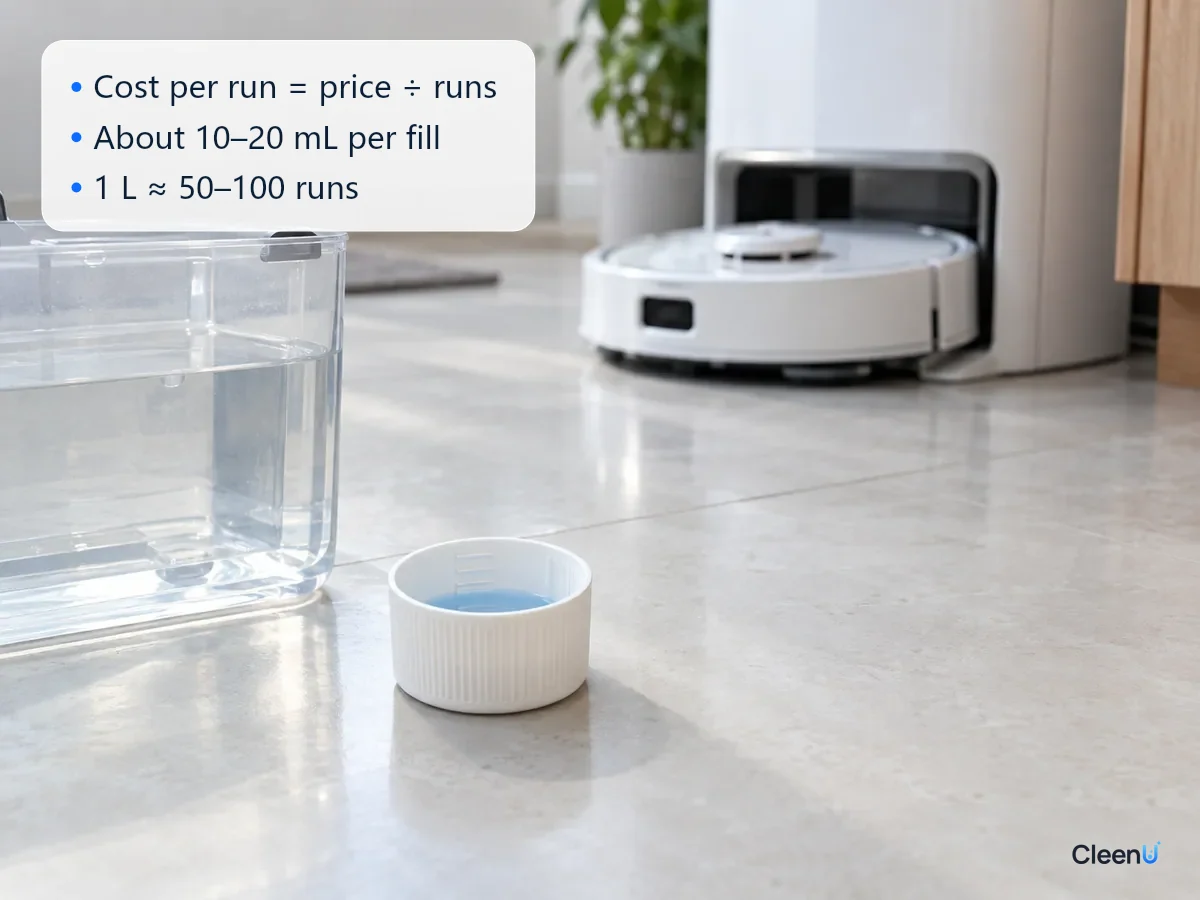
CleenU Robot Vacuum Cleaning Solution, for example, is a concentrate diluted at about 1:50 to 1:100, usually 10 to 20 mL per fill, so a 1 L bottle covers roughly 50 to 100 runs. Divide what you paid by 50 to 100 and you have its cost per run.
If you have a Roborock, iRobot, Ecovacs, Dreame or Narwal robot mop, or a Tineco-style floor washer, CleenU robot mop cleaning solution works in most models; add it to the clean tank or dosing compartment as the manual directs. (CleenU isn't affiliated with these brands.)
Do the same for a ready-to-use product using the amount per fill on its label. Only when both are converted to cost per run is the comparison fair. What often turns up is that a ready-to-use bottle looks cheap but takes more per fill and covers fewer runs, so it costs more per run.
There are hidden costs too. Concentrate is compact, so it's easier to ship and store and uses less packaging for the same number of runs. Big ready-to-use bottles take up more space and need restocking more often.
Concentrated vs ready-to-use robot mop solution, point by point
| Point | Concentrate | Ready-to-use |
|---|---|---|
| How you use it | Dilute to the ratio and measure each time | Add the labeled amount directly |
| Amount per fill | A dozen or so milliliters | Usually more; check the label |
| Runs per bottle | Many | Fewer |
| Cost per run | Usually lower | Usually higher |
| Auto-dosing | Usually a good fit (check the manual) | Not suitable for some models |
| Risk of mistakes | Easy to overdose by eye | No ratio to figure; hard to get wrong |
| Storage and packaging | Compact, less packaging | Bulky; restock more often |
What actually does the work: the concentration in the working solution
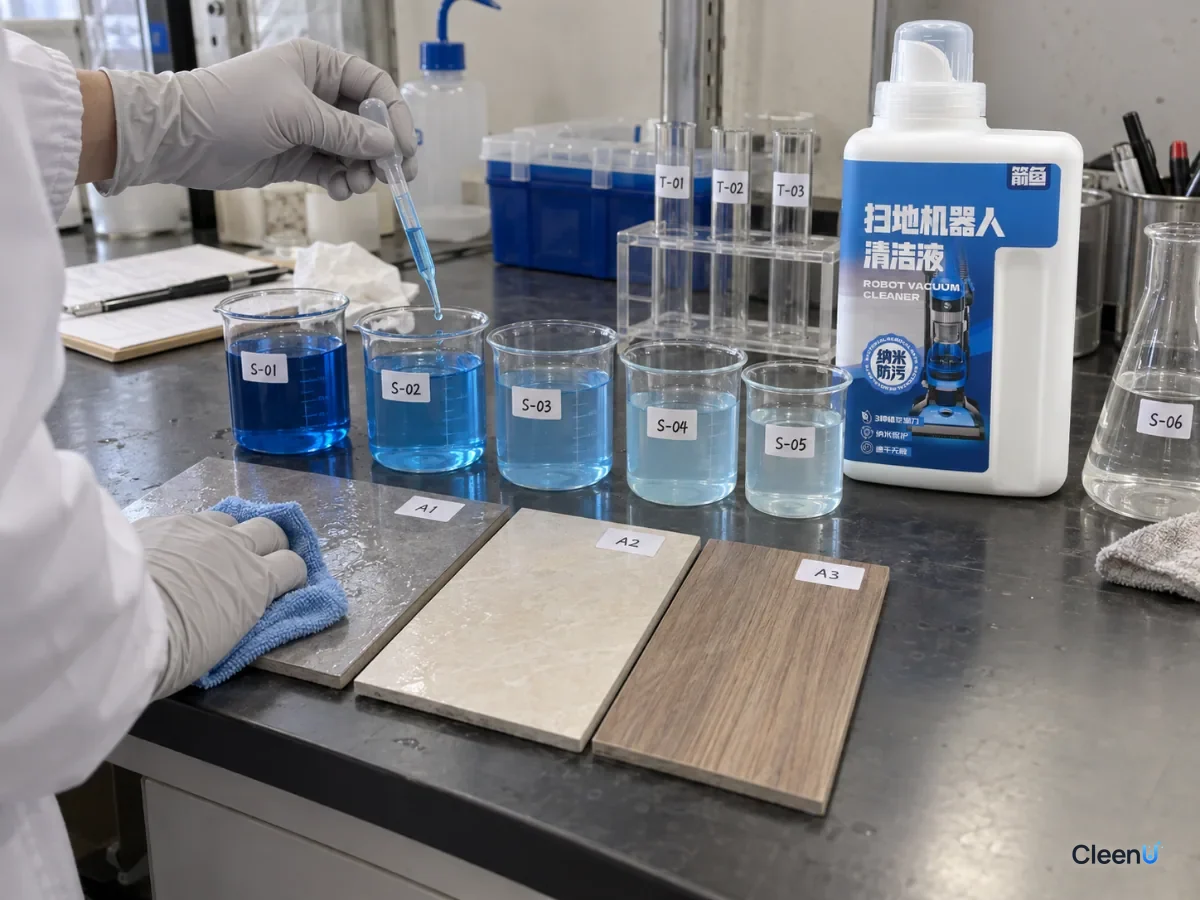
The point people miss most when comparing concentrate and ready-to-use is that the liquid cleaning your floor isn't what's in the bottle. It's the working solution, the diluted mix in the tank.
For surfactants to cut grease, the working solution has to reach a certain concentration. The key concept is the critical micelle concentration (CMC). Above it, surfactant molecules gather into micelles that pull oil inside them, and grease-cutting power fully kicks in. Well below it, the solution still wets surfaces but emulsifies oil poorly. Well above it, cleaning power doesn't keep climbing much; the extra just becomes foam and residue.
When a formula is designed, the manufacturer works out concentrate strength times the recommended dilution so the working solution lands in the right range. Used as labeled, concentrate and ready-to-use should give working solutions of similar strength. The only difference is whether the dilution happens at the factory or in your tank. So to compare cleaning power, compare the working solutions mixed to the label, not how strong the concentrate looks.
That also explains why pouring concentrate by eye causes so much trouble. The concentrate is strong, so even a little extra pushes the working solution far outside its designed range.
Accurate measuring is what makes concentrate work
To get the benefits of concentrate, you have to measure it. A few details make a difference.
The measuring tool: cap markings or a measuring cup are far more accurate than a free pour. CleenU Robot Vacuum Cleaning Solution comes in a 1 L concentrate bottle with a graduated measuring cap for exactly that reason.
Viscosity: the thicker the concentrate, the more clings to the cup and the less makes it into the tank. When it thickens in winter, swish the cup with a little water from the tank after pouring.
Water volume: the ratio is relative to the water. If the tank isn't full, reduce the dose to match the water actually in it.
Auto-dosing: the machine dispensing at a set level is the most consistent way to measure, as long as your manual allows that solution.
Why ready-to-use needs more protection
A ready-to-use product ships with a lot of water already in every bottle. More water means an easier environment for microbes, so ready-to-use products usually need a more robust preservative system to stay stable after opening through their shelf life. If an opened bottle sits for a long time or the opening gets contaminated, the risk of cloudiness or odor is also higher.
Concentrate contains less water and more active ingredients, which is less hospitable to microbes, so it tends to store more stably. Once diluted, though, it has to be used the same day too; on that point the two are the same.
Ready-to-use also means bottling, shipping and shelving a lot of water. For the same number of runs, it takes more shipping weight, more packaging and more storage space. Those costs end up in the price, which is one reason concentrate usually wins on cost per run.
How to tell how concentrated a "concentrate" really is
Two bottles can both say "concentrate" and differ a lot in strength. Check the dilution ratio and the amount per fill on the label.
Dilution ratio: a ratio like 1:50 or 1:100 means one part concentrate to dozens or a hundred parts water. A product that says 1:5 or 1:10 is far less concentrated and takes much more per fill.
Amount per fill: "about 10 to 20 mL per fill" and "about 100 mL per fill" mean a several-fold difference in how many runs a bottle covers.
Clear numbers: a label that just says "use as needed" or "a small amount" with no ratio makes it impossible to work out cost per run and easy to get the dose wrong.
Convert the ratio and amount per fill into runs per bottle, and you'll see whether a concentrate is actually a good deal.
Storing concentrate vs ready-to-use
Concentrate is compact and one bottle lasts a long time, so store it well once it's open. Keep the cap tight and keep it somewhere cool, out of direct light and out of reach of children and pets. Use it within the shelf life on the bottle, and stop if the color or smell changes noticeably. Don't decant concentrate into unlabeled bottles where someone might mistake it for something else.
Ready-to-use also needs a tight cap and should be used within its shelf life. Because it's diluted and bulky, a big bottle can last a long time in a home that doesn't mop often, so keep an eye on the date.
Either way, use the mixture in the clean tank the same day. Water left in the tank for days can grow microbes and give the tank a musty smell.
How to use concentrate without wasting it
The most common problem with concentrate is pouring by eye. A casual pour can be a few tens of milliliters, several times the ratio. That raises your cost per run, and the extra solution foams and leaves residue, so floors turn sticky and streaky and actually look worse.
Three rules for concentrate:
Measure with the cap or a small cup at the label ratio. Don't pour by eye.
Scale to your tank. A small onboard tank takes less; a large dock tank takes more at the same ratio. For example, a clean tank holding 4 L of water at about 1:50 to 1:100 takes roughly 40 to 80 mL. For details, see how much cleaning solution to put in a robot mop.
When the floor is especially dirty, run a second pass instead of doubling the dose.
If your dock has auto-dosing, put the concentrate in the dosing compartment and set the level as the manual describes. The robot then doses it for you, which is the easiest and least error-prone option, as long as the manual allows that solution. If you're not sure, add it to the clean tank and measure by hand.
Who ready-to-use is right for
Ready-to-use isn't a bad choice just because it usually costs more per run. It fits certain situations:
You mop once or twice a week, a bottle lasts a long time, and the cost-per-run difference barely matters.
Older family members or kids help top up the robot, and you'd rather they not work out ratios.
You're new to robot mops and want to get started simply before learning the right dose.
When you choose ready-to-use, still check that it's labeled for robot mops and low-foam, and add only the labeled amount. Don't pour extra just because it's "already diluted."
What matters whichever you choose
Low foam: foam triggers false "dirty tank full" alerts, overflows and film on floors.
Wax-free and low-residue: floors won't get more slippery or sticky with every run.
Labeled for robot mops and allowed by your manual, especially for auto-dosing.
No mixing: before switching products, pour out the old solution and rinse the tank or dosing compartment.
For why dish soap and regular floor cleaners don't belong in the robot, see can you use floor cleaner in a robot mop. For where the solution goes, see where to put cleaning solution in a robot vacuum.
This article is part of the Robot Vacuum Cleaning Solution & Maintenance Guide, which covers the full maintenance schedule and links to every troubleshooting guide.
Concentrate vs ready-to-use: questions people ask
Is concentrate always cheaper than ready-to-use?
Per run it usually is, as long as you measure to the label. Pouring by eye pushes both the cost per run and the residue up.
Can I add concentrate without diluting it?
No. Undiluted concentrate foams and leaves residue that makes floors sticky. Dilute it at the label ratio.
Can I put ready-to-use solution in the auto-dosing compartment?
Check the manual. Some models set their dosing ratio for concentrate, so ready-to-use would end up underdosed.
How long does concentrate last once opened?
Follow the shelf life and storage directions on the bottle. Keep it tightly capped in a cool place, and stop using it if the color or smell changes noticeably.
How do I compare the price of two solutions?
Divide each bottle price by its number of runs to get cost per run, then compare. Runs per bottle = bottle size ÷ amount per fill.
What happens if I add too much concentrate?
Foam, residue, possible false "dirty tank full" alerts, and sticky, streaky floors. Measure with the cap and mop twice when the floor is very dirty.
One solution says 1:200 and another says 1:50 to 1:100. Which is cheaper?
Ratios alone will not tell you; compare cost per run. A ratio only says how much water that particular concentrate needs, and concentrates differ in strength, so 1:200 is not automatically cheaper or stronger. Multiply the mL you add each time by the price per mL, then check that floors come out clean and not sticky. CleenU's solution uses about 1:50 to 1:100, usually 10 to 20 mL per fill.
How many runs do I get from a 1 L bottle of concentrate?
How long it lasts depends on your tank size and how much you add. CleenU Robot Vacuum & Mop Floor Cleaning Solution is a 1 L concentrate with a measuring cap and dilutes at about 1:50 to 1:100, which is roughly 10 to 20 mL for a 1 L tank, so you can estimate from that. Mop dust-only rooms with plain water to stretch it further, and measure with the cap rather than pouring by eye.
For a concentrate with a low cost per run that you measure with the cap, with a 1 L bottle covering roughly 50 to 100 runs, try Robot Vacuum Cleaning Solution.
Whether concentrated or ready-to-use robot mop solution is the better deal comes down to cost per run, not bottle price. Concentrate takes a dozen or so milliliters per fill, lasts dozens to about a hundred runs and usually costs less per run; it also suits auto-dosing, but you need to measure it with the cap or a cup. Ready-to-use pours straight in with no math and suits occasional mopping or anyone who'd rather not measure. Either way, choose low-foam, wax-free and labeled for robot mops, and don't mix products.