
How-to
Using a Robot Mop on a Greasy Kitchen Floor
Direct answer
For light greasy footprints, add a small dose of low-foam solution that emulsifies oil and set the kitchen for an extra pass. Wipe up stove-front splatter, spilled sauces and thick grease by hand first, then let the robot handle daily upkeep. Don't just add more solution.
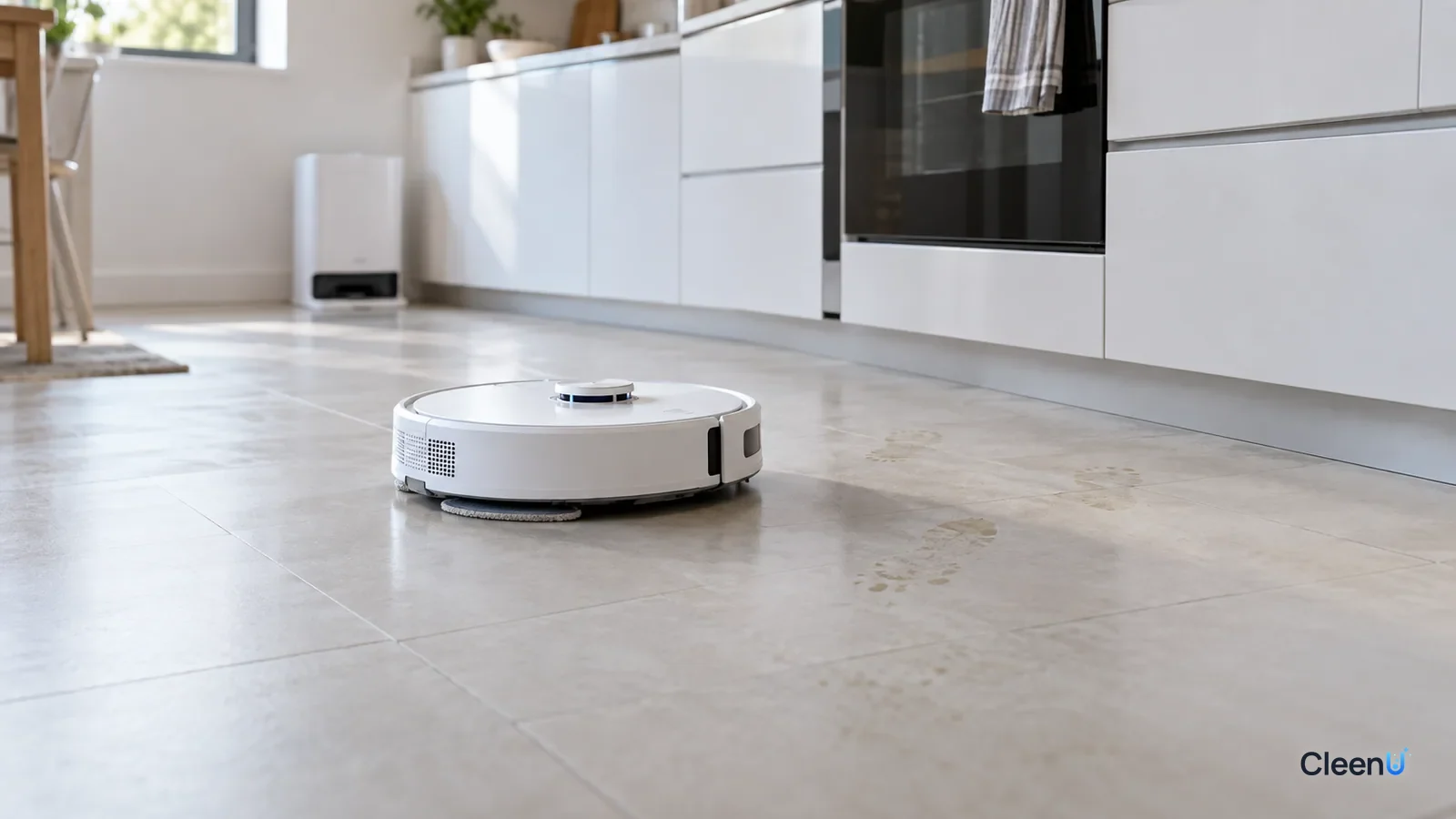
The kitchen is the hardest floor in the house to mop. In the living room and bedrooms, a water-only pass leaves everything clean. In the kitchen, you look in side light afterward and there are still greasy footprints in front of the stove, fridge and sink. Sometimes it even looks worse, dull and slick across the whole floor.
The reason is simple: most of the soil on a kitchen floor is grease.
Where does kitchen floor grease come from?
Cooking fumes. High heat turns some cooking oil into a fine mist. Some goes out through the range hood; the rest drifts around the kitchen and settles on the counters, walls and floor. Those droplets are tiny, so they lay down an even, nearly invisible film.
Splatter and drips. Oil from frying, sauce dripping off a plate, greasy water flung from the sink all land in front of the stove, under the sink and around the table.
Feet carry it out. Walking around the kitchen coats shoes, socks and bare feet with that film, and every step into the dining room and living room leaves a greasy print. That's why the kitchen doorway and the path to the dining table collect the most footprints.
The grease is a mix of plant and animal fats (triglycerides) plus thicker material formed when those fats oxidize and polymerize at cooking temperatures. Fresh film wipes off fairly easily. After a few days of being walked on, it mixes with dust, oxidizes, turns tacky and gets harder to remove.
Why can't a robot mop get grease up with water alone?
Oil and water don't mix. Water is polar and oil is nonpolar, so plain water beads up on a greasy film and barely touches it. The pad picks up a little from the top and smears the rest into a more even film. That's why the floor can look streakier after mopping.
A robot has limited scrubbing power. By hand you can press hard and go back and forth. A robot pad presses with a fixed, light force and passes each spot once or twice. Against grease, it needs chemistry to help.
The pads get greasier. The pad absorbs oil, the dock can't wash it out with water, and it builds up in the fibers until the pad smears it back onto the floor.
So the kitchen is where a robot mop needs cleaning solution most.
Why do greasy footprints get harder to mop after a few days?
Cooking oil is mostly triglycerides, and the unsaturated fatty acids in them have carbon-carbon double bonds. Oxygen, light and warmth slowly oxidize those bonds into peroxides, which then break apart and cross-link, joining small molecules into large ones. Fresh grease is fluid and slippery; a few days later it's tacky and stiff, and it has shifted from clear toward yellow and dull.
That's oxidative polymerization, the same process behind the yellow-brown gunk on a range hood filter or the edge of the stove, just slower on a thinner floor film. Foot traffic also presses dust and grit into it, building a layer of greasy grime.
For a robot mop that means two things. Fresh footprints are the easiest to remove, so mopping the kitchen daily or every other day keeps the film from oxidizing into something sticky. And old, tacky, darkened grime is hard for a robot's light pressure to lift in one go; wipe it once by hand with a diluted cleaner, then let the robot keep it up.
How does solution lift grease off the floor?
The surfactants in a cleaning solution have a water-loving end and an oil-loving end. First they lower water's surface tension so it spreads across the greasy film instead of beading up. That's wetting. Then the oil-loving ends work into the film while the water-loving ends face out, breaking the grease into tiny droplets suspended in the water. That's emulsification. The pad carries those droplets off, the dock washes them into the dirty tank, and no film stays behind.
A neutral robot mop solution relies on wetting and emulsification to handle everyday greasy footprints and thin films. Burnt, polymerized grease on the stovetop is a different job for a stronger alkaline kitchen degreaser and hand scrubbing, not the robot.
How to robot mop a kitchen floor
Six steps from hand prep to daily upkeep
Handle heavy grease and spills by hand first
Blot oil spots, spilled sauce and dropped food with paper towels, then wipe with a damp cloth. For dried grease spots, wipe by hand with a diluted kitchen degreaser, then wipe again with plain water.
Caution:Don't let the robot mop through puddles or food scraps. It will spread grease through the house and foul the pads and dock.
Add a small dose of low-foam solution to the clean tank
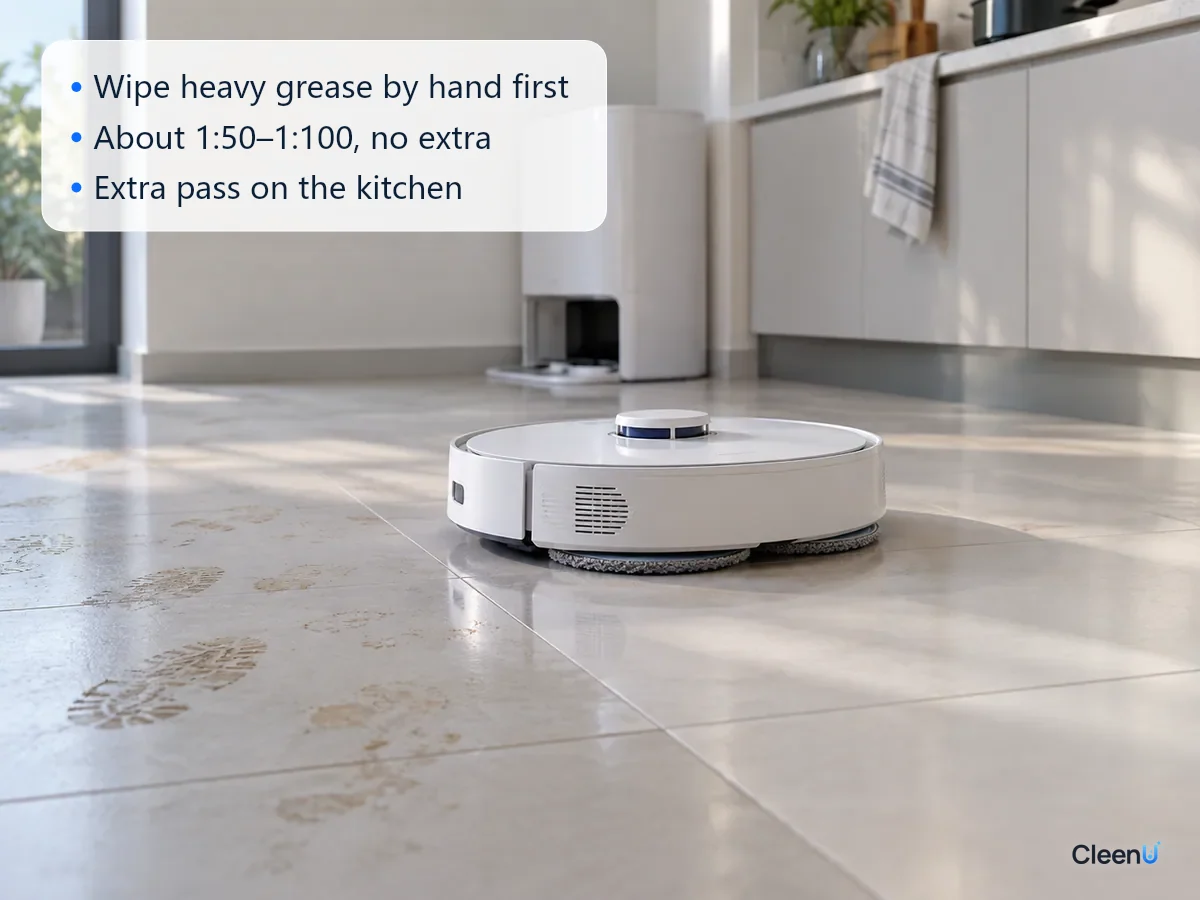
Water first, then solution. CleenU Robot Vacuum Cleaning Solution dilutes at about 1:50 to 1:100; 10 to 20 mL per fill is usually enough, or about 10 to 20 mL for a 1-liter tank. Even in a greasy kitchen, don't increase the dose; doubling it mostly means more residue and foam.
Make the kitchen a priority zone
In the app, set the kitchen, especially in front of the stove, fridge and sink, as a priority zone or schedule two passes there. An extra pass works far better than more water or more solution.
Use medium water flow
On tile, medium flow gives the solution enough water to carry the grease away. On hardwood or vinyl plank, use medium-low as the floor requires.
Mop the kitchen last, or on its own
If your robot allows it, mop the kitchen last or run it separately so the pads don't carry kitchen grease into the bedrooms and living room.
Keep the pads clean
Kitchen mopping loads the pads with grease faster. Take them off weekly and hand wash in warm water with a little laundry detergent, rinse and dry. Replace pads that stay stiff, dark or smell rancid.
Why not just add more solution for a greasy kitchen?
It feels logical: more grease, more cleaner. For a robot mop, it usually backfires.
More residue. A robot never rinses, so the non-volatile ingredients stay on the floor. Double the dose and you double the residue, leaving a tacky, slippery floor that grabs dust and shows footprints even faster. Kitchen floors are already prone to slipping, and residue makes that worse.
More foam. At higher concentration the solution foams more when the dock washes the pads, which can trigger false "tank full" alerts or overflow.
Emulsifying power levels off. Above a certain concentration, surfactants don't cut much more grease; the extra mostly becomes residue.
Normal dosing plus an extra pass, with heavy grease cleaned by hand first, works better. If floors are getting tacky or slippery, see sticky floor after robot mopping.
What to watch for on different kitchen floors
Tile: the most common and easiest. The surface doesn't absorb grease, but cement grout is porous, so grease soaks in and the grout darkens or yellows over time. Brush it every week or two with diluted solution and a soft brush, then let the robot mop it dry.
Hardwood and laminate: kitchens with wood floors need extra care with water. Keep flow low and wipe up spills by hand promptly so grease and water never sit in the seams.
Vinyl plank: its smooth surface shows greasy film clearly in side light. Keep the dose on the low side so residue and grease don't stack into a slick layer.
Natural stone: sensitive to both acids and strong alkalis. Use only a neutral solution, and never put kitchen degreaser straight on a stone floor.
The dining area and kitchen doorway count too
Greasy footprints don't stay in the kitchen. People carry grease out to the dining and living rooms. Set the area around the dining table and the path from the kitchen doorway as priority zones as well.
In pet homes, animals walk around the kitchen and eat and drink by their bowls, so paw prints and drool marks carry oils and proteins too. For more, see robot mopping in homes with cats and dogs.
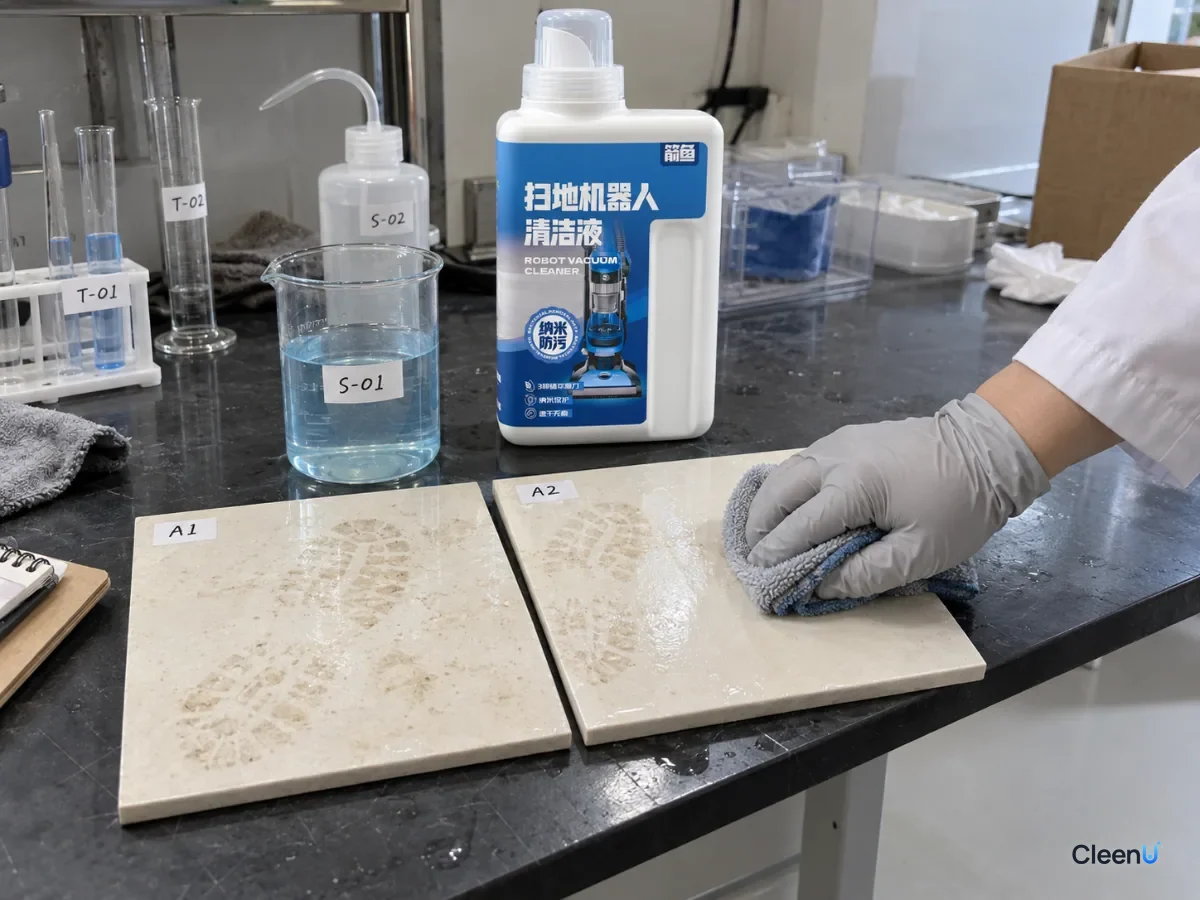
CleenU Robot Vacuum Cleaning Solution is a neutral, low-foam concentrate at pH 6.5 to 7.5 with low-foam nonionic surfactants and a defoamer, no wax, no chlorine and no particles, made for tile, vinyl plank, laminate and sealed hardwood. It targets exactly what robot mops meet every day: footprints, greasy marks and dust. It works in most robot mops from Roborock, iRobot (Roomba Combo and Braava), Ecovacs Deebot, Dreame and Narwal, and in floor washers such as Tineco. Add it to the clean water tank or the dock's designated detergent compartment as your manual directs. CleenU isn't affiliated with these brands; the names only indicate compatibility.
This article is part of the Robot Vacuum Cleaning Solution & Maintenance Guide, which covers the full maintenance schedule and links to every troubleshooting guide.
Don't let the robot mop through these
Large grease puddles, spilled soup or sauce, food scraps, or broken glass or ceramic; or a strong alkaline degreaser that hasn't been wiped off yet. Clean up and dry the area by hand first. Leftover strong alkaline cleaner mixed with robot mop solution can leave floors slippery and damage floor finishes.
Common questions about robot mopping greasy kitchen floors
Can a robot mop actually clean kitchen grease?
Yes, for everyday greasy footprints and thin film, with a small dose of low-foam solution and an extra pass in the kitchen. Thick grease, spots and spills need hand cleanup first.
Can I put kitchen degreaser in the robot for greasy floors?
No. Kitchen degreasers are often strongly alkaline and some foam heavily, so they don't belong in the machine. Use only a low-foam robot mop solution.
Can I add dish soap to the tank to cut grease?
No. Dish soap is high-foam. It fills the dirty tank with foam, trips the level sensor and leaves a tacky residue on floors.
Why does my kitchen floor look streakier after mopping?
Usually water alone smeared the greasy film around, or the pads are loaded with grease. Add a small dose of robot solution and hand wash the pads in warm water with laundry detergent.
Should the kitchen be mopped every day?
In homes that cook often, mopping the kitchen and dining area daily works well; other rooms can go every other day. Adjust to your household.
Would hot water clean the kitchen better?
Heat does help with grease, but most manuals call for room-temperature water, and hot water can damage the tank and seals. If your model washes pads with hot water, follow the manual.
Why does my kitchen floor still feel sticky after the robot mops?
Usually the grease wasn't lifted, or too much solution was added. Wipe heavy spots by the stove by hand, then run two passes in the kitchen zone with a lower water level and solution at about 1:50 to 1:100. Wash the pads promptly, since dirty pads spread grease around.
To help your robot mop lift greasy kitchen footprints without leaving a film on the floor or foam in the dock, try Robot Vacuum Cleaning Solution.
Kitchen floor grease comes from cooking fumes settling, splatter and oily feet. Oil and water don't mix, so a robot mopping with water alone smears the film and makes the floor streakier. Clean heavy grease, spots and spills by hand first. Add a small, label-strength dose of low-foam solution so surfactants can wet and emulsify the film, set the kitchen and dining area for an extra pass instead of adding more cleaner, and wash the pads regularly. That keeps a kitchen floor clean and never tacky.